
The term “additional funds needed (AFN)” is generally defined as follows:
a.Funds that are obtained automatically from routine business transactions.
b.Funds that a firm must raise externally from non-spontaneous sources, i.e., by
borrowing or by selling new stock, to support operations.
c.The amount of assets required per dollar of sales.
d.The amount of internally generated cash in a given year minus the amount of cash
needed to acquire the new assets needed to support growth.
e.A forecasting approach in which the forecasted percentage of sales for each balance
sheet account is held constant.
HD Corp and LD Corp have identical assets, sales, interest rates paid on their debt, tax
rates, and EBIT. Both firms finance using only debt and common equity and total assets
equal total invested capital. However, HD uses more debt than LD. Which of the
following statements is CORRECT?
a.Without more information, we cannot tell if HD or LD would have a higher or lower
net income.
b.HD would have the lower equity multiplier for use in the DuPont equation.
c.HD would have to pay more in income taxes.
d.HD would have the lower net income as shown on the income statement.
e.HD would have the higher operating margin.
Cass & Company has the following data. What is the firm’s cash conversion cycle?
a.31 days
b.34 days
c.38 days
d.42 days
e.46 days
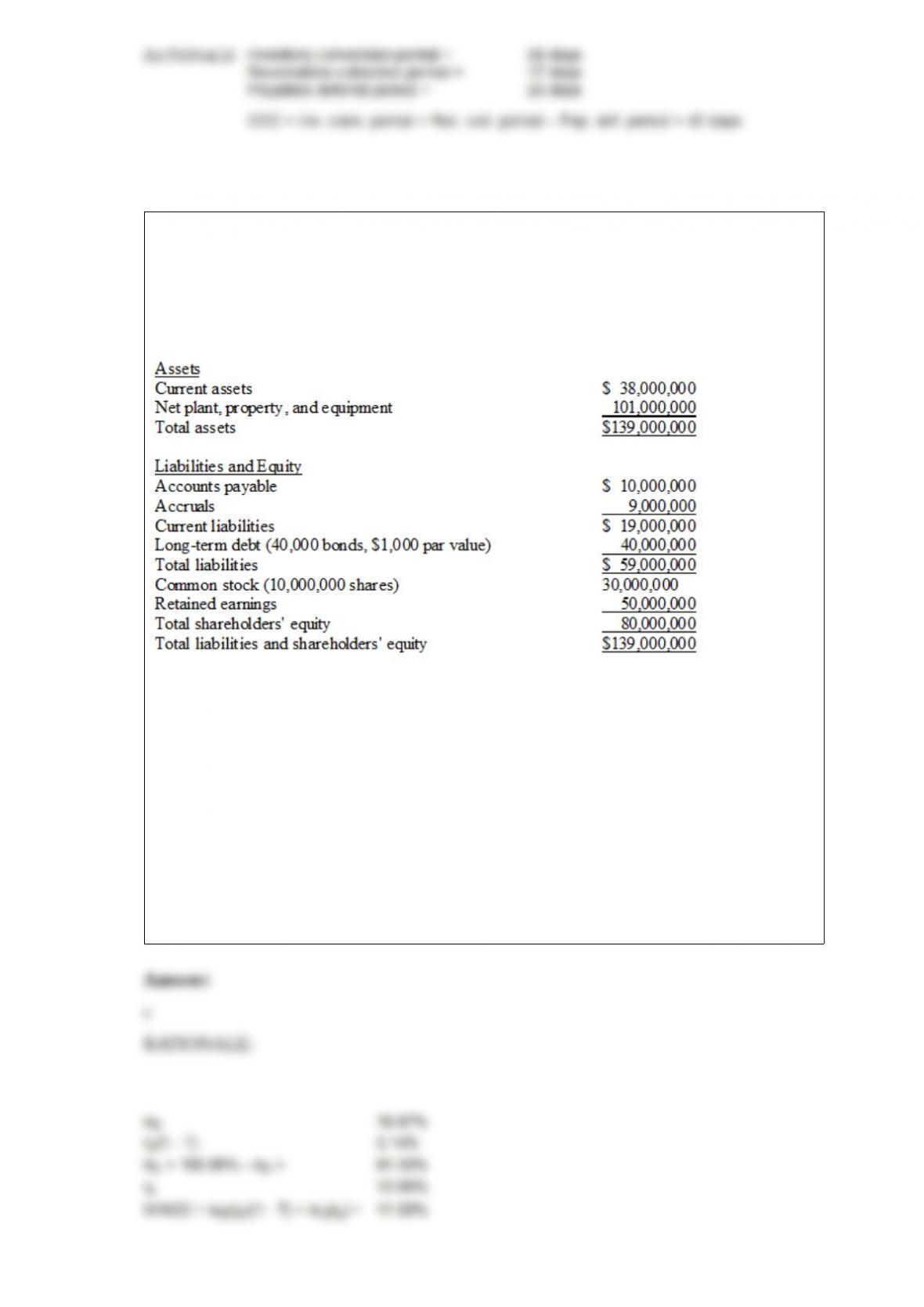
Exhibit 10.1
Assume that you have been hired as a consultant by CGT, a major producer of
chemicals and plastics, including plastic grocery bags, styrofoam cups, and fertilizers,
to estimate the firm’s weighted average cost of capital. The balance sheet and some
other information are provided below.
The stock is currently selling for $15.25 per share, and its noncallable $1,000 par value,
20-year, 7.25% bonds with semiannual payments are selling for $875.00. The beta is
1.25, the yield on a 6-month Treasury bill is 3.50%, and the yield on a 20-year Treasury
bond is 5.50%. The required return on the stock market is 11.50%, but the market has
had an average annual return of 14.50% during the past 5 years. The firm’s tax rate is
40%.
Refer to Exhibit 10.1. What is the best estimate of the firm’s WACC?
a.10.85%
b.11.19%
c.11.53%
d.11.88%
e.12.24%

Company D has a 50% debt ratio, whereas Company E has no debt financing. The two
companies have the same level of sales and the same degree of operating leverage.
Which of the following statements is most CORRECT?
a.If sales increase 10% for both companies, then Company D will have a larger
percentage increase in its net income.
b.If sales increase 10% for both companies, then Company D will have a larger
percentage increase in its operating income (EBIT).
c.If EBIT increases 10% for both companies, then Company D’s net income will rise by
more than 10%, while Company E’s net income will rise by less than 10%.
d.Company E has a higher degree of financial leverage.
e.The two companies have the same degree of total leverage.
In the lease-versus-buy decision, leasing is often preferable
a.because it has no effect on the firm’s ability to borrow to make other investments.
b.because, generally, no down payment is required, and there are no indirect interest
costs.
c.because lease obligations do not affect the firm’s risk as seen by investors.
d.because the lessee owns the property at the end of the lease term.
e.because the lessee may have greater flexibility in abandoning the project in which the
leased property is used than if the lessee bought and owned the asset.
Projects A and B have identical expected lives and identical initial cash outflows
(costs). However, most of one project’s cash flows come in the early years, while most
of the other project’s cash flows occur in the later years. The two NPV profiles are
given below:
Which of the following statements is CORRECT?
a.More of Project A’s cash flows occur in the later years.
b.More of Project B’s cash flows occur in the later years.
c.We must have information on the cost of capital in order to determine which project
has the larger early cash flows.
d.The NPV profile graph is inconsistent with the statement made in the problem.
e.The crossover rate, i.e., the rate at which Projects A and B have the same NPV, is
greater than either project’s IRR.

Which is the best measure of risk for a single asset held in isolation, and which is the
best measure for an asset held in a diversified portfolio?
a.Variance; correlation coefficient.
b.Standard deviation; correlation coefficient.
c.Beta; variance.
d.Coefficient of variation; beta.
e.Beta; beta.
Which of the following statements is CORRECT?
a.Since debt financing raises the firm’s financial risk, increasing the target debt ratio
will always increase the WACC.
b.Since debt financing is cheaper than equity financing, raising a company’s debt ratio
will always reduce its WACC.
c.Increasing a company’s debt ratio will typically reduce the marginal costs of both debt
and equity financing. However, this action still may raise the company’s WACC.
d.Increasing a company’s debt ratio will typically increase the marginal costs of both
debt and equity financing. However, this action still may lower the company’s WACC.
e.Since a firm’s beta coefficient is not affected by its use of financial leverage, leverage
does not affect the cost of equity.
Which of the following statements is CORRECT?
a.While the distinctions are becoming blurred, investment banks generally specialize in
lending money, whereas commercial banks generally help companies raise capital from
other parties.
b.The NYSE operates as an auction market, whereas NASDAQ is an example of a
dealer market.
c.Money market mutual funds usually invest their money in a well-diversified portfolio
of liquid common stocks.
d.Money markets are markets for long-term debt and common stocks.
e.A liquid security is a security whose value is derived from the price of some other
“underlying” asset.
Which of the following statements is CORRECT?
a.When a company increases its debt ratio, the costs of equity and debt both increase.

Therefore, the WACC must also increase.
b.The capital structure that maximizes the stock price is generally the capital structure
that also maximizes earnings per share.
c.All else equal, an increase in the corporate tax rate would tend to encourage
companies to increase their debt ratios.
d.Since debt financing raises the firm’s financial risk, increasing a company’s debt ratio
will always increase its WACC.
e.Since the cost of debt is generally fixed, increasing the debt ratio tends to stabilize net
income.
Stocks A and B each have an expected return of 12%, a beta of 1.2, and a standard
deviation of 25%. The returns on the two stocks have a correlation of +0.6. Portfolio P
has 50% in Stock A and 50% in Stock B. Which of the following statements is
CORRECT?
a.Portfolio P has a beta that is greater than 1.2.
b.Portfolio P has a standard deviation that is greater than 25%.
c.Portfolio P has an expected return that is less than 12%.
d.Portfolio P has a standard deviation that is less than 25%.
e.Portfolio P has a beta that is less than 1.2.
Assume that a firm has a degree of financial leverage of 1.25. If sales increase by 20%,
the firm will experience a 60% increase in EPS, and it will have an EBIT of $100,000.
What will be the EBIT for this firm if sales do not increase?
a.$57,931
b.$60,980
c.$64,189
d.$67,568
e.$70,946

Taussig Technologies is considering two potential projects, X and Y. In assessing the
projects’ risks, the company estimated the beta of each project versus both the
company’s other assets and the stock market, and it also conducted thorough scenario
and simulation analyses. This research produced the following data:
Project X Project Y
Expected NPV $350,000 $350,000
Standard deviation (NPV) $100,000 $150,000
Project beta (vs. market) 1.4 0.8
Correlation of the project cash flows with cash flows from currently existing
projectsCash flows are not correlated with the cash flows from existing projectsCash
flows are highly correlated with the cash flows from existing projects
Which of the following statements is CORRECT?
a.Project X has more stand-alone risk than Project Y.
b.Project X has more corporate (or within-firm) risk than Project Y.
c.Project X has more market risk than Project Y.
d.Project X has the same level of corporate risk as Project Y.
e.Project X has the same market risk as Project Y since its cash flows are not correlated
with the cash flows of existing projects.
Simms Corp. is considering a project that has the following cash flow data. What is the
project’s IRR? Note that a project’s projected IRR can be less than the WACC or
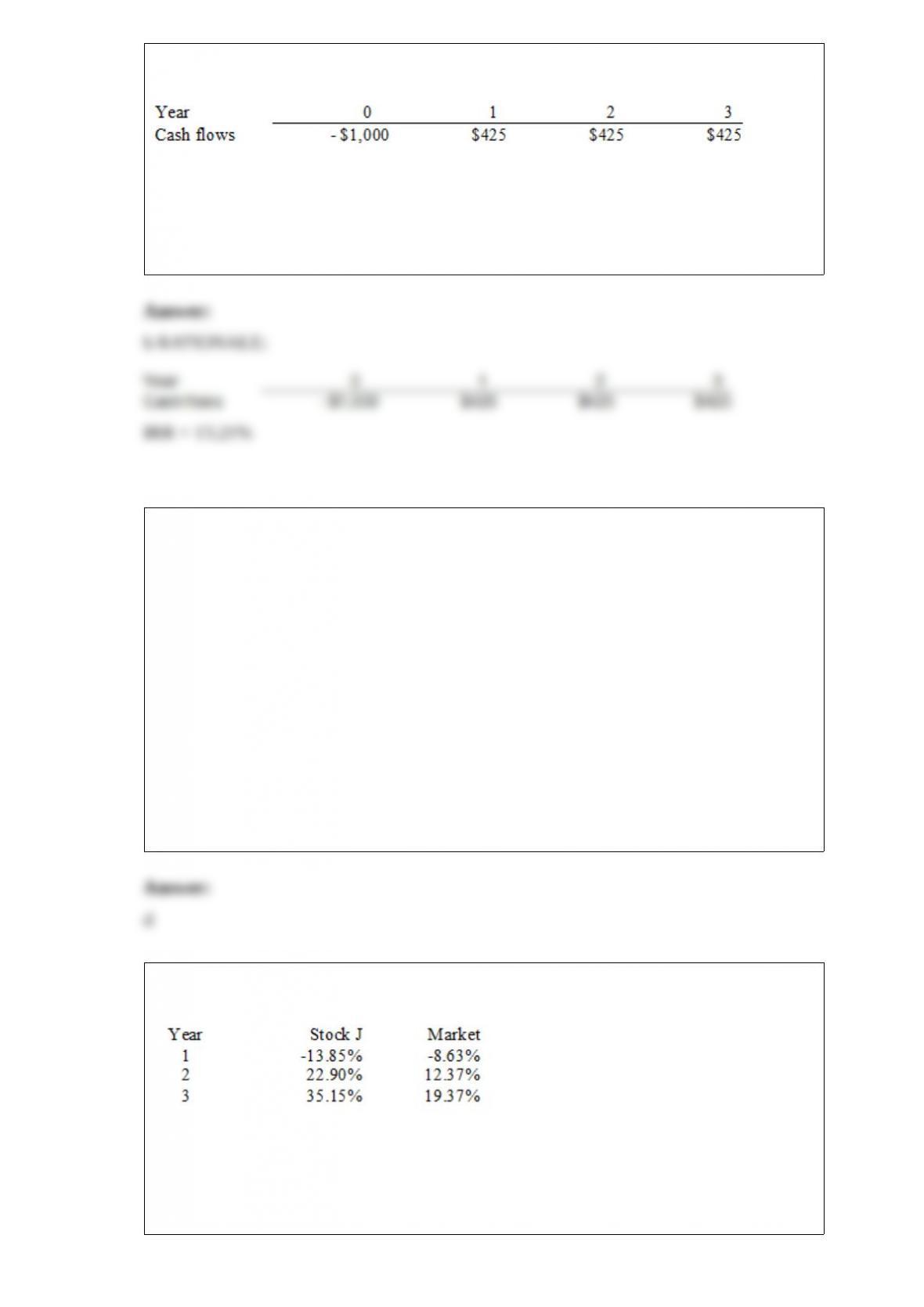
negative, in both cases it will be rejected.
a.12.55%
b.13.21%
c.13.87%
d.14.56%
e.15.29%
If the firm is being operated so as to maximize shareholder wealth, and if our basic
assumptions concerning the relationship between risk and return are true, then which of
the following should be true?
a.If an asset’s beta is larger than the firm’s beta, then the required return on the asset is
less than the required return on the firm.
b.If the beta of the asset is smaller than the firm’s beta, then the required return on the
asset is greater than the required return on the firm.
c.If the beta of the asset is greater than the firm’s beta prior to the addition of that asset,
then the firm’s beta after the purchase of the asset will be smaller than the original firm’s
beta.
d.If the beta of an asset is larger than the firm’s beta prior to the addition of that asset,
then the required return on the firm will be greater after the purchase of that asset than
prior to its purchase.
e.None of the statements is true.
Given the following returns on Stock J and the “market” during the last three years,
what is the beta coefficient of Stock J? (Hint: Think rise over run.)
a.1.58
b.1.66
c.1.75
d.1.84
e.1.93
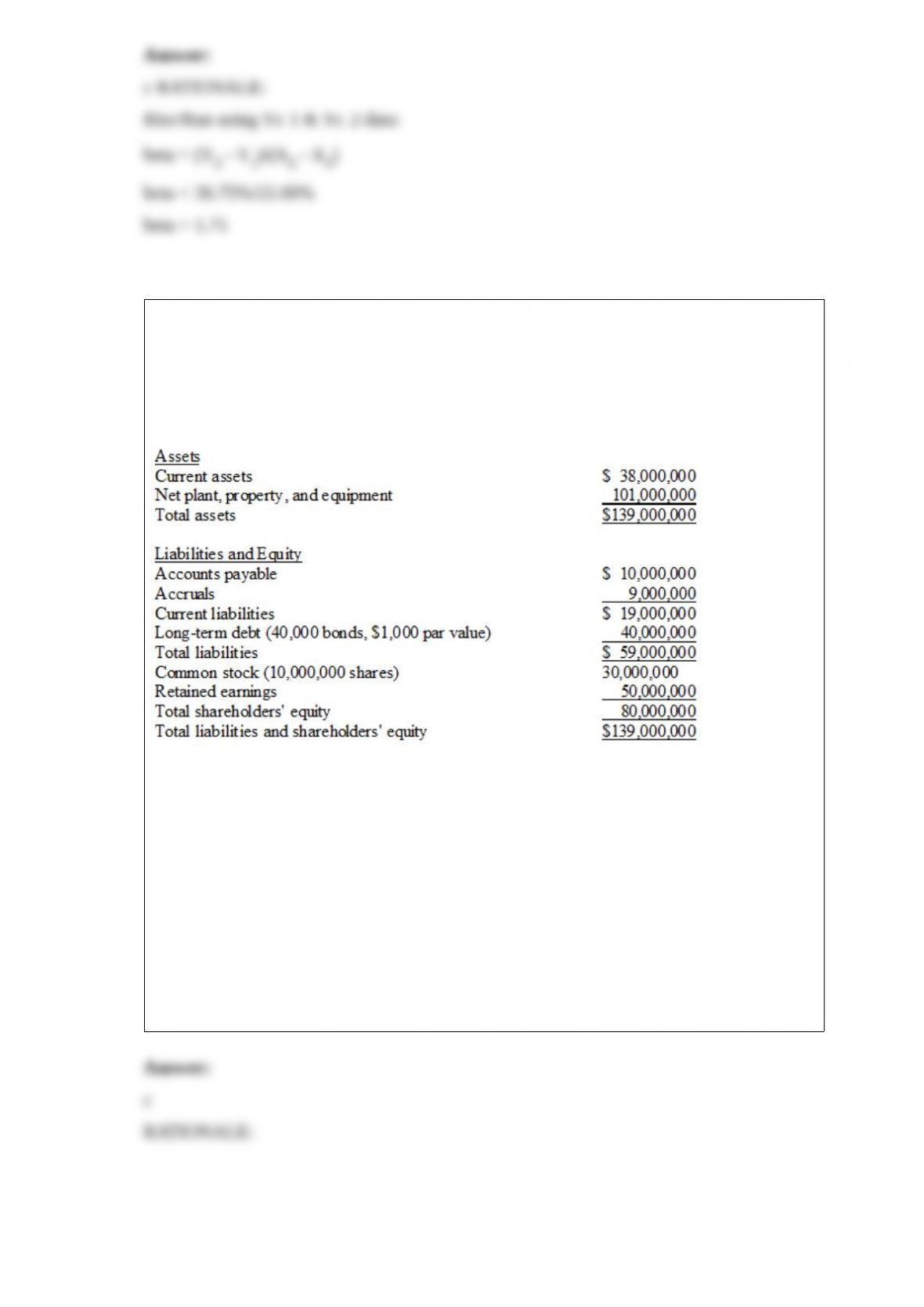
Exhibit 10.1
Assume that you have been hired as a consultant by CGT, a major producer of
chemicals and plastics, including plastic grocery bags, styrofoam cups, and fertilizers,
to estimate the firm’s weighted average cost of capital. The balance sheet and some
other information are provided below.
The stock is currently selling for $15.25 per share, and its noncallable $1,000 par value,
20-year, 7.25% bonds with semiannual payments are selling for $875.00. The beta is
1.25, the yield on a 6-month Treasury bill is 3.50%, and the yield on a 20-year Treasury
bond is 5.50%. The required return on the stock market is 11.50%, but the market has
had an average annual return of 14.50% during the past 5 years. The firm’s tax rate is
40%.
Refer to Exhibit 10.1. What is the best estimate of the after-tax cost of debt?
a.4.64%
b.4.88%
c.5.14%
d.5.40%
e.5.67%

Which of the following statements is CORRECT?
a.The current cash flow from existing assets is highly relevant to investors. However,
since the value of the firm depends primarily upon its growth opportunities, accounting
net income projections from those opportunities are the only relevant future flows with
which investors are concerned.
b.Two metrics that are used to measure a company’s financial performance are net
income and free cash flow. Accountants tend to emphasize net income as calculated in
accordance with generally accepted accounting principles. Finance people generally put
at least as much weight on free cash flows as they do on net income.
c.To estimate the net cash provided by operations, depreciation must be subtracted from
net income because it is a non-cash charge that has been added to revenue.
d.Interest paid by a corporation is a tax deduction for the paying corporation, but
dividends paid are not deductible. This treatment, other things held constant, tends to
discourage the use of debt financing by corporations.
e.If Congress changed depreciation allowances so that companies had to report higher
depreciation levels for tax purposes in 2014, this would lower their free cash flows for
2014.