1) A bond’s yield to maturity varies from investor to investor because each investor has
his or her own required return.
2) The risk-return tradeoff that investors face on a day-to-day basis is based on realized
rates of return because expected returns involve too much uncertainty.
3) The capital asset pricing model uses three variables to evaluate required returns on
common equity: the risk free rate, the beta coefficient, and the market risk premium.
4) A reasonable estimate of the market risk premium based on historical data and expert
opinion is between 5% and 7%.
5) The ex-dividend date is typically two days prior to the payment date of the dividend.
6) The profitability index provides an advantage over the net present value method by
reporting the present value of benefits per dollar invested.
7) U.S. Treasury Bills are extremely liquid due to excellent secondary markets.
8) A major source of long-term capital overseas is in the Eurocurrency market.
9) Financial markets exist in order to allocate savings in the economy to the demanders
of those savings.
10) The forward-spot differential is the difference between the forward rate and the
expected future spot rate.
11) The present value of a $100 perpetuity discounted at 5% is $5,000.
12) To ensure that a borrower is not using short-term bank credit to finance a part of its
permanent needs for funds, banks often require borrowers to clean up their short-term
loans for a 30 – 45 day period during the year.
13) The break-even point in sales dollars is convenient if
A) the firm sells a large amount of one product
B) the firm deals with more than one product
C) the price per unit is very low
D) depreciation expense is high
14) The time necessary for a deposited check to clear through the commercial banking
system causes which of the following types of floats?
A) mail

B) processing
C) transit
D) disbursing
15) Lithium, Inc. is considering two mutually exclusive projects, A and B. Project A
costs $95,000 and is expected to generate $65,000 in year one and $75,000 in year two.
Project B costs $120,000 and is expected to generate $64,000 in year one, $67,000 in
year two, $56,000 in year three, and $45,000 in year four. The firm’s required rate of
return for these projects is 10%. The net present value for Project A is
A) $12,358
B) $16,947
C) $19,458
D) $26,074
16) A “normal” yield curve is
A) downward sloping
B) downward sloping, then upward sloping
C) upward sloping
D) upward sloping, then downward sloping
17) Company A has a higher days sales outstanding ratio than Company B. Therefore
A) Company A sells more on credit than Company B
B) Company A has a higher percentage of cash to credit sales than Company B
C) Company A must be collecting its accounts receivable faster than Company B, on
average
D) Other things being equal, Company B has a cash flow advantage over Company A
18) TellTrue Corporation has preferred stock which paid an annual dividend in 2009 of
$5 per share. TellTrue also has common stock which paid a dividend in 2009 of $5.
Which of the following statements is MOST correct concerning TellTrue stock?
A) The price of the preferred stock should equal the price of the common stock since
the dividends are the same
B) The price of the common stock could be higher than the price of the preferred stock

if the common stock dividends are expected to grow in the future
C) The price of the preferred stock is expected to be higher than the price of the
common stock because the required return on preferred stock is higher than the required
return on common stock
D) If the required return on the preferred stock is the same as the required return on the
common stock, then the price of preferred stock should equal the price of the common
stock if markets are efficient
19) Kokapeli, Inc. has a target capital structure of 40% debt and 60% common equity,
and has a 40% marginal tax rate. If the firm’s yield to maturity on bonds is 7.5% and
investors require a 15% return on the firm’s common stock, what is the firm’s weighted
average cost of capital?
A) 7.20%
B) 10.80%
C) 12.00%
D) 12.25%
20) Break-even analysis is used to study the effect on EBIT of changes in all of the
following EXCEPT
A) corporate taxes
B) prices
C) cost structure
D) volume
21) A lock-box system reduces
A) mail float
B) transit float
C) disbursing float
D) A and B
22) Texas Transport has five possible investment projects for the coming year. Each
project is indivisible. They are:
ProjectInvestment (million)IRR

A$ 618%
B$1015%
C$ 920%
D$ 412%
E$ 324%
The firm’s weighted marginal cost of capital schedule is 12 percent for up to $6 million
of investment; 16 percent for between $6 million and $18 million of investment; and
above $18 million the weighted cost of capital is 18 percent. The optimal capital budget
is
A) $12 million
B) $18 million
C) $23 million
D) $28 million
23) Table 4-2
Drummond Company
Balance Sheet
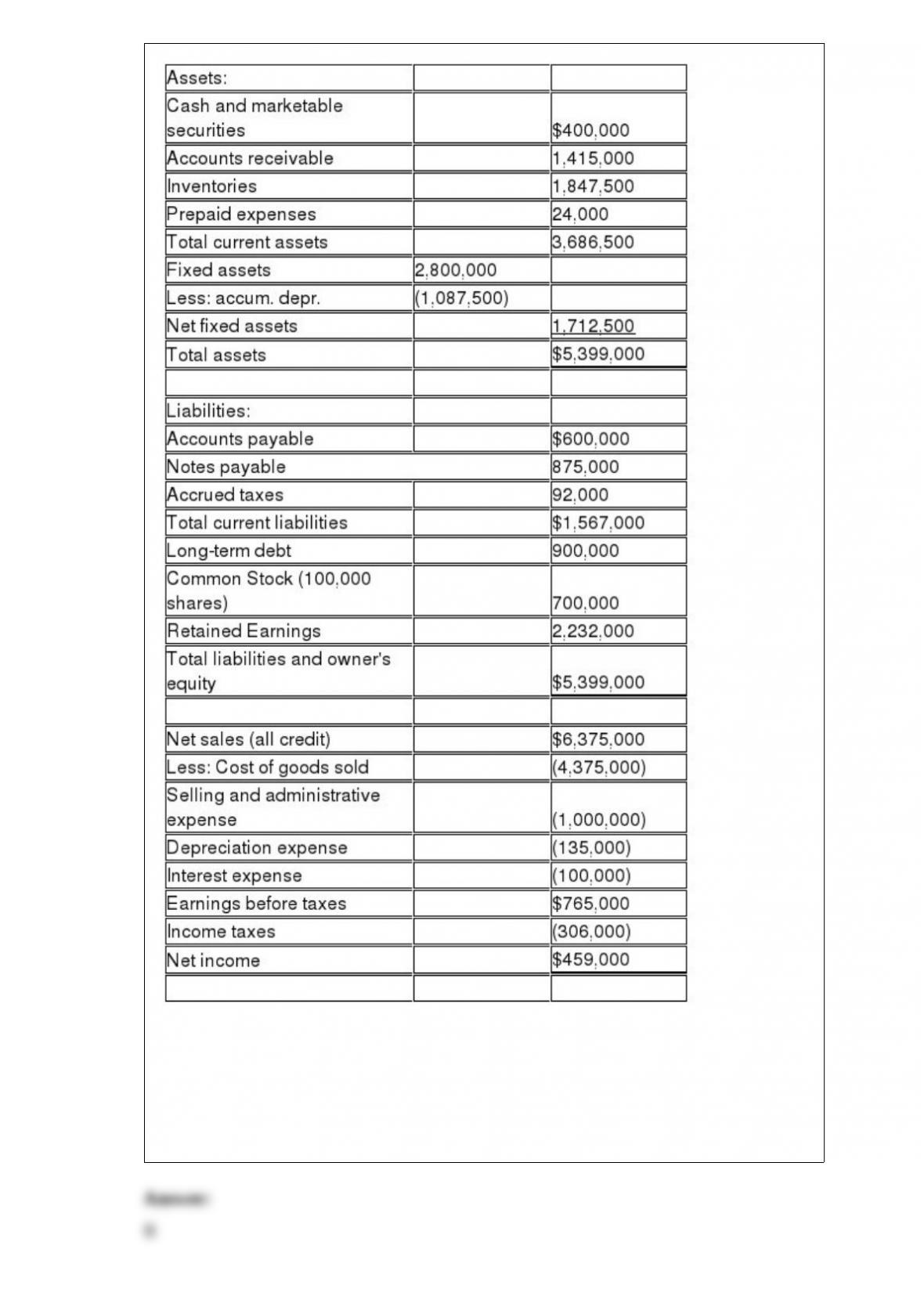
Based on the information in Table 4-2, the inventory turnover ratio is
A) 1.29 times
B) 2.37 times
C) 4.43 times
D) 2.99 times
24) Most preferred stocks have a feature that requires all past unpaid preferred dividend
payments be paid before any common stock dividends can be paid. What is the name of
this feature?
A) participating
B) cumulative
C) provisional
D) convertible
25) Limited partnerships are not as prevalent as corporations because
A) limited partners can lose up to three times the amount they invested in the
partnership if the business goes bankrupt
B) limited partnerships have the disadvantage of double taxation
C) the general partner has no liability, making it difficult for the partnership to borrow
money
D) it is easier to transfer ownership by selling common stock than it is to sell
partnership
26) Surf and Spray Inc. has a beta equal to 1.8 and a required return of 15% based on
the CAPM. If the market risk premium is 7.5%, the risk-free rate of return is
A) 4.1%
B) 3.4%
C) 2.0%
D) 1.5%
27) Calculate the internal rate of return on the following projects:
a.Initial outlay of $60,500 with an after-tax cash flow of $11,897 per year for eight
years.
b.Initial outlay of $647,000 with an after-tax cash flow of $118,000 per year for ten
years.
c.Initial outlay of $25,400 with an after-tax cash flow $11,788 per year for three years.

28) How much money must you pay into an account at the beginning of each of 20
years in order to have $10,000 at the end of the 20th year? Assume that the account
pays 12% per year, and round to the nearest $1.
A) $1,195
B) $111
C) $124
D) $139
29) Johnson Production Company paid a dividend yesterday of $3.50 per share. The
dividend is expected to grow at a constant rate of 10% per year. The price of KayCee’s
common stock today is $40 per share. If KayCee decides to issue new common stock,
flotation costs will equal $4.00 per share. KayCee’s marginal tax rate is 35%. Based on
the above information, the cost of retained earnings is
A) 26.41%
B) 20.09%
C) 19.63%
D) 17.55%
30) Which of the following statements is false?
A) Brokers purchase securities for their own account
B) Most corporate bond trading takes place over the counter
C) Broker-dealers stand ready to buy and sell specific securities at selected prices
D) none of the above
31) Shasta Co. just paid a dividend of $1.65 (D0) on its common stock. This company’s
dividends are expected to grow at a constant rate of 3% indefinitely. If the required rate
of return on this stock is 11%, compute the current value per share of Shasta stock.
A) $20.63
B) $21.24
C) $15.00
D) $55.00
32) What is the internal rate of return’s assumption about how cash flows are

reinvested?
A) They are reinvested at the firm’s discount rate
B) They are reinvested at the required rate of return
C) They are reinvested at the project’s internal rate of return
D) They are only reinvested at the end of the project
33) When a corporation designs an investment strategy for investing temporary excess
cash balances in marketable securities, it must consider a variety of factors. Which of
the following is the most important?
A) maintaining the safety of principal
B) maintaining the greatest float
C) achieving the highest yield
D) illiquidity
34) A company that forgoes the discount when credit terms are 2/10 net 60 due to
insufficient cash flow would be better off to borrow funds and take the discount as long
the company could borrow the funds at any rate
A) less than 16.33%
B) less than 15.47%
C) less than 14.69%
D) less than 12.00%
35) The Native Industries, Inc. is going to issue 180-day commercial paper to raise $25
million. It anticipates a discounted interest rate of 13 percent, and dealer placement
costs of approximately $60,000. What is the effective annual cost of credit to Native
Industries?
A) 13.46%
B) 14.06%
C) 14.45%
D) 15.38%
36) Dakota Oil, Inc. reported that its sales and EBIT increased by 10%, but its EPS
increased by 30%. The much larger change in earnings per share could be the result of

A) high operating leverage
B) high financial leverage
C) a high percentage of credit sale collections from prior years
D) high fixed costs of production
37) A sales forecast for the coming year would reflect
A) any past trend which is expected to continue
B) the influence of any events that might materially affect that trend
C) both A and B
D) neither A nor B
38) Blastdale Corp. is considering borrowing $15,000 for a 60-day period. The firm will
repay the $15,000 principal amount plus $200 in interest. What is the effective annual
rate of interest? Use a 360-day year.
A) 7.2%
B) 8.0%
C) 8.2%
D) 10.5%
39) Based on the data contained in Table A, what is the break-even point in sales
dollars?
TABLE A
Average selling price per unit$18.00
Variable cost per unit$13.00
Units sold400,000
Fixed costs$650,000
Interest expense$ 50,000
A) $2,340,000
B) $1,850,000
C) $1,775,500
D) $700,000
40) Use the “percent of sales method” of preparing pro forma financial statements to

determine the projection for next year’s accounts payable. Make the following
assumptions: current year’s sales are $27,800,000; current year’s cost of goods sold is
$17,528,000; sales are expected to rise by 30%. The firm’s investment in accounts
payable in the current year is $2,218,500. What is the projection for next year’s
accounts payable?
A) $2,127,000
B) $3,781,750
C) $2,884,050
D) $4,184,000
41) Joe is deciding whether or not to invest $10,000 in a business that has pending
lawsuits against it. If Joe invests and the business loses the lawsuits, the most Joe can
lose is
A) $10,000 if Joe is a general partner
B) $10,000 if Joe is a sole proprietor
C) $10,000 if Joe is a limited partner
D) $10,000 plus his share of the lawsuits if Joe is a limited partner
42) The Siskiyou Manufacturing Company will collect an estimated $12,000,000 next
year; and it will receive an estimated 20,000 checks. Siskiyou’s bank has offered to set
up a lock-box system that will reduce float time by 4.5 days. The cost of the system will
be $ .15 per check. What is the minimum annual interest rate on its cash balance that
Siskiyou should receive before it would be willing to adopt the lock-box system?
A) 3.25%
B) 2.03%
C) 1.82%
D) 1.07%
43) Investment A has an expected return of 15% per year, while investment B has an
expected return of 12% per year. A rational investor will choose
A) investment A because of the higher expected return
B) investment B because a lower return means lower risk
C) investment A if A and B are of equal risk
D) investment A only if the standard deviation of returns for A is higher than the
standard deviation of returns for B