
Which of the following statements is FALSE?
A) The most common valuation multiple is the price-earnings (P/E) ratio.
B) You should be willing to pay proportionally more for a stock with lower current
earnings.
C) A firm’s P/E ratio is equal to the share price divided by its earnings per share.
D) The intuition behind the use of the P/E ratio is that when you buy a stock, you are in
sense buying the rights to the firm’s future earnings and differences in the scale of firms’
earnings are likely to persist.
Which of the following statements is FALSE?
A) Investors may have different information regarding expected returns, correlations,
and volatilities, but they correctly interpret that information and the information
contained in market prices and they adjust their estimates of expected returns in a
rational way.
B) Investors may learn different information through their own research and
observations, but as long as they understand the differences in information and learn
from other investors by observing prices, the CAPM conclusions still stand.
C) Every investor, regardless of how much information he has access to, can guarantee
himself an alpha of zero by holding the market portfolio.
D) The CAPM requires making the strong assumption of homogeneous expectations.
Which of the following statements is FALSE?
A) The tangent portfolio is efficient and that, once we include the risk-free investment,
all efficient portfolios are combinations of the risk-free investment and the tangent

portfolio.
B) The optimal portfolio of risky investments depends on how conservative or
aggressive the investor is.
C) By combining the efficient portfolio with the risk-free investment, an investor will
earn the highest possible expected return for any level of volatility her or she is willing
to bear.
D) The efficient portfolio is the tangent portfolio, the portfolio with the highest Sharpe
ratio in the economy.
Which of the following industries is likely to have the lowest costs of financial distress?
A) Airlines
B) Computer software
C) Biotechnology
D) Electric utilities
Consider the following realized annual returns:
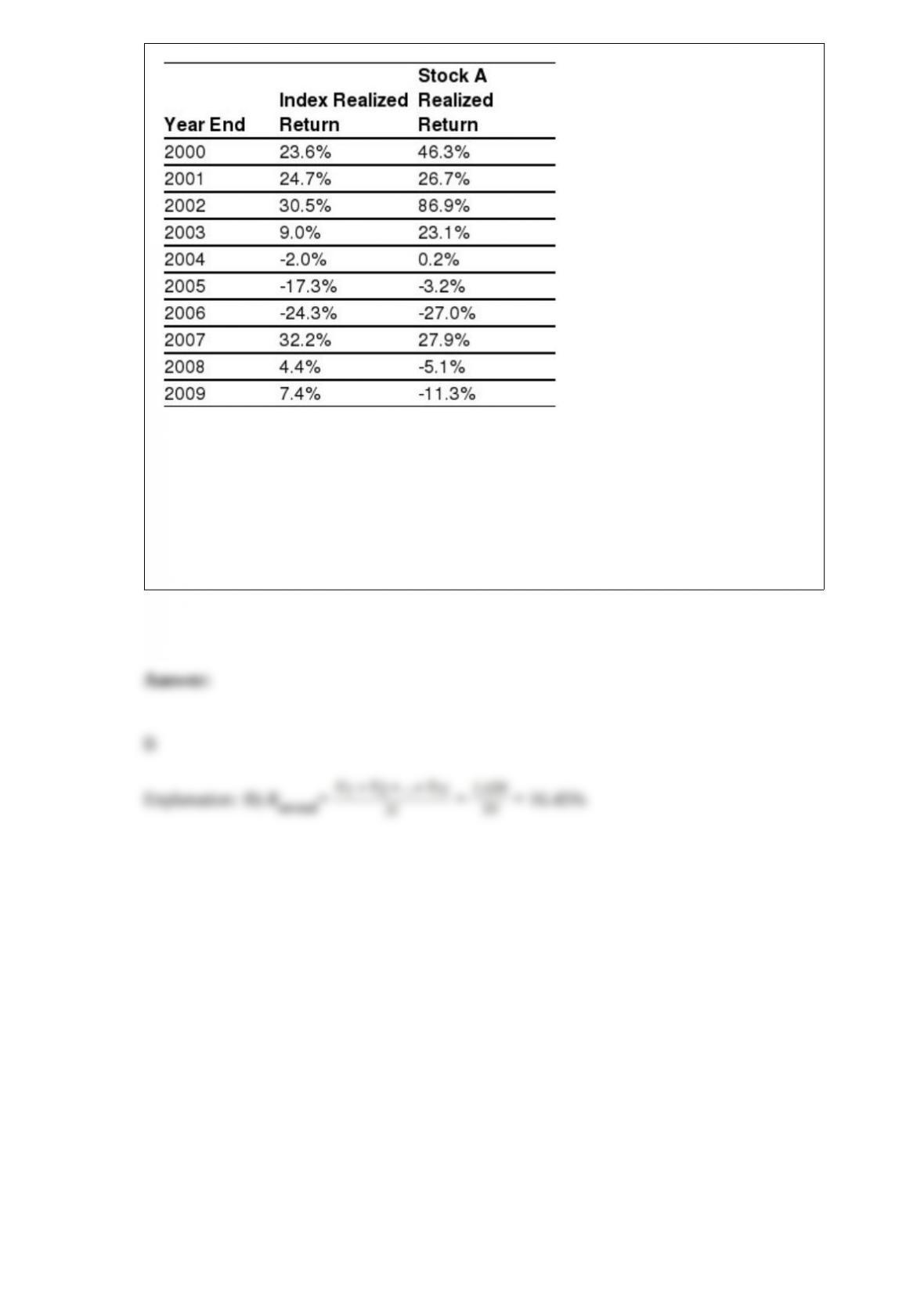
Suppose that you want to use the 10 year historical average return on Stock A to
forecast the expected future return on Stock A. The 95% confidence interval for your
estimate of the expect return is closest to:
A) 13.2% to 19.5%
B) -4.5% to 37.4%
C) 6.5% to 26.3%
D) -15.0% to 47.9%
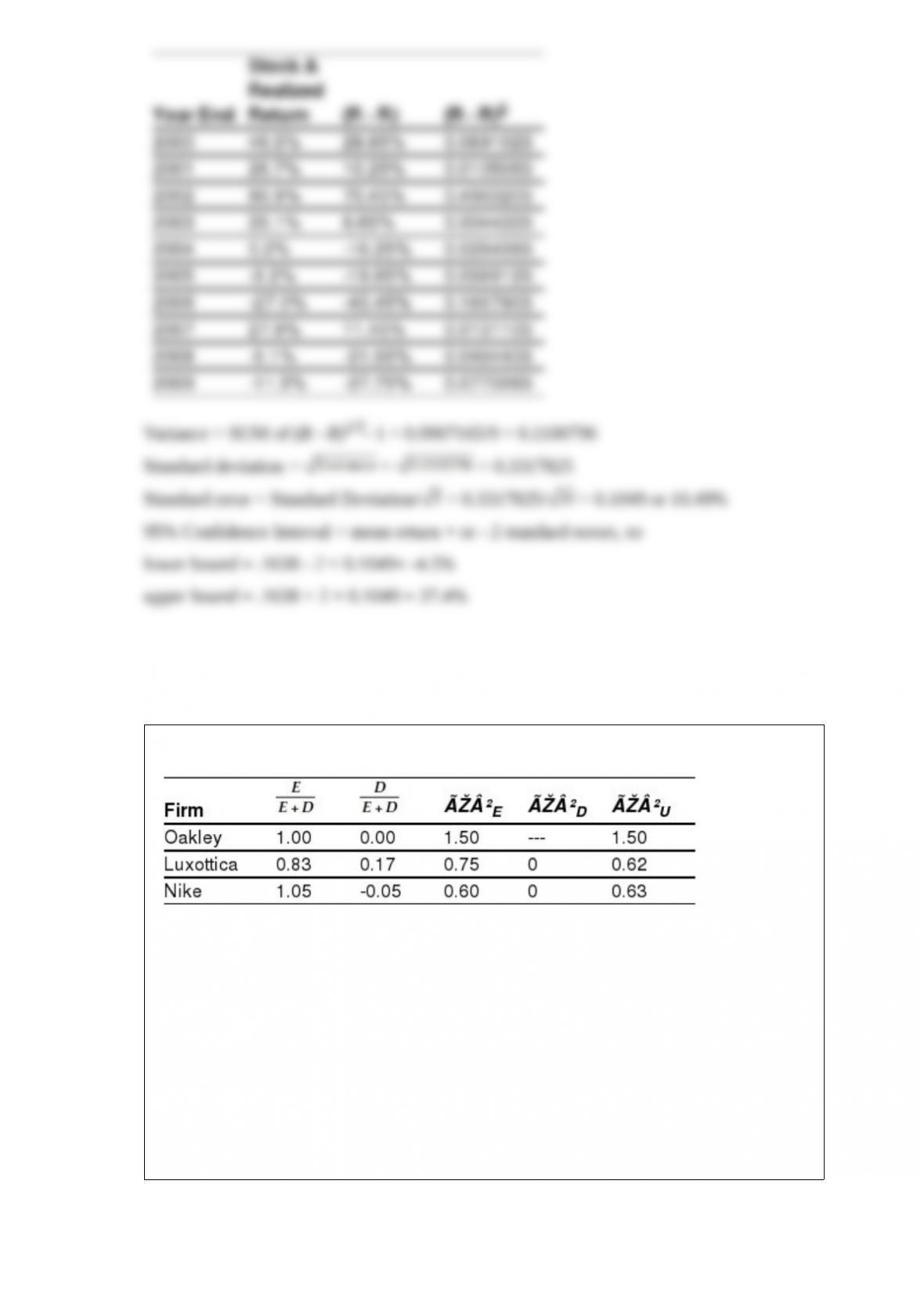
Capital Structure and Unlevered Beta Estimates for Comparable Firms
If the risk-free rate of interest is 6% and the market risk premium has historically
averaged 5%, then the cost of capital for Oakley is closest to:
A) 13.5%
B) 10.2%
C) 9.1%
D) 14.7%

The owner of the Krusty Krab is considering selling his restaurant and retiring. An
investor has offered to buy the Krusty Krab for $350,000 whenever the owner is ready
for retirement. The owner is considering the following three alternatives:
1. Sell the restaurant now and retire.
2. Hire someone to manage the restaurant for the next year and retire. This will require
the owner to spend $50,000 now, but will generate $100,000 in profit next year. In one
year the owner will sell the restaurant.
3. Scale back the restaurant’s hours and ease into retirement over the next year. This will
require the owner to spend $40,000 on expenses now, but will generate $75,000 in
profit at the end of the year. In one year the owner will sell the restaurant.
If the discount rate is 15%, then which alternative should the owner choose:
A) #1
B) #2
C) #3
D) either #1 or #2
E) either #1 or #3
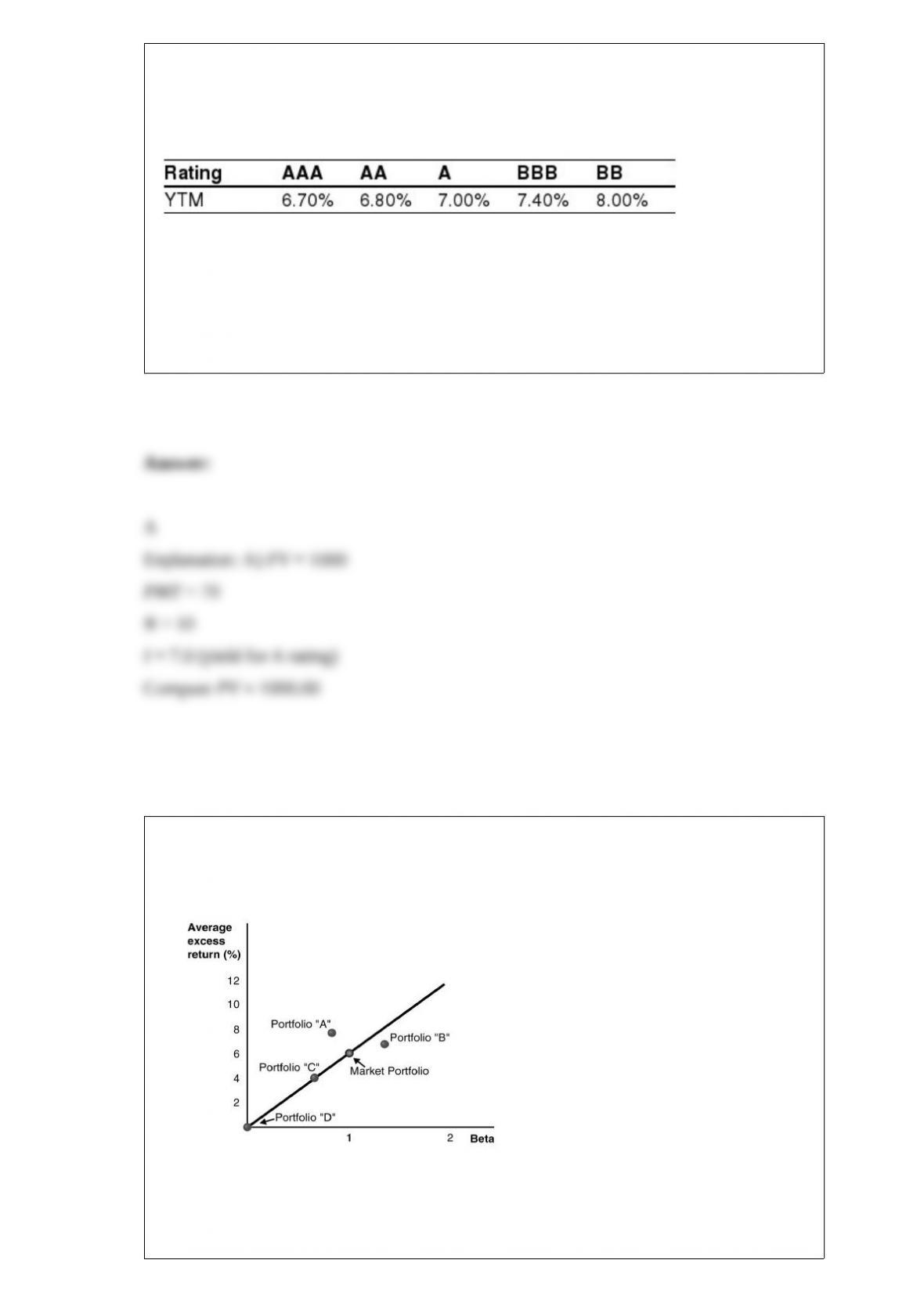
Luther Industries needs to raise $25 million to fund a new office complex. The
company plans on issuing ten-year bonds with a face value of $1000 and a coupon rate
of 7.0% (annual payments). The following table summarizes the YTM for similar
ten-year corporate bonds of various credit ratings:
What rating must Luther receive on these bonds if they want the bonds to be issued at
par?
A) A
B) B
C) BBB
D) AA
Consider the following graph of the security market line:
Which of the following statements regarding portfolio “B” is/are correct?
1. Portfolio “B” has a positive alpha.
2. Portfolio “B” is overpriced.

3. Portfolio “B” is less risky than the market portfolio.
4. Portfolio “B” should not exist if the market portfolio is efficient.
A) 2 and 4
B) 4 only
C) 1, 3, and 4
D) 1 and 4
0 1 2 3
$600 $1,200 $1,800
At an annual interest rate of 7%, the future value of this timeline in year 3 is closest to:
A) $3,295
B) $3,600
C) $3,770
D) $4,035
Assets $200 million
Shareholder Equity $100 million
Sales $300 million
Net Income $15 million
Interest Expense $2 million
If ECE’s return on assets (ROA) is 12%, then ECE’s return on equity (ROE) is:
A) 10%
B) 12%
C) 18%
D) 22%
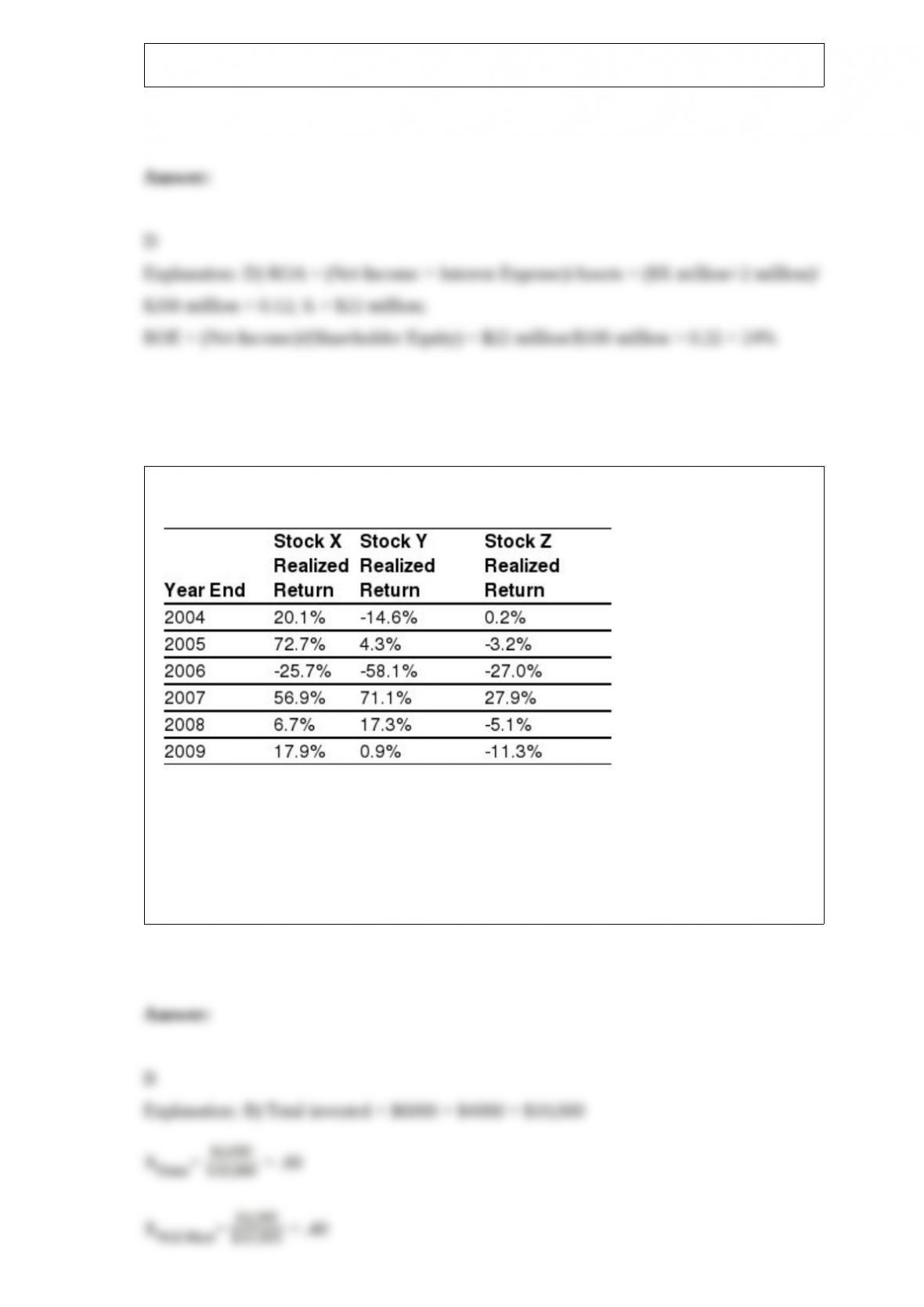
Consider the following returns:
The variance on a portfolio that is made up of a $6000 investments in Duke Energy and
a $4000 investment in Wal-Mart stock is closest to:
A) .050
B) .045
C) .051
D) -0.020

2Var(R1) + x2
2Var(R2) + 2X1X2Cov(R1,R2)
Which of the following statements is FALSE?
A) If there is a fixed supply of resource available, you should rank projects by the
profitability index, selecting the project with the lowest profitability index first and
working your way down the list until the resource is consumed.
B) Practitioners often use the profitability index to identify the optimal combination of
projects when there is a fixed supply of resources.
C) If there is a fixed supply of resources available, so that you cannot undertake all
possible opportunities, then simply picking the highest NPV opportunity might not lead
to the best decision.
D) The profitability index is calculated as the NPV divided by the resources consumed
by the project.
Consider the following two projects:
Assume that projects Alpha and Beta are mutually exclusive. The correct investment
decision and the best rational for that decision is to
A) invest in project Beta since NPVBeta> 0.
B) invest in project Alpha since NPVBeta< NPVAlpha.
C) invest in project Beta since IRRB> IRRA.
D) invest in project Beta since NPVBeta> NPVAlpha> 0.
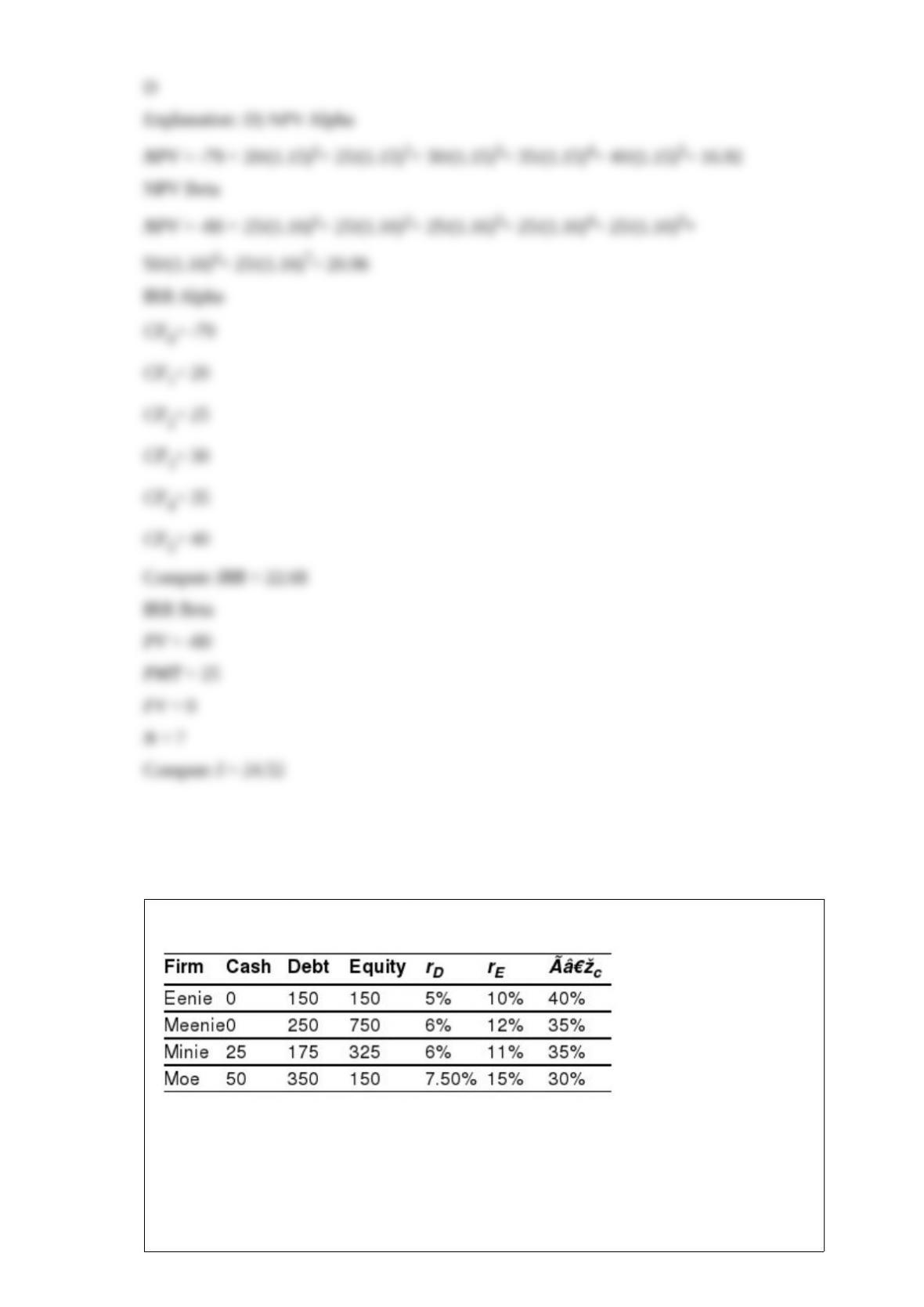
The weighted average cost of capital for “Eenie” is closest to:
A) 6.0%
B) 6.5%
C) 7.5%
D) 5.5%
Suppose that the market portfolio is equally likely to increase by 24% or decrease by
8%. Security “X” goes up on average by 29% when the market goes up and goes down
by 11% when the market goes down. Security “Y” goes down on average by 16% when
the market goes up and goes up by 16% when the market goes down. Security “Z” goes
up on average by 4% when the market goes up and goes up by 4% when the market
goes down.
The expected return on security with a beta of 1 is closest to:
A) -4.0%
B) 3.2%
C) 4.0%
D) 8.0%
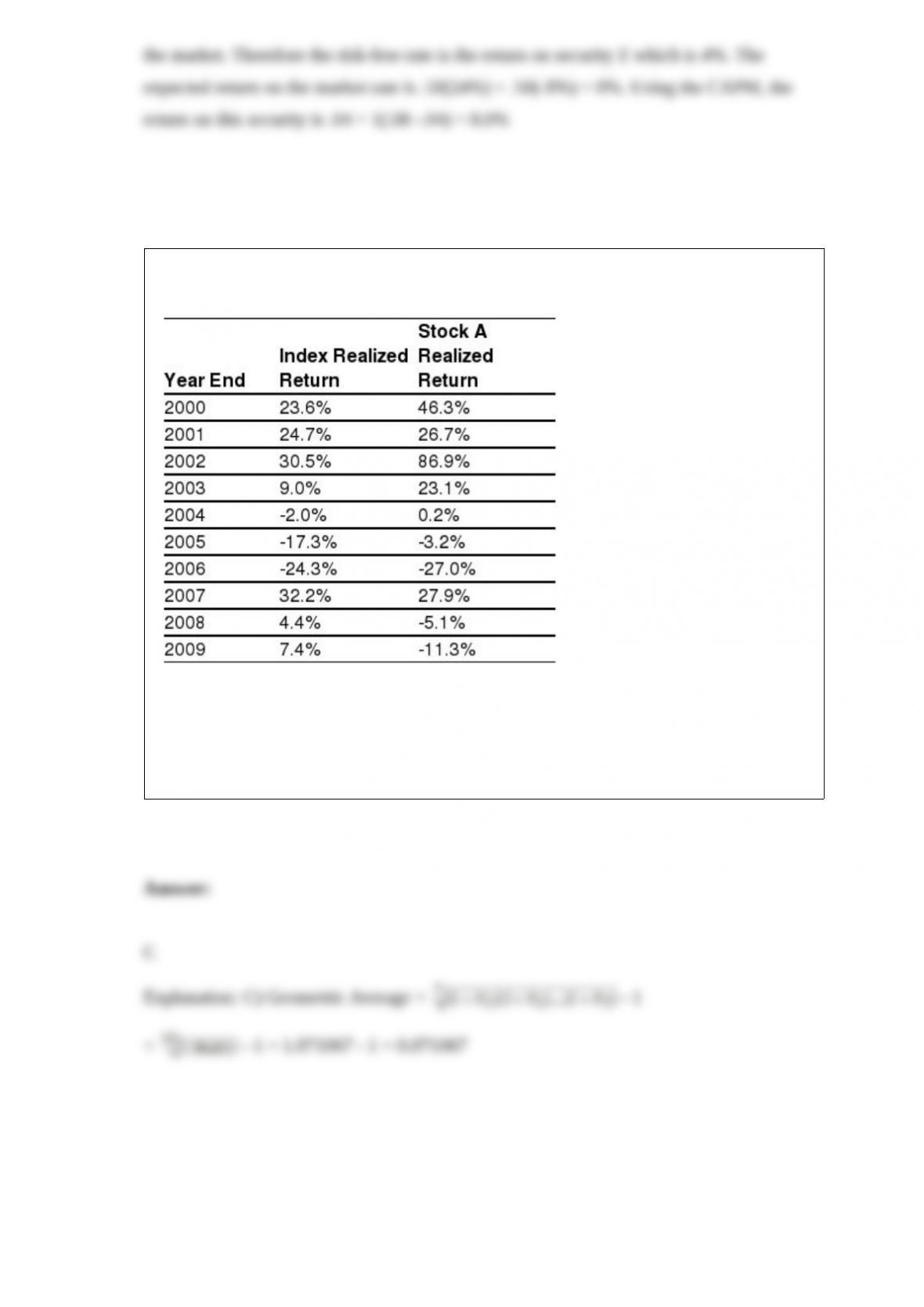
Consider the following realized annual returns:
The geometric average annual return on the Index from 2000 to 2009 is closest to:
A) 9.75%
B) 8.75%
C) 7.10%
D) 8.35%