
A bond has a face value of $1,000 and five years to maturity. This bond has a coupon
rate of 13 percent and is selling in the market today for $902. Coupon payments are
made annually on this bond. What is the yield to maturity (YTM) for this bond?
A. 13 percent
B. 12.75 percent
C. 16 percent
D. 11.45 percent
E. 12 percent
Answer:
A bank has Federal Funds totaling $25 million with an interest-rate sensitivity weight of
1.0. This bank also has loans of $105 million and investments of $65 million with
interest rate sensitivity weights of 1.40 and 1.15 respectively. It also has $135 million in
interest-bearing deposits with an interest rate sensitivity weight of 0.90 and other
money market borrowings of $75 million with an interest rate sensitivity weight of 1.0.
What is the dollar interest-sensitive gap for this bank?
A. $50.25 million
B. -$15 million
C. -$50.25 million
D. $34.25 million
E. None of the options is correct.
Answer:

The duration of a bond is the weighted average maturity of the future cash flows
expected to be received on a bond. Which of the following statements concerning
duration is true? A. The longer the time to maturity, the greater the duration.
B. The higher the coupon rate, the lower the duration.
C. The shorter the duration, the greater the price volatility.
D. All of the options are true.
E. None of the options is true.
Answer:
Which of the following is an advantage of trading financial futures to hedge
interest-rate risk?
A. Only a fraction of the value of the contract must be pledged as collateral
B. Brokers’ commissions are relatively low
C. There is no market risk in trading futures contracts
D. All of the options are correct
E. Only a fraction of the value of the contract must be pledged as collateral and
brokers’ commissions are relatively low

Answer:
Which of the following is not an advantage of using a repurchase agreement?
A. The bank gains excess reserves which can be used to make new deposits.
B. The bank makes use of high-quality but low yielding assets without losing them
permanently.
C. If the agreement is made with a bank which keeps a checkable deposit with another
bank, it can reduce both the bank’s deposits and reserve requirements.
D. The interest rate the bank has to pay is usually low.
E. All of the options are advantages of using a repurchase agreement.
Answer:
A customer makes a savings deposit for 45 days. During that time he earns $5 in
interest and maintains an average daily balance of $1,000. What is the annual
percentage yield on this savings account?
A. 0.5%
B. 4.13%
C. 4.07%
D. 4.5%

E. None of the options is correct
Answer:
A bond has a face value of $1,000 and coupon payments of $120 annually. This bond
matures in three years and is selling in the market for $1,160. Market interest rate is 6
percent. What is this bond’s duration?
A. 3 years
B. 5.71 years
C. 1.96 years
D. 2.71 years
E. None of the options is correct.
Answer:
A bank following a(n) _________________________ liquidity management strategy
must take care that assets with the least profit potential are sold first.
A. asset conversion

B. liability management
C. availability
D. funds source
E. None of the options is correct
Answer:
Which of the following is true of the cost-plus loan pricing method?
A. It considers the competition from other lenders.
B. It allows the bank to compete more aggressively with the commercial paper market.
C. It considers the marginal cost of raising loanable funds.
D. It takes the whole customer relationship into account.
E. None of the options is correct.
Answer:

In the United States a bank to be considered ‘adequately capitalized’ must have a ratio
of Tier 1 (or core) capital to risk-weighted assets of at least:
A. 8 percent
B. 6 percent
C. 10 percent
D. 4 percent
E. None of the options is correct.
Answer:
Which of the following is not a reason for banks to hold liquid assets?
A. To meet customers’ needs for currency
B. To meet capital requirements
C. To meet required reserves
D. To compensate for correspondent bank services
E. To assist in the check clearing process
Answer:

A bank has a ROE of 14 percent and a ROA of 2 percent. What is this bank’s equity
capital to total assets ratio?
A. 7.00 percent
B. 14.29 percent
C. 28.00 percent
D. 16.00 percent
E. None of the options is correct.
Answer:
In the United States, legal reserve requirements on certificates of deposits is currently:
A. zero.
B. 5 percent.
C. 10 percent.
D. 15 percent.
E. 10 percent of the instruments maturing in the next three months.
Answer:

Which of the following assets fit(s) into the 0 percent risk-weight category?
A. Cash
B. Deposits at the Federal Reserve
C. Treasury Bills
D. GNMA mortgage-backed securities
E. All of the options are assets that fit into the 0 percent risk-weight category.
Answer:
A hybrid instrument which allows the issuer to lower its coupon payments if some
significant factor changes is called:
A. a credit option.
B. a standby letter of credit.
C. a credit-linked note.
D. a credit swap.
E. None of the options is correct.
Answer:

The business loan pricing method that bases a loan rate on a relatively low money
market interest rate (such as the Federal funds rate) plus a small margin to cover risk
exposure and a profit margin is known as the:
A. price leadership model.
B. below-prime pricing model.
C. cost-plus loan pricing method.
D. customer profitability analysis.
E. None of the options is correct.
Answer:
A bank expects to raise $30 million in new money if it pays a deposit rate of 7%, $60
million in new money if it pays a deposit rate of 7.5%, $80 million in new money if it
pays a deposit rate of 8%, and it can raise $100 million in new money if it pays a
deposit rate of 8.5%. The bank expects to earn 9% on all money that it receives in new
deposits. What is the marginal cost of deposits if this bank raises its deposit rate from
7.5% to 8%?
A. 0.5%
B. 7.5%
C. 8.0%
D. 9.5%

E. 10.5%
Answer:
Which of the following has become the principal tool of central bank monetary policy
today?
A. Open market operations
B. Functional regulation
C. Umbrella supervision and regulation
D. Margin requirement
E. None of the options are correct.
Answer:
Which of the following is in the 20 percent risk-weight (low credit risk) category?
A. Cash
B. General obligation municipal bonds

C. Residential mortgage loans
D. Credit card loans
E. None of the options is correct.
Answer:
The trusts that arise under a probated will and are often used to save on estate taxes are
called:
A. revocable trusts.
B. irrevocable trusts.
C. indenture trusts.
D. testamentary trusts.
E. living trusts.
Answer:
The Edmond Wine and Cheese shop wants to buy 30 cases of French Champagne on
credit. Bank of America writes a letter of credit stating that the Edmond Wine and
Cheese shop is a good risk and that if they do not pay off the loan, Bank of America
will. Which of the following roles is the bank performing?
A. The intermediation role
B. The payments role
C. The risk management role
D. The guarantor role
E. The policy role
Answer:
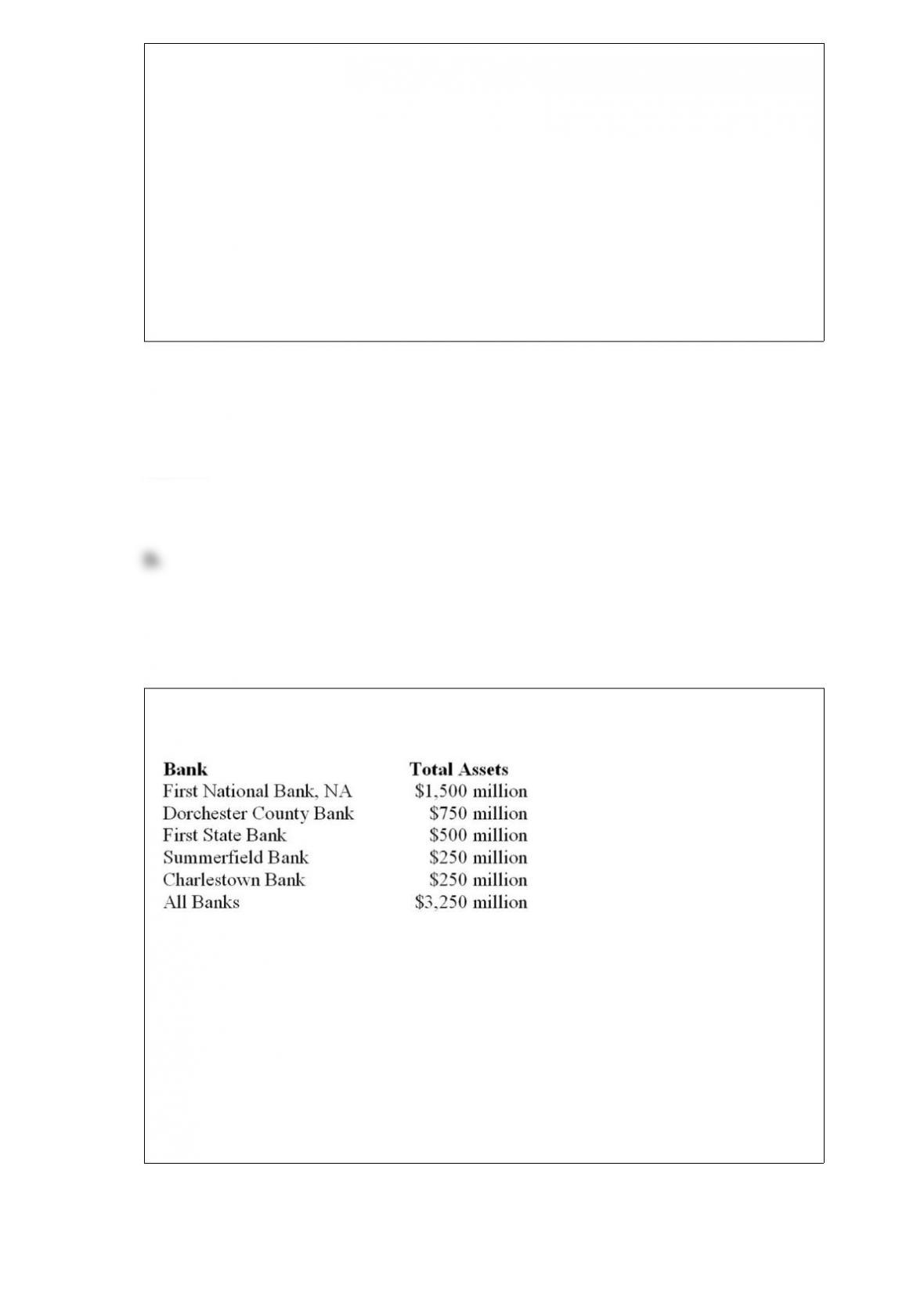
Dorchester County has the following five banks in its market area:
What is the market share of the First National Bank? A. 100.00 percent
B. 75.00 percent
C. 46.15 percent
D. 15.38 percent
E. None of the options is correct

Answer:
A financial institution that buys a put option: A. has the right to accept delivery of the
underlying security at the contract price if they wish.
B. has the right to make delivery of the underlying security at the contract price if they
wish.
C. is obligated to accept delivery of the underlying security at the contract price.
D. is obligated to make delivery of the underlying security at the contract price.
E. is exposed to unlimited losses and limited gains.
Answer:
Which of the following laws restricts Federal Reserve lending to undercapitalized banks
and allows for long-term Fed support only to borrowing institutions that are considered
“viable entities”?
A. Riegle Community Development and Regulatory Improvement Act
B. FDIC Improvement Act
C. Financial Institutions Reform, Recovery, and Enforcement Act
D. Depository Institutions Deregulation and Monetary Control Act
E. None of the options is correct

Answer:
According to the textbook, what is the minimum size of the loan-backed securities
offerings that are likely to be successful?
A. $1 million
B. $10 million
C. $25 million
D. $100 million
E. $1 trillion
Answer:
Andover Bank is planning to purchase Berkley Bank. The current market value of
Andover’s stock is $55 per share while that of Berkley’s stock is $15 per share. Andover
plans to pay Berkley’s stockholders a $5 bonus per share. Currently, Andover has
100,000 shares outstanding and earnings per share of $12, while Berkley has 50,000
shares outstanding and earnings per share of $5. What will be the total number of shares
outstanding for the new bank?
A. 118,182 shares
B. 150,000 shares
C. 166,667 shares
D. 200,000 shares
E. None of the options is correct
Answer:
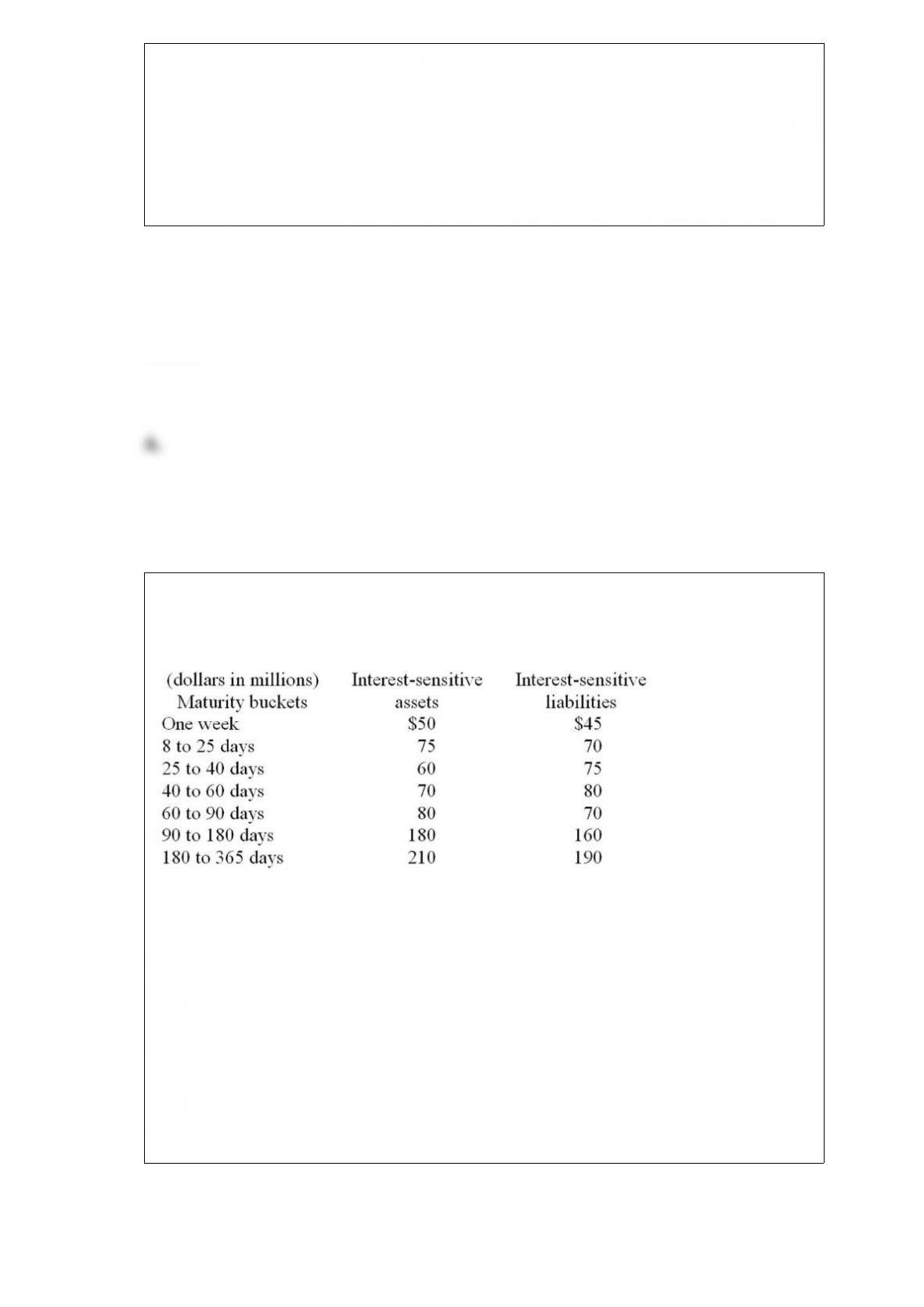
Loyola Bank classifies its assets and liabilities and the period (maturity buckets) within
which they are subject to repricing as on March 31, 2015 as follows:
What is the interest-sensitive gap of the bank as on March 31, 2015?
A. -$30 million
B. $40 million
C. -$45 million
D. $32 million
E. -$38 million

Answer:
The interest-rate measure often quoted on short-term loans and money market securities
such as U.S. Treasury bills is the
A. bank discount rate.
B. yield to maturity.
C. annual percentage rate.
D. net interest margin.
E. None of the options is correct.
Answer:
Paul Carter requests an automobile loan of $15,000 that will be repaid over the next
four years in monthly repayments. The First National Bank tells Mr. Carter that his total
finance charges will be $4675.20. What is the APR on this loan?
A. 16 percent
B. 1 percent
C. 14 percent
D. 7 percent

E. None of the options is correct
Answer:
A bank’s IS GAP is defined as:
A. the dollar amount of interest-sensitive assets divided by the dollar amount of
interest-sensitive liabilities.
B. the dollar amount of earning assets divided by the dollar amount of total liabilities.
C. the dollar amount of interest-sensitive assets minus the dollar amount of
interest-sensitive liabilities.
D. the dollar amount of interest-sensitive liabilities minus the dollar amount of
interest-sensitive assets.
E. the dollar amount of earning assets times the average liability interest rate.
Answer:
A bank maintains an average clearing balance of $1,000,000 with the Federal Reserve.
The Federal funds rate is currently 4.5 percent. What amount of credit will the bank
earn over the reserve maintenance period that can be used to offset any fees charged by
the Federal Reserve?

A. $17,500
B. $1,750
C. $45,000
D. $12,500
E. None of the options is correct
Answer:
A federal funds loan that is automatically renewed each day unless either the borrower
or the lender decides to end the loan agreement is known as a(n):
A. overnight loan.
B. continuing contract.
C. term loan.
D. rollover loan agreement.
E. None of the options is correct.
Answer:

Which of the following trust agreements allows wealth to be passed free of gift and
estate taxes?
A. Revocable trust
B. Irrevocable trust
C. Charitable trust
D. Indenture trust
E. None of the options is correct.
Answer:
The ______________________ is the proportion of shares of stock the shareholders of
an acquired firm receive from the acquiring firm.
Answer:
_________________________ is part of a new technology for processing checks where
the bank takes a picture of the back and the front side of an original check and which
can then be processed as if it were the original.

Answer:
When a customer is charged based on the number and kinds of services used, with the
customers that use a number of services being charged less or having some fees waived,
this is called __________________ pricing.
Answer:
A(n) _________________________ is a contract where a borrower with a lower credit
rating enters into an agreement with a borrower with a higher credit rating to exchange
interest payments.
Answer:
A(n) _______________________ is a traditional service which permits a depositor to
write a draft in payment for goods and services.

Answer:
When all else fails, the ultimate defense against risk in banking is
________________________.
Answer:
______________ are private investment pools which primarily offer to wealthy
investors and major institutions higher investment returns by taking on relatively risky
assets.
Answer:
A(n) ___________________________________________ is an organization which has

over half its income from activities associated with exporting goods and services from
the U.S. They can offer export insurance coverage, transportation, warehousing, and
other services.
Answer:
Variable rate loans and securities are included as part of _______________________
for banks.
Answer:
_________________________ is the risk that a bank may have to sell a part of its
investment portfolio before maturity for a capital loss.
Answer:

_______________________ is a service provided by banks where the bank lends
money to individuals for the purchase of durable and other goods.
Answer:
__________________________ reflects the effectiveness of the expense management
of a bank and is one of the principal components of evaluating ROE.
Answer:
While considering an individual’s income levels, a bank generally prefers the borrower
report ______________________ rather than gross salary.
Answer:

A(n) _________________________ is a short-maturity deposit which pays a
competitive interest rate. Only six preauthorized drafts per month are allowed but only
three withdrawals can be made by writing checks.
Answer:
Answer:
Banks that sell deposits and make loans to businesses, individuals, and institutions are
known as _____________ banks.
Answer:
____________________________ loans are ones that are secured by land, buildings,

and other structures. These loans can be short term construction loans or longer term
loans to finance the purchase of homes and apartments among others.
Answer: