
Recent federal guidelines put in place by the Federal Deposit Insurance Corporation
require banks to develop written procedures to protect against loss from environmental
damage. These procedures are known as the:
A. lender protection program.
B. environmental risk assessment program.
C. lender liability security program.
D. environmental pollution control program.
E. None of the options is correct.
Answer:
The deposit pricing method that favors large-denomination deposits because services
are free if the deposit account balance stays above some minimum figure is called:
A. free pricing.
B. conditionally free pricing.
C. flat-rate pricing.
D. upscale target pricing.
E. marginal cost pricing.
Answer:

The employee productivity ratio for a bank is equal to: A. net operating revenue less
total interest expenses per employee.
B. total interest and noninterest expense per employee.
C. net operating income per full-time-equivalent employee.
D. total operating earnings less salaries and wages expense per employee.
E. None of the options is correct.
Answer:
According to the textbook, the largest category (by dollar volume) of loans extended by
U.S. banks is:
A. real estate loans.
B. financial institution loans.
C. agricultural loans.
D. commercial and industrial loans.
E. None of the options is correct.
Answer:

While the largest U.S. depositories are required to settle their legal reserve requirements
with the Federal Reserve over successive bi-weekly periods, the more numerous but
smaller banks are required to do so:
A. once every day.
B. once every week.
C. once every month.
D. once every quarter.
E. once every year.
Answer:
First National Bank of Edmond asks a prospective customer for her driver’s license.
Which of the 6 Cs of lending would this piece of information belong to?
A. Character
B. Capacity
C. Cash
D. Collateral
E. Conditions

Answer:
When an issuer of securitized loans includes a standby letter of credit with the
securitized loans, they are providing an:
A. internal credit enhancement.
B. external credit enhancement.
C. internal liquidity enhancement.
D. external liquidity enhancement.
E. None of the options is correct.
Answer:
The federal law that requires banks to notify in writing to their credit customers when a
loan request is denied is known as the:
A. Equal Credit Opportunity Act.
B. Competitive Equality in Banking Act.
C. Truth-in-Lending Act.
D. Community Reinvestment Act.
E. None of the options is correct.

Answer:
In addition to the Federal Reserve, the other governmental agency that has also been
loaning large amounts of money to banks and thrift institutions is the:
A. FDIC.
B. OCC.
C. OTS.
D. FHLB.
E. RTC.
Answer:
The account that is built up by annual noncash expense deductions and is subtracted
from Gross Loans on the Report of Condition is:
A. unearned income.
B. nonperforming loans.
C. allocated loan risk deductions.

D. allowance for possible loan losses.
E. None of the options are correct.
Answer:
The coupon rate promised to investors on securities issued against a pool of loans is
6.5%. The default rate on the pool of loans is expected to be 3.5%. The fee to
compensate a servicing institution for collecting payments on the loan is 2%. Fees to set
up credit and liquidity enhancements are 5%. The residual income on this pool of loans
is 7%. What is the expected yield on this pool of loans?
A. 24%
B. 12%
C. 10%
D. 6.5%
E. None of the options is correct.
Answer:
According to Levonian and Rose, in order to achieve some reduction in earnings risk,

interstate banks must:
A. expand into different product lines.
B. expand into a number of different regions.
C. increase the number of people in the management.
D. increase the number of employees.
E. buy smaller banks.
Answer:
According to the cost-plus model for pricing loans, the factors that should be
considered in pricing a loan include:
A. the marginal cost of raising loanable funds to support the loan request.
B. the lender’s nonfunds operating costs.
C. an appropriate margin to compensate the bank for default risk.
D. the bank’s desired profit margin.
E. All of the options are required as factors to price a loan.
Answer:

Which of the following is a disadvantage of an interest rate swap agreement?
A. Basis risk
B. High brokerage fees
C. Default risk
D. Interest rate risk
E. All of the options are disadvantages of interest rate swap agreements.
Answer:
The formulaoperating expense per unit of deposit service plus estimated overhead
expense plus planned profit from each deposit service unit soldreflects which of the
deposit pricing method listed below?
A. Marginal cost pricing
B. Cost plus pricing
C. Conditional pricing
D. Upscale target pricing
E. None of the options is correct
Answer:

A bank wants to examine how well a customer markets their goods and services. They
are most likely to look at which of the following ratios?
A. Wages and salaries/Net sales
B. Accounts receivables/(Annual credit sales/360)
C. Net income after taxes/Net sales
D. Income before interest and taxes/Interest payments
E. (Current assets – Inventory)/Current liabilities
Answer:
The Arnold National Bank has a bond portfolio that consists of bonds with 5 years to
maturity and a 9 percent coupon rate having a face value of $1,000. These bonds are
selling in the market for $1,126. Coupon payments are made annually on this bond.
What is duration of these bonds? A. 3.77 years
B. 4.23 years
C. 5 years
D. 9 years
E. None of the options is correct.

Answer:
A bank’s promise to pay the holder a designated amount of money, on a designated
future date, and often used in international trade is known as a(n):
A. promissory guarantee.
B. discount security.
C. bankers’ acceptance.
D. in-the-money option.
E. accretion note.
Answer:
Banks that issue standby letters of credit may face which of the following types of
risk?
A. Prepayment risk
B. Interest-rate risk
C. Liquidity risk
D. Options B and C only
E. All the options are correct.

Answer:
A securitized asset where the asset used to back the securities is a loan based on the
residual value of a homeowner’s residence is called:
A. a mortgage-backed security.
B. a credit-card-backed security.
C. an automobile-backed security.
D. a loan-backed bond.
E. a home-equity-loan-backed-security.
Answer:
The daily settlement process that credits gains or deducts losses from a futures
customer’s account is called: A. factoring.
B. marking-to-market.
C. margining.
D. maintenance.

E. realizing.
Answer:
The Garic State Bank of New Orleans has been under water for three weeks since
hurricane Katrina hit the state. The lobby is full of mud and other debris. Many of the
valuables stored in the bank’s safety deposit boxes have been ruined. John Garic, the
President and CEO of the bank, has been working night and day to reopen the bank.
What type of risk has John been dealing with? A. Credit risk
B. Liquidity risk
C. Market risk
D. Interest rate risk
E. Operational risk
Answer:
A bank that wants to protect itself from higher borrowing costs due to a decrease in its
credit rating might purchase:
A. a credit risk option.
B. a standby letter of credit.
C. a credit linked note.
D. a credit swap.
E. None of the options is correct
Answer:
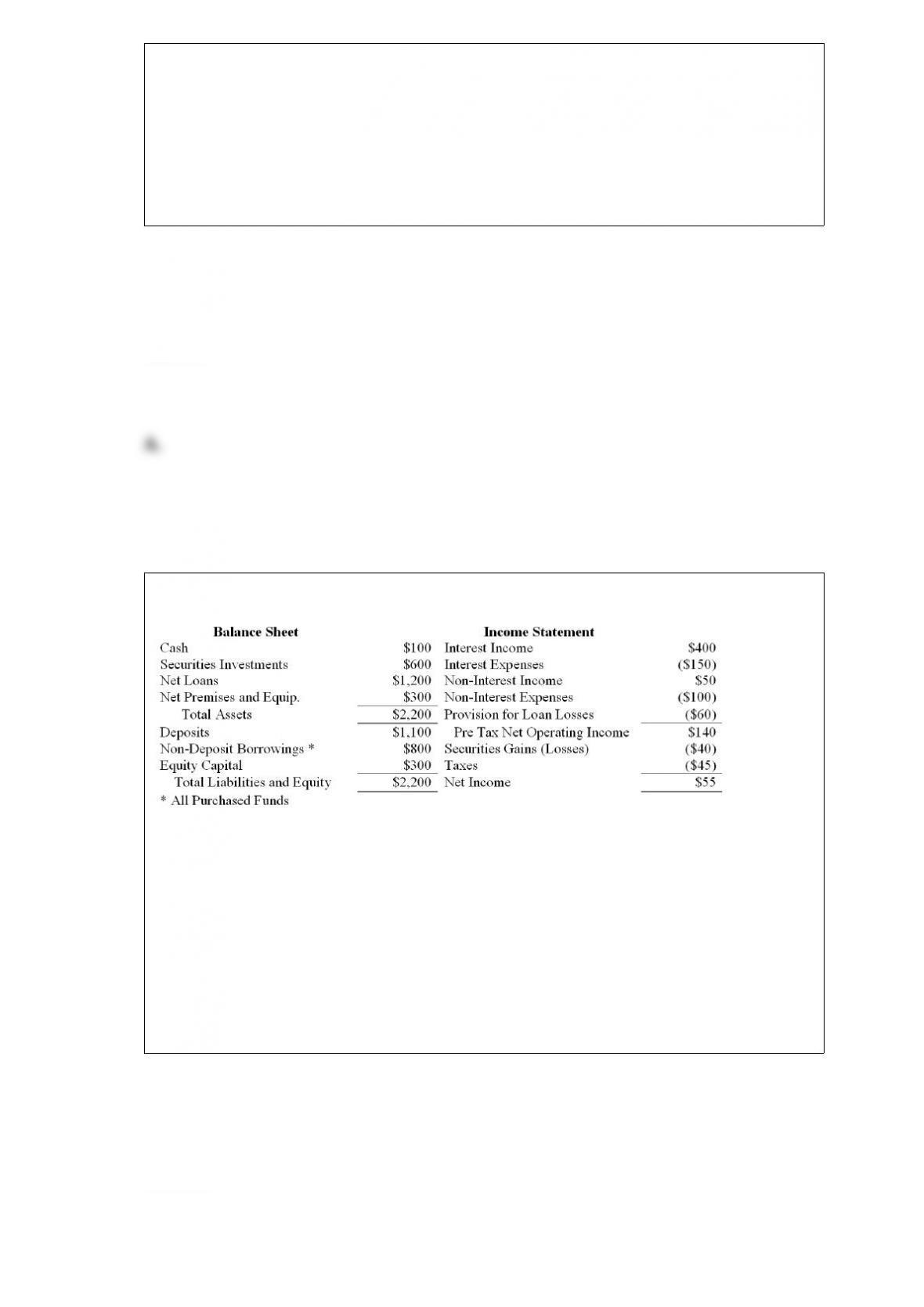
Following data pertains to Castle State Bank.
What is the bank’s ROA? A. 20.45%
B. 18.33%
C. 12.22%
D. 7.33%
E. 2.5%
Answer:

The phenomenon of convergence refers to:
A. financial service firms expanding into other product lines.
B. firms reducing their product lines.
C. bank merger activity.
D. globalization in banking.
E. technological innovation in banking.
Answer:
When a bank’s sources of liquidity exceed it uses of liquidity, the bank will have a:
A. positive liquidity gap.
B. negative liquidity gap.
C. cyclical liquidity gap.
D. seasonal liquidity gap.
E. None of the options is correct.
Answer:

Credit ratings for loan-backed bonds are often:
A. lower than the issuing institution.
B. higher than the issuing institution.
C. at par with the issuing institution.
D. based on the total loans issued by the bank.
E. based on the assets under management of the bank.
Answer:
In the week about to begin, a bank expects $30 million in incoming deposits, $20
million in deposit withdrawals, $15 million in revenues from the sale of nondeposit
services, $25 million in customer loan repayments, $5 million in sale of bank assets,
$45 million in money market borrowings, $60 million in acceptable loan requests, $10
million in repayments of bank borrowings, $5 million in cash outflows to cover other
operating expenses, and $10 million in dividend payments to its stockholders. The
bank’s net liquidity position for the week is expected to be:
A. $30 million surplus.
B. $20 million deficit.
C. $10 million deficit.
D. $15 million surplus.
E. None of the options is correct.

Answer:
The ratio of a bank’s interest income from its loans and security investments less
interest expenses on debt issued, divided by total earning assets measures a bank’s:
A. net operating margin.
B. net return before special transactions.
C. net interest margin.
D. return on assets.
E. None of the options is correct
Answer:
Which of the following is a reason that has made IRA and Keogh accounts more
attractive to depositors recently?
A. Most of these accounts carry floating interest rates
B. These accounts now represent more than half of total deposits of FDIC insured
banks
C. Individuals can deposit unlimited amounts in these accounts

D. Banks need to pay at least 6% on these accounts to depositors
E. Increase in FDIC insurance coverage to $250,000 on these accounts
Answer:
Which of the following is one of the several advantages that bank holding company
organizations have over other types of banking organizations?
A. Greater access to capital markets
B. Tax advantage
C. Product-line diversification
D. Ability to use higher leverage
E. All the options are correct
Answer:
An interest-rate ________ would protect the swap party receiving a floating-rate
payment in a swap.

Answer:
The right of ______________________ allows a bank to call a loan that is in default
and seize any checking or savings deposits the customer may hold with the bank in
order to recover its funds.
Answer:
_____________________ is the sum of all outstanding IOUs owed to the bank in the
form of consumer, real estate, commercial, and agriculture loans as well as other types
of credit extensions.
Answer:
The ________________ approach to managing liquidity starts with two simple facts,
liquidity rises as deposits increase and loans decrease, and liquidity falls when deposits

fall and loans increase.
Answer:
__________________________ are those assets which mature or must be repriced
within the planning period.
Answer:
The ________________________ Act provides consumers with an opportunity to order
one free credit report annually from each of the three nationwide credit bureaus.
Answer:

One reason banks pursue mergers is for _____________________. This allows the
bank to reduce fluctuations in revenues and net income.
Answer:
In a(n) _________________________ an outsider purchases part of a loan from the
selling financial institution. Generally the purchaser has no influence over the terms of
the loan contract.
Answer:
The latest revision to the Basel accord is known as __________ and will cover capital,
liquidity, and debt positions of individual international banks and also the much broader
issues associated with controlling global business cycles and financial system-wide
risks.
Answer:

When financial institutions tempt customers by paying postage both ways in
bank-by-mail services or by offering free gifts such as teddy bears, they are practicing
__________.
Answer:
The ___________________ view of assets and liabilities held that the amount and
types of deposits was primarily determined by customers and hence the key decision a
bank needed to make was with the assets.
Answer:
The _______________________ of a bank is a traditional service where the bank
manages the financial affairs and property of individuals (and in some cases
businesses).
Answer:

The ___________________________________ makes it easier for victims of identity
theft to file a theft report with the Federal Trade Commission and allows the public to
apply for a free credit report once a year from the national credit bureaus.
Answer:
A short term debt security issued by major corporations is known as
_________________.
Answer:
The ____________________________________________ is an international market
for long-term debt denominated in foreign currency units.
Answer:

__________________________ is interest income from loans and investments less
interest expenses on deposits and borrowed funds divided by total earning assets.
Answer:
_________________________ pricing is where a financial institution sets up a
schedule of fees in which a customer pays a low or no fee if the deposit balance stays
above some minimum level and pays a higher fee if the balance declines below that
minimum level.
Answer:
The category of derivative contracts with the largest use by banks is _________.

Answer:
Managers who value fringe benefits, plush offices, and ample travel budgets over the
pursuit of maximum returns for stockholders are exhibiting signs of
_________________________.
Answer: