
Which of the following statements is FALSE?
A) With a stock dividend, a firm does not pay out any cash to shareholders. As a result,
the total market value of the firm’s assets and liabilities, and therefore of its equity, is
unchanged.
B) If the price of the stock falls too low, a company can engage in a reverse split and
reduce the number of shares outstanding.
C) Stock dividends of 50% or higher are generally referred to as stock splits.
D) Rather than pay a dividend using cash or shares of its own stock, a firm can also
distribute shares of a subsidiary in a transaction referred to as a off-shoot.
Which of the following statements is FALSE?
A) Short-term margin loans from a broker are often 1% to 2% lower than the rates paid
on short-term Treasury securities.
B) In the real world investors have different information and expectations regarding
securities.
C) The SML is still valid when interest rates differ.
D) When borrowing and lending occur at different rates there are different tangent
portfolios identified.
Consider the following four corporate bonds that have semiannual compounding:
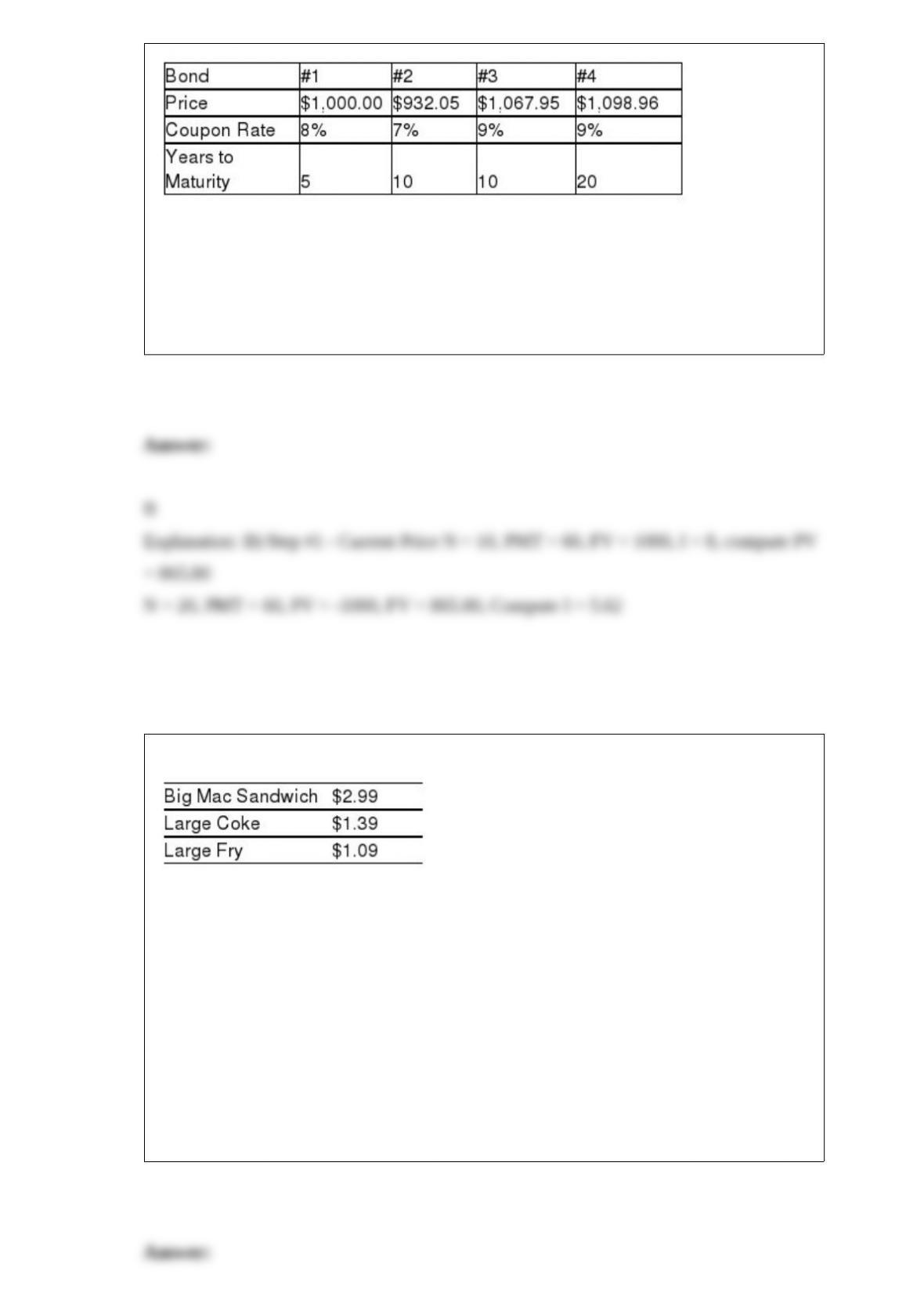
If you sell this bond now, the internal rate of return you will earn on your investment
will be closest to:
A) 5.0%
B) 5.6%
C) 6.0%
D) 8.0%
A McDonald’s Big Mac value meal consists of a Big Mac Sandwich, Large Coke, and a
Large Fry. Assume that there is a competitive market for McDonald’s food items and
that McDonald’s sells the Big Mac value meal for $4.79. Does an arbitrage opportunity
exists and if so how would you exploit it and how much would you make on one extra
value meal?
A) Yes, buy extra value meal and then sell Big Mac, Coke, and Fries to make arbitrage
profit of $0.68.
B) No, no arbitrage opportunity exists.
C) Yes, buy Big Mac, Coke, and Fries then sell value meal to make arbitrage profit of
$1.09.
D) Yes, buy Big Mac, Coke, and Fries then sell value meal to make arbitrage profit of
$0.68.

Consider two mutually exclusive projects A & B. If you subtract the cash flows of
opportunity B from the cash flows of opportunity A, then you should:
A) take opportunity A if the regular IRR exceeds the cost of capital.
B) take opportunity A if the incremental IRR exceeds the cost of capital.
C) take opportunity B if the regular IRR exceeds the cost of capital.
D) take opportunity B if the incremental IRR exceeds the cost of capital.
Luther Corporation
Consolidated Balance Sheet
December 31, 2009 and 2008 (in $ millions)
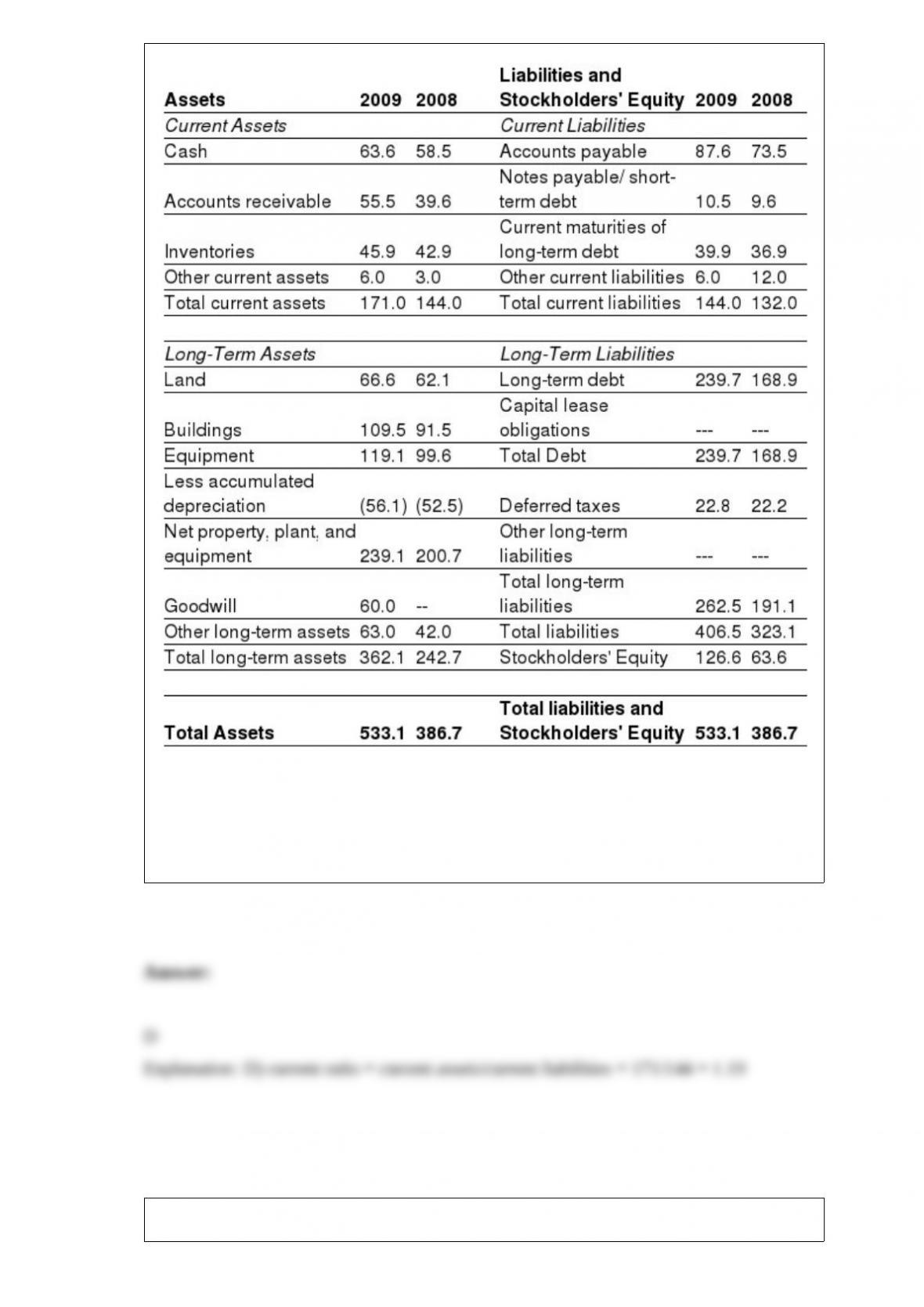
Luther’s current ratio for 2009 is closest to:
A) 0.84
B) 0.92
C) 1.09
D) 1.19
Flagstaff Enterprises expected to have free cash flow in the coming year of $8 million,
and this free cash flow is expected to grow at a rate of 3% per year thereafter. Flagstaff
has an equity cost of capital of 13%, a debt cost of capital of 7%, and it is in the 35%
corporate tax bracket.
If Flagstaff currently maintains a .5 debt to equity ratio, then Flagstaff’s after-tax WACC
is closest to:
A) 10.00%
B) 10.25%
C) 9.50%
D) 8.75%
Estimated 2005 Income Statement and Balance Sheet Data for Ideko Corporation
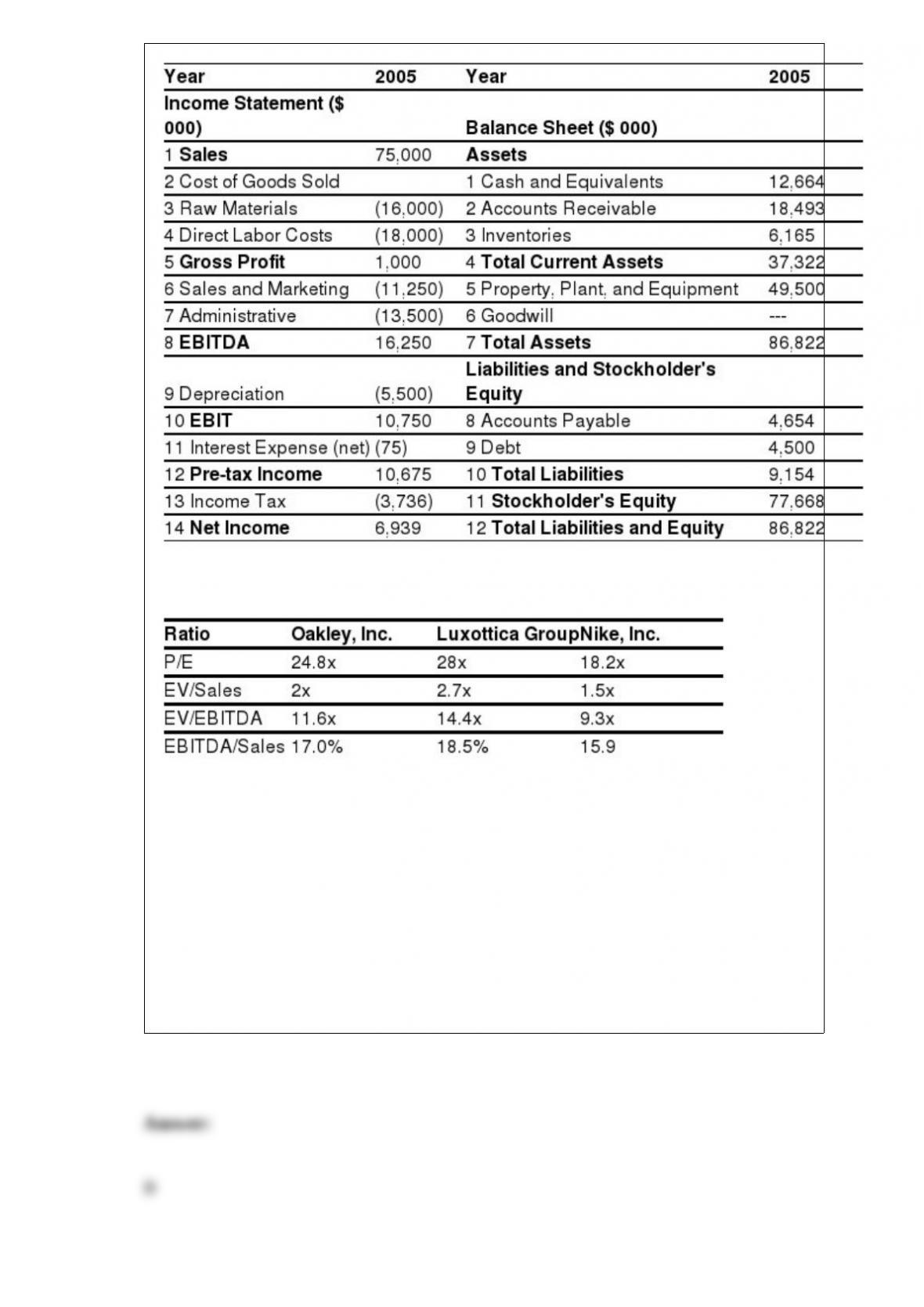
The following are financial ratios for three comparable companies:
Based upon the average EV/Sales ratio of the comparable firms, Ideko’s target
economic value is closest to:
A) $191 million
B) $155 million
C) $165 million
D) $157 million

Luther is a successful logistical services firm that currently has $5 billion in cash.
Luther has decided to use this cash to repurchase shares from its investors, and has
already announced the stock repurchase plan. Currently Luther is an all equity firm with
1.25 billion shares outstanding. Luther’s shares are currently trading at $20 per share.
Assume that in addition to 1.25 billion common shares outstanding, Luther has stock
options given to employees valued at $2 billion. The market value of Luther’s non-cash
assets is closest to:
A) $22 billion
B) $20 billion
C) $25 billion
D) $18 billion
Which of the following cash flows are relevant incremental cash flows for a project that
you are currently considering investing in?
A) The tax savings brought about by the project’s depreciation expense
B) The cost of a marketing survey you conducted to determine demand for the proposed
project
C) Interest payments on debt used to finance the project
D) Research and Development expenditures you have made

Which of the following statements is FALSE?
A) It is possible that an IRR does not exist for an investment opportunity.
B) If the payback period is less than a pre-specified length of time you accept the
project.
C) The internal rate of return (IRR) investment rule is based upon the notion that if the
return on other alternatives is greater than the return on the investment opportunity you
should undertake the investment opportunity.
D) It is possible that there is no discount rate that will set the NPV equal to zero.
Wyatt Oil issued $100 million in perpetual debt (at par) with an annual coupon of 7%.
Wyatt will pay interest only on this debt. Wyatt’s marginal tax rate is expected to be
40% for the foreseeable future.
The present value of Wyatt’s annual interest tax shield is closest to:
A) $4.2 million
B) $7.0 million
C) $40 million
D) $60 million
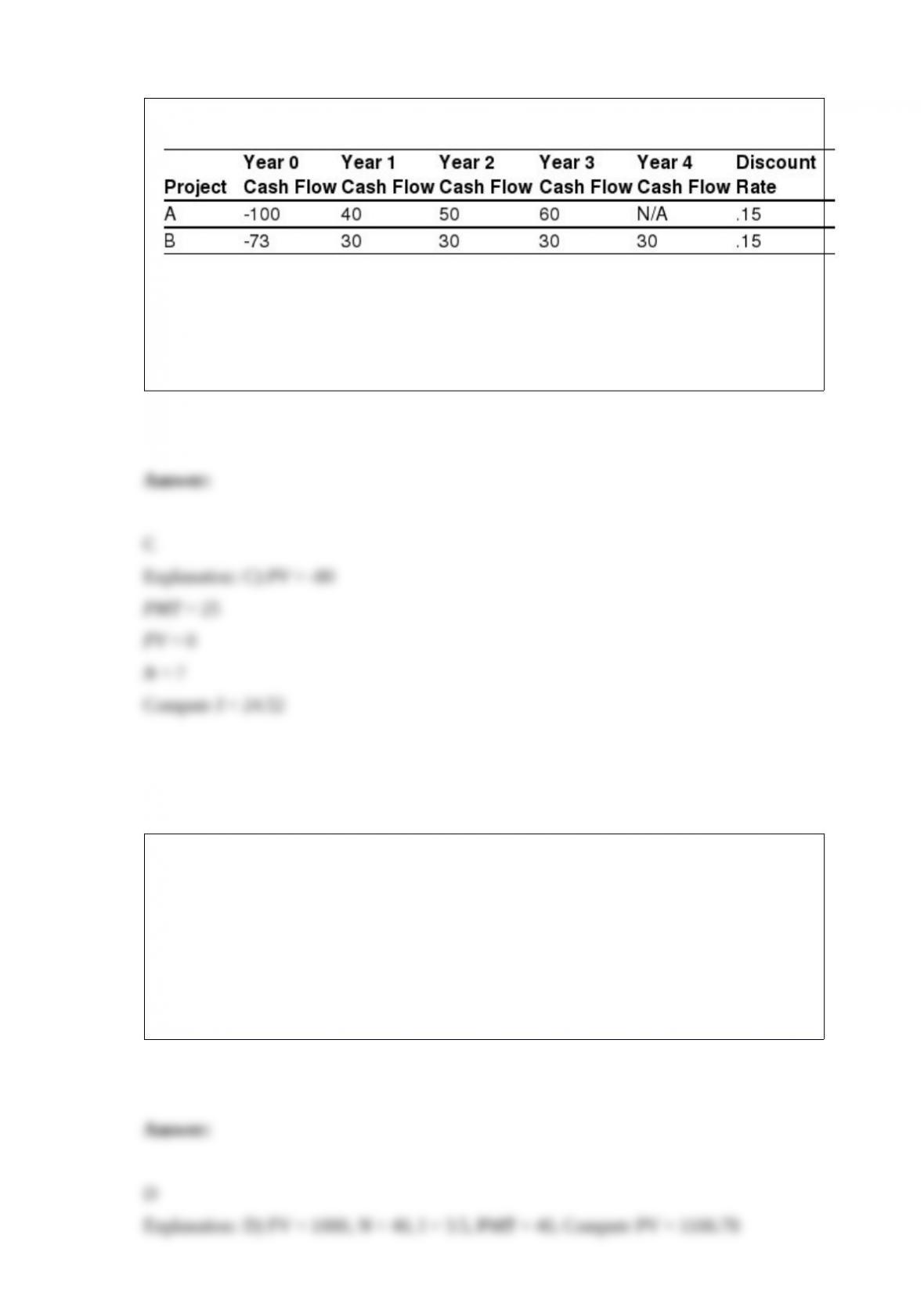
Consider the following two projects:
The internal rate of return (IRR) for project Beta is closest to:
A) 25.0%
B) 22.7%
C) 24.5%
D) 22.2%
Wyatt oil is contemplating issuing a 20-year bond with semiannual coupons, a coupon
rate of 8%, and a face value of $1000. Wyatt Oil believes it can get a AAA rating from
Standard and Poor’s for this bond issue. If Wyatt Oil is successful in getting a AAA
rating, then the issue price for these bonds would be closest to:
A) $891
B) $901
C) $1,000
D) $1,107

Which of the following formulas is INCORRECT?
A) PV of a growing annuity = C ×
B) PV of an annuity = C ×
C) PV of a growing perpetuity =
D) PV of a perpetuity =
d’Anconia Copper has $200 million in cash that it can use for a share repurchase.
Suppose instead that d’Anconia Copper invests the funds in an account paying 5%
interest for one year. Assume that the corporate tax rate is 35%, the individual capital
gains rate is 15% and the individual rate on ordinary income is 30%.
The amount of additional cash that d’Anconia Copper will have at the end of the year
net of corporate taxes is closest to:
A) $2.0 million
B) $5.5 million
C) $6.5 million
D) $7.0 million
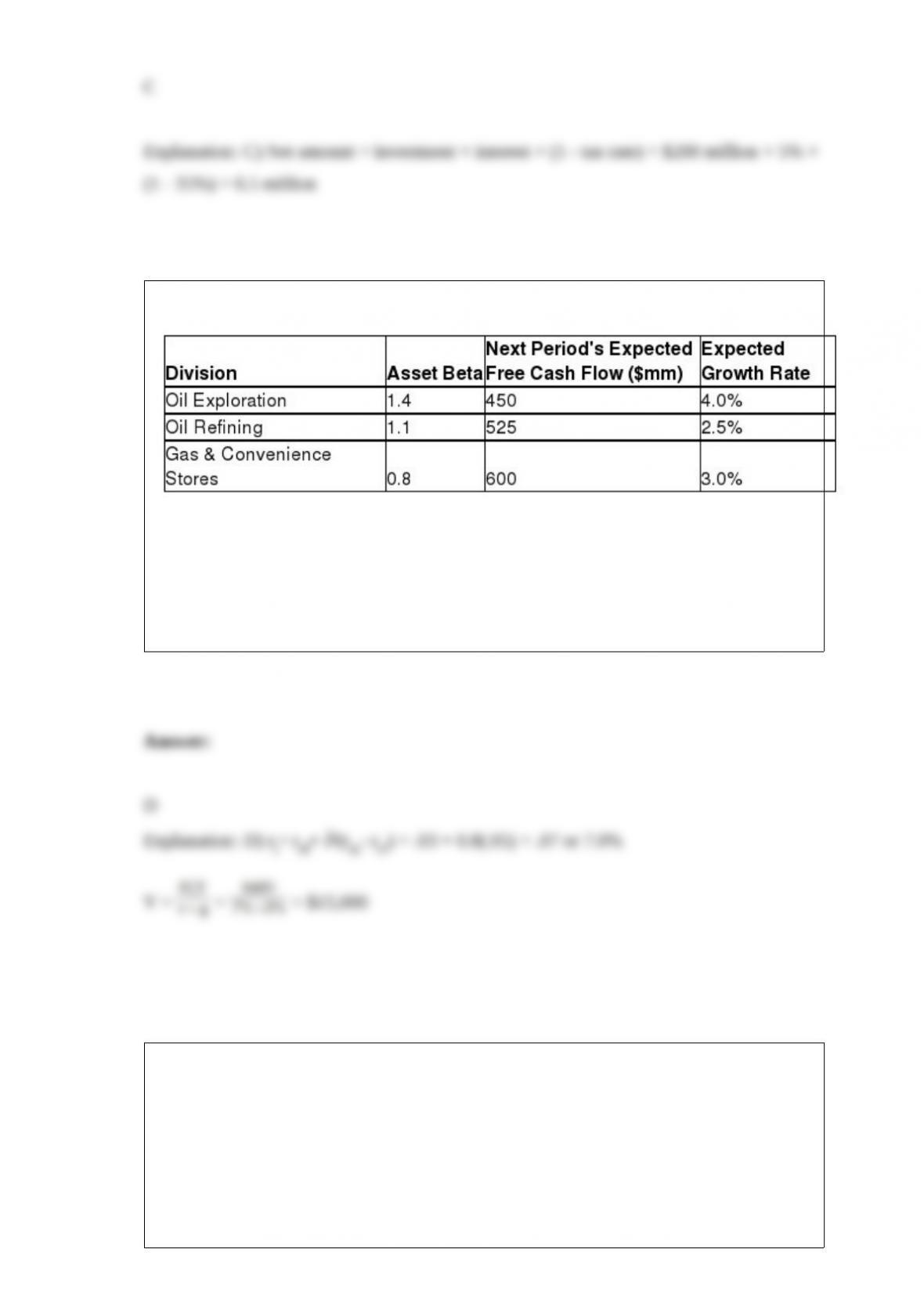
The risk-free rate of interest is 3% and the market risk premium is 5%.
The value of the gas and convenience store division is closest to:
A) $4,500
B) $6,000
C) $8,600
D) $15,000
Omicron Technologies has $50 million in excess cash and no debt. The firm expects to
generate additional free cash flows of $40 million per year in subsequent years and will
pay out these future free cash flows as regular dividends. omicrons unlevered cost of
capital is 10% and there are 10 million shares outstanding. Omicron’s board is meeting
to decide whether to pay out its $50 million in excess cash as a special dividend or to
use it to repurchase shares of the firm’s stock.
Assume that Omicron uses the entire $50 million to repurchase shares. The number of
shares that Omicron will repurchase is closest to:
A) 1.0 million
B) 1.2 million
C) 1.1 million
D) 0.9 million
Consider a project with free cash flows in one year of $90,000 in a weak economy or
$117,000 in a strong economy, with each outcome being equally likely. The initial
investment required for the project is $80,000, and the project’s cost of capital is 15%.
The risk-free interest rate is 5%.
Suppose that to raise the funds for the initial investment the firm borrows $80,000 at the
risk free rate, then the cost of capital for the firm’s levered equity is closest to:
A) 45%
B) 25%
C) 15%
D) 95%

Consider two firms, Chihuahua Corporation and Bernard Industries that are each
expected to pay the same $1.5 million dollar dividend every year in perpetuity.
Chihuahua Corporation is riskier and has an equity cost of capital of 15%. Bernard
Industries is not as shaky as Chihuahua, so Bernard has an equity cost of capital of only
10%. Assume that the market portfolio is not efficient. Both stocks have the same beta
and the CAPM would assign them both an expected return of 12% to both.
The market value for Chihuahua is closest to:
A) $10.0 million
B) $12.5 million
C) $12.0 million
D) $15 million
Estimated 2005 Income Statement and Balance Sheet Data for Ideko Corporation
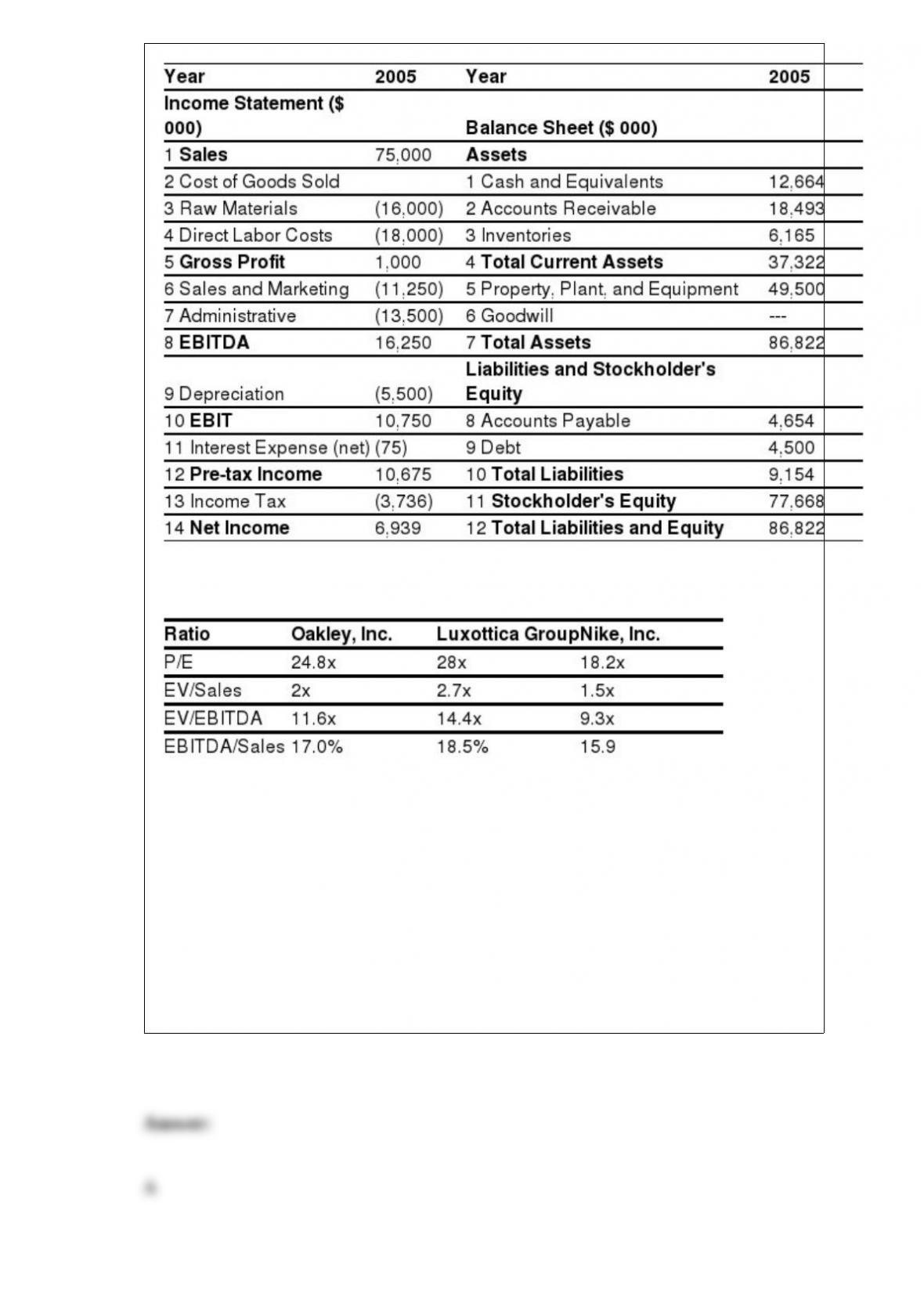
The following are financial ratios for three comparable companies:
Based upon the average EV/EBITDA ratio of the comparable firms, Ideko’s target
economic value is closest to:
A) $191 million
B) $155 million
C) $157 million
D) $193 million
Which of the following statements is FALSE?
A) In a share repurchase, the firm uses excess cash to buy back its own stock.
B) The discounted free cash flow model begins by determining the value of the firm’s
equity.
C) The discounted free cash flow model focuses on the cash flows to all of the firm’s
investors, both debt and equity holders, and allows us to avoid estimating the impact of
the firm’s borrowing decisions on earnings.
D) In recent years an increasing number of firms have replaced dividend payouts with
share repurchases.
You are looking for a new truck and see the following advertisement. “Own a new
truck! No money down. Just five easy annual payments of $8000.” You know that you
can get the same truck from the dealer across town for only $31,120. The interest rate
for the deal advertised is closest to:
A) 9%
B) 8%
C) 8.5%
D) 10%