
1) an approximation to the real interest rate can be calculated by
a. subtracting the nominal interest rate from the inflation rate
b. subtracting the price level from the nominal interest rate
c. dividing the nominal interest rate by the inflation rate
d. subtracting the inflation rate from the nominal interest rate
2) the is/lm/bp analysis suggests that, under flexible exchange rates,
a. monetary policy is less powerful for affecting national income than under fixed
exchange rates
b. a country may have difficulty in staying on the lm curve
c. expansionary fiscal policy, in theory, may cause either depreciation or appreciation of
the home currency
d. expansionary fiscal policy will always lead to a decline in national income
3) suppose that a country a individual investor receives a dividend payment from an
investment made abroad, and the payment is made by a deposit of funds into the
investors bank account in the country where the investment is made. the category for
the credit entry in this situation would be __________, and the category for the debit
entry would be __________.
a. “factor income received from abroad”; “increase in private short-term assets abroad”
b. “decrease in private short-term assets abroad”; ‘service exports”
c. “increase in private short-term assets abroad”; “factor income payment abroad”
d. “factor income received from abroad”; “decrease in short-term assets abroad”
4) the following classical-type table shows the number of days of labor input required
to obtain one unit of output of each of the two commodities in each of the three
countries:
given this information, the united states has an absolute advantage over spain in
a. both goods, and the united states also has an absolute advantage over england in both

goods
b. both goods, but the united states has an absolute advantage over england in neither
good
c. neither good, but the united states has an absolute advantage over england in both
goods
d. neither good, and the united states also has an absolute advantage over england in
neither good
5) foreign investment such as the purchase of foreign bonds or the deposit of funds ina
bank account in another country is called __________ investment; this type of
investment involves __________ control over production in the host country than does
the other type of investment.
a. direct rather than portfolio; more
b. direct rather than portfolio; less
c. portfolio rather than direct; more
d. portfolio rather than direct; less
6) under flexible exchange rates,
a. fiscal policy is most effective in influencing national income when capital is perfectly
immobile internationally and least effective when capital isperfectly mobile
internationally
b. monetary policy is more effective in influencing national income when capital is
perfectly immobile internationally than when capital is perfectly mobile internationally
c. both fiscal policy and monetary policy are completely ineffective in influencing
national income when capital is perfectly immobile internationally
d. fiscal policy has no effect on national income, regardless of what assumptions are
made about the degree of international mobility of capital
7) if a country has a current account deficit, which one of the following is true?
a. y (c + i + g) > 0
b. s + (g – t) – i < 0
c. s < i + (g – t)
d. c – y > 0
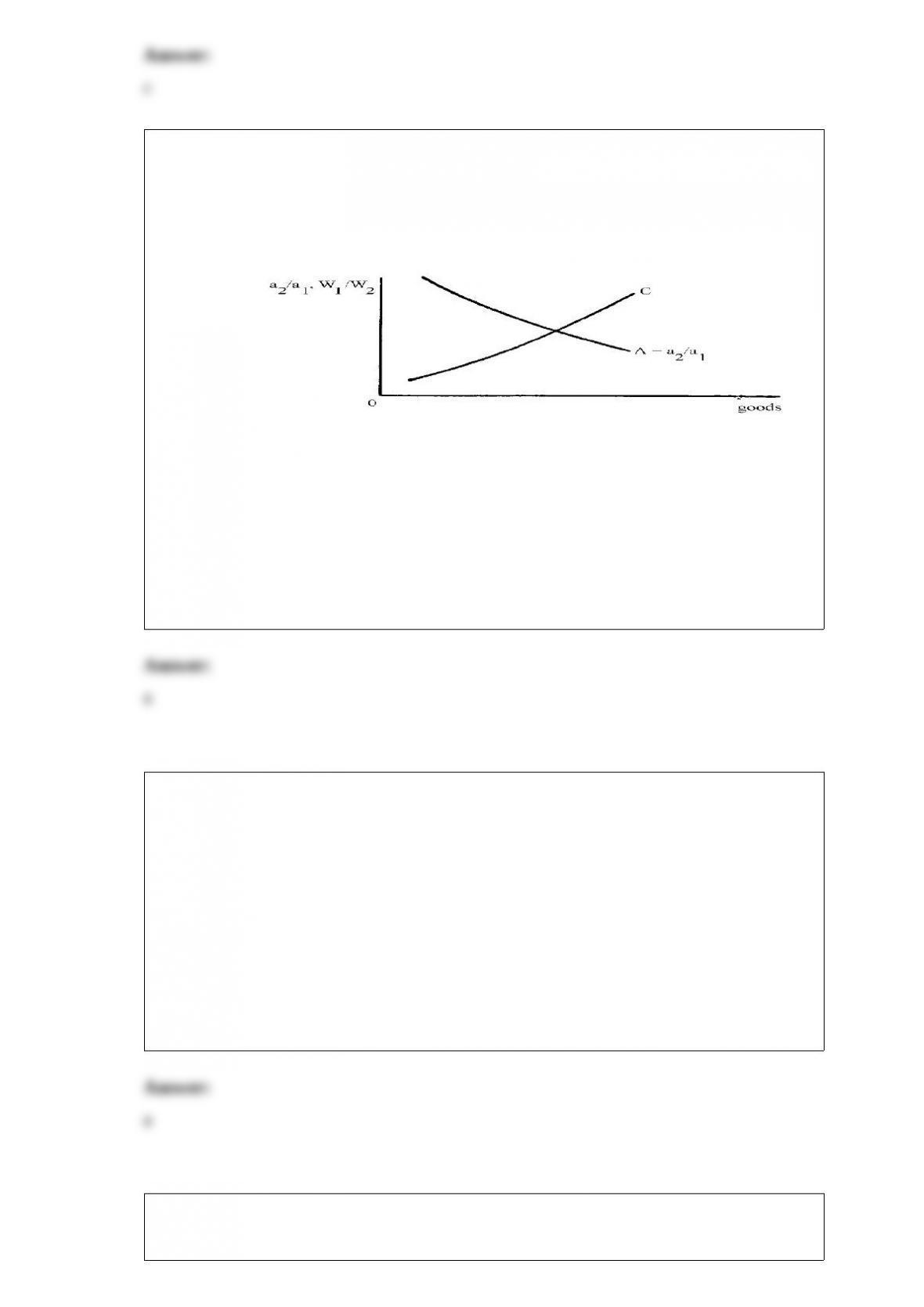
8) you are given the following dornbusch-fischer-samuelson (dfs) graph, where a1 = the
labor-time needed per unit of output in any given industry in the home country, a2 = the
labor-time needed per unit of output in any given industry in the foreign country, w1 =
the wage rate in the home country, and w2 = the wage rate in the foreign country. the
exchange rate e is assumed = 1.
in the dornbusch-fischer-samuelson model, a uniform improvement in labor
productivity in all of the home countrys industries would shift the a schedule
__________ and would lead to the export of a __________ number of goods by the
home country than the number exported before the productivity improvement.
a. upward and to the right; greater
b. upward and to the right; smaller
c.. downward and to the left; greater
d. downward and to the left; smaller
9) suppose that we are in a two-factor, two-country world where the factors of
production are labor (l) and land (t), the returns to the factors are the wage rate (w) and
the rental rate on land (t), and the countries are country a and country b. in this
situation, country a is land-abundant relative to country b by the physical definition of
relative factor abundance if __________, and country a is land-abundant relative to
country b by the price (or economic) definition if __________.
a. (l/t)a < (l/t)b; (w/t)a > (w/t)b
b. (l/t)a < (l/t)b; (w/t)a < (w/t)b
c. (l/t)a > (l/t)b; (w/t)a > (w/t)b
d. (l/t)a > (l/t)b; (w/t)a < (w/t)b
10) developing countries (or ldcs) tend to have a ratio of manufactured goods exports to
total exports that is __________ than the corresponding ratio for high-income countries,

and the ldcs also tend to have a __________ degree of commodity concentration in
their exports than do the high-income countries.
a. higher; higher
b. higher; lower
c. lower; higher
d. lower; lower
11) suppose that, in the isoquant-isocost diagram, with given relative factor prices, an
equilibrium input combination of 10 units of capital and 30 units of labor yields an
output level for the firm of 120 units. suppose that, for this firm, at the same relative
factor prices but with a larger budget, an equilibrium input combination of 15 units of
capital and 45 units of labor yields an output level of 160 units. viewing these
input-output relationships, an economist would say that, in its production process, this
firm experiences
a. increasing returns to scale
b. constant returns to scale
c. decreasing returns to scale
d. increasing returns to scale, constant returns to scale, or decreasing returns to scale
cannot be determined without more information
12) if the demand curve for a good increases and decreases cyclically along a relatively
inelastic (or steep) supply curve, then, in this market, the size of price fluctuations will
be __________ than the size of quantity fluctuations.
a. relatively less
b. the same
c. relatively greater
d. relatively less or the same but not relatively greater
13) given the following ricardo-type table showing the amount of labor input required
to produce one unit of output of each of the two goods in each of the two countries:

if the wage rate in france is 60 per day (i.e., 60 euros per day), what is the upper limit to
the wage rate per day in germany (which also uses the euro) that is compatible with
two-way trade between the countries?
a. 40
b. 48
c. 75
d. 90