
In the liquidity-preference model, a decrease in the money supply causes
a. the nominal interest rate to increase and the equilibrium quantity of money to
decrease.
b. the nominal interest rate to increase and the equilibrium quantity of money to remain
unchanged.
c. the nominal interest rate to decrease and the equilibrium quantity of money to remain
unchanged.
d. both the nominal interest rate and the equilibrium quantity of money to decrease.
Answer:
If output grew 2.8 percent last year and labor productivity grew 1.1 percent, then by
how much did hours worked grow over the year?
a. 1.1 percent
b. 1.3 percent
c. 1.7 percent
d. 3.9 percent
Answer:

If the ideal inflation rate in an economy is 3% and the inflation gap is 8%, the actual
inflation rate in the economy
must be
a. 3%.
b. 5%.
c. 8%.
d. 11%.
Answer:
Answer the questions below.
a. Write the equation for the capital-asset pricing model.
b. Describe, in words, what the CAPM is trying to explain, and describe each element of
the equation in part a.
Use the capital-asset pricing model to predict the returns next year of the following
stocks, if you expect the return to holding stocks to be 12 percent on average, and the
interest rate on three-month T-bills will be 2 percent. Show your calculations.
c. A stock with a beta of −0.3
d. A stock with a beta of 7
e. A stock with a beta of 6
Answer:
You are considering buying a discount bond that costs $1,000 today and pays you
$1,200 in one year. However, there is a 10 percent chance that the company issuing the
bond will go bankrupt and not pay you your interest or return your principal. What is
the expected return on the bond?
a. 20 percent.
b. 10 percent.
c. 8 percent.
d. −4 percent.
Answer:

In recessions, the short-term expected real interest rate usually
a. rises by about 4 percentage points.
b. rises by about 2 percentage points.
c. declines by about 2 percentage points.
d. declines by about 4 percentage points.
Answer:
In the two-period model, an increase in the real interest rate causes the budget
constraint to
a. shift to the left in a parallel fashion.
b. shift to the right in a parallel fashion.
c. rotate in a clockwise direction.
d. rotate in a counterclockwise direction.
Answer:
The total amount of physical capital in all firms and households is called the
a. human capital.

b. capital stock.
c. household income.
d. physical product.
Answer:
A rise in the real interest rate will cause consumer spending to
a. decline.
b. not change.
c. rise.
d. rise at first, then decline later.
Answer:
Term premium refers to
a. the interest rate on a long-term bond minus the average interest rate on future
short-term bonds.
b. the interest rate on a long-term bond plus the average interest rate on future
short-term bonds.

c. the average interest rate on future short-term bonds.
d. the standard deviation of the interest rate on long-term bonds.
Answer:
The income effect refers to the situation when a higher nominal interest rate results
from a(n)
a. decrease in income that increases the demand for money.
b. increase in income that increases the demand for money.
c. increase in the price level that increases the demand for money.
d. decrease in the price level that increases the demand for money.
Answer:
If the Open-Market Desk at the Fed buys securities when the federal funds rate is below
the primary credit discount rate, the most likely effect is that the
a. federal funds rate decreases.
b. primary credit discount rate decreases.
c. primary credit discount rate increases.

d. federal funds rate increases.
Answer:
The probabilities of different returns on a stock over the year are:
Probability Return
10% −5%
15% 0%
20% 5%
30% 10%
25% 20%
The standard deviation of the return on the stock is about____ percent.
a. 5
b. 8
c. 11
d. 14
Answer:

Which of the following is true of the credit crunch that occured in the U.S. economy in
the early 1990s?
a. The credit crunch affected only big business firms.
b. Small business firms that were unable to obtain bank loans were most affected during
the credit crunch.
c. The main reason behind the credit crunch was the dramatic decline in housing prices.
d. The government bailed out many of the financial firms that were affected by the
credit crunch.
Answer:
In which of the following periods was total factor productivity growth the slowest in the
U.S. economy?
a. Long boom
b. Economic liftoff period
c. 1995−2005
d. Reorganization period
Answer:

The rule that is used to set a target for the federal funds rate in response to deviations of
real output and inflation from their targets is
a. the Taylor rule.
b. a nonactivist rule.
c. a money-growth rule.
d. Mc Cullum’s rule.
Answer:
When an economic expansion has been going on for several years, you are likely to
observe that
a. the yield curve is sharply upward sloping.
b. the yield curve is somewhat upward sloping.
c. the yield curve is flat or inverted.
d. the yield curve is a vertical straight line.
Answer:
Okun’s Law relates

a. the unemployment gap and the inflation rate.
b. the unemployment gap and the inflation gap.
c. the inflation gap and the output gap.
d. the unemployment gap and the output gap.
Answer:
During the 2008 financial crisis, the dollar_____ in nominal terms.
a. appreciated sharply
b. appreciated slightly
c. depreciated slightly
d. depreciated sharply
Answer:
IIn 2004, the number of people in the working-age population in a country increased
from 221.2 million to 223.4 million, while the labor force increased from 146.5 million
to 147.4 million. By how much did the labor-force participation rate change?
a. −0.2 percentage point

b. 0.0 percentage point
c. 0.2 percentage point
d. 0.4 percentage point
Answer:
Another name for the realized real interest rate is the
a. securitized real interest rate.
b. expected real interest rate.
c. ex-post real interest rate.
d. ex-ante real interest rate.
Answer:
The market for new securities is known as:
a. the closed market.
b. the primary market.
c. the secondary market.

d. the open market.
Answer:
Consider a bank that has $10 million as reserves, $5million as securities, and $100
million as transaction accounts. If a customer, who is a government securities dealer,
sells $2 million in securities to the Fed
a. the bank’s transaction accounts reduce to $98 million.
b. the bank’s securities reduce by $4 million.
c. the bank’s reserves increase to $12 million.
d. the bank’s loans reduce by $2 million.
Answer:
Suppose the quantity demanded for a security is
BD= 150 − 1b,
and the quantity supplied of the security is
BS= 50 + 1b,
where bis the price of the security in dollars. Suppose that the supply curve shifts to
BS= 75 + 1b.

The equilibrium price of the security
a. rises by $50.
b. rises by $125.
c. falls by $125.
d. falls by $50.
Answer:
Each of the following helps the Federal Reserve to be independent of the federal
government except
a. the fourteen-year terms of the governors.
b. the establishment of the Fed in the Constitution.
c. the staggered terms of the governors.
d. the independence of the Fed’s income.
Answer:
If the demand for a company’s stock decreases, supply remaining unchanged,
a. both its equilibrium price and quantity will rise.

b. both its equilibrium price and quantity will fall.
c. its equilibrium price will rise while its equilibrium quantity will fall.
d. its equilibrium price will fall while its equilibrium quantity will rise.
Answer:
Upside risk is the risk that investors face due to
a. an increase in the market price of a security.
b. an increase in the inflation rate.
c. an decrease in the earnings of the firm they invested in.
d. an increase in the exchange rate.
Answer:
Which of the following statements is true?
a. The Fed does not need to rely on the Government for its operating funds.
b. Open market operations can be used by the Fed only to tighten monetary policy and
not to ease it.

c. The Board of Governors of the Fed is headed by the President of the United States.
d. The operations of the Fed are deeply dependent on the actions of the ruling political
power.
Answer:
In a real business cycle (RBC) model,
a. agents are heterogeneous.
b. agents do not have rational expectations.
c. economic growth and business cycles are explained by two different variables.
d. shocks to productivity are the sole source of the business cycle.
Answer:
A change to a variable in a model that causes other variables to deviate from their
long-run equilibrium values in the short run or in the long run is referred to as a
a. deviation.
b. shock.
c. standard deviation.

d. disequilibrium catalyst.
Answer:
When a household borrows using credit cards and by taking out loans for large
purchases (such as automobiles), the resulting security is known as
a. a discount bond.
b. a Treasury bill.
c. mortgage debt.
d. consumer credit.
Answer:
The believe that it takes a long time for prices and wages to change to restore
equilibrium in an economy.
a. Keynesians
b. classical economists
c. monetarists
d. institutional economists

Answer:
In the aggregate demand-aggregate supply model, everything else remaining
unchanged, an increase in taxes causes
to in the short run.
a. output; increase
b. output; decline
c. output; remain unchanged
d. government spending; increase
Answer:
Suppose that the price of a stock is $50 at the beginning of a year and $53 at the end of
the year, and it pays a dividend of $2 during the year.
a. What is the stock’s current yield?
b. What is the stock’s capital-gains yield?
c. What is the stock’s return?

Answer:
Purchases of new houses are part of
a. net exports.
b. government spending.
c. investment.
d. consumption.
Answer:
The main idea of the government’s supervision and regulation of banks is that it is
willing to_____banks that are solvent,____banks that are insolvent or badly run.
a. insure deposits for; and provide loans to
b. close; but insure deposits for
c. close; but provide loans to

d. insure deposits for or provide loans to; but will close
Answer:
The Dodd-Frank Act of 2010 set a limit to prevent a bank merger if the new bank would
increase its liabilities to more than 10 percent of national bank liabilities. Why?
Answer:
Suppose, the cost of production of a widget in Mexico is 5 pesos. Assume that initially
the exchange rate between the peso and the dollar is 2 pesos per dollar. Later, the
exchange rate changes to 2.5 pesos per dollar. In the initialsituation, a widget sold in the
U.S. would be priced at___; after the change in the exchange rate, the widget would be
priced at______.
a. $2.50; $2.00
b. $2.50; $3.12
c. $0.50; $0.40
d. $0.40; $0.50
Answer:
If the ratio of currency to transaction accounts is 1, the ratio of nontransaction accounts
to transaction accounts is 6, the ratio of retail money-market funds to transaction
accounts is 2, the ratio of required reserves to transaction accounts is 07, and the ratio
of excess reserves to transaction accounts is 02, calculate the M1 multiplier and the M2
multiplier.
Answer:
Can VARs be used to analyze the effects of monetary policy?
Answer:
Why have economists abandoned the use of money-growth rules in the United States?
Explain.
Answer:
A security has a price of $3,000 and an amount to be repaid in a single payment of
$3,400. What is the amount of interest on the security?
Answer:
Explain how compensation per hour has changed in the periods of economic liftoff,
reorganization, and the long boom. What explanations can you offer for the changes?
Answer:
The president of the United States is considering two different candidates to chair the
Federal Reserve. If he chooses Alan, the probability that inflation will be 2 percent is
0.4 and the probability that inflation will be 4 percent is 0.6. If the president chooses
Ben, the probability that inflation will be 2 percent is 0.6 and the probability that
inflation will be 3 percent is 0.4. If you are an investor with your funds invested in
bonds paying 7 percent, calculate the standard deviation of your real return if Alan is
chosen to chair the Fed and if Ben is chosen to chair the Fed. Which candidate would
you prefer? Explain why.
Answer:

A____is a situation in which additions to an economy’s monetary base do not lead to an
increase in the economy’s money supply or decline in the interest rate.
a. liquidity trap
b. recession
c. financial crisis
d. credit crunch
Answer:
In the two-period model, suppose a household’s income in the first period is $40,000,
income in the second period is
$30,000, and the real interest rate is 25 percent. Draw a diagram showing the budget
constraint. Now, suppose the real interest rate rises to 30 percent. Draw the new budget
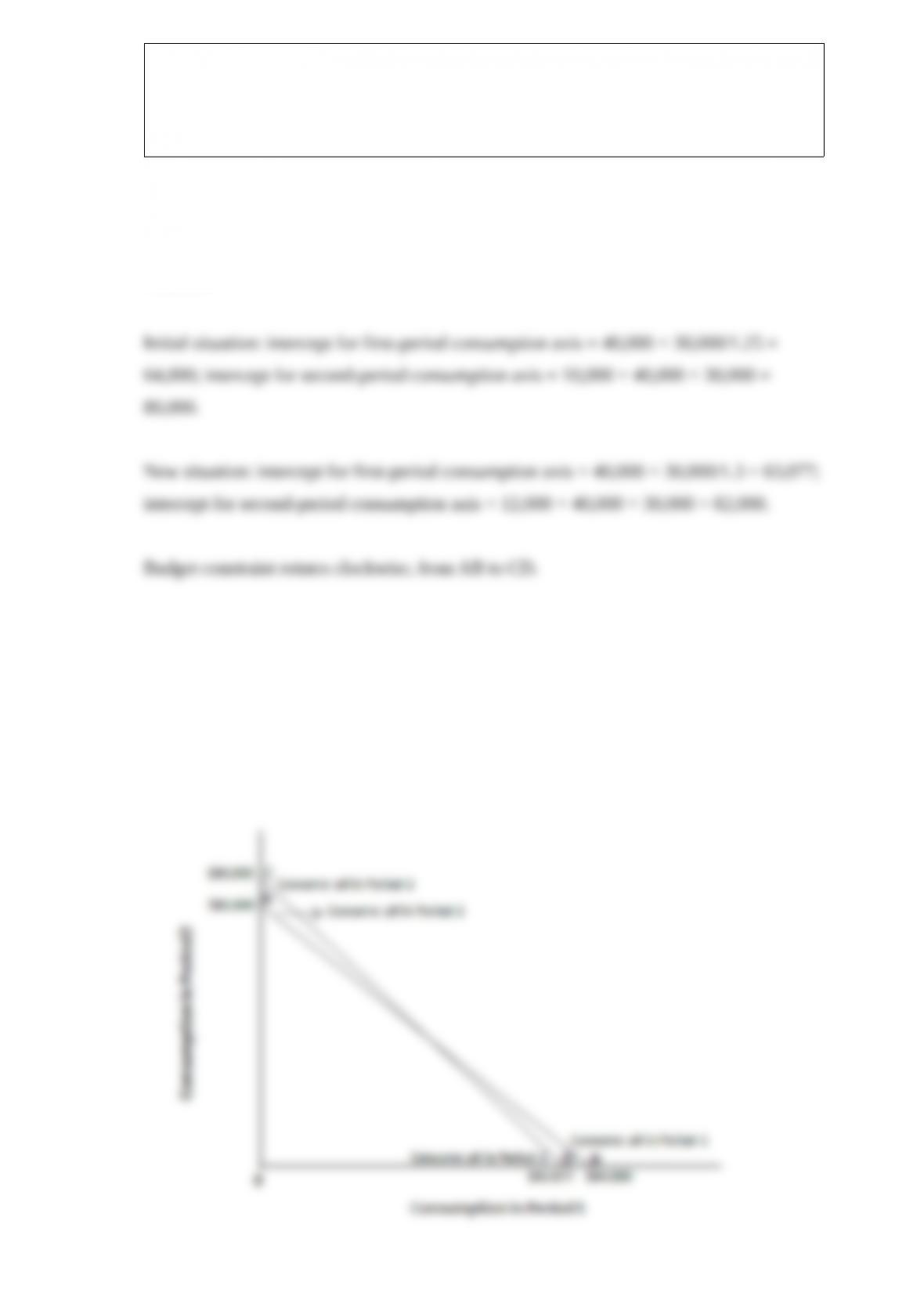
constraint. For the budget constraints you have drawn, be sure to show the values of the
intercepts on each axis. If the household decides that its consumption in period 1 should
always equal its consumption in period 2, determine whether the household is worse off
or better off because of the decline in the real interest rate. Show your work.
Answer:
Describe the relationship between central bank independence and macroeconomic
variables such as inflation and growth.
Answer:
Assume that relative purchasing-power parity holds. In 2004, the price level in Japan is
120 and the price level in the U.S. is In 2005, the price level in Japan is 121 and the
price level in the U.S. is The exchange rate in 2004 is 112 yen per dollar. Calculate the
exchange rate in
Answer:
If the cost of going to the ATM is $2 and the nominal interest rate is 1 percent, someone
who has a 9 percent probability of having his cash lost or stolen and spends $15 each
day will go to the ATM once in every___ days approximately.
a. 25
b. 31
c. 37
d. 43
Answer:
Describe classical economists.
Answer: