
1) Which one of the following formulas illustrates the mechanics of covered interest
arbitrage? Assume the $1 is borrowed and S0 = spot rate; F1 = one-year forward rate;
RF = foreign country risk-free rate; and RUS = U.S. risk-free rate.
A.$1 F1 (1 + RF)/S0 – $1 (1 + RUS)
B.$1 S0 (1 + RF)/F1 – $1 (1 + RUS)
C.$1 F1 (1 + RF)/S0 + $1 (1 + RUS)
D.$1 S0 (1 + RF) – $1 (1 + RUS)/F1
E.$1 S0 (1 + RF)/F1 + $1 (1 + RUS)
2) The DuPont identity can be totally defined by which one of the following?
A.Return on equity, total asset turnover, and equity multiplier
B.Equity multiplier and return on assets
C.Profit margin and return on equity
D.Total asset turnover, profit margin, and debt-equity ratio
E.Equity multiplier, return on assets, and profit margin
3) Miller Lite, Inc. is considering a new four-year expansion project that requires an
initial fixed asset investment of $3.6 million. The fixed asset will be depreciated
straight-line to zero over its four-year life, after which time it will be worthless. The
project is estimated to generate $3.9 million in annual sales, with costs of $2.6 million.
If the tax rate is 35 percent, what is the OCF for this project?
A.$1,160,000
B.$997,720
C.$684,280
D.$845,000,000
E.$911,760
4) Ted is trying to decide what cost of capital he should assign to a project. Which one
of the following should be his primary consideration in this decision?
A.Amount of debt used to finance the project
B.Use, or lack, of preferred stock to finance the project
C.Mix of funds used to finance the project
D.Risk level of the project

E.Length of the project’s life
5) Which one of the following events must occur before a firm can offer a liquidating
dividend?
A.Bankruptcy filing
B.Insolvency declaration
C.Asset sale
D.Negative equity
E.Failed bond issue
6) The amount of time that a firm holds inventory in stock is referred to as which one of
the following?
A.Inventory period
B.Accounts receivable period
C.Accounts payable period
D.Operating cycle
E.Cash cycle
7) Chevelle, Inc. has sales of $487,000 and costs of $394,500. The depreciation expense
is $43,800. Interest paid equals $18,200 and dividends paid equal $6,500. The tax rate
is 35 percent. What is the addition to retained earnings?
A.$10,775
B.$11,460
C.$13,120
D.$13,325
E.$15,450

8) Phil’s Hardware sells its inventory in 75 days, on average. Costs of goods sold for the
year are $631,800. What is the average value of the firm’s inventory?
A.$119,706
B.$129,821
C.$147,132
D.$161,096
E.$182,513
9) Kelly decided to accept the risk and purchased a high growth stock. Her returns for
the past five years are 48 percent, 39 percent, -56 percent, 61 percent, and -24 percent,
respectively. What is the standard deviation of these returns?
A.43.20 percent
B.45.46 percent
C.47.88 percent
D.50.83 percent
E.58.39 percent
10) Which one of the following will decrease the present value of an annuity?
A.Increase in the annuity’s future value
B.Increase in the payment amount
C.Increase in the time period
D.Decrease in the discount rate
E.Decrease in the annuity payment
11) You are given the exchange rate between the U.S. dollar and the Canadian dollar.
You are also given the exchange rate between the U.S. dollar and the Mexican peso.
What is the name given to the Canadian dollar per Mexican peso exchange rate derived
from the information that was provided?
A.Swap rate
B.Depositary rate
C.Forward rate
D.London Interbank rate
E.Cross-rate
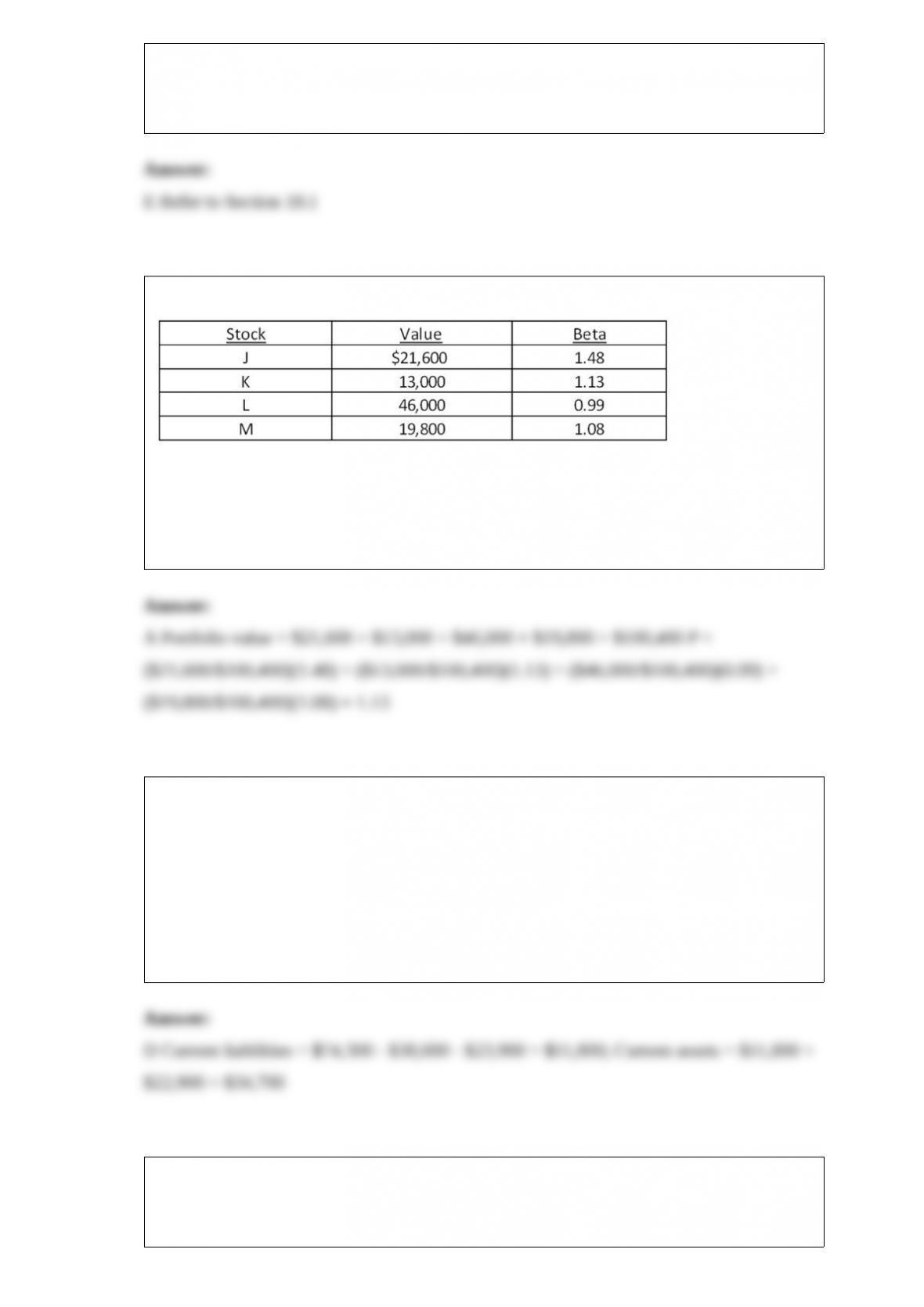
12) What is the beta of the following portfolio?
A.1.13
B.1.15
C.1.17
D.1.21
E.1.23
13) Kroeger Exporters has total assets of $74,300, net working capital of $22,900,
owners’ equity of $38,600, and long-term debt of $23,900. What is the value of the
current assets?
A.$21,600
B.$24,300
C.$38,900
D.$34,700
E.$46,100
14) Kate is the CFO of a major firm and has the job of assigning discount rates to each
project that is under consideration. Kate’s method of doing this is to assign an
incrementally higher rate as the risk level of the project increases over that of the

current firm. Likewise, she assigns lower rates as the risk level declines. Which one of
the following approaches is Kate using to assign the discount rates?
A.Pure play approach
B.Divisional rating
C.Subjective approach
D.Straight WACC approach
E.Equity rating
15) Over the past six years, a stock had annual returns of 14 percent, -3 percent, 8
percent, 21 percent, -16 percent, and 4 percent, respectively. What is the standard
deviation of these returns?
A.11.27 percent
B.13.05 percent
C.13.59 percent
D.15.08 percent
E.14.40 percent
16) Dexter, Inc. has a bond issue outstanding. The issue’s indenture provision prohibits
the firm from redeeming the bonds during the first three years. This provision is
referred to as the _____ provision.
A.safeguard
B.market
C.liquidity
D.deferred call
E.sinking fund
17) Which of the following are participants in the foreign exchange market?
I. U.S. importers
II. U.S. exporters

III. U.S. travelers to Europe
IV. U.S. portfolio manager who purchases foreign securities
A.I and III only
B.II and IV only
C.I, III, and IV only
D.II, III, and IV only
E.I, II, III, and IV
18) Which one of the following is a measure of long-term solvency?
A.Price-earnings ratio
B.Profit margin
C.Equity multiplier
D.Receivables turnover
E.Quick ratio
19) The Park Place has a return on assets of 13.7 percent, a cost of equity of 20 percent,
and a pretax cost of debt of 7.1 percent. What is the debt-equity ratio? Ignore taxes.
A.0.44
B.0.47
C.0.61
D.0.88
E.0.95
20) A firm has adopted a policy whereby it will not seek any additional external
financing. Given this, what is the maximum growth rate for the firm if it has net income
of $12,100, total equity of $94,000, total assets of $156,000, and a 40 percent dividend
payout ratio?
A.4.88 percent
B.5.11 percent
C.6.62 percent
D.7.67 percent
E.8.37 percent

21) Kelly’s uses the firm’s WACC as the required return for some of its projects. For
other projects, the firms uses a rate equal to WACC plus 1 percent, while another set of
projects is assigned rates equal to WACC minus some amount. Which one of the
following factors should be the key factor the firm uses to determine the amount of the
adjustment it will make when assigning the project a discount rate?
A.Firm beta
B.Date for project commencement
C.Risk level of project
D.Division within the firm that will be assigned to manage the project
E.Current debt-equity ratio
22) You are analyzing a project and have developed the following estimates: unit sales
= 1,320, price per unit = $79, variable cost per unit = $43, fixed costs = $24,900. The
depreciation is $11,300 a year and the tax rate is 40 percent. What effect would an
increase of $1 in the selling price have on the operating cash flow?
A.$792
B.$1,249
C.$1,320
D.$1,406
E.$1,433
23) The Sarbanes-Oxley Act of 2002 has:
A.reduced the annual compliance costs of all publicly traded firms in the U.S
B.decreased senior management’s involvement in the corporate annual report
C.greatly increased the number of U.S. firms that are going public for the first time
D.decreased the number of U.S. firms going public on foreign exchanges
E.made officers of publicly traded firms personally responsible for the firm’s financial
statements

24) Which one of the following is an example of a direct bankruptcy cost?
A.Operating at a debt-equity ratio that is less than the optimal ratio
B.Reducing the dividend payout ratio as a means of increasing a firm’s equity
C.Forgoing a positive net present value project to conserve current cash
D.Incurring legal fees for the preparation of bankruptcy filings
E.Losing a key customer due to concerns over a firm’s financial viability
25) The common stock of White’s Hardware closed at $36.80 a share today. Tomorrow
morning, the stock goes ex-dividend. The dividend that is being paid this quarter is
$1.40 a share. The tax rate on dividends is 25 percent. All else equal, what should the
opening stock price be tomorrow morning?
A.$35.19
B.$35.40
C.$35.52
D.$35.75
E.$36.80
26) Inside quotes are defined as the:
A.bid and asked prices presented by NYSE DMMs
B.last bid and asked price offered prior to the market close
C.lowest asked and highest bid offers
D.daily opening bid and asked quotes
E.lasttraded bid and asked prices
27) A firm has multiple divisions of similar nature, yet varying degrees of risk. Which
one of the following would be the most appropriate, yet relatively easy, means of
assigning discount rates to each of its proposed investments?
A.Assign every project a rate equal to the firm’s cost of equity
B.Assign every firm a random rate that varies between the firm’s cost of debt and its
cost of equity
C.Assign every project a rate equal to the firm’s WACC plus or minus a subjective
adjustment
D.Determine the best pure play rate for each project

E.Assign every project a rate equal to the market rate of return at the time of the
proposal