
Market values are appropriate because new projects are generally funded with newly
raised money.
The components of a firm’s capital are debt, common equity, and preferred stock.
It is important to understand that money like any other commodity is subject to the
forces of supply and demand. However, instead of being bought and sold, money is
borrowed and lent. The supply curve of money originates from the desire to borrow and
the demand curve from the willingness to lend.
Sunk costs are monies that have already been spent at the time of the capital project
analysis and cannot influence the future regardless of the decisions about the project.

Ownership of 51% of a company’s outstanding stock guarantees control. But as a
practical matter holding as little as 15% to 25% of a widely held company results in
effective control.
Ignoring risk in capital budgeting can lead to incorrect decisions and change the risk
character of the firm.
The discounted value of a sum is its:
A.future value.
B.present value.
C.amortized value.
D.book value.

The amount the issuer intends to borrow at the coupon rate of interest is generally the:
A.par value.
B.face value.
C.present value.
D.Both a and b
E.None of the above
Assume the following facts about a firm:
If sales are evenly distributed throughout the year, what is the next year’s projected
ending accounts receivable balance?
A.$1,665,000
B.$138,750
C.$1,110,000
D.none of the above
Clonly Corp’s stock pays a dividend of $1.40 and is currently selling for $25, but has

not grown in several years. Management feels that 10% growth is possible if the firm
discontinues its dividend entirely. Harry owns 6,000 and wants to maintain a constant
income stream. How many shares will he have to sell to make up for the first unpaid
dividend if Clonly stops paying dividends and starts growing at 10%? Ignore
transaction costs and taxes.
A.305
B.336
C.240
D.280
The success of junk bonds in the 1980s was based on a rationale that was eventually
proven wrong. That rationale was:
A.the failure rate of risky companies is only slightly higher than that of more reputable
firms.
B.risky firms fail only slightly more often than highly rated firms in good economic
times.
C.during hard times, risky companies fail a lot more frequently than higher rated firms.
D.None of the above correctly states the junk bond rationale.
The annual after-tax free cash flow from the acquisition by Pacific Care of Universal
Health is projected to be $12 million. These flows are expected to continue for 20 years.
No value is placed on cash flows beyond 20 years. If the appropriate risk-adjusted
discount rate is 15 percent, what is the maximum amount Pacific Care should pay to
acquire Universal Health?
A.$79,476,000
B.$70,164,000
C.$75,111,600
D.Cannot be determined
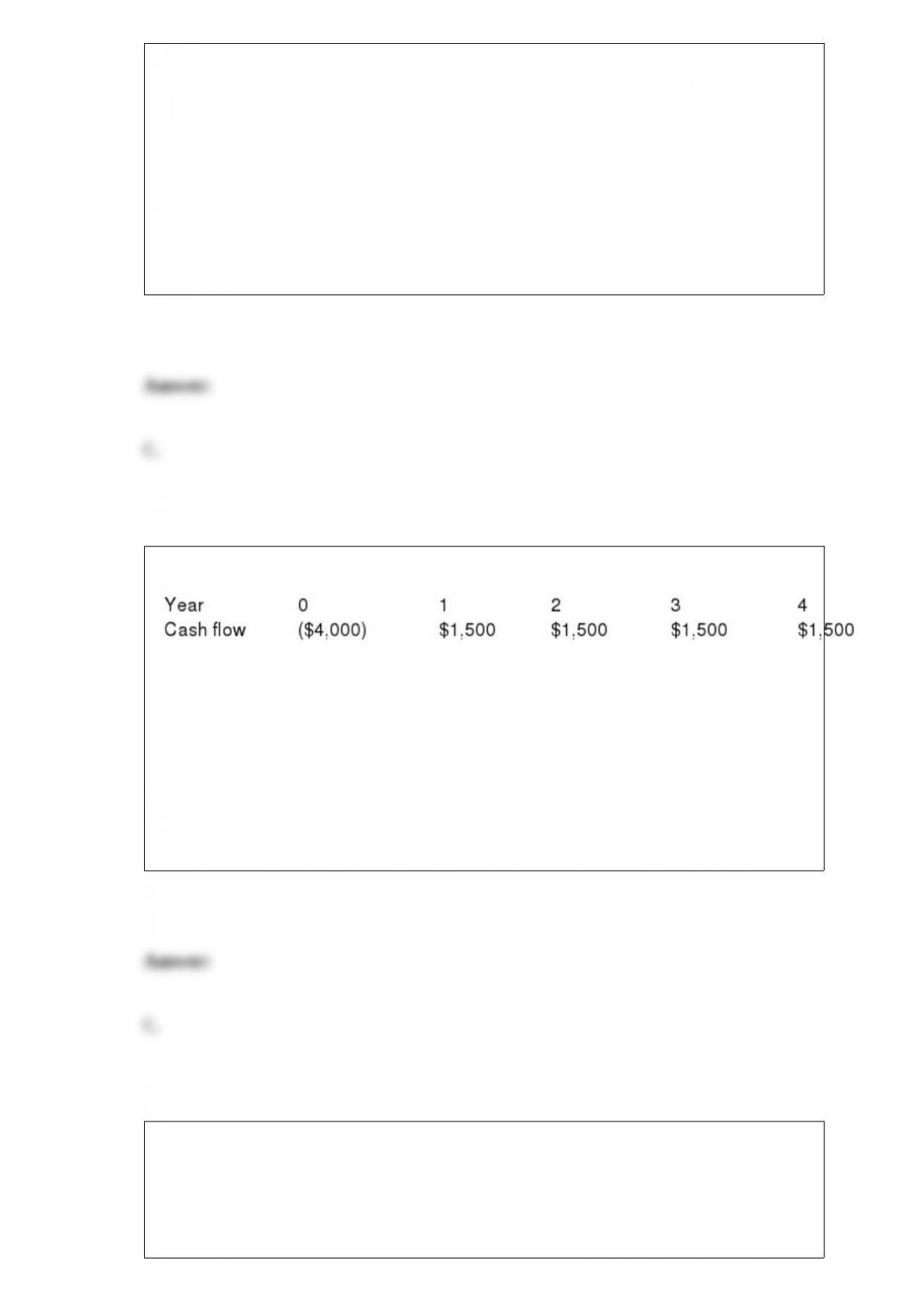
The future cash flows of a stand-alone capital project are:
If the firm’s cost of capital is 12%, which of the following statements is true?
A.The NPV is > $0 and the IRR is less than 12.5%.
B.The NPV is < $0 and the IRR is higher than 12.5%.
C.The NPV is > $0 and the IRR is approximately 18.5%.
D.The NPV is < $0 and the IRR is approximately 18.5%.
The required rate of return on a stock:
A.is the risk-free rate plus a premium for the risk associated with the stock.
B.is the return expected based upon currently available information.

C.is the minimum return that generates trading.
D.is entirely determined by the return on an average stock.
The rate at which a one currency may be exchanged for another immediately (= 2 day
delivery) is the:
A.futures rate.
B.forward rate.
C.spot rate.
D.today rate.
The statement of cash flows records:
A.the receipt and disbursement of cash throughout the period.
B.the cash transactions within the income statement.
C.the cash transactions that affect assets only.
D.the cash transactions that affect liabilities only.

Which of the following statements about the beta coefficient is not true?
A.A beta of > 1 implies that the stock’s volatility is greater than that of the market.
B.A beta of < 0 implies that the stock tends to move against the market.
C.A beta of 1 implies a volatility equal to that of the market.
D.All of the above are true.
In calculating probabilities using a decision tree, which of the following is most
correct?
A.The probabilities emerging from any node must sum to 1.
B.The ultimate probabilities assigned to each of the branches (looking at the right hand
side of the tree) must sum to 1.
C.The probability assigned to any given branch (looking at the right hand side of the
tree) can be no greater than 0.5.
D.Both a. and b. are correct.
E.All of the above are correct.

The foreign exchange market can be described best as:
A.a network of banks and brokers based in financial centers around the world.
B.one of several specific locations in major cities where bankers and brokers trade
foreign currencies.
C.very similar to international stock exchanges except that currencies are traded.
D.All of the above
The owners of registered bonds are recorded with the(a):
A.SEC.
B.transfer agent.
C.registration agent.
D.company.
E.Both a and d
If a firm’s EBIT changes by 20% and it has a degree of financial leverage (DFL) of 2.0,
what is the expected change in earnings per share (EPS)?
A.20%
B.40%

C.50%
D.60%
The broad term “corporate restructuring” refers to:
A.changes in ownership.
B.changes to capital structure.
C.mergers and divestitures.
D.All of the above
The stock market is:
A.an interconnected network of brokers and exchanges licensed by the government to
assist investors in trading securities.
B.located in a large building in New York City called the stock exchange.
C.an exchange that allows people to trade stock certificates in person.
D.very much like a department store in that stocks from different industries are traded.

In a(n) _____ loan, early payments are lower than the monthly interest charge.
A.zero-down loan
B.adjustable-rate mortgage
C.negative amortization
D.Alt-A loan
Using average (as opposed to end-of-period) values in ratio analysis is most appropriate
when:
A.both values in the ratio come from the income statement.
B.both values in the ratio come from the balance sheet.
C.one value comes from the balance sheet and one value comes from the income
statement.
D.Both a. and b. are correct.
E.All of the above are correct.