1) The use of depreciation is an attempt to allocate the past and future costs of an asset
over its useful life.
2) The degree of combined leverage is the sum of the degree of operating leverage and
the degree of financial leverage.
3) Seasonal production allows for maximum efficiency in machinery and manpower
use.
4) High-quality initial public offerings are usually sold in a primary market, such as the
New York Stock Exchange. However, low-quality stocks must usually be sold in
secondary markets, such as NASDAQ.
5) An investment banker acts as a middleman between a corporation needing funds and
investors with funds.
6) Liquidating current assets are really fixed assets since they have lives greater than
one year.
7) One major advantage of commercial paper is that it can always be “rolled over”
(reissued) when it matures.
8) Because there is more uncertainty involved in the initial market reaction to common
stock, a larger “underwriting spread” often exists for stocks, compared to other types of
offerings.
9) SWIFT has combated the growing issue of electronic fraud with smart card
technology that no longer requires users to manually log in to the network, and thus
eliminates any paper trail.
10) A common stockholder cannot force a company into bankruptcy for eliminating the
dividend.
11) Projects with high positive correlation are sometimes valuable because they allow
us to smooth out the overall performance of the firm during a business cycle.
12) The cost of retained earnings is considered to be equal to the required rate of return
on a firm’s outstanding common stock.
13) If a corporation pays no taxes because it is losing money, a preferred stock issuance
becomes more attractive relative to a debt issuance.
14) If a firm has a DFL of 2.0, EPS will change 2% for every 1% change in volume.
15) Some analysts believe that the term structure of interest rates is determined by the
behavior of various types of financial institutions. This theory is called the
A.expectations hypothesis
B.market segmentation theory
C.liquidity premium theory
D.theory of industry supply and demand for bonds
16) Which of the following is not an example of restructuring as discussed in the text?
A.Repurchase of common stock
B.Creating a new organizational chart
C.Merging with companies in related industries
D.Divesting of an unprofitable division
17) Synergy is said to occur when the whole is
A.equal to the sum of the parts
B.less than the sum of the parts
C.greater than the sum of the parts
D.greater than or equal to the sum of the parts
18) The floor price of a convertible bond cannot fall below
A.the conversion ratio
B.the conversion price
C.the conversion premium
D.the pure bond value
19) The theory of the term structure of interest rates, which suggests that long-term
rates are determined by the average of short-term rates expected over the time that a
long-term bond is outstanding, is the
A.expectations hypothesis
B.segmentation theory
C.liquidity premium theory
D.market average rate theory
20) Lucas Inc. earned $15 million last year and retained $6 million. Lucas has 5 million
shares outstanding, and the current price of Lucas shares is $30 per share. What is the
payout ratio?
A.2.67%
B.4%
C.40%
D.60%
21) Analog Computers needs to borrow $475,000 from the Midland Bank. The bank
requires a 15% compensating balance. How much money will Analog need to borrow in
order to end up with $475,000 spendable cash?
A.$546,250
B.$758,264
C.$558,824
D.None of these options
22) Reverse stock splits take place in many cases
A.to avoid delisting by the stock exchanges and NASDAQ
B.to raise the price of the common stock from the individual investor price range to the
institutional investor price range
C.because there may be simply too many shares outstanding from previous stock splits
D.None of these options

23) Which of the following is generally considered to be the least liquid of current
assets?
A.Accounts receivable
B.Inventory
C.Marketable securities
D.Cash equivalents
24) Using the constant growth model, a firm’s expected (D1) dividend yield is 4% of
the stock price, and its growth rate is 5%. If the tax rate is .35%, what is the firm’s cost
of equity?
A.10%
B.6.65%
C.9.0%
D.More information is required to answer the question
25) The financial markets allocate capital to corporations by
A.reflecting expectations of the market participants in the price of the corporation’s
stock
B.requiring higher returns from companies with lower risk than their competitors
C.rewarding companies with expected high returns with lower relative stock prices
D.relying on the opinion of investment bankers
26) Match the following with the items below:
1>convertible security
2>put option
3>conversion premium
4>speculative warrant premium
5>warrant
6>financial sweetener
7>diluted earnings per share
8>minimum warrant value

9>conversion price
A. Equals the conversion ratio divided into the par value.
B. Equals the market price of a convertible bond minus the security’s conversion value.
C. Adjusts earnings per share for potential share issuances related to outstanding
options, convertible securities, and warrants.
D. May be exchanged with the company, usually for shares of common stock.
E. Equals the market value of the common stock minus the option price of the warrant,
all multiplied by the number of shares each warrant entitles the holder to purchase.
F. The market price of the warrant minus the warrant’s intrinsic value.
G. May be used as a means to offer lower interest rates on debt.
H. The use of an equity option to facilitate sale of a debt security.
I. The right to sell an asset for a given time at a specified price.
27) Which of the following statements is true about international equity (stock)
markets?
A.Japanese households are large investors in common stock
B.Commercial banks are generally not involved in the international securities business
C.Some foreign investors are more risk-averse than their counterparts in the United
States and prefer dividend income over less certain capital gains
D.Foreign exchanges never include the listing of U.S. firms
28) A firm will usually increase the ratio of short-term debt to long-term debt when
A.short-term debt has a lower cost than long-term equity
B.the term structure is inverted and expected to shift down
C.the term structure is upward sloping and expected to shift up
D.the firm is undertaking a large capital budgeting project
29) If a firm has the lowest possible degree of operating leverage and the lowest
possible degree of financial leverage, then
A.DOL equals 1, and DFL equals 0
B.DOL equals 0, and DFL equals 1
C.DOL equals 1, and DFL equals 1
D.None of the options

30) In break-even analysis, the contribution margin is defined as
A.price minus variable cost
B.price minus fixed cost
C.variable cost minus fixed cost
D.fixed cost minus variable cost
31) Mr. Blochirt is creating a college investment fund for his daughter. He will put in
$1,000 per year for the next 15 years beginning one year from now and expects to earn
a 6% annual rate of return. How much money will his daughter have when she starts
college?
A.$11,250
B.$12,263
C.$24,003
D.$23,276
32) A firm has operating profit of $15,000 on unit sales of 10,000 units. Fixed costs are
$30,000. What is the firm’s break-even sales level?
A.Less than 6,000 units
B.6,000 units
C.More than 6,000 units
D.There is not enough information to determine the unit break-even point
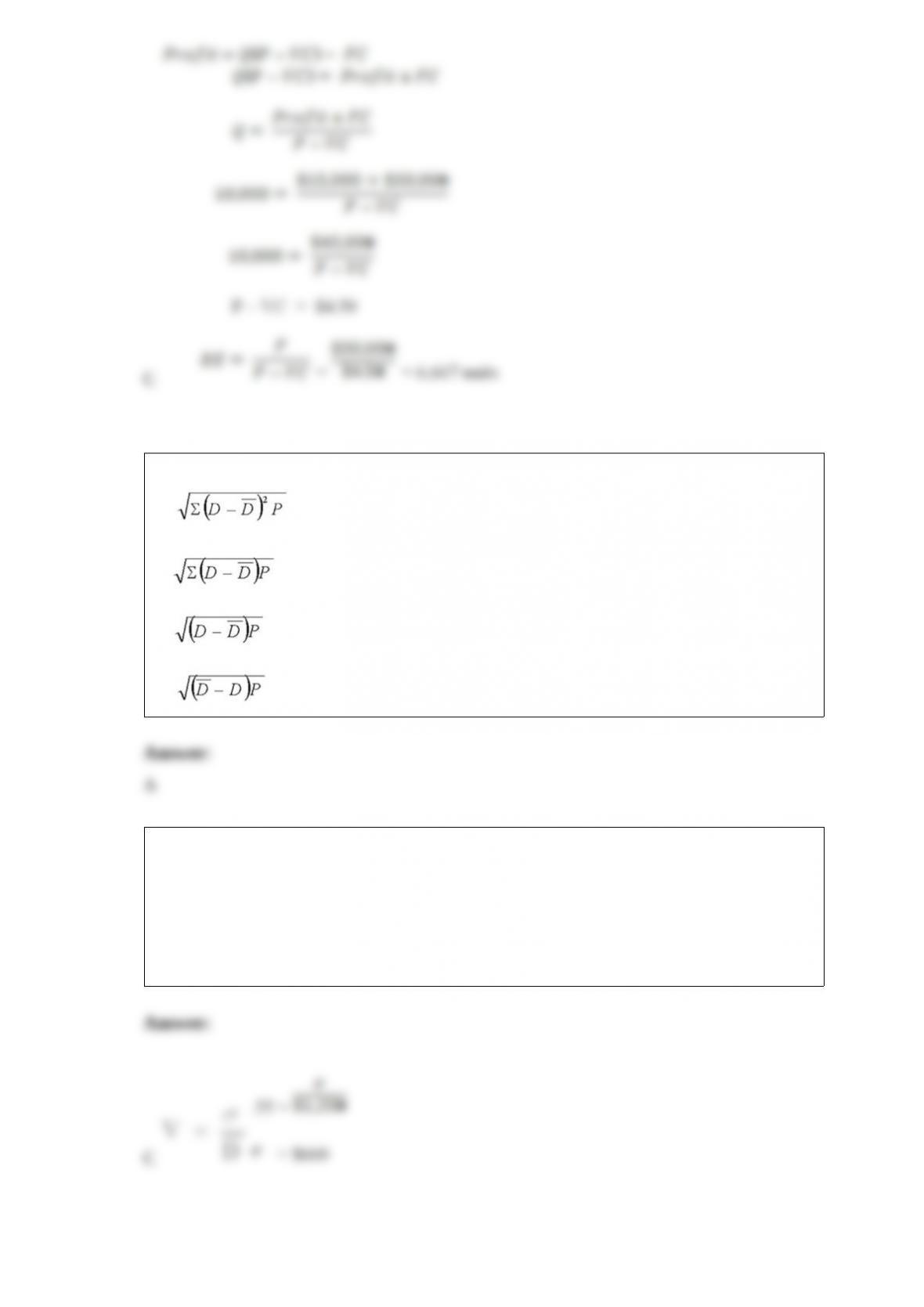
33) The standard deviation can be defined as
A.
B.
C.
D.
34) A project’s coefficient of variation is 0.55 . The project has a positive coefficient of
correlation of 0.20 . The expected value is $1,200. What is one standard deviation?
A.$400.00
B.$220.00
C.$660.00
D.$1,200.00

35) If projects are mutually exclusive
A.they can only be accepted under capital rationing
B.the selection of one alternative precludes the selection of other alternatives
C.the payback method should be used
D.only the net present value method can be used
36) Trade credit may be used to finance a major part of a firm’s working capital when
A.the firm extends less liberal credit terms than the supplier
B.the firm extends more liberal credit terms than the supplier
C.the firm and the supplier both extend the same credit terms
D.neither the firm nor the supplier extends credit
37) An issue of common stock is expected to pay a dividend of $5.15 at the end of the
year. Its growth rate is equal to 6%. If the required rate of return is 10%, what is its
current price?
A.$128.75
B.$36.92
C.$96.00
D.None of these options
38) Sharon Smith will receive $1 million in 50 years. The discount rate is 14%. As an
alternative, she can receive $1,000 today. Which should she choose?
A.The $1 million dollars in 50 years
B.$2,000 today
C.She should be indifferent between the two choices
D.More information is needed
39) Which of the following characteristics are drawbacks of convertible bonds?

A.Downside protection is ineffectual if the bond is bought at a large premium over floor
value
B.Interest rates on the debt-instrument part of a convertible bond are frequently below
market interest rates
C.Conversion may be forced on the bondholder by call provisions on the convertible
bond
D.All of these options are drawbacks of convertibles
40) Match the following with the items below:
1>public placement
2>managing underwriter
3>dilution of earnings
4>market stabilization
5>underwriting spread
6>investment banker
7>going private
8>private placement
9>bull market
10>bear market
A. An investment banker who is responsible for the pricing, prospectus, and legal work
involved in the sale of a new securities issue.
B. Is the difference between the price a selling corporation received for its securities
and the price paid when the issue is sold to the public.
C. A falling stock market.
D. A rising stock market.
E. Financial organization that specializes in selling primary offerings of securities. In
recent years, their duties have expanded into different areas of financial services.
F. Maintains the price of a stock artificially for the purpose of facilitating a new issue of
the security.
G. Results in a decline in earnings per share until earnings can be generated from the
funds raised.
H. The sale of securities to a mixed group of investors by an investment banker.
I. The sale of securities directly to a financial institution by a corporation.
J. The repurchase of all publicly owned shares of common stock by the company and
management.
41) Multinational firms have found that they can lower borrowing costs
A.by borrowing Eurodollars at a lower rate than the U.S. Prime Rate
B.by borrowing foreign currencies through foreign subsidiaries at rates lower than the
U.S. prime rate and then converting these foreign loans into dollars

C.by using more bankers’ acceptances
D.by borrowing Eurodollars at a lower rate than the U.S. prime rate and by borrowing
foreign currencies through foreign subsidiaries at rates lower than the U.S. prime rate
and then converting these foreign loans into dollars
42) Eurodollars
A.can only be redeemed at U.S. banks or their branches in European countries
B.are U.S. dollars that have been converted into several European currencies
C.may be borrowed by anyone who wishes to hold U.S. dollars
D.can only be redeemed at U.S. banks or their branches in any foreign country
43) Which of the following hedging strategies involves a loan without a futures
contract?
A.The Eurobond market
B.The forward exchange market
C.The money market
D.An IMM contract
44) Which of the following are characteristics of money market investments?
A.Money market funds are offered by banks
B.Money market funds are insured up to $100,000 by federal agencies
C.The minimum balance for money market deposit accounts is $5,000
D.None of the options
45) In a public distribution, the dealer group will generally pay a
A.higher price for the stock than the public
B.lower price for the stock than the managing investment banker
C.higher price for the stock than the managing investment banker
D.lower price for the stock than members of the investment banking syndicate group

46) After 10 years, 100 shares of stock originally purchased for $500 were sold for
$900. What was the yield on the investment? Choose the closest answer.
A.19%
B.2.5%
C.8.5%
D.6%
47) Retail companies like Target and Limited Brands exhibit sales patterns that are most
typically influenced by
A.cyclical economic indicators
B.competitive prices
C.seasonality
D.sales promotions
48) When an investment banker acts in the function of an “underwriter,” she
A.gives a “firm commitment” to purchase the securities from the corporation at a set
price
B.guarantees that the company will not suffer a decline in earnings after taxes
C.may sell as many securities as possible and return the rest unsold
D.may give advice to management
49) Net cash flow is equal to
A.income after taxes minus depreciation
B.income after taxes minus dividends
C.cash receipts minus cash payments
D.cash receipts minus cash payments minus depreciation
50) Which of the following is not a time-adjusted method for ranking investment
proposals?
A.The net present value method
B.The payback method
C.The internal rate of return method
D.All of these options are time-adjusted methods
51) BHS Inc. determines that sales will rise from $400,000 to $550,000 next year.
Spontaneous assets are 60% of sales, and spontaneous liabilities are 40% of sales. BHS
has an 8% profit margin and a 40% dividend payout ratio. What is the level of required
new funds?
A.$3,600
B.$5,200
C.$4,000
D.BHS is in balance and no new funds are needed
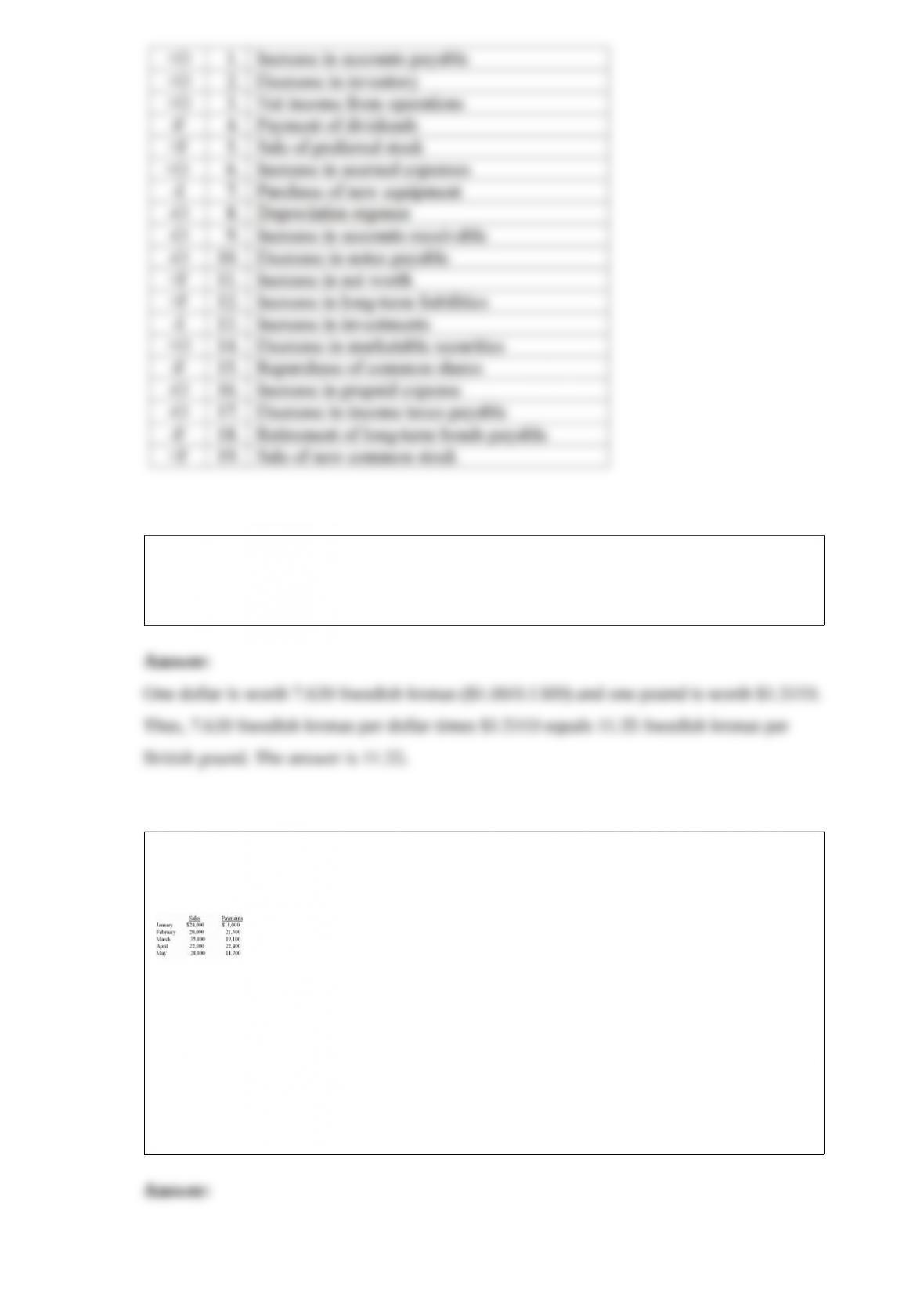
52) Identify each of the following as increasing (+) or decreasing (-) cash flows from
operating activities (0), investment activities (I), or financing activities (F).
(EXAMPLE: The sale of plant and equipment would increase cash flows from investing
activities, and the correct answer would be +I).
53) Suppose a Swedish krona sells for $0.1309 and a British pound sells for $1.5119.
What is the exchange rate (cross rate) of the Swedish krona to the British pound? That
is, how many Swedish kronas are equal to a British pound?
54) Eddie’s Bar and Restaurant Supplies expects its revenues and payments for the first
part of the year to be:
Eighty percent of the firm’s sales are on credit. Past experience shows that 40% of
accounts receivable are collected in the month after sale, and the remainder is collected
in the second month after the sale. Prepare a schedule of cash receipts for March, April,
and May. Eddie’s pays its payments in the following month. Eddie’s had a cash balance
of $2,000 on March 1, which is also its minimum required cash balance. There is an
outstanding loan of $6,000 on March 1 . Prepare a cash budget for March, April, and
May.
55) Ohlin, Meade, and Assoc. plans to borrow $1,500,000 for 12 months. Citibank
gives the firm a stated rate of 10% interest.
What is the effective rate of interest if the loan carries a simple 10% interest with a 20%
compensating balance?
56) If you borrow $15,000 at $1,000 interest for one year, what is your effective interest
cost for the following payment plans?