
Von Bora Corporation is expected pay a dividend of $1.40 per share at the end of this
year and a $1.50 per share at the end of the second year. You expect Von Bora’s stock
price to be $25.00 at the end of two years. Von Bora’s equity cost of capital is 10%.
Suppose you plan to hold Von Bora stock for only one year. Your capital gain from
holding Von Bora stock for the first year is closest to:
A) $0.95
B) $1.40
C) $1.85
D) $1.25
The difference between the weighted-average cost of capital (WACC) and the pre-tax
(unlevered) WACC is:
A) the weighted-average cost of capital is based on the after-tax cost of equity and the
pre-tax WACC is based on the after-tax cost of debt.
B) the weighted-average cost of capital multiplies the cost of equity and the cost of debt
by (1-tax rate) and the pre-tax WACC does not.
C) the weighted-average cost of capital multiplies the cost of debt by (1-tax rate) and
the pre-tax WACC does not.
D) the weighted-average cost of capital multiplies the component costs of equity and
debt by their weight in the capital structure, and the pre-tax WACC does not.
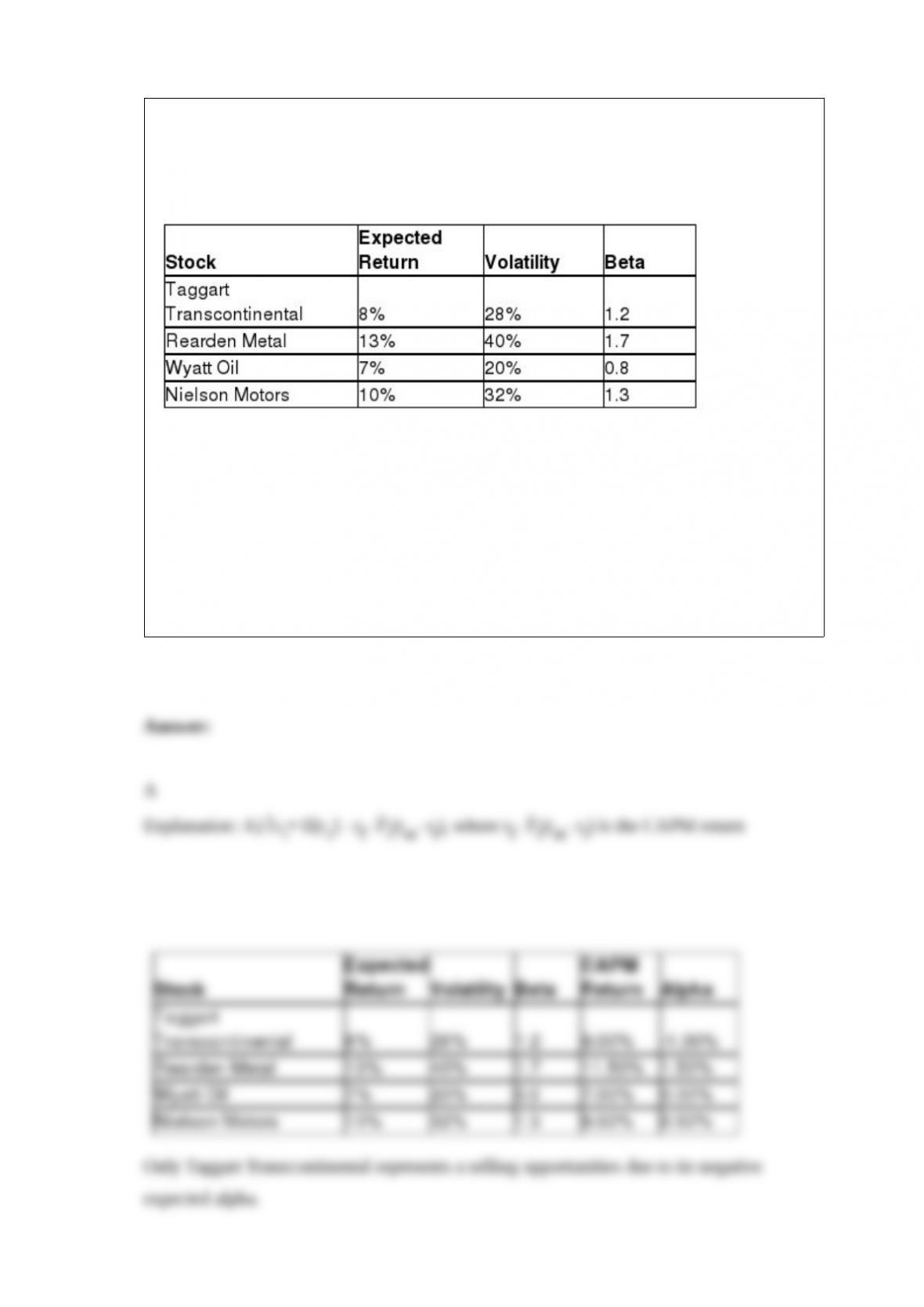
Assume that the CAPM is a good description of stock price returns. The market
expected return is 8% with 12% volatility and the risk-free rate is 3%. New news
arrives that does not change any of these numbers, but it does change the expected
returns of the following stocks:
Which of the following stocks represent selling opportunities?
1. Taggart Transcontinental
2. Rearden Metal
3. Wyatt Oil
4. Nielson Motors
A) 1 only
B) 1 and 2 only
C) 2 and 3 only
D) 2 and 4 only
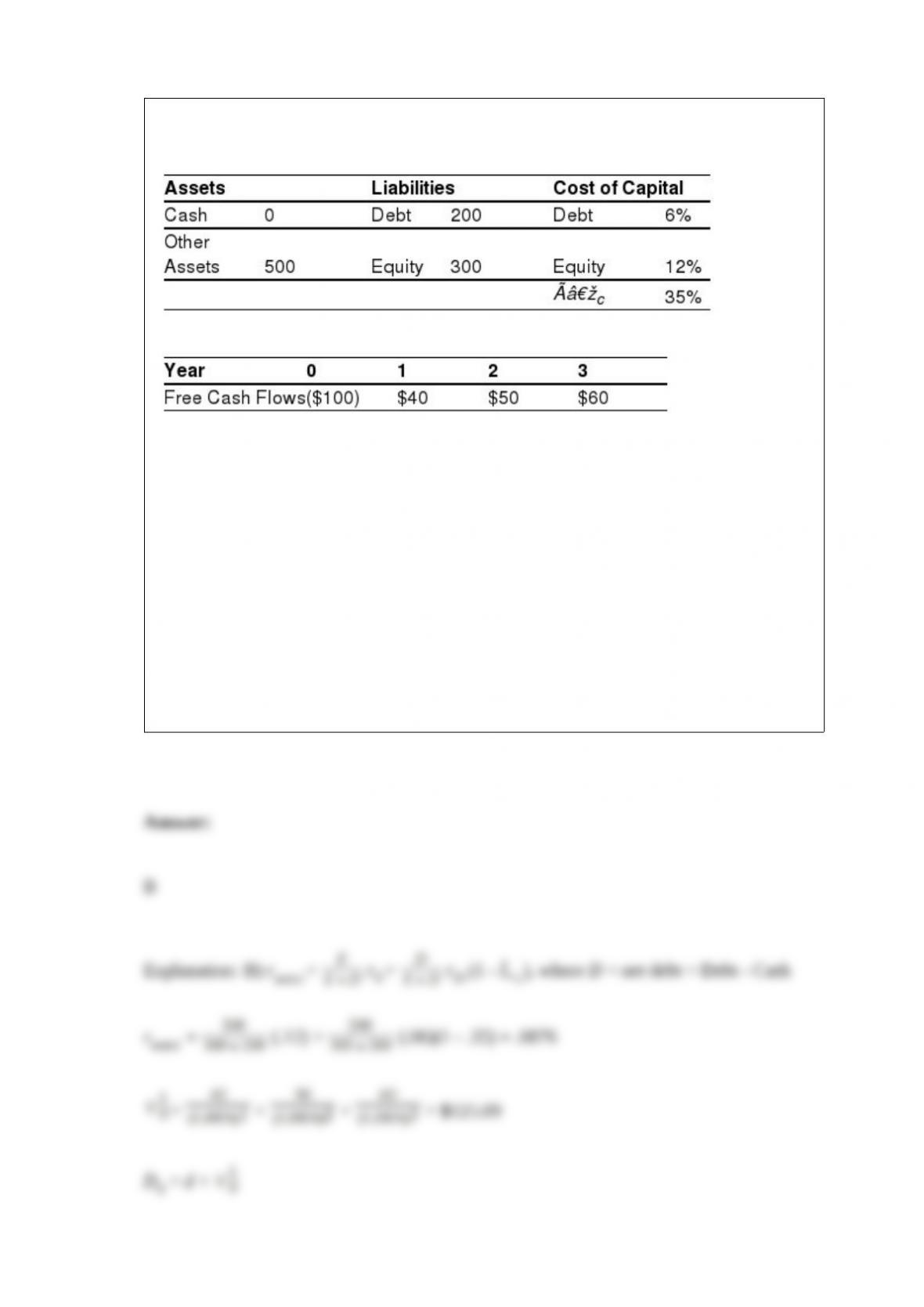
Omicron Industries’ Market Value Balance Sheet ($ Millions)
and Cost of Capital
Omicron Industries New Project Free Cash Flows
Assume that this new project is of average risk for Omicron and that the firm wants to
hold constant its debt to equity ratio.
The interest tax shield provided by Omicron’s new project in year 1 is closest to:
A) $3.00
B) $1.05
C) $50.25
D) $17.60
Which of the following statements is FALSE?
A) The S&P 500 and the Wilshire 5000 indexes are both well-diversified indexes that
roughly correspond to the market of U.S. stocks.
B) Practitioners commonly use the S&P 500 as the market portfolio in the CAPM with
the belief that this index is the market portfolio.
C) Standard & Poor’s Depository Receipts (SPDR, nicknamed ‘spider”) trade on the
American Stock Exchange and represent ownership in the S&P 500.
D) The S&P 500 was the first widely publicized value weighted index and it has
become a benchmark for professional investors.
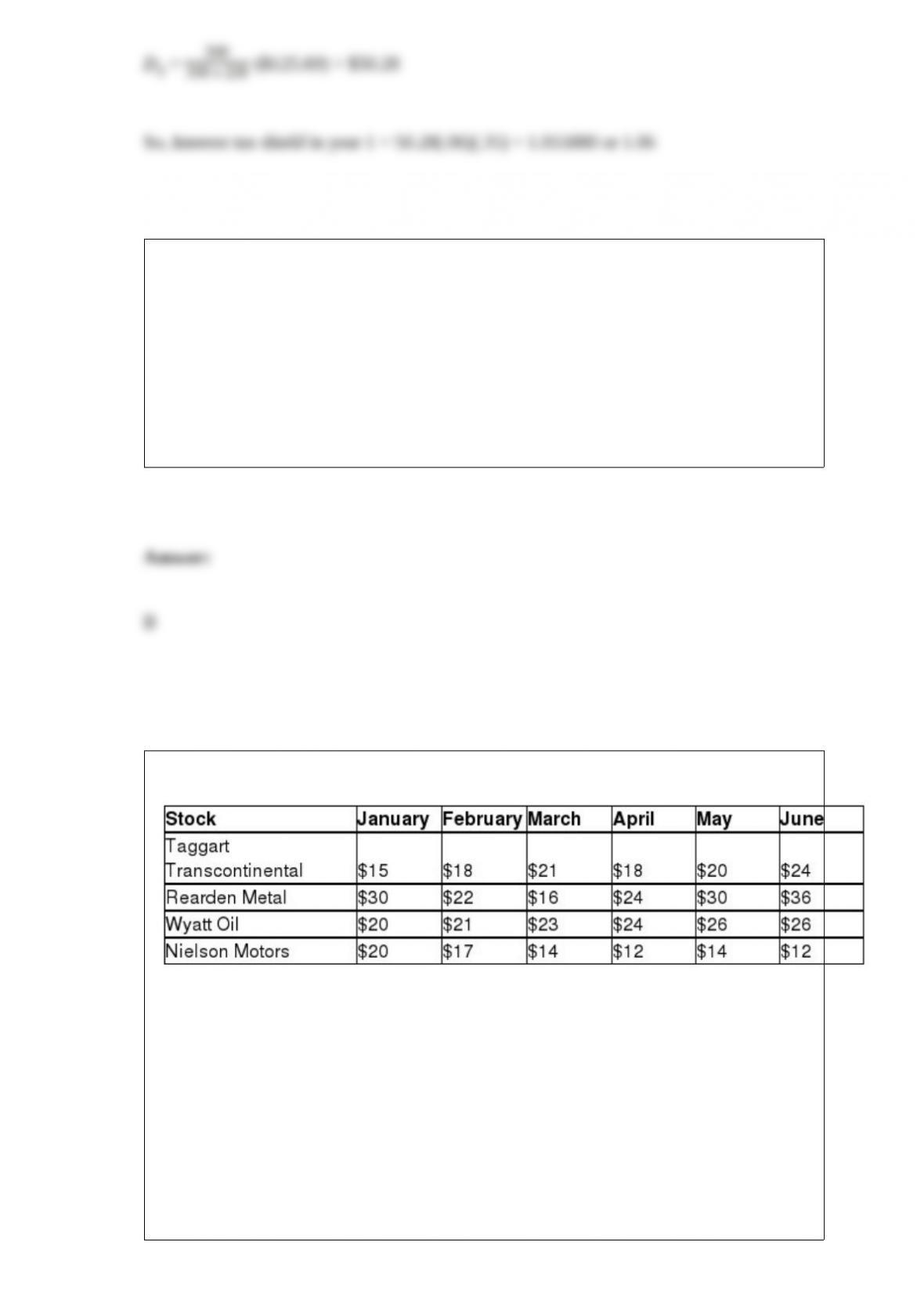
Consider the price paths of the following stocks over a six-month period:
None of these stocks pay dividends.
Assume that you are an investor with the disposition effect and you bought each of
these stocks in January. Suppose that it is currently the end of June, which stocks are
you most inclined to hold?
1. Taggart Transcontinental
2. Rearden Metal
3. Wyatt Oil
4. Nielson Motors
A) 1 only
B) 4 only
C) 1 and 3 only

D) 2 and 4 only
Frank Dewey Esquire from the firm of Dewey, Cheatum, and Howe, has been offered
an upfront retainer of $30,000 to provide legal services over the next 12 months to
Taggart Transcontinental. In return for this upfront payment, Taggart Transcontinental
would have access to 8 hours of legal services from Frank for each of the next 12
months. Frank’s normal billable rate is $250 per hour for legal services.
Assuming that Dewey’s cost of capital is 12% EAR, then the number of potential IRRs
that exist for this problem is equal to:
A) 0
B) 1
C) 2
D) 12
Assume that Rose Corporation’s (RC) EBIT is not expected to grow in the future and
that all earnings are paid out as dividends. RC is currently an all equity firm. It expects
to generate earnings before interest and taxes (EBIT) of $6 million over the next year.
Currently RC has 5 million shares outstanding and its stock is trading for a price of
$12.00 per share. RC is considering borrowing $12 million at a rate of 6% and using the
proceeds to repurchase shares at the current price of $12.00.

Prior to any borrowing and share repurchase, the equity cost of capital for RC is closest
to:
A) 11%
B) 10%
C) 12%
D) 9%
Galt Industries is expected to generate free cash flows of $24 million per year. Galt has
permanent debt of $80 million, a corporate tax rate of 40%, and an unlevered cost of
capital of 12% and its cost of debt capital is 6%.If Galt’s debt cost of capital is 6%, then
Galt’s equity cost of capital is closest to:
A) 11.2%
B) 12.0%
C) 14.8%
D) 15.2%
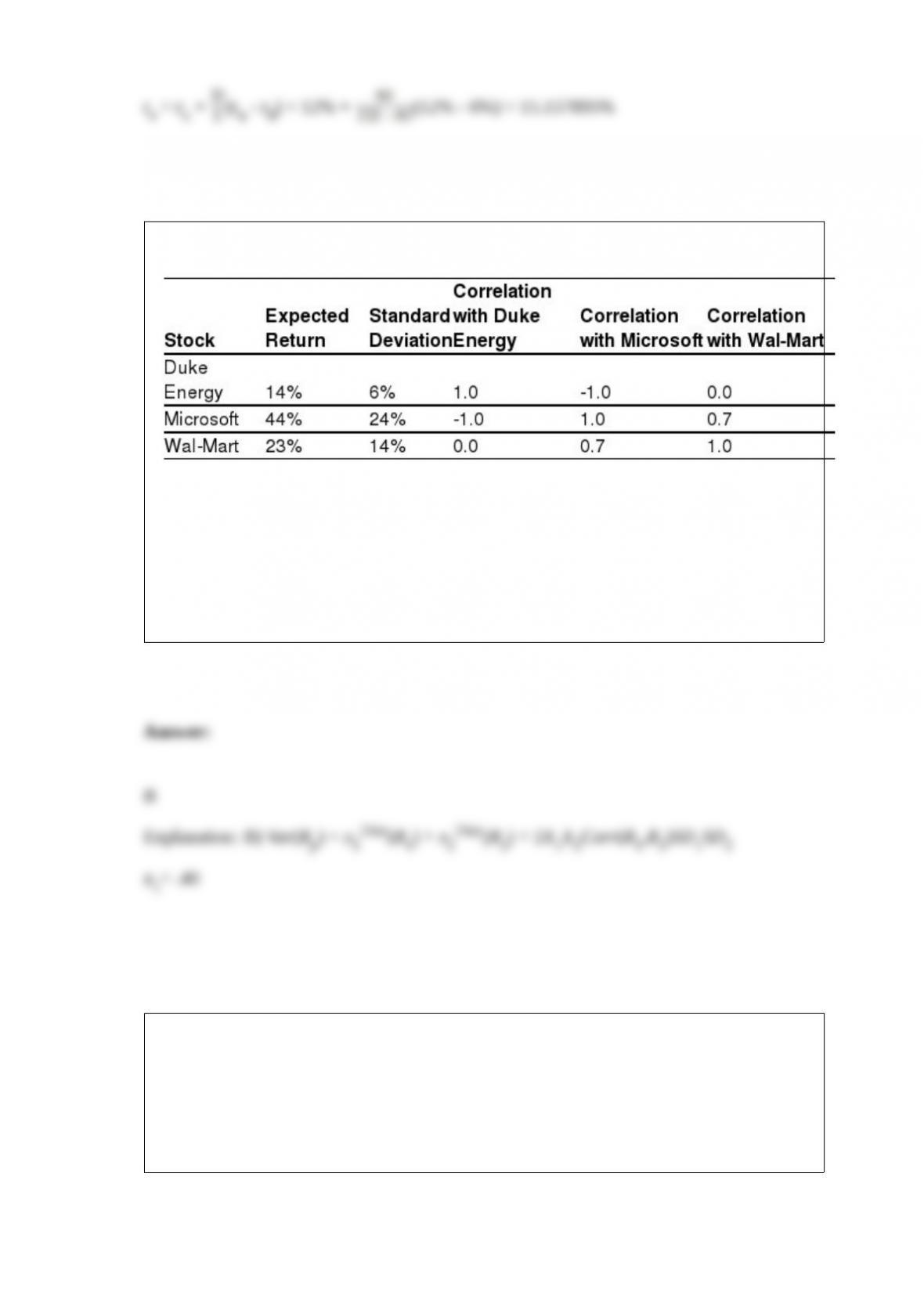
Consider the following expected returns, volatilities, and correlations:
Consider a portfolio consisting of only Duke Energy and Microsoft. The percentage of
your investment (portfolio weight) that you would place in Duke Energy stock to
achieve a risk-free investment would be closest to:
A) 15%
B) 40%
C) 23%
D) 10%
Which of the following statements is FALSE?
A) The process of moving a value or cash flow forward in time is known as
compounding.
B) The effect of earning interest on interest is known as compound interest.
C) It is only possible to compare or combine values at the same point in time.
D) A dollar in the future is worth more than a dollar today.

Which of the following statements is FALSE?
A) If the debt-equity ratio changes over time, the risk of equity’“and, therefore, its cost
of capital’“will change as well.
B) The FTE method can offer an advantage when calculating the value of equity for the
entire firm, if the firm’s capital structure is complex and the market values of other
securities in the firm’s capital structure are not known.
C) The FTE approach does not have the same disadvantage associated with the APV
approach: We don’t need to compute the project’s debt capacity to determine interest
and net borrowing before we can make the capital budgeting decision.
D) The WACC and APV methods compute the firm’s enterprise value, so that a separate
valuation of the other components of the firm’s capital structure is needed to determine
the value of equity.
Due to a pre-existing contract, Recycle America Inc. has the opportunity to acquire
10,000 pounds of scrap aluminum and 2,500 pounds of scrap lead for $10,750. If the
current market price for scrap aluminum is $0.83 per pound and the current market
price for lead is $1.06 per pound, then the added benefit (cost) to you if you acquire this
metal is:
A) ($200)
B) $200
C) ($1,925)
D) $1,925
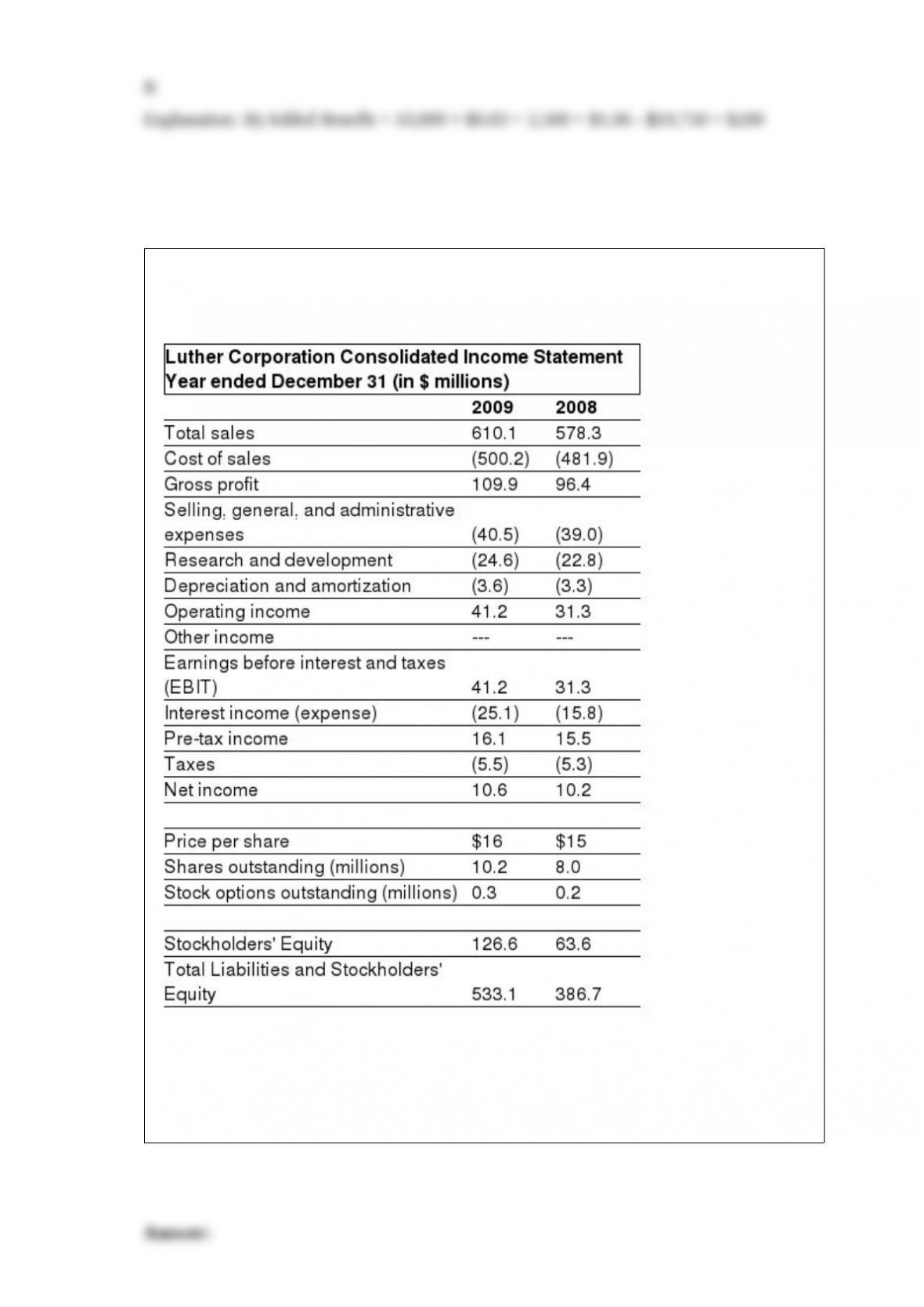
Luther’s return on assets (ROA) for the year ending December 31, 2009 is closest to:
A) 1.6%
B) 6.7%
C) 2.3%
D) 2.6%
Nielson Motors has a share price of $25 today. If Nielson Motors is expected to pay a
dividend of $0.75 this year, and its stock price is expected to grow to $26.75 at the end
of the year, then Nielson’s dividend yield and equity cost of capital are:
A) 3.0% and 7.0% respectively.
B) 3.0% and 10.0% respectively.
C) 4.0% and 6.0% respectively.
D) 4.0% and 10.0% respectively.
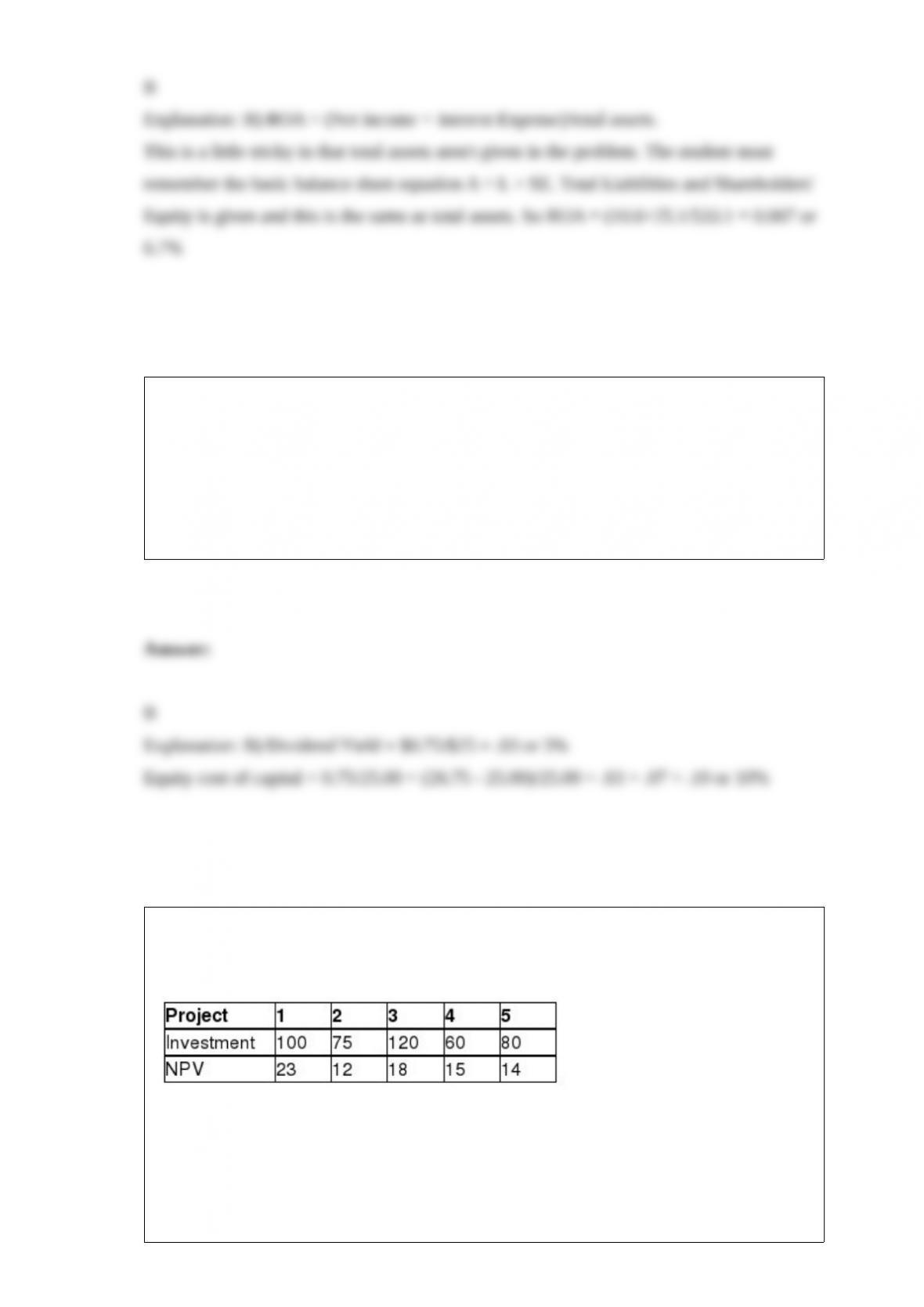
Nielson Motors has a debt-equity ratio of 1.8, an equity beta of 1.6, and a debt beta of
0.20. It is currently evaluating the following projects, none of which would change
Nielson’s volatility.
(All amounts are in $millions.)
In order for Nielson Motor’s to be willing to invest, project 5 must have an NPV greater
than:

A) $10.0 million
B) $12.5 million
C) $18.0 million
D) $22.5 million
The cost of ________ is highest for firms that can easily increase the risk of their
investments.
A) asset substitution
B) debt overhang
C) debt covenants
D) debt maturity
Suppose that you have received two job offers. Rearden Metal offers you a contract for
$75,000 per year for the next two years while Wyatt Oil offers you a contract for
$90,000 per year for the next two years. Both jobs are equivalent. Suppose that Rearden
Metal’s contract is certain, but Wyatt Oil has a 60% chance of going bankrupt at the end
of the year. In the event that Wyatt Oil files for bankruptcy, it will cancel your contract
and pay you the lowest amount possible for you to not quit. If you do quit, you expect
you could find an new job paying $75,000 per year, but you would be unemployed for
four months while searching for this new job.Assuming your cost of capital is 6
percent, based on the present value of your expected wage you should:
A) accept Rearden’s offer since the PV of your expected wage would be approximately
$6,000 higher.
B) accept Rearden’s offer since the PV of your expected wage would be approximately
$8,000 lower.
C) accept Rearden’s offer since the PV of your expected wage would be approximately
$8,000 higher.
D) accept Wyatt’s offer since the PV of your expected wage would be approximately
$6,000 higher.
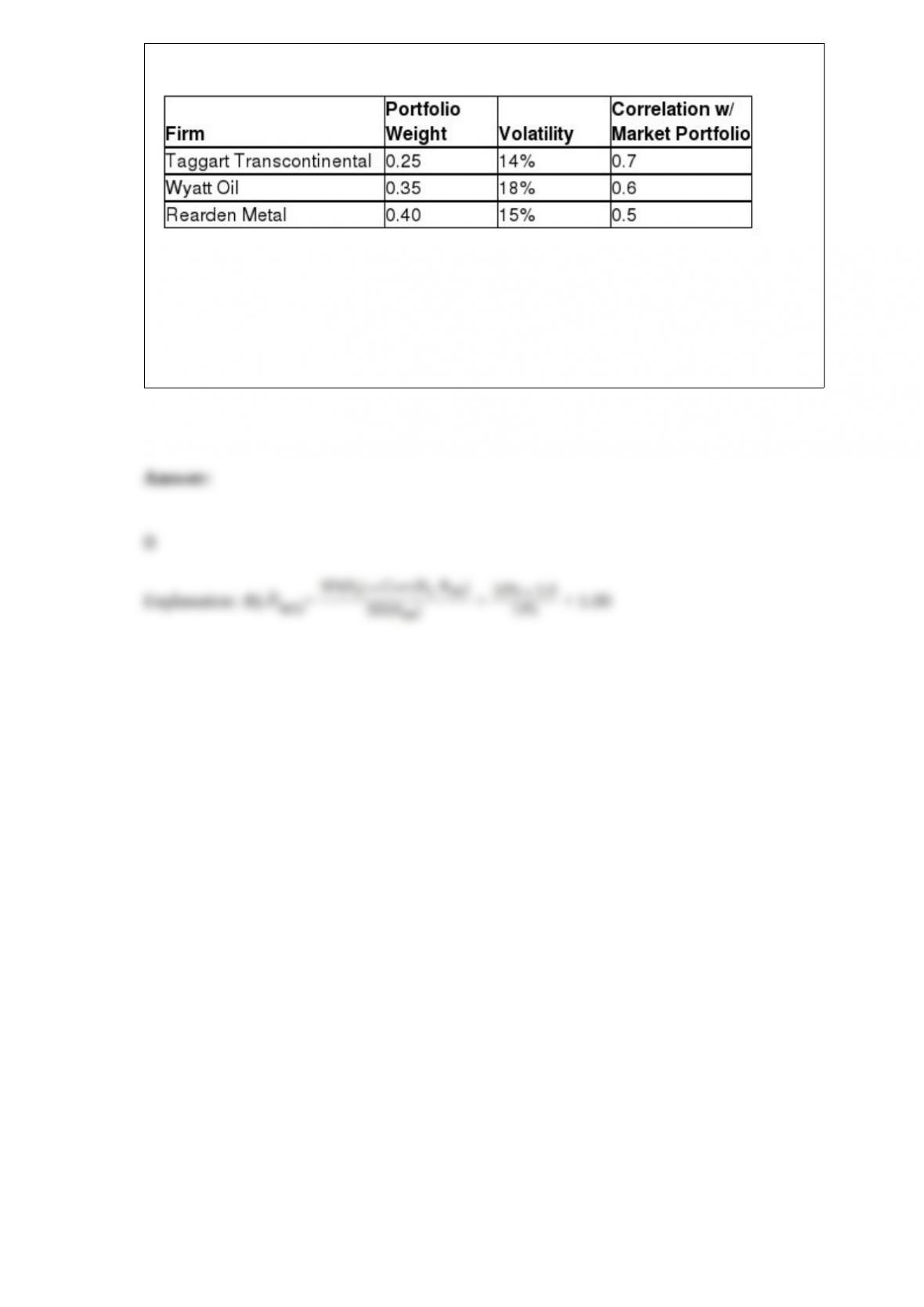
The volatility of the market portfolio is 10%, the expected return on the market is 12%,
and the risk-free rate of interest is 4%The beta for the market is closest to:
A) 0.80
B) 1.00
C) 1.10
D) 1.25