1) An investor gains from short selling by ________ and then later ________.
A) buying a stock; selling it at a higher price
B) selling a stock; buying it back at a lower price
C) buying a stock; selling it at a lower price
D) selling a stock; buying it back at a higher price
2) When the inflation rate is expected to increase, the expected return on bonds relative
to real assets falls for any given interest rate; as a result, the ________ bonds falls and
the ________ curve shifts to the left.
A) demand for; demand
B) demand for; supply
C) supply of; demand
D) supply of; supply
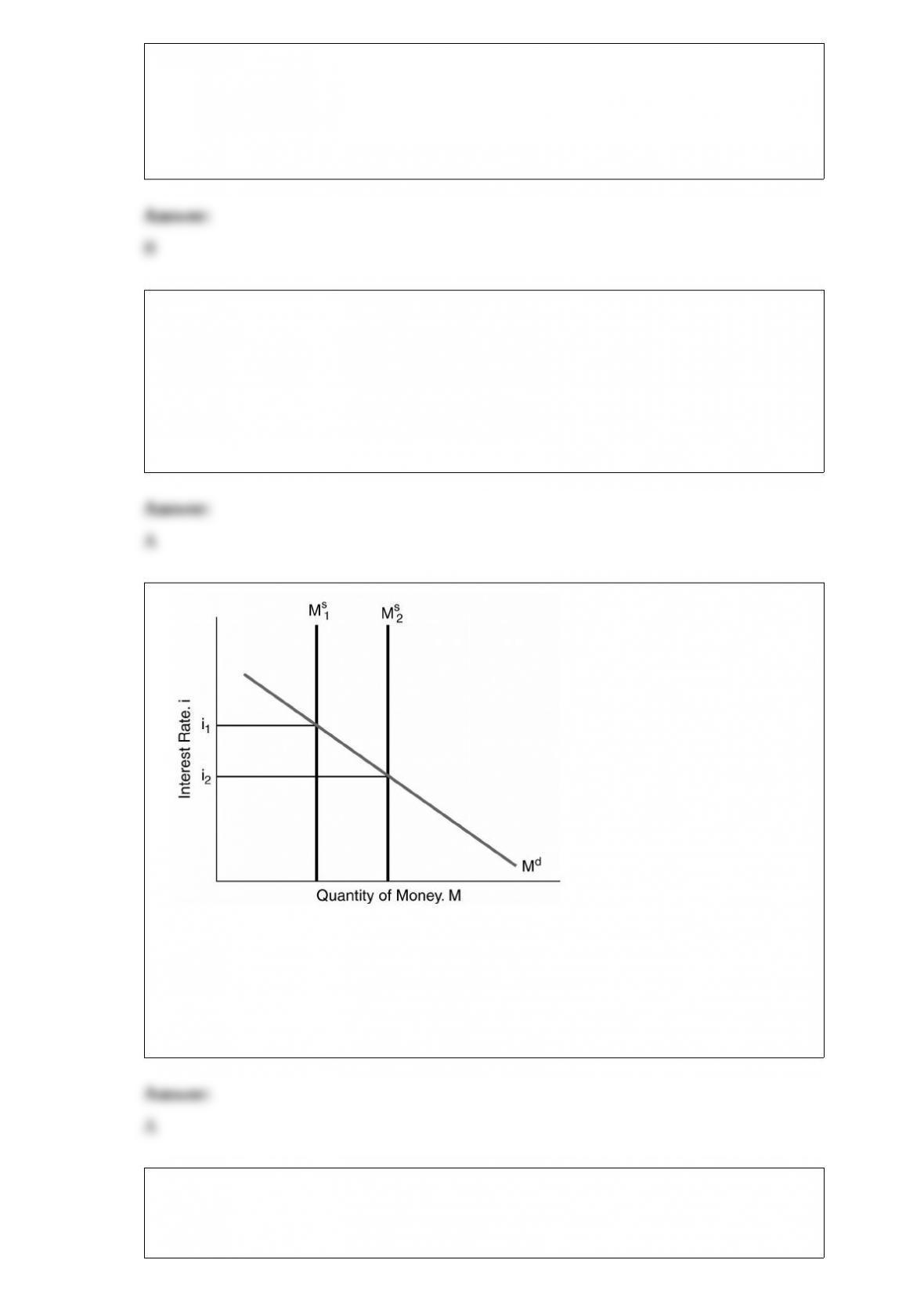
3)
Figure 4.3
In Figure 4.3, an increase in the interest rate from i2 to i1 can be explained by
A) a decrease in money growth
B) an increase in money growth
C) a decline in the price level
D) an increase in the expected price level
4) With the creation of the Federal Deposit Insurance Corporation, member banks of the
Federal Reserve System ________ to purchase FDIC insurance for their depositors,
while nonmember commercial banks ________ to buy deposit insurance.

A) could choose; were required
B) could choose; were given the option
C) were required, could choose
D) were required; were required
5) (I) Most corporate bonds have a face value of $1,000, pay interest semiannually, and
can be redeemed anytime the issuer wishes.
(II) Registered bonds have now been largely replaced by bearer bonds, which do not
have coupons.
A) (I) is true, (II) false
B) (I) is false, (II) true
C) Both are true
D) Both are false
6) A financial institution can achieve cost savings by engaging in multiple activities.
These are called economies of
A) scope
B) scale
C) complexity
D) information
7) In the one-period valuation model, a stock’s value will be higher
A) the higher its expected future price is
B) the lower its dividend is
C) the higher the required return on investments in equity is
D) all of the above
8) When the exchange rate changes from 1.0 euros to the dollar to 1.2 euros to the
dollar, the euro has ________ and the dollar has ________.
A) appreciated; appreciated
B) depreciated; appreciated
C) appreciated; depreciated
D) depreciated; depreciated

9) When bonds become more widely traded, and as a consequence the market becomes
more liquid, the demand curve for bonds shifts to the ________ and the interest rate
________.
A) right; rises
B) right; falls
C) left; falls
D) left; rises
10) Policies that limit the discretion of managers as a way of protecting bondholders’
interests are called
A) restrictive covenants
B) debentures
C) sinking funds
D) bond indentures
11) An unsterilized intervention in which domestic currency is sold to purchase foreign
assets leads to
A) a gain in international reserves
B) a decrease in the money supply
C) an appreciation in the domestic currency
D) all of the above
E) only A and B of the above
12) Financial derivatives include ________.
A) stocks
B) bonds
C) futures
D) none of the above

13) If the interest rate on foreign deposits increases, holding everything else constant,
A) the expected return on these deposits must also increase
B) the expected return on domestic deposits must decrease
C) the expected return on domestic deposits must increase
D) both A and B of the above
E) both A and C of the above
14) An open market ________ leads to a(n) ________ of reserves and deposits in the
banking system and hence to a(n) ________ of the monetary base and the money
supply.
A) sale; expansion; contraction
B) purchase; expansion; contraction
C) sale; expansion; expansion
D) purchase; expansion; expansion
15) The bundling of mortgages into a saleable security (usually for large institutional
investors) is called ________.
A) disintermediation
B) quasi-intermediation
C) futures bundling
D) hedge optioning
E) securitization
16) If bad credit risks are the ones who most actively seek loans and, therefore, receive
them from financial intermediaries, then financial intermediaries face the problem of
A) moral hazard
B) adverse selection
C) free-riding
D) costly state verification
17) Which is not an activity of investment banks?
A) underwriting new issues of corporate stocks and bonds
B) acting as deal makers in mergers

C) acting as intermediaries in the buying and selling of businesses or parts of businesses
D) underwriting new issues of federal government bonds
18) (I) The primary issuers of capital market securities are federal and local
governments, and corporations.
(II) Governments never issue stock because they cannot sell ownership claims.
A) (I) is true, (II) false
B) (I) is false, (II) true
C) Both are true
D) Both are false
19) What is liquidity risk?
A) A problem that arises when a firm runs short of cash
B) The risk of asset prices rising too high
C) The chance that the borrower will fail to repay a loan
D) The risk associated with longer-term contracts
20) Clauses in life insurance policies that eliminate death benefits if the insured person
commits suicide are an example of a ________.
A) restrictive provision
B) restrictive covenant
C) anti-fraud exclusion
D) risk-based deductible
21) Second mortgages serve the following purposes:
A) they give borrowers a way to use the equity they have in their homes as security for
another loan
B) they allow borrowers to get a tax deduction on loans secured by their primary
residence or vacation home
C) they allow borrowers to convert their conventional mortgages into GEMs
D) all of the above
E) only A and B of the above

22) Which of the following are true statements about participants in the money
markets?
A) Large banks participate in the money markets by selling large negotiable CDs
B) The U.S. government and corporations borrow in the money markets because cash
inflows and outflows are rarely synchronized
C) The Federal Reserve is the single most influential participant in the U.S. money
market
D) All of the above are true
E) Only A and B of the above are true
23) According to the interest parity condition, if the domestic interest rate is 12 percent
and the foreign interest rate is 10 percent, then the expected ________ of the foreign
currency must be ________ percent.
A) appreciation; 4
B) appreciation; 2
C) depreciation; 2
D) depreciation; 4
24) When people begin to expect a large run up in stock prices, the demand curve for
bonds shifts to the ________ and the interest rate ________.
A) right; rises
B) right; falls
C) left; falls
D) left; rises
25) When the growth rate of the money supply decreases, interest rates end up being
permanently lower if
A) the liquidity effect is larger than the other effects
B) there is fast adjustment of expected inflation
C) there is slow adjustment of expected inflation
D) the expected inflation effect is larger than the liquidity effect

26) Which of the following is a potential operating target for the Fed?
A) The monetary base
B) The M1 money supply
C) Nominal GDP
D) The discount rate
27) Which life insurance policy usually requires the insured to pay a level premium for
the duration of the policy, and the overpayment accumulates as a cash value that can be
borrowed by the insured at reasonable rates?
A) whole life
B) term
C) universal life
D) none of the above
28) A $10,000, 8 percent coupon bond that sells for $10,000 has a yield to maturity of
A) 8 percent
B) 10 percent
C) 12 percent
D) 14 percent
29) Liquidity services are services that
A) make it easier for customers to conduct transactions
B) conducts transactions for the customer
C) increase transaction costs
D) all of the above
30) Governments in developing countries sometimes adopt policies that retard the
efficient operation of their financial systems. These actions include policies that
A) prevent lenders from foreclosing on borrowers with political clout
B) nationalize banks and direct credit to politically favored borrowers

C) make it costly to collect payments and collateral from defaulting debtors
D) do all of the above
E) do only A and B of the above
31) A ________ PE may indicate that the market feels the firm’s earnings are very
________ risk and is therefore willing to pay a ________ for them.
A) high; low; premium
B) high; high; discount
C) low; low; discount
D) high; high; premium
32) The broad categories of life insurance products including which of the following?
A) term
B) whole life
C) universal life
D) all of the above
33) One problem with duration gap analysis is that it
A) is calculated assuming that the yield curve is flat
B) is calculated assuming that the yield curve does not change
C) does not measure the sensitivity of net worth to interest rate changes
D) does not measure the sensitivity of income to interest rate changes
E) applies only to financial institutions
34) The main source of funds at savings and loan associations is
A) borrowing in the money market
B) borrowing in the capital market
C) deposits
D) equity capital

35) When the interest rate on a bond is below the equilibrium interest rate, there is
excess ________ in the bond market and the interest rate will ________.
A) demand; rise
B) demand; fall
C) supply; fall
D) supply; rise
36) The interest rate that equates the present value of the cash flow received from a debt
instrument with its market price today is the
A) simple interest rate
B) discount rate
C) yield to maturity
D) real interest rate
37) The unusual structure of the Federal Reserve System is perhaps best explained by
A) Americans’ fear of centralized power
B) the traditional American distrust of moneyed interests
C) Americans’ desire to remove control of the money supply from the U.S. Treasury
D) all of the above
E) only A and B of the above
38) Of the sources of external funds for nonfinancial businesses in the United States,
bonds account for approximately ________ of the total.
A) 10%
B) 20%
C) 30%
D) 50%

39)
Figure 4.1
In Figure 4.1, the most likely cause of the increase in the equilibrium interest rate from
i1 to i2 is
A) an increase in the price of bonds
B) a business cycle boom
C) an increase in the expected inflation rate
D) a decrease in the expected inflation rate