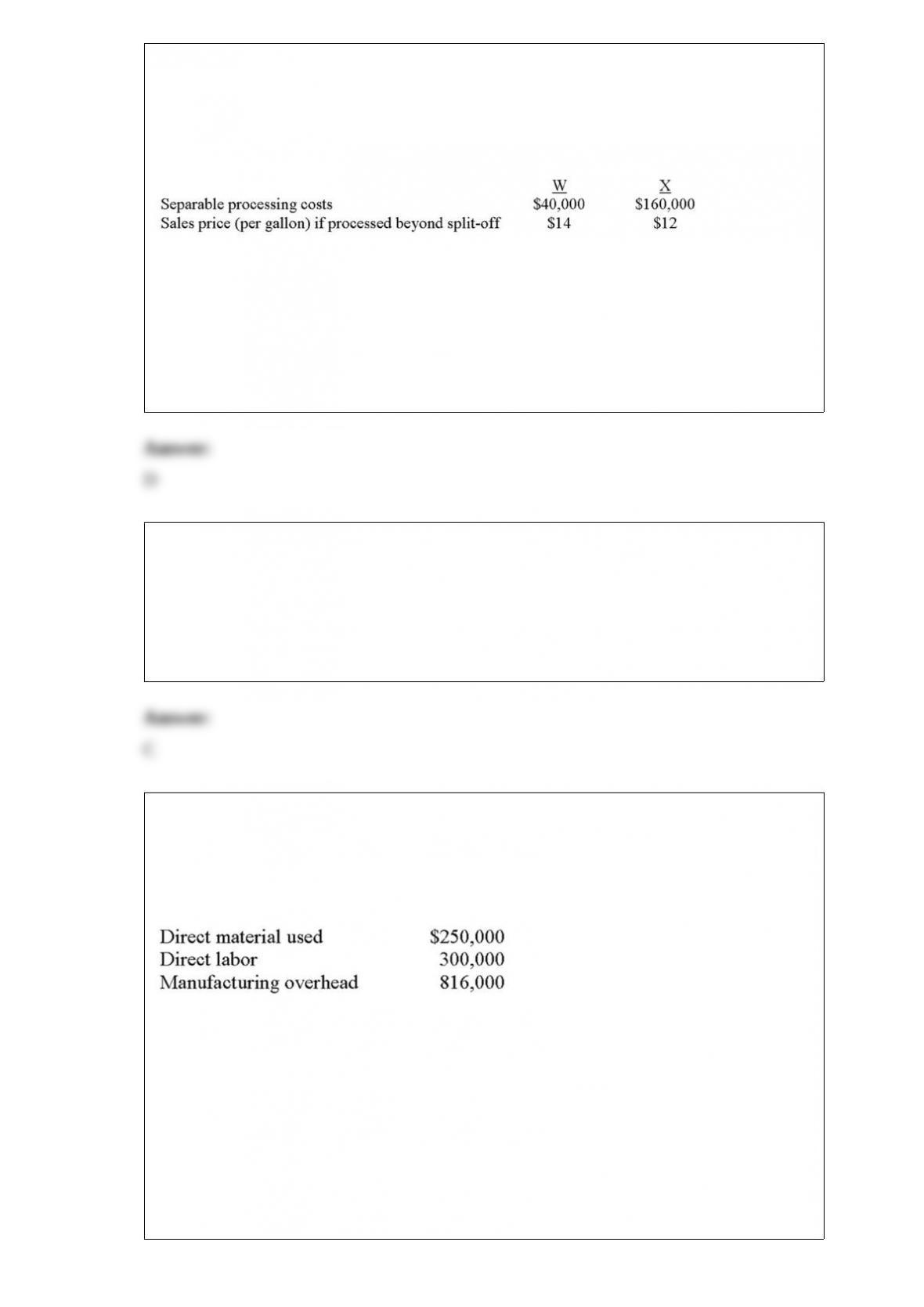
1) Christiansen Corporation manufactures joint products W and X. During a recent
period, joint costs amounted to $300,000 in the production of 20,000 gallons of W and
60,000 gallons of X. Both products will be processed beyond the split-off point, giving
rise to the following data:
The joint cost allocated to W under the net-realizable-value method would be:
A.$75,000
B.$80,000
C.$84,000
D.$90,000
E.None of the other answers are correct
2) Which of the following are methods for setting standards?
A.Analysis of historical data and goal congruence
B.Task analysis and matrix application forms
C.Task analysis and the analysis of historical data
D.Matrix application forms and analysis of historical data
E.Goal congruence and task analysis
3) Athena Corporation uses a job-cost system and applies manufacturing overhead to
products on the basis of machine hours. The company’s accountant estimated that
overhead and machine hours would total $800,000 and 50,000, respectively, for 20×1 .
Actual costs incurred follow.
The manufacturing overhead figure presented above excludes $27,000 of sales
commissions incurred by the firm. An examination of job-cost records revealed that 18
jobs were sold during the year at a total cost of $2,960,000. These goods were sold to
customers for $3,720,000. Actual machine hours worked totaled 51,500, and Athens
adjusts under- or overapplied overhead at year-end to Cost of Goods Sold.
Required:
A. Determine the company’s predetermined overhead application rate.
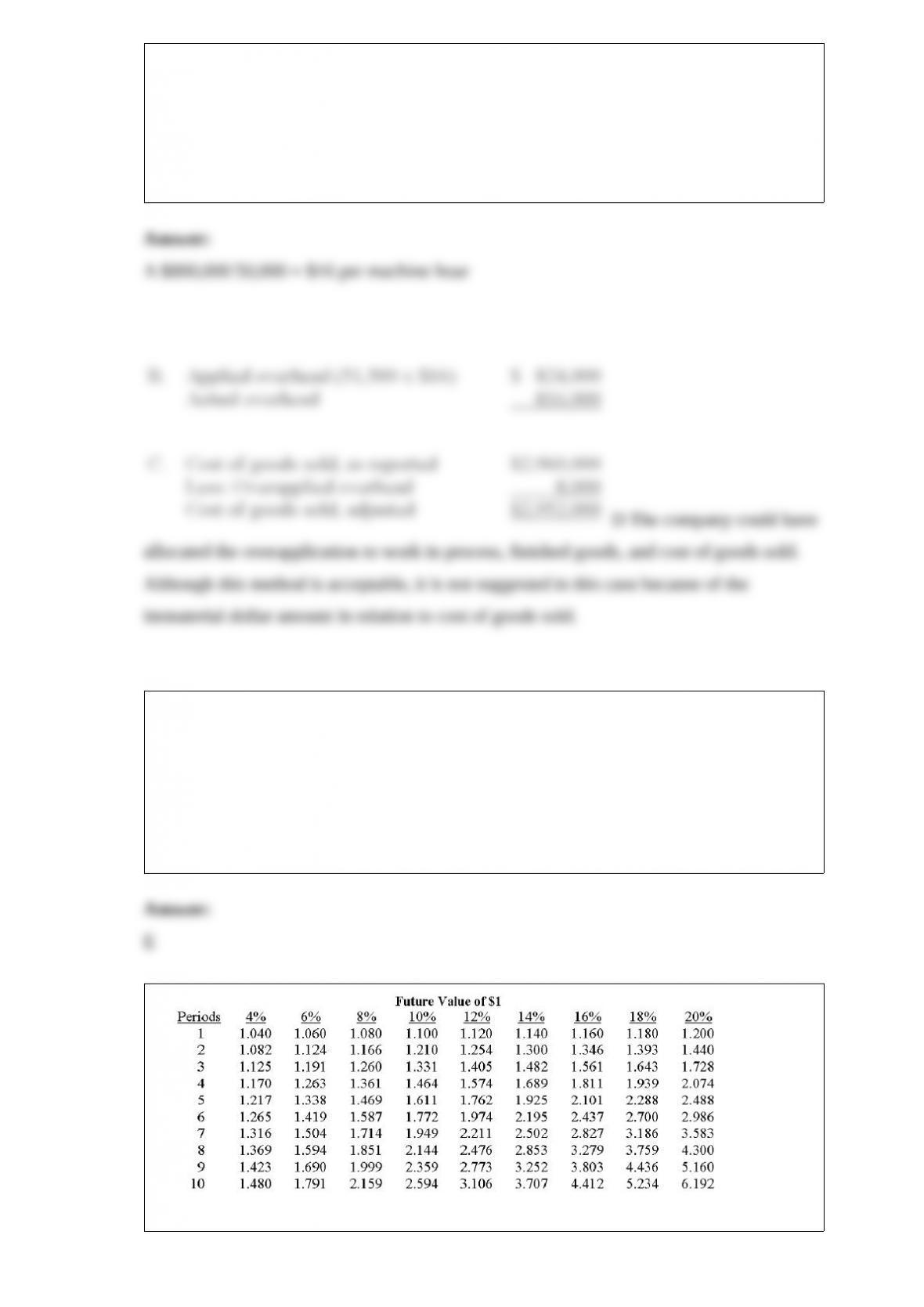
B. Determine the amount of under- or overapplied overhead at year-end. Be sure to
indicate whether overhead was under- or overapplied.
C. Compute the company’s adjusted cost of goods sold.
D. What alternative accounting treatment could the company have used at year-end to
adjust for under- or overapplied overhead? Is the alternative that you suggested
appropriate in this case? Why?
4) An unfavorable labor rate variance is created when:
A.actual labor hours worked exceed standard hours allowed
B.actual hours worked are less than standard hours allowed
C.actual wages paid are less than amounts that should have been paid
D.actual units produced exceed budgeted production levels
E.actual wages paid exceed amounts that should have been paid for the number of hours
worked
5)
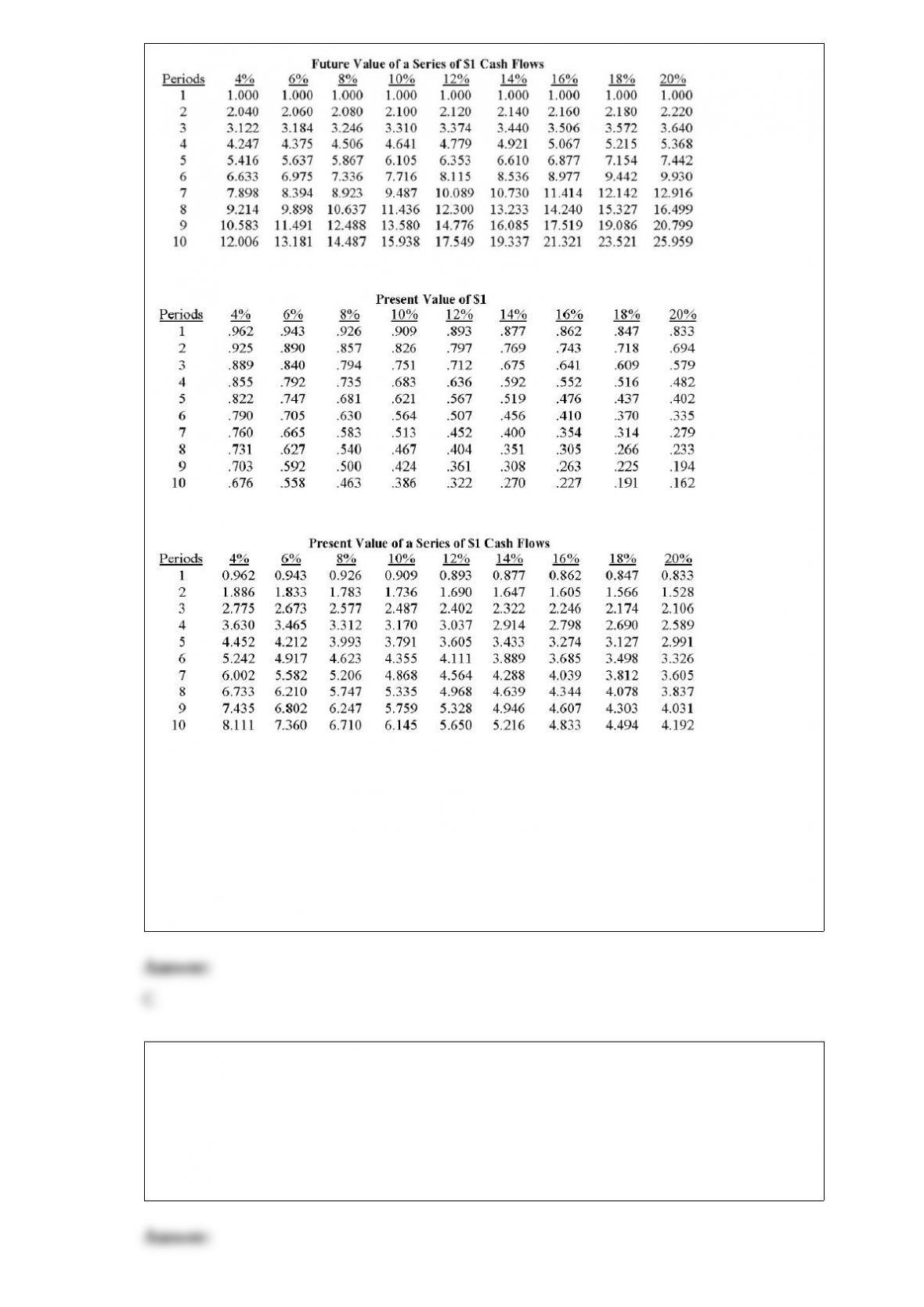
A new machine that costs $172,100 is expected to save annual cash operating costs of
$40,000 over each of the next nine years. The machine’s internal rate of return is:
A.approximately 14%
B.approximately 16%
C.approximately 18%
D.approximately 20%
E.None of the other answers are correct
6) The basic idea behind residual income is to have a division maximize its:
A.earnings per share
B.income in excess of a corporate imputed interest charge
C.cost of capital
D.cash flows
E.invested capital
7) Benson Company, which uses a standard cost system, budgeted $600,000 of fixed
overhead when 40,000 machine hours were anticipated. Other data for the period were:
Actual units produced: 10,000
Standard production time per unit: 3.9 machine hours
Fixed overhead incurred: $620,000
Actual machine hours worked: 42,000
Benson’s fixed-overhead budget variance is:
A.$10,000 favorable
B.$15,000 favorable
C.$15,000 unfavorable
D.$20,000 favorable
E.$20,000 unfavorable
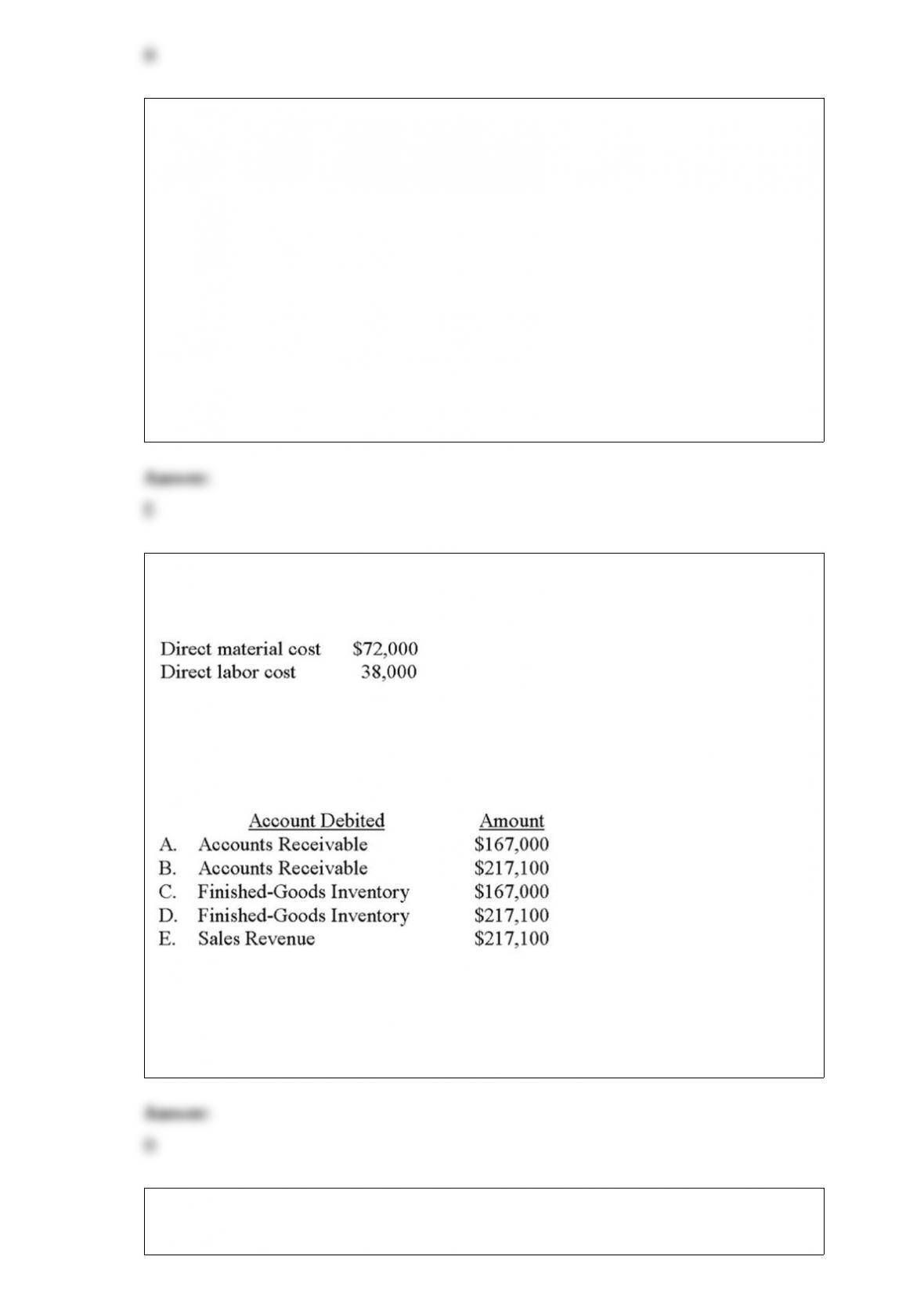
8) Armada Company applies manufacturing overhead by using a predetermined rate of
150% of direct labor cost. The data that follow pertain to job no. 831:
If Armada adds a 30% markup on total cost to generate a profit, which of the following
choices depicts a portion of the accounting needed to record the credit sale of job no.
831?
A.Choice A
B.Choice B
C.Choice C
D.Choice D
E.Choice E
9) Rocky Mountain Company produces two products (X and Y) from a joint process.
Each product may be sold at the split-off point or processed further. Additional
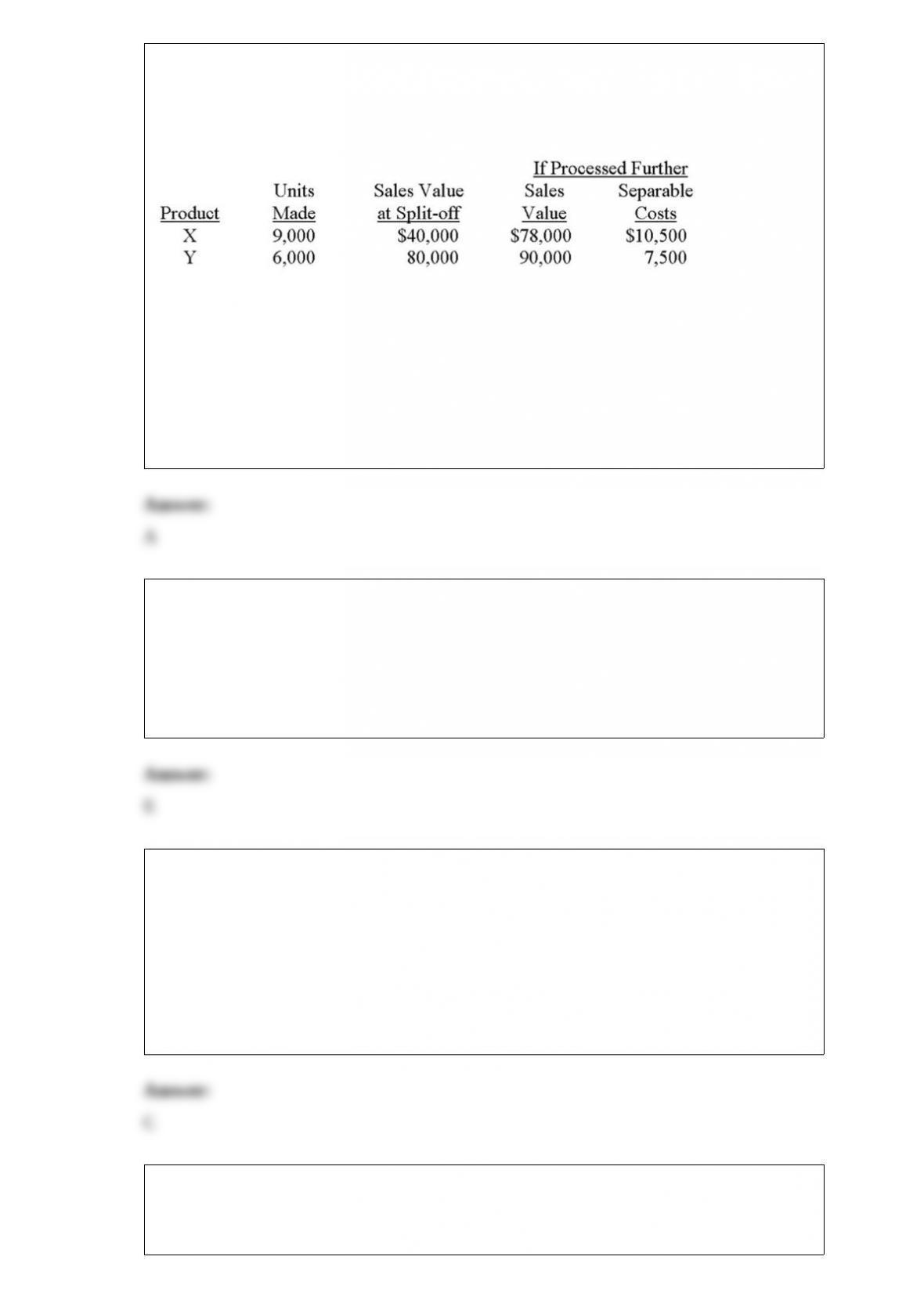
processing requires no special facilities, and production costs of further processing are
entirely variable and traceable to the products involved. Joint manufacturing costs for
the year were $60,000. Sales values and costs were as follows:
If the joint production costs are allocated based on the relative-sales-value method, the
amount of joint cost assigned to product X would be:
A.$20,000
B.$27,000
C.$33,000
D.$40,000
E.None of the other answers are correct.
10) The process of allocating fixed and variable costs separately is called:
A.the separate allocation procedure (SAP)
B.diverse allocation
C.reciprocal-cost allocation
D.common-cost allocation
E.dual-cost allocation
11) All other things being equal, a company that sells multiple products should attempt
to structure its sales mix so the greatest portion of the mix is composed of those
products with the highest:
A.selling price
B.variable cost
C.contribution margin
D.fixed cost
E.gross margin
12) Northlake, Inc., uses the high-low method to analyze cost behavior. The company
observed that at 20,000 machine hours of activity, total maintenance costs averaged
$10.50 per hour. When activity jumped to 24,000 machine hours, which was still within
the relevant range, the average total cost per machine hour was $9.75. On the basis of
this information, the company’s fixed maintenance costs were:
A.$24,000
B.$90,000
C.$210,000
D.$234,000
E.None of the other answers is correct
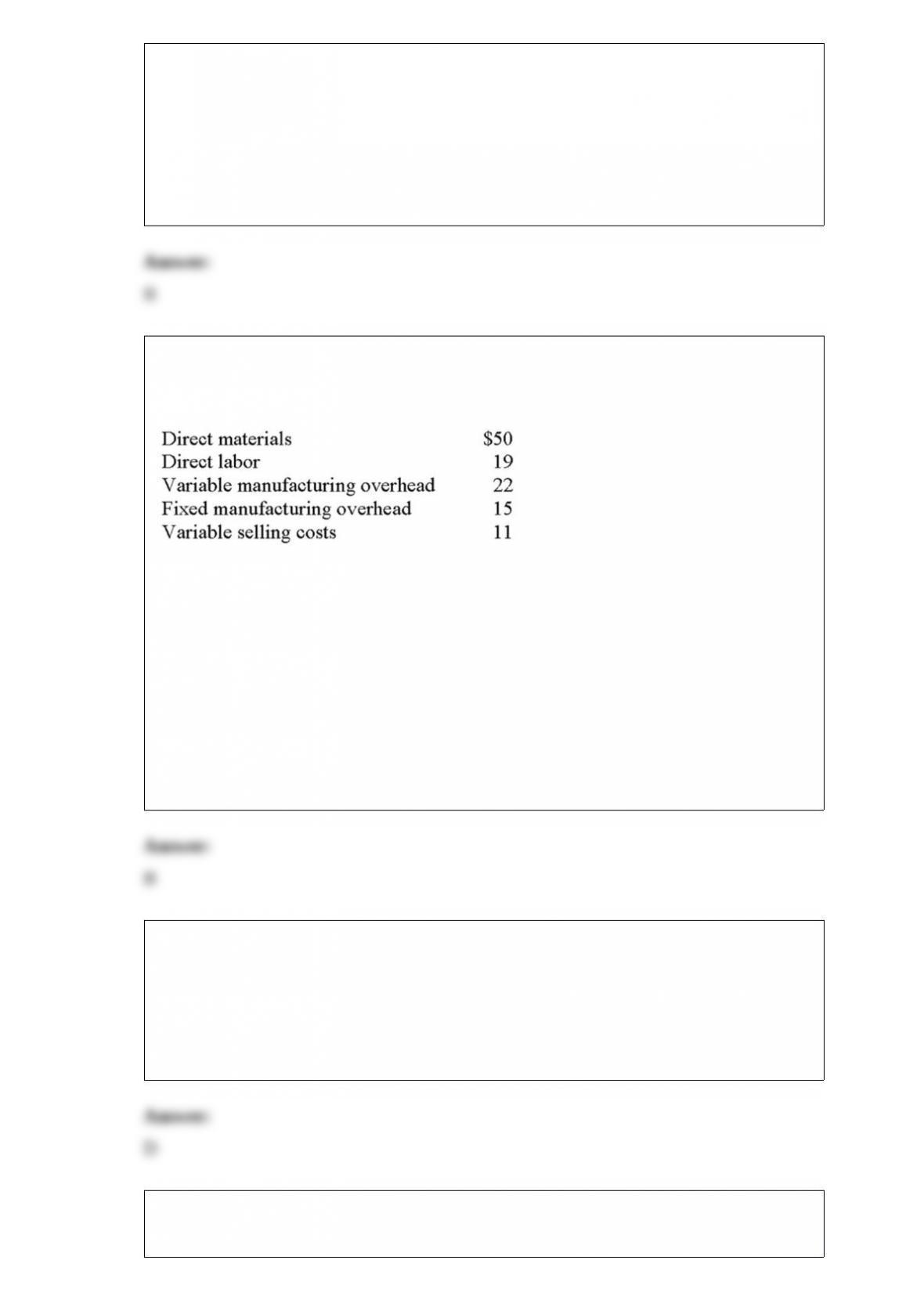
13) Gorski Corporation manufactures parts that are used in the production of washers
and dryers. The following costs are associated with part no. 65:
The company received a special-order inquiry from an appliance manufacturer in Spain
for 15,000 units of part no. 65 . Only $3 of fixed manufacturing will be incurred on the
order, and the variable selling costs per unit will amount to only $5. Since Gorski has
excess capacity, the minimum price that Gorski should charge the Spanish manufacturer
is:
A.$96
B.$99
C.$105
D.$108
E.None of the other answers are correct
14) Nonprofit organizations begin their budgeting process with:
A.a sales budget
B.anticipated funding
C.proforma financial statements
D.services to be provided
E.a cash budget
15) Delaware has computed the following unit costs for the year just ended:
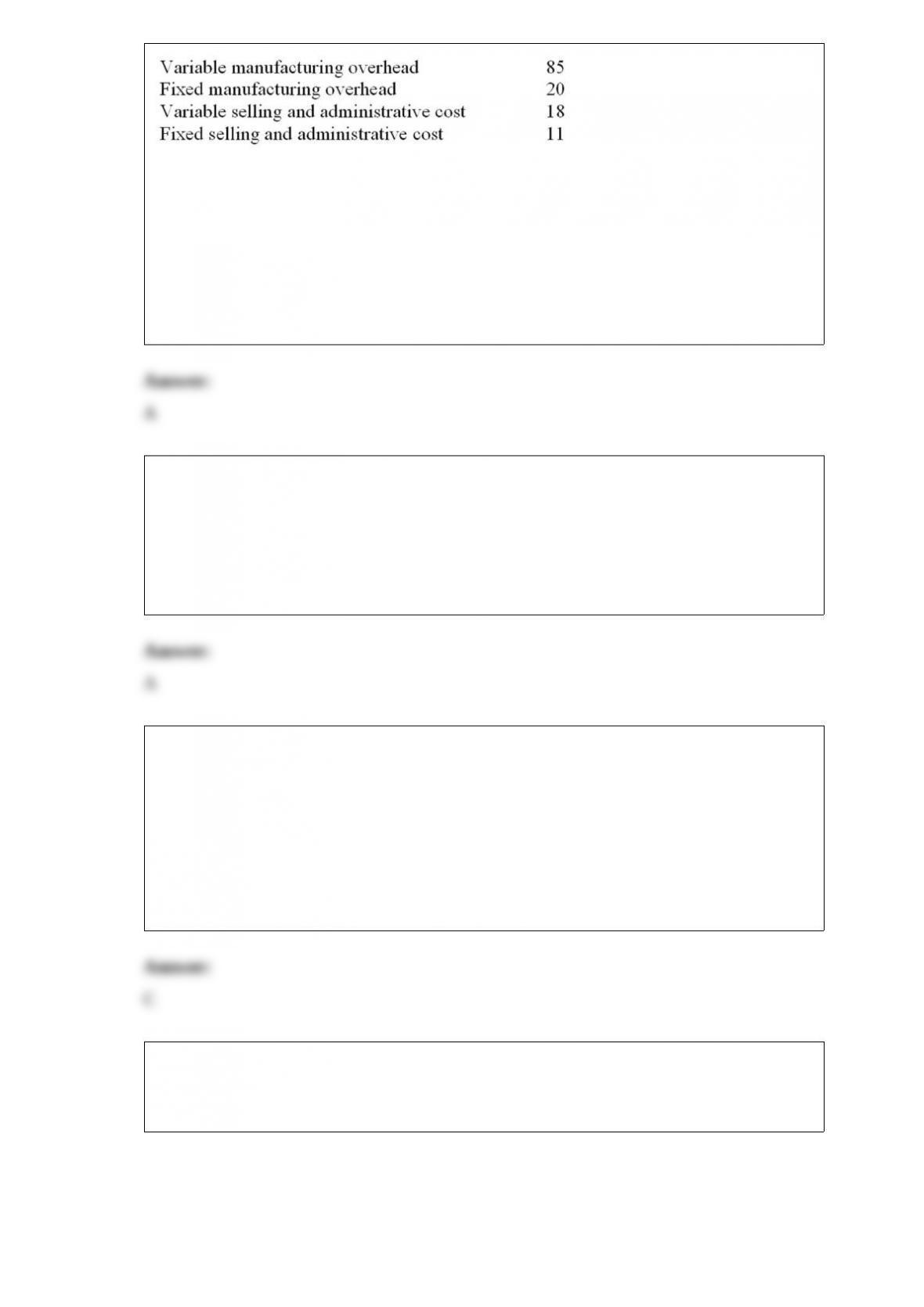
Which of the following choices correctly depicts the per-unit cost of inventory under
variable costing and absorption costing?
A.Variable, $85; absorption, $105
B.Variable, $85; absorption, $116
C.Variable, $103; absorption, $105
D.Variable, $103; absorption, $116
E.None of the other answers are correct
16) The break-even point is that level of activity where:
A.total revenue equals total cost
B.variable cost equals fixed cost
C.total contribution margin equals the sum of variable cost plus fixed cost
D.sales revenue equals total variable cost
E.profit is greater than zero
17) Xin Co., had 3,000 units of work in process on April 1 that were 60% complete.
During April, 10,000 units were completed and as of April 30, 4,000 units that were
40% complete remained in production. How many units were started during April?
A.8,600
B.9,800
C.11,000
D.12,200
E.None of the other answers are correct
18) Consider the graphs that follow (the horizontal axis represents activity; the vertical
axis represents total dollars).
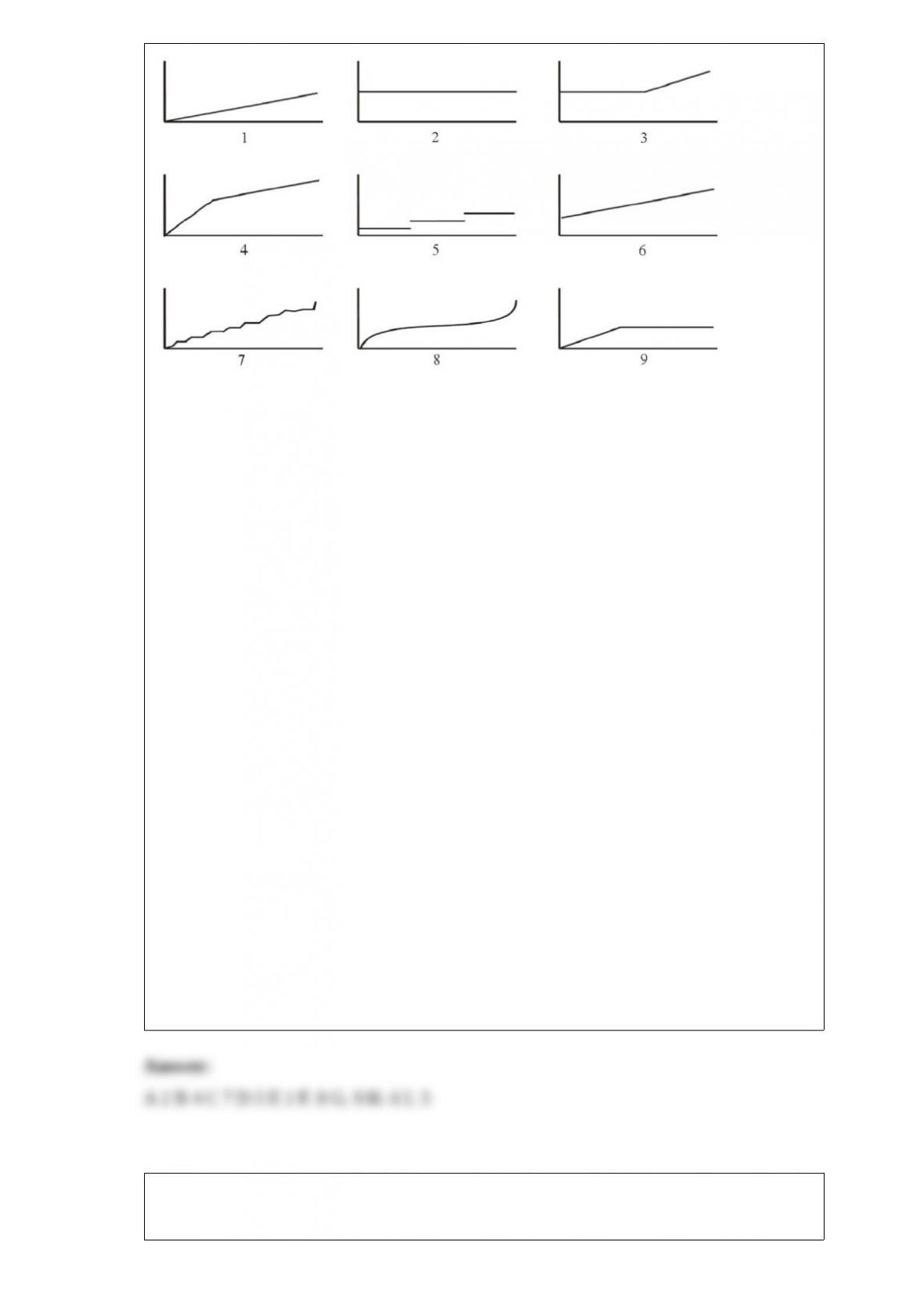
Required:
For items A-I that follow, choose the graph that best represents the cost behavior pattern
described. Note: Graphs can be used more than once.
A. Straight-line depreciation on machinery.
B. The cost of chartering a private airplane. The cost is $800 per hour for the first 6
hours of a flight; it then drops to $600 per hour.
C. The wages of table service personnel in a restaurant. The employees are part-time
workers who can be called upon for as little as 4 hours at a time.
D. Weekly wages of store clerks who work 40 hours each week. One clerk is hired for
every 125 sales made during the month.
E. The cost of tires used in the production of trucks.
F. Outbound shipping charges that increase at a decreasing rate as sales rise because the
firm can use more efficient modes of transportation (e.g., full trailer loads, full rail cars,
etc.). Gradually, however, at high levels of sales, freight costs start to increase at an
increasing rate, which reflects more transactions made to customers in far-away
locations.
G. Equipment leasing costs that are computed at $2 per machine hour worked. The
company pays a maximum of $120,000 per month.
H. The monthly cost of a franchise fee for a fast-food restaurant. The franchisee must
pay $20,000 plus 5% of gross dollar sales.
I. The cost of electricity during peak demand periods, which is based on the following
schedule:
Up to 20,000 kilowatt hours (KWH): $4,000
Above 20,000 kilowatt hours: $4,000 + $0.02 per KWH
19) Which of the following employees at Starbucks would likely be considered as
holding a staff position?
A.The company’s chief operating officer (COO)
B.The manager of a store located in Kansas City, Missouri
C.The company’s lead, in-house attorney
D.The company’s chief financial officer (CFO)
E.The company’s lead, in-house attorney and the company’s chief financial officer
(CFO)
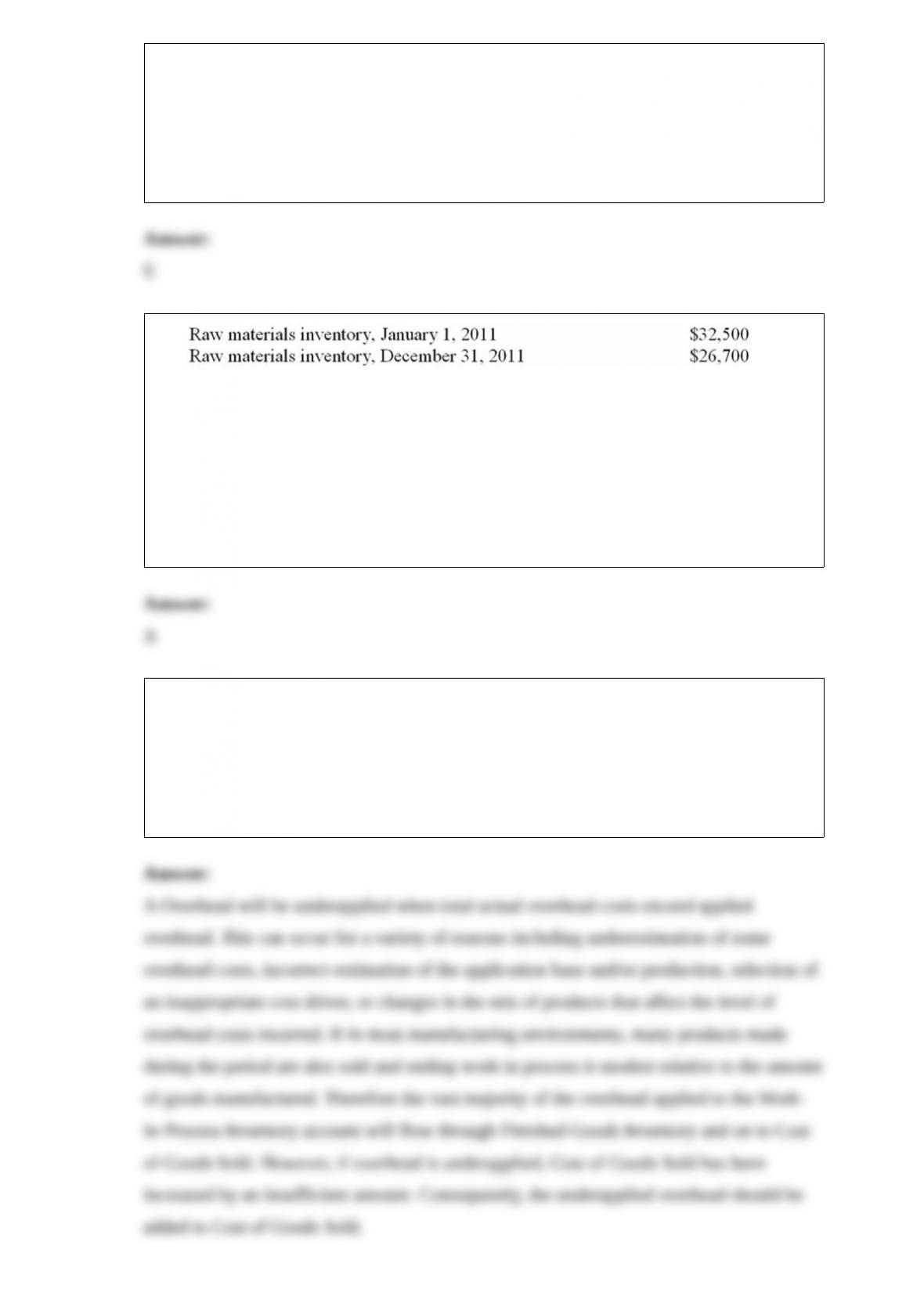
20)
If raw materials used during the year were $135,000 what was the amount of raw
materials purchased during the year?
A.$129,200
B.$140,800
C.$135,000
D.$146,600
E.None of the other answers are correct
21) Manufacturing overhead is applied to production.
A. Describe several situations that may give rise to underapplied overhead.
B. Assume that underapplied manufacturing overhead is treated as an adjustment to
Cost of Goods Sold. Explain why an underapplication of overhead increases Cost of
Goods Sold.
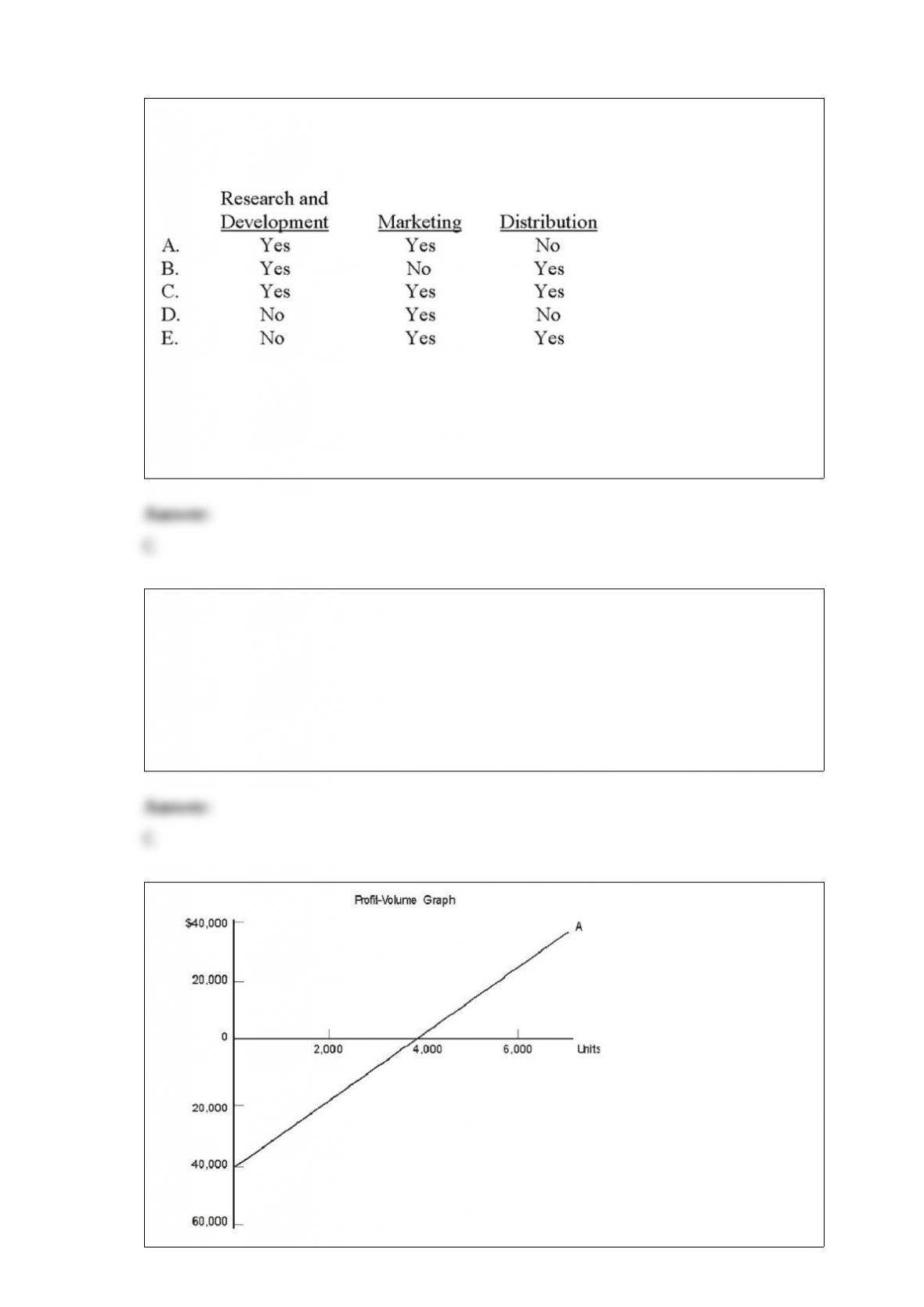
22) Which of the following choices correctly depicts activities that would be included
in a manufacturer’s value chain?
A.Choice A
B.Choice B
C.Choice C
D.Choice D
E.Choice E
23) Airstream builds recreational motor homes. All of the following activities add value
to the finished product except:
A.installation of carpet
B.assembly of the frame to the chassis
C.storage of the vehicle in the sales area
D.addition of exterior lights
E.final painting and polishing
24)
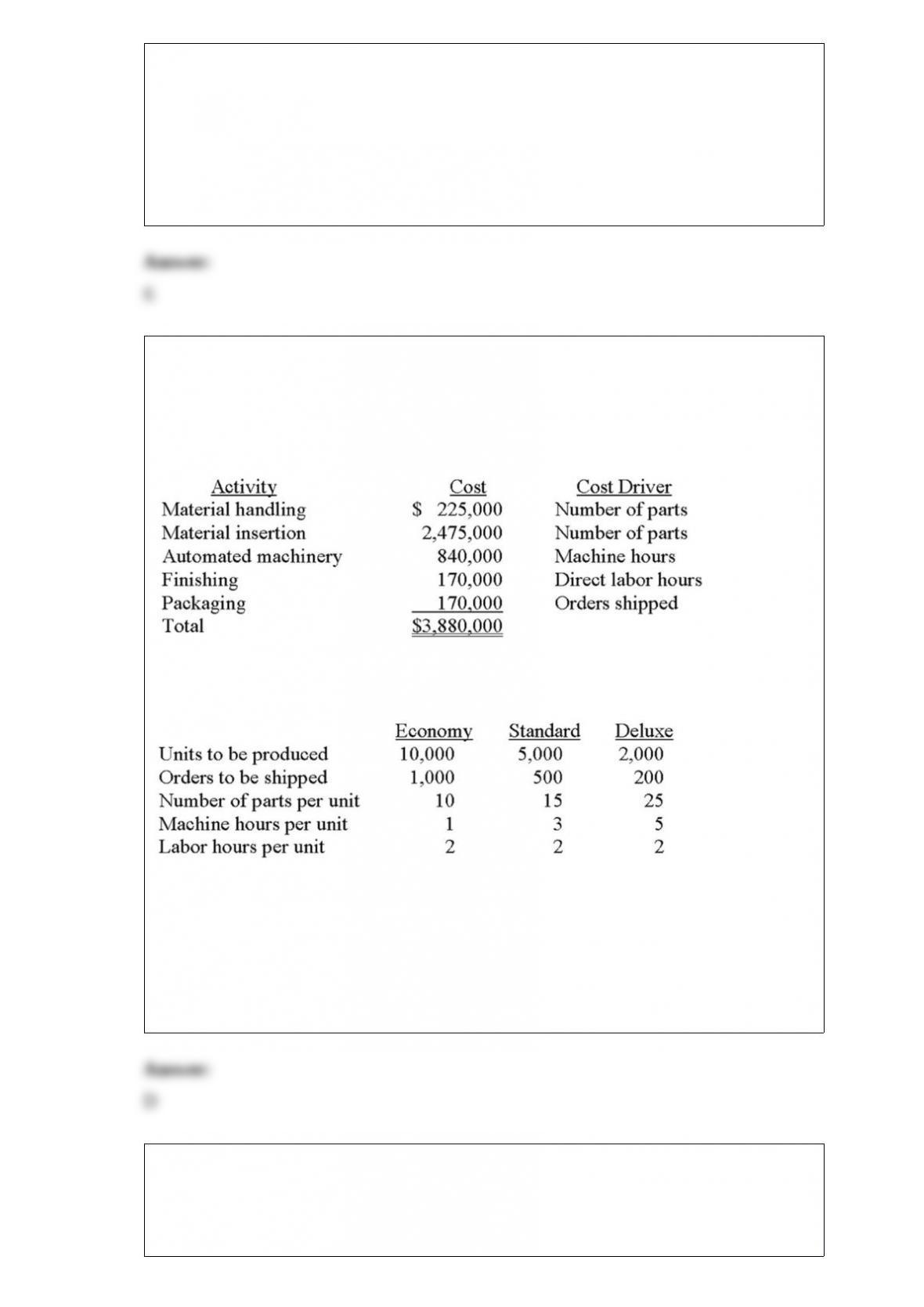
Refer to the figure above. Line A is the:
A.fixed cost line
B.variable cost line
C.total cost line
D.total revenue line
E.profit line
25) HiTech Products manufactures three types of remote-control devices: Economy,
Standard, and Deluxe. The company, which uses activity-based costing, has identified
five activities (and related cost drivers). Each activity, its budgeted cost, and related cost
driver is identified below.
The following information pertains to the three product lines for next year:
What is HiTech’s pool rate for the packaging activity?
A.$4.86 per machine hour
B.$5.00 per labor hour
C.$10.00 per unit
D.$100.00 per order shipped
E.None of the other answers is correct
26) Which of the following is a period cost?
A.Direct material
B.Advertising expense
C.Indirect labor

D.Miscellaneous supplies used in production activities
E.Advertising expense and indirect labor
27) The ROI calculation will indicate:
A.the percentage of each sales dollar that is invested in assets
B.the sales dollars generated from each dollar of income
C.how effectively a company used its invested capital
D.the invested capital generated from each dollar of income
E.the overall quality of a company’s earnings
28) Which of the following is a typical internal control?
A.The use of password-protected computers and software
B.The requirement that separate individuals authorize cash disbursements and sign
checks
C.The use of physical controls over inventories to prevent loss from theft
D.A physical count of inventory at year-end to verify amounts shown on the company’s
accounting records
E.All of the other answers are correct
29) Wardlaw Company, which experiences considerable seasonal variation in its
activity and has a high level of fixed costs, is preparing a bid for a project. This
particular project will be done during a slack period of the year.
Required:
A. How should the fixed costs be handled in the bidding approach to this project?
B. Assume that the company wins the bid and performs the job on a profitable basis,
consistent with the results as projected in the bid. Several months later, the customer
contacts Wardlaw and requests a bid to do another job. This project, however, must be
done during a peak season. How should Wardlaw’s management respond? How do you
think the customer will respond?
30) A manufacturing firm would begin preparation of its master budget by constructing
a:
A.sales budget
B.production budget
C.cash budget
D.capital budget
E.set of pro-forma financial statements
31) Howard Company has established the following standards:
Direct materials: 2.0 pounds at $4.10
Direct labor: 1.5 hours at $7 per hour
Additional information was extracted from the accounting records:
Actual production: 32,000 completed units
Direct materials purchased: 70,000 pounds at $3.82, or $267,400
Direct materials consumed: 65,000 pounds
Actual labor incurred: 51,000 hours at $6.30, or $321,300
Direct-labor rate variance: $35,700 favorable
Direct-labor efficiency variance: $21,000 unfavorable
Assume that the company computes variances at the earliest point in time.
Required:
Prepare journal entries to record the:
A. Purchase of direct materials.
B. Usage of direct materials.
C. Incurrence of direct labor costs.
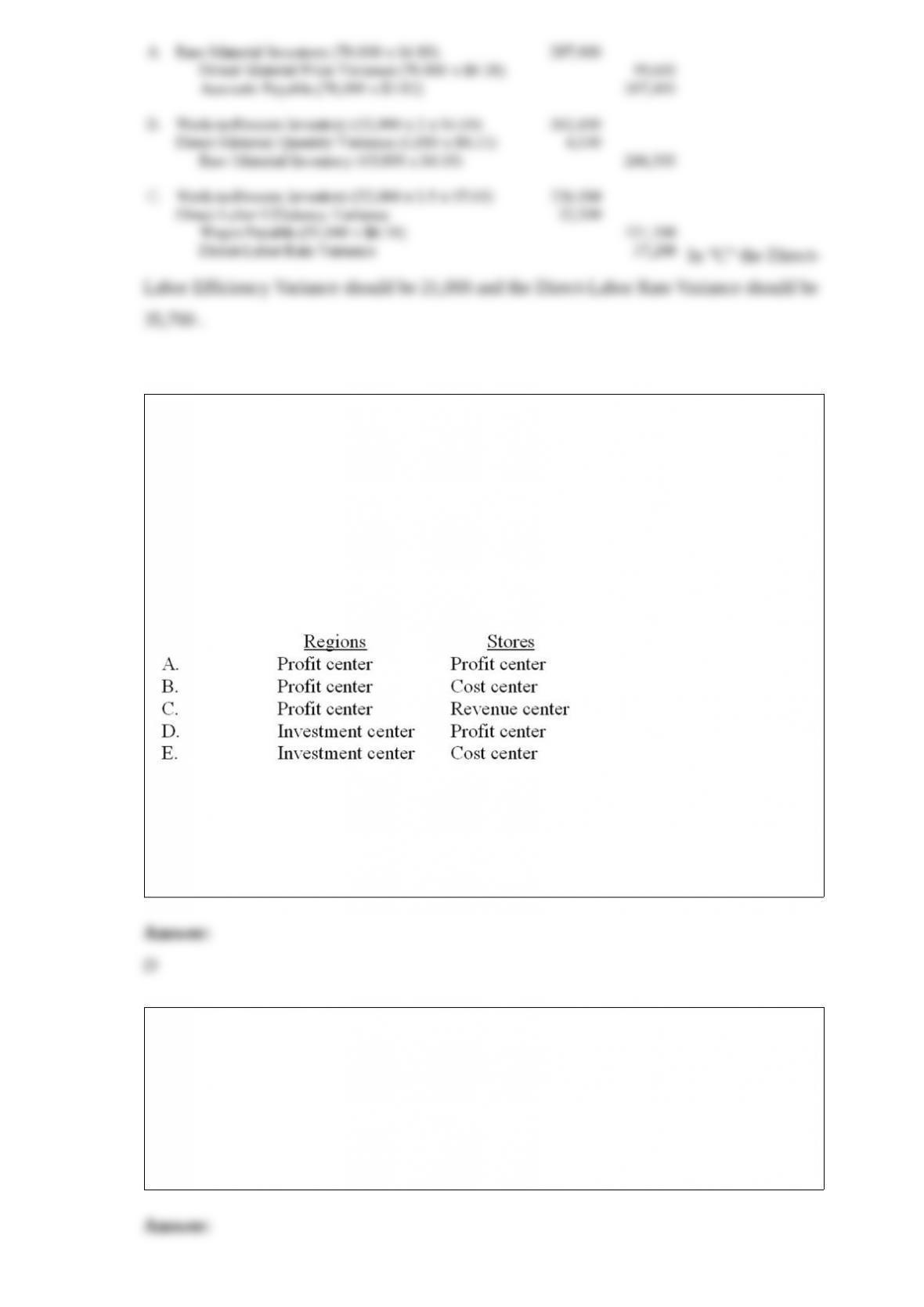
32) Caveman Software operates stores within five regions. Regional managers are held
accountable for marketing, advertising, and sales decisions, and all costs incurred
within their region. In addition, regional managers decide whether new stores will open,
where the stores will be located, and whether the stores will lease or purchase the
facilities. Store managers, in contrast, are accountable for marketing, advertising, sales
decisions, and costs incurred within their stores. Ideally, on the basis of this
information, what type of responsibility center should the software company use to
evaluate its regions and stores?
A.Choice A
B.Choice B
C.Choice C
D.Choice D
E.Choice E
33) Under an activity-based costing system, what is the per-unit overhead cost of
Economy?
A.$141
B.$164
C.$225
D.$228
E.None of the other answers is correct

34) Which of the following manufacturers would most likely not use a process-cost
accounting system?
A.A producer of computer monitors
B.A paint manufacturer
C.A producer of frozen orange juice
D.A builder of customized yachts
E.A lumber mill
35) Which of the following would not be considered a service department in a hospital?
A.Security
B.Cardiac Care
C.Patient Records
D.Accounting
E.Human Resources
36) Which of the following statements about financial planning models (FPMs) is (are)
false?
A.FPMs express a company’s financial and operating relationships in mathematical
terms
B.FPMs allow a user to explore the impact of changes in variables
C.FPMs are commonly known as “what-if” models
D.FPMs have become less popular in recent years because of computers and
spreadsheets
E.Both FPMs are commonly known as “what-if” models and FPMs have become less
popular in recent years because of computers and spreadsheets
37) When the quantity of materials purchased is not equal to the quantity of material
used, most companies base the calculation of the material quantity variance on the:
A.quantity of direct materials purchased
B.quantity of direct materials spoiled
C.quantity of direct materials that should have been used in achieving actual production
D.quantity of direct materials actually used
E.none of the other answers are correct
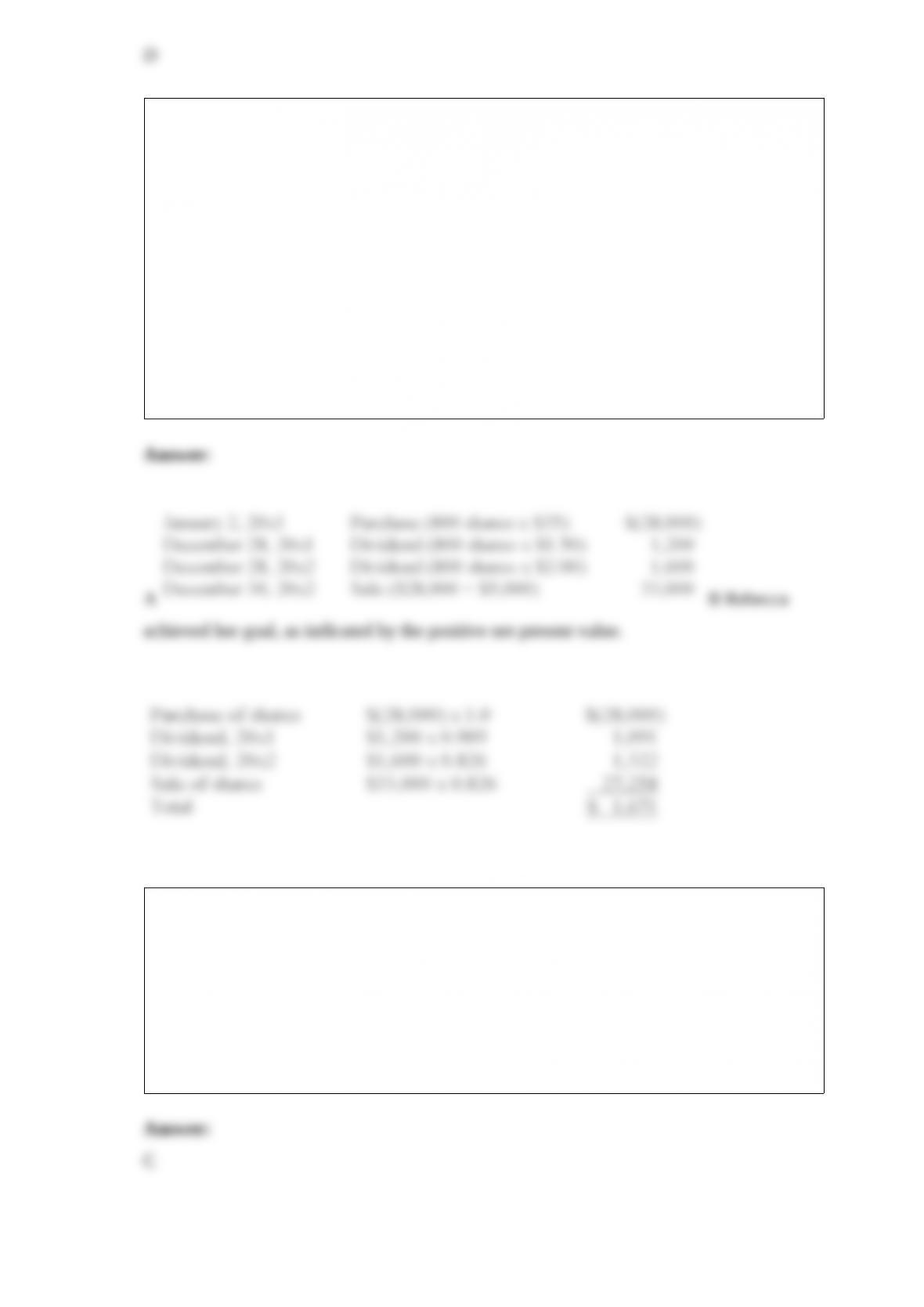
38) On January 2, 20×1, Rebecca Brown purchased 800 shares of Bazooka
Telecommunications common stock at $35 per share. The company paid a $1.50
dividend per share on December 28 of that year, and raised the amount by $0.50 per
share for a distribution on December 28, 20×2 . Rebecca sold her entire investment on
December 30, 20×2, generating a $5,000 gain on the sale of stock.
Required:
A. Prepare a dated listing of the cash inflows and outflows related to Rebecca’s stock
investment. Ignore income taxes.
B. Assume that Rebecca has a 10% hurdle rate for all investments. Rounding to the
nearest dollar, compute the net present value of her investment in Bazooka and
determine whether she achieved her 10% goal.
39) Feinstein, Inc., an appliance manufacturer, is developing a new line of ovens that
uses controlled-laser technology. The research and testing costs associated with the new
ovens is said to arise from a:
A.unit-level activity
B.batch-level activity
C.product-sustaining activity
D.facility-level activity
E.competitive-level activity