
1) The percent of sales method provides a general estimate, but the more detailed cash
budget will ultimately be used to estimate financing needs.
2) Covered interest arbitrage can be taken advantage of when premiums in forward
rates are not exactly equal to the interest rate differential between two countries.
3) Increasing depreciation expense results in a decrease of the incremental after-tax free
cash flow.
4) Because of the overriding importance of cash flows to valuation, one basic tenet of
finance is that dividends increase the value of a company’s common stock.
5) Low dividends may increase stock value due to the advantage of tax deferral that
comes with capital gains.
6) When capital rationing exists, the divisibility of projects is ignored and projects are
funded in order of their PI’s or IRR’s.
7) In a limited partnership at least one general partner must exist; that general partner
has unlimited liability.

8) A firm’s dividend policy includes two basic components: the dividend payout ratio
and dividend stability.
9) Preferred stock and common stock issued by the same firm will have the same
required return because the riskiness of the firm’s cash flows is the same for both
securities.
10) In Excel, the variable pvs stands for a bond’s par value.
11) Investors require higher rates of return to compensate for purchasing power losses
resulting from inflation.
12) During the period 1987 to 2011, the average yield on 3-Month U.S. Treasury bills
was 3.85%, the average inflation rate was 2.92%, the average yield on 30-year Treasury
bonds was 6.14%, and the average return on 30-year AAA-Rated Corporate Bonds was
7.00%. The real risk-free short-term interest rate is
A) 0.90%
B) 2.13%
C) 2.97%
D) 4.76%
13) Advantages of private placements do NOT include which of the following?
A) more financing flexibility
B) lower flotation costs
C) investor protection through extensive regulation
D) funds which are available more quickly than through a public offering

14) All of the following contributed to recent financial crises EXCEPT
A) Focusing on earnings instead of cash flow
B) Focusing on the short run
C) Relying on the efficiency of financial markets
D) Excessive risk taking due to underestimation of risk
15) Texas Transport has five possible investment projects for the coming year. Each
project is indivisible. They are:
ProjectInvestment (million)IRR
A$ 618%
B$1015%
C$ 920%
D$ 412%
E$ 324%
The firm’s weighted marginal cost of capital schedule is 12 percent for up to $6 million
of investment; 16 percent for between $6 million and $18 million of investment; and
above $18 million the weighted cost of capital is 18 percent. The optimal capital budget
is
A) $12 million
B) $18 million
C) $23 million
D) $28 million
16) TC, Inc. has $15 million of outstanding bonds with a coupon rate of 10 percent. The
yield to maturity on these bonds is 12.5 percent. If the firm’s tax rate is 30 percent, what
is relevant cost of debt financing to Kendall, Inc.?
A) 13.75 percent
B) 8.75 percent
C) 7.00 percent
D) 3.75 percent
17) Stock W has an expected return of 12% with a standard deviation of 8%. If returns
are normally distributed, then approximately two-thirds of the time the return on stock
W will be
A) between 12% and 20%

B) between 8% and 12%
C) between -4% and 28%
D) between 4% and 20%
18) Table 4-1
Stewart Company
Balance Sheet
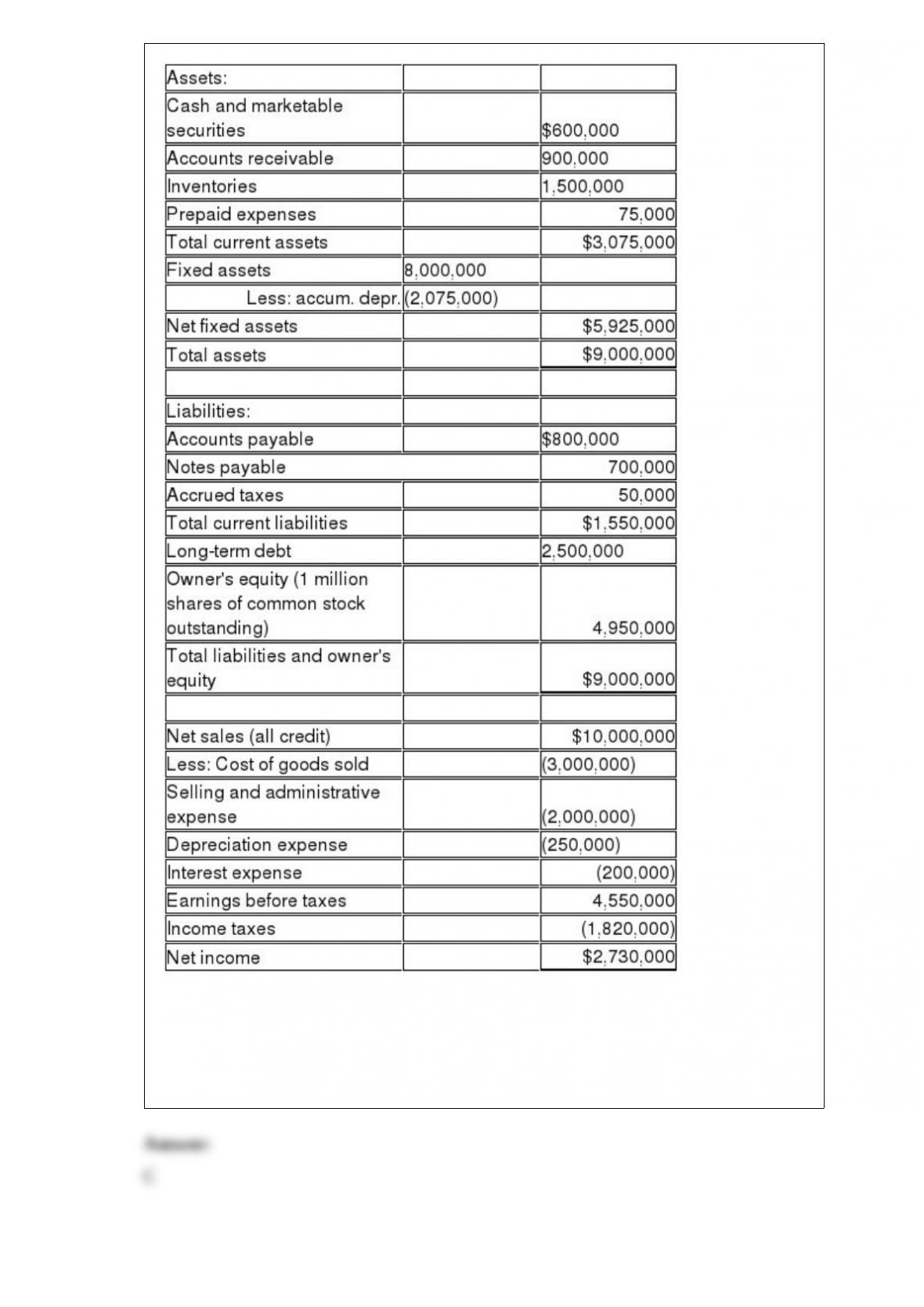
The acid-test ratio is
A) 1.71
B) 1.67
C) 1.02
D) 0.98

19) Parsons Company has a cash flow problem. The company owes its suppliers
$300,000 on credit terms of 2/10 net 40, but Parsons doesn’t have the cash to pay during
the discount period. Parsons, however, can borrow the $300,000 at annual rate of 24%.
Should Parsons borrow the money to pay its accounts payable?
A) No, additional borrowing will cost more for interest ($60,000 per year) than the
discount is worth
B) Yes, the effective cost of forgoing the discount is greater than 24%
C) No, the effective cost of forgoing the discount is equal to 24%, and there are
transactions costs associated with borrowing
D) It doesn’t matter because the present value of the cost of borrowing is exactly equal
to the amount of the discount for paying within 10 days
20) Which of the following will cause the value of a bond to increase, other things held
the same?
A) investors’ required rate of return increases
B) the company’s debt rating drops from AAA to BBB
C) interest rates decrease
D) the bond is callable
21) Which of the following differentiates the cost of retained earnings from the cost of
newly-issued common stock?
A) the cost of the pre-emptive rights held by existing shareholders
B) the greater marginal tax rate faced by the now-larger firm
C) the flotation costs incurred when issuing new securities
D) the larger dividends paid to the new common stockholders
22) An example of the growth factor in common stock is
A) acquiring a loan to fund an investment in Asia
B) retaining profits in order to reinvest into the firm
C) issuing new stock to provide capital for future growth
D) two strong companies merging together to increase their economy of scale
23) Predicting a firm’s future financial needs includes all of the following steps

EXCEPT
A) review of the firm’s sales revenues and expenses over all past planning periods
B) estimation of investment levels for current and fixed assets
C) determination of the firm’s financing needs for the period
D) estimation of projected sales and expenses
24) The EBIT-EPS indifference point
A) identifies the EBIT level at which the EPS will be the same regardless of the
financing plan
B) identifies the point at which the analysis can use EBIT and EPS interchangeably
C) identifies the level of earnings at which the management is indifferent about the
payments of dividends
D) identifies the sales level at which EBIT equals EPS
25) Given that short-term interest rates typically fluctuate less than long-term rates,
interest rate risk is least for
A) treasury bills
B) common stock
C) long-term government bonds
D) medium-term corporate bonds
26) Gross profit is equal to
A) profits plus depreciation
B) revenues – expenses
C) earnings before taxes minus taxes payable
D) sales – cost of goods sold
27) Your firm is considering an investment that will cost $920,000 today. The
investment will produce cash flows of $450,000 in year 1, $270,000 in years 2 through
4, and $200,000 in year 5 . The discount rate that your firm uses for projects of this type
is 11.25%. What is the investment’s internal rate of return?
A) 27.28%
B) 21.26%

C) 20.53%
D) 15.98%
28) Two investors are considering the purchase of Corporation LMQ bonds. The bonds
are selling at their par value of $1,000 with a coupon rate of 9%. Investor A decides to
buy the bonds and Investor B does not buy the bonds.
A) Investor A must have a required return higher than the bond’s yield to maturity
B) The yield to maturity for Investor A must be higher than the yield to maturity for
Investor B
C) Investor B must have required return lower than the bond’s yield to maturity
D) Investor A must have a required return less than or equal to 9%
29) Gerentology Associates, a highly profitable company, is considering two growth
strategies, one that will achieve sales growth of 20% in one year, and the other that will
achieve 20% growth in sales, but over a 4-year time frame. Assuming Gerentology
Associates uses the percent of sales method, which of the following statements is
TRUE?
A) Discretionary financing needed will be much greater for the 4-year growth strategy
B) Discretionary financing needed could be much less for the 4-year growth strategy
due to retained earnings
C) The asset balances at the end of 4 years for strategy two will be much greater than
the asset balances required at the end of year one for strategy one
D) Discretionary financing needed could be much greater for the slow growth strategy
because interest charges will accumulate on the company’s debt
30) The president of Smith Brothers, Inc. wants a dividend policy that minimizes the
likelihood of decreasing the company’s dividend per share. Which of the following
policies should the CEO select?
A) constant dividend payout ratio
B) stable dollar dividend per share
C) regular dividend plus a year-end extra
D) All policies have the same likelihood of a dividend decrease because dividend
changes are dependent on changes in earnings.

31) Which of the following categories of owners enjoy limited liability?
A) all partners in a limited partnership
B) common shareholders of a corporation
C) in a partnership, only the general partners
D) only B and C above
32) Which of the following statements regarding a line of credit is TRUE?
A) The purpose for which the money is being borrowed must be stated by the borrower
B) A line of credit agreement usually fixes the interest rate that will be applied to any
extensions of credit
C) A line of credit agreement is a legal commitment on the part of the bank to provide
the stated credit
D) Such agreements usually cover the borrower’s fiscal year
33) Who bears the greatest risk of loss of value if a firm should fail?
A) bondholders
B) preferred stockholders
C) common stockholders
D) All of the above bear equal risk of loss
34) Which of the following should NOT be included as investment costs in evaluating a
capital asset?
A) interest payments and other financing cash flows that result from raising funds to
finance a project
B) employee training expenses
C) shipping expenses
D) installation expenses
35) Cash and credit management are typically the responsibility of the
A) controller
B) vice president of production and operations
C) chief executive officer, or CEO
D) treasurer

36) Mix Sweet Shop bakes and sells pies. Mix has annual fixed costs of $880,000 and a
variable cost per pie of $7.50. Each pie sells for $15.50 each. The firm expects to sell
500,000 pies annually. What is the break-even point in sales dollars?
A) $3,100,000
B) $2,875,000
C) $1,705,000
D) $1,625,000
37) AFB, Inc. declared a dividend of $2 per share, which was an increase of 25% from
the prior year, yet AFB, Inc. stock declined by 3% the day of the announcement. DAS,
Inc. declared a dividend of $2 per share, which was the same as the prior year, and its
stock increased in value by 2% on the day of the announcement. These events could be
most readily explained by the
A) information effect
B) clientele effect
C) expectations theory
D) residual dividend theory
38) Which of the following forms of business organization has the greatest ability to
attract new capital?
A) sole proprietorship
B) corporation
C) general partnership
D) limited partnership
39) Decker Corp. common stock has a required return of 17.5% and a beta of 1.75 . If
the expected risk free return is 3%, what is the expected return for the market based on
the CAPM?
A) 11.29%
B) 14.29%
C) 13.35%
D) 15.27%

40) Of the following different types of securities, which is typically considered most
risky?
A) long-term corporate bonds
B) long-term government bonds
C) common stocks of large companies
D) common stocks of small companies
41) Which of the statements below are TRUE?
A) The sole proprietorship and the general partnership both feature unlimited liability
B) A corporation is the business form that is typically the most complicated (legally) to
establish
C) The corporation and the limited partnership both provide at least some owners with
limited liabilit
D) all of the above
42) I301 Motors has several investment projects under consideration, all with positive
net present values. However, due to a shortage of trained personnel, a limit of
$1,250,000 has been placed on the capital budget for this year. Which of the projects
listed below should be included in this year’s capital budget? Explain your answer.
43) The effective interest rate on short-term loans from Bank A is 12.5 percent per year.
Bank B claims that their interest rate is only 11 percent per year. However, Bank B
charges interest on a discount basis. Which bank is charging the lowest effective rate of
interest on a one-year loan?
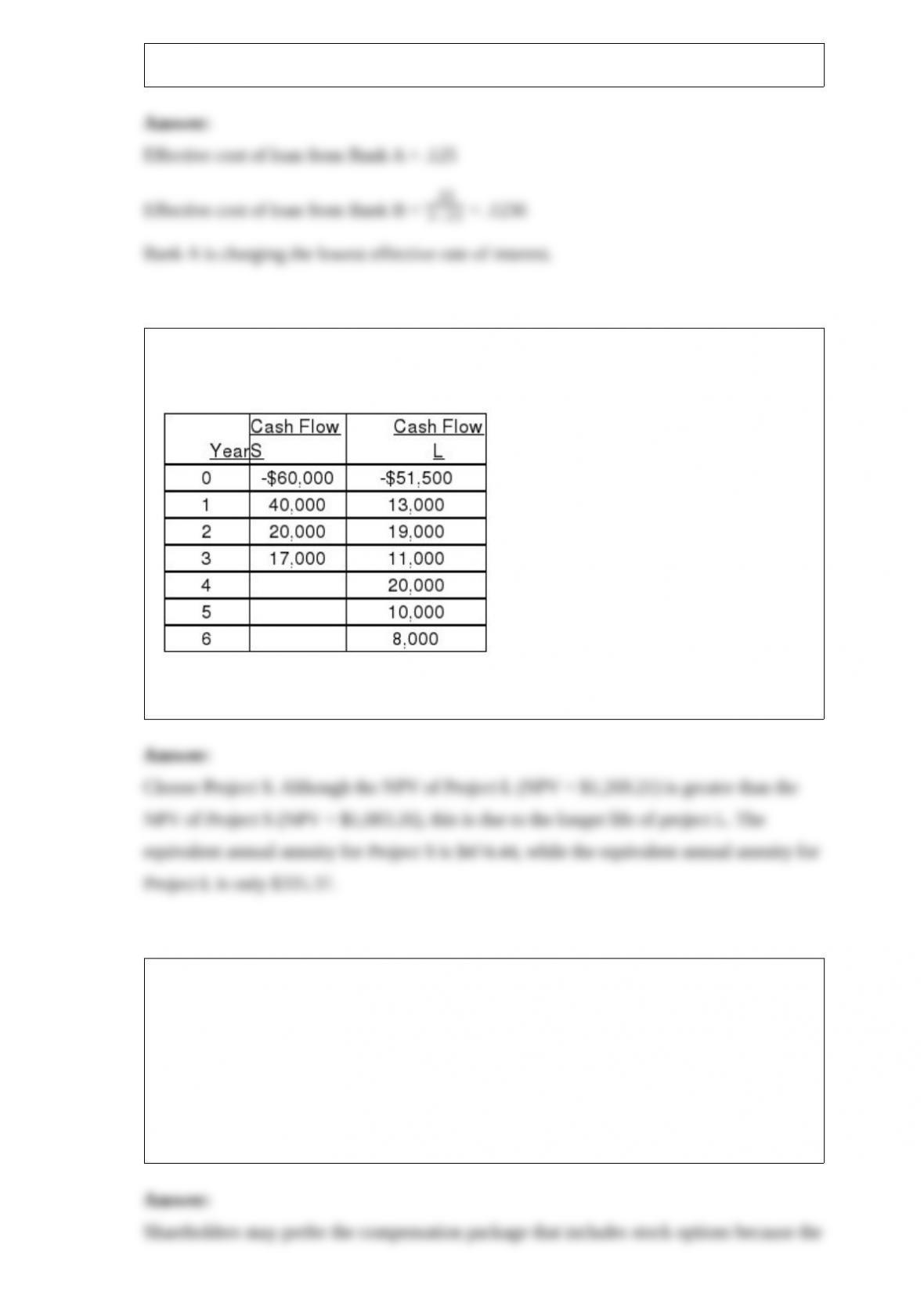
44) The Dickerson PR Firm is considering two mutually exclusive projects with useful
lives of 3 and 6 years. The after-tax cash flows for projects S and L are listed below.
Calculate the equivalent annual annuity for each project assuming a required return of
15%. What decision should be made?
45) The board of directors of Wireless, Inc. is considering two compensation plans for
the CEO of the company. The first would pay the CEO a salary of $250,000 for the
upcoming year. The second would pay the CEO a salary of $100,000 and provide the
CEO with a stock option to buy 100,000 shares of stock for $11 per share. The current
price per share of Wireless, Inc. stock is $10 per share. The stock option expires at the
end of the year. Why might shareholders prefer the second payment plan? As part of
your answer, calculate the breakeven point for the CEO to obtain the same
compensation under option two as he or she would under option one.
46) You are currently 25 years of age. You have developed a lifetime budget that
includes $50,000 at age 40 for a college fund for your kids and $25,000 per year for 20
years to supplement your retirement, the first payment on your 60th birthday and the
last payment on your 79th birthday. You open an investment account on your 25th
birthday that promises to pay 9% interest compounded annually. You want to deposit
equal annual amounts into the account every year on your birthday, starting today (your
25th birthday) and continuing until you are 40 years old (i.e., the last deposit is made on
your 40th birthday). How much will each deposit have to be if you want to meet your
financial goals?
47) If you are willing to pay $1,077 for a 15-year $1,000 par value bond that pays 9
percent interest semiannually, what is your expected rate of return?