1) Which of the following statements best describes the relationship between the
sales-forecasting process and the master-budgeting process?
A.The sales forecast is typically completed after completion of the master budget
B.The sales forecast is typically completed approximately halfway through the
master-budget process
C.The sales forecast is typically completed before the master budget and has no impact
on the master budget
D.The sales forecast is typically completed before the master budget and has little
impact on the master budget
E.The sales forecast is typically completed before the master budget and has significant
impact on the master budget
2) Radner and Associates develops hotels in resort locations. The company is exploring
the construction of a new facility that would have significant meeting and banquet
space for conventions and conferences, and sleeping rooms that average 850 square
feet. The accounting department estimates that land and building costs will amount to
$60 and $120 per square foot of floor area, respectively. Other expenditures during
construction for interest, real estate taxes, and general overhead are expected to total
35% of land and construction cost.
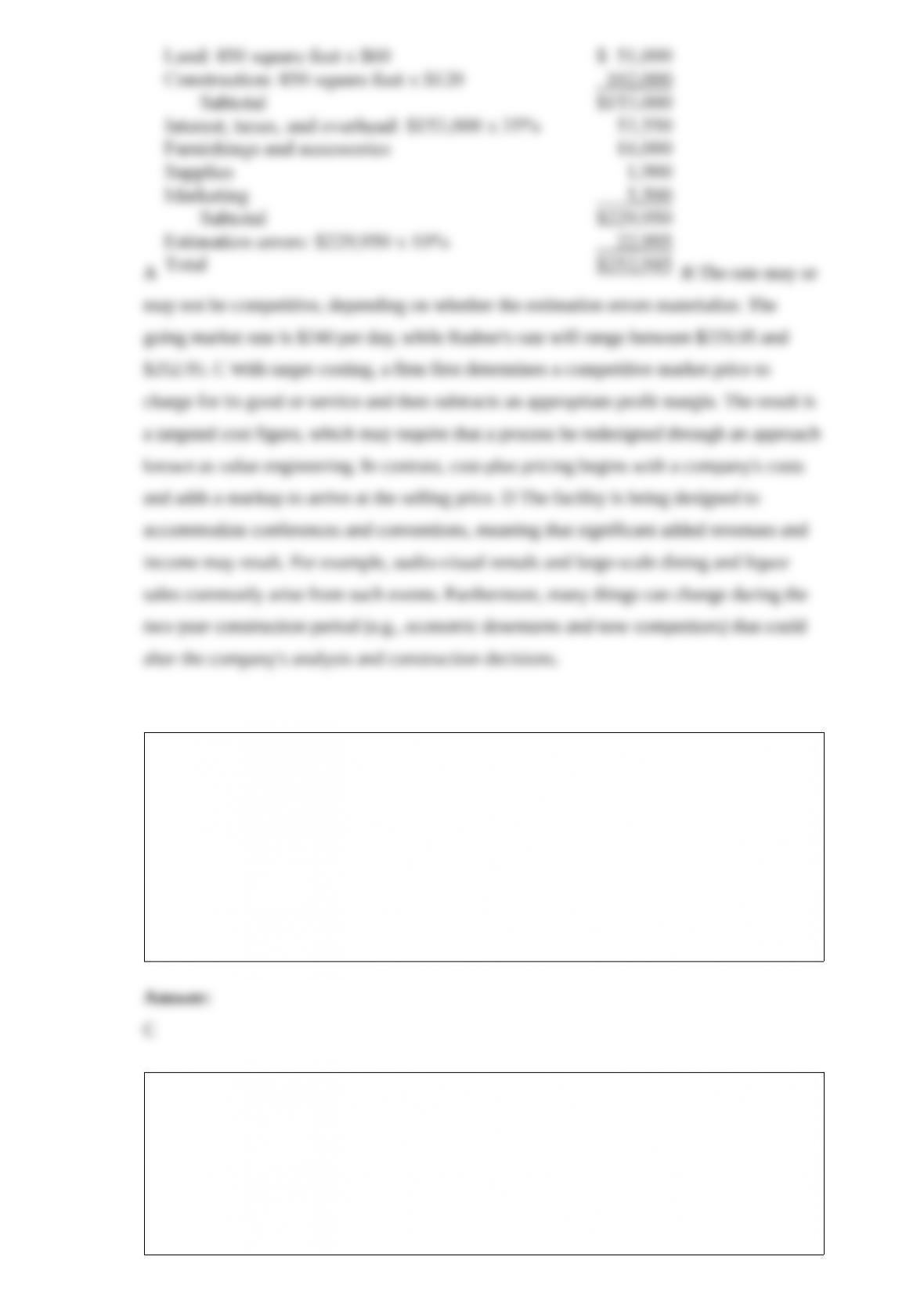
Once basic construction is completed, Radner anticipates per-room initial expenditures
for:
The accounting department suggests that 10% be added to the total of all preceding
costs to allow for estimation errors. Construction is anticipated to take two years.
Radner’s pricing policy is consistent with that of industry leaders, namely, to set a room
rate equal to .1% (.001) of cost. Upon completion, comparable facilities are expected to
charge $240 per day.
Required:
A. Compute the total cost of a sleeping room at the new facility.
B. Is the company’s room rate competitive? Briefly explain.
C. Radner desires to enter this market by adhering to the industry standard and charging
a competitive room rate. If needed, the firm will look for ways to cut expenditures.
Briefly explain the difference between cost-plus pricing and target costing.
D. Other than operating costs and room revenues, what else should Radner consider
before a final decision is made about the facility?
3) Storch Corporation takes eight hours to complete the setup process for a certain
electrical component, with the setup cost averaging $150 per hour. If the company’s
competitor can accomplish the same process in six hours, Stanley’s non-value-added
cost would be:
A.$0
B.$150
C.$300
D.$900
E.$1,200
4) When underapplied or overapplied manufacturing overhead is prorated, amounts can
be assigned to which of the following accounts?
A.Raw-Material Inventory, Manufacturing Overhead, and Direct Labor
B.Cost of Goods Sold, Work-in-Process Inventory, and Finished-Goods Inventory
C.Work-in-Process Inventory, Raw-Material Inventory, and Cost of Goods Sold
D.Raw-Material Inventory, Finished-Goods Inventory, and Cost of Goods Sold
E.Raw-Material Inventory, Work-in-Process Inventory, and Finished-Goods Inventory
5) When pricing products, many companies use target costing and/or cost-plus pricing
methods.
Required:
A. Briefly explain how target costing is applied to new products.
B. How does target costing differ from cost-plus pricing?
C. Can an activity-based costing system be used with target costing? Explain
6) Consider the following statements regarding product-sustaining activities:
I. They must be performed for each batch of product that is made.
II. They must be performed for each unit of product that is made.
III. They are needed to support an entire product line.
Which of the above statements is (are) true?
A.I only
B.II only
C.III only
D.I and II
E.II and III
7) The variable costs per unit are $6 when a company produces 12,000 units of product.
What are the variable costs per unit when 14,000 units are produced?
A.$4.50
B.$5.00
C.$5.50
D.$6.00
E.None of the other answers are correct
8) The true statement about cost behavior is that:
A.variable costs are constant on a per-unit basis and change in total as activity changes
B.fixed costs are constant on a per-unit basis and change in total as activity changes
C.fixed costs are constant on a per-unit basis and constant in total as activity changes
D.variable costs change on a per-unit basis and change in total as activity changes
E.variable costs are constant on a per-unit basis and are constant in total as activity
changes
9) Which of the following would not be classified as a product cost?
A.Direct materials
B.Direct labor
C.Indirect materials
D.Insurance on a manufacturing plant
E.Sales commissions
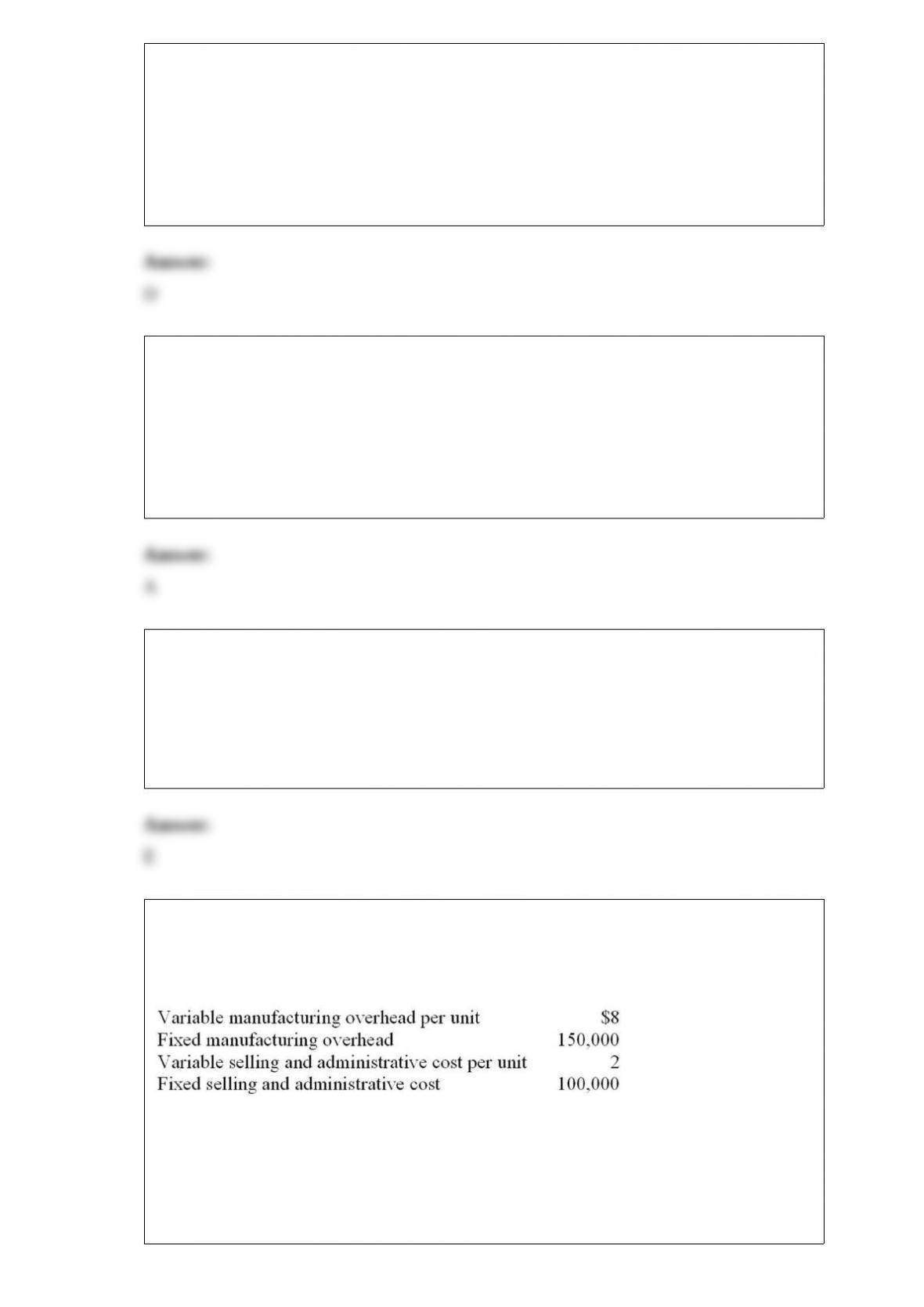
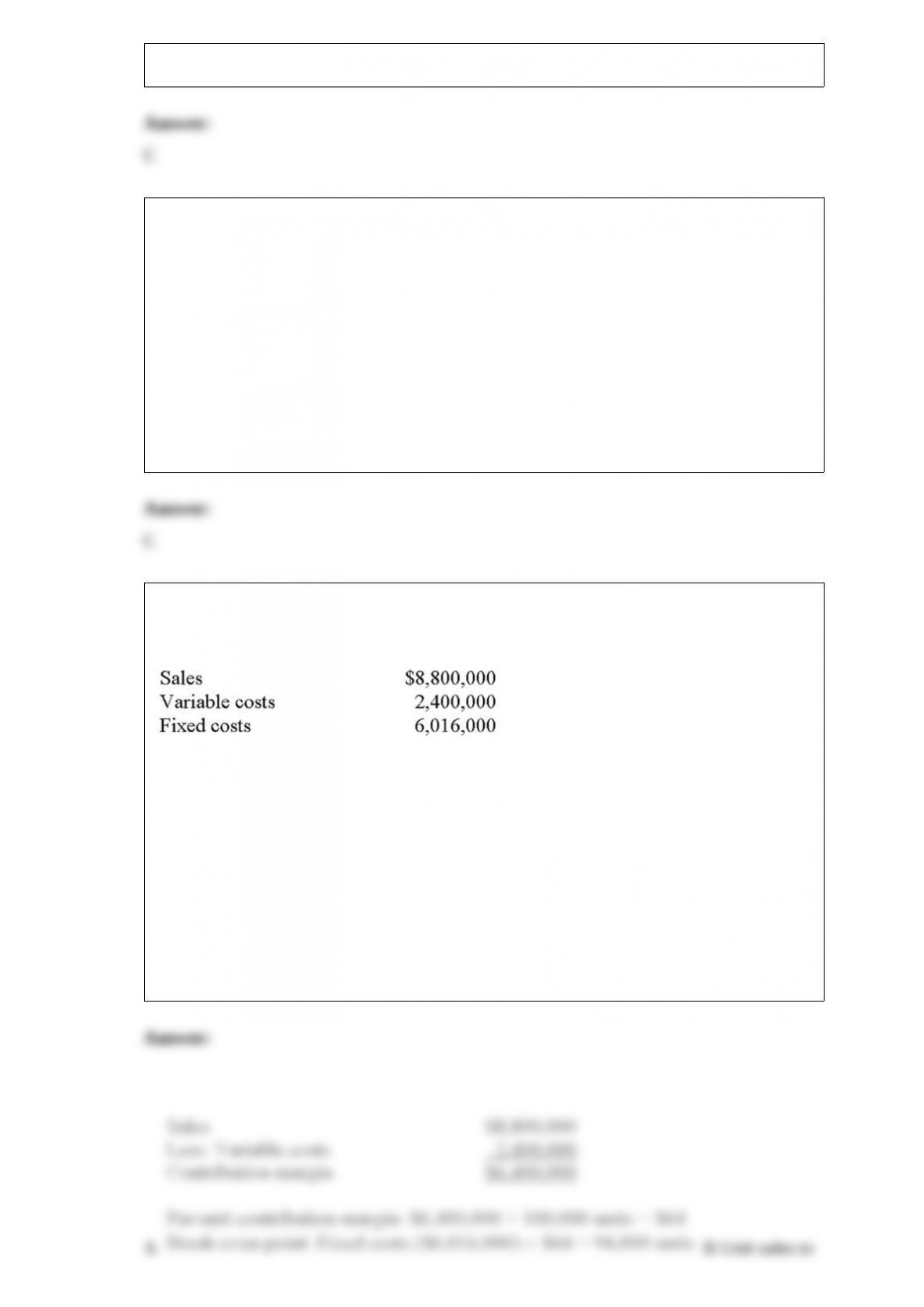
10) Chino began business at the start of the current year. The company planned to
produce 25,000 units, and actual production conformed to expectations. Sales totaled
22,000 units at $30 each. Costs incurred were:
If there were no variances, the company’s absorption-costing income would be:
A.$190,000
B.$202,000
C.$208,000
D.$220,000
E.None of the other answers are correct
11) The market value of Glenwood’s debt and equity capital totals $180 million, 80% of
which is equity related. An analysis conducted by the company’s finance department
revealed a 7% after-tax cost of debt capital and a 10% cost of equity capital. On the
basis of this information, Glenwood’s weighted-average cost of capital:
A.is 7.6%
B.is 8.5%
C.is 9.4%
D.cannot be determined based on the data presented because the cost of debt capital
must be stated on a before-tax basis
E.cannot be determined based on the data presented because the cost of equity capital
must be stated on an after-tax basis
12) The information that follows was obtained from the accounting records of
Gladstone Manufacturing during a period when the company sold 100,000 units.
Required:
A. Compute the company’s per-unit contribution margin and break-even point in units.
B. How many units must Gladstone sell to produce a target profit of $550,400?
C. Assume that Gladstone was able to reduce the variable cost per unit by $4. What
selling price could management charge if it desired to maintain the current break-even
point?
D. Depreciation charges of $640,000 are included in the firm’s fixed costs of
$6,016,000. If these charges were to increase by 10%, what effect, if any, would this
cost increase have on the company’s contribution margin?

13) Dunwoody Corporation has two service departments (Maintenance and Human
Resources) and three production departments (Machining, Assembly, and Finishing).
The two service departments service the production departments as well as each other,
and studies have shown that Maintenance provides the greater amount of service. On
the basis of this information, which of the following cost allocations would likely occur
under the step-down method?
A.Machining cost would be allocated to Assembly
B.Maintenance cost would be allocated to Finishing
C.Maintenance cost would be allocated to Human Resources
D.Human Resources cost would be allocated to Maintenance
E.Both maintenance cost would be allocated to Finishing and maintenance cost would
be allocated to Human Resources
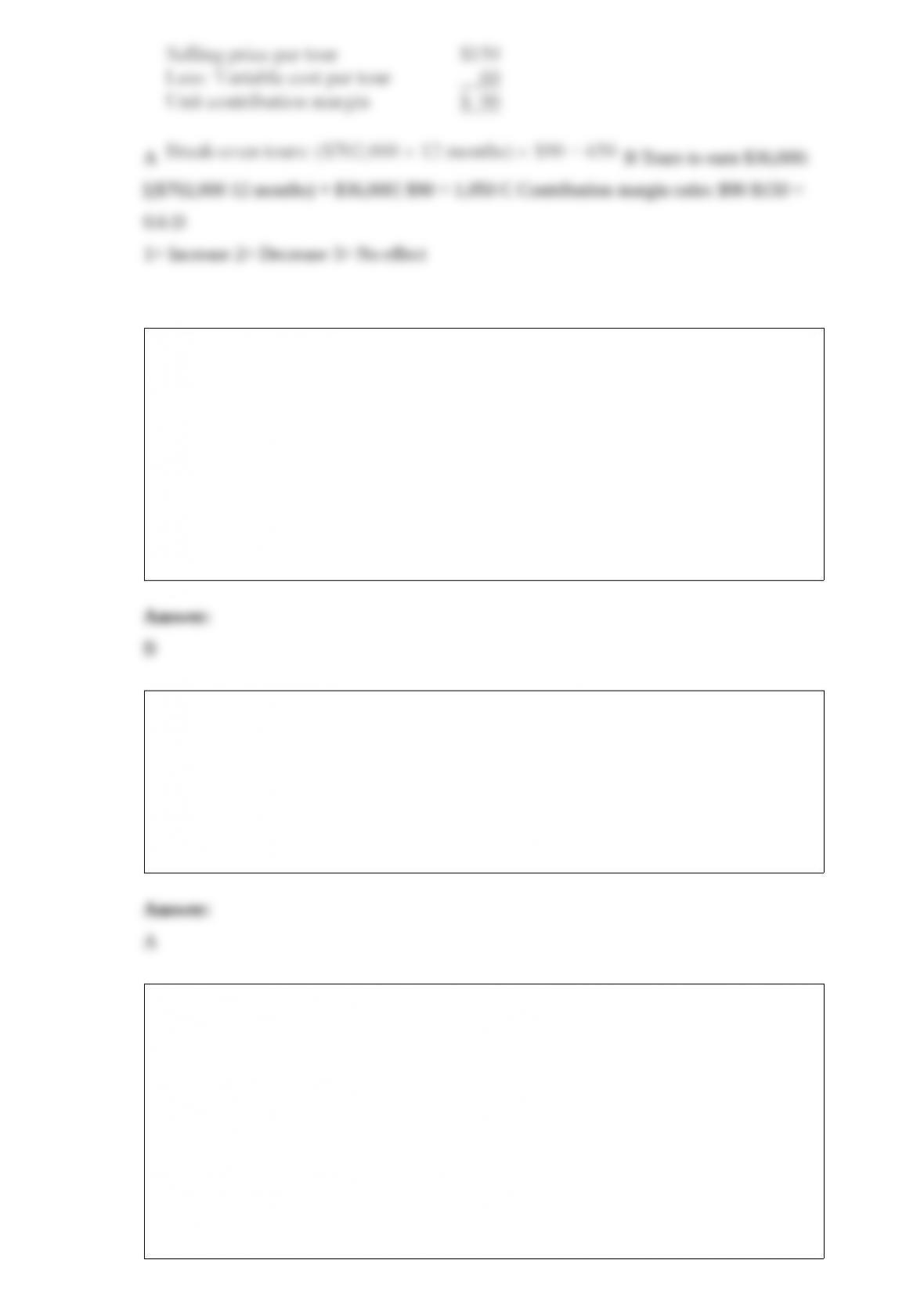
14) Seventh Heaven takes tourists on helicopter tours of Hawaii. Each tourist buys a
$150 ticket; the variable costs average $60 per person. Seventh Heaven has annual
fixed costs of $702,000.
Required:
A. Compute the average number of tours the company must conduct per month to break
even.
B. Compute the average sales revenue needed per month to produce a target average
profit of $36,000 per month. See below (answer to “B”).
C. Calculate the contribution margin ratio.
D. Determine whether the actions that follow will increase, decrease, or not affect the
company’s break-even point.
1> A decrease in tour prices.
2> The termination of a salaried clerk (no replacement is planned).
3> A decrease in the number of tours sold.
15) Miller Company has an operating leverage factor of 5 . Which of the following
statements is true?
Thus, an 8% change in ______ should result in a 40% change in _____. The respective
amounts that change are:
A.An 8% change in income should result in a 40% change in sales revenue
B.An 8% change in sales revenue should result in a 40% change in income
C.An 8% change in variable costs should result in a 40% change in contribution margin
D.An 8% change in fixed costs should result in a 40% change in income
E.An 8% change in variable costs should result in a 40% change in break-even sales
16) Which of the following employees of a commercial printer/publisher would be
classified as direct labor?
A.Book binder
B.Plant security guard
C.Sales representative
D.Plant supervisor
E.Payroll supervisor
17) Consider the following statements about joint product cost allocation:
I. Joint product cost is allocated because it is necessary for inventory valuation.
II. Joint product cost is allocated because it is necessary for making economic decisions
about individual products (e.g., sell at split-off or process further).
III. Joint cost may be allocated to products by using several different methods.
Which of the above statements is (are) correct?
A.I only
B.III only
C.I and II
D.I and III
E.I, II, and III
18) Consider the following statements about capital budgeting postaudits:
I. Postaudits can be used to detect desirable projects that were rejected.
II. Postaudits can be used to detect undesirable projects that were accepted.
III. Postaudits may reveal shortcomings in cash-flow projections, providing insights
that allow a company to improve future predictions.
Which of the above statements is (are) correct?
A.I only
B.II only
C.III only
D.II and III
E.I, II, and III
19) Briefly define and discuss the terms in each of the pairs that follow.
A. Direct and indirect costs
B. Direct materials and indirect materials
C. Manufacturing overhead and direct labor

20) The following costs relate to Southern Company: Variable manufacturing cost, $30;
variable selling and administrative cost, $8; applied fixed manufacturing overhead, $15;
and allocated fixed selling and administrative cost, $4. If Southern uses total-cost
pricing formulas, the company’s markup percentage would be computed on the basis of:
A.$30
B.$38
C.$45
D.$57
E.none of the other answers are correct
21) Consider the following statements about companies that are involved with
international operations:
I. Budgeting for these firms is often very involved because of fluctuating values in
foreign currencies.
II. Multinational firms may encounter hyperinflationary economies.
III. Such organizations often face changing laws and political climates that affect
business activity.
Which of the above statements is (are) true?
A.I only
B.III only
C.I and II
D.II and III
E.I, II, and III
22) Alexander Corporation produces flat-screen computer monitors. Consider the
following selected costs that arose during the current year:
1> Direct materials used: $3,640,000
2> Plant rent, utilities, and taxes: $1,229,000
3> New technology design engineering: $2,040,000
4> Materials receiving: $318,000
5> Manufacturing-run/set-up charges: $115,000
6> Equipment depreciation: $92,000
7> General management salaries: $1,564,000
Required:
A. Briefly distinguish between batch-level and facility-level activities.

B. Determine the cost of the firm’s unit-level, batch-level, product-sustaining, and
facility-level activities.
23) Falcon Enterprises, which manufactures lawn mowers, recently installed a
just-in-time purchasing system and an activity-based management program.
Required:
A. Determine whether the following items would be apt to increase or decrease as a
result of the just-in-time system:
1> Inventory storage costs.
2> Number of suppliers used.
3> Number of raw material shipments handled.
4> Dollars available for alternative investment opportunities.
5> Quality of raw materials purchased.
B. Identify the following items as value-added activities, non-value-added activities, or
both.
1> Attaching the engine to the mower’s body.
2> Installing a new air-conditioning system in the executive offices.
3> Replacing a defective wheel with a new wheel.
4> Designing and printing an owner’s instruction manual for a new model.
5> Moving completed mowers to the finished-goods warehouse.
6> Attaching the handle to the mower’s body. The process took longer than normal
because of a worker slowdown caused by disgruntled employees.
24) The role of managerial accounting information in assisting management is a(n):
A.financial-directingrole
B.attention-directing role
C.planning and controlling role
D.organizational role
E.problem-solving role
25) Marcie Simone is the long-time catering director of Naples-on-the-Beach, a hotel
noted throughout the industry for quality, profitability, and cost control. The hotel
recently catered a steak dinner for a 2,000-person convention. Strict standards were in
place for the dinner: 0.75 pounds of beef per plate at $9 per pound. A review of the
accounting records shortly after the convention showed that 1,680 pounds of beef were
purchased and consumed, costing the hotel $13,440.
Required:
A. Calculate the cost of beef budgeted for the dinner and the total beef variance (i.e.,
the difference between budgeted and actual cost). Should this variance be of concern to
the hotel? Why?
B. Assess the job that Simone did in “managing” the beef purchase by performing a
variance analysis. Comment on your findings.
C. Assume that the hotel received a number of complaints shortly after the dinner
concluded.
Explain a possible reason behind the conventioneers’ unhappiness.
26) The comprehensive set of budgets that serves as a company’s overall financial plan
is commonly known as:
A.an integrated budget
B.a pro-forma budget
C.a master budget
D.a financial budget
E.a rolling budget
27) ADF provides consulting services and uses a job-order system to accumulate the
cost of client projects. Traceable costs are charged directly to individual clients; in
contrast, other costs incurred by ADF, but not identifiable with specific clients, are
charged to jobs by using a predetermined overhead application rate. Clients are billed
for directly chargeable costs, overhead, and a markup.
ADF anticipates the following costs for the upcoming year:
ADF’s partners desire to make a $480,000 profit for the firm and plan to add a
percentage markup on total cost to achieve that figure.
On May 14, ADF completed work on a project for Lawrence Manufacturing. The
following costs were incurred: professional staff salaries, $68,000; administrative
support staff, $8,900; travel, $10,500; and other operating costs, $2,600.
Required:
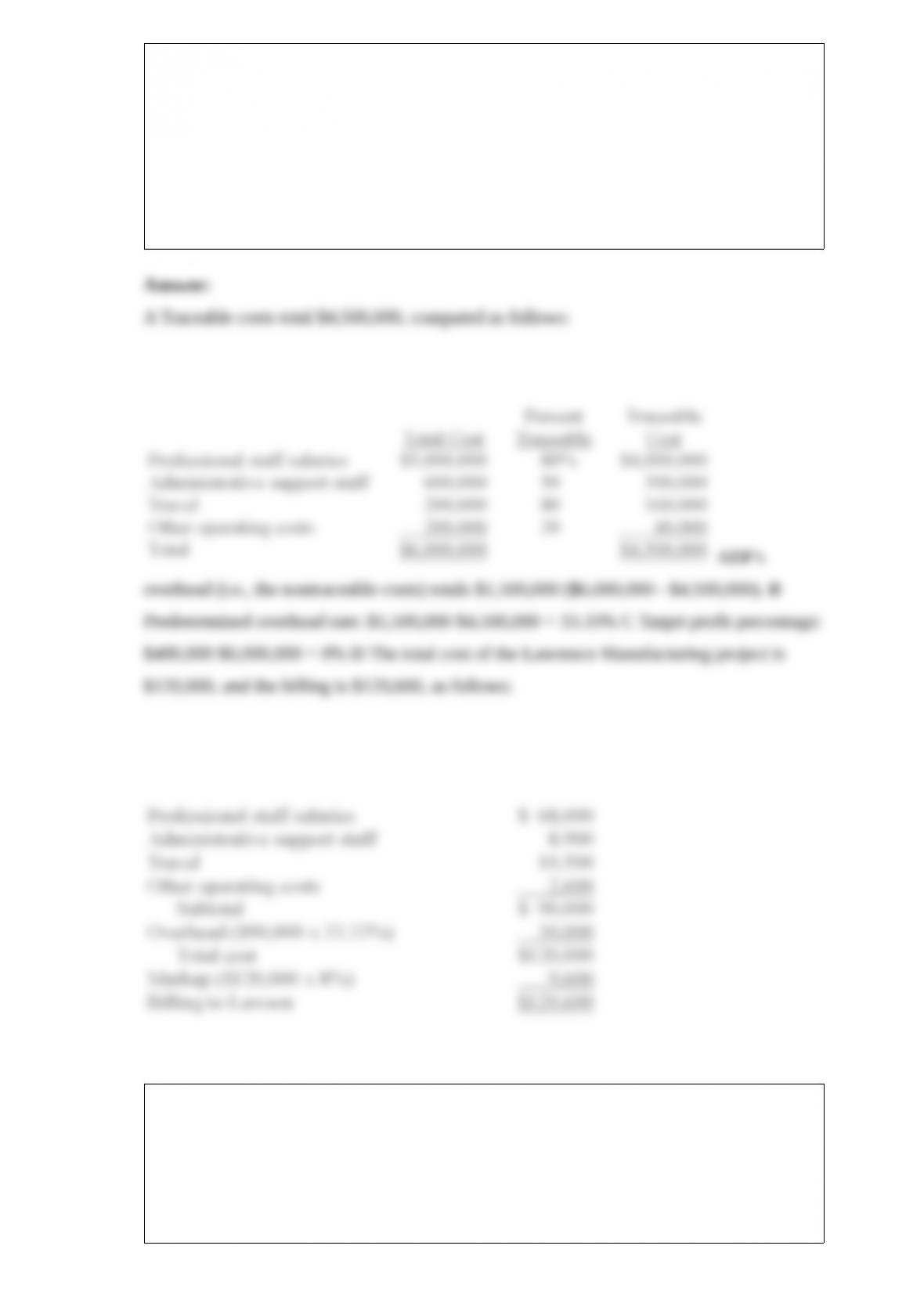
A. Determine ADF’s total traceable costs for the upcoming year and the firm’s total
anticipated overhead.
B. Calculate the predetermined overhead rate. The rate is based on total costs traceable
to client jobs.
C. What percentage of total cost will ADF add to each job to achieve its profit target?
D. Determine the total cost of the Lawrence Manufacturing project. How much would
Lawrence be billed for services performed?
28) Discounted-cash-flow analysis focuses primarily on:
A.the stability of cash flows
B.the timing of cash flows
C.the probability of cash flows
D.the sensitivity of cash flows
E.whether cash flows are increasing or decreasing
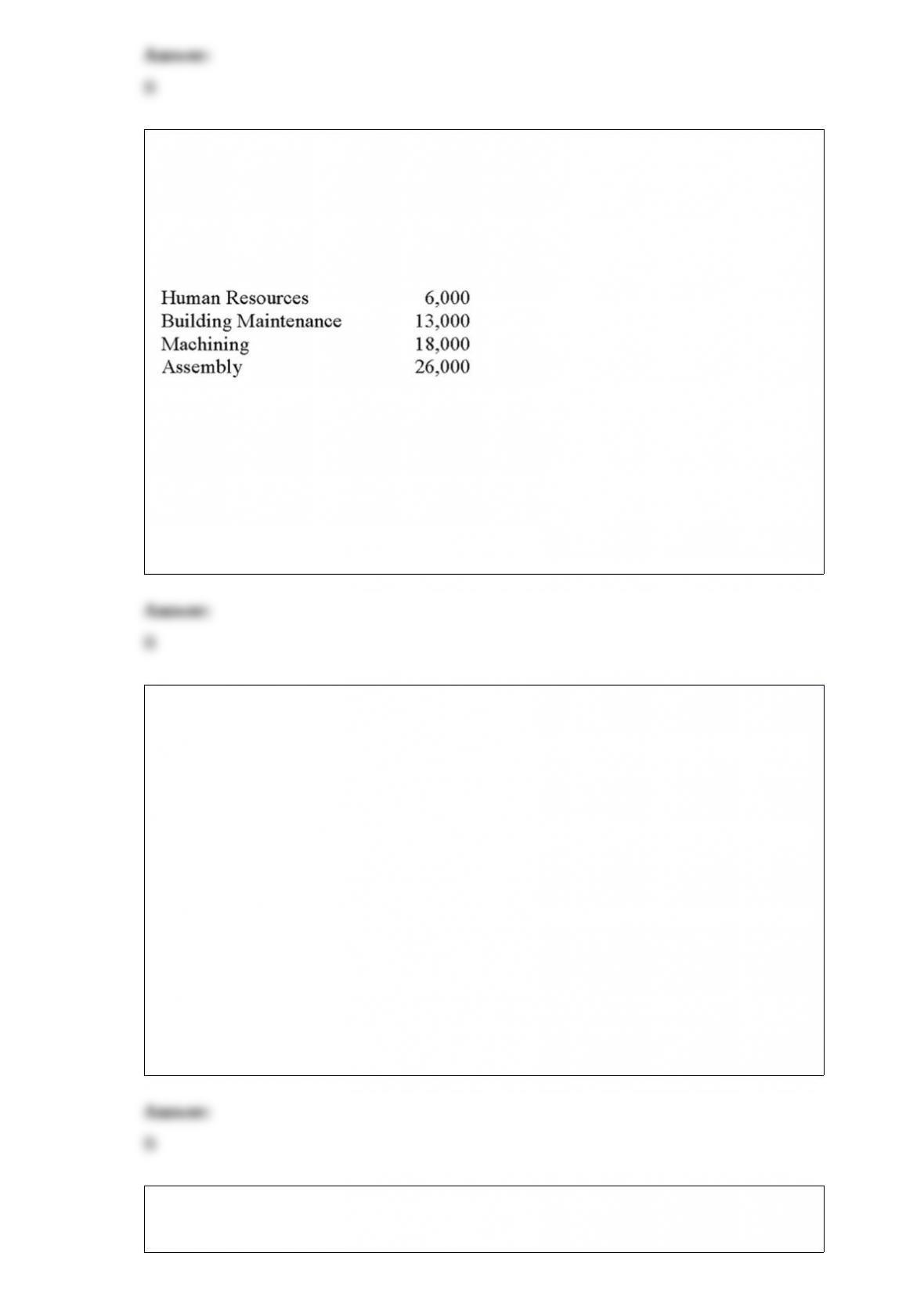
29) Martina, Inc. has two service departments (Human Resources and Building
Maintenance) and two production departments (Machining and Assembly). The
company allocates Building Maintenance cost on the basis of square footage and
believes that Building Maintenance provides more service than Human Resources. The
square footage occupied by each department follows.
Assuming use of the direct method, over how many square feet would the Building
Maintenance cost be allocated (i.e., spread)?
A.19,000
B.44,000
C.50,000
D.63,000
E.More information is needed to judge
30) Universal Manufacturing uses a weighted-average process-costing system. All
materials are introduced at the start of manufacturing, and conversion costs are incurred
evenly throughout the process. The company’s beginning and ending work-in-process
inventories totaled 10,000 units and 15,000 units, respectively, with the latter units
being 2/3 complete at the end of the period. Universal started 30,000 units into
production and completed 25,000 units. Manufacturing costs follow.
Beginning work in process: Materials, $60,000; conversion cost, $150,000
Current costs: Materials, $180,000; conversion cost, $480,000
Universal’s equivalent-unit cost for conversion cost is:
A.$13.71
B.$18.00
C.$21.00
D.$25.20
E.None of the answers is correct
31) The salary that is sacrificed by a college student who pursues a degree full time is
a(n):
A.sunk cost
B.out-of-pocket cost
C.opportunity cost
D.differential cost
E.marginal cost
32) In early July, Jim Lopez purchased a $70 ticket to the December 15 game of the
Chicago Titans. (The Titans belong to the Midwest Football League and play their
games outdoors on the shore of Lake Michigan.) Parking for the game was expected to
cost approximately $22, and Lopez would probably spend another $15 for a souvenir
program and food. It is now December 14 . The Titans were having a miserable season
and the temperature was expected to peak at 5 degrees on game day. Jim is thinking
about skipping the game and taking his wife to the movies and dinner, at a cost of $50.
The amount of sunk cost that should influence Jim’s decision to spend some time with
his wife is:
A.$0
B.$20
C.$50
D.$70
E.None of the other answers are correct
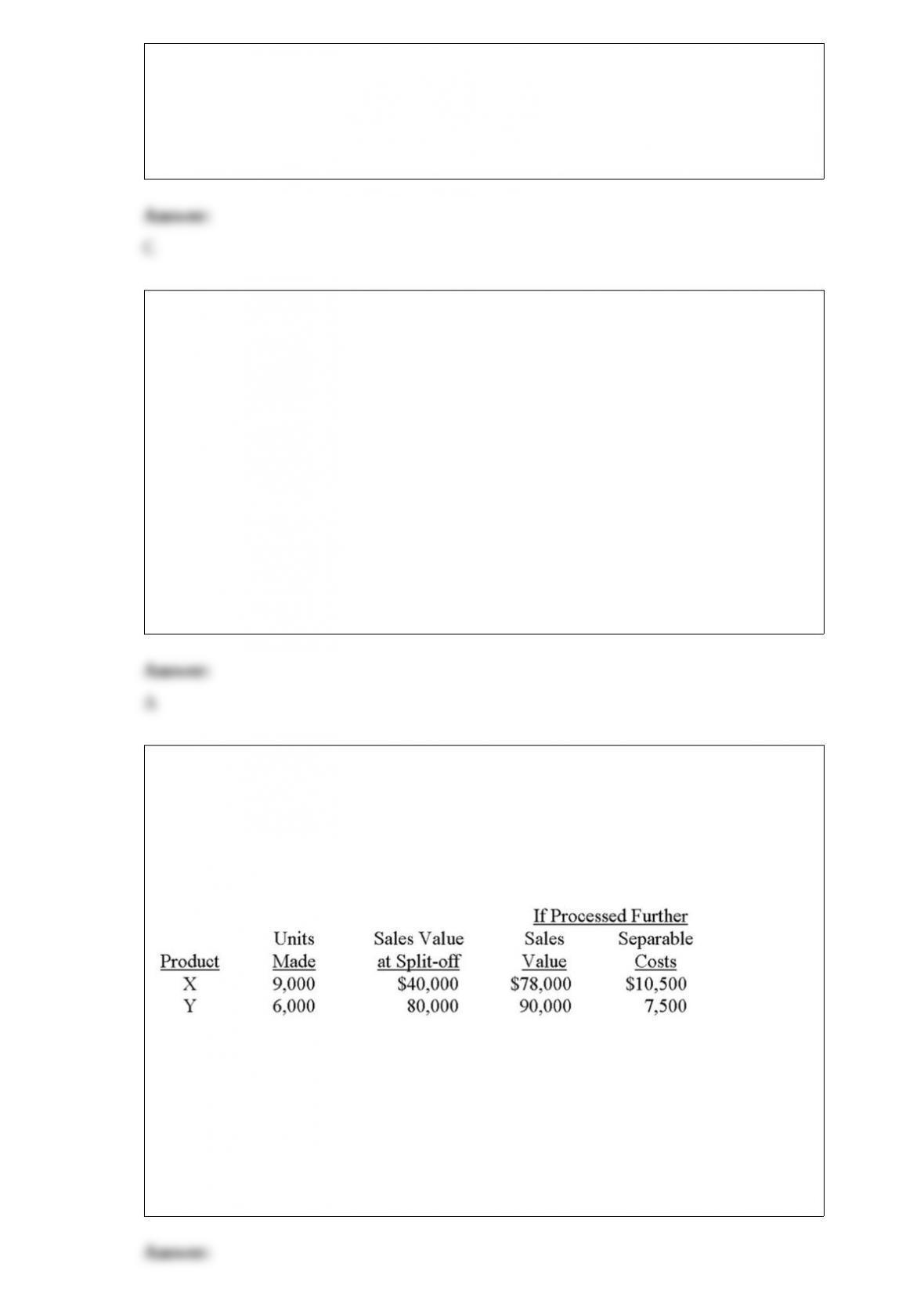
33) Rocky Mountain Company produces two products (X and Y) from a joint process.
Each product may be sold at the split-off point or processed further. Additional
processing requires no special facilities, and production costs of further processing are
entirely variable and traceable to the products involved. Joint manufacturing costs for
the year were $60,000. Sales values and costs were as follows:
If the joint production costs are allocated based on the net-realizable-value method, the
amount of joint cost assigned to product Y would be:
A.$20,000
B.$27,000
C.$33,000
D.$40,000
E.None of the other answers are correct

34) Mad’s Hatters Corporation will evaluate a potential investment in an advanced
manufacturing system by use of the net-present-value (NPV) method. Which of the
following system benefits is least likely to be omitted from the NPV analysis?
A.Savings in operating costs
B.Greater flexibility in the production process
C.Improved product quality
D.Shorter manufacturing cycle time
E.Ability to fill customer orders more quickly
35) Swedish Cruise Lines (SCL), which operates in a very competitive marketplace, is
considering four categories of performance measures: (1) profitability measures, (2)
customer-satisfaction measures, (3) efficiency and quality measures, and (4) learning
and growth measures. The company assigns one manager to each ship in its fleet to
oversee the ship’s general operations. If SCL desired to adopt a balanced-scorecard
approach, which measures should the firm use in the evaluation of its managers?
A.1
B.1, 2
C.2, 3
D.1, 2, 4
E.1, 2, 3, 4
36) When graphing the EOQ, which of the following statements is false?
A.Holding costs are a downward sloping line to the right
B.The EOQ is represented by the minimum total cost
C.Ordering costs are a downward sloping line to the right
D.Average inventory on hand results in higher holding costs
E.As order size increases, so does average inventory on hand
37) Which of the following statements regarding costs and decision making is correct?
A.Fixed costs must be considered only on a per-unit basis
B.Per-unit fixed cost amounts are valid only for make-or-buy decisions
C.Per-unit fixed costs can be misleading because such amounts appear to behave as
variable costs when, in actuality, the amounts are related to fixed expenditures
D.Sunk costs can be misleading in make-or-buy decisions because these amounts
appear to be relevant differential costs

E.Opportunity costs should be ignored when evaluating decision alternatives