
1) In a world with few impediments to capital mobility, the domestic interest rate equals
the sum of the foreign interest rate and the expected depreciation of the domestic
currency, a situation known as the
A) interest parity condition
B) purchasing power parity condition
C) exchange rate parity condition
D) foreign asset parity condition
2) Banks providing depositors with checking accounts that enable them to pay their
bills easily is known as
A) liquidity services
B) asset transformation
C) risk sharing
D) transaction costs
3) Adjustable-rate mortgages
A) benefit homeowners when interest rates are falling
B) reduce financial institutions’ interest-rate risk
C) reduce households’ risk of having to pay higher mortgage payments when interest
rates rise
D) do only A and B of the above
4) With an interest rate of 8 percent, the present value of $100 received one year from
now is approximately
A) $93
B) $96
C) $100
D) $108
5) A decrease in the expected rate of inflation will ________ the expected return on
bonds relative to that on ________ assets.
A) reduce; financial
B) reduce; real

C) raise; financial
D) raise; real
6) If a bond has a favorable tax treatment, its required interest rate (all else equal)
A) will be higher
B) will not be affected
C) will be lower
D) all of the above could happen
7) Government bonds are essentially default risk-free, ________ returns.
A) and will yield high
B) and will yield the highest
C) but will have relatively low
D) none of the above
8) The problem of adverse selection helps to explain
A) which firms are more likely to obtain funds from banks and other financial
intermediaries, rather than from securities markets
B) why collateral is an important feature of consumer, but not business, debt contracts
C) why direct finance is more important than indirect finance as a source of business
finance
D) only A and B of the above
9) The largest operating expense for a bank is
A) salaries and employee benefits
B) interest paid on discount loans
C) interest paid on federal funds borrowed from other banks
D) interest paid on deposits

10) According to the market segmentation theory of the term structure,
A) the interest rate for bonds of one maturity is determined by the supply and demand
for bonds of that maturity
B) bonds of one maturity are not substitutes for bonds of other maturities; therefore,
interest rates on bonds of different maturities do not move together over time
C) investors’ strong preference for short-term relative to long-term bonds explains why
yield curves typically slope downward
D) only A and B of the above
11) The advantage of mutual funds is that they
A) require no cash up front
B) give investors with relatively small amounts of cash to invest access to
large-denomination securities
C) always yield the highest returns
D) both A and B of the above
12) Before 1863,
A) the Federal Reserve System regulated only federally chartered banks
B) the Comptroller of the Currency regulated both state and federally chartered banks
C) the number of federally chartered banks grew at a much faster rate than at any other
time since the end of the Civil War
D) none of the above occurred
13) A decline in the price level causes the demand for money to ________ and the
demand curve to shift to the ________
A) decrease; right
B) decrease; left
C) increase; right
D) increase; left
14) Between 1995 and 2009, the amount of credit default swaps (CDSs) exploded,
along with the marketing of securitized mortgages. By their peak in 2008, there were
about ________ of CDSs outstanding.

A) $62 million
B) $62 billion
C) $6.2 trillion
D) $62 trillion
15) If a bank has $200,000 of deposits, a required reserve ratio of 20 percent, and
$80,000 in reserves, then the maximum deposit outflow it can sustain without altering
its balance sheet is
A) $50,000
B) $40,000
C) $30,000
D) $25,000
16) Banks attempt to screen good credit risks from bad to reduce the incidence of loan
defaults. To do this, banks
A) specialize in lending to certain industries or regions
B) write restrictive covenants into loan contracts
C) expend resources to acquire accurate credit histories of their potential loan
customers
D) do all of the above
17) Which of the following statements about financial markets and securities are
TRUE?
A) Most common stocks are traded over-the-counter, although the largest corporations
have their shares traded at organized stock exchanges such as the New York Stock
Exchange
B) A corporation acquires new funds only when its securities are sold in the primary
market
C) Money market securities are usually more widely traded than longer-term securities
and so tend to be more liquid
D) All of the above are true
E) Only A and B of the above are true

18) The earliest examples of finance companies date back to the beginning of the
________ when retailers offered installment credit to customers.
A) 1800s
B) 1900s
C) 1950s
D) 1980s
19) Which of the following features of Treasury bond futures contracts were not
designed to increase liquidity?
A) standardized contracts
B) traded up until maturity
C) not tied to one specific type of bond
D) marked to market daily
20) If Second National Bank has more rate-sensitive liabilities than rate-sensitive
assets, it can reduce interest-rate risk with a swap which requires Second National to
A) pay a fixed rate while receiving a floating rate
B) receive a fixed rate while paying a floating rate
C) both receive and pay a fixed rate
D) both receive and pay a floating rate
21) Which of the following is an advantage to investors of an open-end mutual fund?
A) Once all the shares have been sold, the investor does not have to put in more money
B) The investors can sell their shares in the over-the-counter market with low
transaction fees
C) The fund agrees to redeem shares at any time
D) The market value of the fund’s shares may be higher than the value of the assets held
by the fund
22) Which of the following is true of mortgage interest rates?
A) Longer-term mortgages have lower interest rates than shorter-term mortgages
B) Mortgage rates are lower than Treasury bond rates because of the tax deductibility of
mortgage interest rates

C) In exchange for points, lenders reduce interest rates on mortgage loans
D) All of the above are true
E) Only A and B of the above are true
23) If you buy an option to buy Treasury futures at 115, and at expiration the market
price is 110,
A) the call will be exercised
B) the put will be exercised
C) the call will not be exercised
D) the put will not be exercised
24) In the early 1990s, to replenish the reserves of the Savings Association Insurance
Fund, insurance premiums for S&Ls were increased from ________ cents per $100 of
deposits to ________ cents and can rise as high as 32.5 cents.
A) 12.5; 17.5
B) 17.5; 20.5
C) 20.8; 23.0
D) 23.0; 27.8
25) Moral hazard and adverse selection problems increased in prominence in the 1980s
A) as deregulation opened up more avenues for savings and loans and mutual savings
banks to take on more risk
B) following a burst of financial innovation in the 1970s and early 1980s that produced
new financial instruments and markets, thereby widening the scope for risk taking
C) following an increase in federal deposit insurance from $40,000 to $100,000
D) because of all of the above
E) because of only A and B of the above
26) If a $5,000 coupon bond has a coupon rate of 13 percent, then the coupon payment
every year is
A) $650
B) $1,300
C) $130
D) $13
E) None of the above
27) Typically, the interest rate on corporate bonds will be ________ the more
restrictions are placed on management through restrictive covenants, because
________.
A) higher; corporate earnings will be limited by the restrictions
B) higher; the bonds will be considered safer by bondholders
C) lower; the bonds will be considered safer by buyers
D) lower; corporate earnings will be higher with more restrictions in place
28) Financial economists consider the ________ to be the most accurate measure of
interest rates.
A) simple interest rate
B) discount rate
C) yield to maturity
D) real interest rate
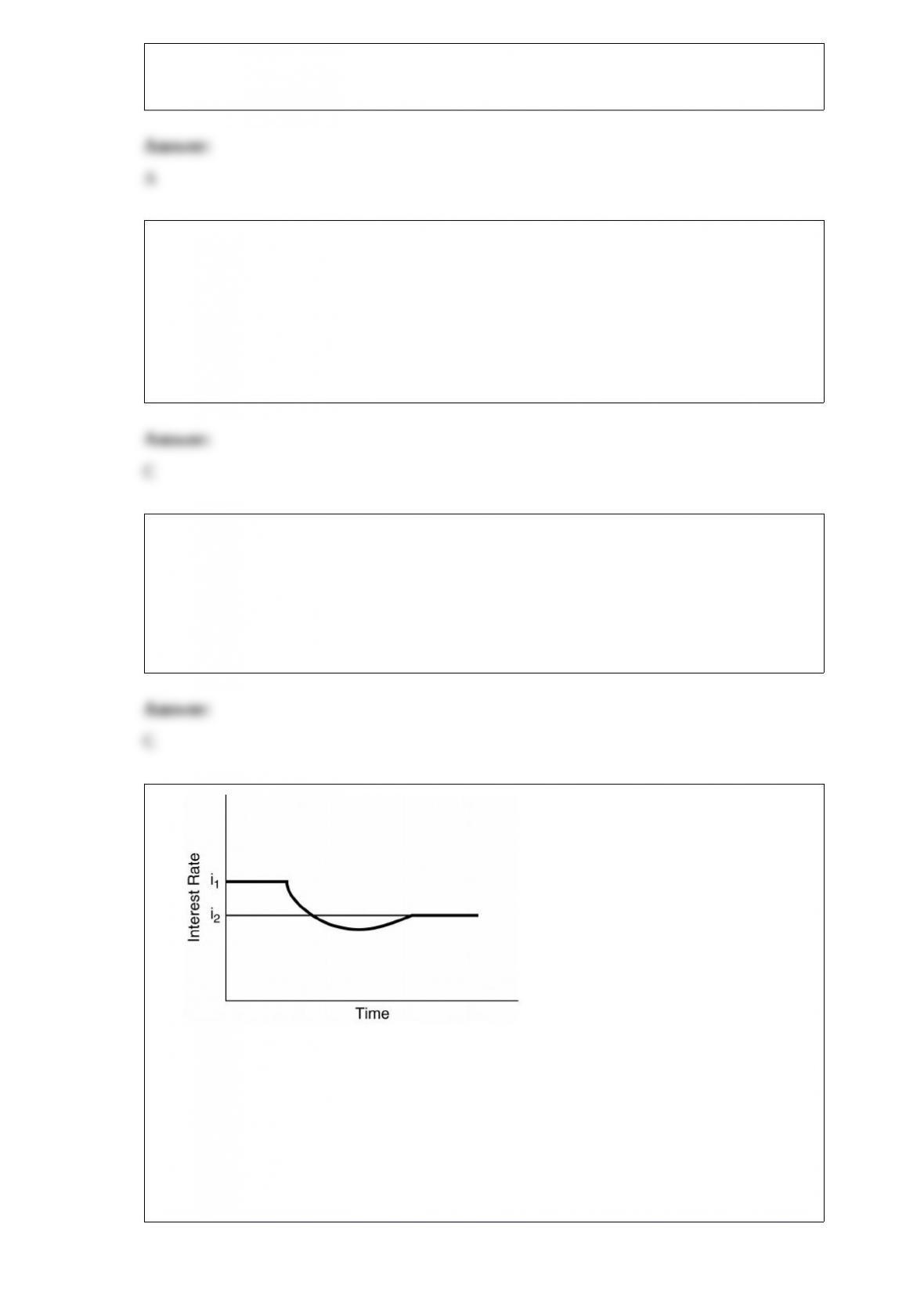
29)
Figure 4.4
Figure 4.4 illustrates the effect of an increased rate of money supply growth. From the
figure, one can conclude that the liquidity effect is ________ than the expected inflation
effect and interest rates adjust ________ to changes in expected inflation.
A) smaller; quickly
B) larger; quickly
C) larger; slowly
D) smaller; slowly

30) The National Banking Act of 1863, and subsequent amendments to it,
A) created a banking system of federally chartered banks
B) established the Office of the Comptroller of the Currency
C) broadened the regulatory powers of the Federal Reserve
D) did all of the above
E) did only A and B of the above
31) Brokerage firms that offered money market security accounts in the 1970s had a
cost advantage over banks in attracting funds because the brokerage firms
A) were not subject to deposit reserve requirements
B) were not subject to the deposit interest rate ceilings
C) were not limited in how much they could borrow from depositors
D) had the advantage of all the above
E) had the advantage of only A and B of the above
32) A disadvantage of dollarization is that it
A) prevents a central bank from creating inflation
B) avoids the possibility of a speculative attack on the domestic currency
C) does not allow a country to pursue its own independent monetary policy
D) is a strong commitment to exchange rate stability
33) The current account balance plus the capital account balance equals
A) the amount of unsterilized exchange market intervention
B) the trade balance
C) the net change in government international reserves
D) both A and C of the above
34) Which of the following do not help people during their retirement?
A) term life insurance

B) annuity
C) whole life insurance
D) universal life insurance
35) Investment banks may lose ________ if new securities issues are ________.
A) large amounts of money; oversubscribed
B) large amounts of money; fully subscribed
C) future business; oversubscribed
D) future business; undersubscribed
36) The agency which regulates stock options is the
A) Securities and Exchange Commission
B) Commodities Futures Trading Commission
C) Federal Trade Commission
D) Both A and B are true
37) The Bush tax cut passed in 2001 reduces the top income tax bracket from 39
percent to 35 percent over the next ten years. As a result of this tax cut, the demand for
municipal bonds should shift to the ________ and the interest rate on municipal bonds
should ________.
A) right; decline
B) right; increase
C) left; decline
D) left; increase