
Which is smallest if the interest rate is 10%?
a. present value of $100 annuity for five years
b. future value of $100 annuity for five years
c. present value of $100 after five years
d. $100 received right now
M-1 includes coins, currency, and ____.
a. demand deposits
b. savings accounts
c. certificates of deposit
d. time deposits
The cost of commercial paper (i.e., the interest rate)
a. increases as the paper’s price increases
b. decreases as the paper’s price increases
c. increases as the paper sells for a premium
d. decreases as the paper sells for a discount
The optimal capital structure involves
a. maximizing the cost of all funds
b. minimizing the cost of all funds
c. using no financial leverage
d. minimizing the weighted average of the cost of funds
Firm X has the following balance sheet:
Sales are currently $100,000 and management expects them to rise by 20 percent to
$120,000. The profit margin on sales is 10 percent and the firm distributes 30 percent of
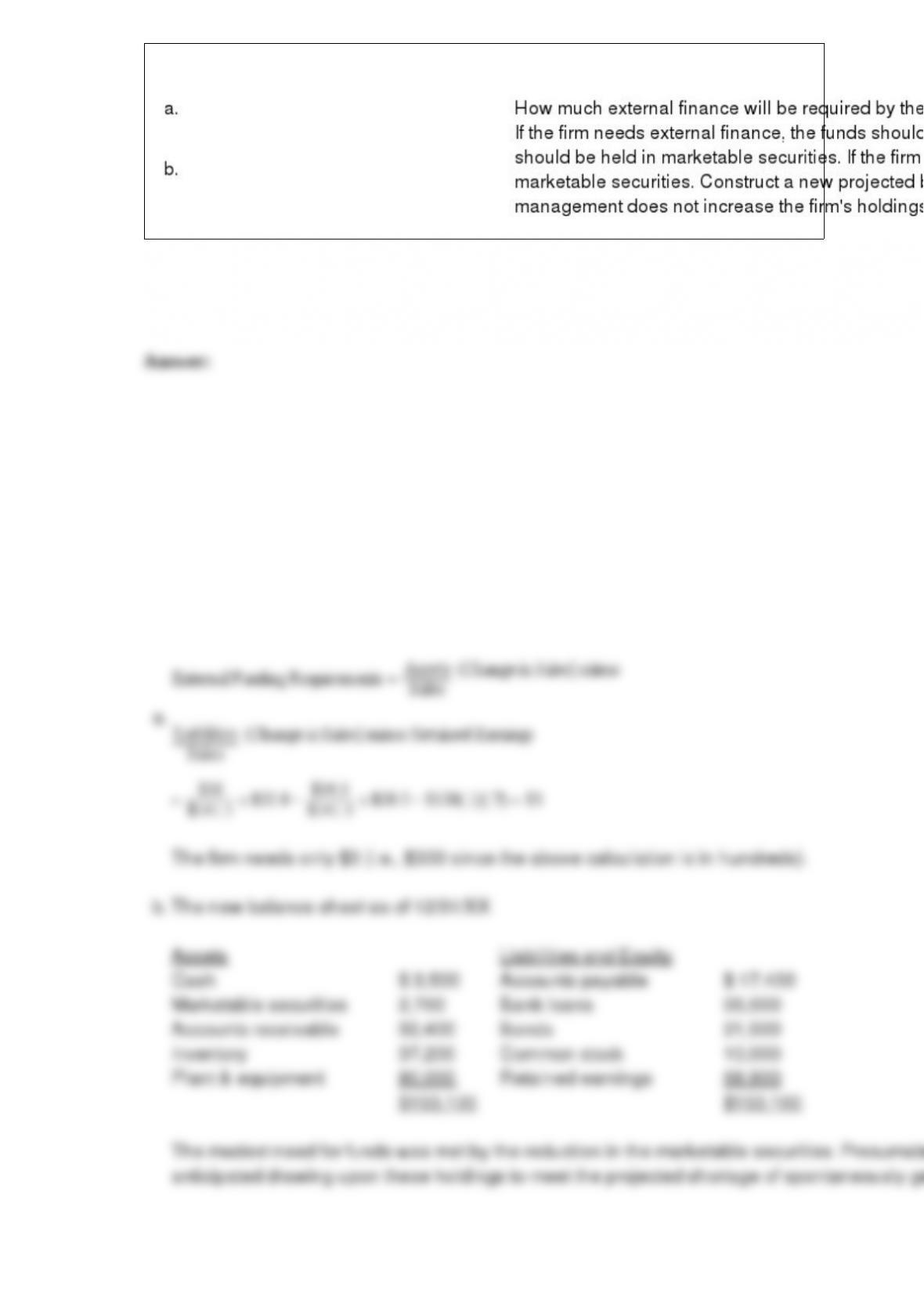
its earnings as cash dividends.

If an individual buys stock on margin and its price rises,
a. the investor must put up additional collateral
b. the investor must pay tax on the unrealized gain
c. the investor must pay interest on the borrowed funds
d. the investor may take delivery of the stock
Which of the following is the largest if the interest rate is 12 percent annually?
1) $100 compounded for three years
2) $100 annuity compounded for three years
3) the present value of $100 received after three years
a. 1
b. 2
c. 3
d. answer cannot be determined
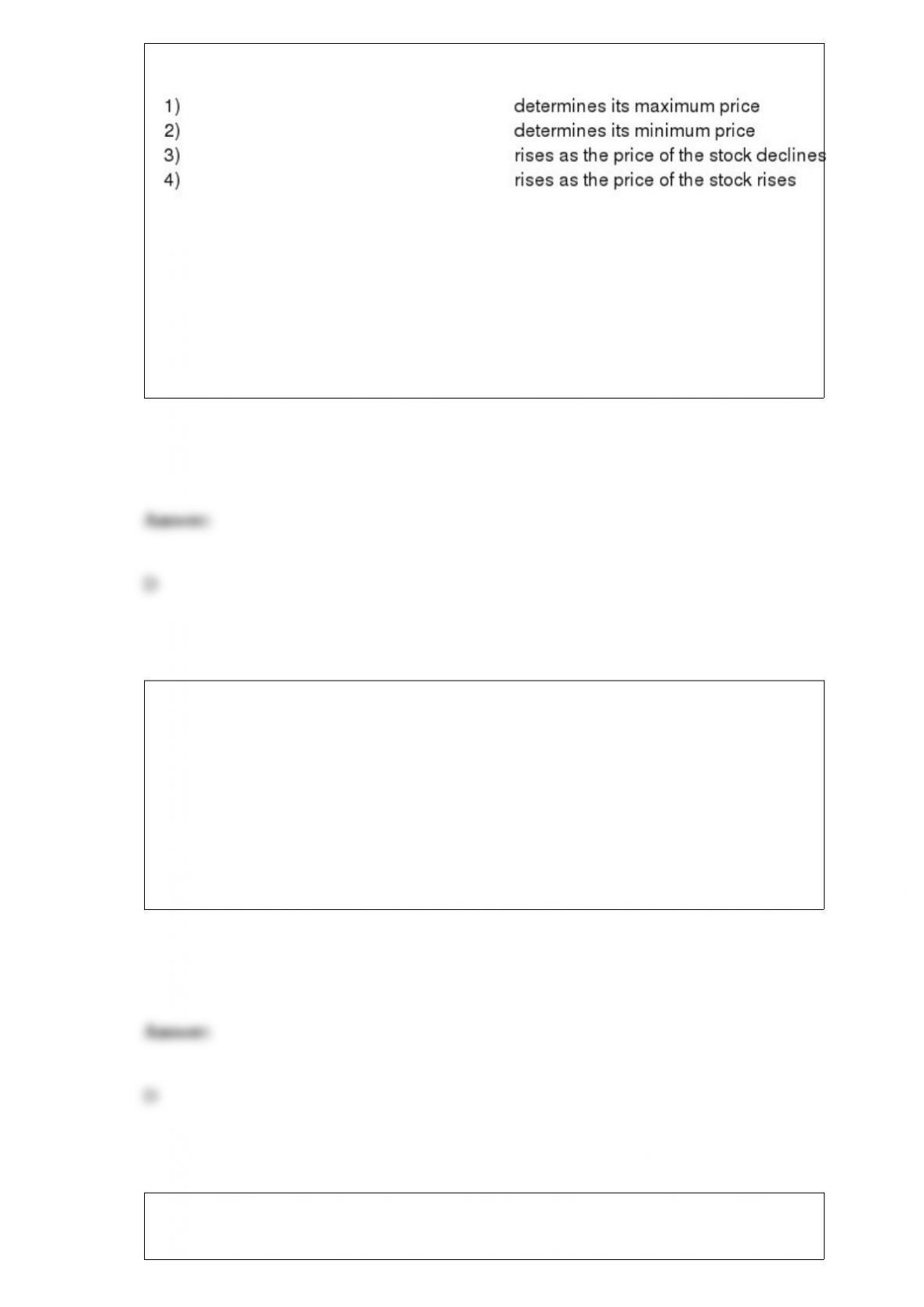
A call’s intrinsic value
a. 1 and 3
b. 1 and 4
c. 2 and 3
d. 2 and 4
Current liabilities do not include
a. short-term bank loans
b. accrued interest
c. accounts payable
d. additional paid-in capital (capital surplus)
If the internal rate of return of two mutually exclusive investments is less than the firm’s
cost of capital, the firm should make

a. both investments
b. neither investment
c. the investment with the higher internal rate of return
d. the investment with the lower net present value
Which of the following increases the firm’s net working capital?
a. an increase in plant financed by retained earnings
b. paying a cash dividend
c. retaining earnings and increasing the firm’s cash
d. paying off an account payable
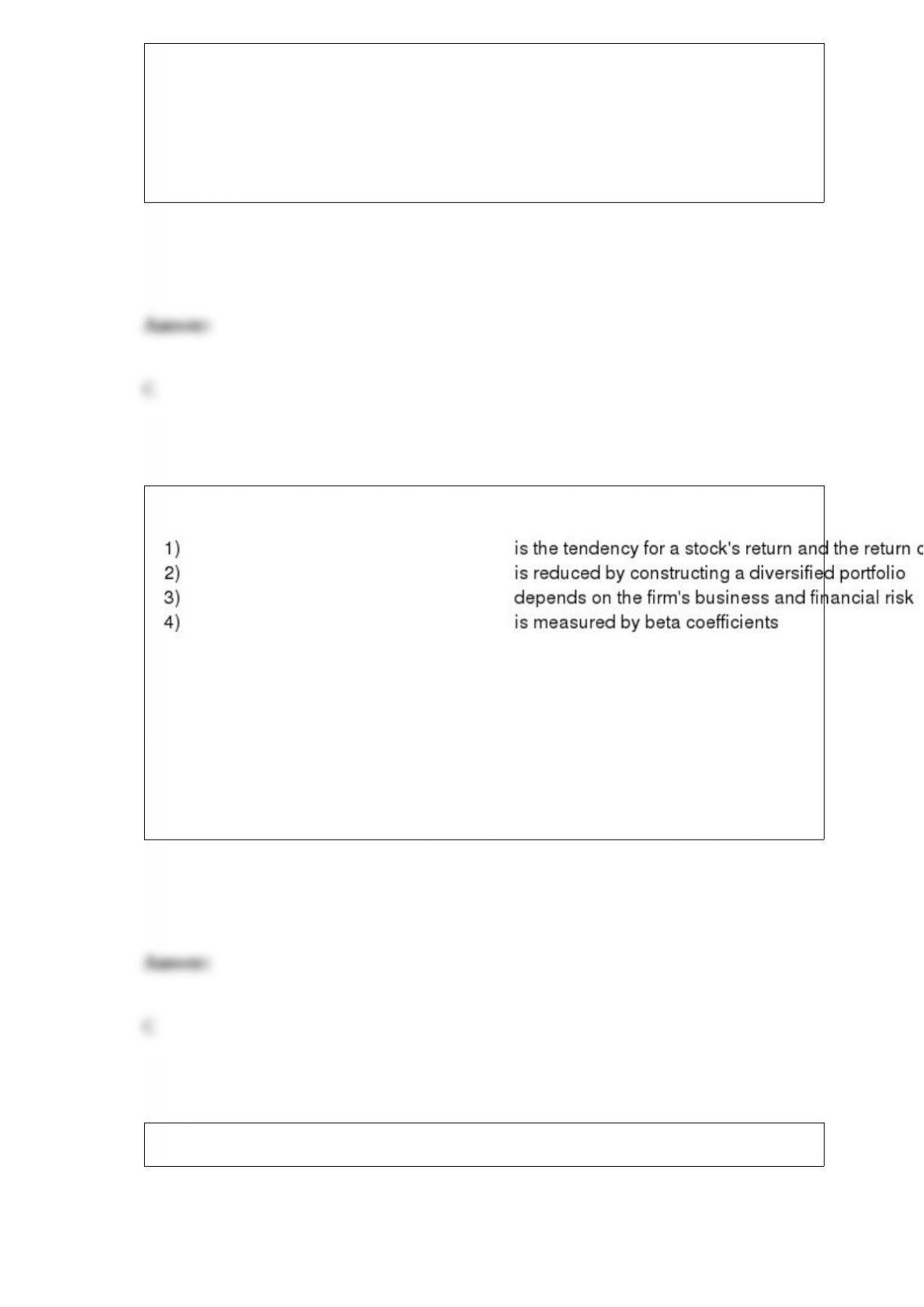
If the valuation of a stock is $20 and it currently sells for $25, then
a. 1 and 3
b. 1 and 4
c. 2 and 3
d. 2 and 4
Systematic risk
a. 1 and 2
b. 2 and 3
c. 1 and 4
d. 2 and 4
The Federal Reserve may contract the money supply by

a. 1 and 3
b. 1 and 4
c. 2 and 3
d. 2 and 4
Preferred stock increases common stockholders’ return
a. more than an equal dollar amount of debt
b. less than an equal dollar amount of debt
c. more than an equal dollar amount of retained earnings
d. less than an equal dollar amount of retained earnings
The lack of correlation between an investment’s return and the firm’s other investments
suggests

a. the investment has little risk
b. portfolio effects may exist
c. the investment’s beta coefficient is low
d. the investment’s net present value is negative
An investor may reduce risk by
a. 1 and 2
b. 1 and 3
c. 2 and 3
d. only 1
Commercial banks offer lines of credit, which
a. are the cheapest sources of long-term loans
b. permit firms to borrow short-term funds only as needed
c. are the cheapest sources of short-term funds
d. are available only to firms
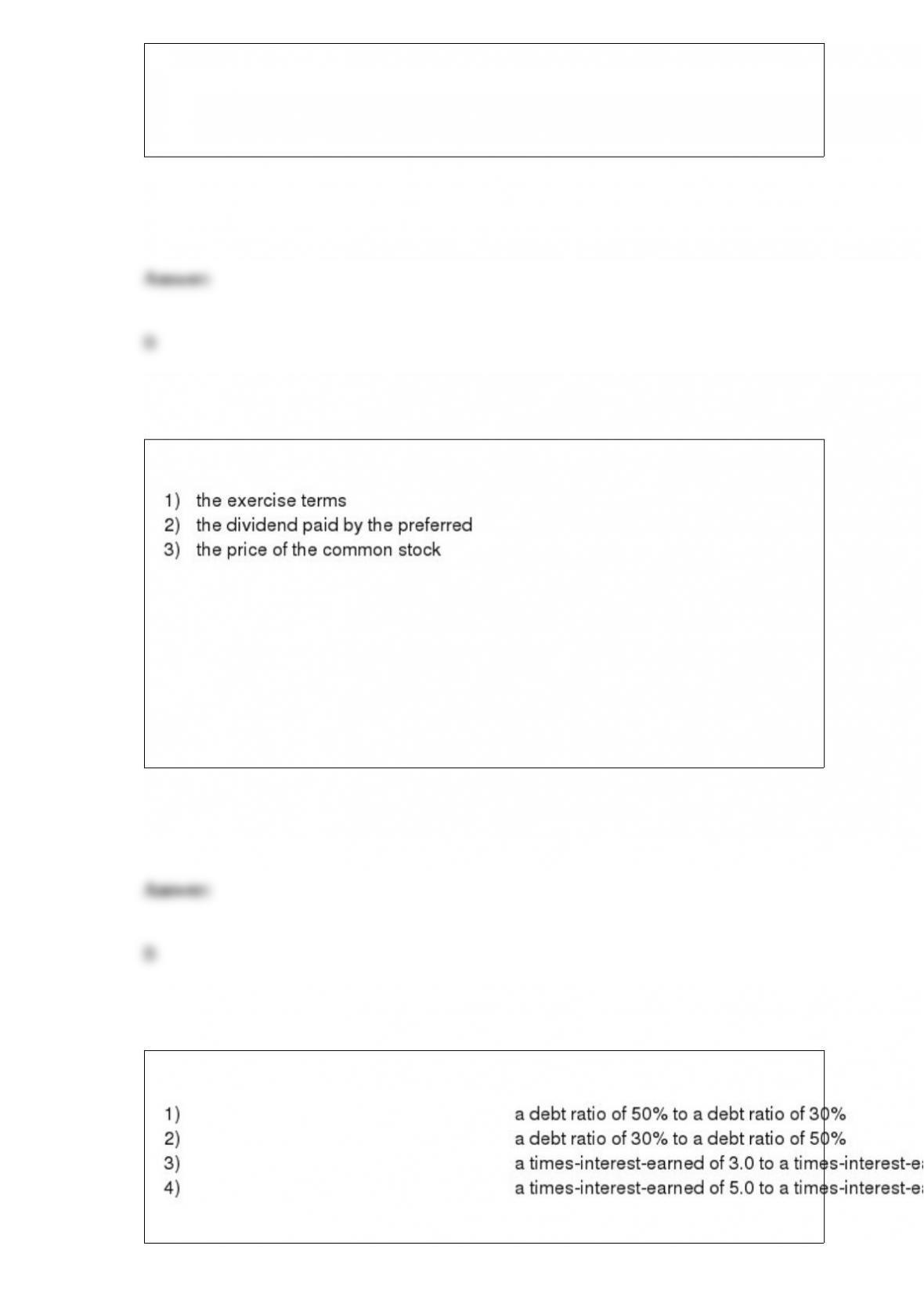
The value of convertible preferred stock as common stock depends on
a. 1 and 2
b. 1 and 3
c. 2 and 3
d. 1, 2, and 3
Owners of long-term debt instruments such as bonds would prefer

a. 1 and 3
b. 1 and 4
c. 2 and 3
d. 2 and 4
During a period of recession, a federal government surplus should retire debt owed
a. the Federal Reserve
b. commercial banks
c. the general public
d. the Federal Deposit Insurance Corporation
A beta coefficient for a risky stock is
a. less than 1.0
b. equal to 1.0
c. greater than 1.0
d. negative

A major weakness with the payback method is it failure to
a. consider the cost of an investment
b. consider an investment’s cash inflows
c. employ the firm’s cost of funds (capital)
d. rank investments
The portfolios of balanced funds
a. exclude American stocks
b. reduce systematic and purchasing power risks
c. are well diversified
d. generate the highest returns

Mutual funds
a. pay federal income taxes
b. distribute earnings to receive favorable tax treatment
c. pay only state and local taxes
d. pay taxes only on capital gains
The net asset value
a. is the price of an investment company’s shares
b. is reduced by the loading fee
c. declines if the value of the fund’s assets are reduced
d. measures the quality of the fund’s management
Term notes sold to the general public
a. are usually for twenty years
b. generally have collateral (i.e., are secured)

c. are generally non-callable
d. have variable interest rates
If the firm must buy silver in the future and thus pay for the metal in the future,
management may reduce the risk of loss from an increase in the price of silver by
a. taking a long position and entering a contract to buy silver
b. taking a short position and entering a contract to deliver silver
c. accepting delivery early
d. refusing to accept delivery if the price rises
The net asset value of a mutual fund’s share increases with
a. an increase in loading fees
b. an increase in interest rates
c. an increase in security prices
d. an increase in the fund’s assets

A closed-end investment company
a. has a fixed capital structure
b. issues new shares when an individual invests
c. redeems its shares
d. charges a loading fee
If a company enters bankruptcy court, bondholders should realize
a. subordinated debt is paid off at face value
b. convertible debt is superior because it may be converted into common stock
c. bondholders may lose their investments
d. stockholders have the superior position

The cash budget excludes
a. receipts
b. disbursements
c. tax payments
d. depreciation
A cash dividend reduces a firm’s equity.
Cash outflows that are not expenses (e.g., mortgage payments) are excluded from the
cash budget.
Banks tend to have more operating leverage than railroads.
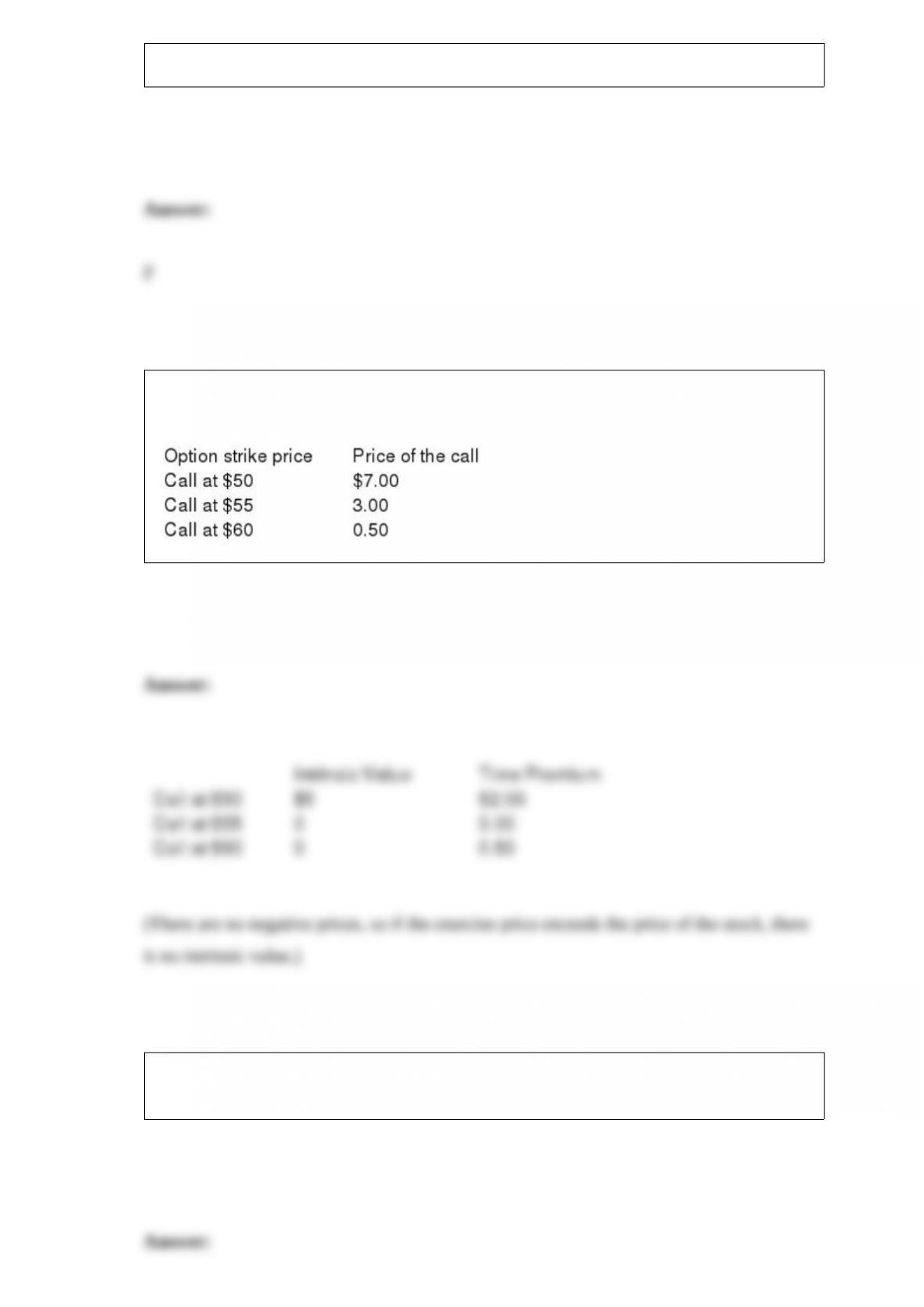
What are the following call options’ intrinsic values and time premiums if the price of
the underlying stock is $55?
An increase in accounts payable and in inventory suggests that net working capital also
increased.

Corporate bylaws specify the relationship between the corporation and the Securities
and Exchange Commission.
An investor may anticipate that a bond will be called if interest rates have risen.
An under-capitalized firm has excessive debt relative to equity.
A “no load” fund is a mutual fund with no fees.

Valuation of stock depends on past dividends.
If the Treasury borrows from the Federal Reserve, the lending capacity of banks is
reduced.
As interest rates increase, the probability that a convertible bond will be called declines.

The International Monetary Fund has the capacity to make loans to foreign
governments.
If forecasting over-predicts the level of an asset, the firm will over-plan its financial
needs.
Partnerships constitute the largest number of firms.
A cash dividend reduces the firm’s assets.

The economic order quantity is inversely related to carrying costs.
Factoring is selling accounts payable for cash.