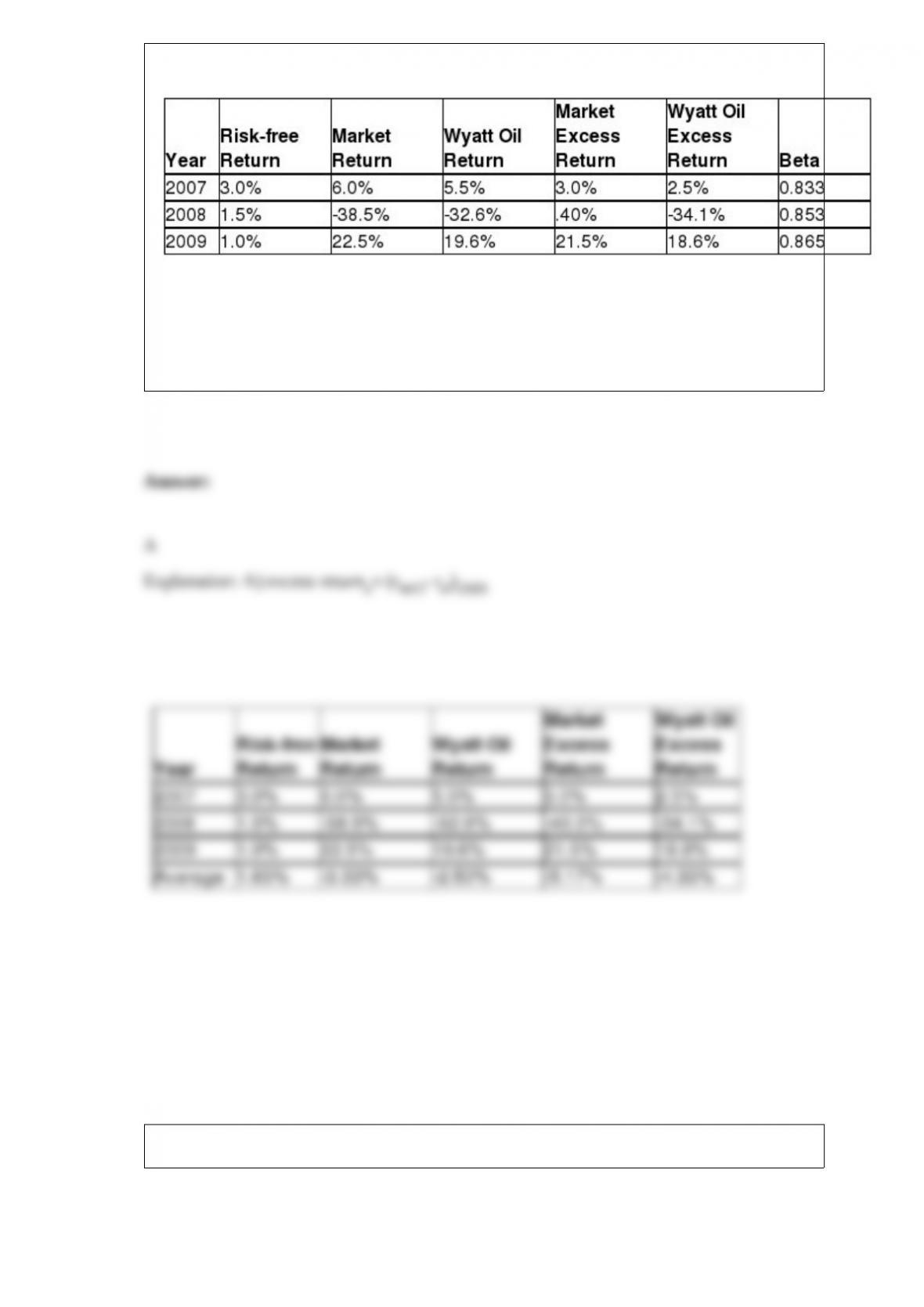
Wyatt Oil’s excess return for 2009 is closest to:
A) 18.6%
B) 19.6%
C) 20.0%
D) 21.5%

Consider a five-year, default-free bond with an annual coupon rate of 5% and a face
value of $1000. The YTM on this bond is closest to:
A) 3.85%
B) 4.20%
C) 4.35%
D) 4.40%
Which of the following statements is FALSE?
A) Sales will ultimately decline as the product nears obsolescence or faces increased
competition.
B) Managers sometimes continue to invest in a project that has a negative NPV because
they have already invested a large amount in the project and feel that by not continuing
it, the prior investment will wasted.
C) With straight-line depreciation the asset’s cost is divided equally over its life.
D) A projects unlevered net income is equal to its incremental revenues less costs and
depreciation, evaluated on an pre-tax basis.
The NPV profile graphs:
A) the project’s NPV over a range of discount rates.
B) the project’s IRR over a range of discount rates.
C) the project’s cash flows over a range of NPVs.
D) the project’s IRR over a range of NPVs.
Which of the following adjustments to net income is NOT correct if you are trying to
calculate cash flow from operating activities?
A) Add increases in accounts payable
B) Add back depreciation
C) Add increases in accounts receivable
D) Deduct increases in inventory
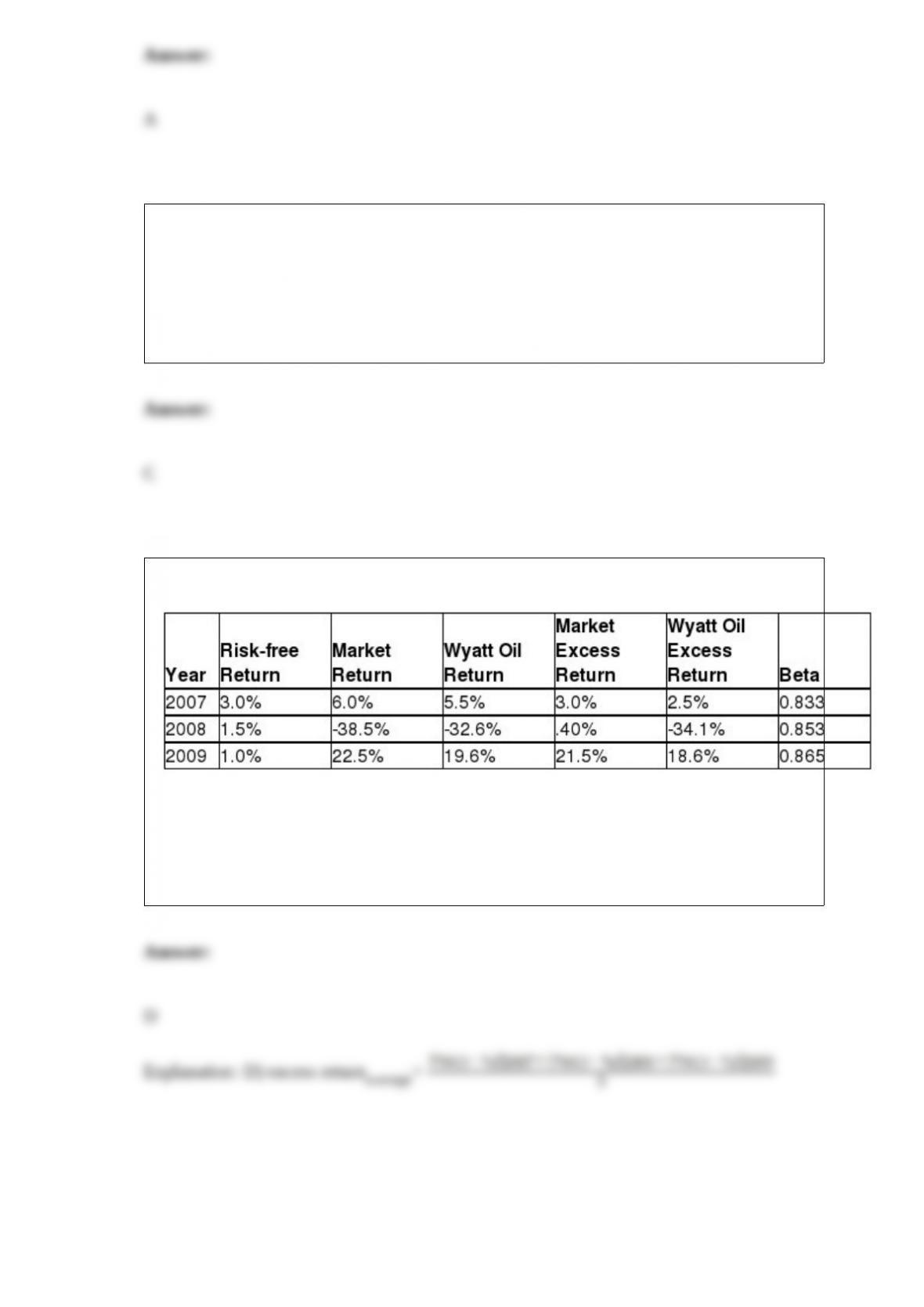
The Market’s average historical excess return is closest to:
A) -2.50%
B) -3.33%
C) -4.33%
D) -5.17%

Which of the following statements is FALSE?
A) When an investment is risky, there are different returns it may earn.
B) In finance, the variance of a return is also referred to as its volatility.
C) The expected or mean return is calculated as a weighted average of the possible
returns, where the weights correspond to the probabilities.
D) The variance is a measure of how ‘spread out” the distribution of the return is.
Which of the following statements is FALSE?
A) Dividing the covariance by the volatilities ensures that correlation is always between
-1 and +1.
B) Volatility is the square root of variance.
C) The closer the correlation is to 0, the more the returns tend to move together as a
result of common risk.
D) If two stocks move together, their returns will tend to be above or below average at
the same time, and the covariance will be positive.

Which of the following statements is correct?
A) You should accept project A since its IRR > 15%.
B) You should reject project B since its NPV > 0.
C) Your should accept project A since its NPV < 0.
D) You should accept project B since its IRR < 15%.
The following equation:
X = rE+ rD
can be used to calculate all of the following EXCEPT:
A) the cost of capital for the firm’s assets.
B) the levered cost of equity.
C) the unlevered cost of equity.
D) the weighted average cost of capital.
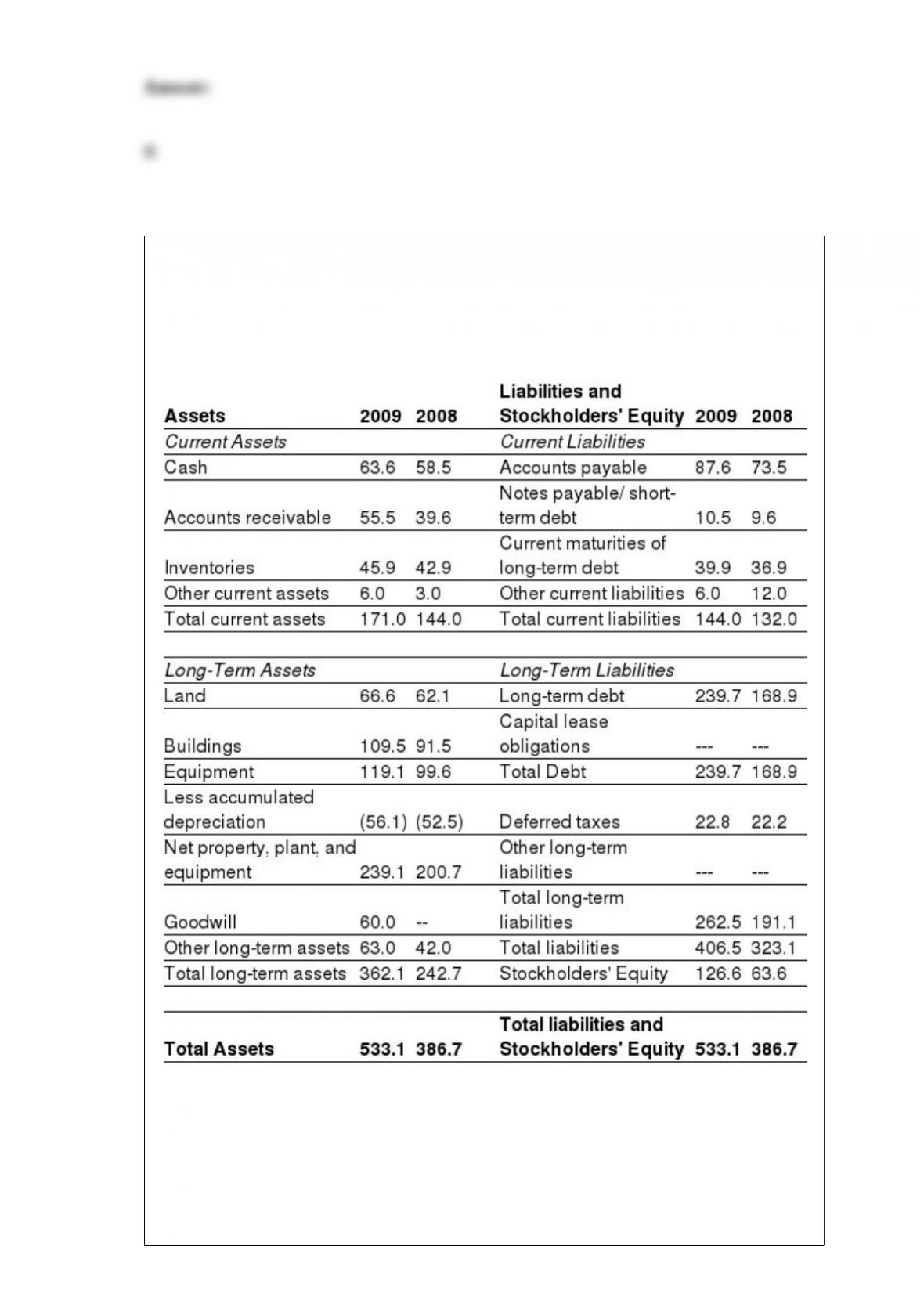
Luther Corporation
Consolidated Balance Sheet
December 31, 2009 and 2008 (in $ millions)
Luther Corporation’s cash ratio for 2009 is closest to:
Luther Corporation’s stock price is $39 per share and the company has 20 million shares
outstanding. Its book value Debt -Equity Ratio for 2009 is closest to:
A) 2.29
B) 0.31
C) 1.89
D) 0.37

The discount rate that sets the present value of the promised bond payments equal to the
current market price of the bond is called:
A) the current yield.
B) the yield to maturity.
C) the zero coupon yield.
D) the discount yield.
Taggart Transcontinental is considering a $250 million investment to launch a new rail
line. The project is expected to generate a free cash flow of $32 million per year, and its
unlevered cost of capital is 8%. Taggart’s marginal corporate tax rate is 35%.Assuming
that to fund the investment Taggart will take on $250 million in permanent debt and
assuming Taggart will incur a 2% (after-tax) underwriting fee on the new debt issue, the
NPV of Taggart’s new rail line is closest to:
A) $195 million
B) $200 million
C) $235 million
D) $240 million
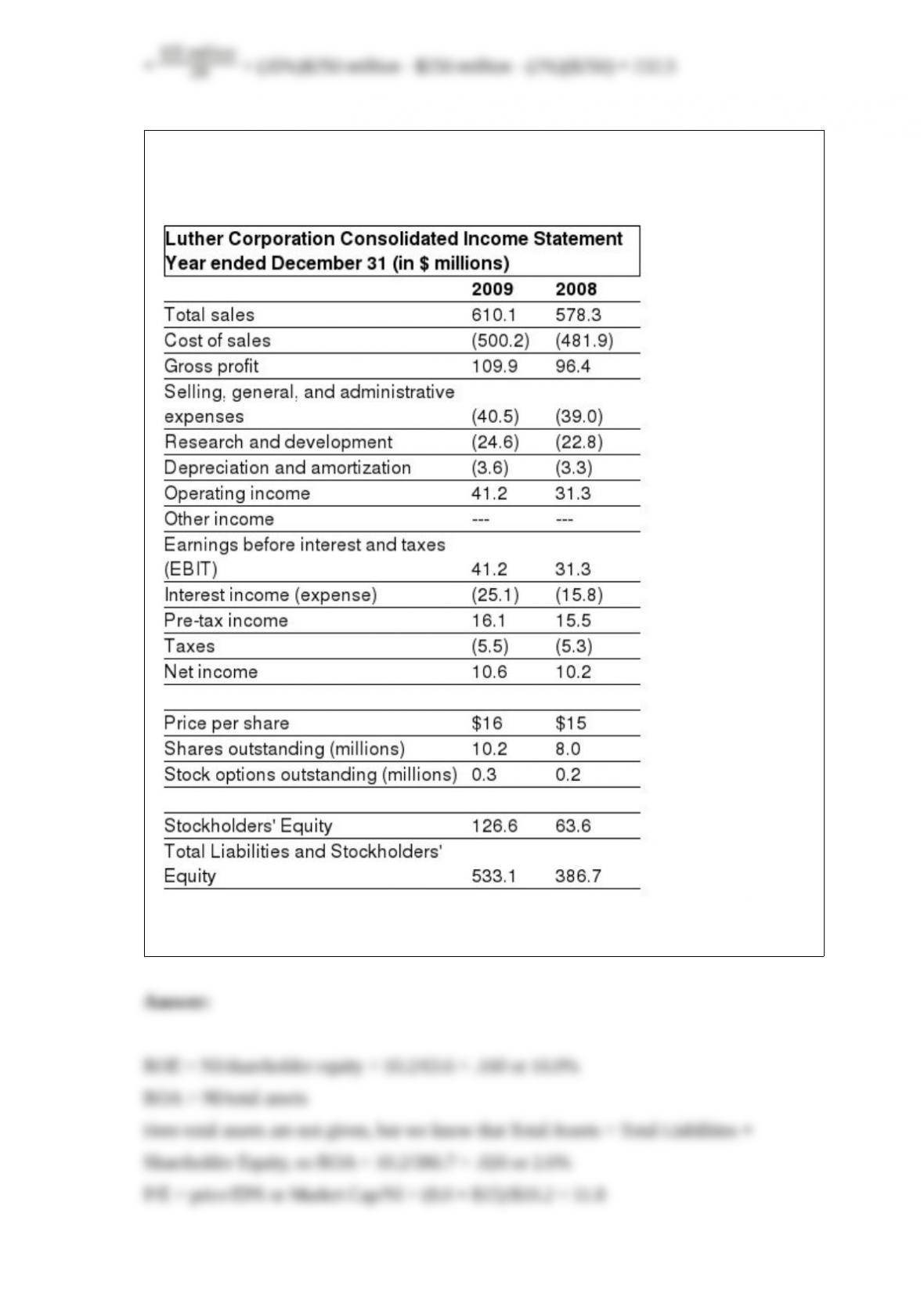
Calculate Luther’s return of equity (ROE), return of assets (ROA), and price-to-earnings
ratio (P/E) for the year ending December 31, 2008.
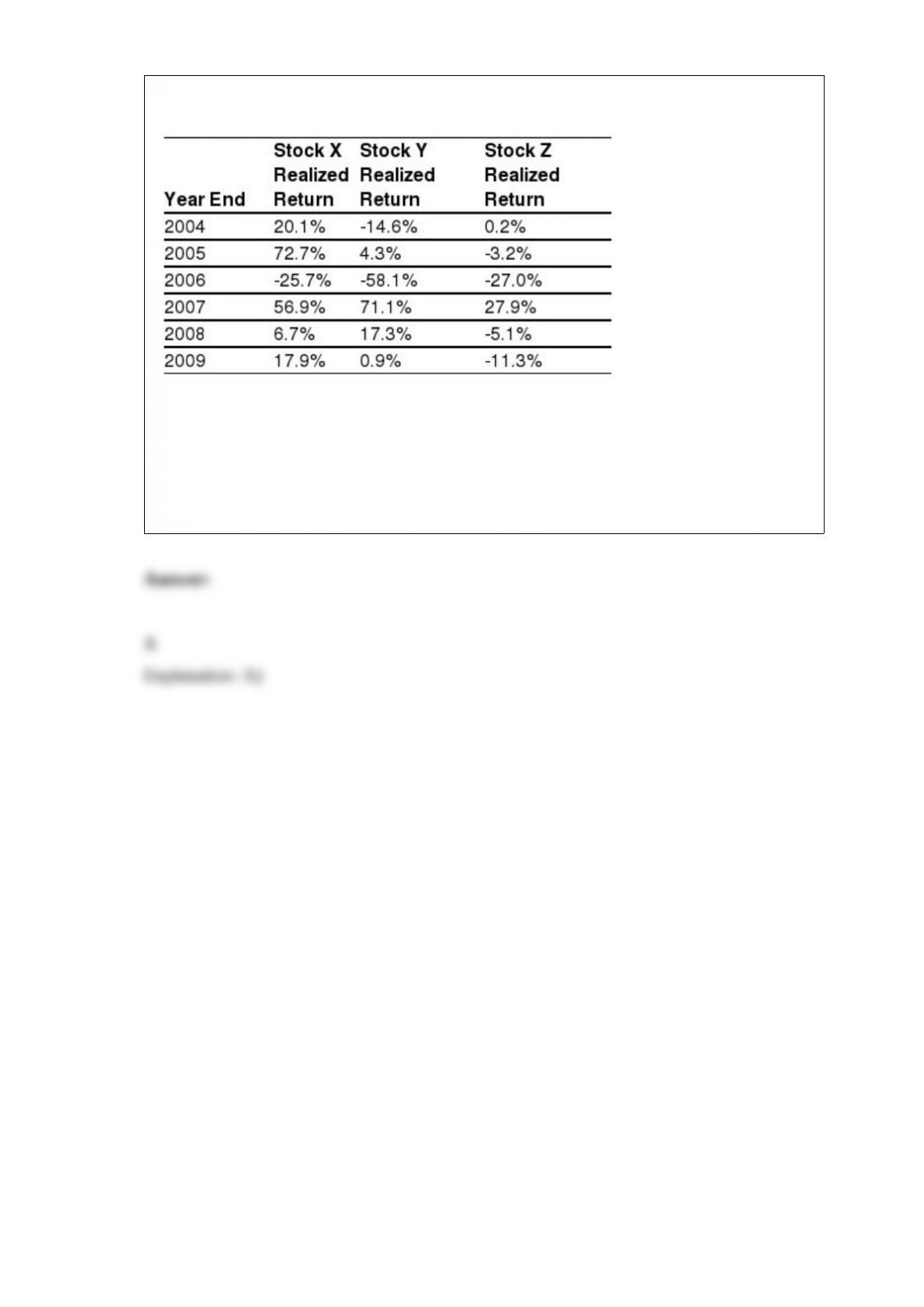
Consider the following returns:
The variance on a portfolio that is made up of equal investments in Stock X and Stock
Y stock is closest to:
A) 0.12
B) 0.10
C) 0.69
D) 0.29

Kinston Enterprises has no debt and a debt obligation of $47 million that is due now.
The market value of Kinston’s assets is $102 million, and the firm has no other
liabilities. Assume that capital markets are perfect and that Kinston has 5 million shares
outstanding.
The number of new shares that Kinston must issue to raise the capital needed to pay its
debt obligation is closest to:
A) 4.3 million
B) 4.7 million
C) 5.0 million
D) 4.0 million

Suppose that Bondi Inc. is a holding company that owns both Pizza Hut and Kentucky
Fried Chicken Franchised Restaurants. If the value of Bondi is $130 million, and the
Pizza Hut Franchises are worth $70 million, then what is the value of the Kentucky
Fried Chicken Franchises?
A) $60 million
B) $70 million
C) $130 million
D) Unable to determine with the information provided
Consider the following equation for the Project WACC with a fixed debt schedule:
rwacc= rU– dÏ„c[rD + f(rU – rD)]
The term f in this equations represents:
A) the annual adjustment percentage to the amount of debt.
B) a measure of the permanence of the debt level.
C) the dollar amount of debt outstanding.
D) the debt-to-value ratio.
Luther Industries has 25 million shares outstanding trading at $18 per share. In addition,
Luther has $150 million in outstanding debt. Suppose Luther’s equity cost of capital is
13%, its debt cost of capital is 7%, and the corporate tax rate is 40%.
Luther’s weighted average cost of capital is closest to:
A) 9.8%
B) 10.8%
C) 11.5%

D) 13.0%
Which of the following statements is FALSE?
A) Given the spot interest rates, we can determine the price and yield of any other
default-free bond.
B) As the coupon increases, earlier cash flows become relatively less important than
later cash flows in the calculation of the present value.
C) When the yield curve is flat, all zero-coupon and coupon-paying bonds will have the
same yield, independent of their maturities and coupon rates.
D) When U.S. bond traders refer to “the yield curve,” they are often referring to the
coupon-paying Treasury yield curve.
You have an investment opportunity that will cost you $10,000 today, but return
$12,500 to you in one year. The IRR of this investment opportunity is closest to:
A) 80%
B) 125%
C) 20%
D) 25%

Big Blue Banana (BBB) is a clothing retailer with a current share price of $10.00 and
with 25 million shares outstanding. Suppose that Big Blue Banana announces plans to
lower its corporate taxes by borrowing $100 million and using the proceeds to
repurchase shares.
Suppose that BBB pays corporate taxes of 35% and that shareholders expects the
change in debt to be permanent. Assuming that capital markets are perfect except for
the existence of corporate taxes, the share price for BBB after this announcement is
closest to:
A) $10.00
B) $10.85
C) $8.60
D) $11.40
Consider the following list of projects:
Assuming that your capital is constrained, which project should you invest in last?
A) Project A
B) Project I
C) Project D
D) Project C
Which of the following statements is FALSE?
A) Because capital expenditures can vary substantially from period to period, most
practitioners rely on enterprise value to free cash flow multiples.
B) Common multiples to consider are enterprise value to EBIT, EBITDA, and free cash
flow.
C) If two stocks have the same payout and EPS growth rates as well as equivalent risk,
then they should have the same P/E ratio.
D) Looking at enterprise value as a multiple of sales can be useful if it is reasonable to
assume that the firms will maintain similar margins in the future.

Your firm currently has $250 million in debt outstanding with an 8% interest rate. The
terms of the loan require the firm to repay $50 million of the balance each year.
Suppose that the marginal corporate tax rate is 35% and that the interest tax shields
have the same risk as the loan. What is the present value of the interest tax shields from
this debt?
Assume that you are 30 years old today, and that you are planning on retirement at age
65. Your current salary is $45,000 and you expect your salary to increase at a rate of 5%
per year as long as you work. To save for your retirement, you plan on making annual
contributions to a retirement account. Your first contribution will be made on your 31st
birthday and will be 8% of this year’s salary. Likewise, you expect to deposit 8% of
your salary each year until you reach age 65. Assume that the rate of interest is 7%.
The future value at retirement (age 65) of your savings is:

Consider two mutually exclusive projects with the following cash flows:
You are considering using the incremental IRR approach to decide between the two
mutually exclusive projects A & B. Assuming that the discount rate for project A is 16%
and the discount rate for B is 15%, then given that these are mutually exclusive
projects, which project would you take and why?

An exchange traded fund (ETF) is a security that represents a portfolio of individual
stocks. Consider an ETF for which each share represents a portfolio of two shares of
Apple Inc. (APPL), one share of Google (GOOG), and ten shares of Microsoft (MSFT).
Suppose the current stock prices of each individual stock are as shown below:
If the ETF is currently trading for $1,200, what arbitrage opportunity is available? What
trades would you make?
What are some common multiples used to value stocks?