
The Blue Lagoon has a return on equity of 23.62 percent, an equity multiplier of 1.48,
and a capital intensity ratio of 1.06. What is the profit margin?
A. 15.06 percent
B. 13.57 percent
C. 15.84 percent
D. 16.92 percent
E. 14.60 percent
Which one of the following formulas illustrates the mechanics of covered interest
arbitrage? Assume the $1 is borrowed and S<sub>0</sub> = spot rate; F<sub>1</sub>
= one-year forward rate; R<sub>F</sub> = foreign country risk-free rate; and
R<sub>US</sub> = U.S. risk-free rate.
A. $1 × F1 × (1 + RF)/S0– $1 × (1 + RUS)
B. $1 × S0 × (1 + RF)/F1– $1 × (1 + RUS)
C. $1 × F1 × (1 + RF)/S0 + $1 × (1 + RUS)
D. $1 × S0 × (1 + RF) – $1 × (1 + RUS)/F1
E. $1 × S0 × (1 + RF)/F1 + $1 × (1 + RUS)
Sweet Treats pays a constant annual dividend of $2.38 a share and currently sells for
$52.60 a share. What is the rate of return?
A. 4.56 percent
B. 5.39 percent
C. 4.52 percent
D. 4.83 percent
E. 5.91 percent
Derek’s is a brick-and-mortar toy store. The firm is considering expanding its operations
to include Internet sales. Which one of the following would be the best firm to use in a
pure play approach to analyzing this proposed expansion?
A. Another brick-and-mortar store that also sells online
B. A wholesale toy distributor
C. A toy store that sells online only
D. The oldest online retailer of any product
E. Derek’s own store
Delmont Movers has a profit margin of 7.1 percent and net income of $63,700. What is
the common-size percentage for the cost of goods sold if that expense amounted to
$522,600 for the year?
A. 12.19 percent
B. 23.50 percent
C. 53.25 percent
D. 61.06 percent
E. 58.25 percent
Based on the period 1926-2014, what rate of return should you expect to earn over the
long-term if you are unwilling to bear risk?
A. Between 0 and 1 percent
B. Between 1 and 2 percent
C. Between 2 and 3 percent
D. Between 3 and 4 percent
E. Between 4 and 5 percent
Titans has 7 percent bonds outstanding that mature in 16 years. The bonds pay interest
semiannually and have a face value of $1,000. Currently, the bonds are selling for
$1,015 each. What is the firm’s pretax cost of debt?
A. 6.97 percent
B. 6.84 percent
C. 7.14 percent
D. 7.31 percent
E. 6.40 percent
One year ago, you purchased 600 shares of stock for $14 a share. The stock pays $.41 a
share in dividends each year. Today, you sold your shares for $15.30 a share. What is
your total dollar return on this investment?
A. $1,222
B. $7,43
C. $815
D. $780
E. $1,026
Stacey deposits $5,000 into an account that pays 2 percent interest, compounded
annually. At the same time, Kurt deposits $5,000 into an account paying 3.5 percent
interest, compounded annually. At the end of three years:
A. Both Stacey and Kurt will have accounts of equal value.
B. Kurt will have twice the money saved that Stacey does.
C. Kurt will earn exactly twice the amount of interest that Stacey earns.
D. Kurt will have a larger account value than Stacey will.
E. Stacey will have more money saved than Kurt.
Which one of the following commences on the day inventory is purchased and ends on
the day the payment for the sale of that inventory is collected? Assume all sales and
purchases are on credit.
A. Inventory period
B. Accounts receivable period
C. Accounts payable period
D. Operating cycle
E. Cash cycle

Which one of the following will affect the capital structure weights used to compute a
firm’s weighted average cost of capital?
A. Decrease in the book value of a firm’s equity
B. Decrease in a firm’s tax rate
C. Increase in the market value of the firm’s common stock
D. Increase in the market risk premium
E. Increase in the firm’s beta
A preferred stock sells for $54.20 a share and has a market return of 9.68 percent. What
is the dividend amount?
A. $5.09
B. $5.14
C. $4.75
D. $5.42
E. $5.25
The use of borrowing by an individual to adjust his or her overall exposure to financial
leverage is referred to as:
A. M&M Proposition I.
B. capital restructuring.
C. homemade leverage.
D. M&M Proposition II.
E. financial risk management.
Chasteen, Inc., is considering an investment with an initial cost of $145,000 that would
be depreciated straight-line to a zero book value over the life of the project. The cash
inflows generated by the project are estimated at $76,000 for the first two years and
$30,000 for the following two years. What is the internal rate of return?
A. 21.44 percent
B. 21.29 percent
C. 17.43 percent
D. 17.55 percent
E. 20.11 percent
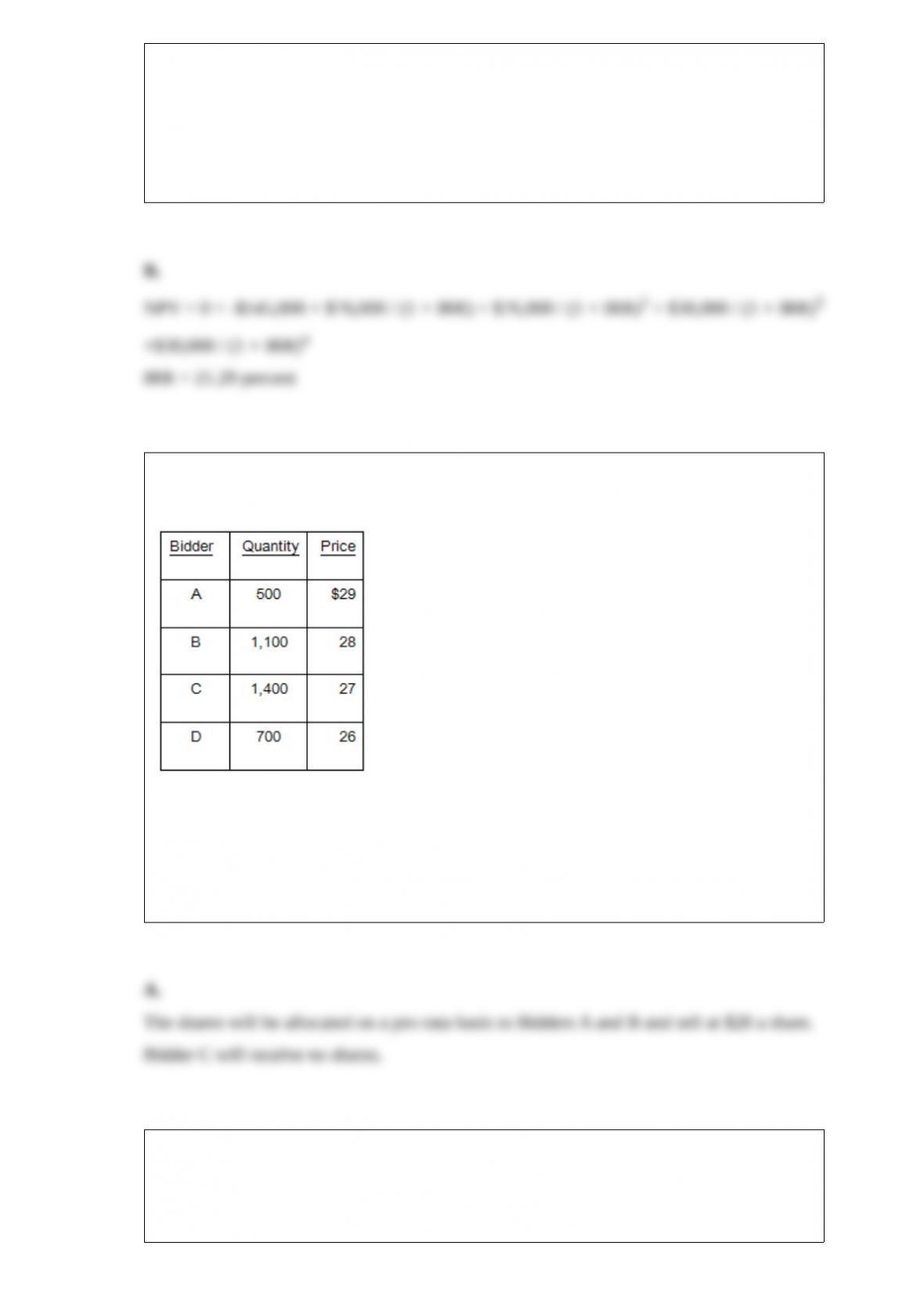
Winston’s Grocers would like to sell 1,000 shares of stock using the Dutch auction
method. The bids received are as follows:
Bidder C will receive _____ shares and pay a price per share of _____.
A. 0; $0
B. 600; $38.00
C. 272; $37.00
D. 272; $38.75
E. 700; $38.75
NASDAQ is best described as:
A. a modern-day trading floor with locations in Chicago and London.
B. an electronic communication network.
C. an electronic network of securities dealers.

D. an internet broker’s market.
E. a primary market.
Which one of the following had a zero standard deviation of returns for the period of
1926-2014?
A. All of the listed security types had a standard deviation of returns in excess of zero
percent.
B. U.S. Treasury bills
C. Long-term corporate bonds
D. Large-company stocks
E. Long-term government bonds
The High Water Mark is operating at its optimal point. Which one of the following
conditions exists given this firm’s operating status?
A. Carrying costs exceed shortage costs
B. Carrying costs are equal to zero
C. Both carrying costs and shortage costs are at their minimum levels
D. Shortage costs are equal to zero
E. Shortage costs equal carrying costs
A firm has a cost of equity of 13 percent, a cost of preferred of 11 percent, an aftertax
cost of debt of 5.2 percent, and a tax rate of 35 percent. Given this, which one of the
following will increase the firm’s weighted average cost of capital?
A. Increasing the firm’s tax rate
B. Issuing new bonds at par
C. Redeeming shares of common stock
D. Increasing the firm’s beta
E. Increasing the debt-equity ratio
Western Electric has 21,000 shares of common stock outstanding at a price per share of
$61 and a rate of return of 15.6 percent. The firm has 11,000 shares of $8 preferred
stock outstanding at a price of $48 a share. The outstanding debt has a total face value
of $275,000 and currently sells for 104 percent of face. The yield to maturity on the
debt is 8.81 percent. What is the firm’s weighted average cost of capital if the tax rate is
35 percent?
A. 14.52 percent
B. 13.44 percent
C. 14.19 percent
D. 14.37 percent
E. 13.92 percent
The ratios that are based on financial statement values and used for comparison
purposes are called:
A. financial ratios.
B. industrial statistics.
C. equity standards.
D. accounting returns.
E. analytical standards.
Which one of the following is the vertical intercept of the security market line?
A. Market rate of return
B. Individual security rate of return
C. Market risk premium
D. Individual security beta multiplied by the market risk premium
E. Risk-free rate
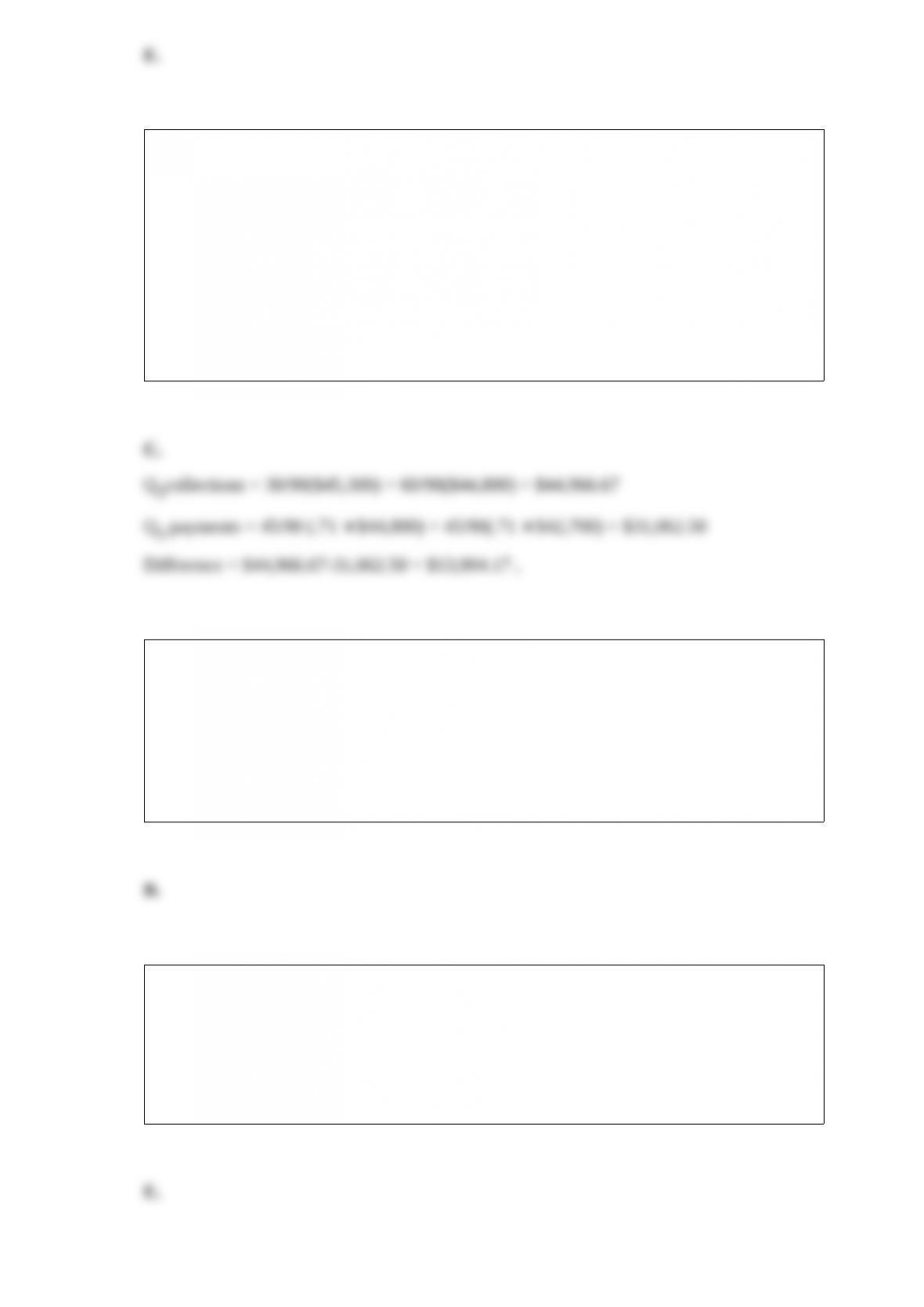
Red Barn has estimated quarterly sales, starting with Quarter 1, of $42,600, $45,300,
$44,800, and $42,700. Purchases are equal to 71 percent of the following quarter’s
sales. The accounts receivable period is 30 days and the accounts payable period is 45
days. Assume there are 30 days in each month. By how much will the firm’s collections
exceed its payments for Quarter 3?
A. $14,088.86
B. $11,884.33
C. $13,904.17
D. $12,925.86
E. $12,211.17
Lester lent money to The Corner Store by purchasing bonds issued by the store. The
rate of return that he and the other lenders require is referred to as the:
A. pure play cost.
B. cost of debt.
C. weighted average cost of capital.
D. subjective cost.
E. cost of equity.
An income statement prepared according to GAAP:
A. reflects the net cash flows of a firm over a stated period of time.
B. reflects the financial position of a firm as of a particular date.
C. distinguishes variable costs from fixed costs.
D. records revenue when payment for a sale is received.
E. records expenses based on the matching principle.
Which one of the following is an example of the political risks associated with foreign
operations?
A. Technological changes
B. Exchange rate fluctuations
C. Translation exposure to exchange rate risk
D. Changes in foreign tax laws
E. Changes in relative wage rates between the home country and the foreign country
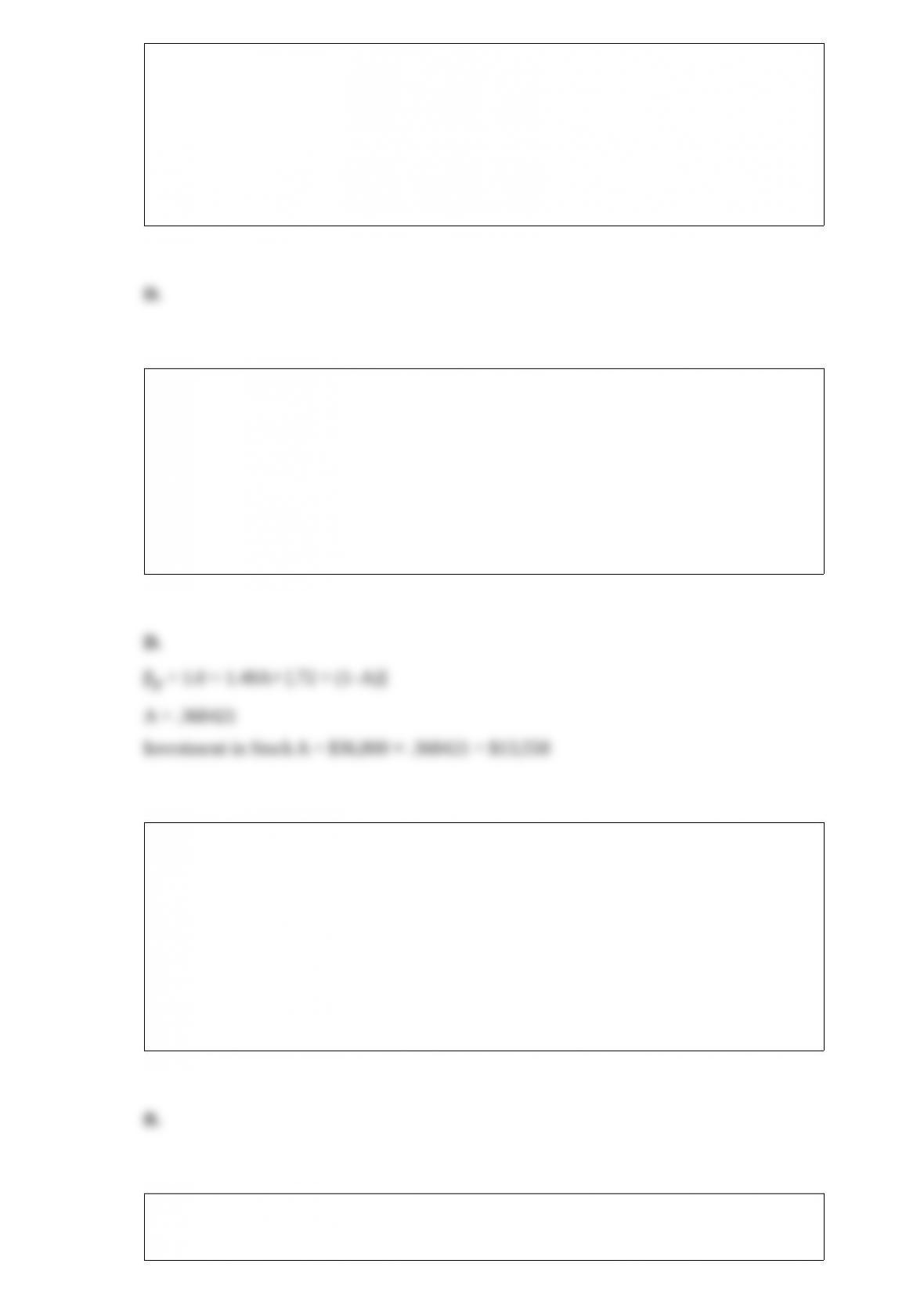
You own a $36,800 portfolio that is invested in Stocks A and B. The portfolio beta is
equal to the market beta. Stock A has an expected return of 22.6 percent and has a beta
of 1.48. Stock B has a beta of .72. What is the value of your investment in Stock A?
A. $8,619
B. $12,333
C. $14,500
D. $13,558
E. $17,204
Consider a portfolio comprised of four risky securities. Assume the economy has three
economic states with varying probabilities of occurrence. Which one of the following
will guarantee that the portfolio variance will equal zero?
A. The portfolio beta must be 1.0.
B. The portfolio expected rate of return must be the same for each economic state.
C. The portfolio risk premium must equal zero.
D. The portfolio expected rate of return must equal the expected market rate of return.
E. There must be equal probabilities that the state of the economy will be a boom or a
bust.
A stock produced returns of 11 percent, 19 percent, and 2 percent over three of the past
four years, respectively. The arithmetic average for the past four years is 9 percent.
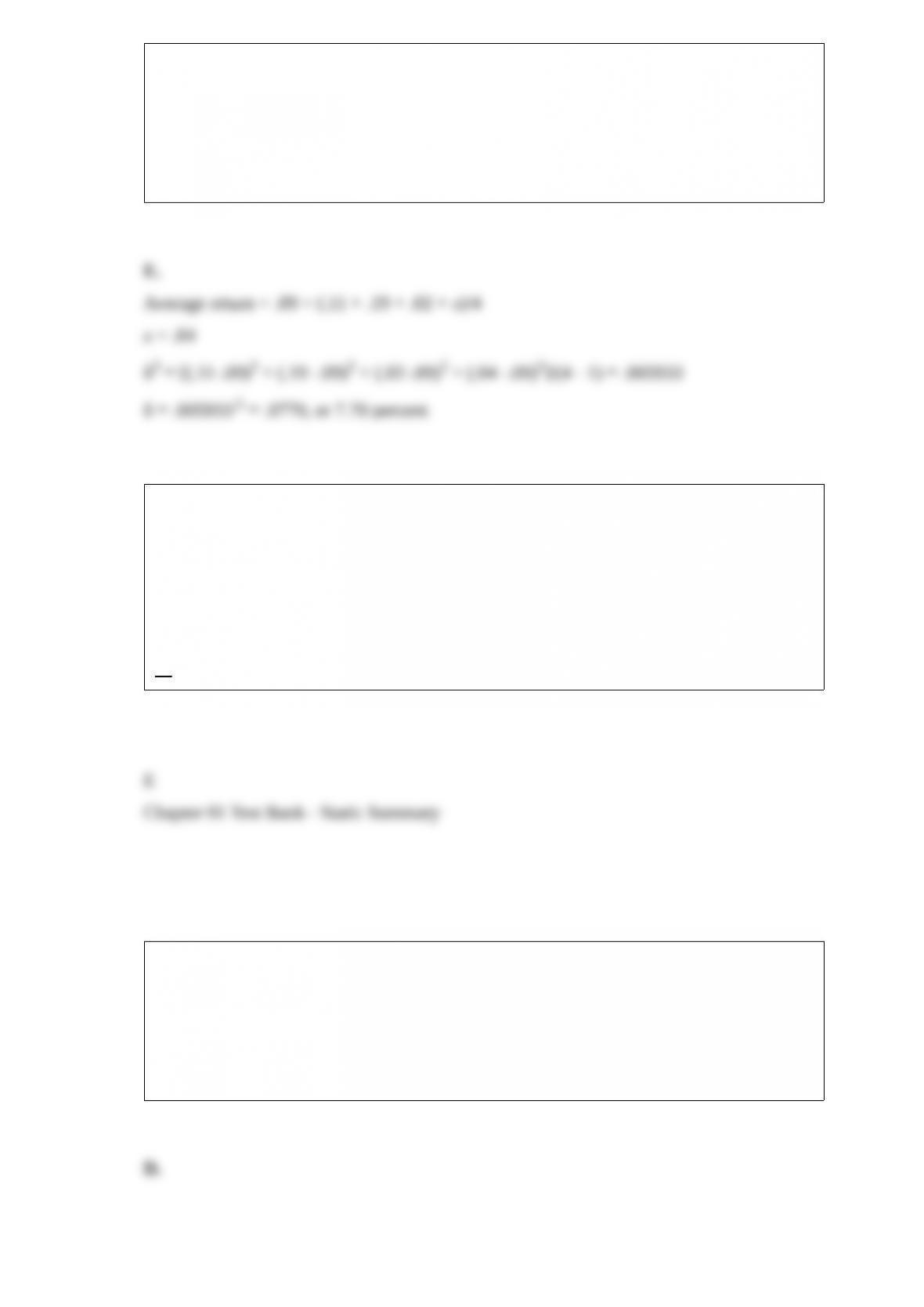
What is the standard deviation of the stock’s returns for the four-year period?
A. 5.46 percent
B. 8.54 percent
C. 9.09 percent
D. 6.83 percent
E. 7.70 percent
Which one of the following statements is correct?
A. All of the major stock exchanges are U.S. based.
B. The NYSE was created by the National Association of Securities Dealers in the early
1930s.
C. The Chicago Stock Exchange is a dealer market.
D. OTC markets have a physical trading floor generally located in either New York City
or Chicago.
E. The primary purpose of the NYSE is to match buyers with sellers.
Which one of the following best defines a regular cash dividend?
A. Distribution by a firm to its shareholders
B. Payment from any source by a firm to its owners
C. One-time payment of cash by a firm to its shareholders
D. Cash payment by a firm to its owners as part of a firm’s normal operations
E. Distribution of the proceeds from the sale of a portion of a firm’s operations
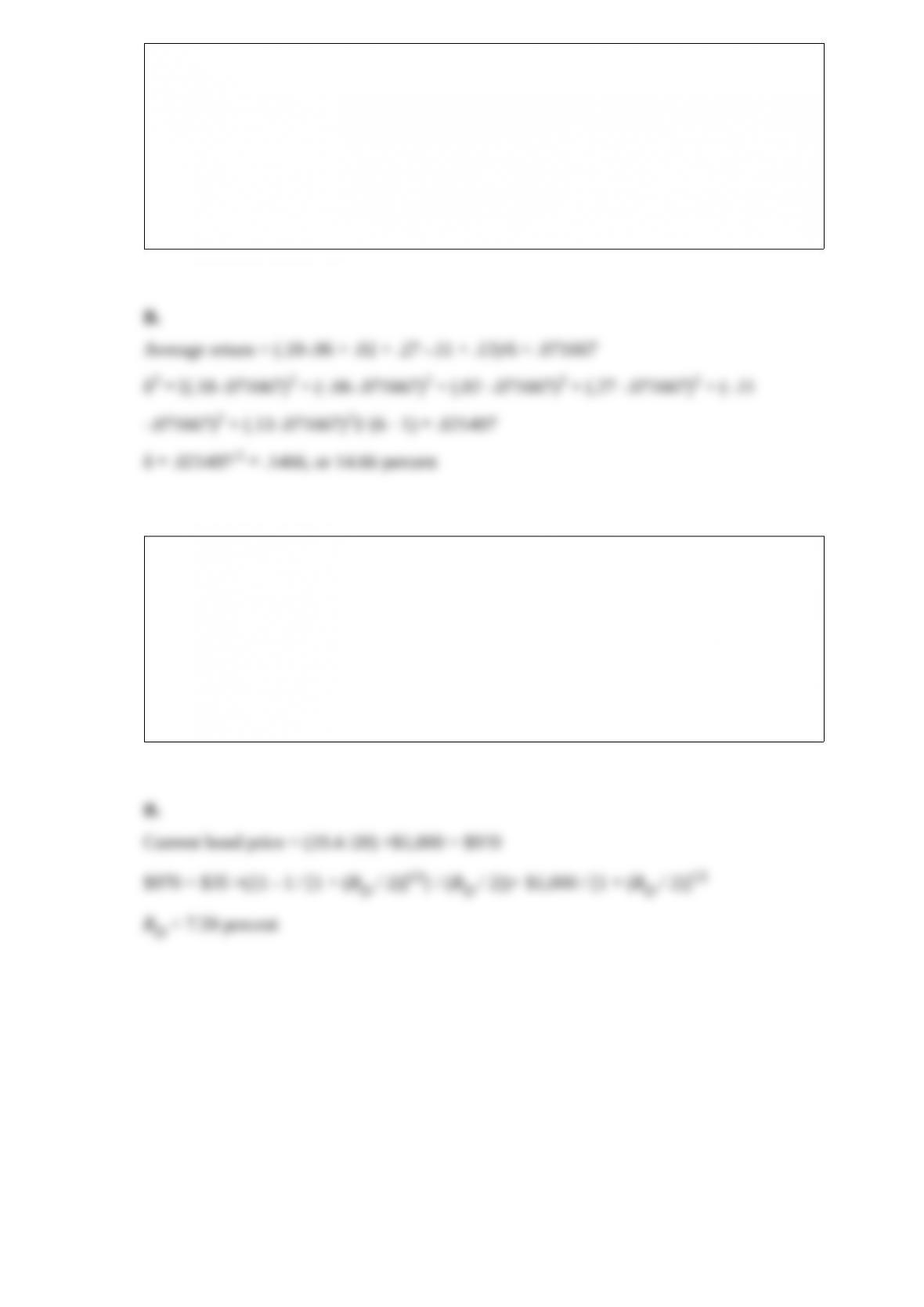
Over the past six years, a stock had annual returns of 18 percent, -6 percent, 2 percent,
27 percent, -11 percent, and 13 percent, respectively. What is the standard deviation of
these returns?
A. 15.27 percent
B. 14.66 percent
C. 13.59 percent
D. 15.08 percent
E. 14.38 percent
Madison Square Stores has a $20 million bond issue outstanding that currently has a
market value of $19.4 million. The bonds mature in 6.5 years and pay semiannual
interest payments of $35 each. What is the firm’s pretax cost of debt?
A. 8.21 percent
B. 7.59 percent
C. 7.08 percent
D. 7.74 percent
E. 7.80 percent