1) the triffin paradox
a.was first proposed by professor robert triffin
b.warned that the gold-exchange system of the bretton woods agreement was
programmed to collapse in the long run
c.was indeed responsible for the eventual collapse of the dollar-based gold-exchange
system in the early 1970s
d.all of the above are correct
2) which of the following is true?
a.the competitive effect is that a currency depreciation may affect operating cash flow
in the foreign currency by altering the firm’s competitive position in the marketplace
b.the conversion effect is defined as a given accounting cash value in a foreign currency
will be converted into a lower dollar amount after currency depreciation
c.the competitive effect is defined as a given operating cash flow in a foreign currency
will be converted into a lower dollar amount after a currency depreciation
d.none of the above
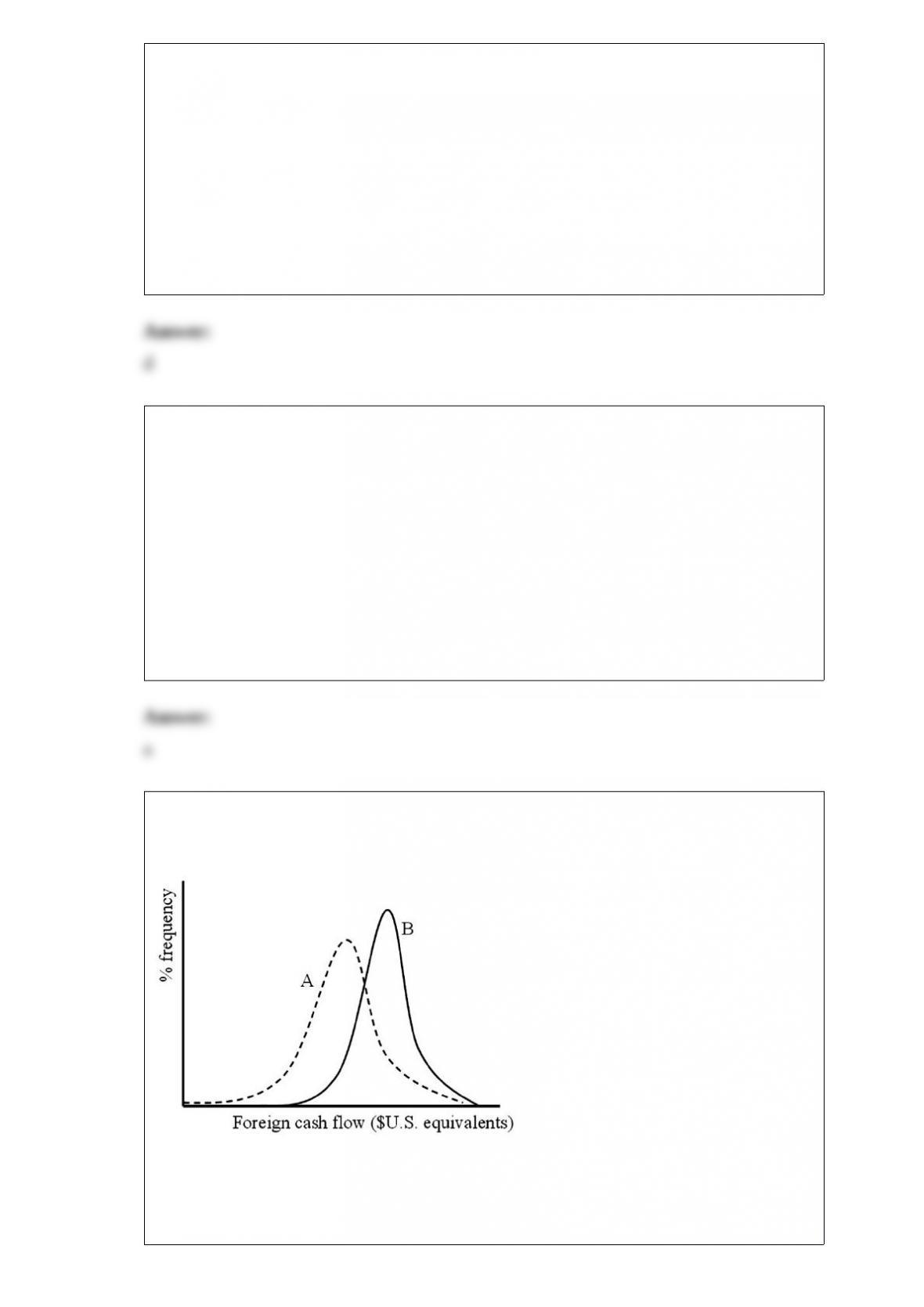
3) in the figure at right, label curves a and b respectively,
a.unhedged, hedged
b.hedged, unhedged

c.normal, abnormal
d.none of the above
4) the board of directors may grant stock options to managers. these are
a.call options
b.put options
c.none of the above
5) a convertible bond pays interest annually at a coupon rate of 5% on a par value of
$1,000. the bond has 10 years maturity remaining and the discount rate on otherwise
identical non-convertible debt is 6.5%. the bond is convertible into shares of common
stock at a conversion price of $25 per share (i.e. the bond is exchangeable for 40
shares). today’s closing stock price was $20. what is the floor value of this bond?
a.$800.00
b.$892.17
c.$1,250
d.none of the above
6) a bill of lading
a.is a document issued by the common carrier specifying that it has received the foods
for shipment; it can serve as title to the goods
b.later becomes a banker’s acceptance
c.is a time draft that calls for payment upon physical delivery of goods
d.none of the above

7) the required return on equity for an all-equity firm is 10.0%. they are considering a
change in capital structure to a debt-to-equity ratio of the tax rate is 40%, the pre-tax
cost of debt is 8%. find the new cost of capital if this firm changes capital structure.
a.14.93%
b.8.67%
c.7.40%
d.none of the above
8) unlike the theory of international trade or the theory of international portfolio
investment,
a.we do not have a well-developed, comprehensive theory of fdi
b.the comprehensive theory of fdi focuses on mean-variance efficiency
c.the comprehensive theory of fdi is an arbitrage argument, like interest rate parity
d.none of the above
9) to find the swap rate for a 3-year swap, you would
a.take the arithmetic average of the 1-, 2-, and 3-year forward rates
b.take the geometric average of the 1-, 2-, and 3-year forward rates
c.bootstrap the libor yield curve
d.none of the above
10) a major risk faced by a swap dealer is credit risk. this is
a.the probability that a counterparty will default
b.the probability that both counterparties default
c.the probability floating rates will move against the dealer
d.none of the above
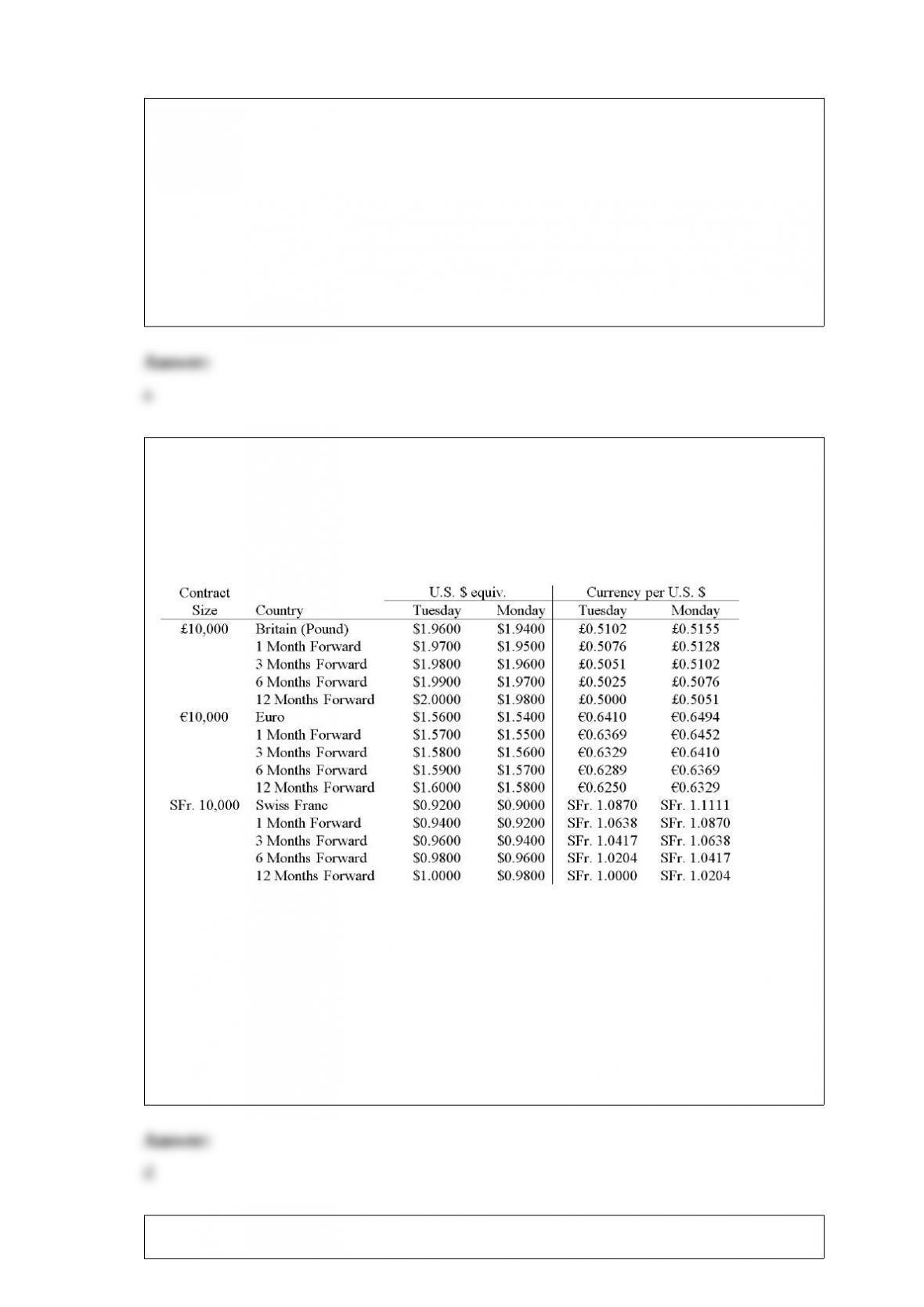
11) the sensitivity of “realized” domestic currency values of the firm’s contractual cash
flows denominated in foreign currency to unexpected changes in the exchange rate is
a.transaction exposure
b.translation exposure
c.economic exposure
d.none of the above
12) your firm is an italian exporter of bicycles. you have sold an order to a british firm
for £1,000,000 worth of bicycles. payment from the customer (in pounds sterling) is
due in 12 months. detail a strategy using futures contracts that will hedge your
exchange rate risk. have an estimate of how many contracts of what type and maturity.
a.go long 100 12-month pound futures contracts; and long 125 12-month euro futures
contracts
b.go short 100 12-month pound futures contracts; and short 125 12-month euro futures
contracts
c.go long 100 12-month pound futures contracts; and short 125 12-month euro futures
contracts
d.go short 100 12-month pound futures contracts; and long 125 12-month euro futures
contracts
e.none of the above
13) with regard to a swap bank acting as a dealer in swap transactions, interest rate risk

refers to
a.the risk that arises from the situation in which the floating-rates of the two
counterparties are not pegged to the same index
b.the risk that interest rates changing unfavorably before the swap bank can lay off to an
opposing counterparty on the other side of an interest rate swap entered into with the
first counterparty
c.the risk the swap bank faces from fluctuating exchange rates during the time it takes
for the bank to lay off a swap it undertakes with one counterparty with an opposing
transaction
d.the risk that a counterparty will default
14) a dealer in pounds who thinks that the exchange rate is about to increase in
volatility
a.may want to widen his bid-ask spread
b.may want to decrease his bid-ask spread
c.may want to lower his ask price
d.none of the above
15) under a 1981 voluntary trade agreement japanese automobile manufacturers were
not allowed to increase their exports to the u.s. market. as a result
a.they exited the market
b.honda was motivated to circumvent the trade barriers
c.honda’s fdi may have been part of an overall corporate strategy designed to bolster
their competitive position vis–vis their domestic rivals such as toyota
d.both b and c
16) the international monetary system can be defined as the institutional framework
within which
a.international payments are made
b.movement of capital is accommodated

c.exchange rates among currencies are determined
d.all of the above
17) the current spot exchange rate is $1.55 = 1.00 and the three-month forward rate is
$1.60 = 1.00. consider a three-month american call option on 62,500. for this option to
be considered at-the-money, the strike price must be
a.$1.60 = 1.00
b.$1.55 = 1.00
c.$1.55 (1 + i$)3/12 = 1.00 (1 + i)3/12
d.none of the above