
The Shoe Box is considering adding a new line of winter footwear to its product lineup.
Which of the following are relevant cash flows for this project?
I. Decreased revenue from products currently being offered if this new footwear is
added to the lineup
II. Revenue from the new line of footwear
III. Money spent to date looking for a new product line to add to the store’s offerings
IV. Cost of new counters to display the new line of footwear
A. I and IV only
B. II and IV only
C. II and III only
D. I, II, and IV only
E. II, III, and IV only
Answer:
The recognition principle states that:
A. costs should be recorded on the income statement whenever those costs can be
reliably determined.
B. costs should be recorded when paid.
C. the costs of producing an item should be recorded when the sale of that item is
recorded as revenue.
D. sales should be recorded when the payment for that sale is received.
E. sales should be recorded when the earnings process is virtually completed and the

value of the sale can be determined.
Answer:
Mercury Homes just declared a 4-for-3 stock split. Which of the following occurred as a
result of this split?
I. Number of shares outstanding increased by one-third
II. Number of shares outstanding decreased by one-fourth
III. Price per share increased by one-third
IV. Price per share decreased by one-fourth
A. I only
B. I and III only
C. I and IV only
D. II and III only
E. II and IV only
Answer:

You live in the U.S. and want to invest in a Chinese company, which will be referred to
as “CC,” because you believe its stock is uniquely positioned to be unusually profitable
over the next five years. However, you do not have direct access to the Chinese
financial markets. You may be able to indirectly invest in CC by purchasing which one
of the following?
A. Swap
B. ADR
C. Gilt
D. Bulldog bond
E. Samurai bond
Answer:
Donner United has total owners’ equity of $18,800. The firm has current assets of
$23,100, current liabilities of $12,200, and total assets of $36,400. What is the value of
the long-term debt?
A. $5,400
B. $12,500
C. $13,700
D. $29,800
E. $43,000

Answer:
Which one of the following is a capital structure decision?
A. Determining the optimal inventory level
B. Establishing the preferred debt-equity level
C. Selecting new equipment to purchase
D. Setting the terms of sale for credit sales
E. Determining when suppliers should be paid
Answer:
The Tattle Teller has a printing press sitting idly in its back room. The press has no
market value to another printer because the machine utilizes old technology. The firm
could get $250 for the press as scrap metal. The press is six years old and originally cost
$148,000. The current book value is $2,570. The president of the firm is considering a
new project and feels he can use this press for that project. What value, if any, should be
assigned to the press as an initial cost of the new project?
A. $0
B. $250

C. $2,245
D. $2,570
E. $2,495
Answer:
BJB, Inc. stock has an expected return of 15.15 percent. The risk-free rate is 3.8 percent
and the market risk premium is 8.6 percent. What is the stock’s beta?
A. 1.19
B. 1.21
C. 1.32
D. 1.48
E. 1.62
Answer:

A firm wishes to maintain an internal growth rate of 4.5 percent and a dividend payout
ratio of 60 percent. The current profit margin is 7.5 percent and the firm uses no
external financing sources. What must the total asset turnover be?
A. 0.98
B. 1.06
C. 1.21
D. 1.44
E. 1.59
Answer:
Taylor Farms is borrowing $75,000 for three years at an APR of 9 percent. The loan
calls for the principal balance to be reduced by equal amounts over the life of the loan.
Interest is to be paid in full each year. The payments are to be made annually at the end
of each year. How much will Taylor Farms pay in interest over the life of this loan?
A. $12,311.67
B. $12,484.90
C. $12,840.00
D. $13,500.00
E. $13,887.32

Answer:
Miser Materials paid $27,500 in dividends and $28,311 in interest over the past year
while net working capital increased from $13,506 to $18,219. The company purchased
$42,000 in net new fixed assets and had depreciation expenses of $16,805. During the
year, the firm issued $25,000 in net new equity and paid off $21,000 in long-term debt.
What is the amount of the cash flow from assets?
A. $21,811
B. $30,811
C. $36,189
D. $49,811
E. 51,811
Answer:
Red Roofs, Inc. has current liabilities of $24,300 and accounts receivable of $7,800.
The firm has total assets of $43,100 and net fixed assets of $23,700. The owners’ equity

has a book value of $21,400. What is the amount of the net working capital?
A. $5,100
B. -$4,900
C. $6,500
D. $18,800
E. -$2,600
Answer:
Florence Mills is an all-equity firm with a total market value of $250,000. The firm has
8,000 shares of stock outstanding. Management is considering issuing $50,000 of debt
at an interest rate of 7 percent and using the proceeds on a stock repurchase. Ignore
taxes. How many shares can the firm repurchase if it issues the debt securities?
A. 1,600 shares
B. 1,618 shares
C. 1,647 shares
D. 1,656 shares
E. 1,699 shares
Answer:

Harry Joiner, Inc. currently has an inventory turnover of 15.7, a payables turnover of
9.6, and a receivables turnover of 8.1. How many days are in the cash cycle?
A. 30.29 days
B. 32.70 days
C. 56.51 days
D. 84.39 days
E. 104.72 days
Answer:
A firm uses its weighted average cost of capital to evaluate the proposed projects for all
of its varying divisions. By doing so, the firm:
A. automatically gives preferential treatment in the allocation of funds to its riskiest
division.
B. encourages the division managers to recommend only their most conservative
projects.
C. maintains the current risk level and capital structure of the firm.
D. automatically maximizes the total value created for its shareholders.
E. allocates capital funds evenly among its divisions.

Answer:
As of Monday morning, the ledger balance and the available balance for a firm was
$3,600. During the day, the firm wrote three checks in the amounts of $230, $590, and
$870. The firm deposited a check for $350 and a check for $920. What is the amount of
the collection float as of the end of the day?
A. $420
B. $580
C. $840
D. $1,270
E. $1,690
Answer:
Smith and Weston has 55,000 shares of common stock outstanding at a price of $31 a
share. It also has 3,000 shares of preferred stock outstanding at a price of $62 a share.
The firm has 8 percent, 12-year bonds outstanding with a total face value of $400,000.
The bonds are currently quoted at 101.2 percent of face and pay interest semiannually.
What is the capital structure weight of the firm’s preferred stock if the tax rate is 35
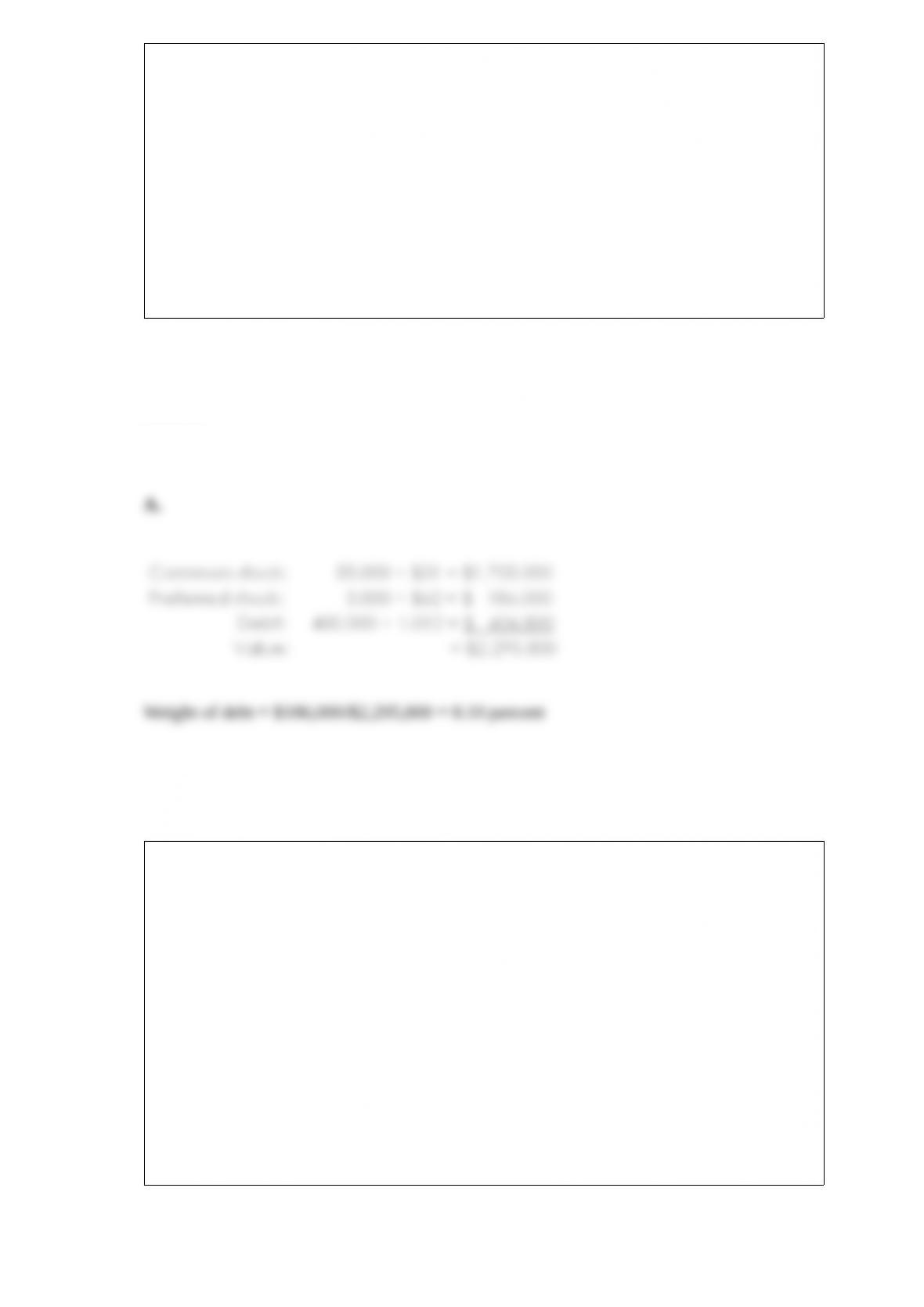
percent?
A. 8.10 percent
B. 15.20 percent
C. 15.67 percent
D. 16.84 percent
E. 17.63 percent
Answer:
Chasteen, Inc. is considering an investment with an initial cost of $185,000 that would
be depreciated straight-line to a zero book value over the life of the project. The cash
inflows generated by the project are estimated at $76,000 for the first two years and
$30,000 for the following two years. What is the internal rate of return?
A. 6.44 percent
B. 6.94 percent
C. 7.43 percent
D. 7.55 percent
E. 8.11 percent

Answer:
You would like to borrow money three years from now to build a new building. In
preparation for applying for that loan, you are in the process of developing target ratios
for your firm. Which set of ratios represents the best target mix considering that you
want to obtain outside financing in the relatively near future?
A. Times interest earned = 1.7; debt-equity ratio = 1.6
B. Times interest earned = 1.5; debt-equity ratio = 1.2
C. Cash coverage ratio = 0.8; debt-equity ratio = 0.8
D. Cash coverage ratio = 2.6; debt-equity ratio = 0.3
E. Cash coverage ratio = 0.5; total debt ratio = 0.2
Answer:
You are given the following information concerning Around Town Tours:
Debt: 8,500, 7.1 percent coupon bonds outstanding, with 14 years to maturity and a
quoted price of 102.6. These bonds pay interest semiannually.
Common stock: 265,000 shares of common stock selling for $76 per share. The stock
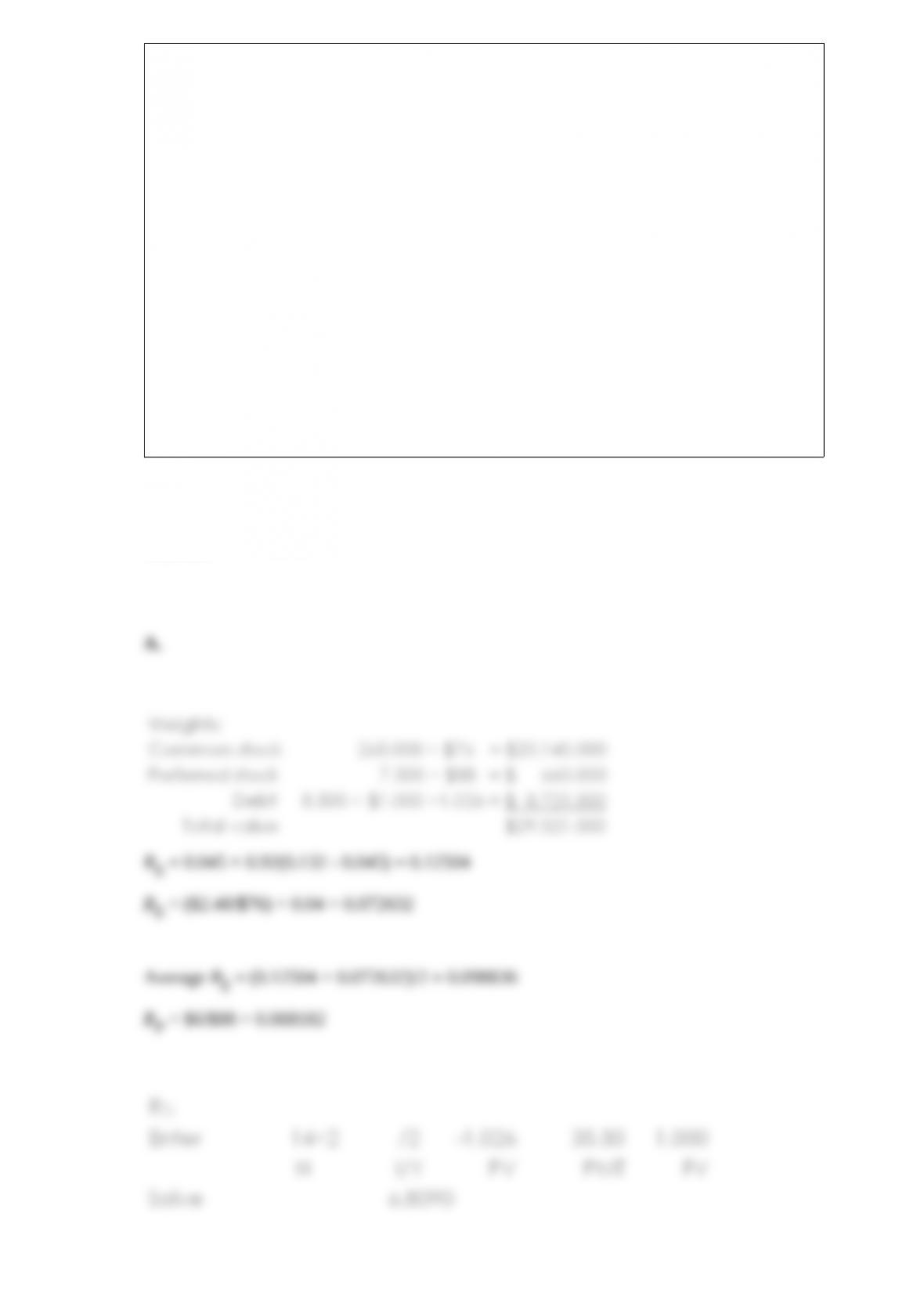
has a beta of 0.92 and will pay a dividend of $2.48 next year. The dividend is expected
to grow by 4 percent per year indefinitely.
Preferred stock: 7,500 shares of 6 percent preferred stock selling at $88 per share.
Market: A 13.2 percent expected return, a 4.5 percent risk-free rate, and a 34 percent tax
rate.
Calculate the WACC for this firm.
A. 8.22 percent
B. 8.67 percent
C. 9.29 percent
D. 9.57 percent
E. 10.08 percent
Answer: