
1) The more fixed-charge securities (such as bonds and preferred stock) the firm
employs in its financial structure, the greater its financial leverage.
2) The presence of debt and/or preferred stock in a firm’s financial structure means the
firm is using financial leverage.
3) Anticipatory buying occurs because of an anticipated decrease in interest rates.
4) The objective of capital structure management is to maximize the market value of the
firm’s common stock.
5) The bid rate is the rate at which the bank buys the foreign currency from the
customer by paying in home currency.
6) For a given stated interest rate, an investor would receive a greater future value with
daily compounding as opposed to monthly compounding.
7) For any individual project, if the project is acceptable based on its internal rate of
return, then the project will also be acceptable based on its modified internal rate of
return.

8) A treasury bill is a near-cash asset.
9) Issuing new short-term bonds to finance an expansion is an example of spontaneous
financing.
10) It is often the case that the planning process has its greatest value when the resulting
forecasts have the most error, because the planning process offers its greatest value
when the future is the most uncertain.
11) As market rates of interest rise, investors move their funds into bonds, thus
increasing their price and lowering their yield.
12) A firm’s weighted average cost of capital is a function of (1) the individual costs of
capital, (2) the capital structure mix, and (3) the level of financing necessary to make
the investment.
13) Increases in working capital needs should be included as part of the initial outlay of
a project, but decreases in working capital for a project should not be considered
because they are not guaranteed.
14) When making financial decisions, managers should always look at marginal, or
incremental cash flows.

15) SEC regulations require that corporate stock repurchases must be done in the open
market so that all shareholders have an equal opportunity to sell their shares.
16) Shareholders react to poor investment or dividend decisions by causing the total
value of the firm’s stock to fall, and they react to good decisions by bidding the price of
the stock up.
17) Assume that an investment is forecasted to produce the following returns: a 10%
probability of a $1,400 return; a 50% probability of a $6,600 return; and a 40%
probability of a $1,500 return. What is the expected amount of return this investment
will produce?
A) $4,040
B) $7,640
C) $12140
D) $1,540
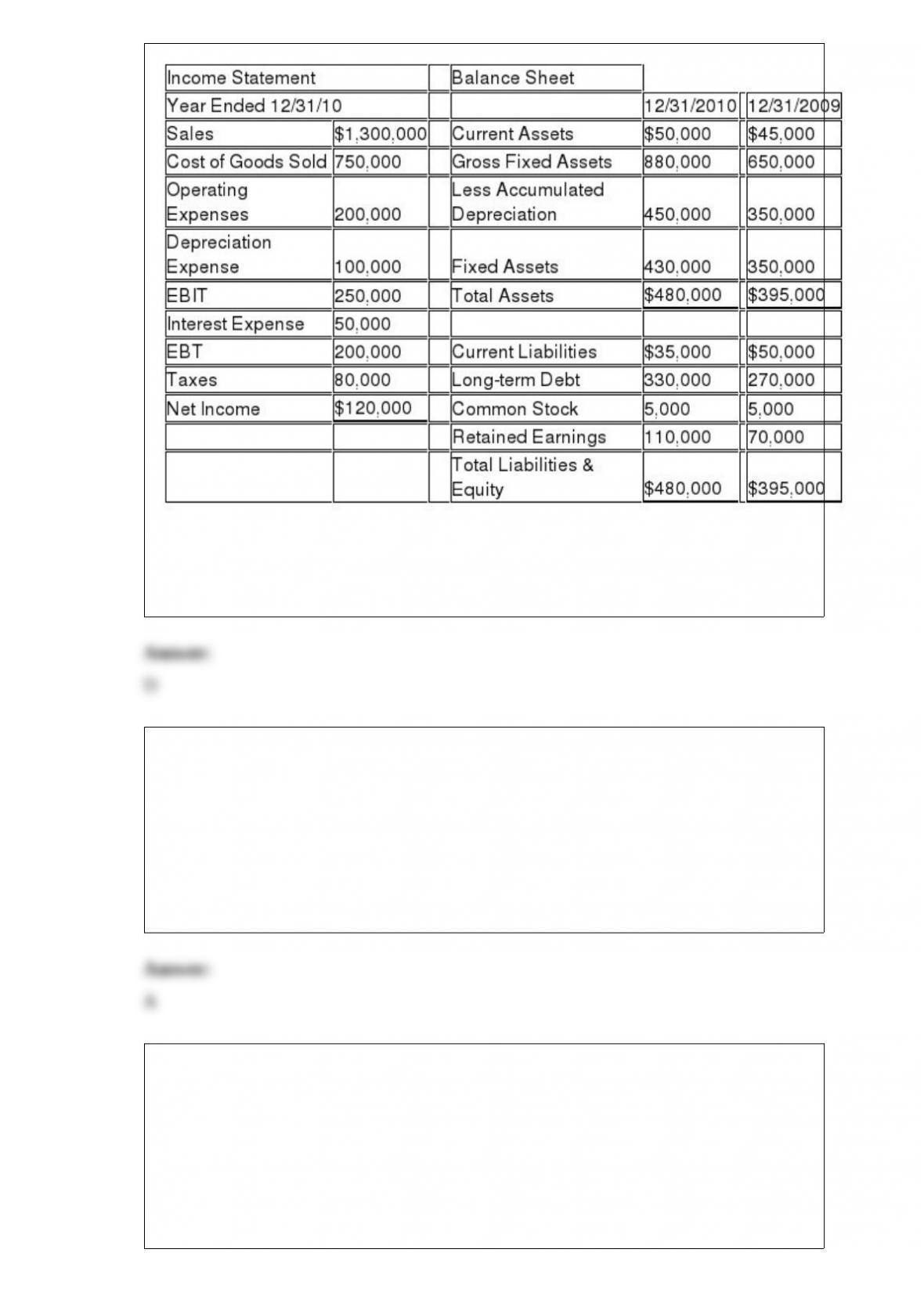
18) Given the following financial statements for ACME Corporation, what amount did
the company pay in dividends for 2010?
A) $45,000
B) $25,000
C) $100,000
D) $80,000
19) Kohler Manufacturing typically achieves one of three production levels in any
given year: 8 million pounds of steel, 10 million pounds of steel, or 16 million pounds
of steel. In tracking some of its costs, Kohler’s controller discovered one cost that was
$10 per pound no matter what the production level for the year. This is an example of a
A) variable cost
B) fixed cost
C) semivariable cost
D) semifixed cost
20) A financial manager is evaluating a project which is expected to generate profits of
$100,000 per year for the next 10 years. The project should be accepted if
A) the cost of the project is less than $1,000,000
B) the cost of the project is less than the present value of $100,000 per year for 10 years
C) this project’s expected profits are higher than any other projects the corporation has
available
D) the present value of the project’s cash inflows exceeds the present value of the
project’s cash outflows

21) South Stage, Inc. preferred stock pays an annual dividend of $2.75 per share. If the
stock is currently selling for $27.50 per share, what is the expected rate of return on this
stock?
A) 2.75%
B) 10.0%
C) 17.5%
D) 27.5%
22) All of the following statements about agency problems are true EXCEPT
A) Agency problems interfere with the goal of maximizing shareholder value
B) Agency costs are paid by the managers who do not act in the shareholders’ best
interest
C) Agency problems result from the separation of management and the ownership of a
firm
D) The root cause of agency problems is conflicts of interest
23) The term “lumpy asset” means
A) the same thing as assets that exhibit scale economies
B) assets that can be purchased in incremental units
C) assets that have economies of scale but not economies of scope
D) assets that must be purchased in discrete quantities
24) A British-made component costs 36 U.K. pounds. A company in the United States
needs to buy these components and the current indirect quote indicates that one dollar
will buy .6250 pounds. Ignoring transactions costs, how much will one component cost
in U.S. dollars?
A) $22.50
B) $45.94
C) $57.60
D) $72.00

25) D’Anthony borrowed $50,000 today that he must repay in 15 annual end-of-year
installments of $5,000. What annual interest rate is D’Anthony paying on his loan?
A) 2.222%
B) 3.333%
C) 5.556%
D) 33.33%
26) Table 4-1
Stewart Company
Balance Sheet
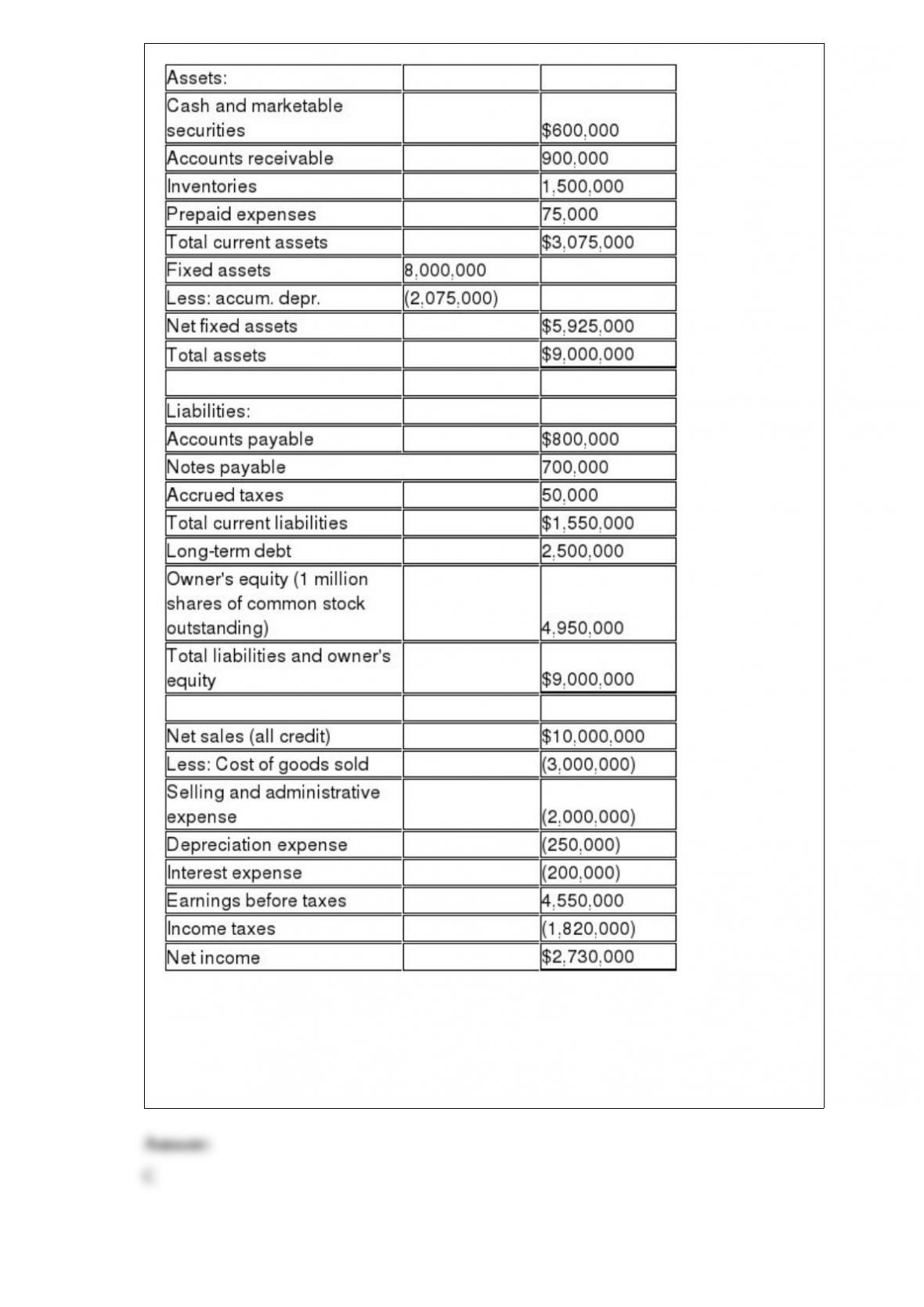
Based on the information in Table 4-1, the acid-test ratio is
A) 1.71
B) 1.67
C) 1.02
D) 0.98

27) You are thinking of adding one of two investments to an already well- diversified
portfolio.
Security ASecurity B
Expected Return = 14%Expected Return = 16%
Standard Deviation ofStandard Deviation of
Returns = 16%Returns = -20%
Beta = 1.2Beta = 1.2
If you are a risk-averse investor, which one is the better choice?
A) Security A
B) Security B
C) Either security would be acceptable because they have the same beta
D) Security B, but only if Security B’s required return is greater than 12%
28) The cost of external equity capital is greater than the cost of retained earnings
because of
A) flotation costs on new equity
B) increasing marginal tax rates
C) higher dividends
D) greater risk for shareholders
29) An investor who requires a 12% percent return for a stock that pays no dividends
and requires a 9% return for a stock that pays its entire return from dividends is most
likely a proponent of
A) the bird-in-the-hand dividend theory
B) the residual dividend theory
C) the clientele effect
D) the information effect
30) Shareholder wealth maximization means
A) maximizing earnings per share
B) maximizing dividends per share
C) maximizing the price of existing common stock
D) maximizing stockholders equity

31) Which of the following statements concerning bonds and risk is true?
A) Because the interest payments and maturing value are known, the only risk
associated with investing in bonds is default risk
B) Zero coupon bonds are always more risky than bonds with high coupon rates
because of the time value of money
C) Bonds are generally less risky than common stock because of the preference for debt
over equity in the event of bankruptcy and liquidation
D) B-rated bonds are above average for risk, i.e., less risky than the average bond
32) Buying and selling in more than one market to make a riskless profit is called
A) profit-maximization
B) arbitrage
C) international trading
D) cannot be determined from the above information
33) Beginning with an investment in one company’s securities, as we add securities of
other companies to our portfolio, which type of risk declines?
A) systematic risk
B) market risk
C) non-diversifiable risk
D) unsystematic risk
34) Two companies have identical assets and operating activities. Which of the follow
statements is true?
A) Both companies have the same net income
B) The company with more debt will have lower operating income due to interest
expense
C) The company with more debt will have higher operating income due to leverage
D) The company with more debt will have lower net income due to interest expense
35) The investment banker performs what three basic functions?
A) underwriting, distributing, and regulating
B) underwriting, advising, and price-pegging

C) underwriting, distributing, and advising
D) underwriting, distributing, and negotiating
36) An example of the growth factor in common stock is
A) acquiring a loan to fund an investment in Asia
B) retaining profits in order to reinvest into the firm
C) issuing new stock to provide capital for future growth
D) two strong companies merging together to increase their economy of scale
37) Assume that Federated Stores, whose credit card billings total $120 billion per year,
were to implement a lockbox arrangement that would speed up the collection of its
credit card billings by 2 full days. If Federated could earn 3.5% on its marketable
securities, how much would the firm earn per year from such a lockbox arrangement?
Assume a 365-day year.
A) $316.99 million
B) $244.58 million
C) $230.14 million
D) $183.50 million
38) AFB Systems is considering a new marketing campaign that will require the
addition of a new computer programmer and new software. The programmer will
occupy an office in AFB’s current building and will be paid $8,000 per month. The
software license costs $1,000 per month. The rent for the building is $4,000 per month.
AFB’s computer system is always on, so running the new software will not change the
current monthly electric bill of $900. The incremental expenses for the new marketing
campaign are
A) $13,900 per month
B) $9,000 per month
C) $13,000 per month
D) $8,000 per month
39) Maximization of shareholder wealth
A) represents a zero sum game in which one corporation gains at the expense of others
B) provides benefits to society as scarce resources are directed to their most productive
use
C) is not a practical goal since it cannot be measured effectively
D) is achieved only if cash flows exceed accounting profits
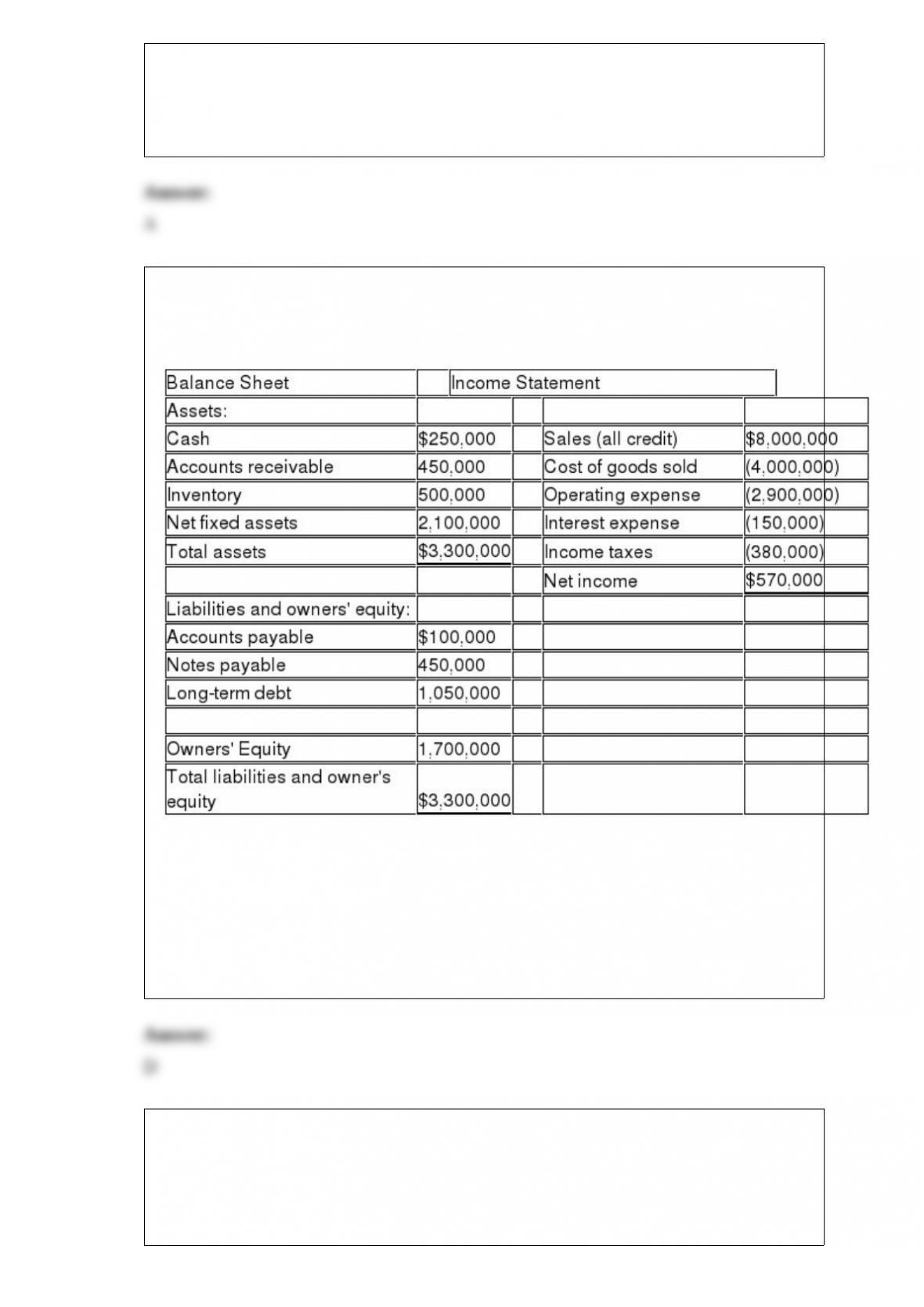
40) Table 4-3
Emery Corporation
Based on the information in Table 4-3, assuming that the firm has no preferred stock,
and paid $300,000 in common dividends, the firm’s return on equity was
A) 79.43%
B) 61.89%
C) 43.34%
D) 33.53%
41) You deposit $5,000 per year at the end of each of the next 25 years into an account
that pays 8% compounded annually. How much could you withdraw at the end of each
of the 20 years following your last deposit if all withdrawals are the same dollar
amount? (The twenty-fifth and last deposit is made at the beginning of the 20-year
period. The first withdrawal is made at the end of the first year in the 20-year period.)

A) $18,276
B) $27,832
C) $37,230
D) $43,289
42) Which of the following is considered a spontaneous source of financing?
A) short-term notes payable
B) accounts payable
C) long-term notes payable
D) preferred stock
43) Dryden, Corp. has 500,000 shares of common stock outstanding, a P/E ratio of 11,
and $900,000 earnings available for common stockholders. The board of directors has
just voted a 5:2 stock split.
a.If you had 100 shares of stock before the split, how many shares will you have after
the split?
b.What was the total value of your investment in Dryden stock before the split?
c.What should be the total value of your investment in Dryden stock after the split?
d.In view of your answers to (b) and (c) above, why would a firm’s management want
to have a stock split?

44) If you put $2,000 in a savings account that yields 8% compounded semiannually,
how much money will you have in the account in 20 years (round to nearest $10)?
A) $6,789
B) $8,342
C) $9,602
D) $9,972
45) Your firm is considering an investment that will cost $920,000 today. The
investment will produce cash flows of $450,000 in year 1, $270,000 in years 2 through
4, and $200,000 in year 5. The discount rate that your firm uses for projects of this type
is 11.25%. What is the investment’s profitability index?
A) 1.21
B) 1.26
C) 1.43
D) 1.69
46) You are considering investing in Ford Motor Company. Which of the following are
examples of diversifiable risk?
I.Risk resulting from possibility of a stock market crash.
II.Risk resulting from uncertainty regarding a possible strike against Ford.
III.Risk resulting from an expensive recall of a Ford product.
IV.Risk resulting from interest rates decreasing.
A) I only
B) I and IV
C) I, II, III, IV
D) II, III
47) Which of the following should NOT be considered when calculating a firm’s
WACC?
A) cost of preferred stock
B) after-tax cost of bonds
C) cost of common stock
D) cost of carrying inventory

48) ND Electric Company issued $1,000 bonds that have an annual coupon rate of
6.5%. The present market value of the bonds is $1,225. If the bonds have 17 years
remaining until maturity, what is the current yield on ND Electric Company bonds?
A) 5.3%
B) 6.5%
C) 7.2%
D) 13.2%
49) If markets were entirely efficient (perfect), which of the following would we
conclude?
A) There would be no inflation
B) Book value would be the same as market value
C) No firms would ever default on their bonds
D) Market value and intrinsic value would be the same