
When stock prices fall
A) an individual’s wealth is not affected nor is their willingness to spend.
B) a business firm will be more likely to sell stock to finance investment spending.
C) an individual’s wealth may decrease but their willingness to spend is not affected.
D) an individual’s wealth may decrease and their willingness to spend may decrease.
Asset transformation can be described as
A) borrowing long and lending short.
B) borrowing short and lending long.
C) borrowing and lending only for the short term.
D) borrowing and lending for the long term.
Which of the following is most likely to lead to inflationary monetary policy?
A) declining oil prices
B) resolution of conflict in the Middle East
C) the enactment of a free-trade agreement with Mexico
D) rising unemployment
Money is
A) anything that is generally accepted in payment for goods and services or in the
repayment of debt.
B) a flow of earnings per unit of time.
C) the total collection of pieces of property that are a store of value.

D) always based on a precious metal like gold or silver.
According to aggregate demand and supply analysis, the negative supply shocks of
1973-1975 and 1978-1980 had the effect of
A) increasing aggregate output, lowering unemployment, and raising the inflation.
B) decreasing aggregate output, raising unemployment, and raising the inflation.
C) increasing aggregate output, raising unemployment, and raising the inflation.
D) decreasing aggregate output, raising unemployment, and lowering the inflation.
The result of the too-big-to-fail policy is that ________ banks will take on ________
risks, making bank failures more likely.
A) small; fewer
B) small; greater
C) big; fewer
D) big; greater
Everything else held constant, if aggregate output is to the ________ of the IS curve,
then there is an excess supply of goods which will cause aggregate output to ________.
A) right; fall
B) right; rise
C) left; fall
D) left; rise

Which of the following $1,000 face-value securities has the highest yield to maturity?
A) a 5 percent coupon bond with a price of $600
B) a 5 percent coupon bond with a price of $800
C) a 5 percent coupon bond with a price of $1,000
D) a 5 percent coupon bond with a price of $1,200
The Glass-Steagall Act, before its repeal in 1999, prohibited commercial banks from
A) issuing equity to finance bank expansion.
B) engaging in underwriting and dealing of corporate securities.
C) selling new issues of government securities.
D) purchasing any debt securities.
A common element in all of the banking crisis episodes in different countries is
A) the existence of a government safety net.
B) deposit insurance.
C) increased regulation.
D) lack of competition.

A return to the gold standard, that is, using gold for money will ________ the ________
for gold, ________ its price, everything else held constant.
A) increase; demand; increasing
B) decrease; demand; decreasing
C) increase; supply; increasing
D) decrease; supply; increasing
The evidence on the interest sensitivity of the demand for money suggests that the
demand for money is ________ to interest rates, and there is ________ evidence that a
liquidity trap exists.
A) sensitive; substantial
B) sensitive; little
C) insensitive; substantial
D) insensitive; little
Financial intermediaries develop ________ in things such as computer technology
which allows them to lower transactions costs.
A) expertise
B) diversification
C) regulations
D) equity

Financial innovation has caused
A) banks to suffer declines in their cost advantages in acquiring funds, although it has
not caused a decline in income advantages.
B) banks to suffer a simultaneous decline of cost and income advantages.
C) banks to suffer declines in their income advantages in acquiring funds, although it
has not caused a decline in cost advantages.
D) banks to achieve competitive advantages in both costs and income.
Keynes argued that when interest rates were low relative to some normal value, people
would expect bond prices to ________ so the quantity of money demanded would
________.
A) increase; increase
B) increase; decrease
C) decrease; increase
D) decrease; decrease
During the bank panics of the Great Depression the excess reserve ratio
A) increased sharply.
B) decreased sharply.
C) increased slightly.
D) decreased slightly.
The Fed’s holdings of securities consist primarily of ________, but also in the past have

included ________.
A) Treasury securities; bankers’ acceptances
B) municipal securities; bankers’ acceptances
C) bankers’ acceptances; Treasury securities
D) Treasury securities; municipal securities
Everything else held constant, if a central bank makes an unsterilized ________ of
foreign assets, then the domestic money supply will decrease and the domestic currency
will ________.
A) purchase; appreciate
B) purchase; depreciate
C) sale; appreciate
D) sale; depreciate
If one party pays a fixed fee on a regular basis in return for a contingent payment that is
triggered by a downgrading of a firm’s credit rating, that is called a
A) credit option.
B) credit swap.
C) credit-linked note.
D) credit default swap.
If you buy a put option on treasury futures at 110, and at expiration the market price is
115, the ________ will ________ exercised.

A) call; be
B) put; be
C) call; not be
D) put; not be
From before the financial crisis began in September of 2007 to when the crisis was over
at the end of 2009, amount of Federal Reserve assets rose, leading to
A) a huge increase in the monetary base.
B) a huge expansion of the money supply.
C) an economic expansion.
D) a high inflation.
Loophole mining refers to financial innovation designed to
A) hide transactions from the IRS.
B) conceal transactions from the SEC.
C) get around regulations.
D) conceal transactions from the Treasury Department.
Currency includes
A) paper money and coins.
B) paper money, coins, and checks.
C) paper money and checks.
D) paper money, coins, checks, and savings deposits.

In the market for reserves, if the federal funds rate is between the discount rate and the
interest rate paid on excess reserves, a decline in the reserve requirement ________ the
________ curve of reserves and causes the federal funds interest rate to fall, everything
else held constant.
A) decreases; demand
B) increases; demand
C) increases; supply
D) decreases; supply
If the Japanese yen appreciates from $0.01 per yen to $0.02 per yen, the U.S. dollar
depreciates from ________ per dollar to ________ per dollar.
A) 100¥; 50¥
B) 10¥; 5¥
C) 5¥; 10¥
D) 50¥; 100¥
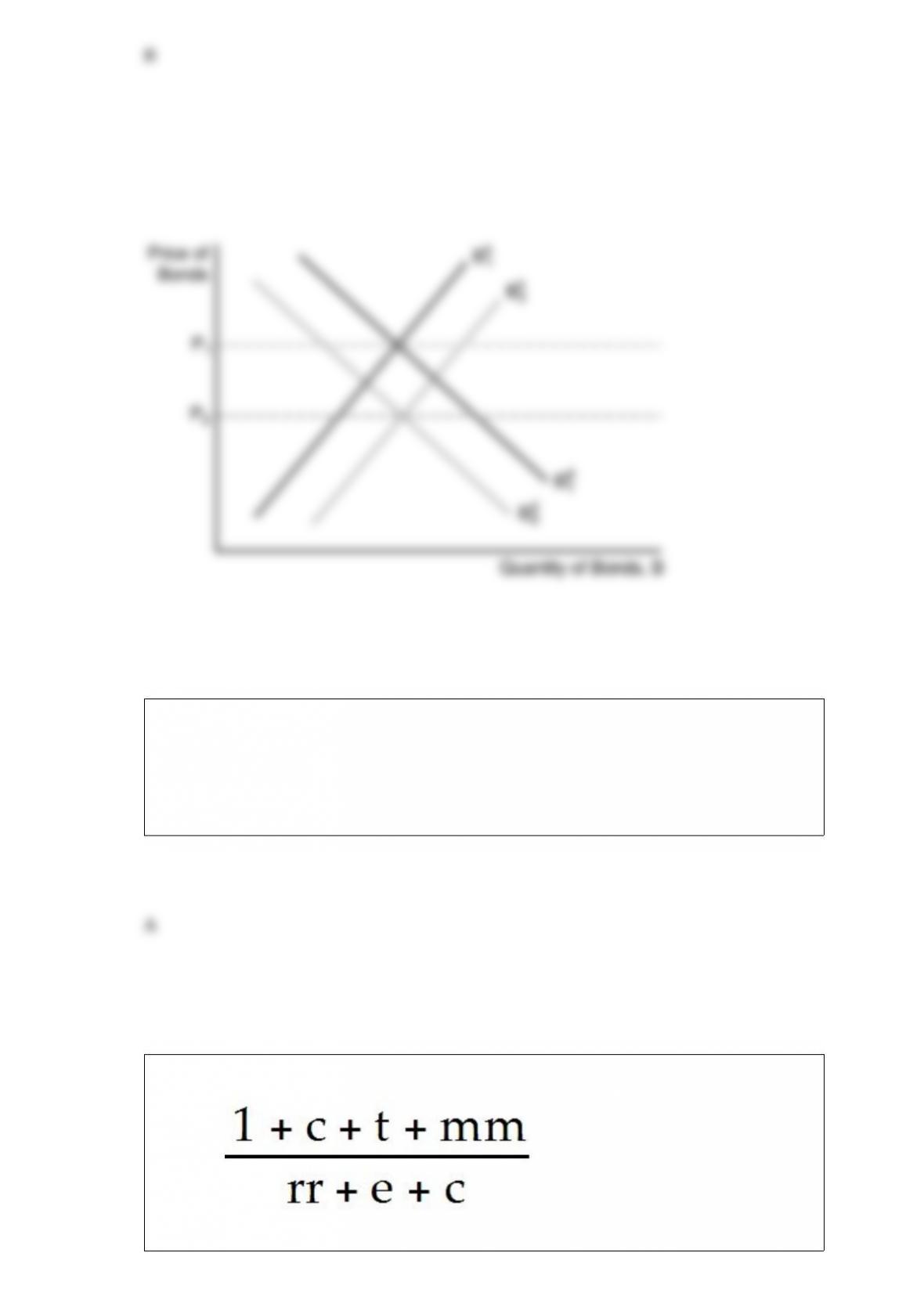
If real estate prices are expected to drop, all else equal, the demand for bonds ________
and the interest rate_______.
A) increases; rises
B) increases; falls
C) decreases; rises
D) decreases; falls
The speculative motive for holding money is closely tied to what function of money?
A) store of wealth
B) unit of account
C) medium of exchange
D) standard of deferred payment
The M2 money supply is represented by
A) M2 = × MB.
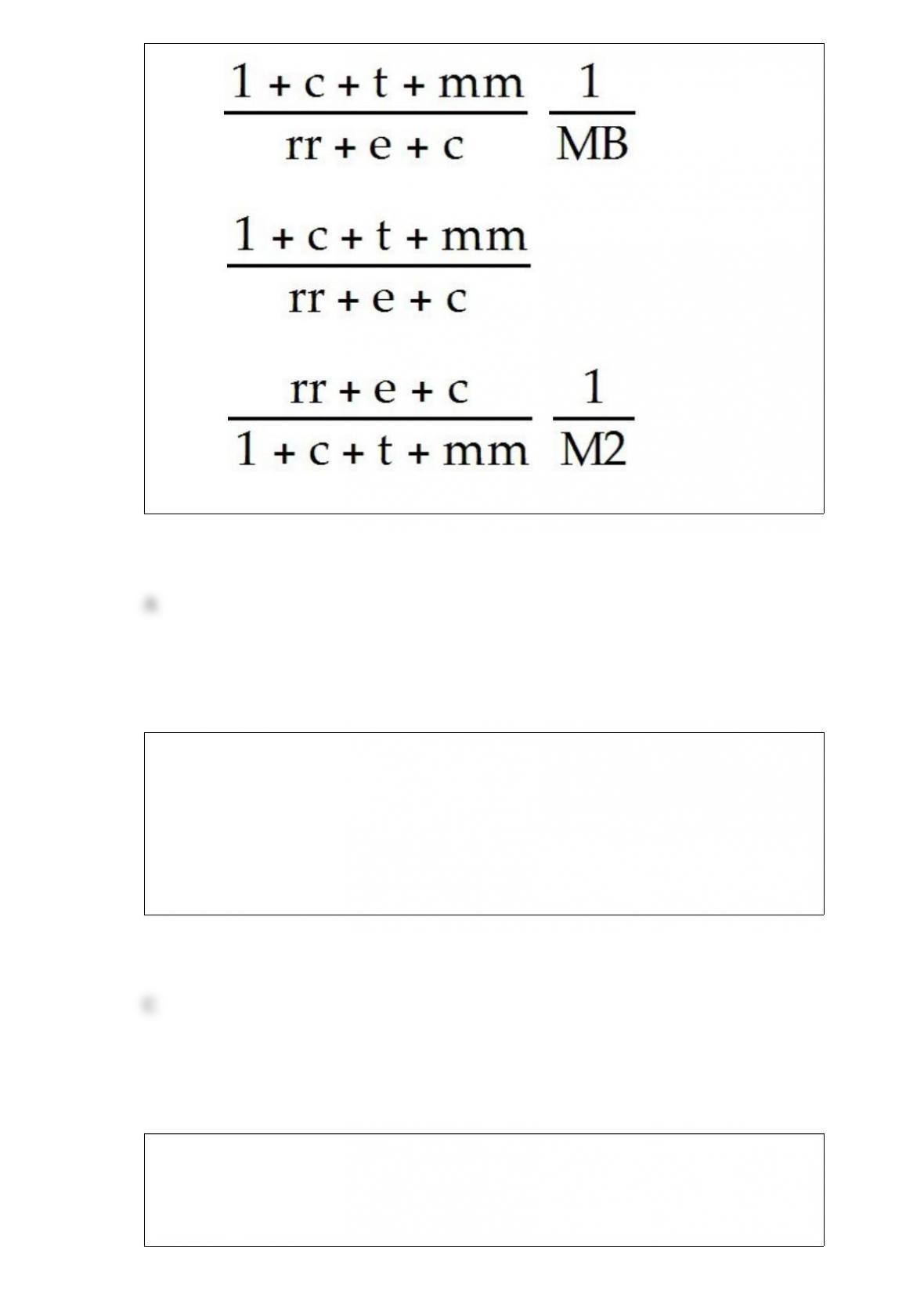
B) M2 = × .
C) MB = × M2.
D) MB = × .
If the required reserve ratio is 10 percent, currency in circulation is $400 billion,
checkable deposits are $1000 billion, and excess reserves total $1 billion, then the
currency-deposit ratio is
A) 0.25.
B) 0.50.
C) 0.40.
D) 0.05.
The expected return on dollar deposits in terms of foreign currency can be written as the
________ of the interest rate on dollar deposits and the expected appreciation of the
dollar.
A) product

B) ratio
C) sum
D) difference