
1) The cost of preferred stock is the ratio of the preferred stock dividend to a firm’s net
proceeds from the sale of the preferred stock.
2) A takeover target’s management will not support a proposed takeover due to a very
high tender offer.
3) If the NPV is greater than the initial investment, a project should be rejected.
4) The steeper the slope of the EBIT-EPS capital structure line, the lower is the
financial risk.
5) A debtor in possession in a Chapter 11 bankruptcy proceeding is responsible for
valuing the bankrupt firm both in terms of its liquidation value and as a going concern.
6) The free cash flow valuation model is based on the same principle as the P/E
valuation approach; that is, the value of a share of stock is the present value of future
cash flows.
7) A decrease in fixed financial costs will result in a(n)________.
A) increase in financial risk
B) decrease in financial risk
C) increase in operating leverage
D) decrease in operating leverage

8) The approximate before-tax cost of debt for a 15-year, 10 percent, $1,000 par value
bond selling at $950 is ________.
A) 10 percent
B) 10.7 percent
C) 12 percent
D) 15.4 percent
9) Generally, an increase in risk will result in ________.
A) a lower required return or interest rate
B) a higher required return or interest rate
C) a higher return on investment
D) a lower return on investment
10) A firm needs $5 million of new long-term financing. The firm is considering the
sale of common stock or a convertible bond. The current market price of the common
stock is $65 per share. To sell this new issue, the stock would have to be underpriced by
$2 and sold for $63 per share. The firm currently has 600,000 shares of common stock
outstanding. The alternative is to issue 20-year, 10 percent, and $1,000 par-value
convertible bonds. The conversion price would be set at $73 per share, and the bond
could be sold at par. The earnings for the firm are expected to be $4,000,000 in the
coming year. Assuming the firm chooses the convertible bond, the earnings per share
after all bonds are converted will be ________.
A) $6.67
B) $5.97
C) $5.85
D) $5.78
11) Which of the following is true of collection float?
A) It represents the time delay between when payment is placed in the mail and when it
is received
B) It represents the time between receipt of a payment and its deposit into a firm’s
account
C) It results from the lapse between the time when a firm deducts a payment from its
checking account ledger and the time when funds are actually withdrawn from its

account
D) It results from the delay between the time when a customer deducts a payment from
the checking account ledger and the time when the vendor actually receives the funds in
a spendable form
12) An excess earnings accumulation tax is levied when ________.
A) shareholders receive dividends which exceed a firm’s earnings
B) firms do not pay dividends in order to delay the owners’ tax liability
C) firms do not pay dividends to reinvest in the firm
D) earnings exceed accumulated dividends over the years
13) The risk of an investment in a Eurodollar deposit is partially due to ________.
A) the fact that the center of the Eurodollar market is in London
B) the fact that the majority of these deposits are not in the form of U.S. dollars
C) the presence of some foreign exchange risk
D) the fact that these instruments only pay interest at maturity
14) The advantages of holding companies include ________.
A) reduced federal corporate taxes due to the holding company status
B) decreased risk resulting from the leverage effect
C) possible state tax benefits realized by each subsidiary in its state of incorporation
D) low cost of administration
15) The economic order quantity (EOQ) is the order quantity which minimizes
________.
A) the order cost per order
B) the total inventory costs
C) the carrying costs per unit per period
D) order quantity in units
16) Emmy Lou, Inc. has an expected dividend next year of $5.60 per share, a growth
rate of dividends of 10 percent, and a required return of 20 percent. The value of a share
of Emmy Lou, Inc.’s common stock is ________.
A) $28.00
B) $56.00
C) $22.40
D) $18.67
17) With a floating-rate note, the interest rate on the note changes ________.
A) when the risk level of the borrower changes
B) when the prime rate changes
C) when the demand for loans changes
D) when bank profits changes
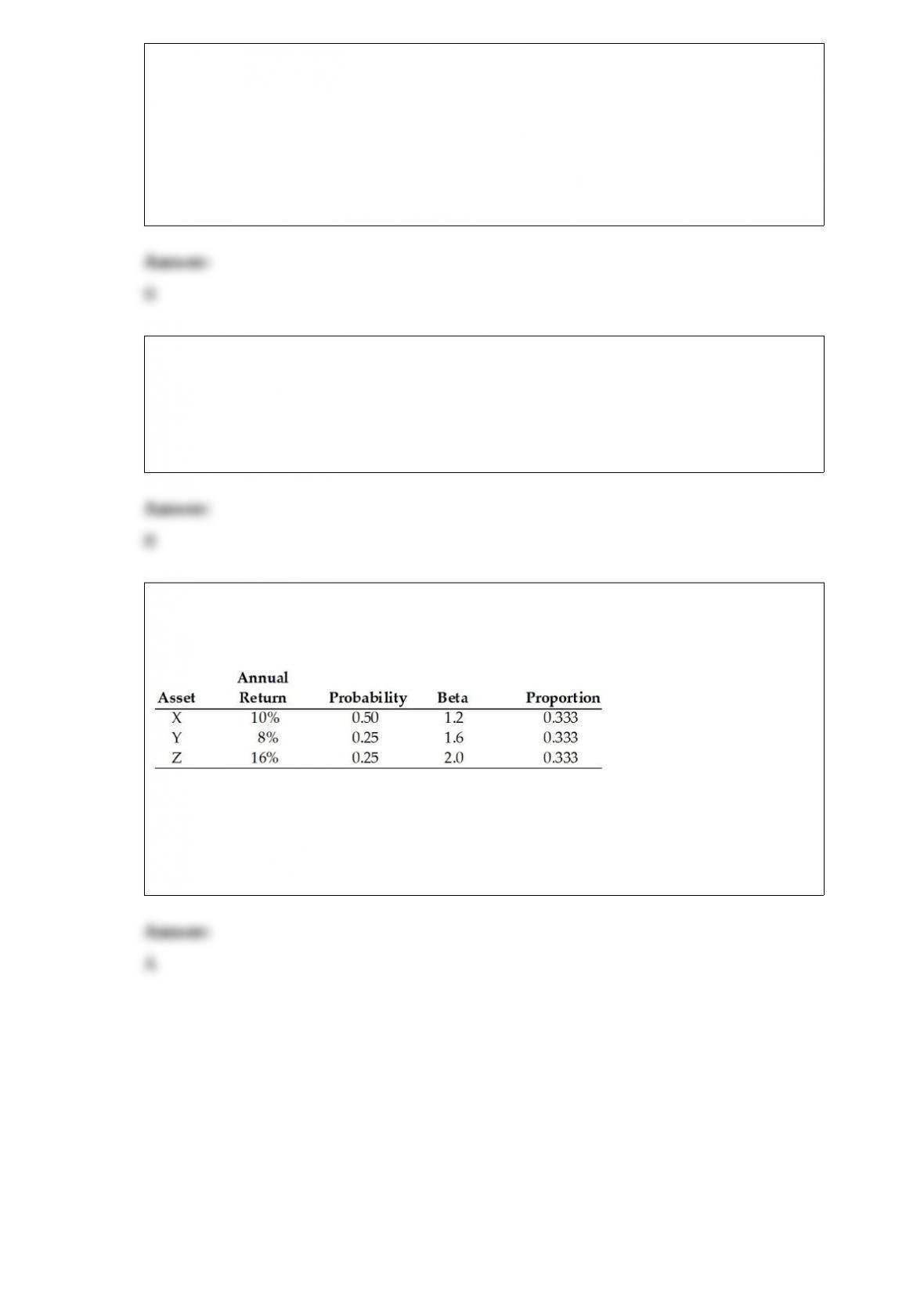
18) Table 8.2
You are going to invest $20,000 in a portfolio consisting of assets X, Y, and Z, as
follows:
The beta of the portfolio in Table 8.2 indicates this portfolio ________.
A) has more risk than the market
B) has less risk than the market
C) has an unrelated amount of risk compared to the market
D) has the same risk as the market