
1) When assessing the risk impact of adding a new security to a portfolio, it is necessary
to consider the
a. New securities variance
b. Variance of every security in the portfolio
c. Weight of every security in the portfolio
d. Average covariance of the new security with every security in the portfolio
e. All of the above
2) Which of the following is not a relaxation of the assumptions for the CAPM?
a. Differential lending and borrowing rates
b. A zero beta model
c. Transaction costs
d. Taxes
e. Homogeneous expectations and fixed planning periods
3) The basic distinction between a primary and a secondary market is
a.proceeds from sales in the primary market go to the current owner of a security;
proceeds in secondary market go to the original owner.
b.primary markets involve direct dealings within regional exchanges.
c.only new securities are sold in the primary market; only outstanding securities are
bought and sold in the secondary market.
d.primary markets deal exclusively in bonds; secondary markets deal primarily in
common stock.
e.None of the above.
4) Which of the following statements is false?
a. Derivatives help shift risk from risk-adverse investors to risk-takers.
b. Derivatives assist in forming cash prices.
c. Derivatives provide additional information to the market.
d. In many cases, the investment in derivatives (both commissions and required
investment) is more than in the cash market.
e. None of the above (that is, all are reasons)
5) Mutual fund performance studies have shown that most funds
a. Have risks and returns that are inconsistent with their stated objectives.
b. Have risks and returns that are consistent with their stated objectives.
c. Do not have stated objectives.
d. Have experienced risk-adjusted returns above the market.
e. Have changed their objectives over time.
6) Exhibit 6.6
USE THE INFORMATION BELOW FOR THE FOLLOWING PROBLEM(S)
Rit= return for stock i during period t
Rmt= return for the aggregate market during period t
Refer to Exhibit 6.6. What is the abnormal rate of return for Stock A during period t
using only the aggregate market return (ignore differential systematic risk)?
a.-2.3%
b.-0.3%
c.0.3%
d.2.3%
e.3.0%
7) Exhibit 10.8
USE THE INFORMATION BELOW FOR THE FOLLOWING PROBLEM(S)
Zeco Company has the following financial statements for year ending 12/31/2008.
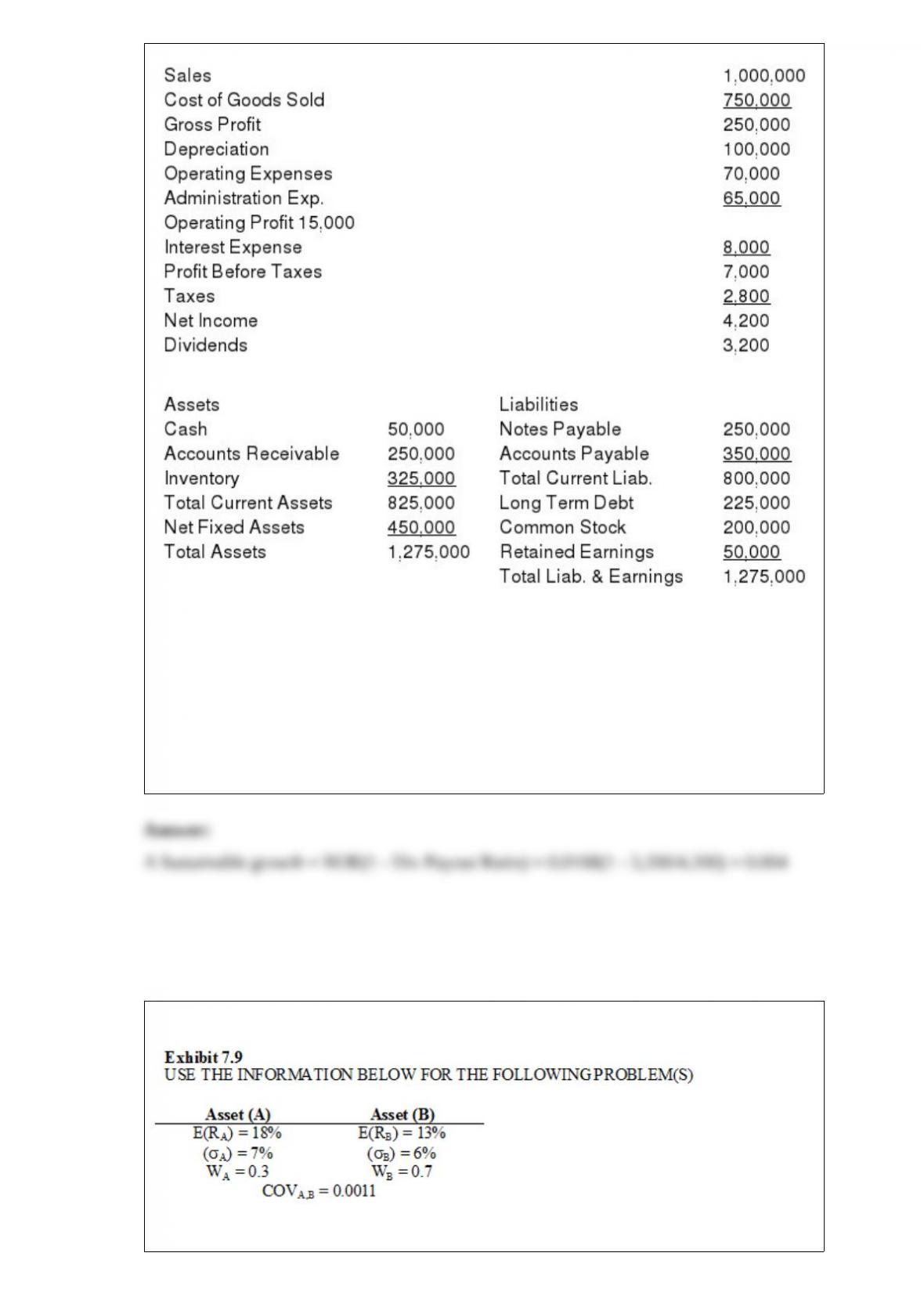
The Zeco Company’s industry averages are as follows:
Net Profit Margin = 4.5%; Total Asset Turnover = 0.8; Total Assets/Equity = 1.5
Calculate the sustainable growth rate for Zeco Company.
a. 0.4%
b. 0.7%
c. 1.3%
d. 2.1%
e. 4.1%
8)
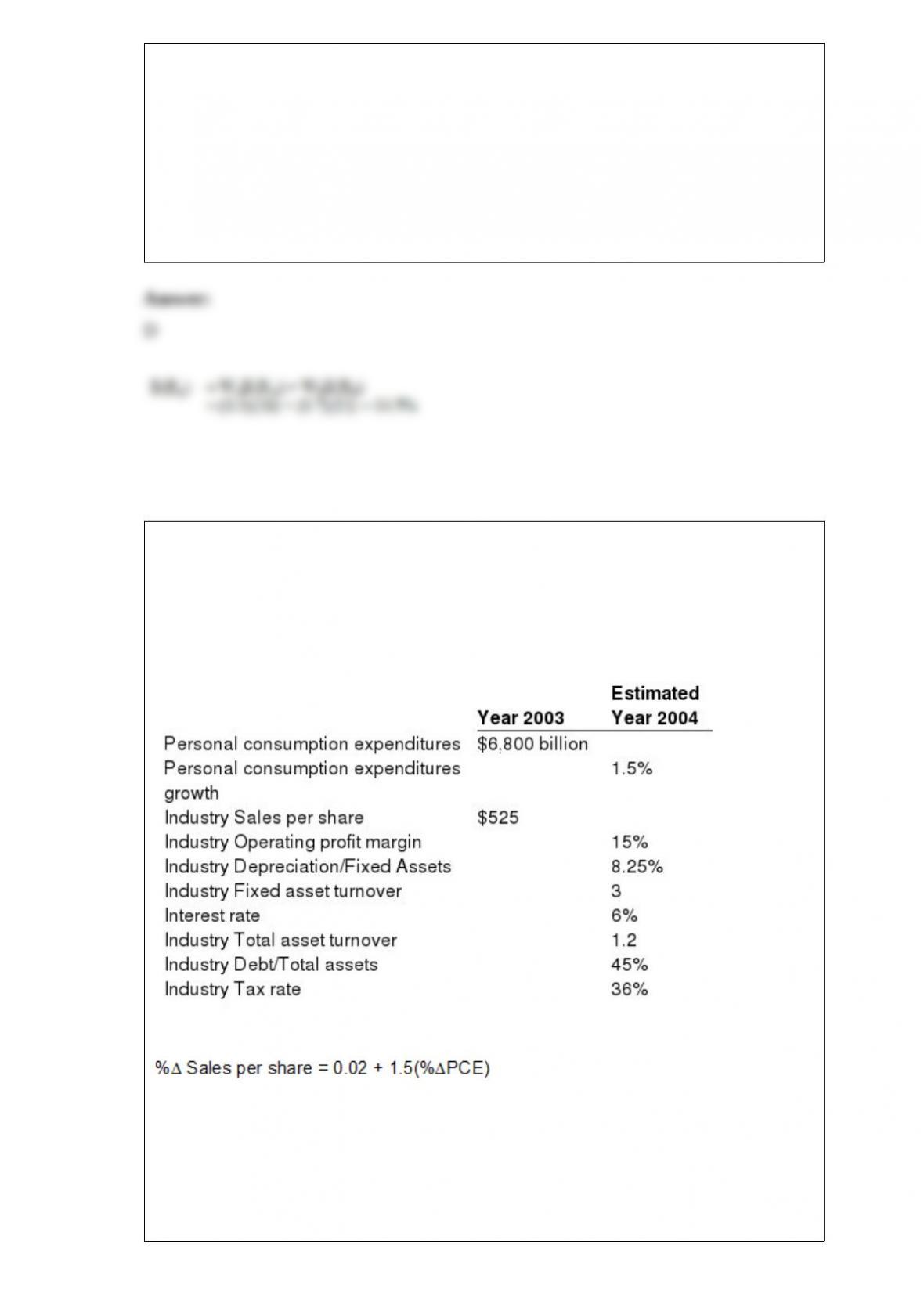
Refer to Exhibit 7.9. What is the expected return of a portfolio of two risky assets if the
expected return E(Ri), standard deviation (si), covariance (COVi,j), and asset weight
(Wi) are as shown above?
a. 10.10%
b. 11.60%
c. 13.88%
d. 14.50%
e. 15.37%
9) Exhibit 13.1
USE THE INFORMATION BELOW FOR THE FOLLOWING PROBLEM(S)
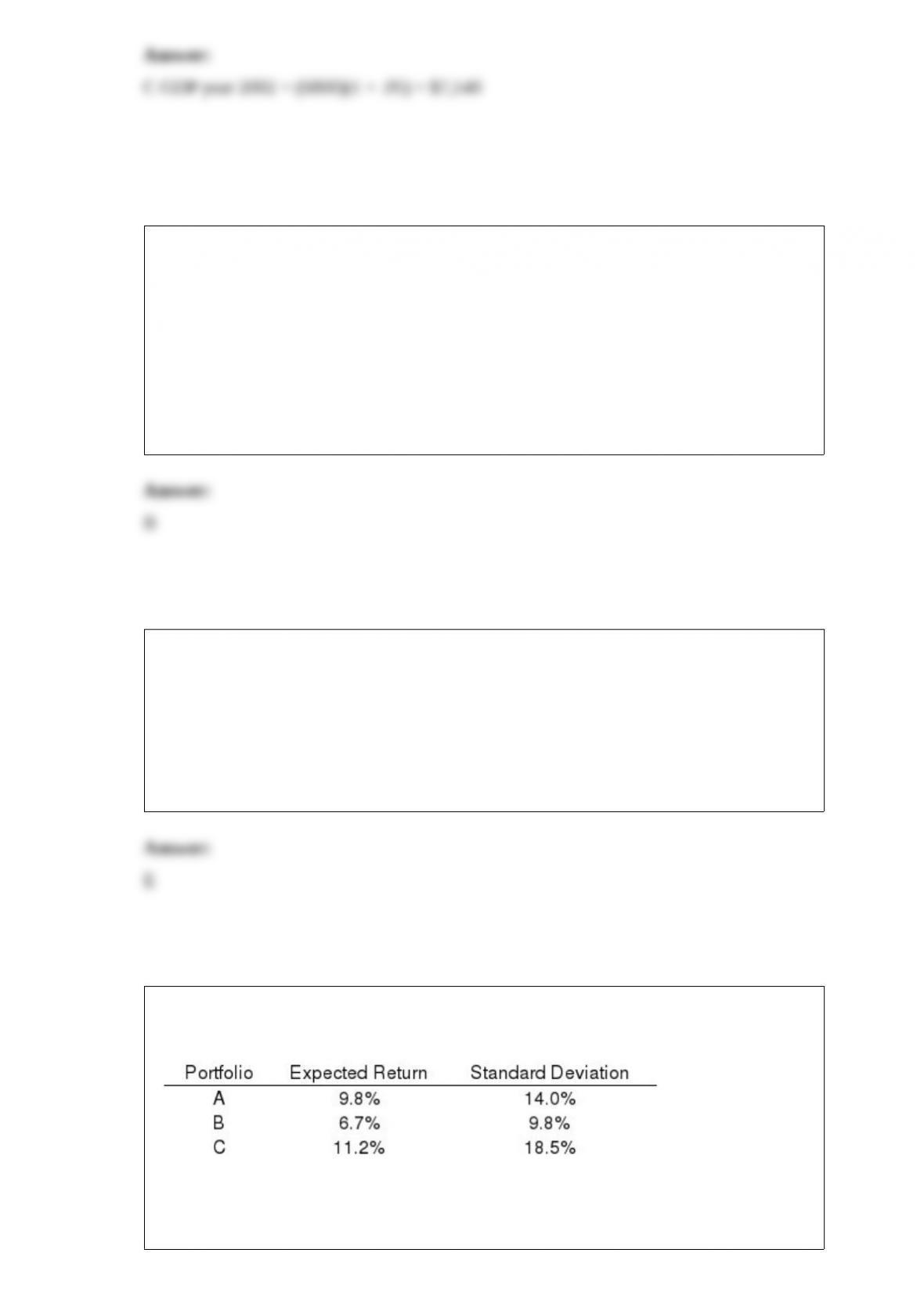
Assume that you are an analyst for the U.S. Autoparts Industry. Consider the following
information that you propose to use to obtain an estimate of year 2002 EPS for the U.S.
Autoparts Industry:
In addition a regression analysis indicates the following relationship between growth in
industry sales per share and personal consumption expenditures (PCE) growth is
Calculate personal consumption expenditures for the year 2004.
a. $7,500 billion
b. $7,000 billion
c. $7140 billion
d. $7,550.5 billion
e. $6,825.75 billion
10) For a poorly diversified portfolio the appropriate measure of portfolio performance
would be
a. The Treynor measure because it evaluates portfolio performance on the basis of
return and diversification.
b. The Sharpe measure because it evaluates portfolio performance on the basis of return
and diversification.
c. The Treynor measure because it uses standard deviation as the risk measure.
d. The Sharpe measure because it uses beta as the risk measure.
e. None of the above.
11) An investor considering investment in warrants as part of an overall program,
should consider which of the following?
a. Diversification
b. Cutting losses short, and letting profits run
c. A low intrinsic value
d. Viewing warrant selection as a portion of the total investment process
e. All of the above
12) Exhibit 8.5
USE THE INFORMATION BELOW FOR THE FOLLOWING PROBLEM(S)
Refer to Exhibit 8.5. Which of the three portfolios are most likely to be the market
portfolio?
a. Portfolio A
b. Portfolio B
c. Portfolio C
d. All of the portfolios are equally likely to be the market portfolio
e. There is insufficient information to differentiate between the three portfolios
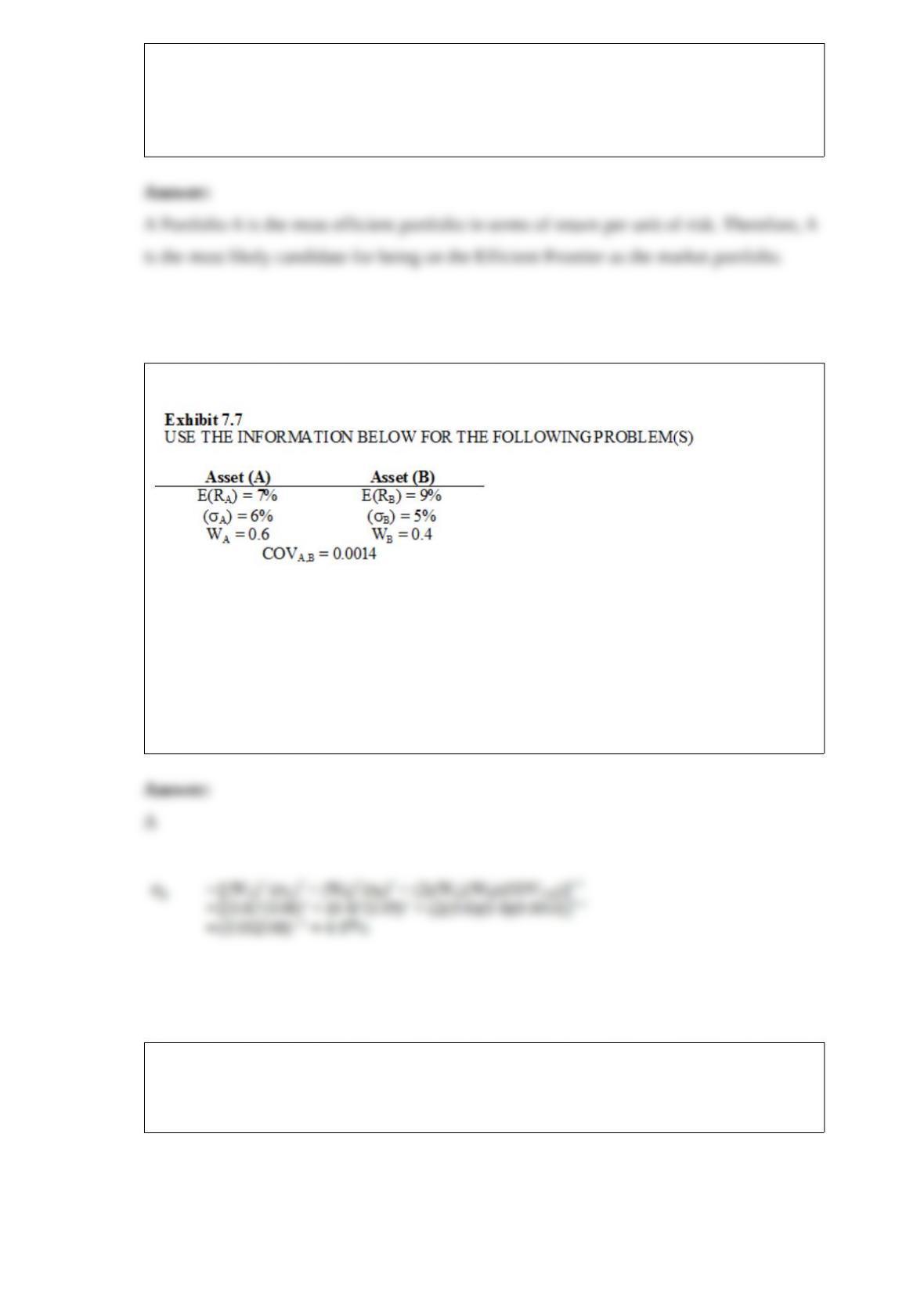
13)
Refer to Exhibit 7.7. What is the standard deviation of this portfolio?
a. 4.87%
b. 3.62%
c. 4.13%
d. 5.76%
e. 6.02%
14) Exhibit 10.9
USE THE INFORMATION BELOW FOR THE FOLLOWING PROBLEM(S)
You are provided with the following year end information for All Systems Corporation.
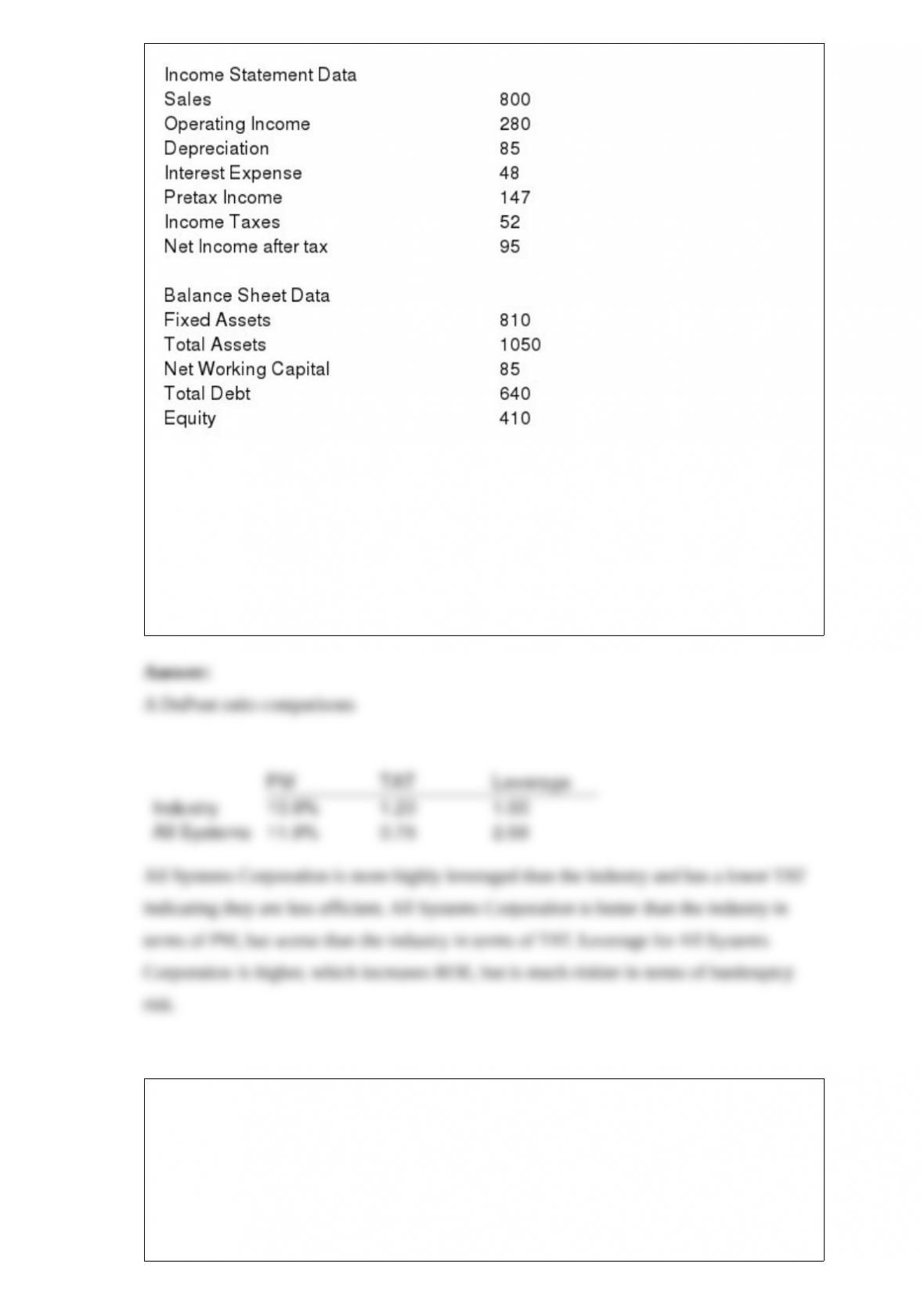
The industry norms for profit margin (PM), total asset turnover (TAT), and financial
leverage are 10.9%, 1.2, and 1.0, respectively. Based on this information it appears that
All Systems Corporation is
a. Better than the industry in terms of PM, but worse in terms of TAT
b. Better than the industry for all three ratios
c. Better than the industry for TAT and leverage, but worse for PM
d. Worse than the industry for all three measures
e. None of the above
15) A stock currently trades at $110. June call options on the stock with a strike price of
$120 are priced at $5.75. Calculate the dollar return on one call contract.
a. -$1000
b. $1000
c. $575
d. -$575
e. $0

16) Exhibit 21.8
USE THE INFORMATION BELOW FOR THE FOLLOWING PROBLEM(S)
Consider a portfolio manager with a $20,500,000 equity portfolio under management.
The manager wishes to hedge against a decline in share values using stock index
futures. Currently a stock index future is priced at 1250 and has a multiplier of 250. The
portfolio beta is 1.25.
Assume that a month later the equity portfolio has a market value of $20,000,000 and
the stock index future is priced at 1150 with a multiplier of 250. Calculate the profit on
the equity position.
a. $100,000
b. -$200,000
c. $600,000
d. -$500,000
e. $400,000
17) Refer to Exhibit 5.4. Calculate the average annual rate of change for this index for
the 5 year period using the arithmetic mean.
a.0.28%
b.1.28%
c.2.80%
d.3.58%
e.6.38%
18) The common stock of BioTech Industries pays a dividend of $1 per share and has a
current market price of $27 per share. The convertible bond is selling for $1100. The
payback or breakeven time for the bond is
a. 1.75 years.

b. 2.89 years.
c. 3.20 years.
d. 3.60 years.
e. 4.32 years.
19) When a borrower pledges financial assets as collateral for a bond it is called a(n)
a. Mortgage bond.
b. Equipment trust certificate.
c. Mortgage pass-through security.
d. Collateral trust bond.
e. Collateralized mortgage obligation (CMO).
20) Hedge funds that are organized as a limited partnership
a. Are less restricted in how they make investments than general partnership hedge
funds
b. Typically have larger abnormal returns than general partnership hedge funds
c. Are usually less correlated with traditional asset class investments than general
partnership hedge funds
d. Have less liquid investments than mutual funds
e. None of the above

21) A portfolio containing a share of stock and a put option will have the same value as
a portfolio containing a call option and the risk-free discount bond.
22) If the intrinsic value of an asset is greater than the market price, you would want to
buy the investment.
23) For a bond the present value model incorporates both the coupon receipts and the
capital gain or loss.
24) If an incorrect proxy market portfolio such as the S&P index is used when
developing the security market line, the slope of the line will tend to be underestimated.
25) To solve comparability problems across countries, global equity indexes with
consistent sample selection, weighting and computational procedure have been
developed.