
Fee income arising from fiduciary transactions include all of the following except:
A. fees for checking account maintenance.
B. fees for managing and protecting a customer’s property.
C. fees for recordkeeping for corporate security.
D. fees for dispersing interest and dividend payments for a corporation.
E. fees for managing corporate and individual retirement plans.
Answer:
Which of the following is a characteristic of a swap buyer?
A. They generally have a lower credit rating
B. They prefer fixed rate longer term loans
C. They often have a positive duration gap
D. They generally have substantial holdings of longer term assets
E. All of the options are correct
Answer:

One reason for the fairly large number of unit banks in the United States is:
A. de-merger of branch banks.
B. low profitability in larger banks.
C. continuous formation of new banks.
D. regulations prohibiting formation of branch banks.
E. All the options are correct.
Answer:
There are three pillars of Basel II. One of them is to make market discipline a powerful
force compelling risky banks to lower their risk exposure. What does Basel II want to
do to make this happen?
A. Require minimum capital requirement based on the bank’s own evaluation of its
risk.
B. Require greater public disclosure of each bank’s true financial condition.
C. Expand the risks to be evaluated to include credit risk market risk, and operational
risk.
D. Require a supervisory review of each bank’s risk evaluation procedures.
E. All of the options are correct.
Answer:

Loans granted to businesses to cover such expenses as purchasing inventories, paying
taxes, and meeting payrolls are known as:
A. commercial and industrial loans.
B. agricultural loans.
C. real estate loans.
D. loans to individuals.
E. None of the options is correct.
Answer:
Which of the following requires that bank loans to insiders be priced at market rates?
A. Community Reinvestment Act of 1977
B. Equal Credit Opportunity Act of 1974
C. Sarbanes-Oxley Act of 2002
D. Bank Lending Act of 2003
E. U.S. Patriot Act
Answer:

During the middle ages, banks encountered religious opposition because:
A. loans to the poor often carried high interest rates.
B. loans and deposits were primarily for wealthy customers.
C. the Industrial Revolution demanded new methods of making payments and
obtaining credit.
D. savings and wealth were lost due to war, theft, and expropriation by governments.
E. All of the options are correct.
Answer:
The Tidewater State Bank has $1,000 in total assets (all of which are earning assets),
$700 of which will be repriced within the next 90 days. This bank also has $800 in total
liabilities, $400 of which will be repriced within the next 90 days. Currently, the bank is
earning 8 percent on its assets and is paying 5 percent on its liabilities.If interest rates
on both assets and liabilities rise by 2 percent in the next 90 days, what would be the
bank’s net interest margin? A. 4 percent
B. 4.4 percent
C. 4.6 percent
D. 2.4 percent
E. 6 percent

Answer:
Which of the following is a key advantage(s) of issuing standby letters of credit?
A. Letters of credit generate fee income for the bank.
B. Letters of credit typically reduce the borrower’s cost of borrowing.
C. Letters of credit can usually be issued for a relatively low cost.
D. The probability is low that the issuer of the letter of credit will be called upon to
pay.
E. All the options are correct.
Answer:
You know the following information about the Webb State Bank:
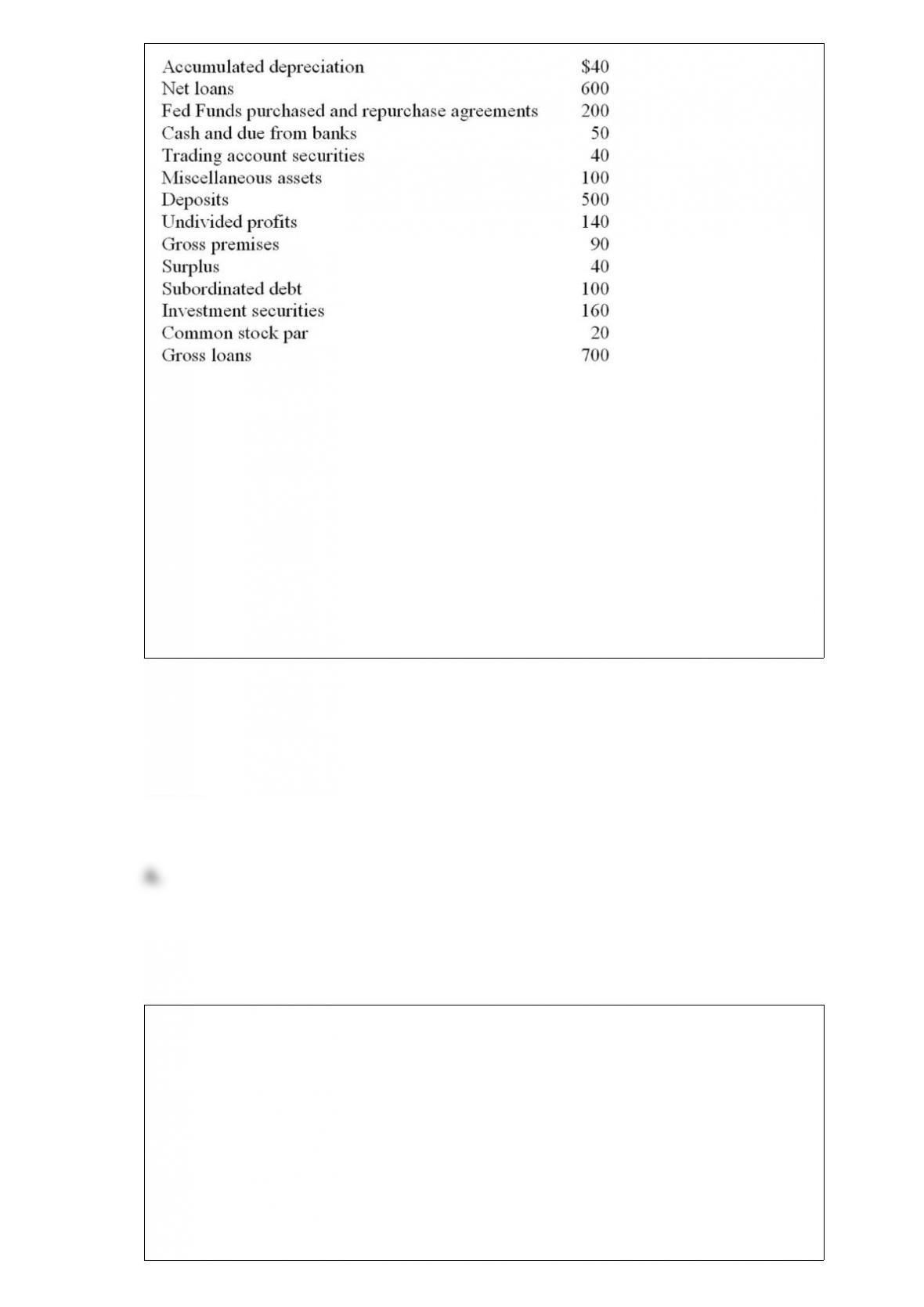
Given this information, what is the value of this firm’s total assets?
A. $1,000
B. $300
C. $800
D. $200
E. $500
Answer:
The biggest problem for international banks at the beginning of the 21st century is:
A. the Internet.
B. interest rate risk.
C. foreign exchange risk.
D. non-performing loans.

E. None of the options is correct.
Answer:
If Denmark requires that all foreign banks operating in Denmark have at least ten
percent capital, what reason for regulating international banks is this action most likely
in support of?
A. Protecting the safety of depositor funds
B. Promoting stable growth in money and credit
C. Providing foreign currency controls
D. Protecting domestic financial institutions
E. Restricting the outflow of scarce capital
Answer:
A bank that wires funds for the purchase of a beach house in South Carolina for a
customer in Oklahoma is carrying out the __________ of banks.
A. intermediation role

B. payment role
C. guarantor role
D. agency role
E. policy role
Answer:
Which of the following is a reason that many states and the federal government finally
enact interstate banking laws?
A. The need for new capital in order to revive struggling local economies
B. The expansion of service offerings by nonbank financial institutions
C. The belief among regulators that larger firms may be more efficient and stable
D. Advances in technology which allowed banks to service customers in broader
geographic areas
E. All the options are reasons for the passage of interstate banking laws
Answer:

A swap where the notional amount declines over time is called:
A. a quality swap
B. a bullet swap
C. an amortizing swap
D. an accruing swap
E. None of the options are correct
Answer:
Suppose a bank has an asset duration of 5 years and a liability duration of 2.5 years.
The bank has $1,000 million in assets and $750 million in liabilities. It is planning to
trade in Treasury bond futures whose underlying’s duration is 8.5 years and is currently
selling at $99,000 for a $100,000 contract. How many futures contracts does the bank
need to fully hedge itself against interest rate risk?
A. 3,714 contracts
B. 3,125 contracts
C. 2,971 contracts
D. 371 contracts
E. None of the options are correct
Answer:

Mark Green is considering buying a new Honda Accord. The purchase price of the car
is $21,000 but Mark has a trade-in worth $4,500. Mark needs a loan to buy the car and
knows that his local bank requires him to put down 10 percent of the purchase price
after the value of the trade-in is considered. Mark also knows that bank will charge 8
percent for the loan and require monthly payments over the next 4 years.
What is the minimum down payment that Mark must make?
A. $2,100
B. $450
C. $1,650
D. $2,550
E. None of the options is correct
Answer:
One of the benefits for a bank securing a federal (national) charter instead of a state
charter is that:
A. federal rules can pre-empt state laws.
B. a federal charter is generally easier and less costly to secure.
C. a federal charter often allows to lend a higher percentage of capital to a single
borrower.
D. a federal charter usually entails lower supervisory fees.
E. None of the options are correct.

Answer:
A bank has an average asset duration of 5 years and an average liability duration of 3
years. This bank has total assets of $500 million and total liabilities of $250 million.
Currently, market interest rates are 10 percent. If interest rates fall by 2 percent (to 8
percent), what is this bank’s change in net worth?
A. Net worth will decrease by $31.81 million.
B. Net worth will increase by $31.81 million.
C. Net worth will increase by $27.27 million.
D. Net worth will decrease by $27.27 million.
E. Net worth will not change at all.
Answer:
The Bridges State Bank has new loan requests of $315, needs to purchase $125 million
in U.S. Treasury securities for reserve requirements, and anticipates draws on lines of
credit in the amount of $65 million. If total deposits received today are $205 million
and the bank expects to bring in an additional $185 million in deposits next week, what
is the estimated funds gap for the Bridges State Bank?
A. $505 million

B. -$390 million
C. $115 million
D. -$315 million
E. None of the options is correct
Answer:
Someone who collects the payments on the securitized loans and passes on those
payments to the trustee is called:
A. the originator.
B. the special-purpose entity.
C. the trustee.
D. the servicer.
E. the credit enhancer.
Answer:

For an issuer, a standby credit letter is a(n):
A. securitized strip.
B. loan strip.
C. contingent obligation.
D. indirect loan.
E. None of the options is correct.
Answer:
The First National Bank of Tucson has determined that the value of their property in
Tucson has tripled in the last three years. They decide that they would like to use this
property to raise funds and will rent space from the new owners of the building. What
way of meeting their capital needs is the bank taking?
A. Issuing common stock
B. Issuing preferred stock
C. Issuing subordinated notes and debentures
D. Selling assets and leasing facilities
E. Swapping stock for debt instruments
Answer:

A firm submits their financial records to a bank. Upon examination, the bank discovers
that this firm has $500 in cash, $2,500 in accounts receivables, $1,000 in inventory,
$5,000 in plant and equipment and that their assets totaled $9,000. In addition this bank
discovered that the firm had $2,000 in current liabilities, $2,500 in long-term debt, and
$4,500 in net worth. Finally, this bank discovered that this firm had $20,000 in net sales
(all of which are on credit) and $2,000 in net income. What is this firm’s average
collection period?
A. 18 days
B. 45 days
C. 72 days
D. 162 days
E. None of the options is correct.
Answer:
Deposit accounts whose principal function is to make payments for purchases of goods
and services are called:
A. drafts.
B. second-party payments accounts.
C. thrift deposits.
D. transaction accounts.
E. None of the options is correct.

Answer:
The Clearwater National Bank is planning to set up a new branch. This new branch is
anticipated to generate 5 percent of the total business of the bank after it is opened. The
bank also expects the returns on this branch to be 15 percent with a standard deviation
of 5 percent. Currently the bank has a 10 percent rate of return with a standard deviation
of 5 percent. The correlation between the bank’s current return and returns on the new
branch is expected to be -0.3. What is the bank’s total expected return after adding this
branch?
A. 15 percent
B. 10 percent
C. 15.25 percent
D. 10.25 percent
E. 11.5 percent
Answer:
Large depository institutions tend to act:
A. both as dealers and end users.
B. only as dealers.
C. only as end users.

D. neither as dealers nor end users.
E. largely as speculators.
Answer:
If a credit letter is issued to backstop payments on loan-backed securities, the credit
letter is a form of:
A. collateralized asset.
B. residual income.
C. direct loan obligation.
D. credit enhancement.
E. None of the options is correct.
Answer:
Suppose there are four banks in a local community. Each of these banks has 25 percent
of the deposits in this community. What is the Herfindahl-Hirschman Index (HHI) for
this community?

A. 10,000
B. 100
C. 2,500
D. 625
E. None of the options is correct
Answer:
The FDIC requires the insured banks to maintain Tier 1 capital of at least __________
for at least the first three years of their operations.
A. 10 percent
B. 8 percent
C. $12 million
D. 15 percent
E. $10 million
Answer:

Computer facilities in retail shops and stores that permit a customer to instantly pay for
goods and services electronically by deducting the cost of each purchase directly from
his or her deposit account are known as:
A. ATMs.
B. POS terminals.
C. ACHs.
D. In-store branches.
E. ALMs.
Answer:
The fastest growing financial crime in the U.S. is:
A. financial statement misrepresentation.
B. bank robberies.
C. individual privacy violations.
D. credit card fraud.
E. identity theft.
Answer:

A customer makes a savings deposit for 15 days. During that time he earns $15 in
interest and maintains an average daily balance of $2,200. What is the annual
percentage yield on the savings account?
A. 0.68%
B. 16.36%
C. 16.59%
D. 17.98%
E. None of the options is correct
Answer:
A bank promises an annual return of 4.85 percent on a 60 day, $300,000 CD. What will
be the total amount due to the customer at the end of the two-month period?
A. $302,425
B. $314,550
C. $14,550
D. $2,425
E. None of the options is correct
Answer:

The __________________________ allows adequately capitalized and managed bank
holding companies to acquire banks anywhere in the United States. However, no one
bank can control more than 30 percent of the deposits in any one state (unless the state
waives this restriction) or more than 10 percent of the deposits across the country.
Answer:
Often when loans are securitized, they are passed on to a(n) ________________ which
pools the loans and sells securities.
Answer:
A(n) __________________ fund, is a type of mutual fund offered through a bank’s
affiliated company. The bank acts as a transfer agent, custodian, and offers investment
advice in this type of mutual fund.
Answer:

The __________________________ is a standardized report provided by federal
regulators which reports the balance sheet, income statement, and other data for all
federally supervised banks. It also contains information on peer institutions.
Answer:
One part of ROE is ________________________ or net income divided by pre-tax net
operating income, which measures a financial firm’s use of security gains and losses
and other tax management tools to minimize tax exposure.
Answer:
A(n) __________________ rates the securities to be sold from a pool of securitized
loans so that investors have a better idea of what the new securities are likely to be
worth.

Answer:
The key problem in a large money center bank is ________________. Managers may
be knowledgeable about banking practices but may be less informed about products and
services of subsidiary companies.
Answer:
_______ is the spread between the cash price and futures price of an underlying asset.
Answer:
When a financial institution offers a(n) __________________ mutual fund, it acts as
broker for an unaffiliated mutual fund or group of funds and does not act as an
investment advisor.

Answer:
____________________________ is the cost to the lender for borrowing adequate
funds in the cost-plus loan pricing model.
Answer:
When a foreign government takes actions that interfere with the repayment of an
international loan, it causes a special type of risk called ______________.
Answer:
The most effective delivery channel of financial services appears to be ____________.
It combines full-service branches and electronic limited service facilities within the
same firm.

Answer:
At the center of the debate of the Basel Agreement is the ____________, headquartered
in Basel, Switzerland, which assists central banks in their transactions with each other
and serves as a forum for international financial issues.
Answer:
_________________________ are a stable base of deposited funds that are not highly
sensitive to movements in market interest rates and tend to remain with the depository
institution.
Answer:
__________________________ is a noncash expense on the bank’s income statement

which allows the bank to account for future bad loans.
Answer:
_____________ provide businesses with short-term credit, lasting from a few days to
about one year. These loans come close to self-liquidating loans.
Answer:
One of the problems with the newer lending model called _________________ was
found to at least partially contribute to the recent crisis in the mortgage market.
Answer:

A relatively new type of credit derivative is a CDO which stands for
_______________.
Answer: