1) The following selected costs were extracted from the accounting records of
Louisiana Machining (LAM):
1> Direct materials used in production
2> Wages of machine operators
3> Factory utilities
4> Sales commissions
5> Salary of LAM’s president
6> Factory depreciation
7> Wages of plant security guards
8> Uncollectible accounts expense
9> Machine lubricant used in production
A. 1, 2, 3, 6, 7, 9
B. 3, 6, 7, 9
C. 4, 5, 8
D. 2, 3, 6, 7, 9
E. 8
F. 1, 2, 3, 6, 7, 9
Required:
By the use of numbers, identify the costs that would be used to calculate:
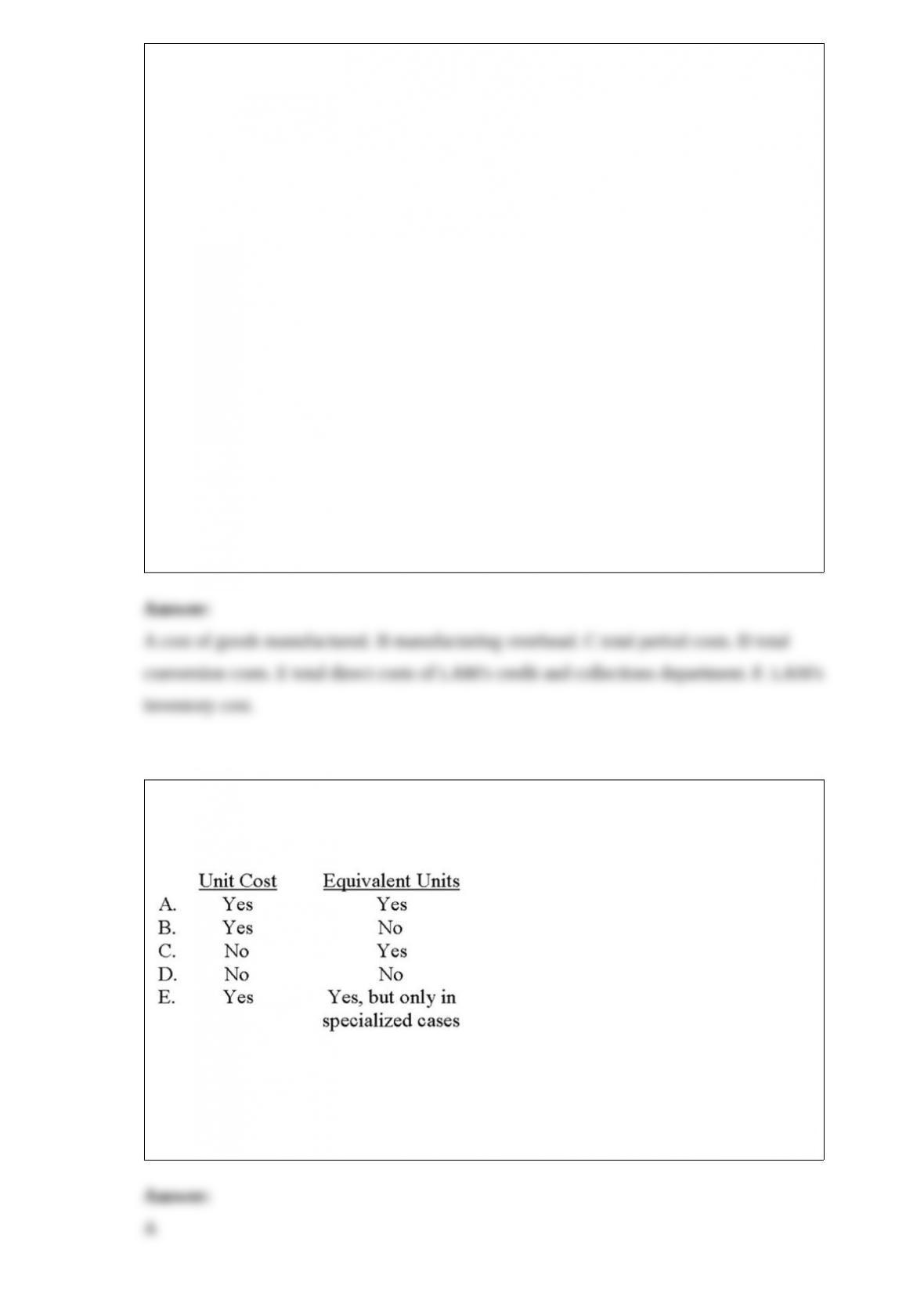
2) Which of the following are needed to calculate the total cost of the ending
work-in-process inventory under the weighted-average process-costing method?
A.Choice A
B.Choice B
C.Choice C
D.Choice D
E.Choice E
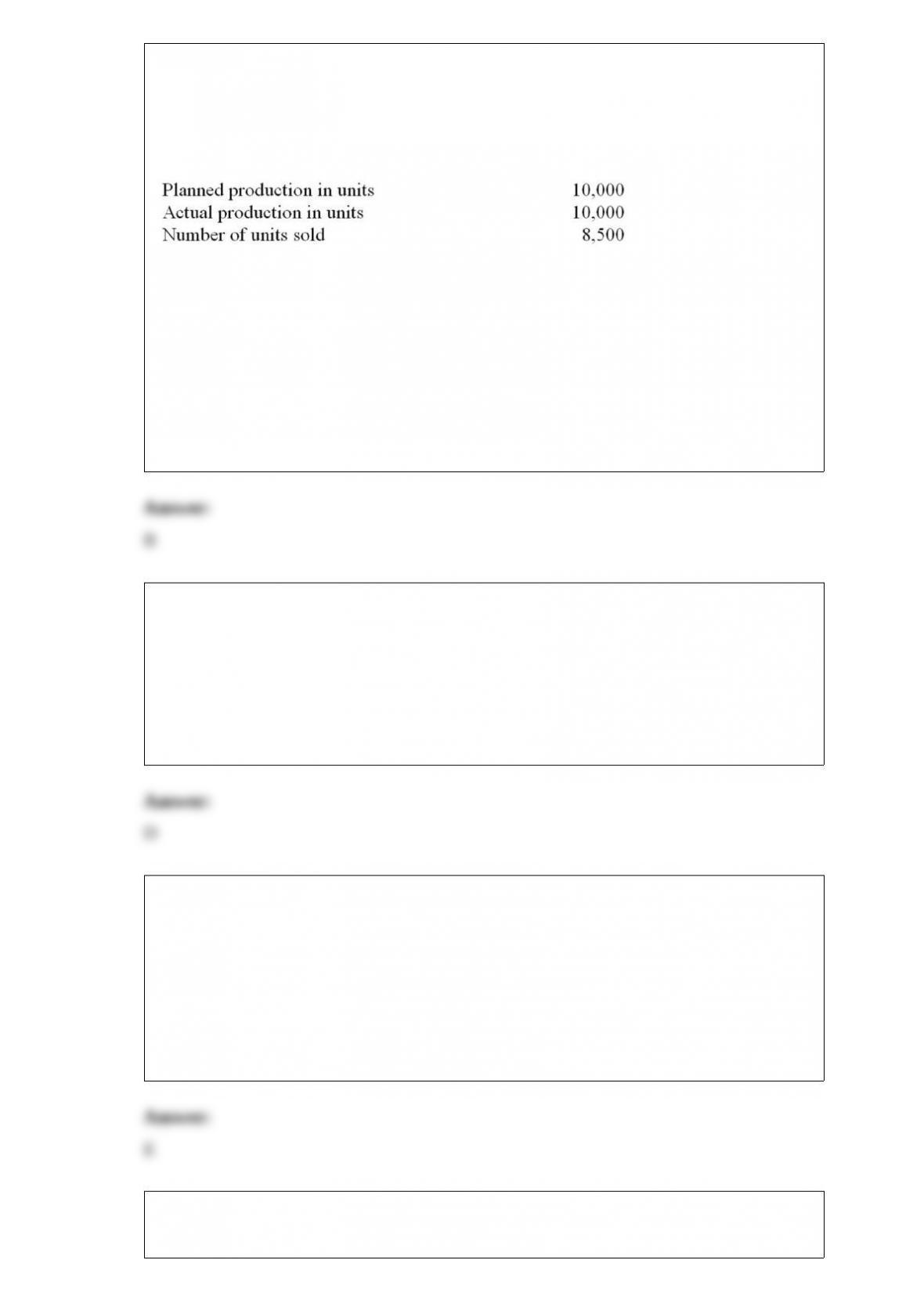
3) Franz began business at the start of this year and had the following costs: variable
manufacturing cost per unit, $9; fixed manufacturing costs, $60,000; variable selling
and administrative costs per unit, $2; and fixed selling and administrative costs,
$220,000. The company sells its units for $45 each. Additional data follow.
There were no variances.
The income (loss) under variable costing is:
A.$(7,500)
B.$9,000
C.$15,000
D.$18,000
E.None of the other answers are correct
4) Which of the following measures of performance is, in part, based on the
weighted-average cost of capital?
A.Return on investment
B.Capital turnover
C.Book value
D.Economic value added (EVA)
E.Gross margin
5) When allocating joint costs, Weinberg calculates the final sales value of the various
products manufactured and subtracts appropriate separable costs. The company is using
the:
A.gross margin at split-off method
B.reciprocal-accounting method
C.relative-sales-value method
D.physical-units method
E.net-realizable-value method
6) Beach Bum Corporation has fixed manufacturing cost of $12 per unit. Consider the
three independent cases that follow.
Case A: Absorption- and variable costing income each totaled $240,000 in a period
when the firm produced 18,000 units.
Case B: Absorption-costing income totaled $320,000 in a period when finished-goods
inventory levels rose by 7,000 units.
Case C: Absorption-costing income and variable-costing income respectively totaled
$220,000 and $250,000 in a period when the beginning finished-goods inventory was
14,000 units.
Required:
A. In Case A, how many units were sold during the period?
B. In Case B, how much income would Beach Bum report under variable costing?
C. In Case C, how many units were in the ending finished-goods inventory?
7) Which of the following can be linked to a wave of corporate scandals that took place
not too long ago?
A.Greedy corporate executives
B.Managers who made over-reaching business deals
C.Lack of oversight by companies’ audit boards and boards of directors
D.Shoddy work by external auditors
E.All of these
8) The following information was taken from the segmented income statement of
Restin, Inc., and the company’s three divisions:
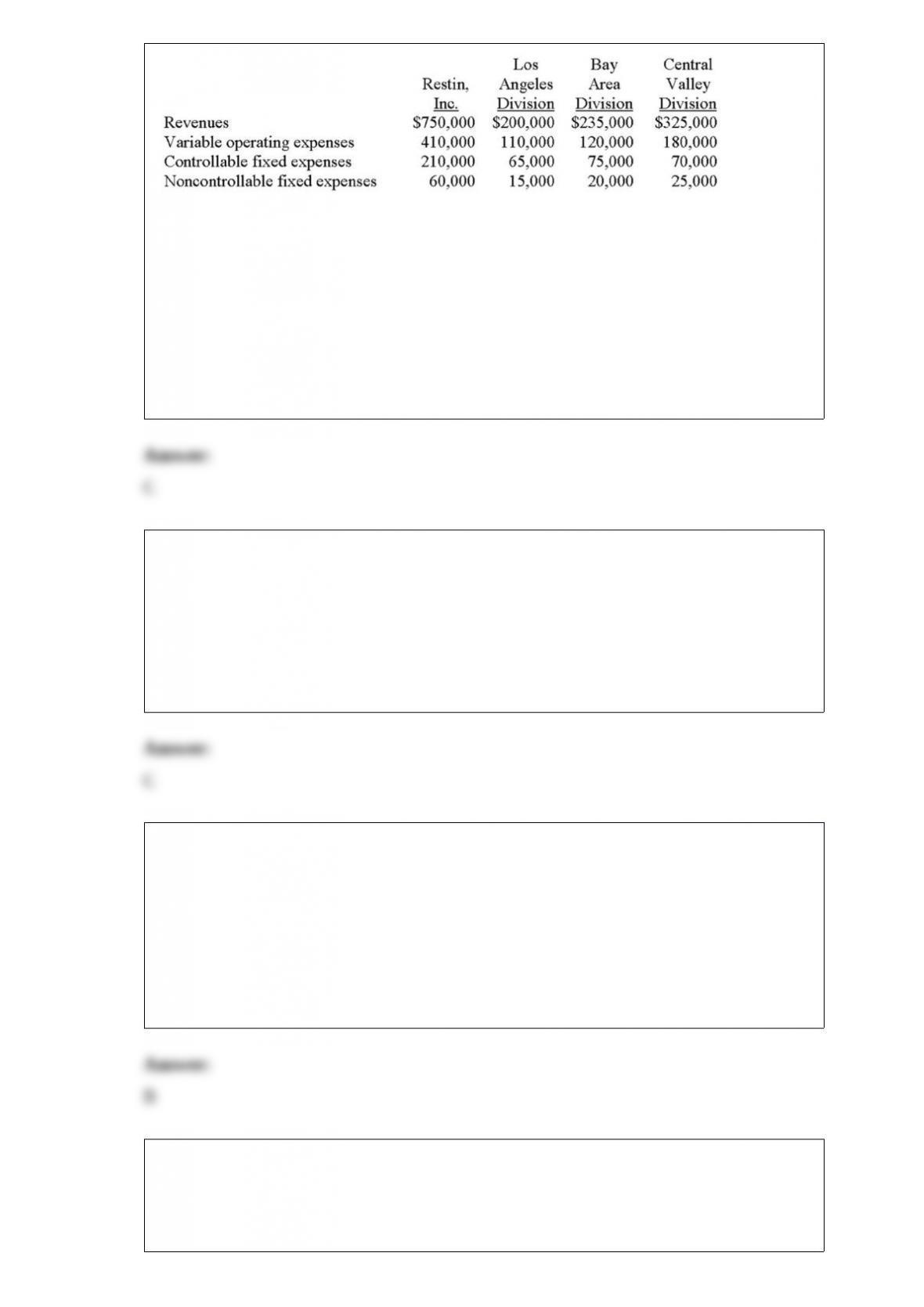
In addition, the company incurred common fixed costs of $18,000.
Bay Area’s segment profit margin is:
A.$14,000
B.$18,000
C.$20,000
D.$40,000
E.$115,000
9) Which of the following statements represents a similarity between financial and
managerial accounting?
A.Both are useful in providing information for external users
B.Both are governed by GAAP
C.Both draw upon data from an organization’s accounting system
D.Both rely heavily on published financial statements
E.Both are solely concerned with historical transactions
10) Which of the following terms describes a pricing strategy in which a new product’s
initial price is set high and then eventually lowered to appeal to a broader range of
customers?
A.Penetration pricing
B.Price skimming
C.Customer pricing
D.Designed pricing
E.Market-share pricing
11) DuChien Corporation recently produced and sold 100,000 units. Fixed costs at this
level of activity amounted to $50,000; variable costs were $100,000. How much cost
would the company anticipate if during the next period it produced and sold 102,000
units?

A.$150,000
B.$151,000
C.$152,000
D.$153,000
E.None of the other answers is correct
12) Draco, Inc. has the following overhead standards:
Variable overhead: 4 hours at $8 per hour
Fixed overhead: 4 hours at $10 per hour
The standards were based on a planned activity of 20,000 machine hours when 5,000
units were scheduled for production. Actual data follow.
Variable overhead incurred: $167,750
Fixed overhead incurred: $210,000
Machine hours worked: 19,800
Actual units produced: 5,100
Draco’s fixed-overhead volume variance is:
A.$4,000 favorable
B.$4,000 unfavorable
C.$10,000 favorable
D.$10,000 unfavorable
E.None of the other answers are correct
13) Listed below are five variances (and possible causes) that are under review by
management of Knox Company. Which of the following is least likely to cause the
variance indicated?
A.The need to ship goods acquired from a distant supplier via FedEx rather than via
truck; material price variance
B.The need to complete goods on a timely basis during a period of high absenteeism;
labor rate variance
C.A work-team that is very unhappy with its supervisor; labor efficiency variance
D.The need to close a plant for two days because of blizzard conditions; material
quantity variance, part no. 542
E.A malfunctioning piece of manufacturing equipment; labor efficiency variance
14) Consider the following statements about why prices are often based on product
costs:
I. Companies sell many products and services, and cost-based approaches provide a
simple and direct pricing method.
II. The cost of a product or service provides a lower limit or floor, below which price
should not be set in the long run.
III. Determining a company’s demand and marginal revenue curves is difficult, costly,
and time consuming.
Which of the above statements is (are) true?
A.I only
B.III only
C.I and III
D.II and III
E.I, II, and III
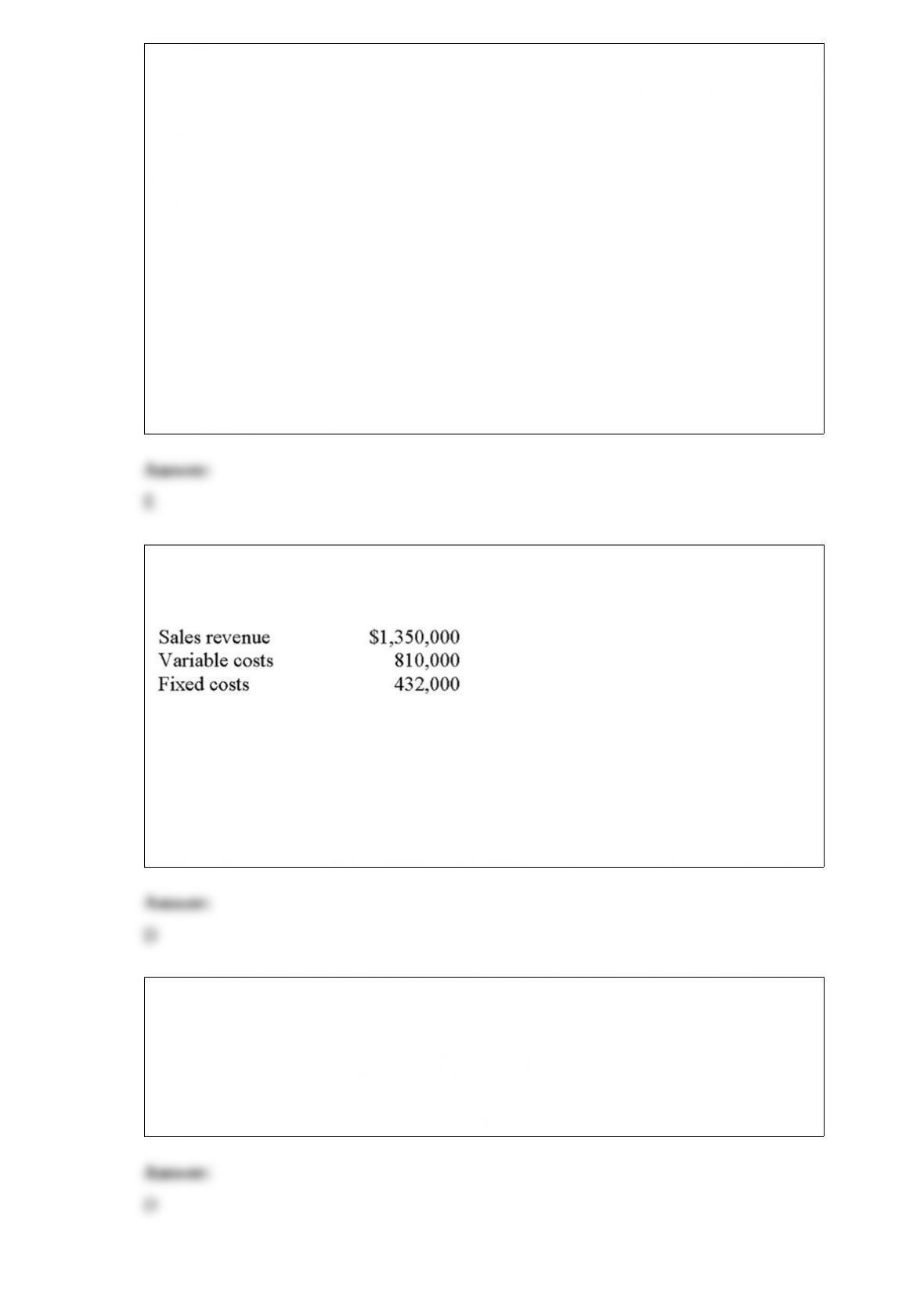
15) Barrey, Inc. is subject to a 40% income tax rate. The following data pertain to the
period just ended when the company produced and sold 45,000 units:
How many units must Barrey sell to earn an after-tax profit of $180,000?
A.42,000
B.45,000
C.51,000
D.61,000
E.None of the other answers is correct
16) Work-in-process inventory is composed of:
A.direct material and direct labor
B.direct labor and manufacturing overhead
C.direct material and manufacturing overhead
D.direct material, direct labor, and manufacturing overhead
E.direct material only
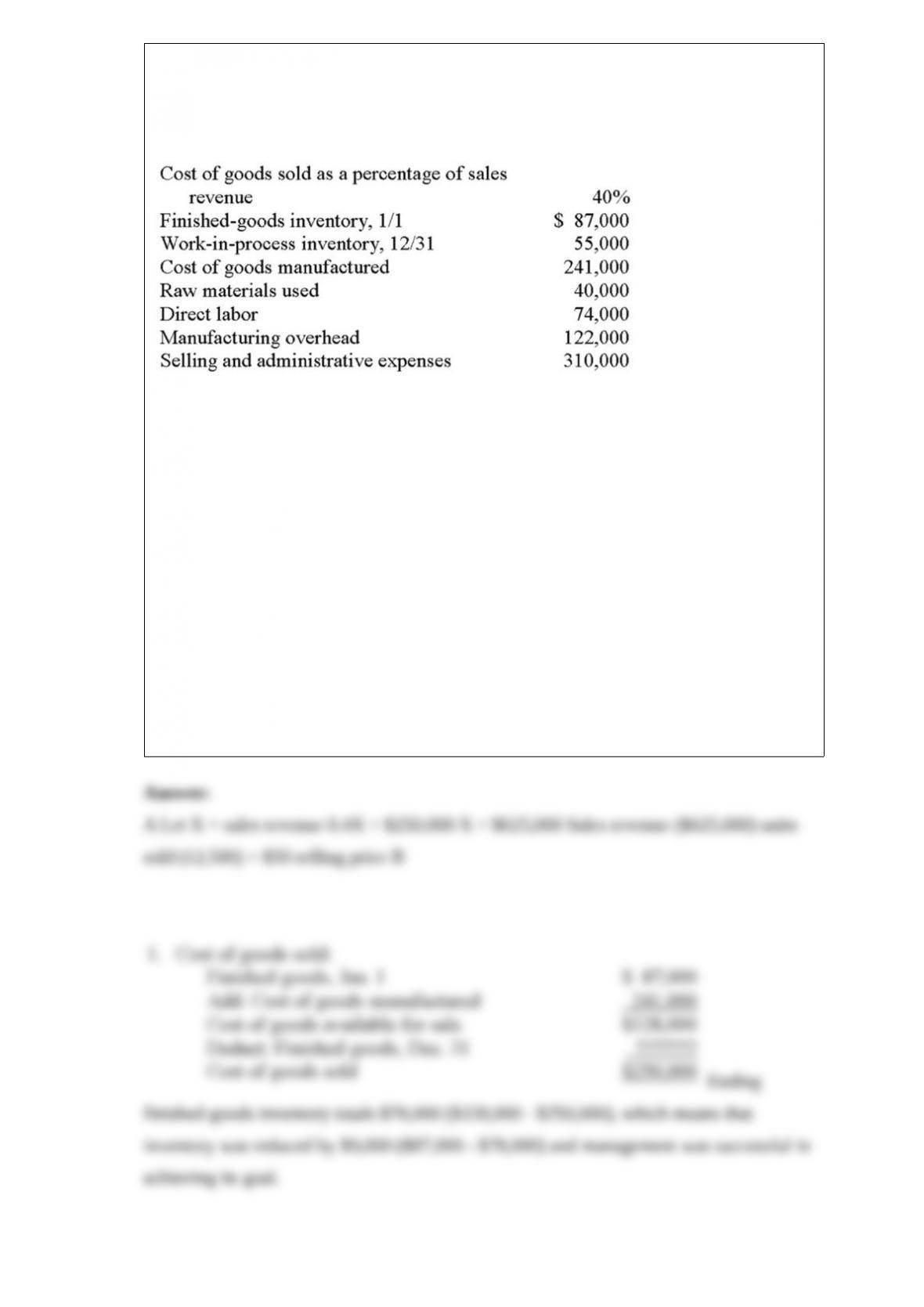
17) Heathrow Corporation sold 12,500 units of its single product during the year,
reporting a cost of good sold that totaled $250,000. A review of the company’s
accounting records disclosed the following information:
Heathrow is subject to a 30% income tax rate.
Required:
A. Determine the selling price per unit.
B. Management established a goal at the beginning of the year to reduce the company’s
investment in finished-goods inventory and work-in-process inventory.
1> Analyze cost of goods sold and determine if management’s goal was achieved with
respect to finished-goods inventory. Show computations.
2> Analyze the firm’s manufacturing costs and determine if management’s goal was
achieved with respect to work-in-process inventory. Show computations.
C. Is the company profitable? Show calculations.
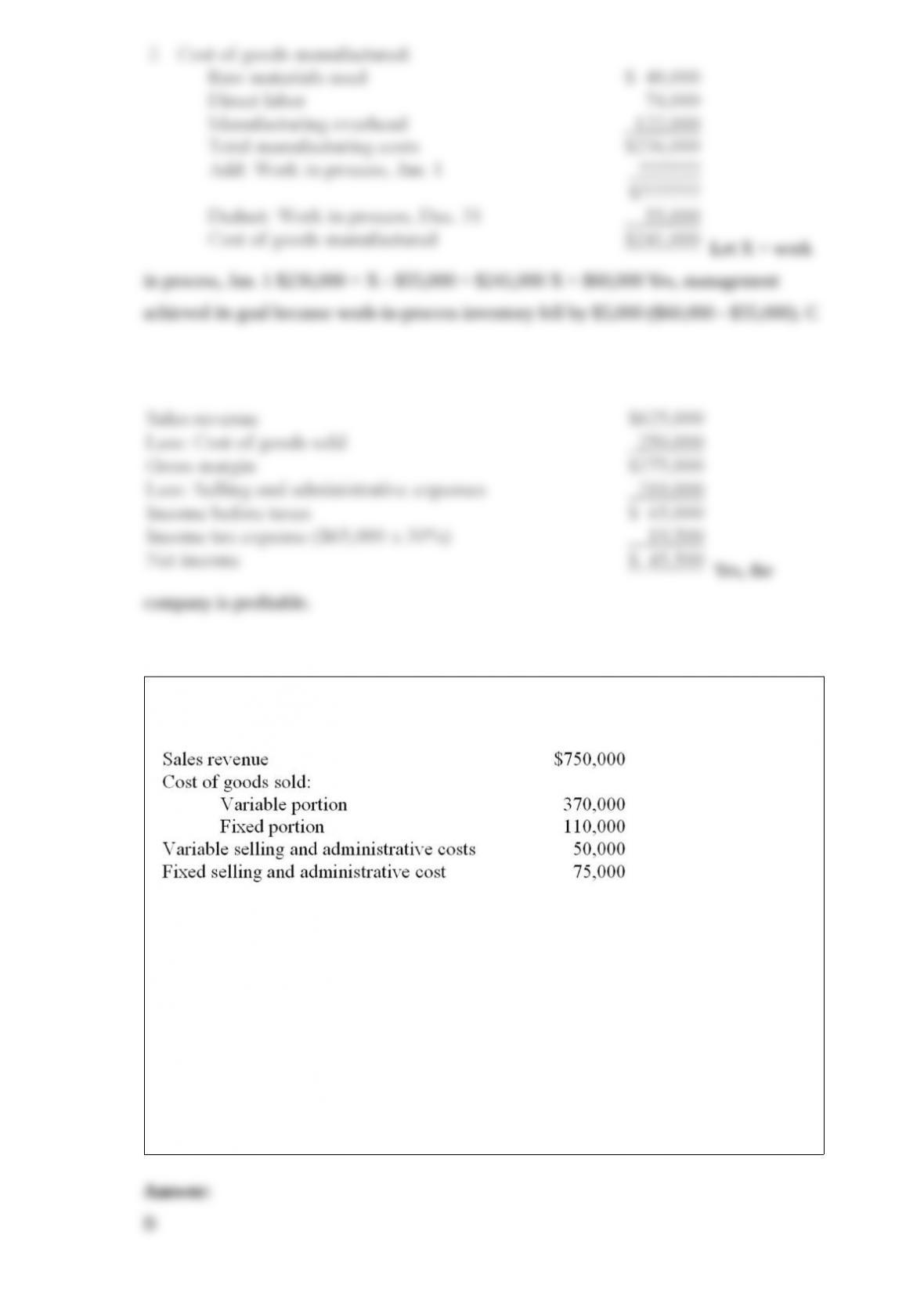
18) The following data relate to LebeauxCorporation for the year just ended:
Which of the following statements is correct?
A.Lebeaux’s variable-costing income statement would show a gross margin of $270,000
B.Lebeaux’s variable costing income statement would show a contribution margin of
$330,000
C.Lebeaux’s absorption-costing income statement would show a contribution margin of
$330,000
D.Lebeaux’s absorption costing income statement would show a gross margin of
$330,000
E.Lebeaux’s absorption-costing income statement would show a gross margin of
$145,000
19) Othello Manufacturing incurred $106,000 of direct labor and $11,000 of indirect
labor. The proper journal entry to record these events would include a debit to Work in
Process for:
A.$0 because Work in Process should be credited
B.$0 because Work in Process is not affected
C.$11,000
D.$106,000
E.$117,000
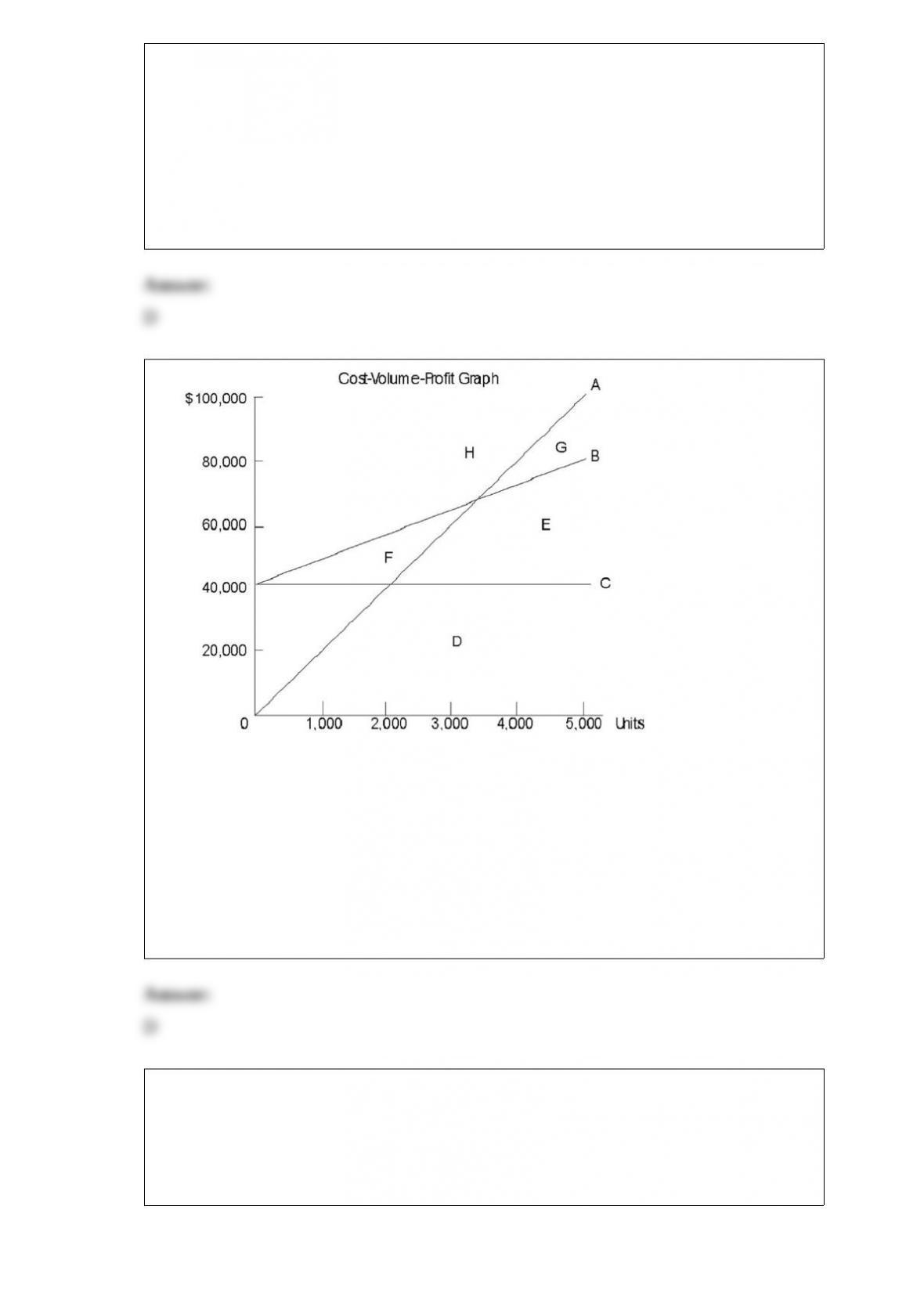
20)
Refer to the figure above. Assume that the company whose cost structure is depicted in
the figure expects to produce a profit for the upcoming accounting period. The profit
would be shown on the graph by the letter:
A.D
B.E
C.F
D.G
E.H
21) Margery, Inc., which uses a job-costing system, is a labor-intensive firm, with many
skilled craftspeople on the payroll. Job no. 789 was the only job in process on January
1, having costs of $22,500 as of that date. Direct materials used and direct labor
incurred during January were:
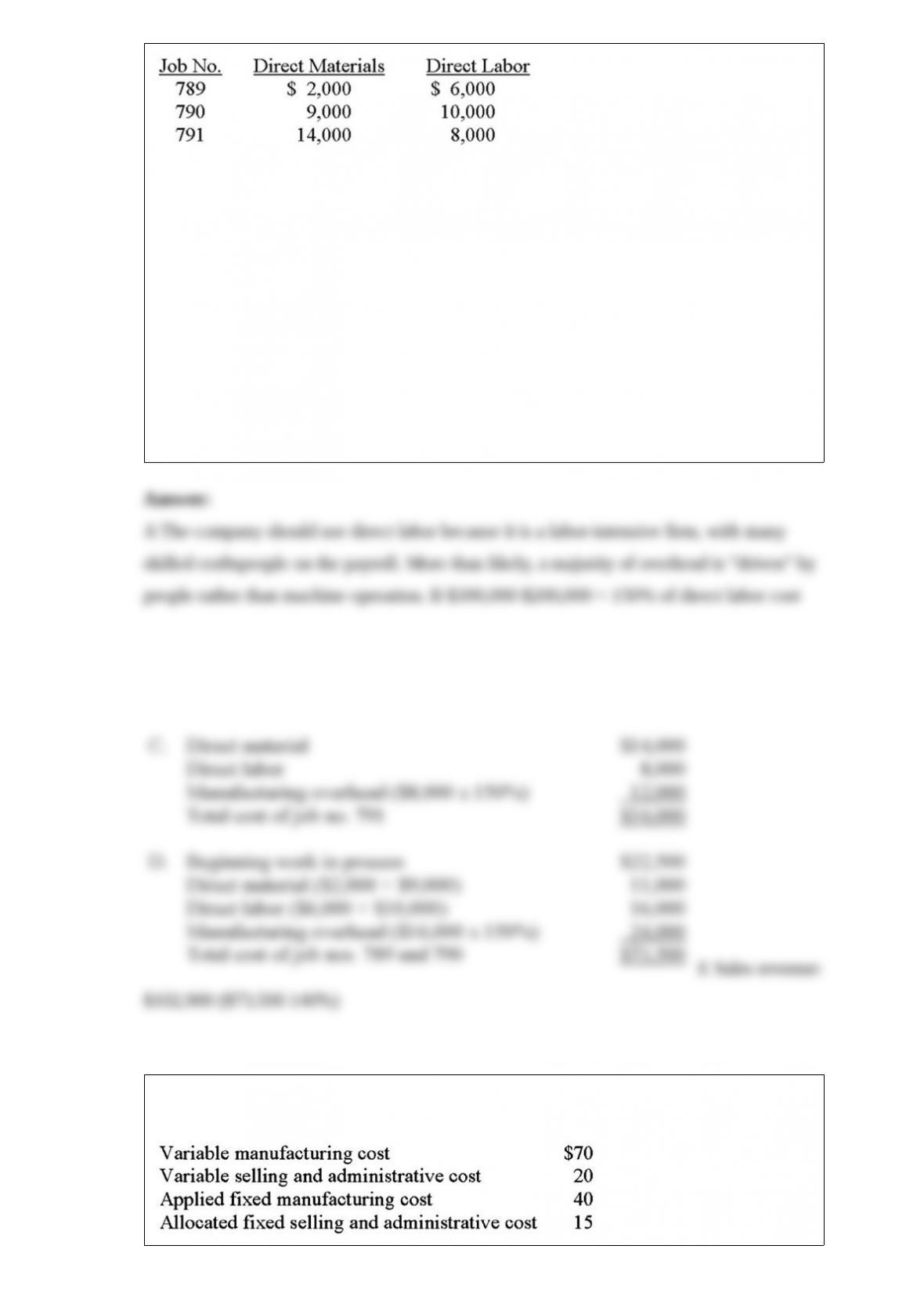
Job no. 791 was the only job in production as of January 31 .
Required:
A. Should Margery use direct labor or machine hours as a cost driver. Why?
B. Assume that the company decided to use direct labor as its cost driver. If the
budgeted amounts of direct labor and manufacturing overhead are anticipated to be
$200,000 and $300,000, respectively, what is the firm’s predetermined overhead rate?
C. Compute the cost of work-in-process inventory as of January 31 .
D. Compute the cost of jobs completed during January.
E. Suppose that the company sold all of its completed jobs, adding a 40% markup to
cost. How much would the firm report as sales revenue?
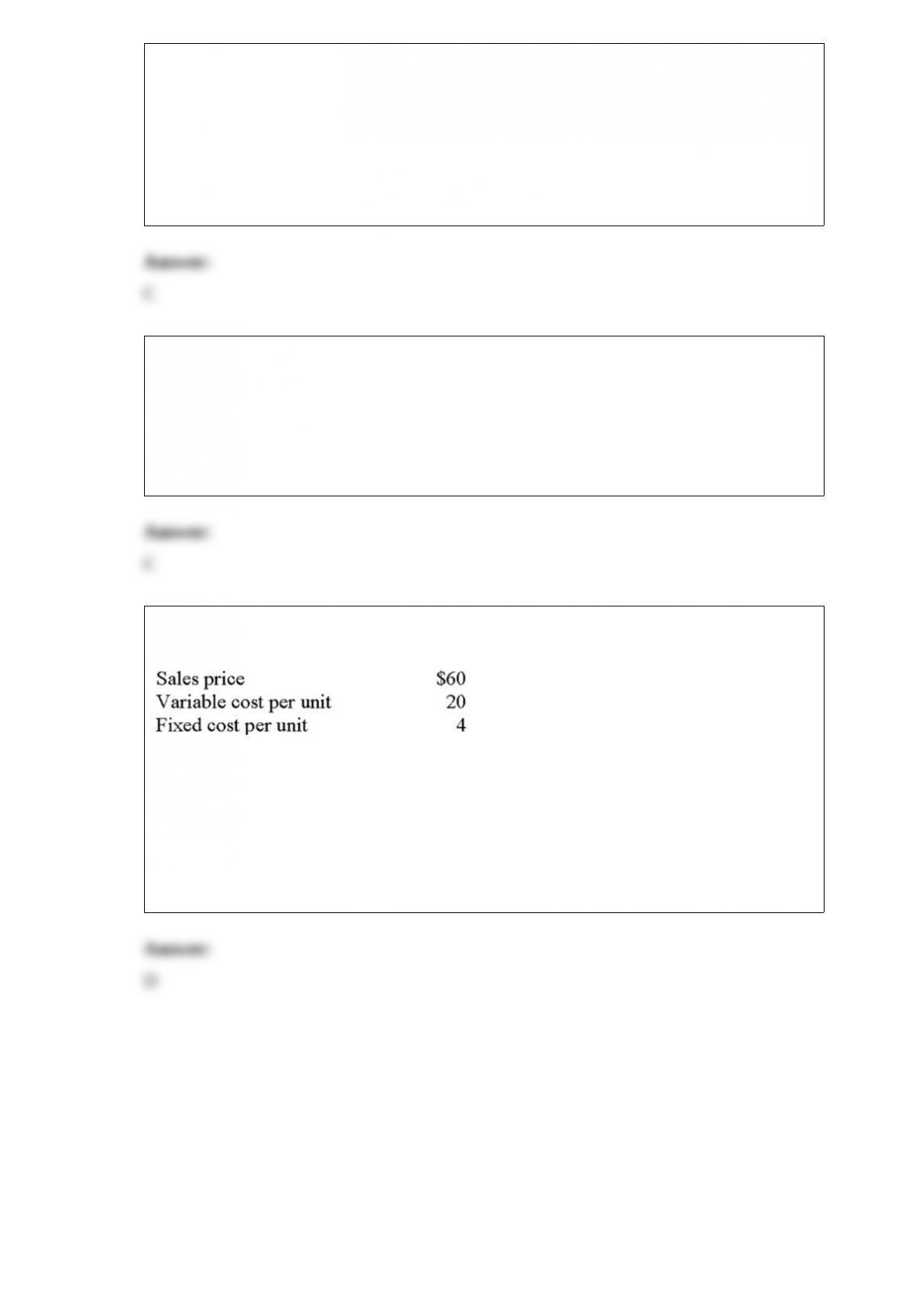
22) The following data pertain to Lemon Enterprises:

What price will the company charge if the firm uses cost-plus pricing based on variable
manufacturing cost and a markup percentage of 110%?
A.$84
B.$147
C.$210
D.$231
E.None of the other answers are correct
23) Summers Corporation recently used $75,000 of direct materials and $9,000 of
indirect materials in production activities. The journal entries reflecting these
transactions would include:
A.a debit to Manufacturing Overhead for $9,000
B.a debit to Manufacturing Overhead for $84,000
C.a debit to Raw-Material Inventory for $75,000
D.a debit to Work-in-Process Inventory for $84,000
E.a credit to Manufacturing Overhead for $9,000
24) A perfection standard:
A.tends to motivate employees over a long period of time
B.is attainable in an ideal operating environment
C.would make allowances for normal amounts of scrap and waste
D.is generally preferred by behavioral scientists
E.will result in a number of favorable variances on a performance report
25) Which of the following statements is (are) true regarding a company that has
implemented flexible manufacturing systems and activity-based costing?
I. The company has erred, as these two practices used in conjunction with one another
will severely limit the firm’s ability to analyze costs over the relevant range.
II. Costs formerly viewed as fixed under traditional-costing systems may now be
considered variable with respect to changes in cost drivers such as number of setups,
number of material moves, and so forth.
III. As compared with the results obtained under a traditional-costing system, the
concept of break-even analysis loses meaning.
A.I only
B.II only
C.III only
D.I and II
E.II and III
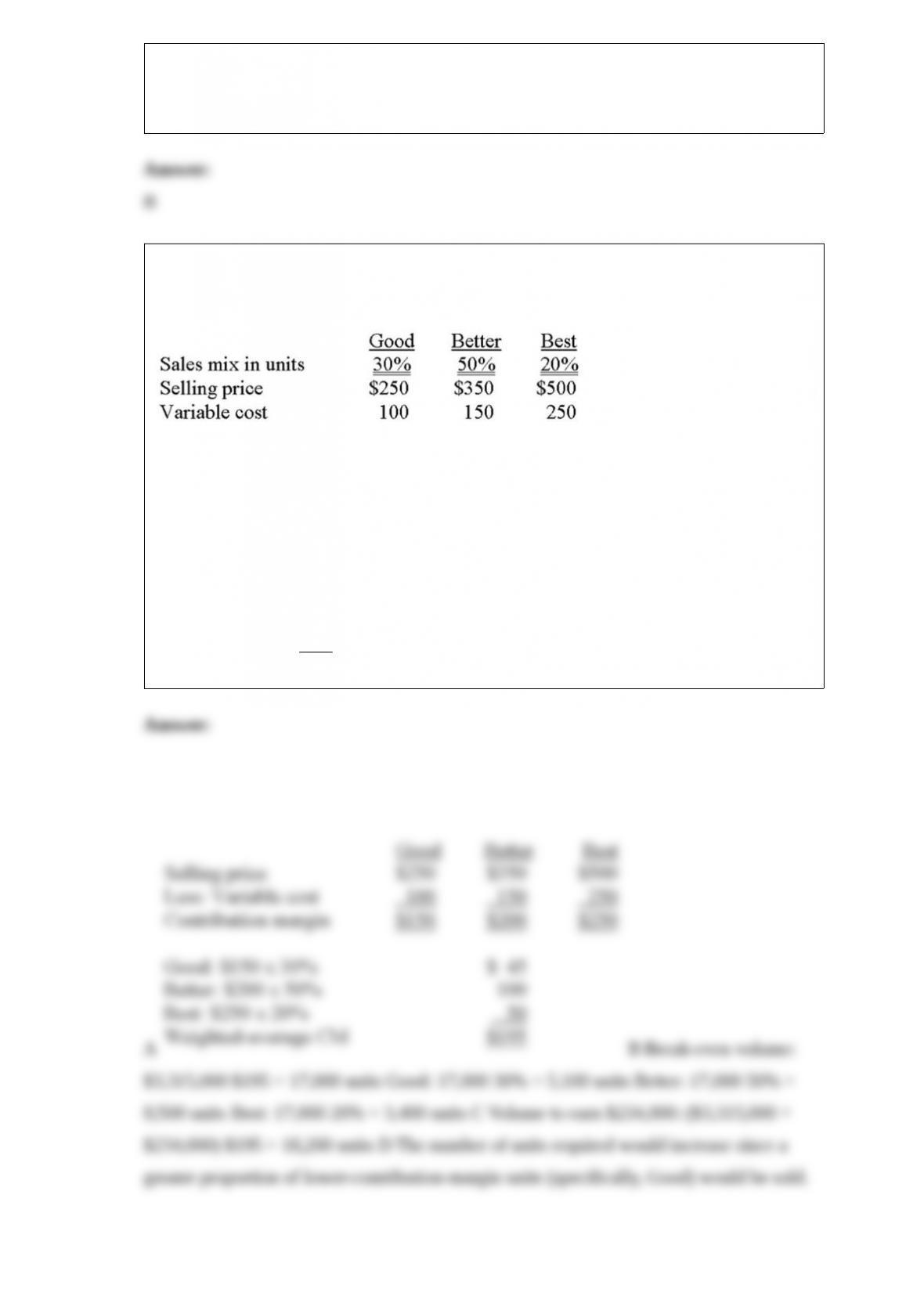
26) Boyze Company manufactures and sells three products: Good, Better, and Best.
Annual fixed costs are $3,315,000, and data about the three products follow.
Required:
A. Determine the weighted-average unit contribution margin.
B. Determine the break-even volume in units for each product.
C. Determine the total number of units that must be sold to obtain a profit for the
company of $234,000.
D. Assume that the sales mix for Good, Better, and Best is changed to 50%, 30%, and
20%, respectively. Will the number of units required to break-even increase or
decrease? Explain. Hint: Detailed calculations are not needed to obtain the proper
solution.
27) All of the following are expensed under variable costing except:
A.variable manufacturing overhead
B.fixed manufacturing overhead
C.variable selling and administrative costs
D.fixed selling and administrative costs
E.variable selling and administrative costs and fixed selling and administrative costs
28) Standard cost systems can have motivational effects; some are desirable, some are
not. Consider the following situation:
The materials purchasing manager is paid a salary plus a bonus based on the net
favorable materials price variance. Generally, this bonus amounts to 30 – 40% of the
manager’s total compensation. Due to the bankruptcy of a company in a related field,
there is an opportunity to buy a key raw material. The standards for this material call for
grade 2A, usually purchased for $56 per ton. Because of the bankruptcy, the company
can obtain a higher grade, 4A, for $62 per ton. While the quality of the final product
will be the same regardless of the grade of material used, there will be substantial
savings in material yield and labor productivity if 4A is used. These savings are
expected to be two-to-three times the additional cost of $6 per ton.
Required:
A. How would an unfavorable price variance on a particular purchase affect the overall
price variance for the year and the manager’s bonus?
B. Would the use of the materials price variance as a basis for the manager’s bonus lead
to a desirable or undesirable behavioral outcome? Explain, being sure to note whether
the manager would likely pursue acquisition of the grade 4A material.
29) Kel-Leigh Corporation, with operations throughout the country, will soon allocate
corporate overhead to the firm’s various responsibility centers. Which of the following
is definitely not a cost object in this situation?
A.The maintenance department
B.Product no. 675
C.Kelly Corporation
D.The Midwest division
E.The telemarketing center
30) Which of the following manufacturers would most likely use job-order costing?
A.Chemical manufacturers
B.Microchip processors
C.Custom-furniture manufacturers
D.Gasoline refiners
E.Fertilizer manufacturers
31) At a volume level of 500,000 units, Sullivan reported the following information:
The company’s contribution-margin ratio is closest to:
A.0.33
B.0.40
C.0.60
D.0.67
E.None of the other answers is correct