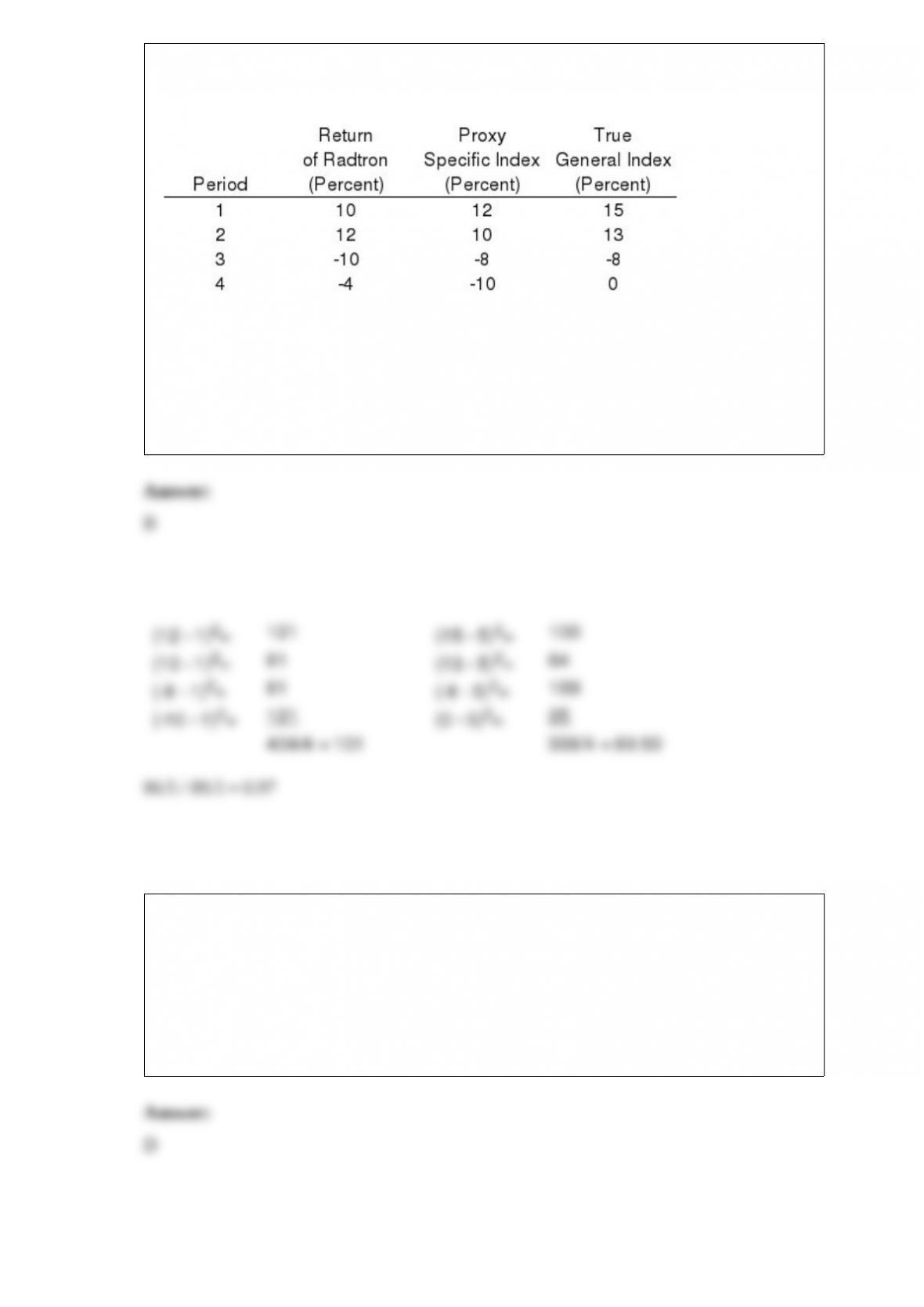
1) Exhibit 8.3
USE THE INFORMATION BELOW FOR THE FOLLOWING PROBLEM(S)
Refer to Exhibit 8.3. What is the beta for Radtron using the true index?
a. 0.87
b. 0.97
c. 1.02
d. 1.15
e. 1.28
2) If this year is consistent with historical trends you would expect the return for small
capitalization stocks to be
a.Below common stocks and above long-term government bonds.
b.Below common stocks and below long-term government bonds.
c.Above last year’s return on the same stocks.
d.Above common stock, long-term government, and corporate bonds.
e.The least variable among long-term bonds and common stocks.
3) Excess liquidity is defined as
a. The year-to year percentage change in the M2 money supply less the year-to-year
percentage change in the nominal GNP.
b. The growth rate in M2 money supply less the growth rate in M1 money supply.
c. The year-to-year percentage change in the M1 money supply less the year-to-year
percentage.
d. The year-to-year percentage change in the “real” GNP less the year-to-year
percentage change in the nominal GNP.
e. None of the above
4) In a multifactor model, time horizon risk represents
a. Unanticipated changes in the level of overall business activity.
b. Unanticipated changes in investors’ desired time to receive payouts.
c. Unanticipated changes in short term and long term inflation rates.
d. Unanticipated changes in the willingness of investors to take on investment risk.
e. None of the above.
5) Exhibit 13.2
USE THE INFORMATION BELOW FOR THE FOLLOWING PROBLEM(S)
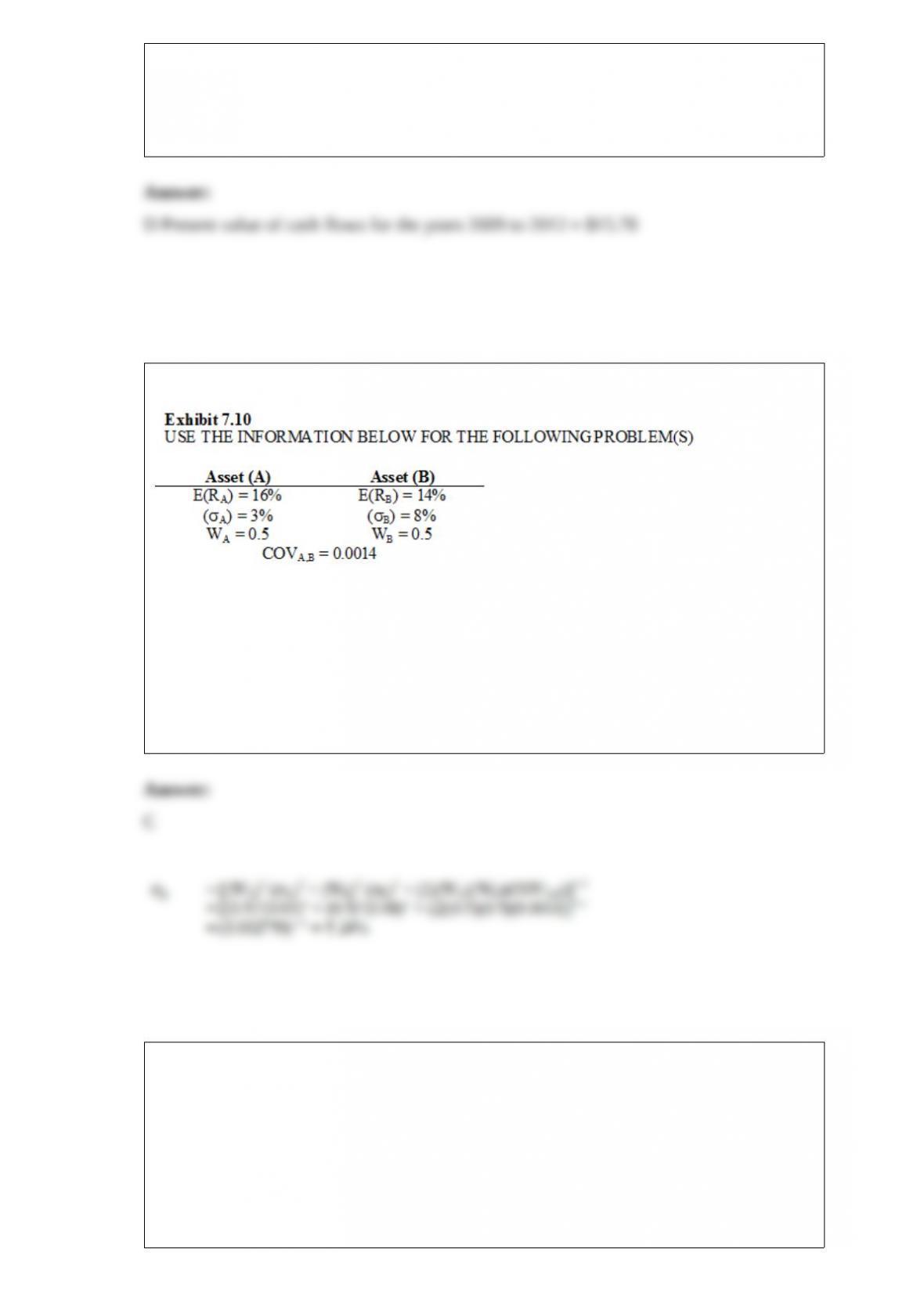
At the end of the year 2004 the Office Equipment Industry had free cash flow to equity
(FCFE) of $2.50 per share. The following annual growth rates in FCFE are projected:
From year 2013 onward growth in FCFE is expected to remain constant at 5% per year.
The industry has a beta of 0.90 and the current industry price is $105. Currently the
yield on 10-year Treasury notes is 5% and the equity risk premium is 4%
Calculate the present value now (Year 2004) of FCFE during the period of declining
growth (that is for years 2009 to 2012).
a. $17.19
b. $14.15
c. $11.59
d. $15.78
e. $18.09
6)
Refer to Exhibit 7.10. What is the standard deviation of this portfolio?
a. 3.02%
b. 4.88%
c. 5.24%
d. 5.98%
e. 6.52%
7) You own 50 shares of Auto Corporation that you purchased for $30 a share. The
stock is currently selling for $50 a share and you placed a stop loss order at $45. If the
stock price drops to $35 a share what is your return on this investment?
a.-30.0%
b.16.7%
c.50.0%
d.66.7%
e.150.0%
8) The ____ the number of stocks in a portfolio and the ____ the time period the ____
the portfolio beta.
a. Larger, longer, less stable
b. Larger, longer, more stable
c. Larger, shorter, less stable
d. Larger, shorter, more stable
e. Smaller, longer, more stable
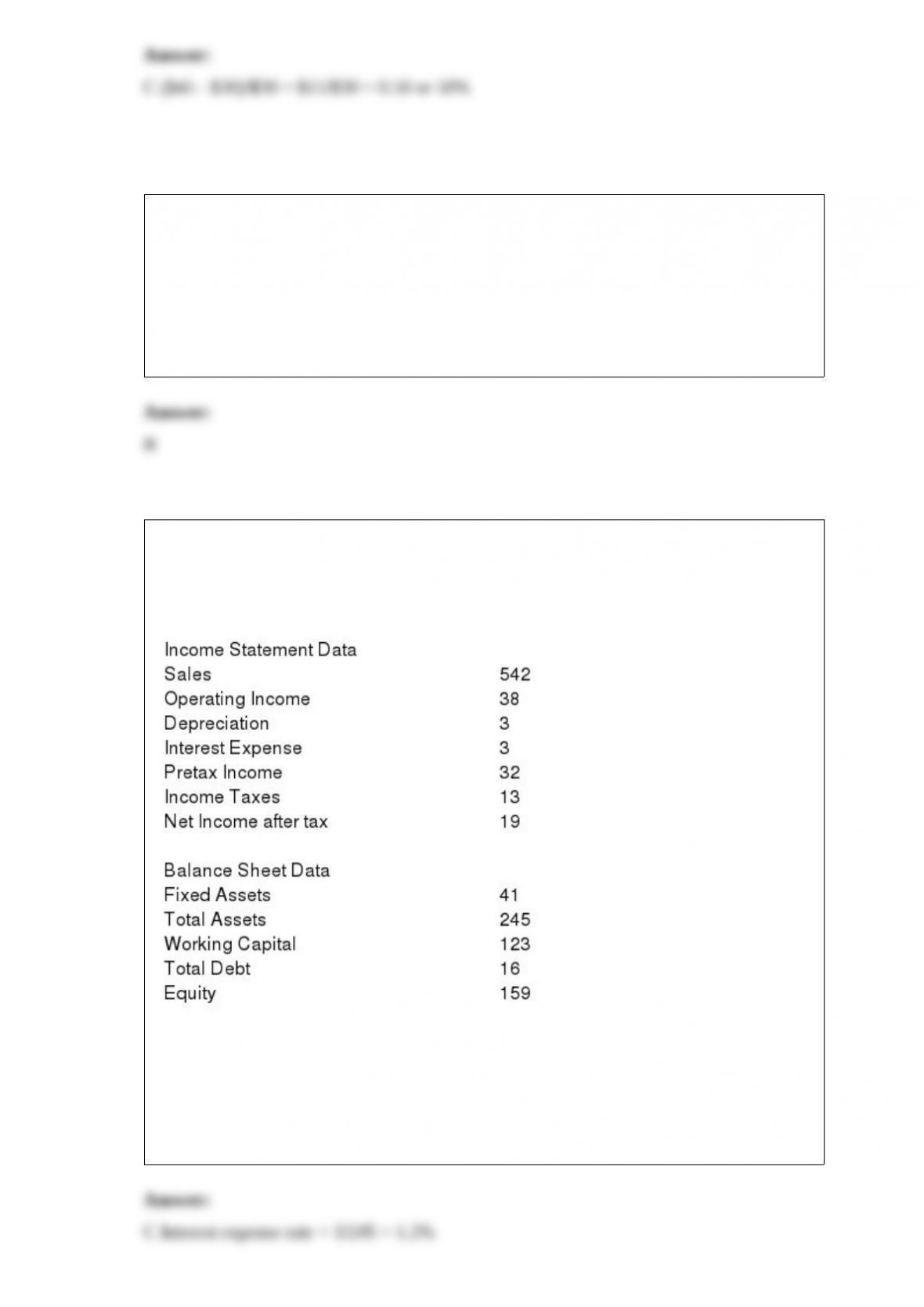
9) Exhibit 10.5
USE THE INFORMATION BELOW FOR THE FOLLOWING PROBLEM(S)
You are provided with the following information about Albermarle Corp.
Calculate the interest expense rate.
a. 7%
b. 0.5%
c. 1.2%
d. 5%
e. 2.3%
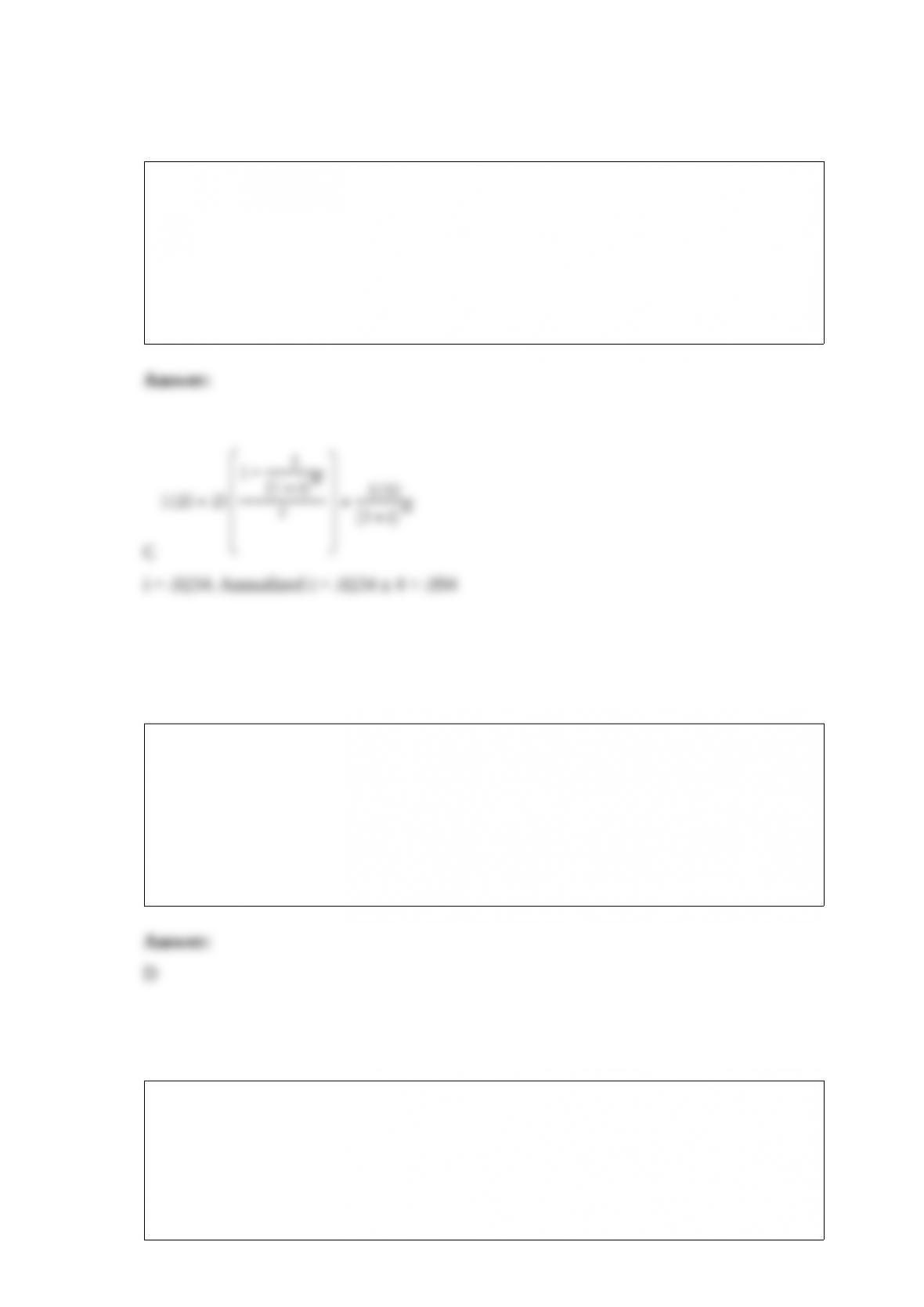
10) Suppose you have a 10%, 20 year bond traded at $1,120. If it is callable in 5 years
at $1,150, what is the bond’s approximate yield to call? Interest is paid quarterly.
a. 7.78%
b. 8.00%
c. 9.40%
d. 9.36%
e. 9.72%
11) In which industrial life cycle stage do sales correlate highly with an economic series
or the economy in general?
a. Pioneering development
b. Rapidly accelerating growth
c. Mature growth
d. Stabilization and market maturity
e. Deceleration of growth and decline
12) Which of the following is not a risk premium component of bonds?
a. Bond quality
b. Term to maturity of the bond
c. Indenture provisions
d. Foreign bond risk
e. All of the above are risk premium components of bonds.

13) An equity portfolio manager can neutralize the risk of falling stock prices by
entering into a hedge position where the payoffs are
a. Not correlated with the existing exposure.
b. Positively correlated with the existing exposure.
c. Negatively correlated with the existing exposure.
d. Any of the above.
e. None of the above.
14) Calculate the expected return for F Inc. which has a beta of 1.3 when the risk free
rate is 0.06 and you expect the market return to be 0.125.
a. 12.65%
b. 13.55%
c. 14.45%
d. 15.05%
e. 16.34%
15) Which of the following is not a step required for a multifactor risk model to
estimate expected return for an individual stock position?
a. Identify a set of K common risk factors.
b. Estimate the risk premia for the factors.
c. Estimate the sensitivities of the each stock to these K factors.
d. Calculate the expected returns using linear programming analysis.
e. All of the above are necessary steps for a multifactor risk model.

16) A forward contract is similar to an option contract because they both
a. Can provide insurance against the price of the underlying stock
b. Are paid for up front in the form of premiums
c. Are paid for at the end of the contract in the form of premiums
d. Require a future settlement payment
e. None of the above
17) Calculate the yield to maturity of a zero coupon bond with a face value of $1000,
maturing in 10 years and selling for a price of $529.30.
a. 6.57%
b. 8.45%
c. 4.16%
d. 10.23%
e. 12.17%
18) All of the following are one of Malkiel’s stated relationships between yield changes
and bond prices except
a. Bond prices move inversely to bond yields.
b. Longer-maturity bonds experience larger price changes than shorter-maturity bonds.
c. Bond price volatility increases at a diminishing rate as term to maturity increases.
d. Bond price movements resulting from equal absolute increases or decreases in yield
are symmetrical.
e. Bond price volatility is inversely related to the coupon rate.

19) A no-load fund imposes a substantial sales charge and sells shares at their NAV.
20) Interest rate anticipation is the most conservative management strategy.
21) A good secondary market is important to the efficiency of the primary market.
22) If the 50-day moving average line crosses the 200-day moving average line from
below on good volume, this would be a bullish signal.
23) In the absence of arbitrage opportunities, the forward contract price should be equal
to the current spot price plus interest.
24) According to the DuPont system ROE (return on equity) can be decomposed into

the profit margin ratio and the total asset turnover ratio.