
Suppose that Rose Industries is considering the acquisition of another firm in its
industry for $100 million. The acquisition is expected to increase Rose’s free cash flow
by $5 million the first year, and this contribution is expected to grow at a rate of 3%
every year there after. Rose currently maintains a debt to equity ratio of 1, its marginal
tax rate is 40%, its cost of debt rD is 6%, and its cost of equity rE is 10%. Rose
Industries will maintain a constant debt-equity ratio for the acquisition.
Given that Rose issues new debt of $50 million initially to fund the acquisition, the
present value of the interest tax shield for this acquisition is closest to:
A) $24 million
B) $50 million
C) $20 million
D) $15 million
An independent film maker is considering producing a new movie. The initial cost for
making this movie will be $20 million today. Once the movie is completed, in one year,
the movie will be sold to a major studio for $25 million. Rather than paying for the $20
million investment entirely using its own cash, the film maker is considering raising
additional funds by issuing a security that will pay investors $11 million in one year.
Suppose the risk-free rate of interest is 10%.
Without issuing the new security, the NPV for this project is closest to what amount?
Should the film maker make the investment?
A) $1.7 million; Yes
B) $1.7 million; No
C) $2.7 million; Yes
D) $2.7 million; No
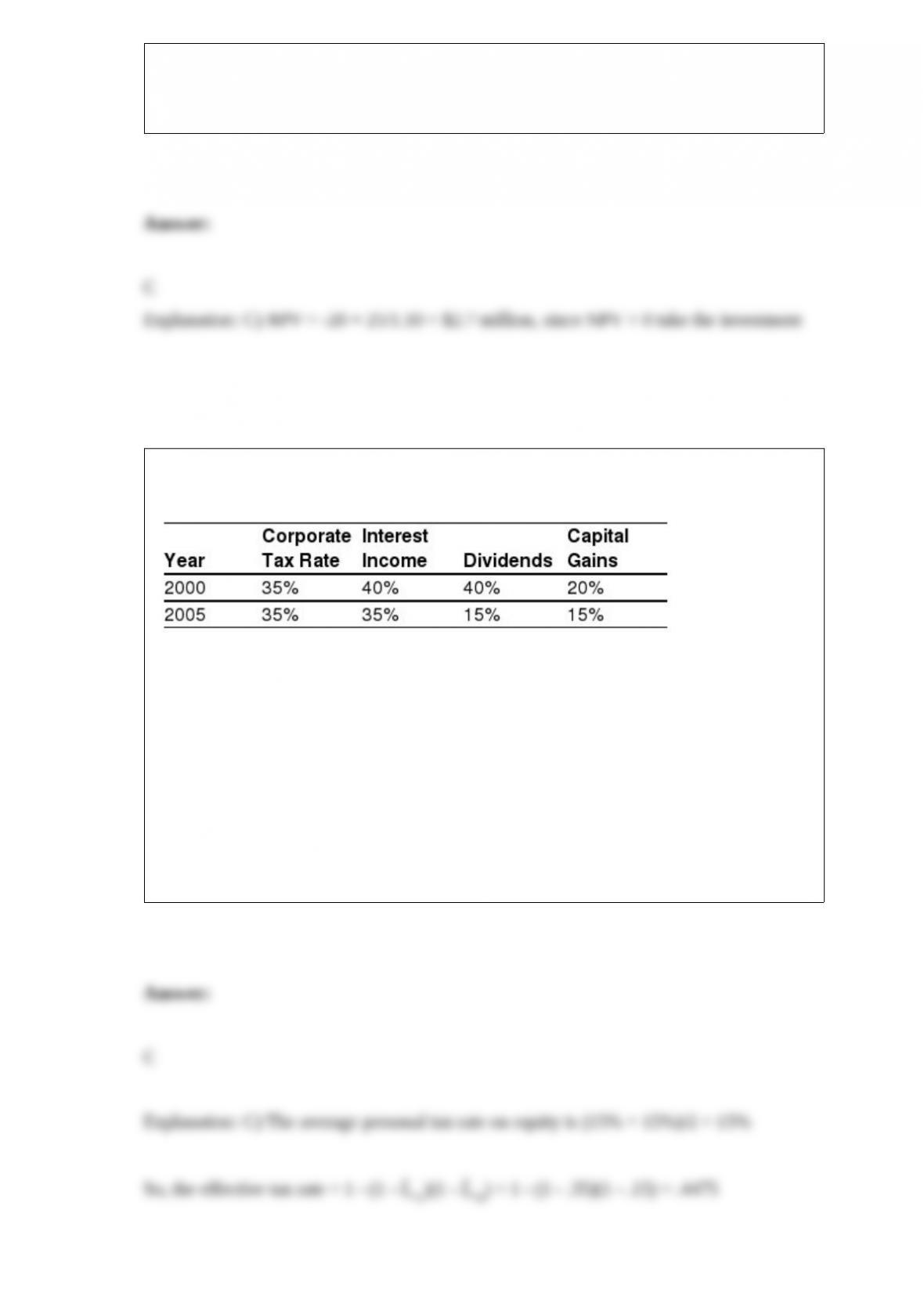
Consider the following top federal tax rates in the United States:
Personal Tax Rates
In 2005, assuming an average dividend payout ratio of 50%, the effective tax rate for
equity holders was closest to:
A) 30%
B) 55%
C) 45%
D) 50%

Suppose the term structure of interest rates is shown below:
What is the shape of the yield curve and what expectations are investors likely to have
about future interest rates?
A) Inverted; Higher
B) Normal; Higher
C) Inverted; Lower
D) Normal; Lower
Suppose you invest $20,000 by purchasing 200 shares of Abbott Labs (ABT) at $50 per
share, 200 shares of Lowes (LOW) at $30 per share, and 100 shares of Ball Corporation
(BLL) at $40 per share.Suppose over the next year Ball has a return of 12.5%, Lowes
has a return of 20%, and Abbott Labs has a return of -10%. The return on your portfolio
over the year is:
A) 0%
B) 7.5%
C) 3.5%
D) 5.0%
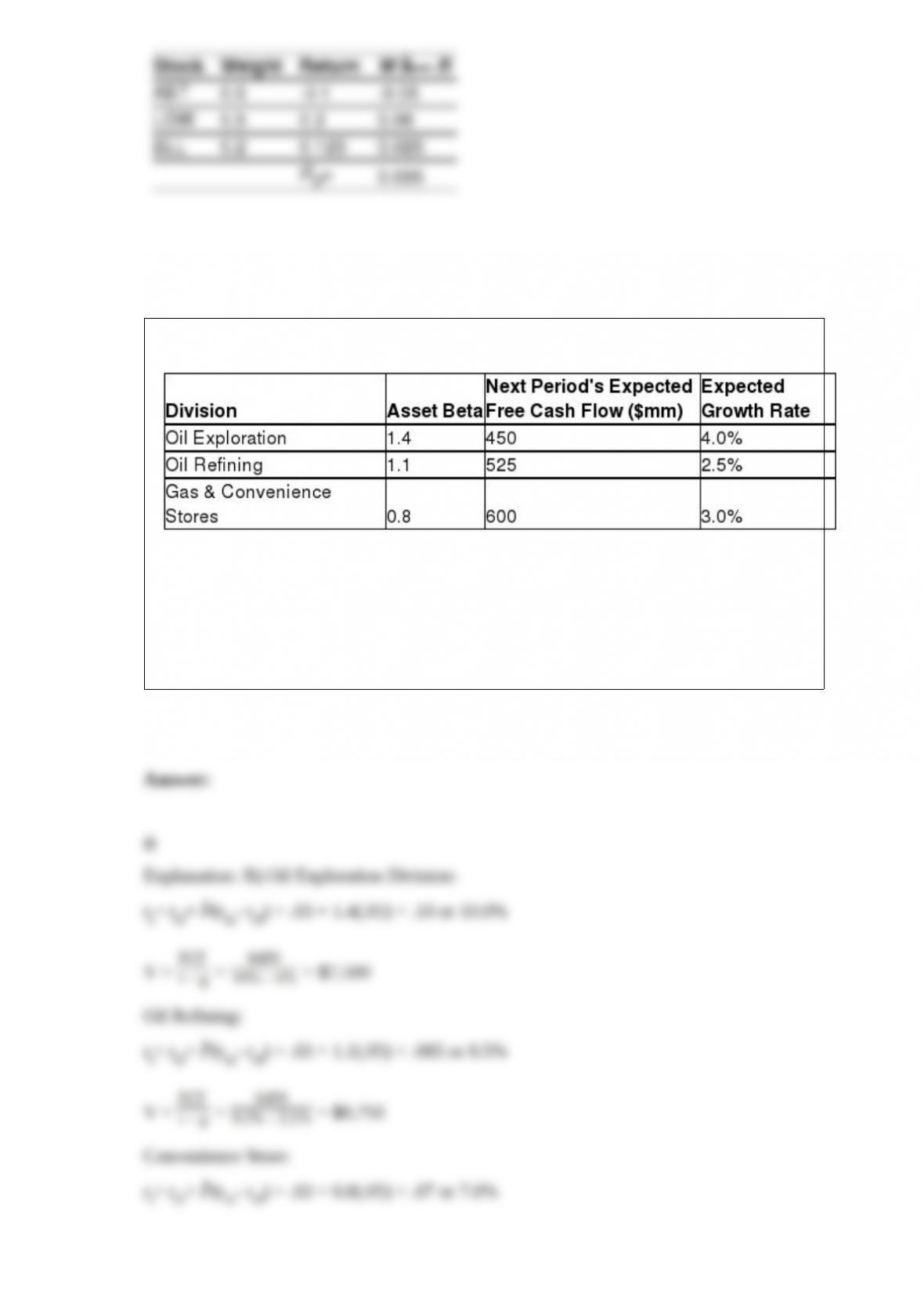
The risk-free rate of interest is 3% and the market risk premium is 5%.
The overall asset beta for Wyatt Oil is closest to:
A) 0.95
B) 1.05
C) 1.15
D) 1.25

Which of the following organization forms for a business does NOT avoid double
taxation?
A) Limited partnership
B) “C” corporation
C) “S” corporation
D) Limited liability company
Which of the following statements is FALSE?
A) Most projects will require the firm to invest in net working capital.
B) The main components of net working capital are cash, inventory, receivables, and
property, plant and equipment.
C) ΔNWCt= NWCt– NWCt – 1.
D) In the final year of a project, the firm ultimately recovers the investment in net
working capital.
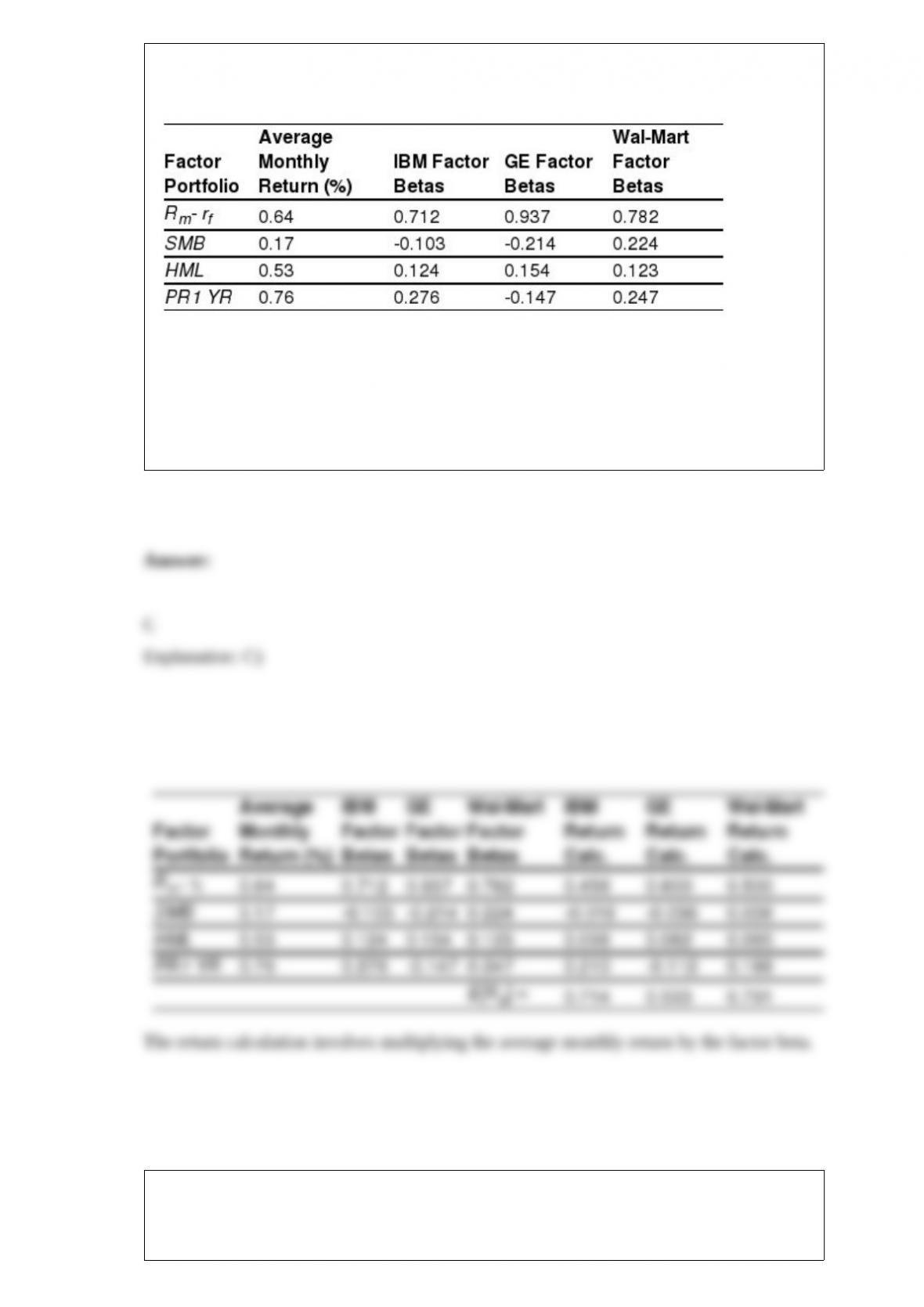
Consider the following information regarding the Fama French Carhart four factor
model:
Using the FFC four factor model and the historical average monthly returns, the
expected monthly return for IBM is closest to:
A) 0.79%
B) 0.53%
C) 0.71%
D) 1.01%
Which of the following statements is FALSE?
A) It is not actually necessary to identify the efficient portfolio itself. All that is required
is to identify a collection of portfolios from which the efficient portfolio can be

constructed.
B) Although we might not be able to identify the efficient portfolio itself, we know
some characteristics of the efficient portfolio.
C) An efficient portfolio can be constructed from other diversified portfolios.
D) An efficient portfolio need not be well diversified.
Which of the following questions is FALSE?
A) With perfect capital markets, all securities are fairly priced and issuing securities is a
zero-NPV transaction.
B) The fees associated with the financing of the project are independent of the project’s
required cash flows and should be ignored when calculating the NPV of the project.
C) When a firm borrows funds, a mispricing scenario arises if the interest rate charged
differs from the rate that is appropriate given the actual risk of the loan.
D) The WACC, APV, and FTE methods determine the value of an investment
incorporating the tax shields associated with leverage.
Rosewood Industries has EBIT of $450 million, interest expense of $175 million, and a
corporate tax rate of 35%.
The total of Rosewood’s net income and interest payments is closest to:
A) $270 million

B) $355 million
C) $290 million
D) $450 million
Wyatt Oil issued $100 million in perpetual debt (at par) with an annual coupon of 7%.
Wyatt will pay interest only on this debt. Wyatt’s marginal tax rate is expected to be
40% for the foreseeable future.
Assume that five years have passed since Wyatt issued this debt. While tax rates have
remained at 40%, interest rates have dropped so that Wyatt’s current cost of debt capital
is now only 4%. The present value of Wyatt’s annual interest tax shield is now closest
to:
A) $2.8 million
B) $40.0 million
C) $60.0 million
D) $70.0 million

Which of the following investments had the largest fluctuations overall return over the
past eighty years?
A) Small stocks
B) S&P 500
C) Corporate bonds
D) Treasury Bills
Which of the following statements is FALSE?
A) The Capital Asset Pricing Model is the most important method for estimating the
cost of capital that is used in practice.
B) Because the risk that determines expected returns is unsystematic risk, which is
measured by beta, the cost of capital for an investment is the expected return available
on securities with the same beta.
C) A common assumption is that the project has the same risk as the firm.
D) To determine a project’s cost of capital we need to estimate its beta.

Dagny Taggart has just purchased a home and taken out a $400,000 mortgage. The
mortgage has a 30-year term with monthly payments and has an APR of 5.4%.
Dagny’s monthly payments are closest to:
A) $1,110
B) $1,800
C) $2,215
D) $2,245
Which of the following statements is FALSE?
A) A common approximation is to assume that in the long run, dividends will grow at a
constant rate.
B) The dividend each year is the firm’s earnings per share (EPS) multiplied by its
dividend payout rate.
C) There is a tremendous amount of uncertainty associated with any forecast of a firm’s
future dividends.
D) During periods of high growth, it is not unusual for firms to pay out 100% of their
earnings to shareholders in the form of dividends.
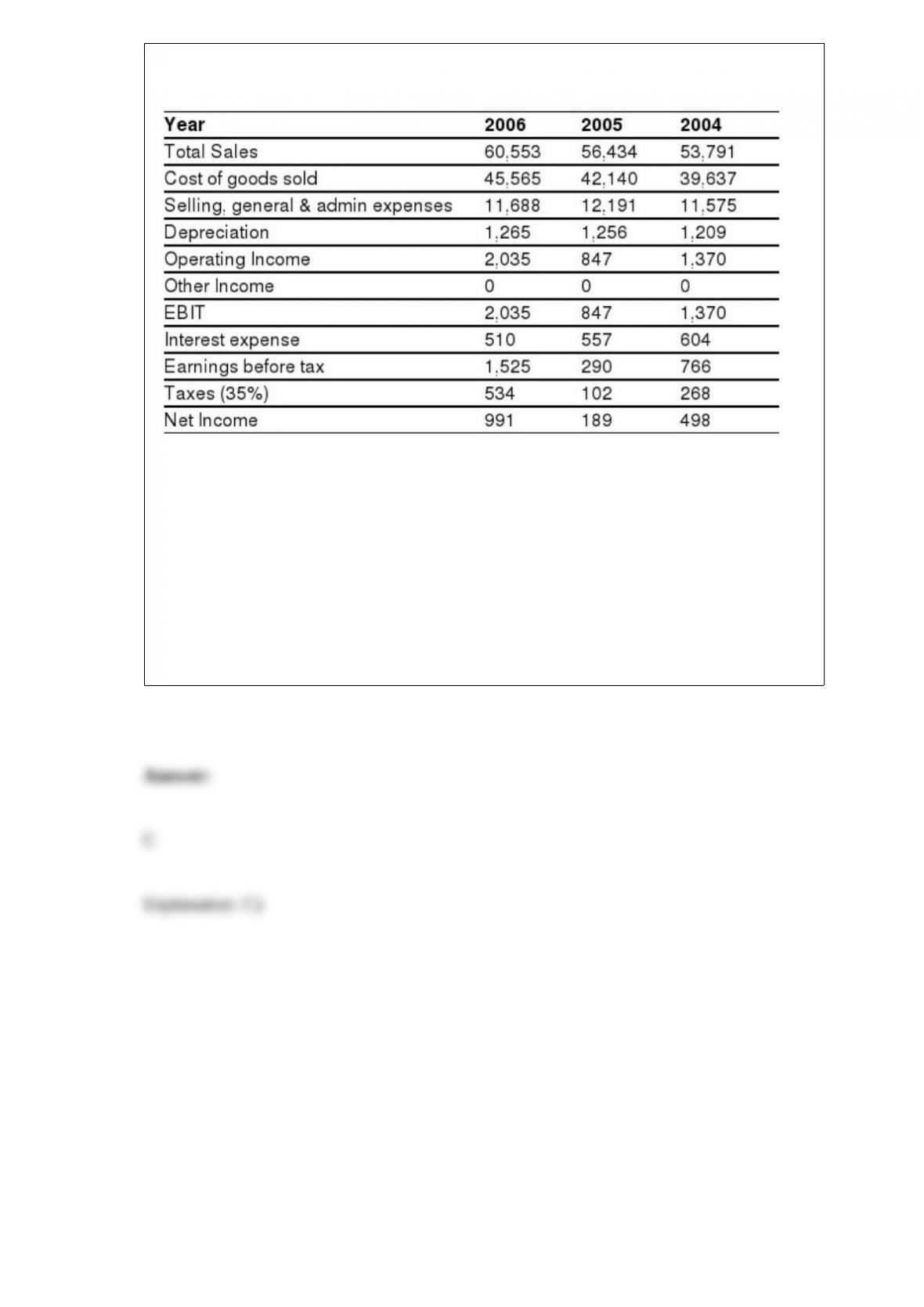
Consider the following income statement for Kroger Inc. (all figures in $ Millions):
The interest rate tax shield for Kroger in 2004 is closest to:
A) $268 million
B) $393 million
C) $211 million
D) $94 million
Which of the following statements is FALSE?
A) Problems can arise using the IRR method when the mutually exclusive investments
have different cash flow patterns.
B) The IRR is affected by the scale of the investment opportunity.
C) Multiple incremental IRRs might exist.
D) The incremental IRR rule assumes that the riskiness of the two projects is the same.
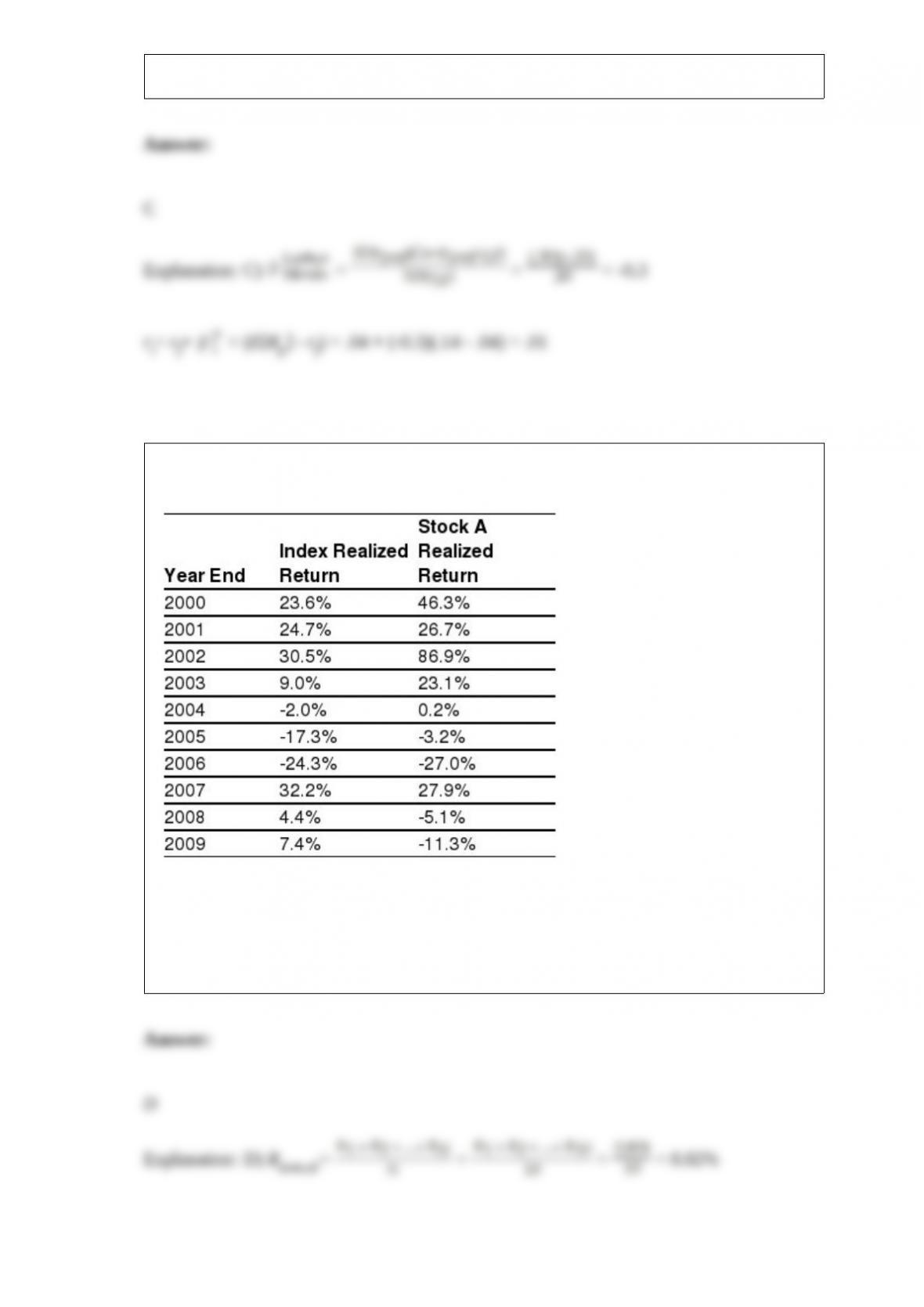
Consider the following zero-coupon yields on default free securities:
The forward rate for year 4 (the forward rate quoted today for an investment that begins
in three years and matures in four years) is closest to:
A) 4.5%
B) 4.6%
C) 4.4%
D) 5.0%

Galt Industries is expected to generate free cash flows of $24 million per year. Galt has
permanent debt of $80 million, a corporate tax rate of 40%, and an unlevered cost of
capital of 12% and its cost of debt capital is 6%.Galt’s WACC is closest to:
A) 6.0%
B) 9.6%
C) 10.3%
D) 10.7%

Consider the following four alternatives:
1. $132 received in two years.
2. $160 received in five years.
3. $200 received in eight years.
4. $220 received in ten years.
The ranking of the four alternatives from most valuable to least valuable if the interest
rate is 6% per year would be:
A) 1, 2, 3, 4
B) 1, 3, 2, 4
C) 4, 3, 1, 2
D) 3, 4, 2, 1
You are presently invested in the Luther Fund, a broad based mutual fund that invest in
stocks and other securities. The Luther Fund has an expected return of 14% and a
volatility of 20%. Risk-free Treasury bills are currently offering returns of 4%. You are
considering adding a precious metals fund to your current portfolio. The metals fund
has an expected return of 10%, a volatility of 30%, and a correlation of -.20 with the
Luther Fund.The expected return on the precious metals fund is closest to:
A) -3%
B) 4%
C) 1%
D) 10%
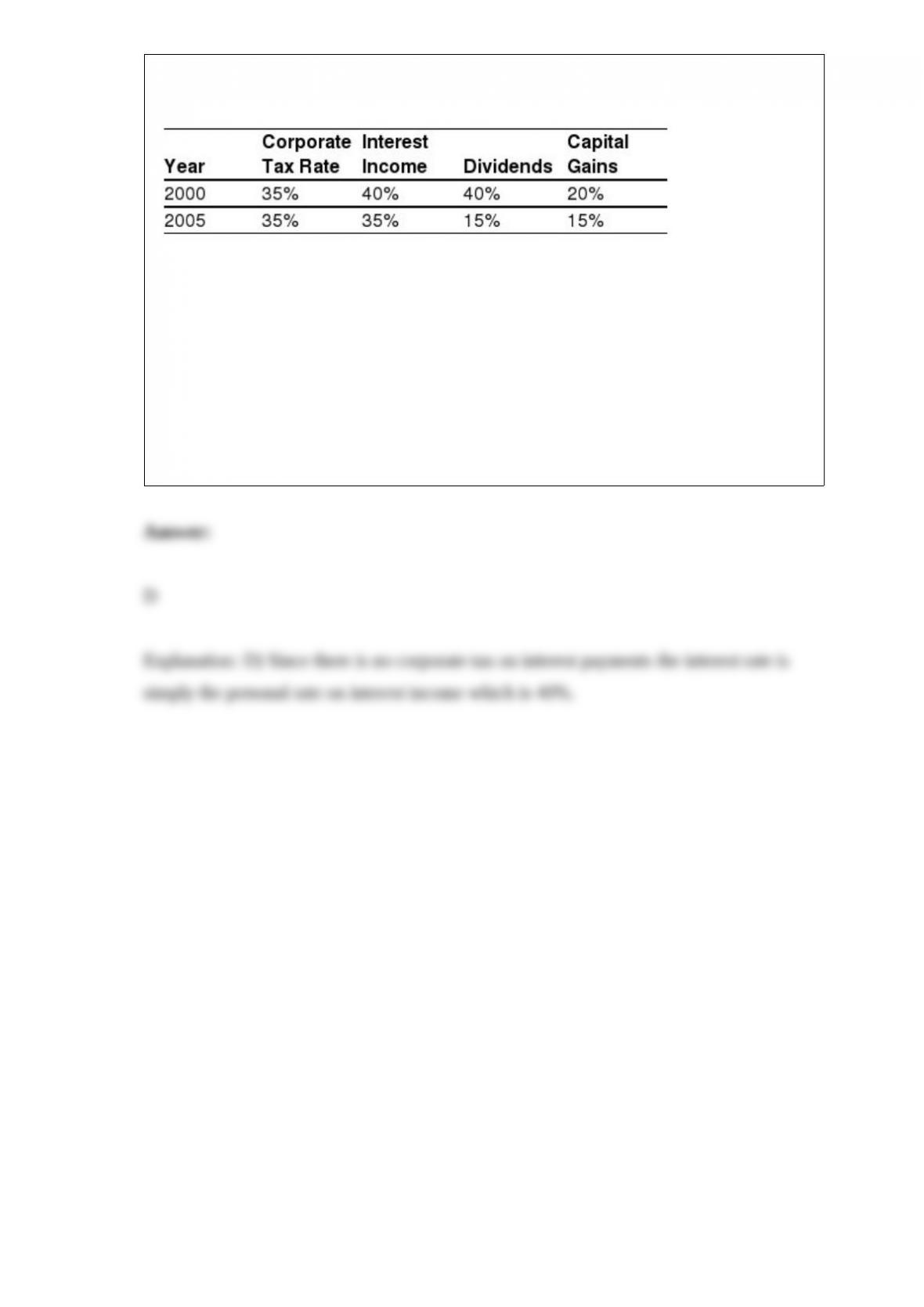
Consider the following realized annual returns:
The average annual return on the Index from 2000 to 2009 is closest to:
A) 7.10%
B) 4.00%
C) 9.75%
D) 8.75%
Consider the following top federal tax rates in the United States:
Personal Tax Rates
In 2000, the effective tax rate for debt holders was closest to:
A) 61%
B) 52%
C) 64%
D) 40%