
Suppose Novak Company experienced a reduction in its ROE over the last year. This
fall could be attributed to:
A) an increase in net profit margin.
B) a decrease in asset turnover.
C) an increase in leverage.
D) a decrease in Equity.
Which of the following statements is FALSE?
A) The investor’s opportunity cost of capital is the best available expected return
offered in the market on an investment of comparable risk and term of the cash flows
being discounted.
B) Interest rates we observe in the market will vary based on quoting conventions, the
term of investment, and risk.
C) The opportunity cost of capital is the return the investor forgoes when the investor
takes on a new investment.
D) For a risk-free project, the opportunity cost of capital will typically be greater than
the interest rate of U.S. Treasury securities with a similar term.
Consider two securities, A & B. Suppose a third security, C, has the same cash flows as
A and B combined. Given this information about securities A,B, & C, which of the
following statements is INCORRECT?
A) If the total price of A and B is cheaper than the price of C, then we could make a
profit selling A and B and buying C.
B) Price(C) = Price(A) + Price(B)
C) Because security C is equivalent to the portfolio of A and B, by the law of one price
they must have the same price.
D) The relationship known as value additivity says that the value of a portfolio is equal

to the sum of the values of its parts.
Which of the following statements is FALSE?
A) If the CAPM correctly computes the risk premium, investors would stop investing
only when they expected the alpha of an investment strategy to be negative.
B) If the CAPM correctly computes the risk premium, an investment opportunity with a
positive alpha is a positive NPV investment opportunity.
C) If the CAPM correctly computes the risk premium, investors should flock to invest
in positive alpha stocks.
D) Anyone can implement a momentum trading strategy and therefore generate a
positive investment opportunity.
Suppose you invest $20,000 by purchasing 200 shares of Abbott Labs (ABT) at $50 per
share, 200 shares of Lowes (LOW) at $30 per share, and 100 shares of Ball Corporation
(BLL) at $40 per share.
The weight on Abbott Labs in your portfolio is:
A) 50%
B) 40%
C) 30%
D) 20%
Which of the following statements is FALSE?
A) Beta measures the sensitivity of a security to market wide risk factors.
B) Volatility measures total risk, while beta measures only systematic risk.
C) The beta is the expected percentage change in the excess return of the market
portfolio for a 1% change in the excess return of a security.
D) Utilities tend to be stable and highly regulated, and thus are insensitive to
fluctuations in the overall market.
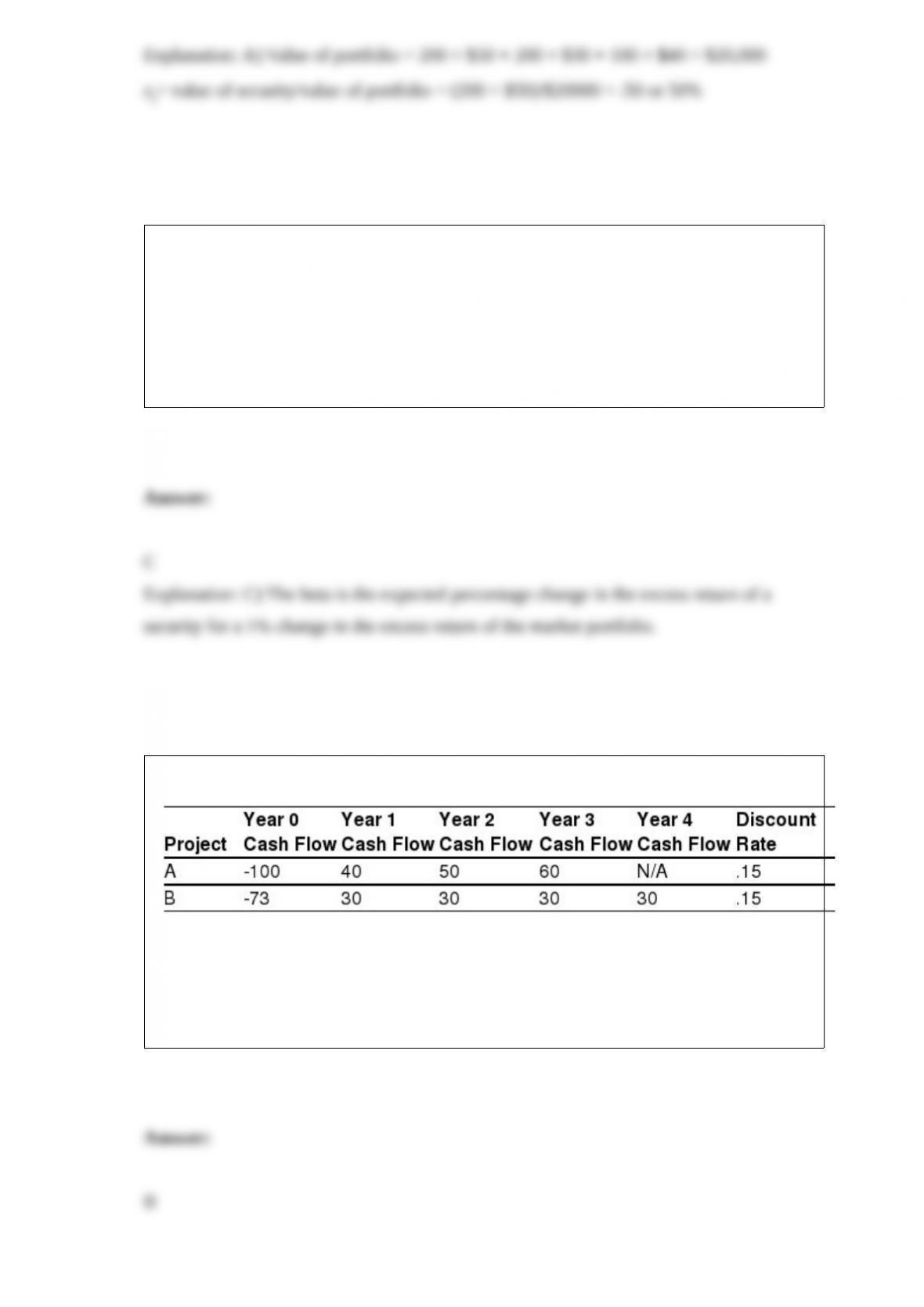
Consider the following two projects:
The maximum number of IRRs that could exist for project B is:
A) 3
B) 1
C) 2
D) 0

Wyatt Oil pays a regular dividend of $2.50 per share. Typically the stock price drops by
$2.00 per share when the stock goes ex-dividend. Suppose the capital gains tax rate is
20%, but investors pay different tax rates on dividends. Absent transactions cost, the
highest dividend tax rate of an investor who could gain from trading to capture the
dividend is closest to:
A) 0%
B) 20%
C) 24%
D) 36%
The Sarbanes-Oxley Act (SOX) stiffened penalties for providing false information by:
A) requiring the CEO and CFO to return bonuses or profits from the sale of stock that
are later shown to be due to misstated financial reports.
B) imposing large compliance costs on small companies.
C) requiring auditing firms to have long-standing relationships with their clients and
receive lucrative auditing and consulting fees from them.
D) putting strict limits on the amount of non-audit fees (consulting or otherwise) that an
accounting firm can earn from a firm that it audits.
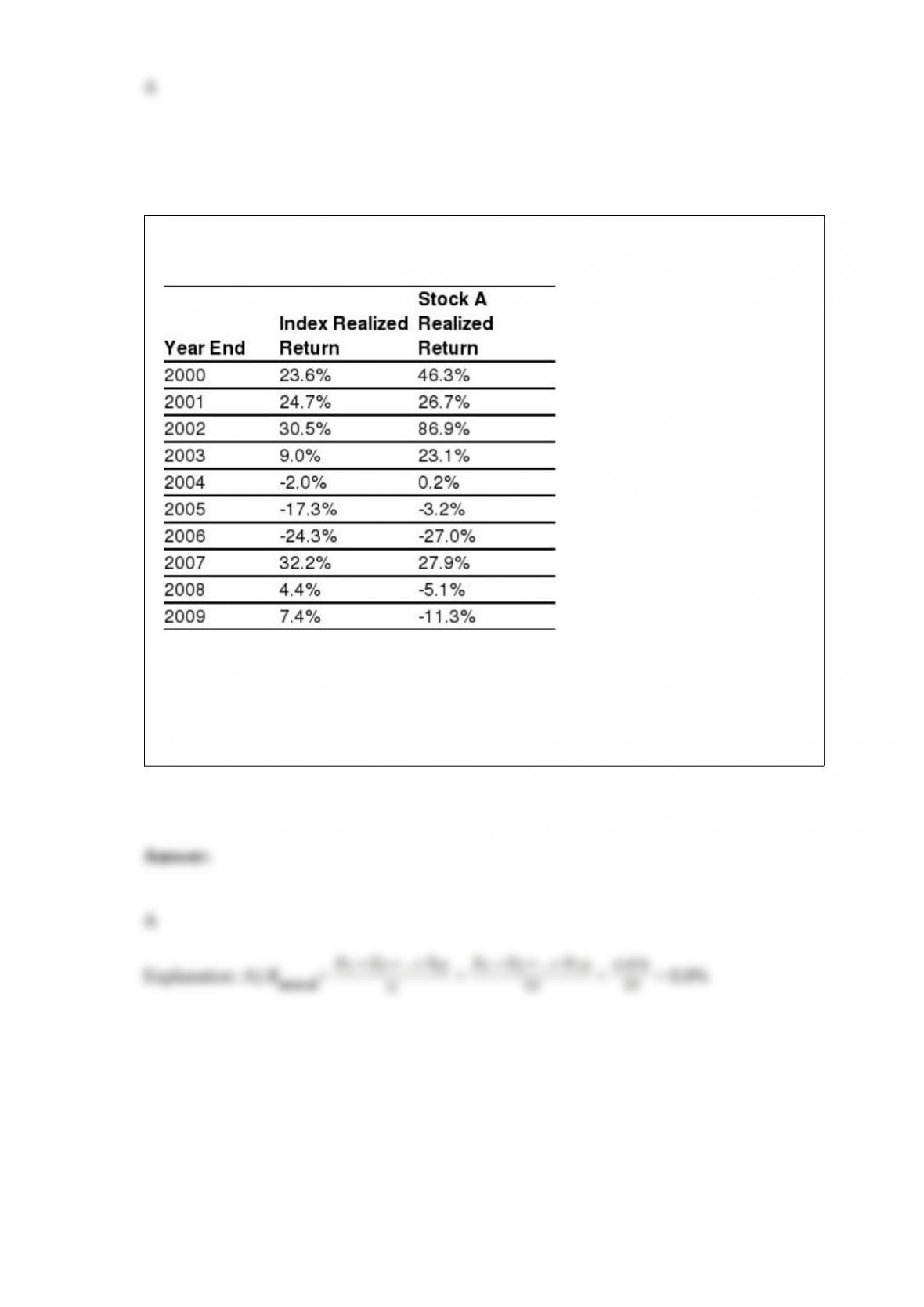
Consider the following realized annual returns:
The standard deviation of the returns on the Index from 2000 to 2009 is closest to:
A) 19.5%
B) 20.5%
C) 3.8%
D) 8.8%
The inventory days ratio measures:
A) the average length of time it takes a company to sell its inventory.
B) the average length of time it takes the company’s suppliers to deliver its inventory.
C) the level of sales required to keep a company’s average inventory on the books.
D) the percentage change in inventory over the past year.
Which of the following statements is FALSE?
A) While debt itself may be cheap, it increases the risk and therefore the cost of capital
of the firm’s equity.
B) Although debt does not have a lower cost of capital than equity, we can consider this
cost in isolation.
C) We can use Modigliani and Miller’s first proposition to derive an explicit
relationship between leverage and the equity cost of capital.
D) The total market value of the firm’s securities is equal to the market value of its
assets, whether the firm is unlevered or levered.

) Consider an economy with two types of firms, S and I. S firms always move together,
but I firms move independently of each other. For both types of firm there is a 70%
probability that the firm will have a 20% return and a 30% probability that the firm will
have a -30% return.
The standard deviation for the return on a portfolio of 20 type S firms is closest to:
A) 5.10%
B) 23.0%
C) 15.0%
D) 5.25%
You are offered an investment opportunity in which you will receive $25,000 in one
year in exchange for paying $23,750 today. Suppose the risk-free interest rate is 6% per
year. Should you take this project? The NPV for this project is closest to:
A) Yes; NPV = $165
B) No; NPV = $165
C) Yes; NPV = -$165
D) No; NPV = -$165
Kinston Industries just announced that it will cut its dividend from $3.00 to $2.00 per
share and use the extra funds to expand its operations. Kinston’s dividends were
expected to grow at a 2% rate, and its share price was $37.50. With the new expansion,
Kinston dividends are expected to grow at a 5% rate. Kinston’s share price following
this announcement should be:
A) $20.00
B) $30.00
C) $37.50
D) $40.00
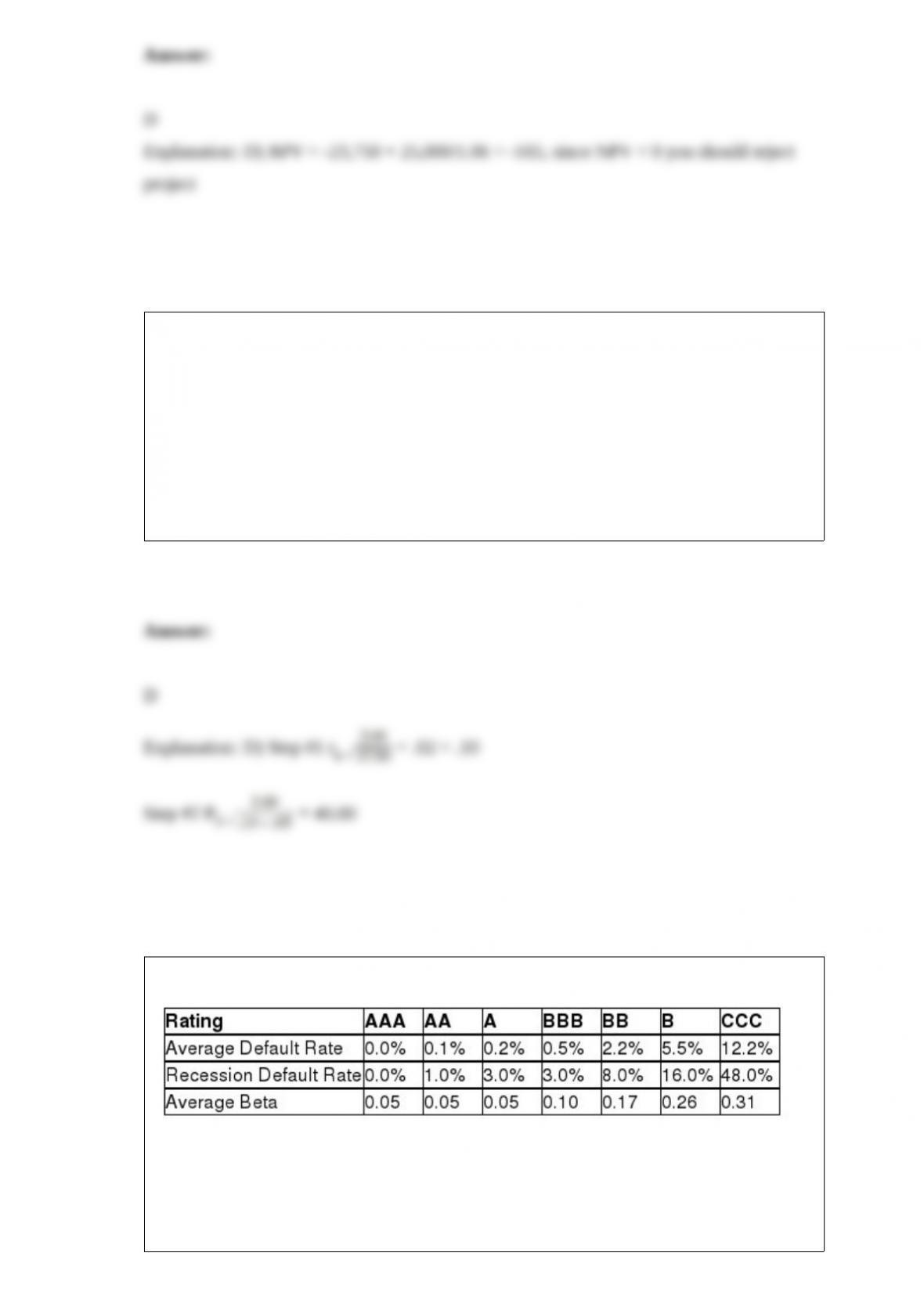
Consider the following information regarding corporate bonds:
Wyatt Oil has a bond issue outstanding with seven years to maturity, a yield to maturity
of 7.0%, and a BBB rating. The bondholders’ expected loss rate in the event of default
is 70%. Assuming a normal economy the expected return on Wyatt Oil’s debt is closest
to:
A) 3.0%

B) 3.5%
C) 4.9%
D) 6.7%