1) suppose that data are assembled on (1) research and development expenditures as a
fraction of industry costs across u.s. industries (ranked from highest to lowest), and (2)
the export success of u.s. industries (ranked from highest to lowest). if the product cycle
theory is useful as an explanation for the pattern of u.s. exports, then an analyst would
expect that statistical association (rank correlation coefficient) between these two series
of data would be
a. positive
b. zero
c. negative
d. positive, zero, or negative cannot be determined without more information
2)
(this question draws appendix b material.)
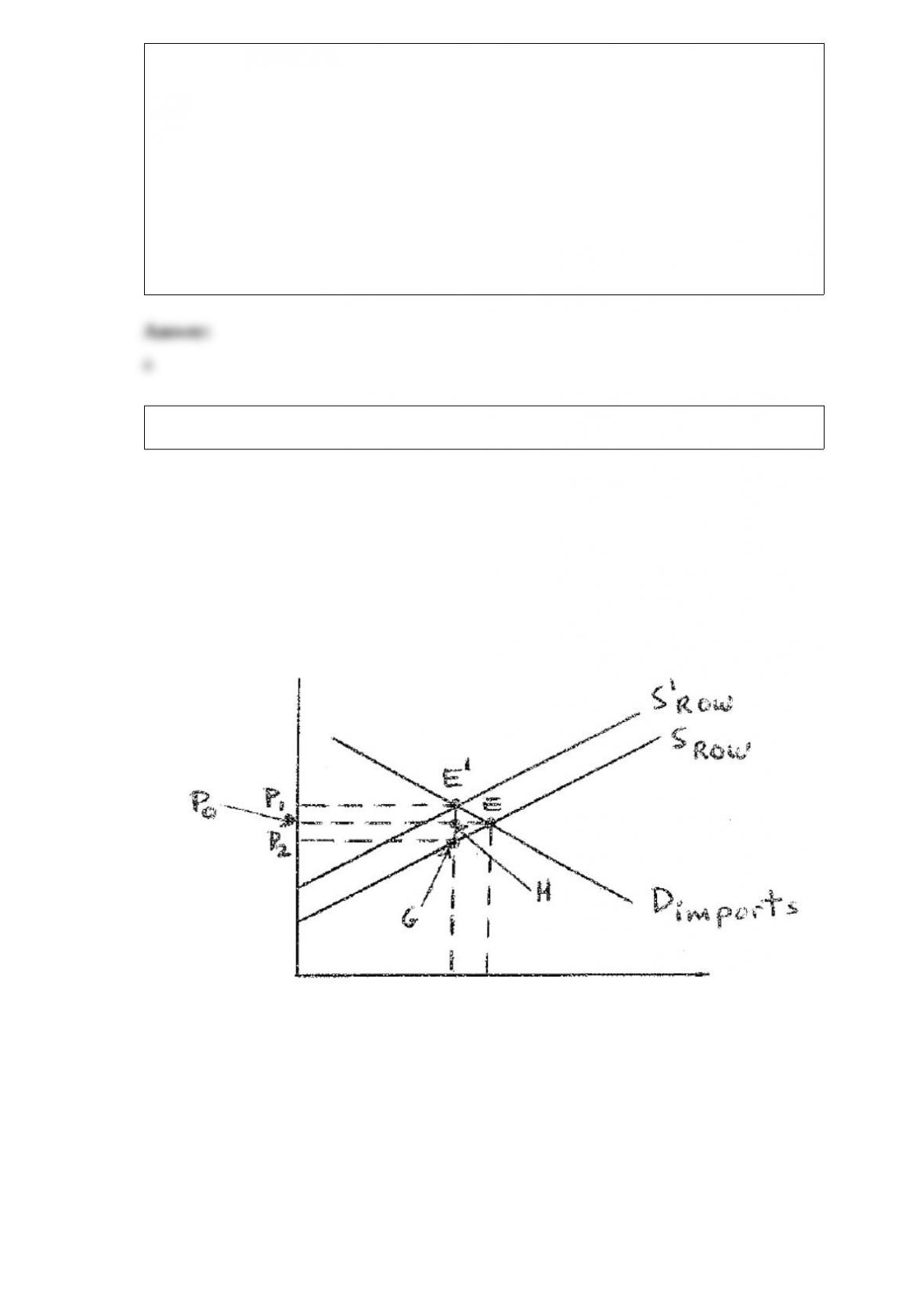
given the following diagram showing country as demand for imports schedule for good x
(dimports), the supply of exports schedule to a from the rest of the world of good x (srow),
and the supply of exports schedule to a from the rest of the world of good x when country
a has imposed a specific tariff on imports of good x (srow):
price
quantity
a. the total tariff revenue collected by country a is indicated by the rectangle p0p1e’h
b. distance op2 indicates the net price received by the foreign suppliers after payment of
the tariff

c. the loss of consumer surplus in country a because of the imposition of the tariff is
indicated by rectangle p2p0hg
d. country a is a ‘small” country
3) if, in time period #1, the equilibrium value of the pound is $1.60, but then u.k. prices
doublebetween time period #1 and time period #2 while u.s. prices rise by 60 percent,
then the (relative) purchasing power parity theory would say that the equilibrium value
of the pound in time period #2 is
a. $0.80
b. $1.25
c. $1.28
d. $2.00
4) at the present time in the international monetary system,
a. gold is the largest component of international reserves held by central banks
b. no country is permitted to have a flexible (or floating) exchange rate
c. no country uses, as part or all of its money, another countrys currency unit
d. one form of international monetary arrangement that has similarities with the old
gold standard is a currency board
5) if, when a country grows, its home production of its import good increases by 15
percent and its home consumption of the import good also increases by 15 percent,
then, with the economic growth, the countrys absolute quantity of imports will
__________.
a. increase
b. decrease
c. remain constant
d. increase, decrease, or remain constant cannot be determined without more
information
6) the krugman economies-of-scale strategic trade policy model stresses that protection
given to a home firm will, other things equal, __________ the marginal cost of
producing each level of home output and will __________ the marginal cost of
producing each level of foreign output.
a. decrease; also decrease
b. decrease; increase
c. increase; also increase
d. increase; decrease
7)
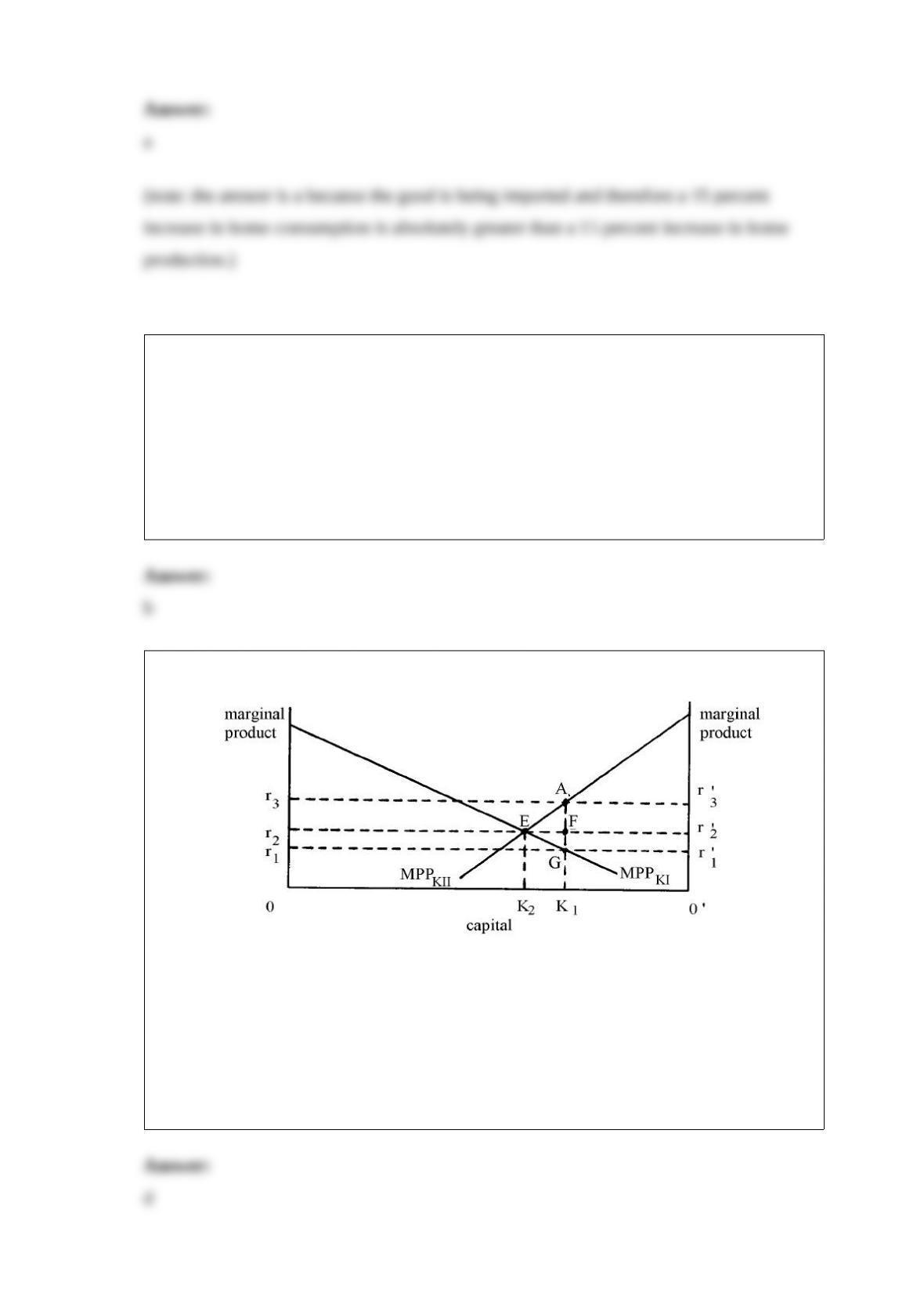
in the diagram above, if restrictions on capital flows were removed and capital was
allowed to flow from the low-return country to the high-return country, then national
income (i.e., gnp) in country i would __________ by the amount of area __________.
a. decrease; k2efk1
b. decrease; k2egk1
c. increase; aef
d. increase; efg

8) if a (large) country b puts an export tax on a good, and assuming that world demand
for the export from b is not perfectly inelastic, then, because of the tax, the price of the
good in country b will __________ and the price of the good on the world market
__________.
a. increase; also will increase
b. increase; will decrease
c. decrease; will increase
d. decrease; also will decrease
9) the policy of minimum government interference in or regulation of economic
activity, advocated by adam smith and the classical economists, was known as
a. the law of comparative advantage
b. laissez-faire
c. the labor theory of value
d. mercantilism
10) in a perfectly-competitive world, restrictions placed by developing countries to halt
a brain drain would lead to __________ in efficiency and world output in a static sense;
over time, these restrictions might, other things equal, __________ in the per capita
income differences between developing countries and developed countries if skilled
labor has important production externalities.
a. a decrease; lead to an increase
b. a decrease; also lead to a decrease
c. an increase; lead to a decrease
d. an increase; also lead to an increase
11) in the situation of demand reversal in a 2x2x2 context where all the assumptions of
the heckscher-ohlin analysis hold except for the assumption of identical demands across
countries, and when the countries are trading with each other,
a. one country will be conforming to the trade pattern predicted by the heckscher-ohlin
theorem but the other country will not be conforming to that pattern.
b. both countries will be conforming to the trade pattern predicted by the
heckscher-ohlin theorem if the price (or economic) definition of relative factor
abundance is used but not if the physical definition of relative factor abundance is used.
c. both countries will be conforming to the trade pattern predicted by the
heckscher-ohlin theorem if the physical definition of relative factor abundance is used
but not if the price (or economic) definition of relative factor abundance is used.
d. factor price equalization across the two countries cannot occur.
12)
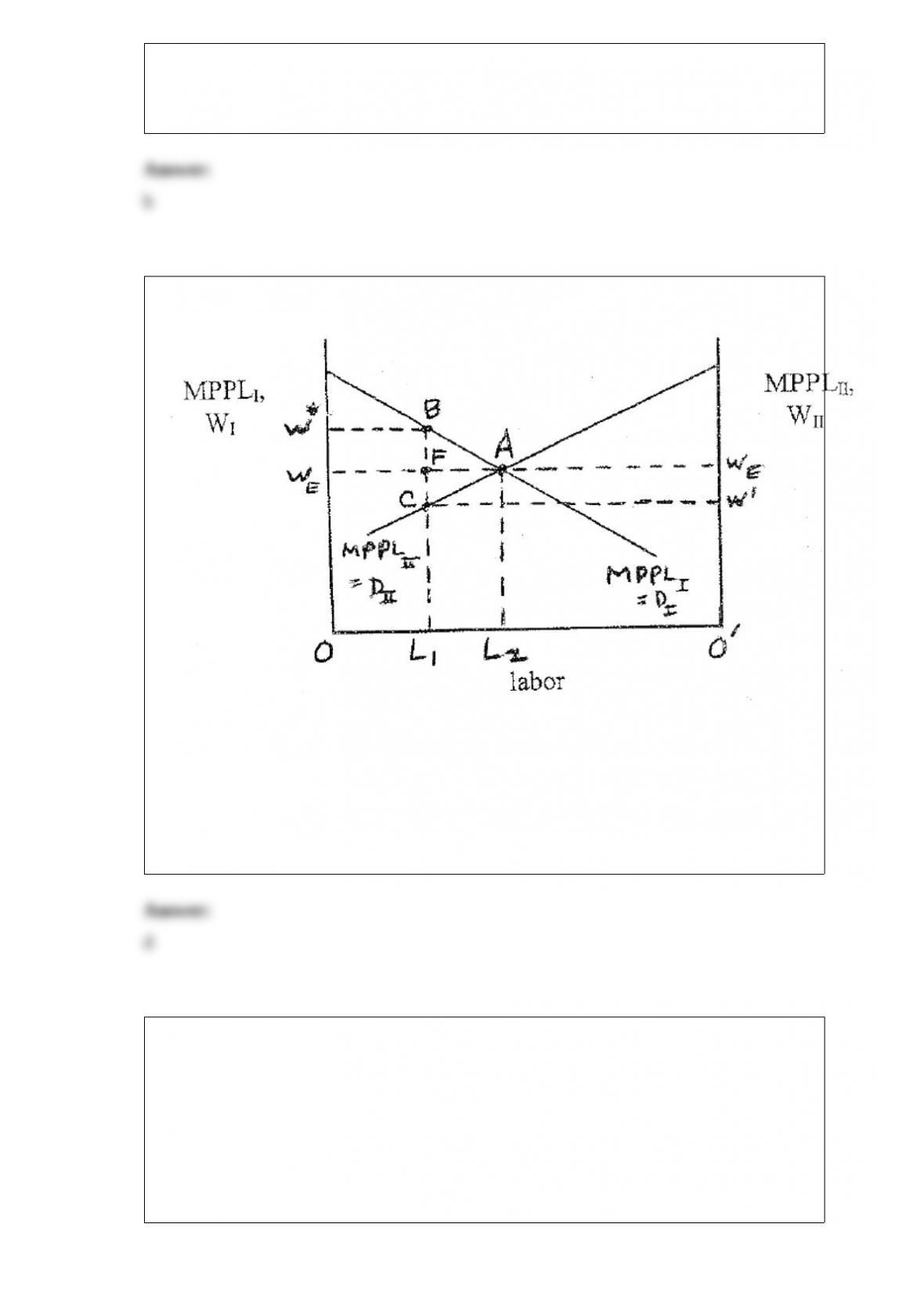
in the graph above, the migration of labor would result in an increase in country is gross
national product of the amount of area __________.
a. l1cbal2
b. l1cal2
c. cfa
d. fba
13) if country a forms a customs union with country b, then
a. country b continues to get tariff revenue from country as exports sent to b
b. all new trade between countries a and b because of the union is known as trade
creation
c. the welfare of countries a and b must necessarily be enhanced, especially if a and b
begin to buy many items from each other that they used to buy from the outside world
d. countries a and b may especially benefit from the union if substantial economies of
scale exist in some of the a and b industries

14) if country a’s (px/py) in autarky is greater than the (px/py) on the world market,
then, as the country moves from autarky to trade, the relative price of good x facing as
producers will __________, and as producers will hence want to shift their production
toward producing __________.
a. decrease; more of good x and less of good y
b. decrease; more of good y and less of good x
c. increase; more of good x and less of good y
d. increase; more of good y and less of good x
15) the asian crisis of 1997-1998 importantly involved movement of short-term
financial capital __________ countries such as thailand and malaysia, with a
consequent __________ of their currencies, which in turn caused __________ in the
trade balances of other countries of the world.
a. out of; depreciation; an improvement
b. out of; appreciation; a deterioration
c. out of; depreciation; a deterioration
d. into; appreciation; an improvement
16) the term xa in the textbook is defined as the expected rate of appreciation of the
foreign currency. a mathematical way to express this definition [where e is the spot rate
of the foreign currency and e(e) is the expected future spot rate of the foreign currency]
is __________.
a. e(e) – e
b. e
e(e)
c. e(e) -1
e
d. e(e) – e
e – 1