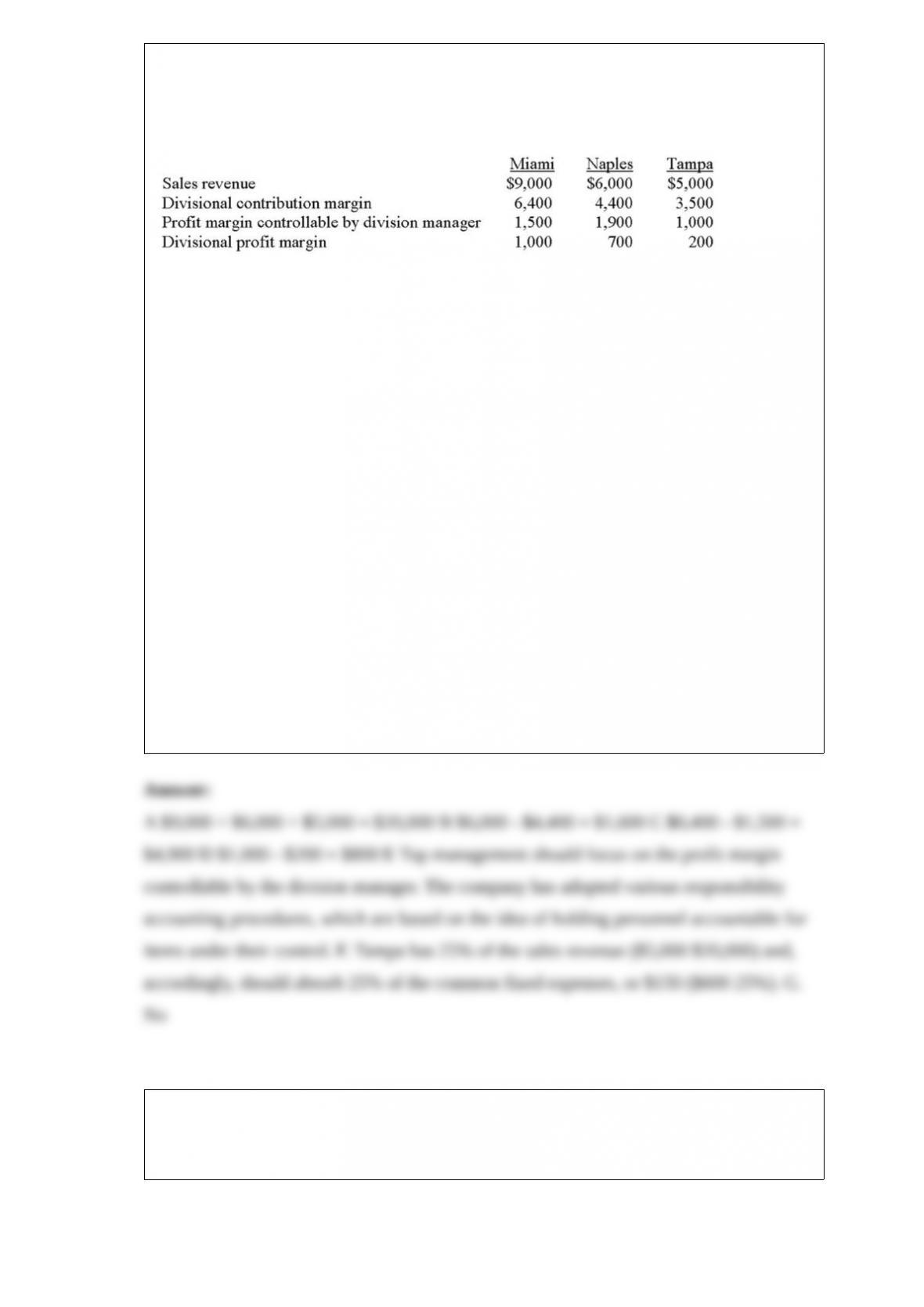
1) Pretty Lady is an upscale boutique that operates various stores throughout Florida.
The company, which has three divisions (Miami, Naples, and Tampa), reported the
following information for the year just ended (in thousands):
Pretty Lady also reported $600 of common fixed expenses that top management wants
to allocate to the divisions on the basis of sales revenue. As the company’s chief
executive officer notes, “Each division helped to incur a portion of these costs and, as a
result, each should absorb its fair share.” The firm has adopted various responsibility
accounting procedures to evaluate division personnel.
Required:
A. Compute the company’s total sales revenue.
B. Calculate the amount of variable operating expense incurred by the Naples Division.
C. Calculate the fixed costs controllable by Miami’s management.
D. Calculate the fixed costs traceable to the Tampa Division but controllable by others.
E. Pretty Lady desires to promote a division manager to the corporate office to oversee
selected operations. In determining which individual to promote, should Pretty Lady’s
top management focus on the profit margin controllable by the division manager or the
overall divisional profit margin? Briefly explain.
F. If the company follows the desires of top management, how much of the common
fixed expenses would be allocated to the Tampa Division?
G. Do cost allocations such as those in part “F” typically appear on a segmented income
statement?
2) The accounting records of Diego Company revealed the following costs, among
others:
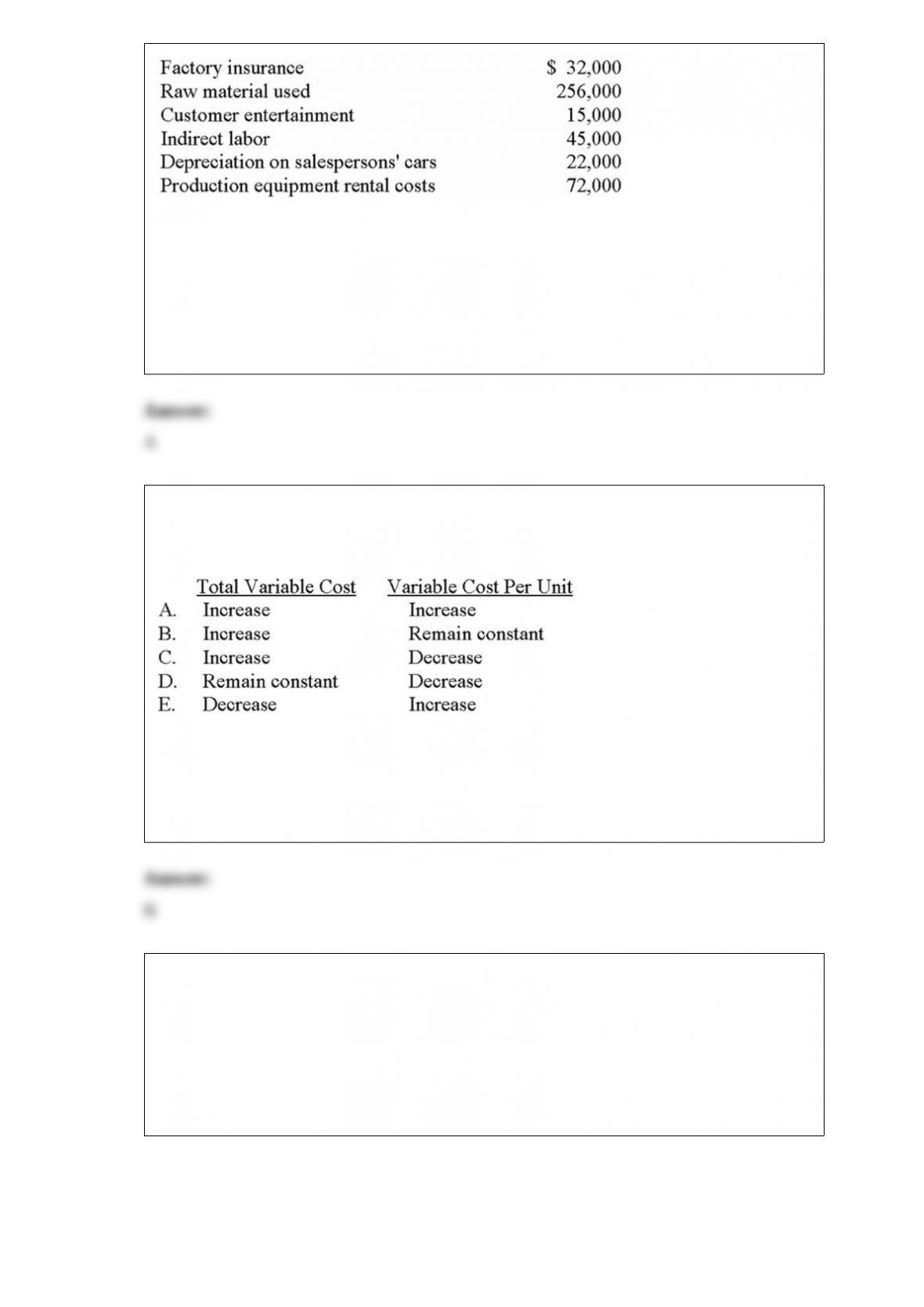
Costs that would be considered in the calculation of manufacturing overhead total:
A.$149,000
B.$171,000
C.$186,000
D.$442,000
E.None of the other answers are correct
3) Mastel Company has a variable selling cost. If sales volume increases, how will the
total variable cost and the variable cost per unit behave?
A.Choice A
B.Choice B
C.Choice C
D.Choice D
E.Choice E
4) St. James, Inc., currently uses traditional costing procedures, applying $800,000 of
overhead to products Beta and Zeta on the basis of direct labor hours. The company is
considering a shift to activity-based costing and the creation of individual cost pools
that will use direct labor hours (DLH), production setups (SU), and number of parts
components (PC) as cost drivers. Data on the cost pools and respective driver volumes
follow.
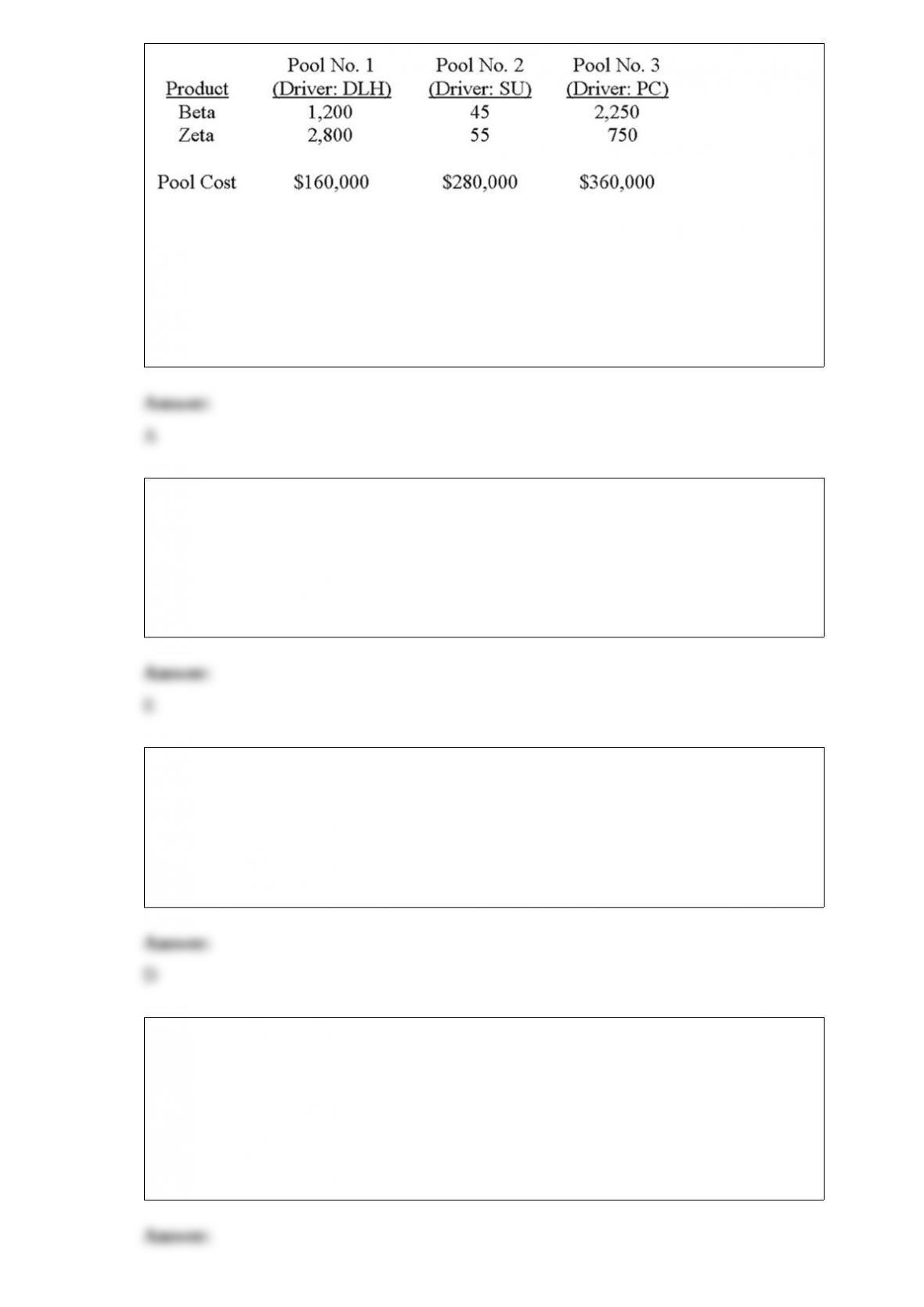
The overhead cost allocated to Beta by using traditional costing procedures would be:
A.$240,000
B.$356,000
C.$444,000
D.$560,000
E.None of the other answers is correct
5) Selling and administrative expenses would likely appear on the balance sheet of:
A.The Gap
B.Texas Instruments
C.Turner Broadcasting System
D.All of these firms
E.None of these firms
6) Work-in-process inventory is composed of:
A.direct material and direct labor
B.direct labor and manufacturing overhead
C.direct material and manufacturing overhead
D.direct material, direct labor, and manufacturing overhead
E.direct material only
7) Which of the following is the proper calculation of a company’s depreciation tax
shield?
A.Depreciation tax rate
B.Depreciation (1 – tax rate)
C.Depreciation tax rate
D.Depreciation (1 – tax rate)
E.Depreciation deduction + income taxes
8) Consider the following statements about pricing:
I. Prices are often determined by the market, subject to the constraint that costs must be
covered in the long run.
II. Prices are often based on costs, subject to the constraint that customers and
competitors will exert an influence.
III. A balance of market forces and cost is important when making pricing decisions.
Which of the above statements is (are) true?
A.I only
B.II only
C.I and III
D.II and III
E.I, II, and III
9) A company’s sales forecast would likely consider all of the following factors except:
A.past sales levels and trends
B.the company’s intended pricing policy
C.the company’s product costing policy
D.market research studies
E.planned advertising and promotions
10) The accounting records of Backspace, Inc., revealed an accounts receivable balance
of $195,000 on January 1, 20×6 . Forty percent of the company’s sales are for cash, and
the remaining 60% are on account. Of the credit sales, 30% are collected in the month
of sale and 70% are collected in the following month. Total sales in January and
February are expected to amount to $500,000 and $530,000, respectively.
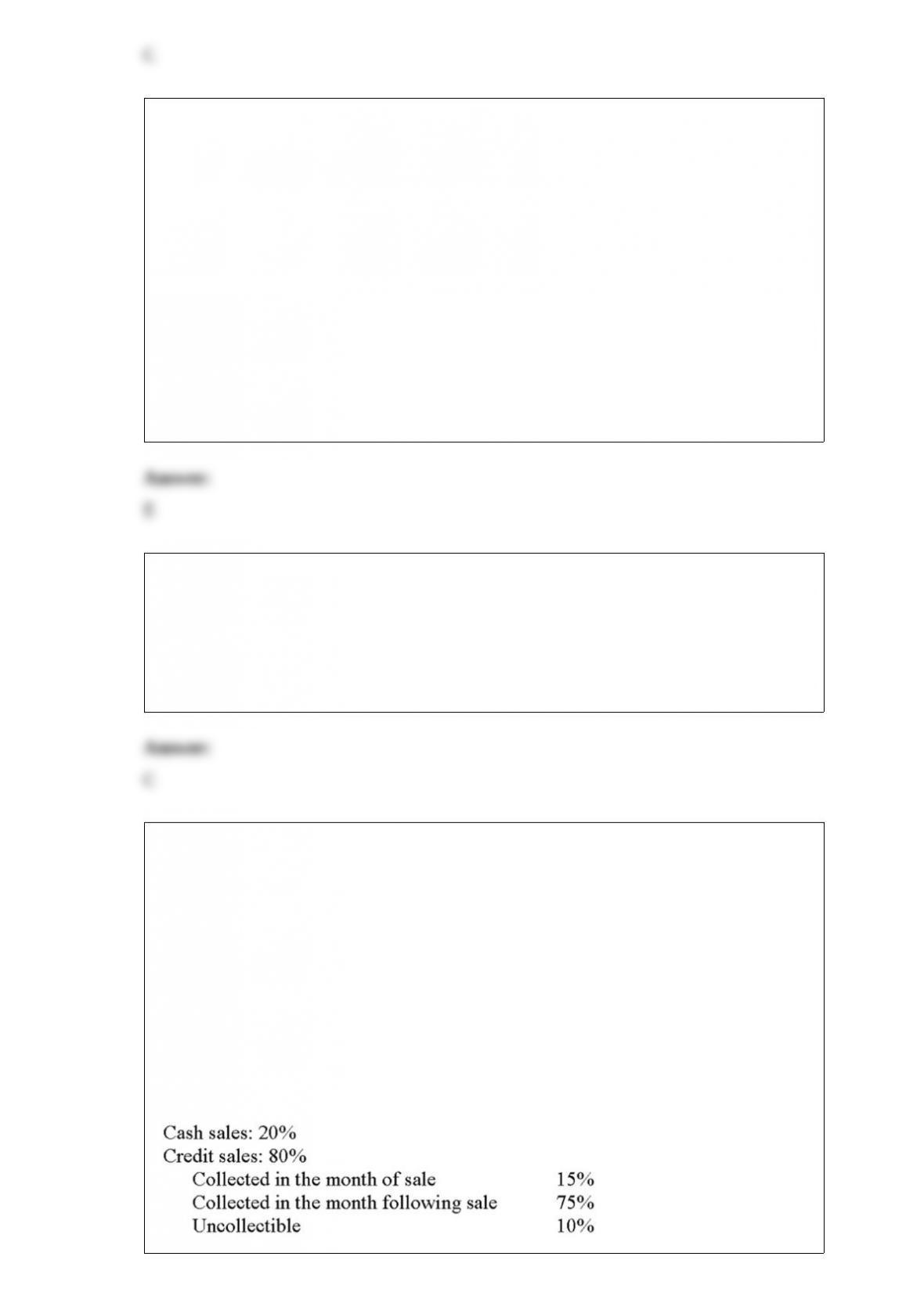
Assume that in the latter half of 20×6, Backspace hired a new sales manager who
aggressively tried to maximize the company’s market share. She implemented a
compensation system for the sales force that was 100% commission based, with the
commission calculated on the basis of gross sales dollars. Sales volume increased
dramatically in a very short period of time, and the sales and collection patterns
changed, as follows:
Required:
A. Compute the company’s cash inflows for January and February, 20×6 .
B. Determine the outstanding receivables balance at the end of February.
C. Compare the sales and collection patterns before and after the arrival of the new
sales manager. Have things improved or deteriorated? Explain.
D. On the basis of the information presented, determine what likely caused the
improvement or deterioration in collection patterns.
11) Consider the following items:
A. Tomatoes used in the manufacture of Hunts ketchup
B. Administrative salaries of executives employed by Jet Blue Airlines
C. Wages of assembly-line workers at a Ford plant
D. Marketing expenditures of the Atlanta Braves baseball club
E. Commissions paid to Coca-Cola’s salespeople
F. Straight-line depreciation on manufacturing equipment owned by Dell Computer
G. Shipping charges incurred by Office Depot on out-going orders
H. Speakers used in Sony home-theater systems
I. Insurance costs related to a Mary Kay Cosmetics’ manufacturing plant
Required:
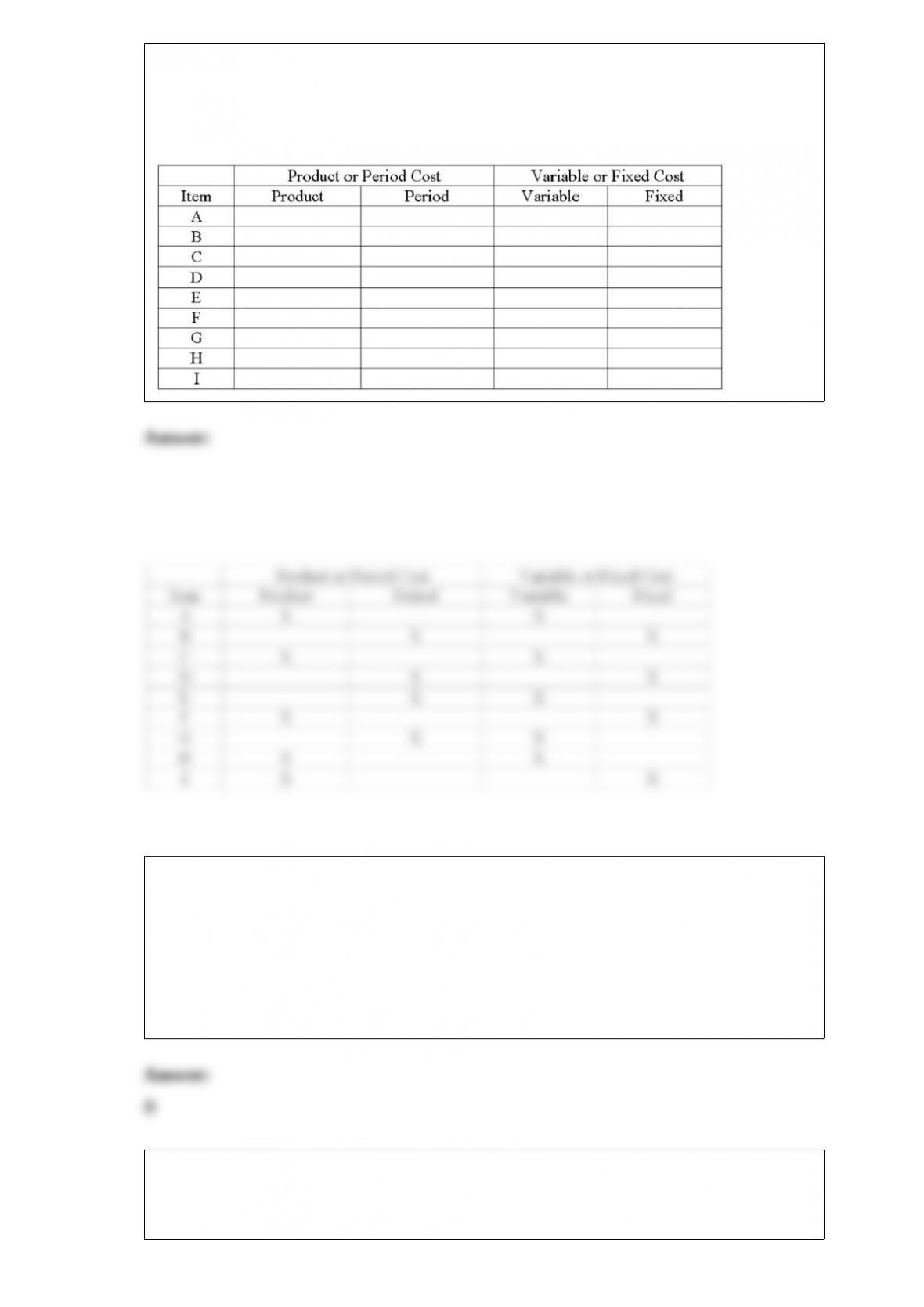
Complete the table that follows and classify each of the costs listed as (1) a product or
period cost and (2) a variable or fixed cost by placing an “X” in the appropriate column.
12) The tuition that will be paid next semester by a college student who pursues a
degree is a(n):
A.sunk cost
B.out-of-pocket cost
C.indirect cost
D.average cost
E.marginal cost
13) Switzer, Inc., which sells books to college bookstores and individuals, uses
activity-based costing and activity-based management. The following information is
available for the company’s three cost pools:
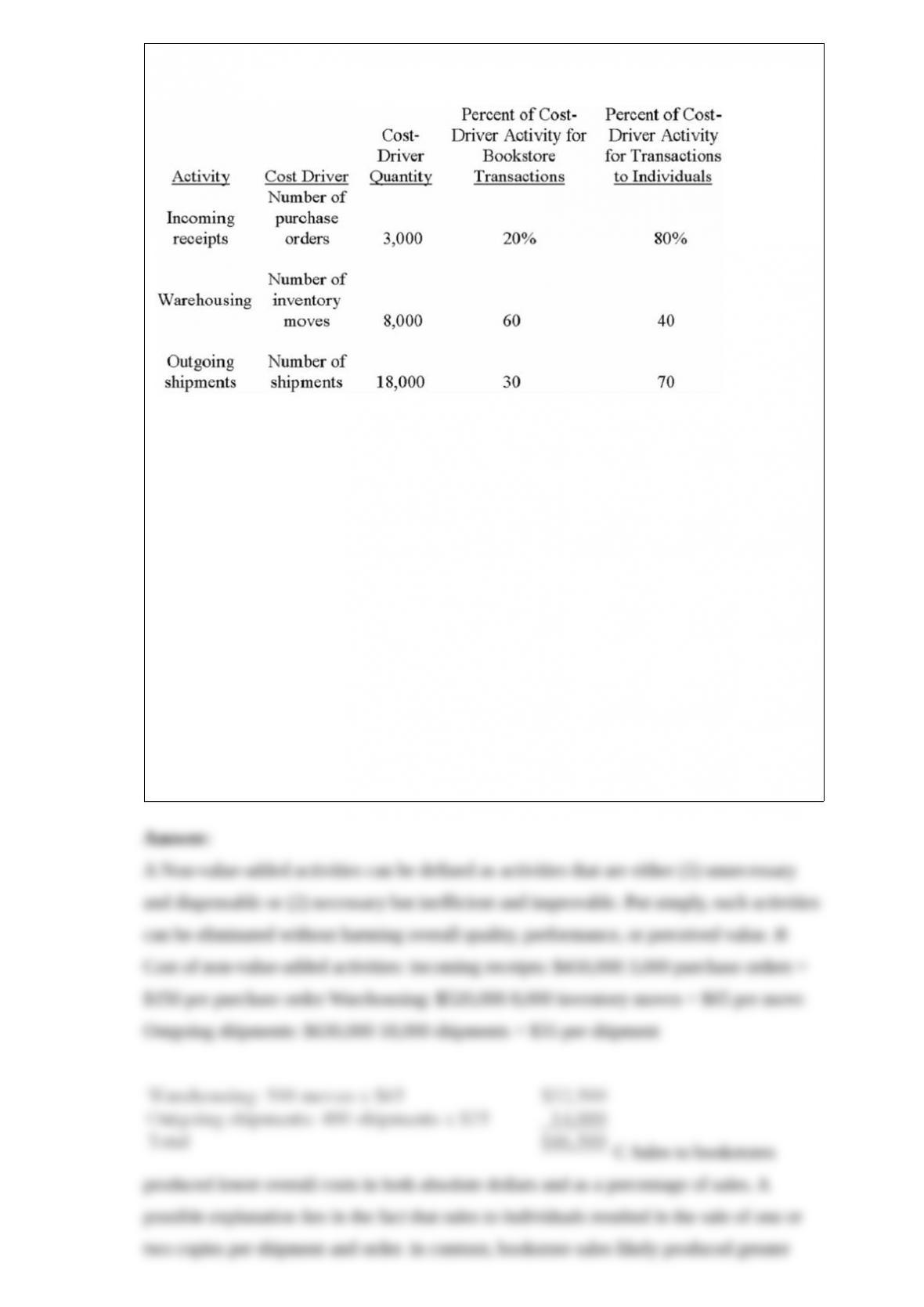
Bookstore sales totaled $8,400,000, and sales to individuals amounted to $2,400,000.
Costs for the three activities were: Incoming receipts, $450,000; warehousing,
$520,000; and outgoing shipments, $630,000. A review of the company’s activities
found various inefficiencies with respect to the warehousing of textbooks (acquired for
eventual sale to bookstores) and outgoing shipments to individuals. These inefficiencies
resulted in an extra 500 moves and 400 shipments, respectively.
Required:
A. What is a non-value-added activity?
B. How much did non-value-added activities cost Switzer this past year?
C. Which of the two marketssales to bookstores or sales to individualsresulted in lower
overall costs for incoming receipts, warehousing, and outgoing shipments? Evaluate
these costs in both absolute dollars and as a percentage of sales. In addition, present a
possible explanation for your results. Note: Exclude costs that arose from inefficient
operations.
14) When comparing EOQ and JIT inventory systems, which of the following
statements is false?
A.The EOQ approach takes the viewpoint that some inventory is necessary
B.The EOQ system assumes a constant order quantity
C.JIT argues that inventory investments should be minimized
D.The EOQ system focuses on acquisition and holding costs
E.JIT argues that safety stocks are necessary to reduce the probability of a stock
shortage
15) Belcher Company, which desires to enter the market with a new product, will
perform the following tasks:
1Design and engineer the product.
2Determine the product’s cost.
3Determine the desired profit margin.
4Determine the suggested selling price.
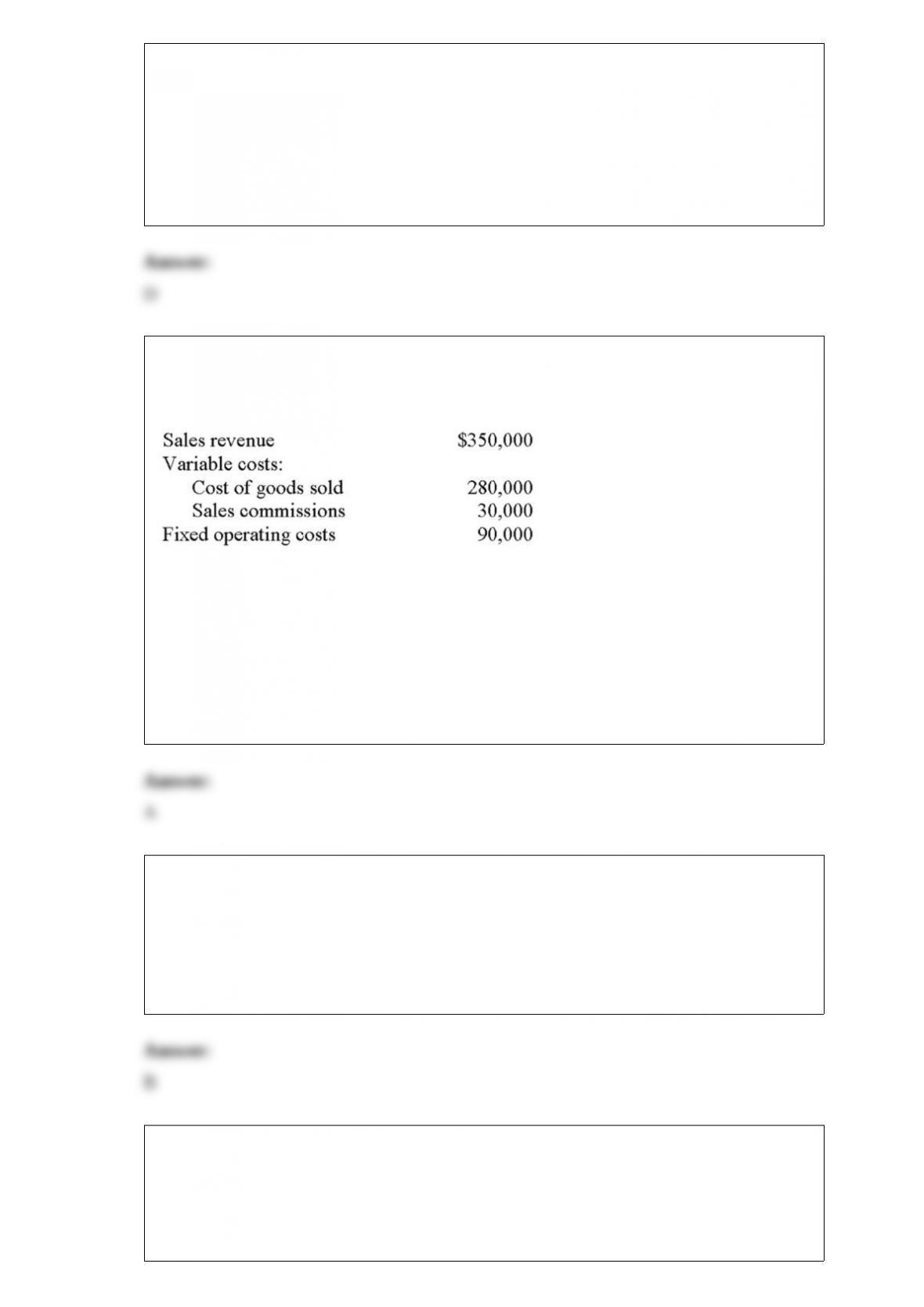
If Belcher uses target costing, which task would the company perform first?
A.1
B.2
C.3
D.4
E.None of the other answers are correct
16) The Shoe Department at the El Paso Department Store is being considered for
closure. The following information relates to shoe activity:
If 70% of the fixed operating costs are avoidable, should the Shoe Department be
closed?
A.Yes, El Paso would be better off by $23,000
B.Yes, El Paso would be better off by $50,000
C.No, El Paso would be worse off by $13,000
D.No, El Paso would be worse off by $40,000
E.None of the answers are correct
17) The Sarbanes-Oxley Act established the:
A.Securities and Exchange Commission (SEC)
B.Public Company Accounting Oversight Board (PCAOB)
C.Financial Accounting Standards Board (FASB)
D.Institute of Management Accountants (IMA)
E.American Accounting Association (AAA)
18) The procedure used to compute the future value of a series of cash flows is known
as:
A.compounding
B.the annuity method
C.discounting
D.the future-cost approach
E.indexing
19) Draco, Inc. has the following overhead standards:
Variable overhead: 4 hours at $8 per hour
Fixed overhead: 4 hours at $10 per hour
The standards were based on a planned activity of 20,000 machine hours when 5,000
units were scheduled for production. Actual data follow.
Variable overhead incurred: $167,750
Fixed overhead incurred: $210,000
Machine hours worked: 19,800
Actual units produced: 5,100
Draco’s variable-overhead spending variance is:
A.$550 favorable
B.$4,550 unfavorable
C.$4,800 favorable
D.$9,350 unfavorable
E.None of the other answers are correct
20) The decision process that has managers select from among several acceptable
investment proposals to make the best use of limited funds is known as:
A.capital rationing
B.capital budgeting
C.acceptance or rejection analysis (ARA)
D.cost analysis
E.project planning
21) Borders Overnight operates an overnight package delivery service that competes
with Federal Express and United Parcel Service (UPS). Top management is considering
the use of a balanced scorecard to evaluate operations.
A. What is a balanced scorecard and other than customer-satisfaction measures, what
are its typical key components?
B. List four customer-satisfaction measures that Borders might use to evaluate
performance.
22) In order for a company to achieve a sustainable competitive advantage, it must:
A.perform one or more activities in the value chain at the same quality level as its
competitors
B.perform all activities in the value chain at the same quality level as its competitors
C.perform its value chain activities at a higher quality level than one of its competitors
D.two of the answers are correct
23) The process of managing the various activities in the value chain, along with the
associated costs, is commonly known as:
A.activity-based costing
B.strategic cost management
C.total quality management
D.computer-integrated costing
E.sound management practices (SMP)
24) When allocating service department costs, companies should use:
A.actual costs rather than budgeted costs, and separate rates for variable and fixed costs
B.budgeted costs rather than actual costs, and separate rates for variable and fixed costs
C.budgeted costs rather than actual costs, and a rate that combines variable and fixed
costs
D.actual costs rather than budgeted costs, and a rate that combines variable and fixed
costs
E.a rate that is based on matrix theory
25) Which of the following managerial functions involves a detailed financial and
operational description of anticipated operations?
A.Decision making
B.Planning
C.Directing operational activities
D.Controlling
E.Measuring
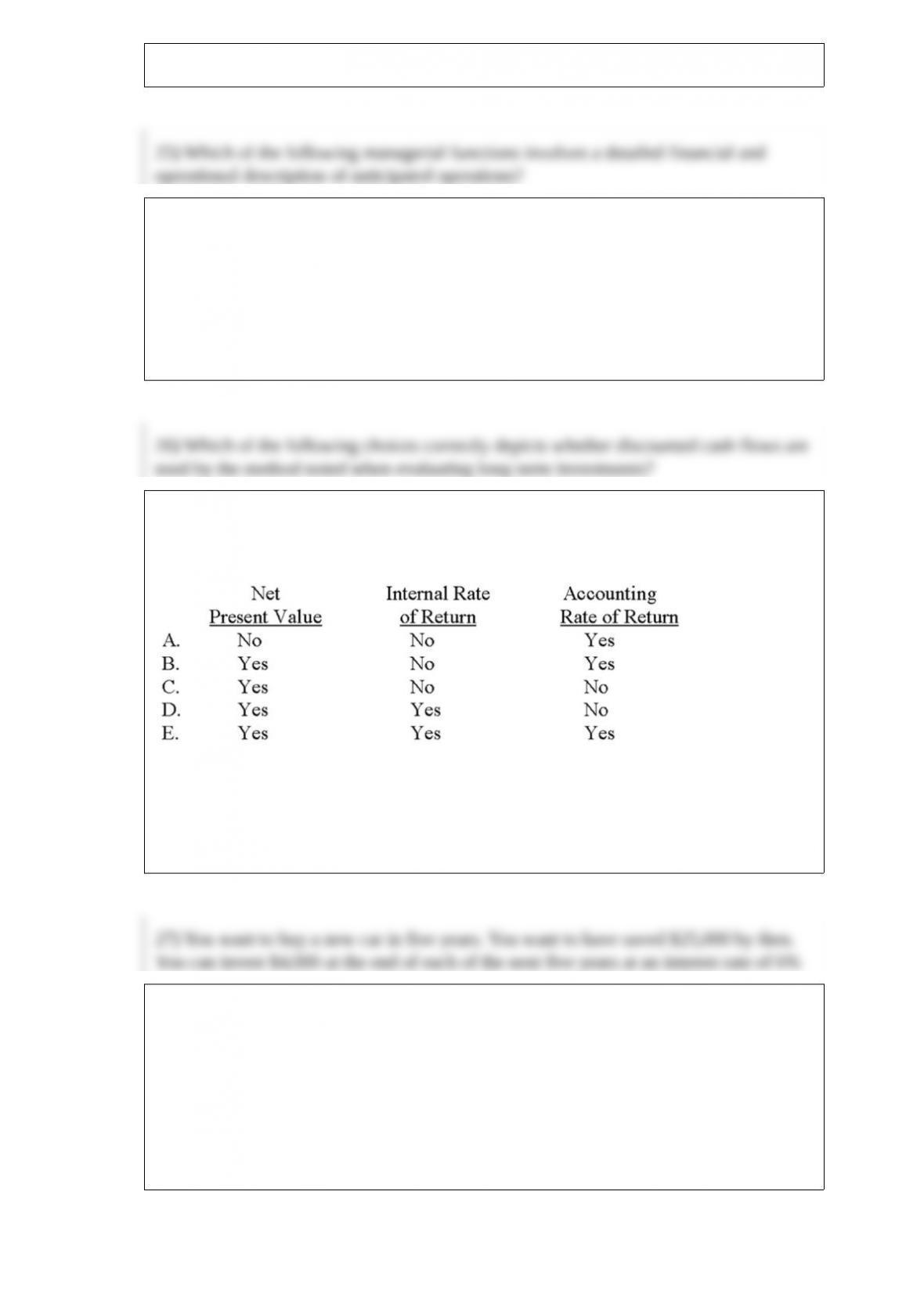
26) Which of the following choices correctly depicts whether discounted cash flows are
used by the method noted when evaluating long-term investments?
A.Choice A
B.Choice B
C.Choice C
D.Choice D
E.Choice E
27) You want to buy a new car in five years. You want to have saved $25,000 by then.
You can invest $4,000 at the end of each of the next five years at an interest rate of 6%
compounded annually. Will you have enough money at the end of the fifth year?
A.No. You are short $2,452
B.Yes. You have $1,532 more than you need
C.No. You are short $1,532
D.Yes. You have $2,452 more than you need
E.None of the other answers are correct
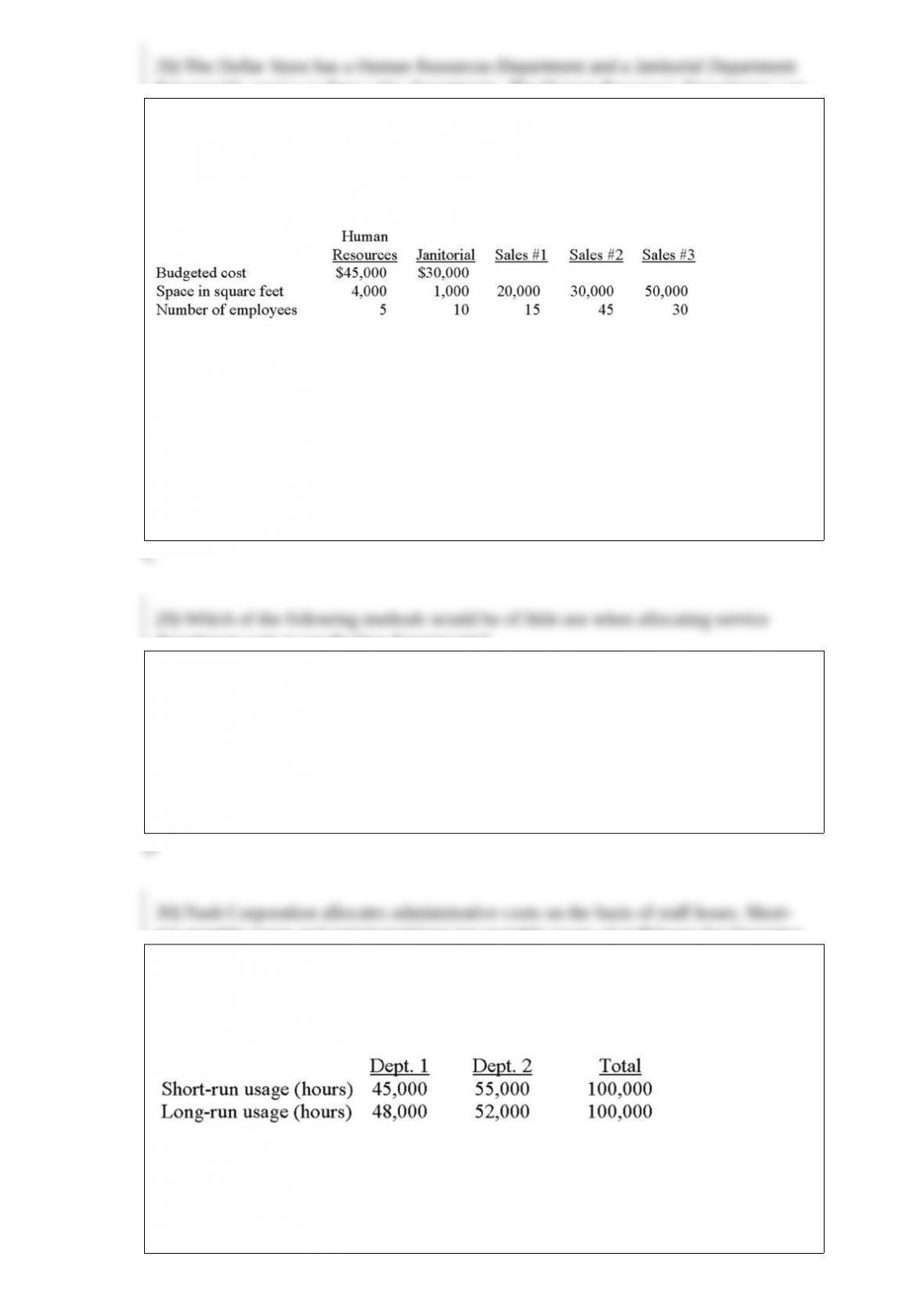
28) The Dollar Store has a Human Resources Department and a Janitorial Department
that provide service to three sales departments. The Human Resources Department cost
is allocated on the basis of employees, and the Janitorial Department cost is allocated
on the basis of space. The following information is available:
Using the step-down method and assuming that the Human Resources Department is
allocated first, the amount of Human Resources cost allocated to Sales Department no.
3 is:
A.$12,000
B.$12,857
C.$13,500
D.$15,000
E.$22,500
29) Which of the following methods would be of little use when allocating service
department costs to production departments?
A.The direct method
B.The reciprocal method
C.The step-down method
D.The net-realizable-value method
E.The dual-cost allocation method
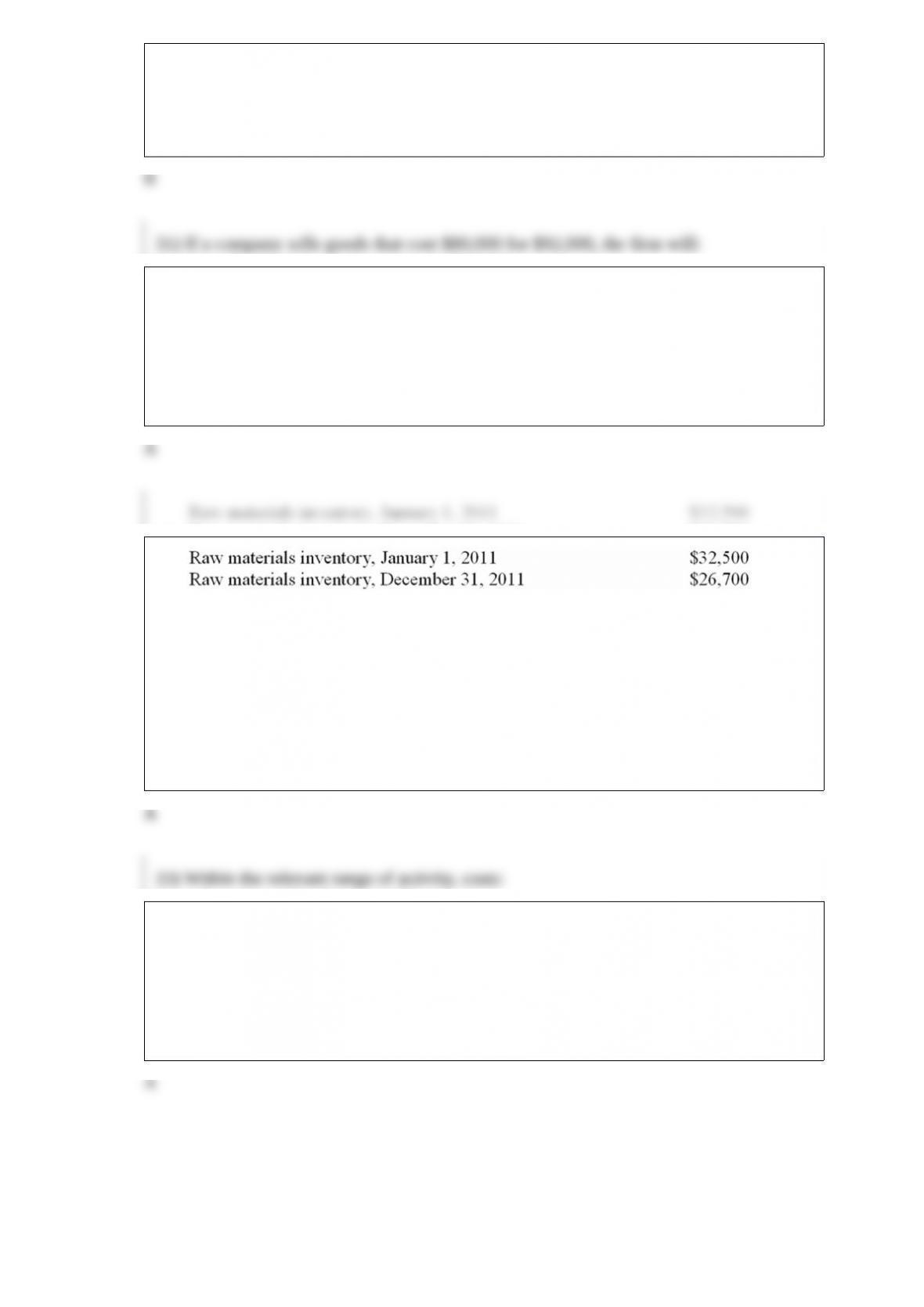
30) Nash Corporation allocates administrative costs on the basis of staff hours.
Short-run monthly usage and anticipated long-run monthly usage of staff hours for
Operating Departments 1 and 2 follow.
Variable and fixed administrative costs total $180,000 and $400,000, respectively. If
Nash uses dual-cost accounting procedures, the total amount of administrative cost to
allocate to Department 2 would be:
A.$301,600
B.$307,000
C.$313,600
D.$319,000
E.None of the other answers are correct
31) If a company sells goods that cost $80,000 for $92,000, the firm will:
A.reduce Finished-Goods Inventory by $80,000
B.reduce Finished-Goods Inventory by $92,000
C.report sales revenue on the balance sheet of $92,000
D.reduce Cost of Goods Sold by $80,000
E.follow more than one of the other procedures
32)
If raw materials used during the year were $135,000 what was the amount of raw
materials purchased during the year?
A.$129,200
B.$140,800
C.$135,000
D.$146,600
E.None of the other answers are correct
33) Within the relevant range of activity, costs:
A.can be estimated with reasonable accuracy
B.can be expected to change radically
C.exhibit decreasing marginal cost patterns
D.exhibit increasing marginal cost patterns
E.cannot be estimated satisfactorily