
You are analyzing a project and have developed the following estimates: unit sales =
1,320, price per unit = $79, variable cost per unit = $43, fixed costs = $24,900. The
depreciation is $11,300 a year and the tax rate is 40 percent. What effect would an
increase of $1 in the selling price have on the operating cash flow?
A. $792
B. $1,249
C. $1,320
D. $1,406
E. $1,433
Answer:
Which of the following statements correctly relate to M&M Proposition I, with taxes?
I. Debt decreases the value of a firm.
II. The levered value of a firm exceeds the firm’s unlevered value.
III. The weighted average cost of capital (WACC) is constant.
IV. The optimal capital structure is zero debt.
A. I only
B. II only
C. II and III only
D. I and IV only
E. I, III, and IV only
Answer:
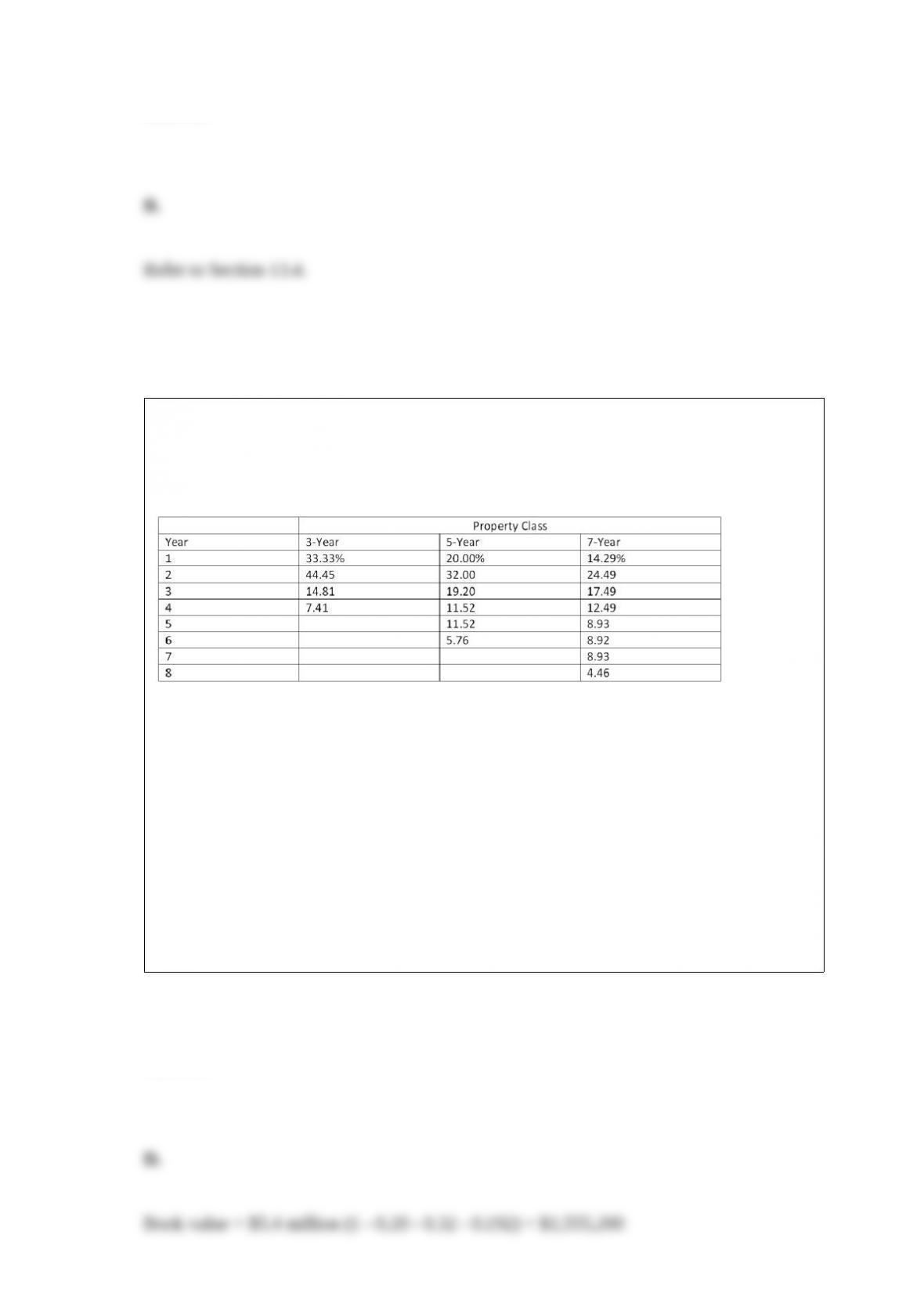
An asset used in a three-year project falls in the five-year MACRS class for tax
purposes. The asset has an acquisition cost of $5.4 million and will be sold for $1.2
million at the end of the project. If the tax rate is 35 percent, what is the aftertax salvage
value of the asset?
Table 9.7 Modified ACRS depreciation allowances
A. $1,075,680
B. $780,000
C. $904,320
D. $1,324,320
E. $1,187,560
Answer:

A stock has a market price of $46.10 and pays a $2.40 annual dividend. What is the
dividend yield?
A. 4.13 percent
B. 4.84 percent
C. 5.21 percent
D. 5.52 percent
E. 5.78 percent
Answer:
Downtown Merchants has paid a quarterly dividend of $0.60 per share for the past two
years. This quarter, the firm plans to pay $0.60 plus an additional $0.05. The firm has
stated that it uncertain whether it will pay $0.60 or $0.65 per share next quarter. Which
one of the following is the best description of the additional $0.05 that is being paid this
quarter?
A. Liquidating dividend
B. Special dividend
C. Extra dividend
D. Stock dividend
E. Normal dividend

Answer:
The spot rate between Japan and the U.S. is 100.37 = $1, while the one-year forward
rate is 99.97 = $1. A one-year risk-free security in the U.S. is yielding 3.8 percent. What
is the rate of return on a one-year risk-free security in Japan assuming that interest rate
parity exists?
A. 3.32 percent
B. 3.39 percent
C. 3.44 percent
D. 3.49 percent
E. 3.56 percent
Answer:
If a project with conventional cash flows has a profitability index of 1.0, the project
will:
A. never pay back.

B. have a negative net present value.
C. have a negative internal rate of return.
D. produce more cash inflows than outflows in today’s dollars.
E. have an internal rate of return that equals the required return.
Answer:
Which one of the following methods of analysis is most similar to computing the return
on assets (ROA)?
A. Internal rate of return
B. Profitability index
C. Average accounting return
D. Net present value
E. Payback
Answer:

Which one of the following individuals is most apt to purchase a municipal bond?
A. Minimum-wage employee
B. Retired individual with minimal current income
C. Recent college graduate
D. Tax-exempt organization
E. Highly compensated business owner
Answer:
Which one of the following forms of business organization offers liability protection to
some of its owners but not to all of its owners?
A. Sole proprietorship
B. General partnership
C. Limited partnership
D. Limited liability company
E. Corporation
Answer:

Of the following, which two are the best reasons for doing a reverse stock split?
I. Return a stock to its normal trading range
II. Eliminate small shareholders
III. Reduce shareholder costs
IV. Avoid delisting
A. I and II
B. I and III
C. II and III
D. II and IV
E. III and IV
Answer:
West Coast Builders is offering preferred stock for sale with a 6.75 percent rate of
return. What is the amount of the annual dividend on this stock if the current market
price per share is $83.87?
A. $5.66
B. $6.09
C. $6.53

D. $7.50
E. $7.75
Answer:
Which one of the following is a system for managing demand-dependent inventories
that minimizes the amount of inventory on hand?
A. Inventory flow log
B. Materials requirements planning
C. Just-in-time inventory system
D. Kanban
E. Keiretsu
Answer:
Bruno’s is considering a change from its current capital structure. Bruno’s currently has
an all-equity capital structure and is considering a capital structure with 30 percent debt.

There are currently 6,500 shares outstanding at a price per share of $46. EBIT is
expected to remain constant at $43,000. The interest rate on new debt is 8.5 percent and
there are no taxes. Tracie owns $20,700 worth of stock in the company. The firm has a
100 percent payout. What would Tracie’s cash flow be under the new capital structure
assuming that she keeps all of her shares?
A. $1,998
B. $2,227
C. $2,815
D. $3,027
E. $3,499
Answer:
Which of the following are factors that help explain why the percentage of U.S.
industrial firms paying dividends has increased since the early 2000s?
I. Decrease in the number of non-dividend-paying firms
II. Maturing of young, successful firms
III. Signaling of a firm’s financial health
IV. May 2003 tax act

A. I and III only
B. II and IV only
C. I, II, and III only
D. II, III, and IV only
E. I, II, III, and IV
Answer:
Which one of the following reduces the number of shares outstanding but does not
change a firm’s total equity?
A. Stock split
B. Distribution
C. Reverse split
D. Liquidation
E. Redemption
Answer:

Valley Forge and Metal purchased a truck five years ago for local deliveries. Which one
of the following costs related to this truck is the best example of a sunk cost? Assume
the truck has a usable life of eight years.
A. New tires that will be purchased this winter
B. Costs of repairs needed so the truck can pass inspection next month
C. Money spent last month repairing a damaged front fender
D. Engine tune-up that is scheduled for this afternoon
E. Cost for a truck driver for the remainder of the truck’s useful life
Answer:
Beverly’s is a retail chain selling the latest fashions through its outlets located in various
neighborhood malls. Clothing Galore is a wholesaler that buys from textile mills and
sells to retail outlets. Beverly’s has a cost of capital of 13.6 percent, while Clothing
Galore’s cost of capital is 17.8 percent. Both firms are considering opening a retail
outlet in a gigantic new mall. Both proposals are quite similar in design and have
basically the following financial features: an initial cash outlay of $2.7 million, a
projected five-year life with no salvage value, and cash inflows of $845,000 a year for
the life of the project. Which firm or firms, if either, should open a retail outlet in the
new mall?
A. Beverly’s only
B. Clothing Galore only
C. Both Beverly’s and Clothing Galore
D. Neither Beverly’s nor Clothing Galore
E. The answer cannot be determined based on the information provided.

Answer:
Innovative Technologies has 50,000 shares of stock outstanding at a market price of $8
a share. Which one of the following stock splits should the firm declare if it wants to
increase the stock price to exactly $20 a share? Ignore any taxes or market
imperfections.
A. 5-for-2 stock split
B. 3-for-1 stock split
C. 1-for-3-reverse stock split
D. 2-for-5 reverse stock split
E. 3-for-10 reverse stock split
Answer:

Which one of the following is defined as the average compound return earned per year
over a multiyear period?
A. Geometric average return
B. Variance of returns
C. Standard deviation of returns
D. Arithmetic average return
E. Normal distribution of returns
Answer:
Which one of the following represents the rate of return a firm must earn on its assets if
it is to maintain the current value of its securities?
A. Cost of equity
B. Internal rate of return
C. Aftertax cost of debt
D. Weighted average cost of capital
E. Debt-equity ratio
Answer:

Which one of these statements is correct?
A. Since the early 1980s, it has become increasingly more difficult to do a stock
repurchase due to SEC regulations.
B. It is relatively easy to determine whether or not a firm has completed a planned stock
repurchase.
C. Fixed stock repurchases allow managers to repurchase shares only when they feel
those shares are undervalued.
D. A fixed stock repurchase plan could be a negative net present value investment for
the stock issuer.
E. Stock repurchases send the exact same signals to investors as do cash dividends.
Answer: