
1) A subsidiary will normally have a more difficult time forecasting future outflow
payments if its purchases are international rather than domestic.
a. True
b. False
2) To force the value of the British pound to depreciate against the dollar, the Federal
Reserve should:
a. sell dollars for pounds in the foreign exchange market and the Bank of England
should sell dollars for pounds in the foreign exchange market
b. sell pounds for dollars in the foreign exchange market and the Bank of England
should sell dollars for pounds in the foreign exchange market
c. sell pounds for dollars in the foreign exchange market and the Bank of England
should sell pounds for dollars in the foreign exchange market
d. sell dollars for pounds in the foreign exchange market and the Bank of England
should sell pounds for dollars in the foreign exchange market
3) When a firm analyzes the feasibility of a project, it should consider the:
a. variability of the project’s cash flow
b. correlation of the project’s cash flow relative to the prevailing cash flows of the MNC
c. A and B
d. none of the above
4) Which of the following is the least effective way of hedging exposure in the long
run?
a. long-term forward contract
b. currency swap
c. parallel loan
d. money market hedge
5) Assume that the U.S. one-year interest rate is 5% and the one-year interest rate on

euros is 8%. You have $100,000 to invest and you believe that the international Fisher
effect (IFE) holds. The euro’s spot exchange rate is $1.40. What will be the yield on
your investment if you invest in euros?
a. 8%
b. 5%
c. 3%
d. 2.78%
6) When a U.S. firm borrows a foreign currency and has no offsetting position in this
currency, it will incur an effective financing rate that is always above the ____ if the
currency ____.
a. foreign currency’s interest rate; appreciates
b. foreign currency’s interest rate; depreciates
c. domestic interest rate; depreciates
d. domestic interest rate; appreciates
7) If the Fed decides to weaken the dollar utilizing unsterilized intervention, it should
be aware that this action may backfire because it will increase money supply and thus
increase inflation.
a. True
b. False
8) In capital budgeting analysis, the use of a cumulative NPV is useful for:
a. determining a probability distribution of NPVs
b. determining the time required to achieve a positive NPV
c. determining how the required rate of return changes over time
d. determining how the cost of capital changes over time
e. A and B
9) Assume the following information:
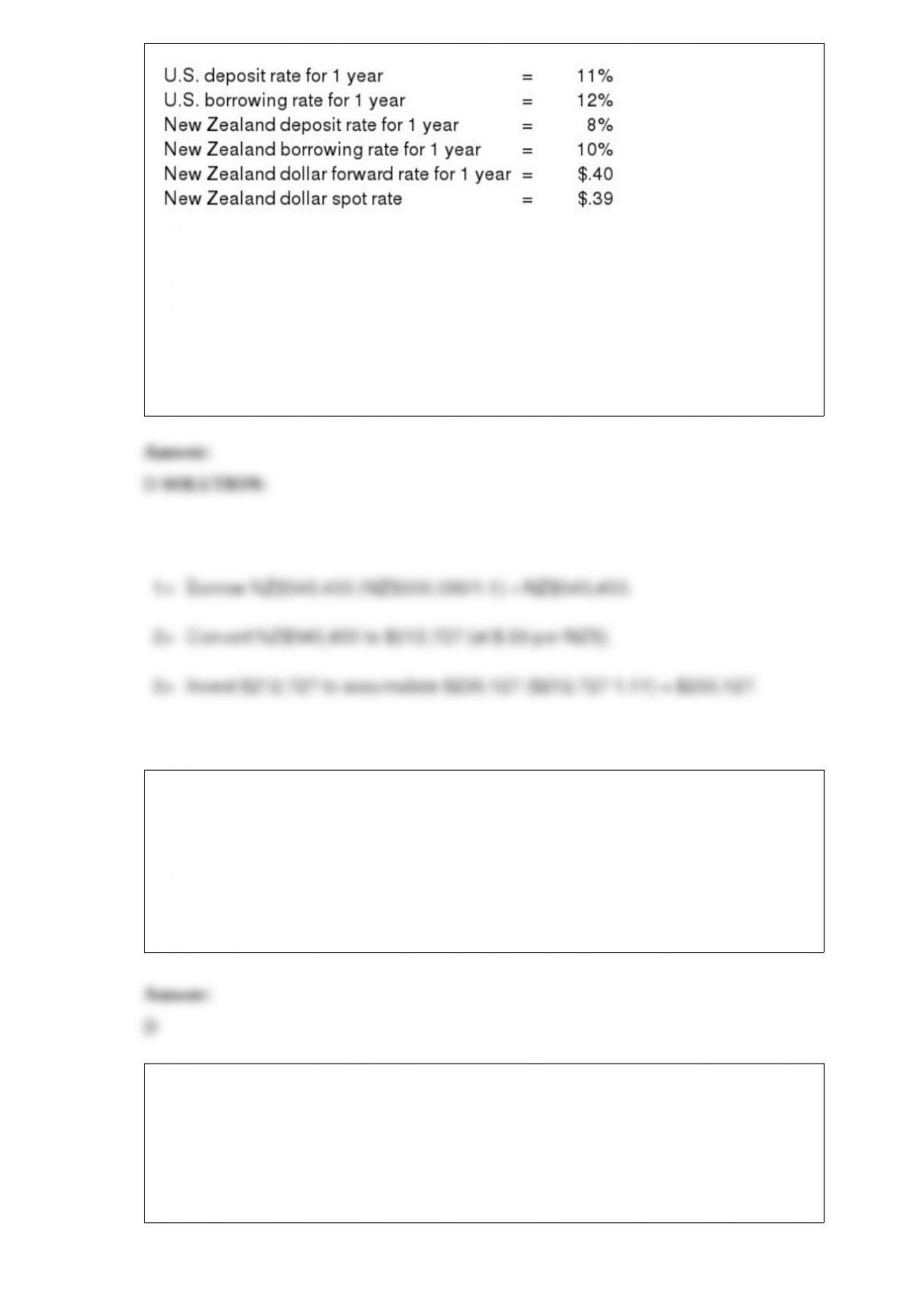
Also assume that a U.S. exporter denominates its New Zealand exports in NZ$ and
expects to receive NZ$600,000 in 1 year. You are a consultant for this firm.
Using the information above, what will be the approximate value of these exports in 1
year in U.S. dollars given that the firm executes a money market hedge?
a. $238,584
b. $240,000
c. $234,000
d. $236,127
10) When a U.S.-based MNC has a subsidiary in Mexico that needs financing, the
MNC’s exposure to exchange rate risk can be minimized if:
a. the parent issues dollar-denominated equity and provides the proceeds to the
subsidiary
b. the parent provides its retained earnings to the Mexican subsidiary
c. the subsidiary obtains a dollar-denominated loan from a financial institution
d. the subsidiary obtains a peso-denominated loan from a financial institution
11) Assume a subsidiary is forced to borrow in excess of the MNC’s optimal capital
structure. Also assume that the parent company reduces its debt financing by an
offsetting amount. Under this scenario, the cost of capital for the MNC overall could
not have changed.
a. True
b. False

12) Assume that the forward rate is used to forecast the spot rate. The forward rate of
the Canadian dollar contains a 6% discount. Today’s spot rate of the Canadian dollar is
$.80. The spot rate forecasted for one year ahead is:
a. $.860
b. $.848
c. $.740
d. $.752
e. none of the above
13) If speculators expect the spot rate of the yen in 60 days to be ____ than the 60-day
forward rate on the yen, they will ____ the yen forward and put ____ pressure on the
yen’s forward rate.
a. higher; buy; upward
b. higher; sell; downward
c. higher; sell; upward
d. lower; buy; upward
14) If a U.S.-based MNC focused completely on importing, then its valuation would
likely be adversely affected if most currencies were expected to appreciate against the
dollar over time.
a. True
b. False
15) If interest rate parity exists and transactions costs are zero, foreign financing with a
simultaneous forward purchase of the currency borrowed will result in an effective
financing rate that is:
a. less than the domestic interest rate
b. greater than the domestic interest rate
c. equal to the domestic interest rate

d. greater than the domestic interest rate if the forward rate exhibits a premium and less
than the domestic interest rate if the forward rate exhibits a discount
16) Hedgers should buy calls if they are hedging an expected outflow of foreign
currency.
a. True
b. False
17) If the French government wants to decrease inflation in France, it will exchange
foreign currency for euros.
a. True
b. False
18) A U.S. MNC has the equivalent of $1 million cash outflows in each of two highly
negatively correlated currencies. During ____ dollar cycles, cash outflows are ____.
a. weak; somewhat stable
b. weak; favorably affected
c. weak; adversely affected
d. none of the above
19) Blake Inc. needs 1,000,000 in 30 days. It can earn 5 percent annualized on a
German security. The current spot rate for the euro is $1.00. Blake can borrow funds in
the U.S. at an annualized interest rate of 6 percent. If Blake uses a money market hedge
to hedge the payable, what is the cost of implementing the hedge?
a. $1,000,000
b. $1,055,602
c. $1,000,830
d. $1,045,644

20) Assume that the New Zealand inflation rate is higher than the U.S. inflation rate.
This will cause U.S. consumers to ____ their imports from New Zealand and New
Zealand consumers to ____ their imports from the U.S. According to purchasing power
parity (PPP), this will result in a(n) ____ of the New Zealand dollar (NZ$).
a. reduce; increase; appreciation
b. increase; reduce; depreciation
c. reduce; increase; depreciation
d. reduce; increase; appreciation
21) “Dumping” is used in the text to represent the:
a. exporting of goods that do not meet quality standards
b. sales of junk bonds to foreign countries
c. removal of foreign subsidiaries by the host government
d. exporting of goods at prices below cost
22) Assume that the risk-free interest rate in the U.S. is the same as that in Country M.
Assume that the government of Country M is more likely to rescue local firms that
experience financial problems. Other things being equal, Country M’s firms are likely to
use a ____ degree of financial leverage than U.S. firms. If a firm based in Country M
had the same degree of financial leverage and the same operating characteristics as a
U.S. firm, its cost of capital would be ____ than that of the U.S. firm.
a. higher; higher
b. higher; lower
c. lower; lower
d. lower; higher

23) Which of the following is not mentioned in the text as a theory of international
business?
a. Theory of Comparative Advantage
b. Imperfect Markets Theory
c. Product Cycle Theory
d. Globalization of Business Theory
e. All of the above are mentioned in the text as theories of international business
24) In general, any key managerial decision that is based on forecasted exchange rates
should rely completely on one forecast rather than alternative exchange rate scenarios.
a. True
b. False
25) Since the forward rate does not capture the nominal interest rate between two
countries, it should provide a less accurate forecast for currencies in high-inflation
countries than the spot rate.
a. True
b. False
26) An advantage of freely floating exchange rates is that a country with floating
exchange rates is more insulated from unemployment problems in other countries.
a. True
b. False
27) When the war in Iraq began in 2003, some MNCs feared that oil prices would ____
and that U.S. inflation and interest rates would ____.
a. rise; rise
b. fall; fall
c. rise; fall
d. fall; rise

28) Because there are sometimes no substitutes for traded goods, this will:
a. reduce the probability that PPP shall hold
b. increase the probability that PPP shall hold
c. increase the probability the IFE will hold
d. B and C
29) Some governments restrict foreign ownership of local firms. Such restrictions may
limit or prevent international acquisitions.
a. True
b. False
30) ____ is not a factor that causes currency supply and demand schedules to change.
a. Relative inflation rates
b. Relative interest rates
c. Relative income levels
d. Expectations
e. All of the above are factors that cause currency supply and demand schedules to
change.
31) A firm produces goods for which substitute goods are produced in all countries.
Appreciation of the firm’s local currency should:
a. increase local sales as it reduces foreign competition in local markets
b. increase the firm’s exports denominated in the local currency
c. increase the returns earned on the firm’s foreign bank deposits
d. increase the firm’s cash outflow required to pay for imported supplies denominated in
a foreign currency
e. none of the above
32) There is an active secondary market for banker’s acceptances.
a. True
b. False
33) To hedge translation exposure, MNCs could ____ that their foreign subsidiaries
receive as earnings to create a cash outflow in the currency to offset the earnings
received in that currency.
a. purchase the currency forward
b. sell the currency forward
c. purchase futures contracts of the currency
d. A or C
e. none of the above
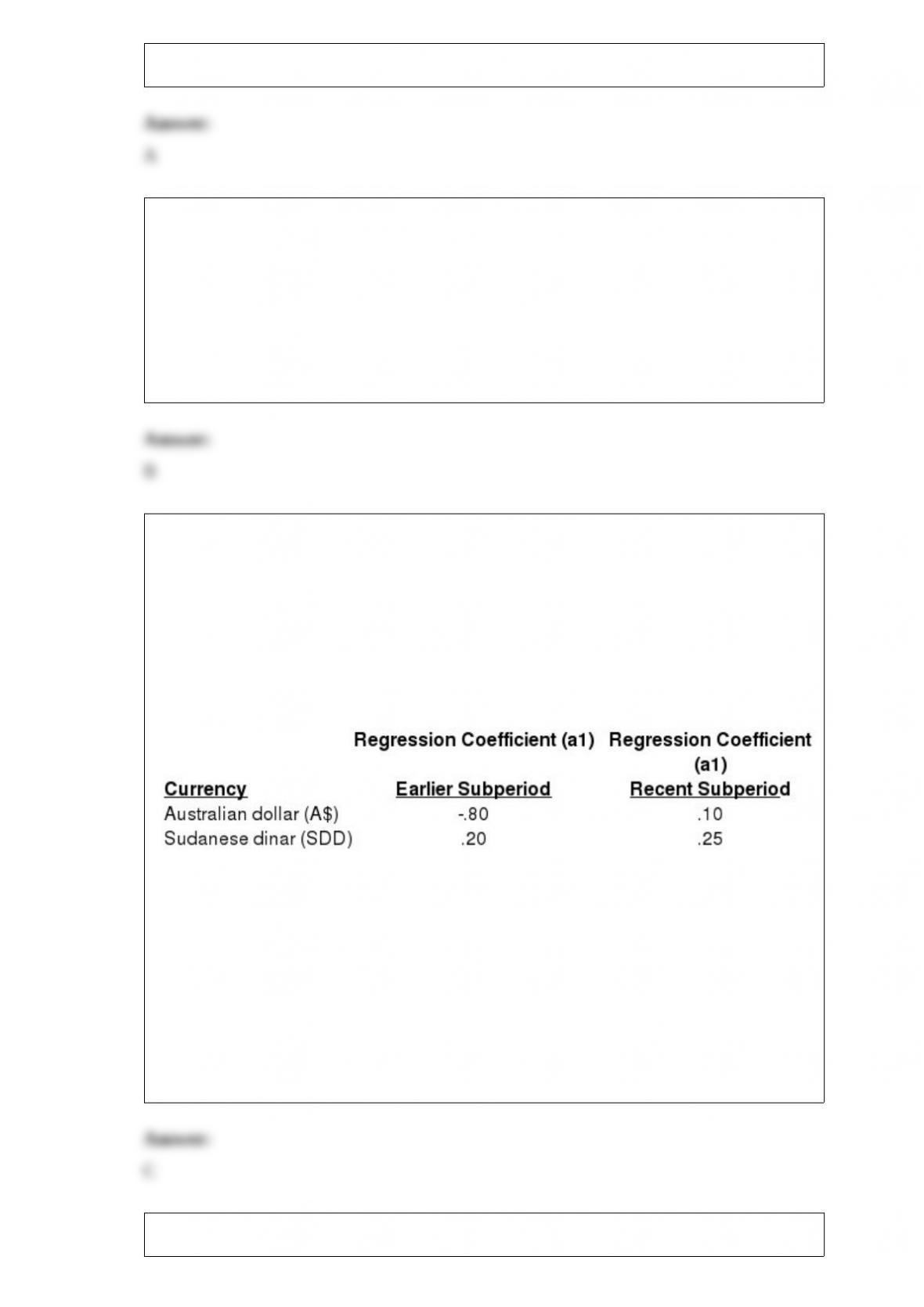
34) The following regression model was run by a U.S.-based MNC to determine its
degree of economic exposure as it relates to the Australian dollar and Sudanese dinar
(SDD):
PCFt = a0 + a1et + mt
where the term on the left-hand side is the percentage change in inflation-adjusted cash
flows measured in the firm’s home currency over period t, and et is the percentage
change in the exchange rate of the currency over period t. The regression was run over
two subperiods for each of the two currencies, with the following results:
Based on these results, which of the following statements is probably not true?
a. The MNC was more sensitive to movements in the Australian dollar than in the dinar
in the earlier subperiod
b. The MNC was more sensitive to movements in the dinar than in the Australian dollar
in the more recent subperiod
c. The MNC probably had more outflows than inflows in Australian dollars in the
earlier subperiod
d. The MNC probably had more inflows than outflows denominated in dinar in the
more recent subperiod
e. All of the above are true
35) An MNC may deviate from its target capital structure in each country where

financing is obtained, yet still achieve its target capital structure on a consolidated basis.
a. True
b. False
36) The yields offered on newly issued bonds tend to be:
a. lower in less developed countries where labor costs are low
b. relatively high in countries such as Japan and the U.S. because the credit risk
premium is much higher there than in other countries
c. the same across countries at a give point in time
d. none of the above
37) In order to stimulate a stagnant economy, a government operating under a managed
float may attempt to weaken its currency.
a. True
b. False
38) As a(n) ____ to an interest rate swap, a financial institution simply arranges a swap
between two parties.
a. ultraparty
b. broker
c. counterparty
d. none of the above