1) As a general rule, the proportion of pay “at risk” falls off for executives on the higher
rungs of the corporate ladder.
2) The FASB endeavors to draft pronouncements that clearly identify the accounting
objective, explain the accounting principle(s) being applied, avoid bright-line rules, and
provide enough implementation guidance for consistent application.
3) For tax purposes, taxpayers would prefer not to capitalize interest payments.
4) The FASB’s agenda lists as “inactive” a project that would require firms to use the
direct method of reporting cash flows from operating activities.
5) U.S. GAAP permits companies to report components of other comprehensive income
(OCI) as part of the statement of changes in stockholders’ equity.
6) The accounting for an asset whose carrying value exceeds its expected future
economic benefits is guided by the concept of verifiability.
7) A significant increase in capital expenditures reported in the investing section of the
cash flow statement that coincides with a significant decrease in operating expenses as a
percentage of sales may be an indication that the firm is improperly capitalizing costs
that should be expensed.

8) Under RAP, loan charge-offs decrease bank capital and reduce bank net income.
9) Periodic pension expense computed under IFRS generally consists only of current
service cost, past service cost and net interest on the net defined benefit liability or
asset.
10) International financial reporting standards require firms to report short-term
receivables at fair value and to disclose their net realizable value in the notes to the
financial statements.
11) GAAP states that if it is impractical to determine the cumulative effect of applying a
change in accounting principle to prior periods€such as when a firm adopts the LIFO
inventory accounting method€the new accounting principle is to be applied as if the
change was made prospectively as of the earliest date practicable.
12) The FASB and the IASB issued a jointly developed leasing exposure draft which
will ultimately result in all leases being treated as capital leases.
13) Under IFRS if a company opts to present separately a net income statement and a
statement of comprehensive income, the net income statement must immediately follow
the statement of comprehensive income.

14) Harry’s Clothing Inc., used the following headings on the company’s December 31,
2014 balance sheet:
(A) Current assets
(B) Long-term investments
(C) Property and equipment
(D) Intangible assets
(E) Other assets
(F) Current liabilities
(G) Long-term debt
(H) Shareholders’ equity
For each of the following items, indicate its normal balance sheet classification
category. Use (NA) for items that would not appear on the face of the balance sheet, but
would be discussed in the notes to the financial statements.
_____ 1> Accounts receivable
_____ 2> Accrued interest on notes payable (2015 maturity)
_____ 3> Accumulated depreciation
_____ 4> Goodwill
_____ 5> Preferred stock
_____ 6> Common stock
_____ 7> Customer deposits on products to be shipped in a few months
_____ 8> Depreciation methods and estimated lives of equipment
_____ 9> Prepaid insurance
_____ 10> Assets (surplus production equipment) held for sale
15) The U.K. Equity account “Hedging reserve” is reported on a U.S. GAAP balance
sheet as
A.capital reserve.
B.revaluation reserve.
C.capital in excess of par.
D.an accumulated other comprehensive income account.
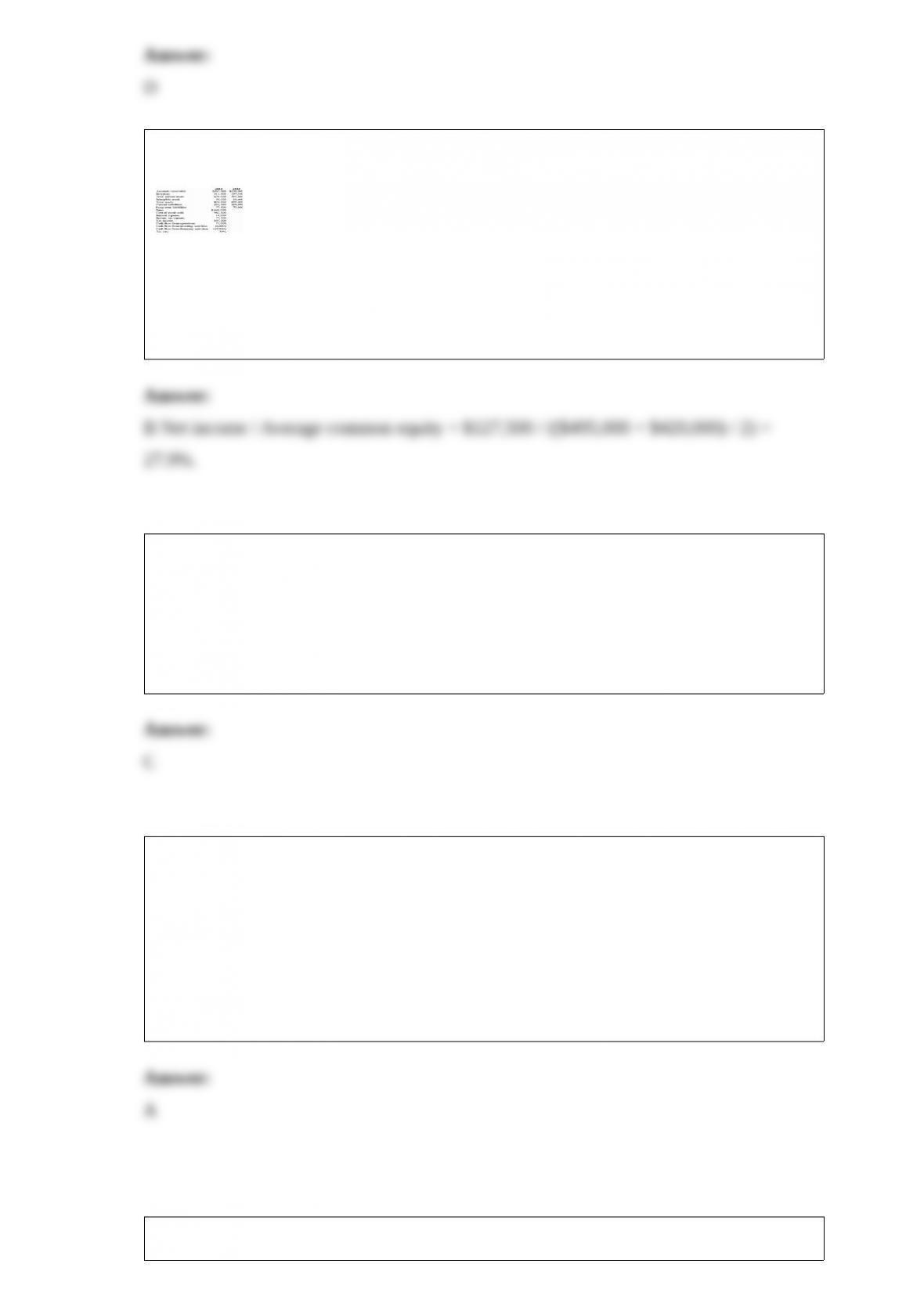
16) Condensed financial data are presented below for the Phoenix Corporation:
If there is no preferred stock, the return on common equity for 2014 is (rounded):
A.25.8%
B.27.9%
C.41.4%
D.43.4%
17) According to the 2012 AICPA survey of 2011 annual reports, the most widely-used
method of depreciation for financial reporting purposes is
A.declining-balance.
B.sum-of-the-years’ digits.
C.straight-line.
D.units-of-production.
18) When actuarial estimates related to defined benefit pension plans are adjusted
A.both U.S. GAAP and IFRS require companies to report these valuation changes in
OCI each period.
B.only U.S. GAAP requires companies to report these valuation changes in OCI each
period.
C.only IFRS requires companies to report these valuation changes in OCI each period.
D.neither U.S. GAAP nor IFRS requires companies to report these valuation changes in
the financial statements.
19) Manero Company included the following information in its annual report:

In a trend balance sheet, each balance sheet item is expressed as a percentage of
A.total assets.
B.the base year item.
C.sales.
D.equity.
20) The size of the divergence between FIFO cost of goods sold and replacement cost
of goods sold depends on
A.the severity of input cost changes.
B.the rapidity of physical inventory turnover.
C.both the severity of input cost changes and the rapidity of physical inventory
turnover.
D.a multitude of factors including the severity of input cost changes and the rapidity of
physical inventory turnover.
21) Condensed financial data are presented below for the Phoenix Corporation:
The days inventory held for 2014 is (rounded):
A.96 days.
B.106 days.
C.116 days.
D.138 days.
22) The earliest moment that the critical event and measurability are both satisfied for
revenue recognition is usually
A.before the sale.
B.after the sale.
C.at the time of sale.
D.when payment is received.

23) Based on a comprehensive survey of U.S. companies, the most common financial
performance measure used in annual and long-term incentive plans for senior
executives is
A.return on equity.
B.economic value added.
C.return on capital.
D.net income or revenues.