1) during the price-specie-flow adjustment process to a trade imbalance, if demands for
goods are inelastic, then, when the price level __________ in the country with the trade
deficit, the value of that countrys exports will __________ as the price-specie-flow
process takes place.
a. falls; increase
b. falls; decrease
c. rises; increase
d. rises; decrease
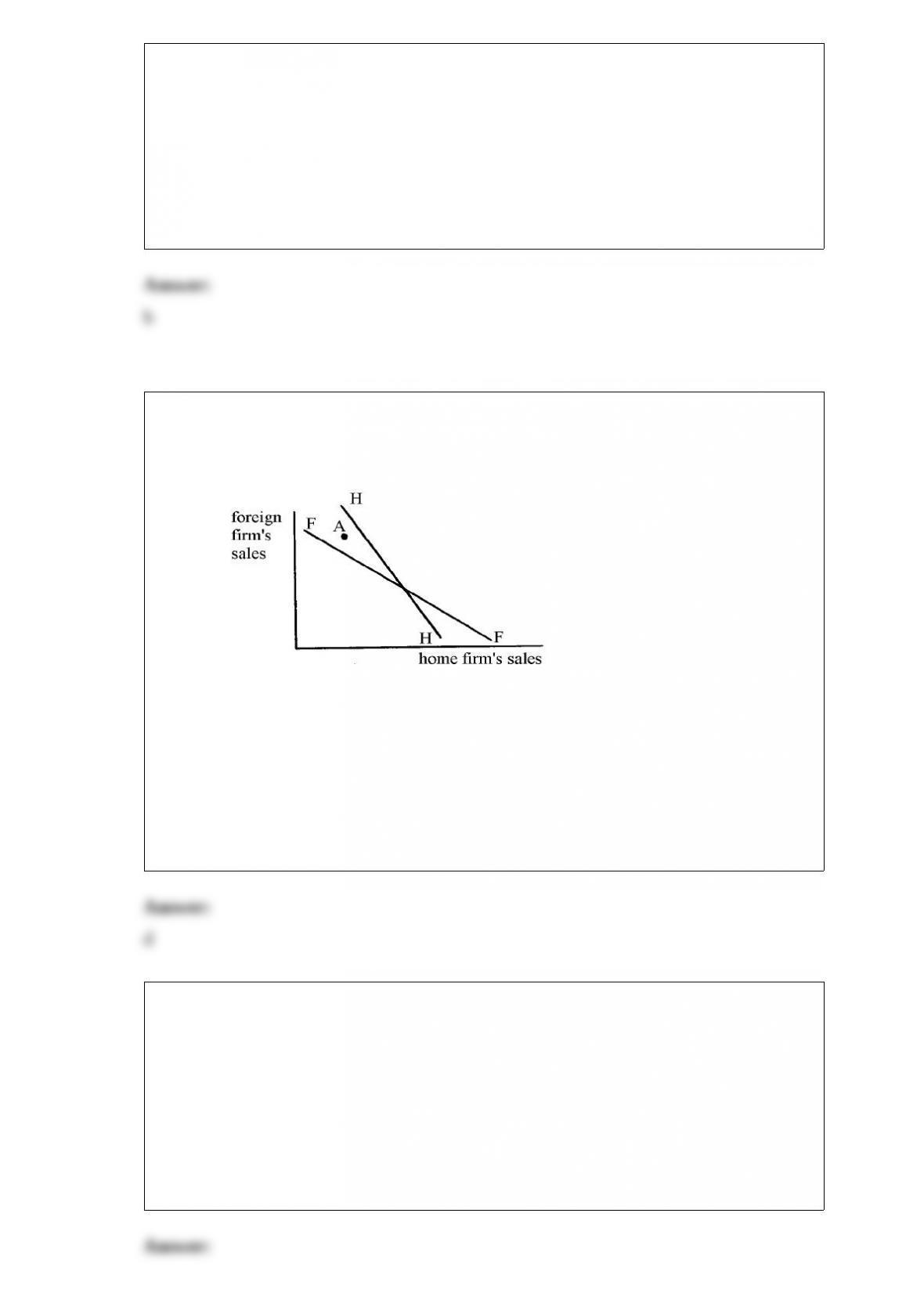
2) the following diagram shows a reaction function graph for two firms selling in an
export market, where hh is the home firms reaction function and ff is the foreign firms
reaction function.
in the reaction function diagram, if economies of scale exist for both firms, then
protection instituted in the home market to keep out the foreign firms product will,
other things equal, cause hh to shift to the __________.
a. left (or downward) and also will cause ff to shift to the left (or downward)
b. left (or downward) and will cause ff to shift to the right (or upward)
c. right (or upward) and also will cause ff to shift to the right (or upward)
d. right (or upward) and will cause ff to shift to the left (or downward)
3) if, when a country grows, its home production of its export good increases by 10
percent and its home consumption of its export good also increases by 10 percent, then,
with the economic growth and with other things equal, the countrys absolute quantity of
exports will __________.
a. increase
b. decrease
c. remain constant
d. increase, decrease, or remain constant cannot be determined without more
information
4)
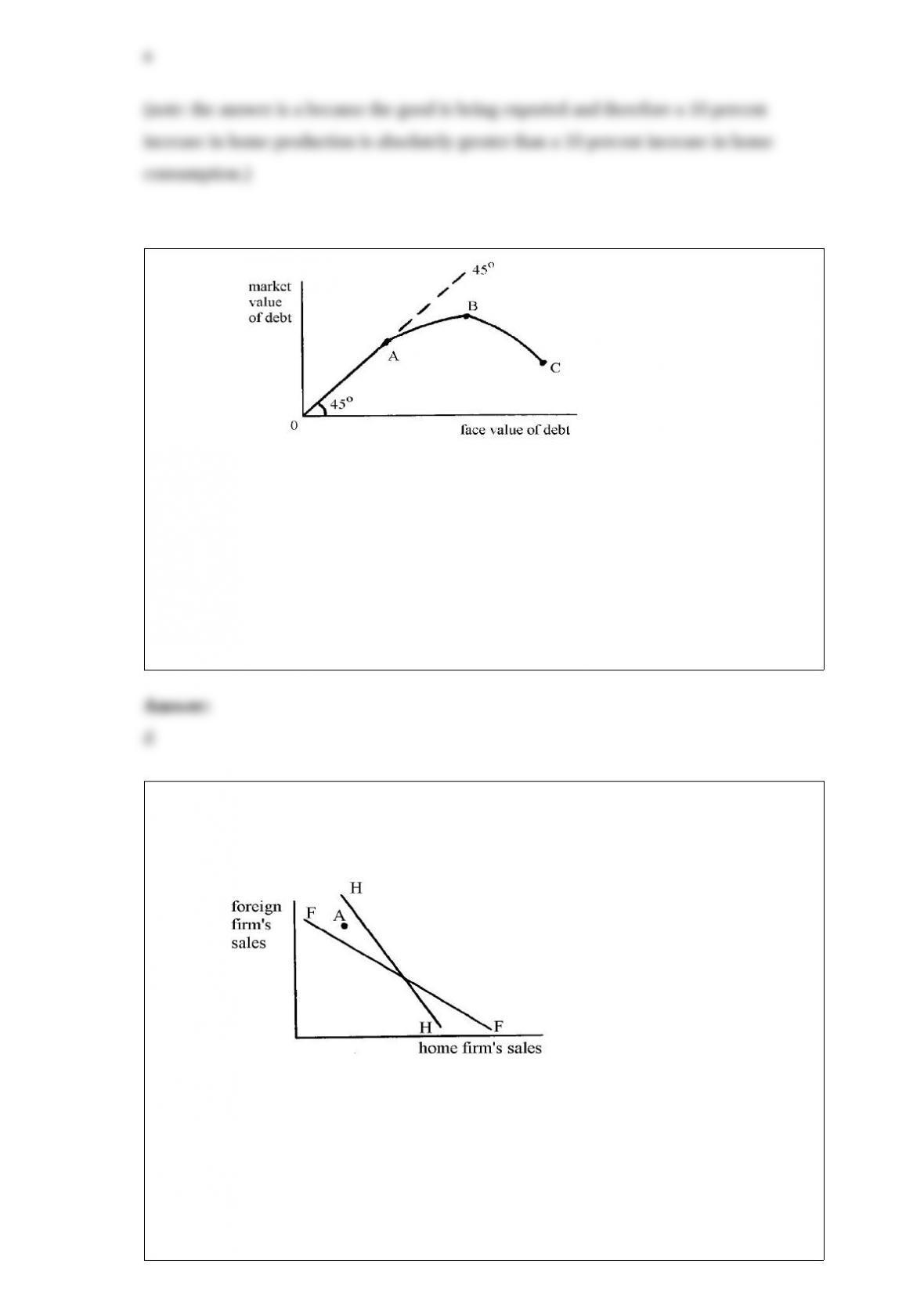
in the diagram above, where curve 0abc relates the market value of ldc external debt to
the face value of the external debt, the range __________ indicates a situation where
debt relief or forgiveness for ldcs would reduce amount of debt owed by developing
countries but would also increase the market value of the debt. in this range, any one
bank __________.
a. ab; would lose by forgiving debt unless all other banks also forgave debt
b. ab; could gain by forgiving debt even though other banks did not forgive debt
c. bc; would lose by forgiving debt unless all other banks also forgave debt
d. bc; could gain by forgiving debt even though other banks did not forgive debt
5) the following diagram shows a reaction function graph for two firms selling in an
export market, where hh is the home firms reaction function and ff is the foreign firms
reaction function.
in the reaction function diagram above, if the firms are at point a and if both firms are
seeking to maximize profit, the foreign firm wants to __________ its sales in this
market, and the home firm __________its sales in this market.
a. decrease; also wants to decrease
b. decrease; wants to increase
c. increase; wants to decrease
d. increase; also wants to increase

6) if two countries have identical production-possibilities frontiers but different tastes, it
is possible for each country to gain from trade with the other country
a. in the classical model but not in the neoclassical model
b. in the neoclassical model but not in the classical model
c. in both the classical model and the neoclassical model
d. in neither the classical model nor the neoclassical model
7) in roughly the last three decades, the traditional measures of income inequality (such
as the gini coefficient) have shown that the degree of inequality in the united states has
__________. however, if it were the case over that time period that the prices of goods
primarily consumed by high-income individuals have increased more rapidly than the
prices of goods primarily consumed by low-income individuals, then real income
inequality in the united states over that same time period would likely have been
_________ than suggested by the traditional measures.
a. decreased; decreased to a lesser extent
b. decreased; decreased to an even greater extent
c. increased; increased to a lesser extent
d. increased; increased to an even greater extent
8) a crawling peg arrangement
a. has currently been adopted by a majority of the member of the international monetary
fund
b. relies on a set of indicators, such as size of a countrys international reserves, to
trigger changes in the parity value of the countrys currency
c. has been adopted by fewer than five members of the international monetary fund
d. usually permits very wide variations of the countrys currency around the parity value
9) in the dornbusch overshooting model, asset markets adjust __________ rapidly to
disturbances than do goods markets, and therefore the exchange rate and the price level
__________ proportionately to each other in the short run.
a. more; move
b. more; do not move
c. less; move
d. less; do not move
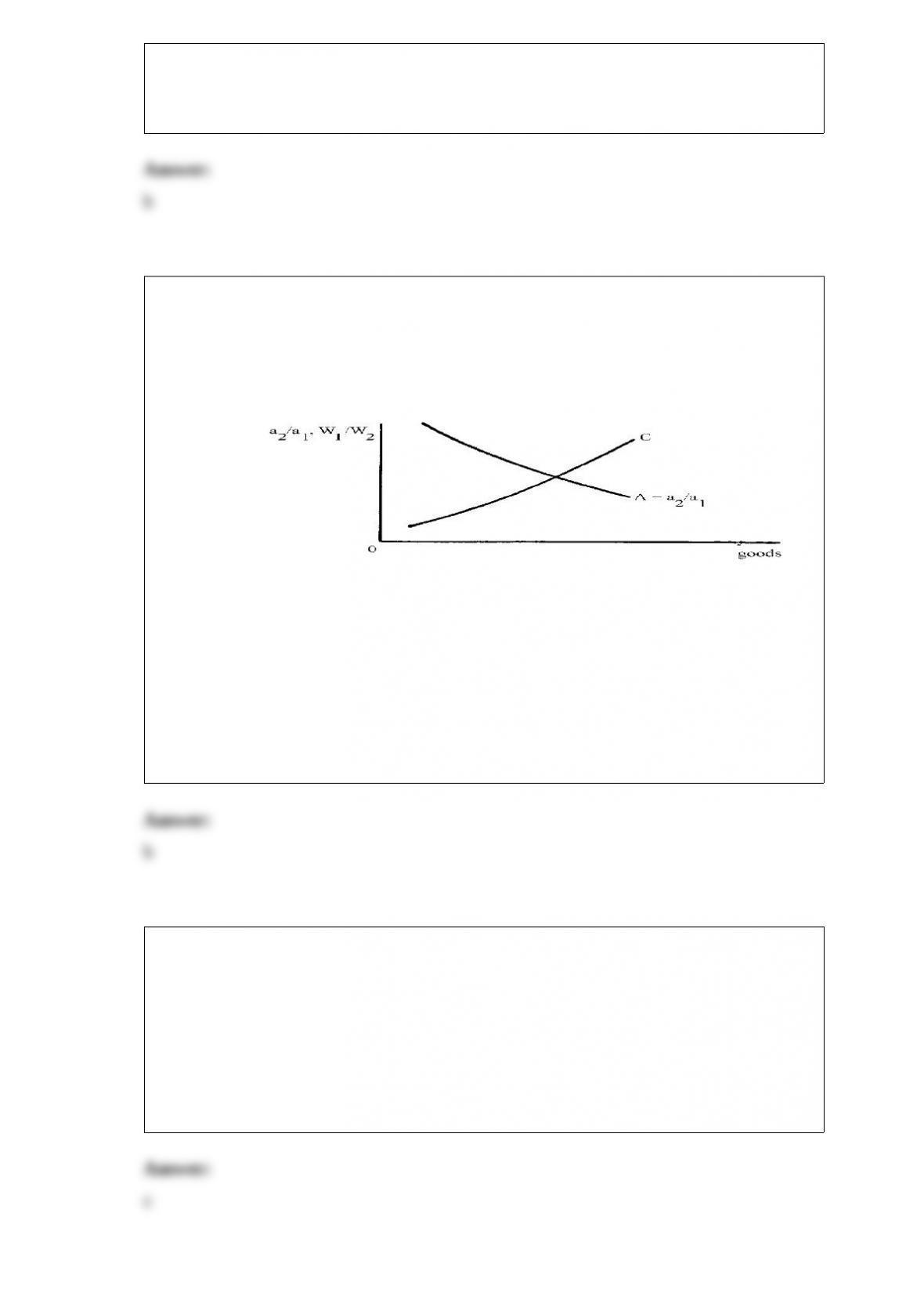
10) you are given the following dornbusch-fischer-samuelson (dfs) graph, where a1 =
the labor-time needed per unit of output in any given industry in the home country, a2 =
the labor-time needed per unit of output in any given industry in the foreign country, w1
= the wage rate in the home country, and w2 = the wage rate in the foreign country. the
exchange rate e is assumed = 1.
in the dornbusch-fischer-samuelson graph, a good that is located on the horizontal axis
to the left of the point directly below the intersection of the a curve with the c curve will
be exported by the __________ country, and, for this good, __________.
a. home; a2/a1 < w1/w2 (or a1/a2 > w2/w1)
b. home; a2/a1 > w1/w2 (or a1/a2 < w2/w1)
c. foreign; a2/a1 < w1/w2 (or a1/a2 > w2/w1)
d. foreign; a2/a1 > w1/w2 (or a1/a2 < w2/w1)
11) under the international monetary system as it actually operated between 1947 and
1971, the emergence of seemingly chronic deficits and surpluses in various countries
balance-of- payments positions (i.e., deficits and surpluses which did not seem to get
eliminated) was called
a. the liquidity problem
b. the confidence problem
c. the adjustment problem
d. the imf problem

12) if country i is defined as relatively capital-abundant in relation to country ii by the
price (or economic) definition of factor abundance, then the price of labor relative to the
price of capital is __________ in country i than in country ii, and the heckscher-ohlin
theorem would suggest that country i would export relatively __________ goods to
country ii.
a. higher; capital-intensive
b. higher; labor-intensive
c. lower; capital-intensive
d. lower; labor-intensive
13) in the game-theoretic analysis of tariff reaction functions of two governments,
suppose that the equilibrium position has been attained (i.e., the countries are located at
the intersection of their respective tariff reaction functions). if, from this equilibrium
position, one country reduces its tariff rate while the other country does not change its
tariff rate, the result, other things equal, is that the country that has reduced its tariff will
experience __________.
a. an increase in its welfare
b. no change in its welfare
c. a decrease in its welfare
d. an increase, no change, or a decrease in its welfare cannot be determined without
more information