
The value of common stockholders’ equity can be estimated as the present value of
future abnormal earnings discounted at the cost of equity.
Stockholders are the residual claimants of a company.
Cash flow from operations is usually less volatile than net income.
Prospective analysis can only be conducted after historical financial statements have
been adjusted.

When the income statement of a foreign subsidiary is translated into the reporting
currency from the functional currency, the gross margin will remain the same in the
translation process.
GAAP stands for General American Accounting Principles, and must be adhered to by
publicly traded companies when preparing their financial statements.
The accounting-based stock valuation formula calculates the value of a stock as the
book value of the net operating assets plus the present value of future expected
dividends discounted at the cost of equity.

For item to be considered a special item, it should be either unusual in nature or
infrequent in occurrence but not both.
External auditors provide “reasonable”, as opposed to “absolute” assurance that the
financial statements provide no material misstatement.
To produce a reliable forecast of earnings, an analyst must first separate the persistent
components of earnings from the nonrecurring components.
Cash flow from investing when averaged over an extended period of time would
normally be expected to be negative (i.e. net outflow).

Two companies operate in the same industry, but one has a much higher PE ratio than
the other. One reason for the difference in PE ratio could be the quality of earnings.
Under GAAP accounting, a company has the choice of using cash or accrual accounting
in preparing its financial statements.
If a company increases its expected rate of compensation increase for the purposes of
calculating its pension obligations, the accumulated benefit obligation and the projected
benefit obligation will both increase.

Pension accounting for defined benefit plans requires that retroactive adjustments to the
plan (prior service costs) be recognized immediately in full in the pension expense.
When examining the debt to equity ratio of a company, consideration should be given to
pension liabilities. Specifically, it should be determined if the projected benefit
obligation significantly exceeds the plan assets and if it does compare this to any
liability recorded on balance sheet.
What will be the diluted EPS if average stock price during the year is $35 and treasury
shares that can be purchased are 1,000?
A. $3
B. $5
C. $6
D. $4.17

The following information can be found in ABC Co.’s financial statements.
Assume a tax rate of 35%. Inventories valued using the LIFO method represented
approximately 80% of consolidated inventories.
What will be the value of inventory for 2006 if ABC used FIFO valuation?
A. $633,485
B. $570,430
C. $633,381
D. $488,581
Earnings Persistence
a. What is meant by “earnings persistence”?
b. Why might an analyst be interested in examining the earnings persistence of a
company?
c. How might managerial incentives affect the analysis of earnings persistence?
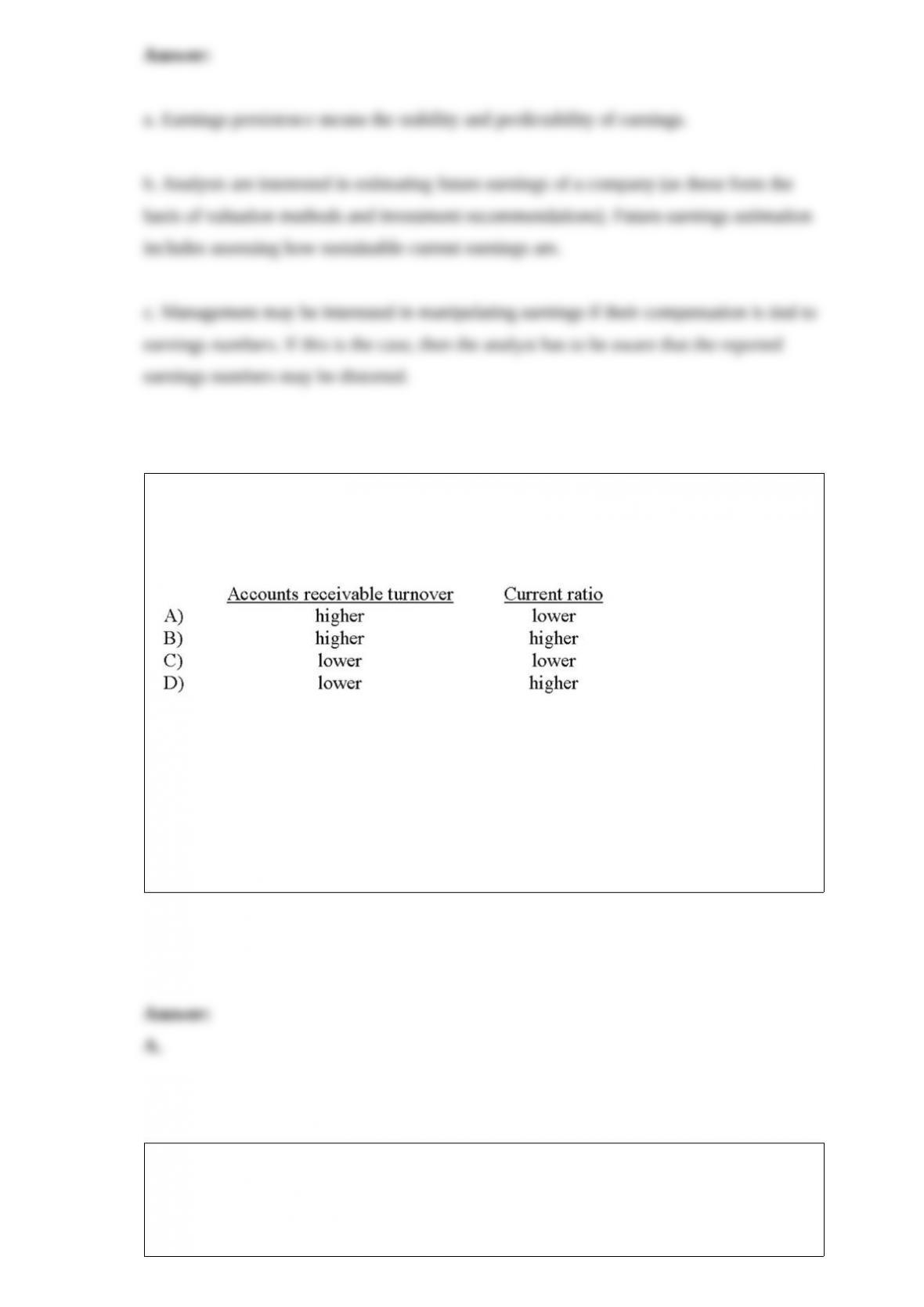
A firm has a current ratio greater than 1.0. During the course of the year the firm sells
$60 million of accounts receivable with limited recourse. If it had not sold the
receivables it would have taken out a short-term loan. The effect of selling the
receivables is:
A. Option A
B. Option B
C. Option C
D. Option D
With respect to LIFO, which of the following is incorrect?
A. If a company uses LIFO for tax purposes, it must use it for GAAP purposes.

B. If the LIFO reserve increases in a given year, cost of goods sold under the LIFO
inventory costing is higher than it would have been if FIFO had been used for that year.
C. LIFO results in better matching on the income statement than FIFO.
D. LIFO results in inventory levels on the balance sheet that are closer to current cost
than FIFO.
Which of the following increases when accounts receivable is sold?
A. Current ratio
B. Accounts receivable turnover
C. Debt-to-equity ratio
D. Days’ sales in receivables
Dylan Corporation issues a zero coupon bond with $100,000 face value, with a 5-year
maturity, and the market rate is 7%. Interest on corporate bonds is normally paid
semiannually. In the liability section of Dylan’s balance sheet, the proceeds from selling
the zero-coupon immediately after issuance will be closest to:
A. $70,892.
B. $71,299.
C. $70,000.
D. $100,000.

The short-term liquidity of a company:
A. is only of concern to investors, not creditors, of a company.
B. is determinable by looking at debt to equity ratio.
C. depends largely upon prospective cash flows.
D. is determinable by calculating cash to current liabilities ratio.
Which of the following items would not typically be included in the components of the
current ratio?
A. Inventory
B. Accounts payable
C. Capitalized software development costs
D. Deferred charges

Pension intensity of a company can be measured by expressing the pension plan assets
and the pension obligation separately as:
A. a percentage of its total liabilities.
B. a percentage of its total assets.
C. a percentage of its net income.
D. a percentage of its shareholders’ equity.
If a company leases equipment to other companies and records these leases as operating
leases rather than capital leases, its:
I. recorded liabilities will be lower.
II. recorded assets will be higher.
III. total cash flows will be higher.
IV. debt to equity ratios will be lower.
A. I and III
B. II and IV
C. I only
D. II, III, and IV

If the software refinement had been capitalized and amortized over a three-year period
beginning in the year the cost was incurred, but was expensed for tax purposes, the
deferred tax position at the end of fiscal 2005 would have been:
A. a deferred tax credit of $2.8 million.
B. a deferred tax credit of $3.5 million.
C. a deferred tax credit of $5.2 million.
D. a deferred tax debit of $4 million.
When calculating Acme’s return on net operating assets in Year 3, which of the
following adjustments to the asset base is most appropriate to consider?
A. Accumulated depreciation adjustment
B. Intangible asset adjustment
C. Operating asset adjustment
D. No asset adjustment
Recorded bad debt expense for March should be:
A. $12.5.
B. $11.
C. $10.

D. $15.
An asset is considered to be liquid if:
A. it is readily converted into a fixed asset.
B. it is an intangible asset.
C. it is readily converted into cash.
D. it is part of retained earnings.
Which of the following would affect the comparability of accounting information for a
given company from one accounting period to the next?
I. Change in accounting principles
II. Disposition of segment of business
III. Restructuring expenses
IV. Change in auditors
A. I and II
B. I and III
C. I, II, and III

D. I, III, and IV
Return on common equity for Year 1 is:
A. 19.0%.
B. 19.60%.
C. 21.08%.
D. 26.03%.
Which of the following is not an effect of capitalization?
A. Capitalization usually reduces net income.
B. Capitalization usually yields a smoother net income.
C. Capitalization usually decreases the volatility of the return on investment.
D. Capitalization usually increases net income.

Accounting income consists of all the following components except:
A. permanent component.
B. transitory component.
C. value irrelevant component.
D. realized component.
Which of the following ratios is not generally considered to be helpful in assessing
short-term liquidity?
A. Acid-test ratio
B. Current ratio
C. Days’ to collect receivables
D. Total asset turnover
ABC Corporation and DEF Corporation operate in the same industry. ABC has a PE
ratio that is 50% higher than DEF Corporation. Which of the following accounts for
some of the difference in the observed PE ratios?
I. ABC uses more conservative accounting principles.
II. ABC has a higher cost of equity capital.
III. ABC has higher expected future growth.
IV. DEF uses FIFO and ABC uses LIFO.
A. I, II, III, and IV
B. I, III, and IV
C. I and III
D. II, III, and IV
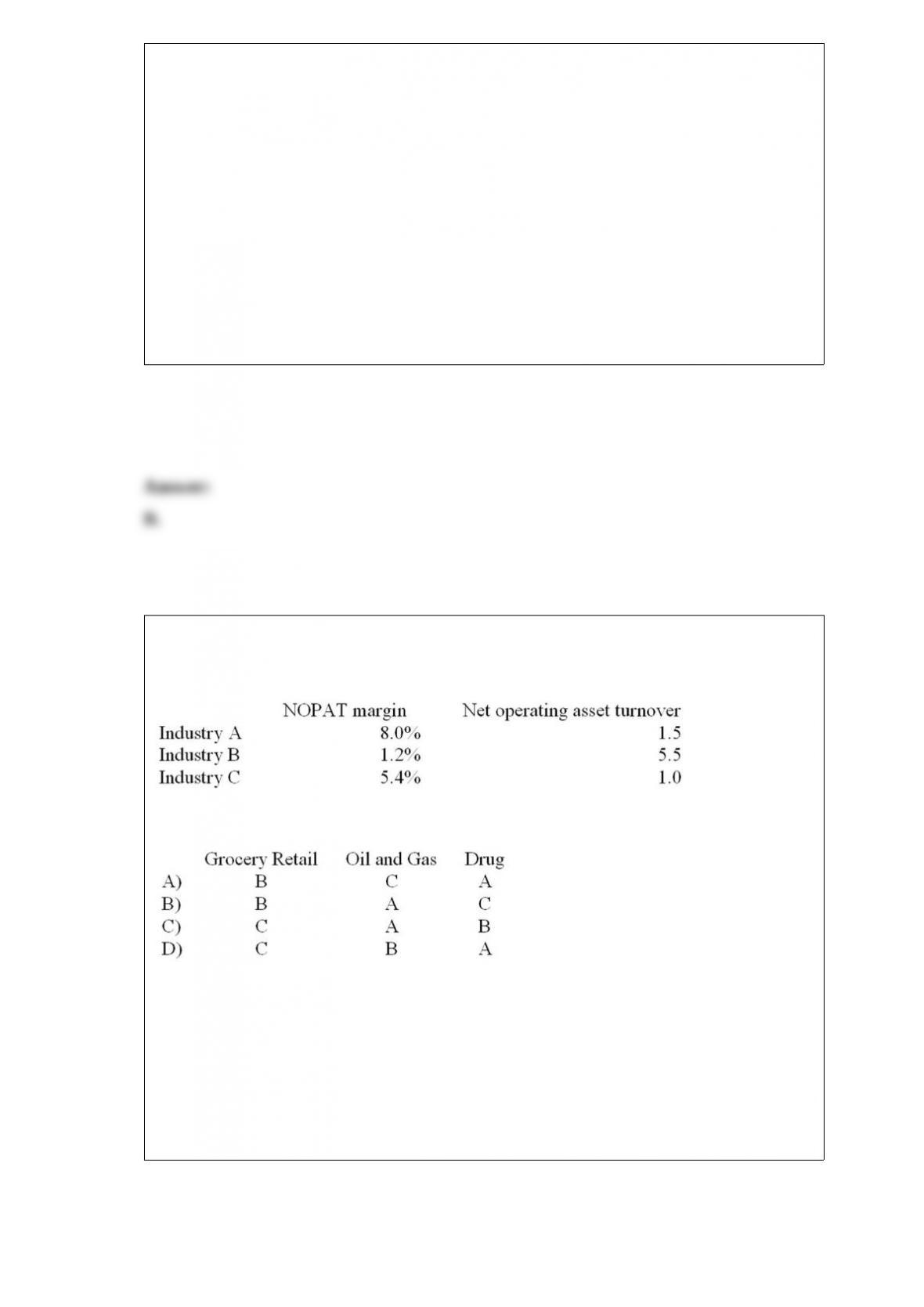
Below are the net operating asset turnovers and net operating profit margins for
companies that operate in three different industries (A, B and C). The industries are
grocery stores, oil extraction and drug industry.
Match the industry to A, B or C
A. Option A
B. Option B
C. Option C
D. Option D

Which of the following statements is correct with respect to the times interest earned
ratio?
I. It is independent of operating income.
II. It is independent of the interest rate paid on debt.
III. It is independent of the tax rate.
IV. It is independent of the amount of dividends paid.
A. I, II, and III
B. I and III
C. I and IV
D. III and IV
What would be the net income in the consolidated income statement for year X2
assuming any excess purchase price relates to goodwill, and goodwill was found to be
impaired by $830?
A. $1,461
B. $1,560
C. $1,012.2
D. $730

A write-down in asset value is:
A. a very rare occurrence.
B. not allowed under GAAP.
C. results in a direct debit to stockholders’ equity.
D. required if an asset is deemed to have permanent impairment of value.
If Yutter’s dividend payout ratio increased to 50% after year 1 then:
A. the sustainable equity growth rate would increase.
B. the return on equity would decrease.
C. the value of the stock would decrease.
D. the return on net operating assets would decrease.
Based on GAAP, which of the following is true of comprehensive income?

A. It should be reported as part of sales in the income statement.
B. It can be reported as part of statement of shareholders’ equity.
C. It should be reported as a line item before earnings after tax in the balance sheet.
D. It should be reported as part of operating activities in the statement of cash flows.
Which of the following is not likely to be used to measure a company’s liquidity?
A. Working capital
B. Financial leverage
C. Current ratio
D. Acid-test (quick) ratio
Beginning and ending plant assets are $325,000 and $370,000 respectively. Beginning
and ending accumulated depreciation are $82,800 and $95,000 respectively.
Depreciation expense for the period was $30,000, and new assets of $76,000 were
purchased. Plant assets were sold at a $10,500 loss. What were the cash proceeds from
the sale?
A. $17,800
B. $3,100
C. $2,700

D. $31,000
The primary responsibility for fair and accurate financial reporting rests with the:
A. shareholders.
B. SEC.
C. management.
D. auditors.
The matching principle requires that:
A. revenues earned and expenses incurred in generating those revenues should be
reported in the same income statement.
B. non-operating gains and losses should be netted against each other.
C. a proportion of each dollar collected will be assumed to be a recovery of cost.
D. assets will be matched to the liabilities incurred to purchase them.

If a company receives an unqualified audit opinion it means the auditors:
A. did not complete a full audit and therefore do not feel qualified to give an opinion on
financial statements.
B. are providing assurance that the company will remain financially viable for at least
the next year.
C. are providing assurance that the company’s financial statements fairly present
company’s financial performance and position.
D. are providing assurance that the company’s financial statements are free from
misstatement, fraudulent accounting and fairly indicate future performance.