
When accounts receivable are pledged as collateral rather than factored, the lender
assumes the default risk on the receivables.
Personal computers have changed the nature of financial planning. Armed with a PC
and the right software, just about anyone can be a competent planner.
Unlike accruals, the volume of trade payables is controllable by the financial manager.
Most companies that adopt a target payout ratio policy modify their actual dividend
payments because of the signaling effect.

The cash manager’s goal is to minimize the firm’s cash balances.
A bond selling at par will have a yield to maturity equal to its current yield.
Short-term US Treasury Bills yield 6%, the market’s current yield is 14%, and a
company’s beta is 1.2. According to the CAPM approach, the estimated cost of retained
earnings is 15.6%.
CDOs can be valued easily and are priced on the basis of their annualized yields.

All of the following are stakeholders in a company – Stockholders, Customers,
Creditors, Employees, Management, Suppliers and the Local Community.
Risk aversion does not mean that investors avoid risk entirely. Rather, they will accept
risk if they are adequately compensated by additional expected return.
A firm’s cash includes currency, coins, demand deposit accounts in banks, and may
include marketable securities.
If a $1,000.00 bond sells for par value, then the bond sells for ____.
A.$1,000.00
B.more than $1,000.00
C.less than $1,000.00
D.a price that cannot be determined without knowledge of the coupon rate

Companies A, B and C combine and continue as C. This is called a:
A.merger.
B.consolidation.
C.an acquisition of A and B by C.
D.both a. and c.
A big disadvantage of proprietorships versus corporations is:
A.the inexperience of proprietors.
B.the difficulty of raising money to start or expand the business for proprietors.
C.taxes on the proprietor.
D.the limited personal liability of the proprietor.

Different securities issued by the same company have different levels of risk so that:
A.equity (stock) has the highest risk, debt (bonds) the lowest, and preferred stock is in
between.
B.equity (stock) has the lowest risk, debt (bonds) the highest, and preferred stock is in
between.
C.Preferred stock has the highest risk because it’s an unusual security that doesn’t
interest many investors, equity (stock) and debt (bonds) are about the same.
D.debt is the riskiest security because companies often default on bonds before failing
entirely; preferred stock is a little safer than common stock, that’s why it’s called
preferred.
Which of the following capital budgeting techniques does NOT take into account the
cost of capital?
A.Payback Period
B.Net Present Value
C.Internal Rate of Return
D.Profitability Index
E.All of the above take into account the cost of capital.
The proper ranking of the four kinds of business plan from longest to shortest term is:

A.budgeting, forecasting, strategic planning, operational planning.
B.strategic planning, budgeting, operational planning, forecasting.
C.forecasting, strategic planning, operational planning, budgeting.
D.strategic planning, operational planning, budgeting, forecasting.
E.strategic planning, forecasting, budgeting, operational planning.
The bad debt reserve represents:
A.money that will be paid by the company.
B.money that will be paid by customers.
C.the fact that not all receivables are collected in the normal course of business.
D.insurance against bad debts.
Swift Limited is considering a project with the following cash flows. Calculate the
approximate MIRR of the project. The cost of capital is 10 percent.

A.15%
B.25%
C.13%
D.14%
Changes to net working capital are categorized as:
A.cash flow from operating activities.
B.cash flow from investment activities.
C.cash flow from financing activities.
D.None of the above
Which of the following does not characterize a change that has taken place in

international business in the past 60 years?
A.Imports have increased significantly, from 3% to 13 % of GDP.
B.Exports have remained at about 4% of GDP.
C.Many U.S. businesses have made direct investments in other countries.
D.U.S. investors have increased their portfolio investments in foreign stocks and bonds.
E.Virtually every company of any size is impacted by international business.
The efficient market hypothesis asserts that:
A.it is virtually impossible to consistently pick stocks that perform exceptionally well
because all publicly available information is immediately reflected in stock prices.
B.studying historic patterns of stock price movements will generally identify winning
investments.
C.fundamental analysis performed by individuals often reveals bargains despite the fact
that professionals analyze all information as soon as it becomes available.
D.All of the above
The purpose of antitrust laws is to ____.
A.prevent unfriendly mergers
B.encourage consolidations

C.maintain competition within an industry
D.encourage conglomerate mergers
Mae Chen, manager of Chen Fabrics, is comparing two assumptions about the terminal
cash flow arising from an expansion project. The Year 7 cash flow is $250,000. One
assumption is that subsequent cash flows are constant. An equally valid assumption is
that subsequent cash flows will grow at a four percent rate. If Chen Fabrics€ cost of
capital is 11 percent, what is the difference in the calculation of the project€s terminal
value?
A.Under $25,000
B.Between $250,000 and $500,000
C.Between $500,001 and $1,000,000
D.Over 1,000,000
An investment portfolio is (are):
A.found in an art collection.
B.collections of financial assets held by a broker.
C.collections of financial assets held by investors.
D.riskier than one stock.
A project has an initial cost of $20,000.00 and no another costs throughout the life of
the project. Assuming the project has a PI of 1.23, the IRR is ____.
A.greater than the discount rate
B.lower than the discount rate
C.equal to the discount rate
D.not comparable to the discount rate
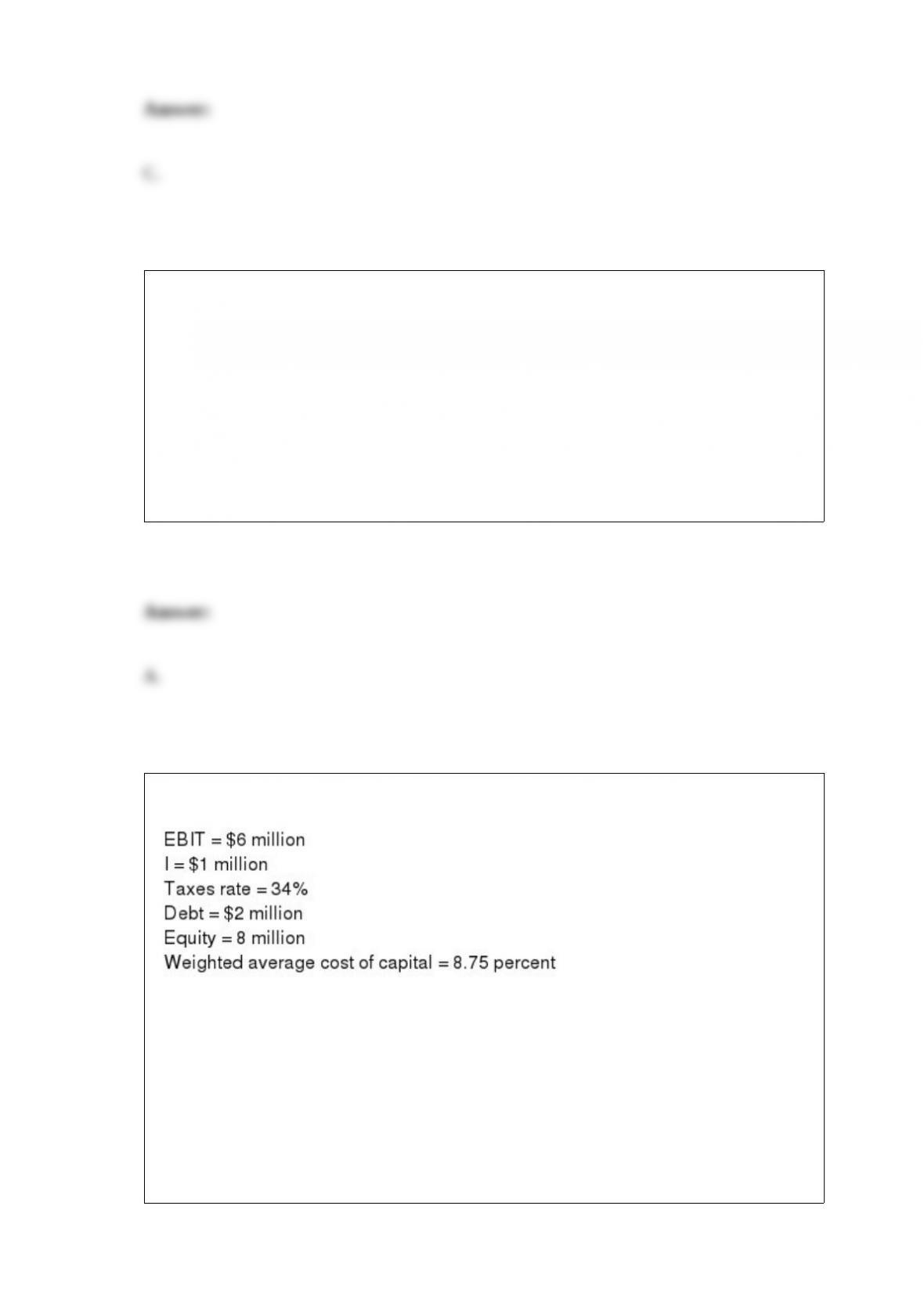
The following information was obtained about Nashville Bottling.
Over the reporting period, what is its economic value added?
A.$2,300,000
B.$3,085,000
C.$3,300,000
D.$5,037,500

Factoring receivables:
A.means selling them at a discount to a financial organization.
B.means the seller is always responsible for losses from uncollectible accounts.
C.means the seller must do all of its own credit and collection functions.
D.means the borrowed funds must be repaid to the lending company periodically.