
A bank’s core deposits are:
a. vault cash.
b. stable deposits that are not typically withdrawn over short periods of time.
c. the bank’s deposits at the Federal Reserve.
d. the most interest rate sensitive liabilities of a bank.
e. deposits held in foreign offices.
Answer:
Keeping all other factors constant, banks can reduce the volatility of net interest income
by:
a. adjusting the dollar amount of rate-sensitive assets.
b. adjusting the dollar amount of fixed-rate liabilities.
c. using interest rate swaps.
d. Bank can reduce volatility of net interest income by doing all of the above.
e. a. and c. only
Answer:

Historically, most industrial loan companies have operated to:
a. accept deposits.
b. assist their parent company in some facet of the firm’s core business.
c. exclusively make commercial loans.
d. increase the safety and soundness of the parent company.
e. purchase municipal securities.
Answer:
Which of the following primarily takes futures positions that are outstanding for just
minutes?
a. Scalper
b. Local
c. Day trader
d. Position trader
e. Commission broker
Answer:

How long will it take you to double your money if you can invest at 7.2% per year?
a. 9.97 years
b. 9.28 years
c. 8.62 years
d. 7.21 years
e. 6.98 years
Answer:
Relative to retail banks, wholesale banks:
a. deal primarily with consumers.
b. operate with fewer commercial deposits.
c. purchase more non-core liabilities.
d. hold proportionally more consumer loans.
e. All of the above.

Answer:
Return on assets can be calculated as:
a. return on equity plus the equity multiplier.
b. net interest income divided by earning assets.
c. asset utilization minus the expense ratio and the tax ratio.
d. interest income minus interest expense.
e. earning assets divided by average total assets.
Answer:
Which of the following is not a channel for delivering banking services?
a. Mobile banking.
b. Online banking.
c. Automated Teller Machines.
d. Branch banking.
e. Retail banking.

Answer:
If a bank has a positive GAP, a decrease in interest rates will cause interest income to
__________, interest expense to__________, and net interest income to __________.
a. increase, increase, increase
b. increase, decrease, increase
c. increase, increase, decrease
d. decrease, decrease, decrease
e. decrease, increase, increase
Answer:
______________ transactions are the highest-cost type of transaction for a bank.
a. Web-based
b. ATM
c. Work station
d. Live teller
e. After-hours

Answer:
In determining reserves, the banks and the Federal Reserve currently use:
a. a leading reserve accounting system.
b. a contemporaneous reserve accounting system.
c. a lagging reserve accounting system.
d. an actual reserve accounting system.
e. a holding reserve accounting system.
Answer:
All of the following are loan classifications under the Uniform Bank Performance
Report except:
a. real estate loans.
b. automobile loans.
c. individual loans.
d. commercial loans.
e. agricultural loans.

Answer:
Long-term interest rates tend to be higher than short-term interest rates:
a. at the bottom of the business cycle.
b. at the end of an expansionary period.
c. at the beginning of a contractionary period.
d. at the peak of the business cycle.
e. during periods of rapid deflation.
Answer:
What is the firm’s liability cycle?
a. 30 days
b. 59 days
c. 65 days
d. 95 days
e. 113 days

Answer:
Which of the following is not a fundamental function of the Federal Reserve?
a. Conduct the nation’s monetary policy.
b. Provide an effective payments system.
c. Regulate banking operations.
d. Ensure bank profitability.
e. All of the above are fundamental functions of the Federal Reserve.
Answer:
If you invested $200 today, another $400 in one year, and another $600 in two years,
how much will your investment be worth (to the nearest dollar) in five years, assuming
a 7% annual compound return?
a. $1,540
b. $600
c. $720
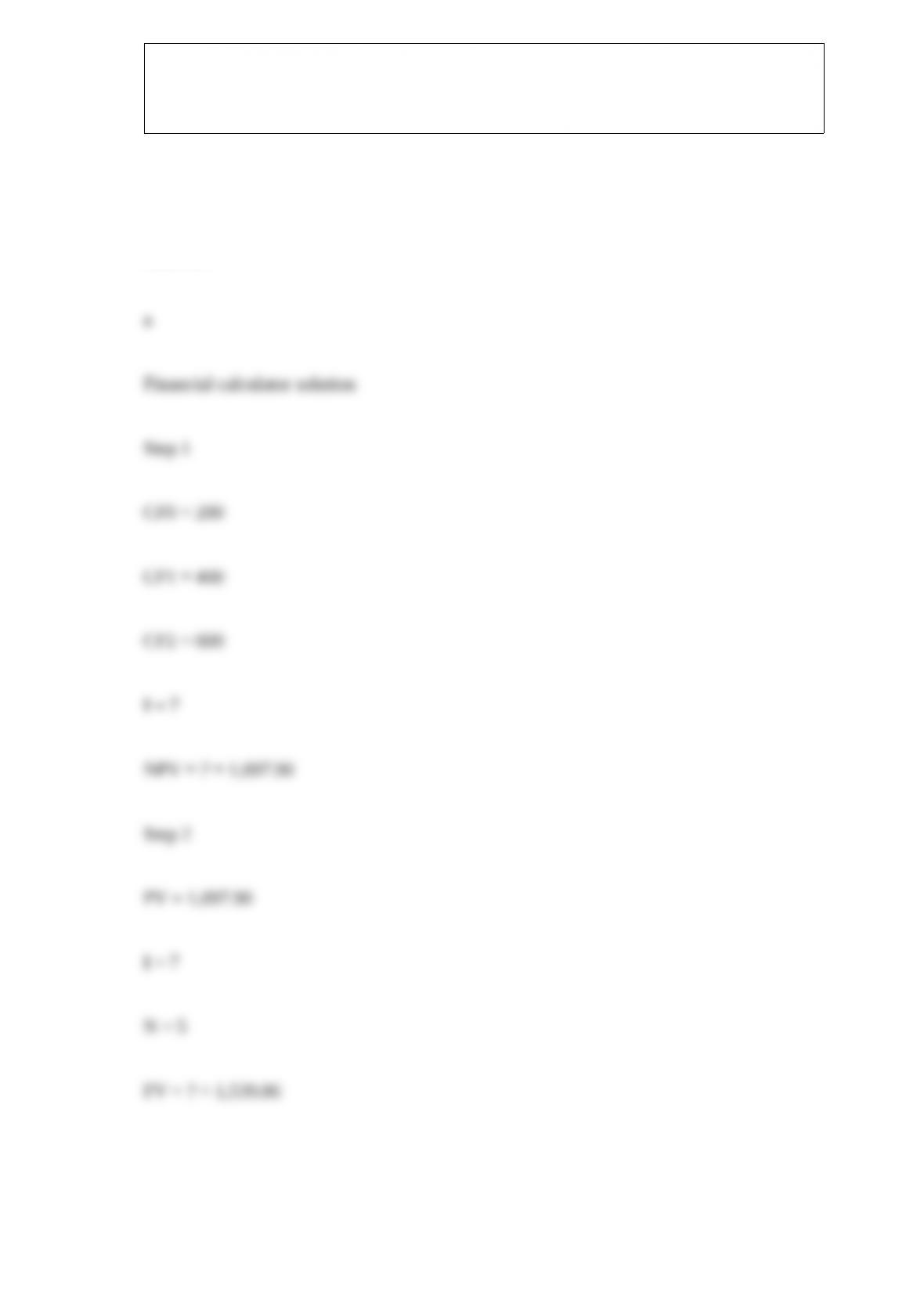
d. $770
e. None of the above
Answer:

Which of the following does not directly influence the amount of required reserves a
bank must hold?
a. The required reserve ratio.
b. The dollar amount of cash items in process of collection.
c. The dollar amount of demand deposits outstanding.
d. The dollar amount of money market deposit accounts outstanding.
e. The dollar amount of NOW accounts outstanding.
Answer:
Which of the following is not a difference between futures and forward contracts?
a. Futures contracts are marked-to-market daily, while futures contracts are not.
b. Buyers and sellers deal directly with each other on forward contracts but go through
and exchange with futures contracts.
c. Futures contracts are standardized, forward contracts generally are not.
d. Delivery rarely occurs on futures contracts but generally occurs with forward
contracts.
e. All of the above are differences between futures and forward contracts.
Answer:

The national average FICO score is:
a. 370
b. 470
c. 570
d. 670
e. 770
Answer:
Which Act limited the activities a company could engage in if it owned a bank?
a. Federal Reserve Act
b. Bank Holding Act
c. McFadden Act
d. Glass-Steagall Act
e. Competitive Equality Banking Act
Answer:

Which of the following indicates the potential demand for new loans?
a. Low business growth and activity
b. A relatively large percentage of demand deposits
c. Large, unused commercial credit lines outstanding
d. Large deposits held by a single customer
e. The level of uninsured deposits
Answer:
A bank quotes you a rate of 7% on a CD, compounded quarterly. What is the effective
annual rate?
a. 6.79%
b. 6.81%
c. 6.87%
d. 7.13%
e. 7.19%
Answer:

A financial holding company cannot own which of the following?
a. A bank.
b. A bank holding company.
c. A thrift.
d. A thrift holding company.
e. A financial holding company may own all of the above.
Answer:
At a minimum, cash flow from operations should cover:
a. interest on long-term debt.
b. dividends plus mandatory principal payments on debt.
c. capital expenditures plus dividends.
d. the change in marketable securities.

e. dividends plus interest.
Answer:
Which of the following indicates the potential for deposits leaving a bank?
a. High business activity and growth
b. Deposits that are inelastic to changes in interest rates
c. An aggressive bank loan officer
d. Large deposits held by a single customer
e. Small unused commercial credit lines outstanding
Answer:
An investor anticipates she will have funds to invest in the T-Bill market. If she hedges
by buying futures contracts and rates decline, which of the following is true?
a. The investor will profit on the futures contract.
b. The investor will profit in the spot market.
c. The investor will have locked in a minimum 10% return.
d. The investor will lose in the spot market.

e. a. and d.
Answer:
A stripped security:
a. pays no interest.
b. has no par value.
c. is easier to value than a traditional bond.
d. should sell as a package of zero coupon bonds.
e. None of the above
Answer:
Which of the following is not considered a volatile liability?
a. Jumbo CDs
b. Deposits in foreign offices
c. Repurchase agreements
d. Federal funds sold

e. All of the above are considered volatile liabilities
Answer:
Eurodollar deposits:
a. are very different from domestic CDs from the depositor’s perspective.
b. have no maturity.
c. pay interest rates slightly above CDs issued by U.S. banks.
d. are subject to reserve requirements established by the Fed.
e. are generally small in nature, with a maximum denomination of $10,000.
Answer:
Which of the following is not one of the five Cs of (good) credit?
a. Character
b. Collateral
c. Capital
d. Capacity

e. Credit
Answer:
Mortgage prepayment risk:
a. is greatest for stripped securities.
b. increases as interest rates increase.
c. is eliminated in Z-tranche CMOs.
d. is eliminated by buying stripped mortgage backed securities that mature when the
bank needs the funds.
e. is larger on high-rate mortgages.
Answer:
Which of the following is true regarding duration gap analysis?
a. The magnitude of the duration gap is related to the amount of interest rate risk a bank
is subject to.
b. Management can adjust the duration gap to speculate on future interest rate changes.
c. A positive duration gap means a bank’s market value of equity will decrease with an

increase in interest rates.
d. All of the above are true.
e. a. and c.
Answer:
A negotiable instrument often used in trading goods that guarantees payment to the
owner the instrument is known as (a):
a. bankers acceptance.
b. payment guarantee.
c. commercial paper.
d. bankers payment.
e. repurchase agreement.
Answer: