
1) the firm may not be able to pass through changes in the exchange rate
a.in markets with low product differentiation
b.in markets with high price elasticities
c.both a and b
d.none of the above
2) the most important international reserve asset, comprising 94 percent of the total
reserve assets held by imf member countries is
a.gold
b.foreign exchanges
c.special drawing rights (sdrs)
d.reserve positions in the international monetary fund (imf)
3) a u.s. firm holds an asset in israel and faces the following scenario:
where,
p* = israeli shekel (is) price of the asset held by the u.s. firm
p = dollar price of the same asset
which of the following conclusions are correct?
a.most of the volatility of the dollar value of the israeli asset can be removed by
hedging exchange risk because b2[var(s)] and var(e) are 236,717 ($)2 and 493,751 ($)2
respectively
b.most of the volatility of the dollar value of the israeli asset cannot be removed by
hedging exchange risk because b2[var(s)] and var(e) are 236,717 ($)2 and 493,751 ($)2
respectively
c.most of the volatility of the dollar value of the israeli asset cannot be removed by
hedging exchange risk because b2[var(s)] and var(e) are 8.22 ($)2 and 59,211 ($)2,

respectively
d.most of the volatility of the dollar value of the israeli asset can be removed by
hedging exchange risk because b2[var(s)] and var(e) are 8.22 ($)2 and 59,211 ($)2
respectively
4) contingent exposure can best be hedged with
a.options
b.money market hedging
c.futures
d.all of the above
5) banker’s acceptances usually have maturities ranging from
a.30 to 180 days
b.90 to 360 days
c.1 year to 5 years
d.over 5 years
6) if a country is grappling with a major balance-of-payment difficulty, it may not be
able to expand imports from the outside world. instead, the country may be tempted to
a.impose measures to restrict imports
b.impose measures to discourage capital outflows
c.both a and b
d.none of the above
7) when the mexican peso collapsed in 1994, declining by 37 percent,
a.u.s. firms that exported to mexico and priced in peso were adversely affected

b.u.s. firms that exported to mexico and priced in dollars were adversely affected
c.u.s. firms were unaffected by the peso collapse, since mexico is such a small market
d.both a and b
8) monetary policy for the countries using the euro as a currency is now conducted by
a.the federal reserve
b.the bundesbank
c.european central bank
d.none of the above
9) in which type of market can liquidity “dry up”?
a.a bull market
b.a bear market
c.a speculative bubble
d.a financial panic
10) suppose you observe a spot exchange rate of $1.50/. if interest rates are 5% apr in
the u.s. and 3% apr in the euro zone, what is the no-arbitrage 1-year forward rate?
a.1.5291/$
b.$1.5291/
c.1.4714/$
d.$1.4714/

11) today for a mnc to produce merchandise in one country on capital equipment
financed by funds raised in a number of different currencies through issuing securities
to investors in many countries and then selling the finished product to customers in yet
other countries is
a.not uncommon
b.extremely common
c.uncommon
d.the norm
12) cross-correlations among major stock markets and exchange markets are
a.relatively high
b.relatively low
c.essentially perfect
d.practically zero
13) suppose abc investment banker ltd., is quoting swap rates as follows: 7.50 – 7.85
annually against six-month dollar libor for dollars, and 11.00 – 11.30 percent annually
against six-month dollar libor for british pound sterling. abc would enter into a $/£
currency swap in which:
a.it would pay annual fixed-rate dollar payments of 7.5% in return for receiving annual
fixed-rate £ payments at 11.3%
b.it will receive annual fixed-rate dollar payments at 7.85% against paying annual
fixed-rate £ payments at 11%
c.a and b
d.none of the above
14) if u.s. taxing authorities did not limit the amount of the foreign tax credit to the
equivalent amount of the u.s. tax

a.payers would arguably subsidize part of the tax liabilities of u.s. mnc’s foreign earned
income
b.national neutrality would suffer
c.mncs would all depart our shores
d.all of the above
15) concentrated ownership of a public company
a.can be an effective way to alleviate the agency problem between shareholders and
managers
b.is the norm in great britain
c.tends to be an ineffective way to alleviate conflicts of interest between groups of
shareholders
d.none of the above
16) when corporate governance breaks down
a.shareholders are unlikely to receive fair returns on their investments
b.managers may be tempted to enrich themselves at shareholder expense
c.the board of directors is not doing its job
d.all of the above
17) while there is no comprehensive theory of fdi, many existing theories emphasize
a.imperfections in product markets
b.imperfections in capital markets
c.imperfections in labor markets
d.all of the above
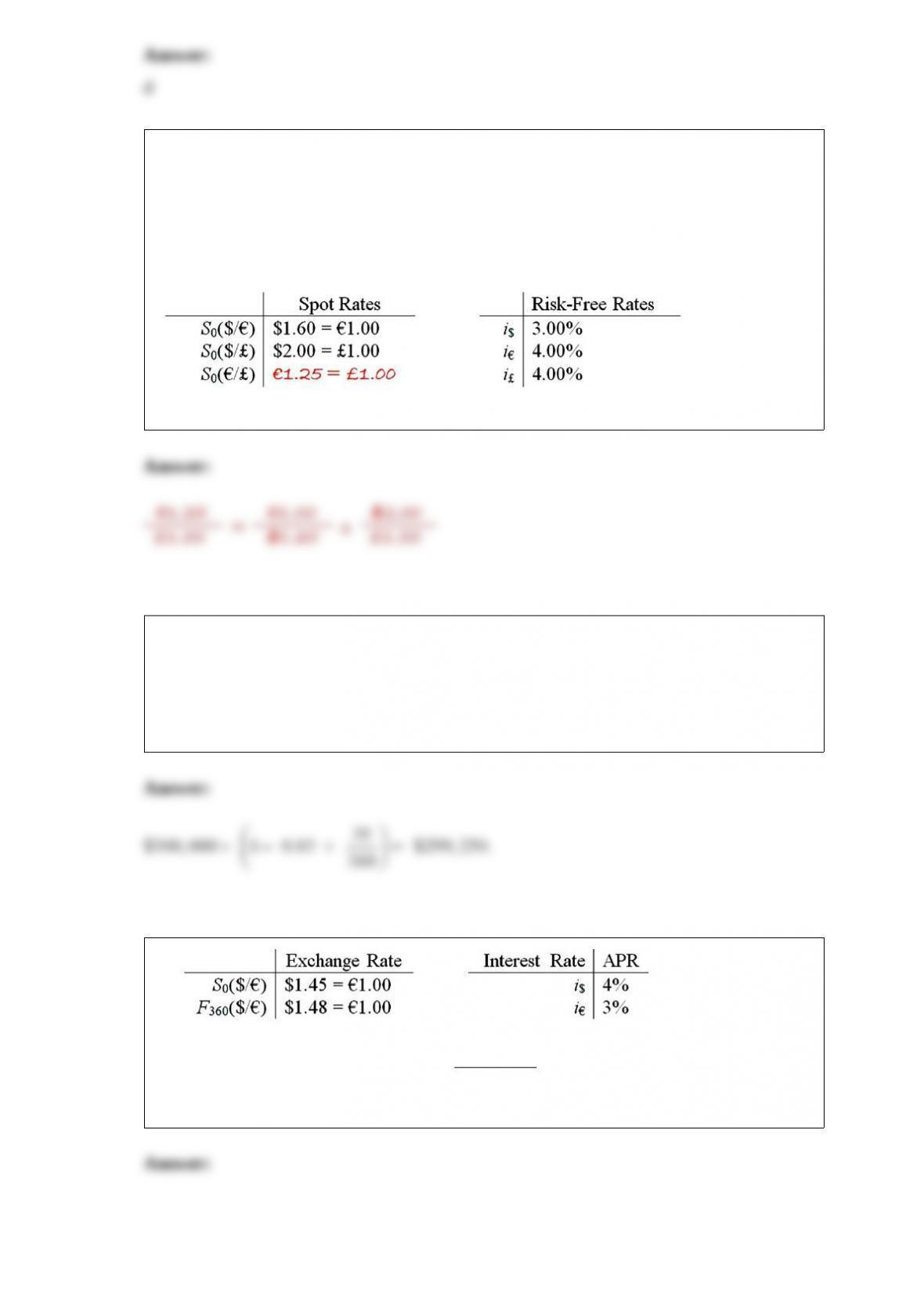
18) consider an option to buy £10,000 for 12,500. in the next period, if the pound
appreciates against the dollar by 37.5 percent then the euro will appreciate against the
dollar by ten percent. on the other hand, the euro could depreciate against the pound by
20 percent.
big hint: don’t round, keep exchange rates out to at least 4 decimal places.
calculate the current /£ spot exchange rate.
19) the time from acceptance to maturity on a $300,000 banker’s acceptance is 30 days.
the importing bank’s acceptance commission is 3 percent and that the market rate for
30-day b/as is 4 percent.
determine the amount the exporter will receive if he holds the b/a until maturity.
20)
please note that your answers are worth zero points if they do not include currency
symbols ($, )
if you borrowed 1,000,000 for one year, how much money would you owe at maturity?
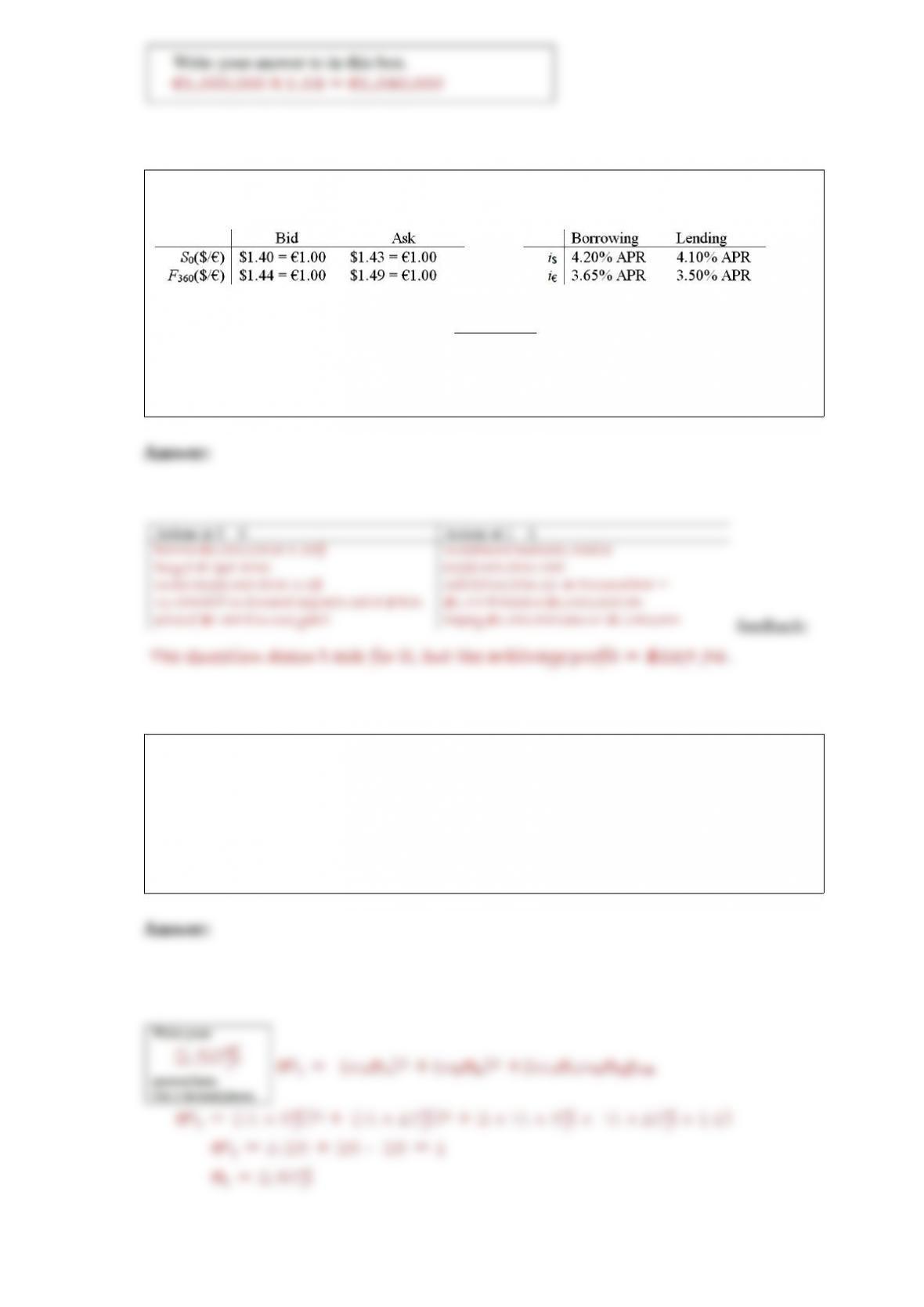
21) assume that you are a retail customer.
please note that your answers are worth zero points if they do not include currency
symbols ($, )
there is (at least) one (smallish) profitable arbitrage at these prices. what is it?
22) the stock market of country a has an expected return of 8%, and standard deviation
of expected return of 5%. the stock market of country b has an expected return of 16%
and standard deviation of expected return of 10%.
assume that the correlation of expected return between a and b is negative 1. calculate
the standard deviation of expected return of the portfolio in the last question.
23) the stock market of country a has an expected return of 5%, and standard deviation
of expected return of 8%. the stock market of country b has an expected return of 15%
and standard deviation of expected return of 10%.
assume that the correlation of expected return between a and b is negative 1. calculate
the standard deviation of expected return of the portfolio in the last question.
24) calculate the euro-based return an italian investor would have realized by investing
10,000 into a $50 american stock using 50% margin. one year after investment, the
stock pays a $1 dividend, and sells for $54 the exchange has changed from .625 per
dollar to .6875 per dollar. the interest on the margin loan is 1% per year. the margin loan
was denominated in dollars.
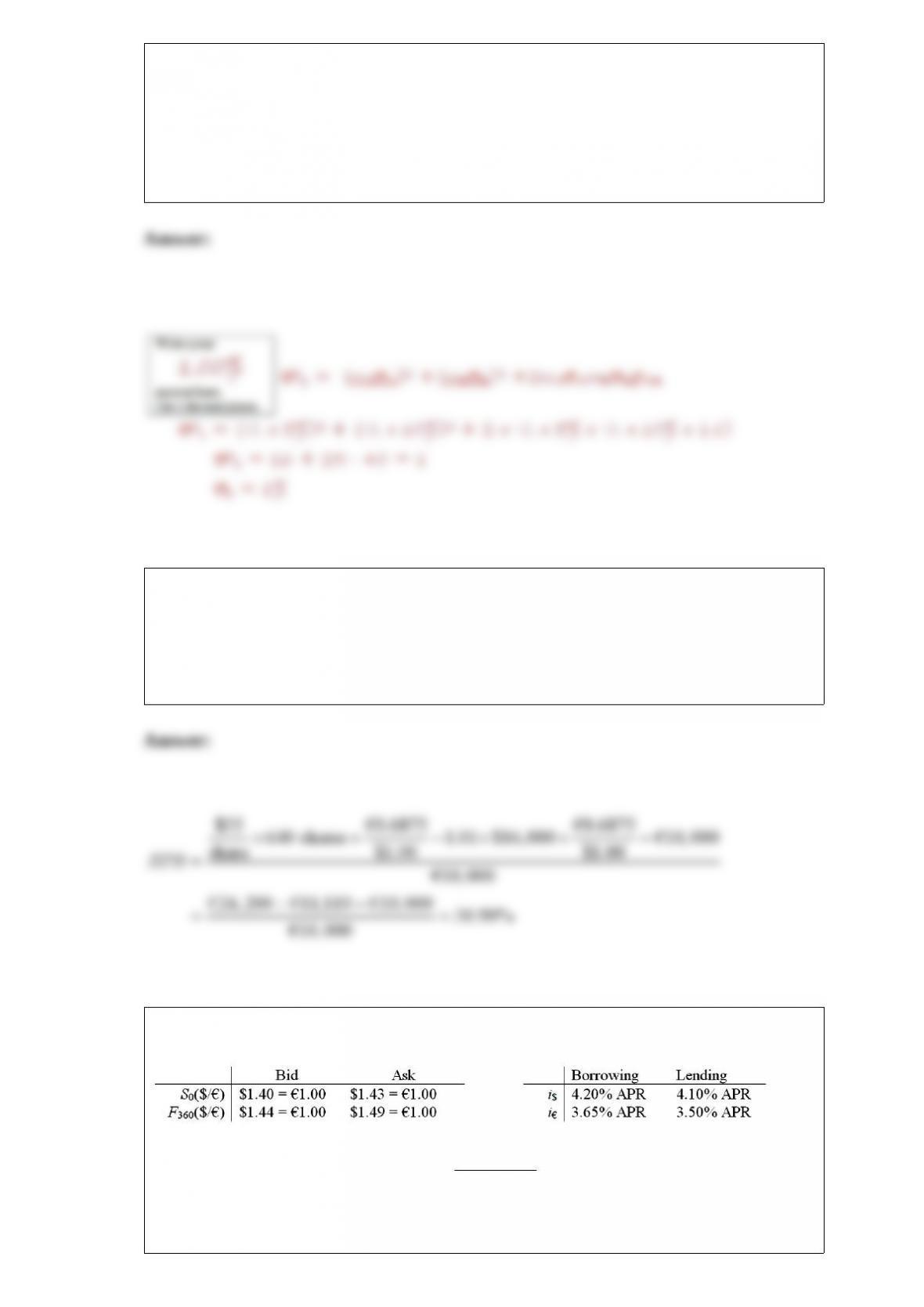
25) assume that you are a retail customer.
please note that your answers are worth zero points if they do not include currency
symbols ($, )
if you borrowed $1,000,000 for one year, how much money would you owe at
maturity?