
Payment of dividends is a financing activity.
In substance, there is absolutely no difference between the 100% stock dividend and the
two-for-one stock split.
Depreciation is recomputed starting in the period that a change in estimate is known.
A sole proprietorship is an accounting entity, even though it has only a single owner.
The lower-of-cost-or-market method affects how much income is reported in each year
but not the total income over the company’s life.
A goodwill write-off is a noncash expense.
The MD&A section of a corporation’s annual report contains information about changes
in the income statement, liquidity, and capital resources.
The days to collect accounts receivable is calculated by dividing credit sales by the
average accounts receivable.

For a newspaper subscription, subscription revenue is always credited when cash is
received from the customer.
The accumulated depreciation is sometimes referred to as the allowance for
depreciation.
An audit is an examination of transactions and financial statements.
A firm may have a significant amount of net income, as computed by accountants on
the accrual basis, and yet have a severe decline in cash.

A change in accounting principle occurs when a company voluntarily changes from one
acceptable accounting principle to another and when a standard-setting authority issues
a new accounting standard that requires the change in accounting principle.
Although the issuer of bonds typically keeps a separate account for unamortized
discounts and premiums, investors do not.
Due to accrual accounting’s system of matching expenses with their associated
revenues, pensions and postretirement benefits are expenses when earned by
employees.
The Internet is a powerful, useful tool used by investors. Which statement is false
regarding the Internet as it relates to investors?

A) The Internet provides almost immediate access to company press releases including
company profitability.
B) Investors can purchase and sell securities online without the use of a broker.
C) The Internet is always an accurate source of company information.
D) An investor can use the Internet to get useful information about potential companies
to invest in.
E) Often purchasing and selling stock online is free, but there are instances when an
investor must have a brokerage account and pay for services.
A company issues its capital stock to acquire a building. Both parties in the transaction
should record the transaction using the:
A) fair value of the capital stock
B) fair value of the building
C) book value of the building
D) fair value of the capital stock or the fair value of the building, whichever is easier to
determine objectively
E) book value of the capital stock
The journal entry to purchase merchandise under a periodic inventory system includes a
debit to

A) Cost of Goods Sold.
B) Inventory.
C) Purchases.
D) Accounts Receivable.
E) Accounts Payable.
Treating a capital expenditure as repairs and maintenance expense
A) understates expenses and overstates owners’ equity.
B) understates expenses and understates assets.
C) overstates expenses and understates net income.
D) overstates assets and overstates owners’ equity.
E) overstates assets and overstates revenue.
On January 1, 2015, equipment is purchased for $100,000. The equipment will be used
for ten years and has no salvage value. What is the depreciation expense for the year
ending December 31, 2016?
A) $1,000
B) $2,000

C) $10,000
D) $20,000
E) $100,000
If a company would like to repay a bank loan of $7,000, the bookkeeper would
A) debit Cash and credit Notes Receivable for $7,000.
B) debit Notes Receivable and credit Cash for $7,000.
C) debit Cash and credit Accounts Payable for $7,000.
D) debit Cash and credit Notes Payable for $7,000.
E) debit Notes Payable and credit Cash for $7,000.
When preparing the statement of cash flows under the indirect method, an appropriate
procedure would be to
A) subtract an increase in wages payable.
B) subtract an increase in accounts receivable.
C) subtract amortization expense.
D) determine cash paid to suppliers.

E) add a gain from the sale of a fixed asset.
The amount accumulated in the future, including principal and interest is the
A) future value.
B) annuity value.
C) present value.
D) rate of return.
E) accumulated full value.
The cash proceeds received from issuing a bond are less than the face value of the bond.
It is apparent that the bond was issued at
A) face value.
B) a premium.
C) a discount.
D) par value.
E) nominal value.

If a company is using a periodic inventory system, the balance in its inventory account
three-quarters of the way through an accounting period would be equal to the
A) amount of inventory on hand at that date.
B) inventory on hand at the beginning of the period.
C) total of the beginning inventory plus goods purchased during the accounting period.
D) amount of goods purchased during the period.
E) inventory on hand at the beginning of the period multiplied by 75%.
Palatino Ranchers acquired a $300,000 15-year, 10% callable bond on January 1, 20X9,
for cash of $258,702. The bond was acquired at a price to yield 12%. The bond pays
interest every June 30 and December 31. On December 31, 20X9, after interest had
been received, the bond owned by Palatino Ranchers was called at a price of 101 (101%
of face value). Assume the company intends to hold the bond until maturity and the
company uses the effective interest method of discount or premium amortization.
Prepare the appropriate journal entry for each of the following events:
a. The purchase of the bond on January 1, 20X9
b. The receipt of the June 30, 20X9, interest payment
c. The receipt of the December 31, 20X9, interest payment
d. The bond being called on December 31, 20X9

Video Company had sales during July 20X3 of $30,000. During the month, the
company had purchases of $10,000. At July 1, 20X3, the company had inventory of
$10,000. Assuming the company has a gross profit percentage of 40%, what is the
estimated ending inventory for Video Company at July 31, 20X3?
A) $ 2,000
B) $ 16,000
C) $ 18,000
D) $ 20,000
E) none of the above
Expenditures for long-lived assets are expensed when they
A) add new assets.
B) increase capacity.
C) improve efficiency.
D) provide benefits lasting one year or less.
E) lengthen an asset’s useful life.
Useful Organizing began operations on January 1, 20X3, when the owners invested
$80,000 cash in the company. Also on January 1, the company paid for a $30,000
machine. The machine has a useful life of 4 years and a $2,000 residual value. During
its first year of operations, the company had sales of $96,000 and operating expenses
except depreciation of $67,000. All sales were cash sales and all non-depreciation
operating expenses were paid in cash. Useful Organizing has a 30% tax rate and pays
all taxes on December 31. What is the cash balance after taxes on December 31, 20X3,
if Useful Organizing uses double-declining-balance depreciation?
A) $59,800
B) $74,500
C) $74,800
D) $88,800
E) $89,500
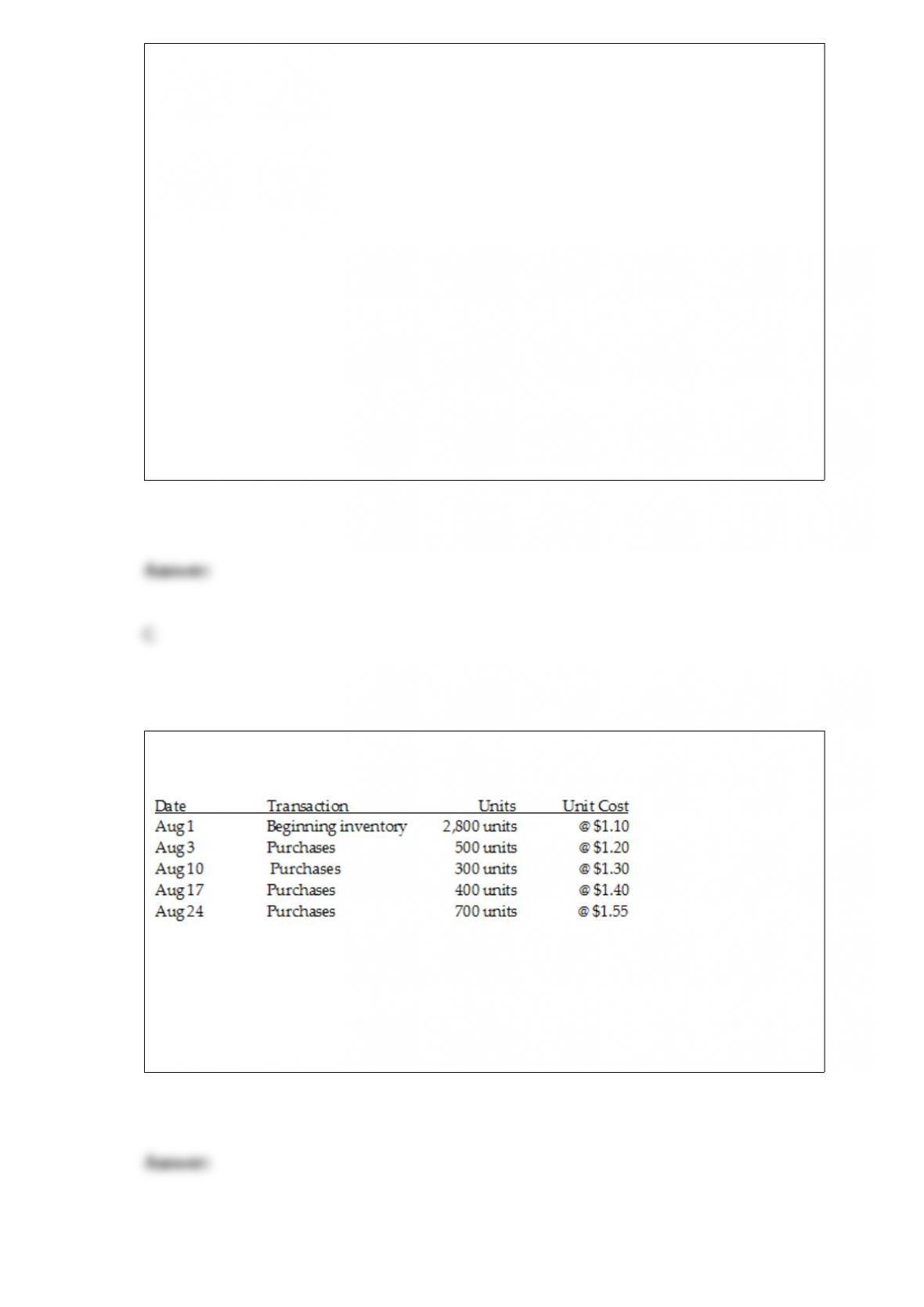
Tall Trees Gear uses the periodic inventory method and recorded the following
inventory and purchase transactions for the month of August, 20X3.
Determine the ending inventory balance at August 31 and the cost of goods sold for the
month of August, 20X3 for Tall Trees Gear. Tall Trees Gear sold 3,200 units during
August, 20X3. On August 31, a physical inventory count was conducted, and 1,500
units were on hand. Assume the company uses the last-in-first-out (LIFO) cost flow
assumption.

In regards to physical inventory counts and valuations, it is not unusual
A) to use inventory counts to be able to journalize sales.
B) for firms to choose fiscal accounting periods to end when inventory levels are high.
C) to count inventory when inventory levels are high.
D) to count inventory twice per week.
E) for external auditors to use experts.
Which of the following statements is false?
A) Trading securities are short-term investments with unrealized gains and losses due to
changes in market value that are recognized in the income statement.
B) The unrealized gains and losses from changes in market value of available-for-sale
securities are not recognized in the income statement, but rather are carried in a separate
account in the stockholders’ equity section.
C) Held-to-maturity securities are always classified as long-term investments.
D) Available for sale securities are accounted for at market value.
E) Held-to-maturity securities are accounted for at amortized cost.