
1) If you only earned interest on your initial investment, and not on previously earned
interest, it would be called simple interest.
2) The firm’s cost of capital may also be referred to as the firm’s opportunity cost of
capital.
3) The hedging principle involves the use of hedge funds to manage the firm’s working
capital.
4) For a given constant required rate of return, the greatest portion of a preferred
stockholder’s return comes from increases in the price of preferred stock.
5) A currency swap is the exchange of principal and interest in one currency for the
same in another currency for an agreed period of time.
6) Bonds issued in a country different from the one in which the currency of the bond is
denominated are called Eurobonds.
7) Calculating the modified internal rate of return on an Excel spreadsheet involves the
use of the IRR function multiple times, once using the financing rate, and once using
the reinvestment rate.

8) The cost of debt used in the international investment decision is the lesser of the
parent’s or the subsidiary’s cost of debt.
9) The terms of sale identify the possible discount for early payment, the discount
period, and the total credit period.
10) The percent of sales method provides a more detailed plan for future financing
needs than the cash budget because both pro forma income statements and balance
sheets are used in the analysis.
11) Liquidity refers to the ability to quickly convert an asset into cash without lowering
the selling price.
12) Capital markets are all the financial institutions that help a business raise long-term
capital.
13) Negative historical returns are not possible during periods of high volatility (high
standard deviations of returns) due to the risk-return tradeoff.
14) In general, common stock and preferred stock are both valued by calculating the
present value of all expected future cash flows, using the required return as the discount

rate.
15) If a project is acceptable using the NPV criterion, then it will also be acceptable
using the discounted payback period since both methods use discounted cash flows to
make the accept/reject decision.
16) The clientele effect does not imply that either high or low dividends are optimal,
rather that firm’s should not make significant and arbitrary changes in their existing
dividend policy.
17) The present value of an annuity increases as the discount rate increases.
18) The required return of a preferred stockholder, rps, is higher than the cost of
preferred stock for the corporation because stockholder’s must pay federal taxes on their
dividend income.
19) Different discounted cash flow evaluation methods may provide conflicting
rankings of investment projects when
A) the size of investment outlays differ
B) the projects are mutually exclusive
C) the accounting policies differ
D) the internal rate of return equals the cost of capital

20) John Box Inc. has an annual interest expense of $30,000 and pays income tax equal
to 40 percent of taxable income (EBT). John Box’s times-interest-earned ratio is 4.2.
What is John Box’s net income?
A) $96,000
B) $57,000
C) $126,000
D) $57,600
21) The Sarbanes-Oxley Act of 2002, in order to protect investors, requires a higher
level of accountability for which of the following groups?
A) corporate officers
B) public accountants
C) boards of directors
D) all of the above
22) Beta is a statistical measure of
A) unsystematic risk
B) total risk
C) the standard deviation
D) the relationship between an investment’s returns and the market return
23) The law of one price suggests that all of the following will have the same price in
different countries EXCEPT
A) oil
B) grain
C) fresh vegetables
D) silver
24) The return on the market portfolio is currently 12%. Mobile Phone Corporation
stockholders require a rate of return of 30% and the stock has a beta of 3.2. According
to CAPM, determine the risk-free rate.
A) 9.80%
B) 6.50%

C) 4.64%
D) 3.82%
25) Prior to 1973 the exchange rates between the major currencies of the world were
A) on a floating exchange rate system
B) on an arbitrage exchange rate system
C) on a fixed exchange rate system
D) on a spot exchange rate system
26) Calculate the effective cost of the following trade credit terms if the discount is
forgone and payment is made on the net due date.
a.2/10 net 50
b.2/15 net 60
c.2/20 net 45
27) CraftCo, Inc.’ projected sales for the first six months of 2012 are given below:
Jan.$500,000April$490,000
Feb.$740,000May$740,000
Mar.$380,000June$610,000
40% of sales are collected in cash at time of sale, 50% are collected in the month
following the sale, and the remaining 10% are collected in the second month following
the sale. Cost of goods sold is 60% of sales. Purchases are made in the month prior to
the sales, and payments for purchases are made in the month of the sale. Total other
cash expenses are $40,000/month. The company’s cash balance as of February 28, 2012
will be $25,000. Excess cash will be used to retire short-term borrowing (if any).
CraftCo, Inc. has no short term borrowing as of February 28, 2012. Assume that the
interest rate on short-term borrowing is 1% per month. The company must have a
minimum cash balance of $15,000 at the beginning of each month. What is CraftCo,
Inc.’ earnings before interest and taxes for April 2012?
A) $156,000
B) $142,000
C) $133,000
D) $ 93,000
28) Increased depreciation expenses affect tax-related cash flows by
A) increasing taxable income, thus increasing taxes
B) decreasing taxable income, thus reducing taxes
C) decreasing taxable income, with no effect on cash flow since depreciation is a
non-cash expense
D) pushing a corporation into a higher tax bracket
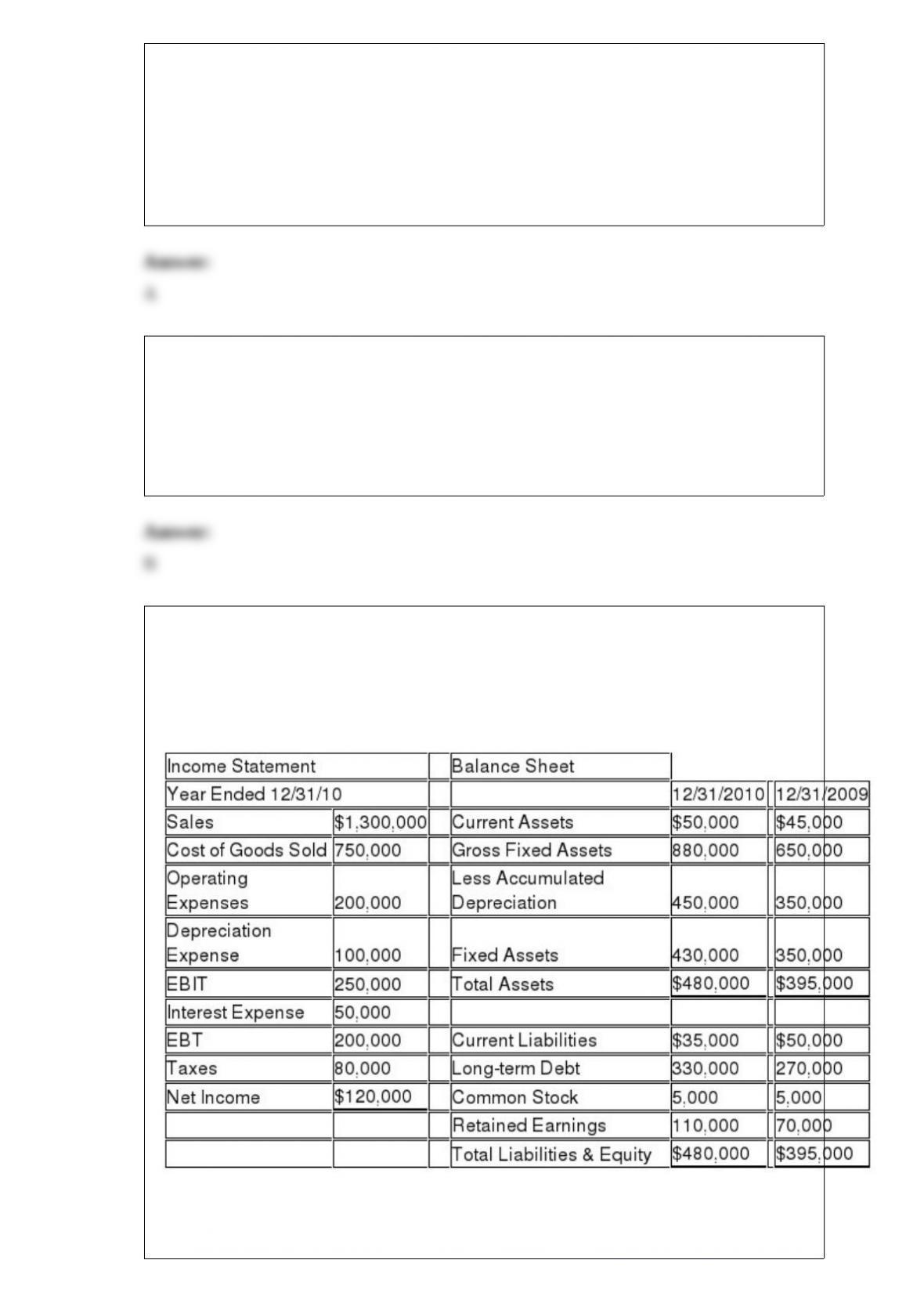
29) Given the following financial statements for ARGON Corporation, and assuming
that ARGON paid a common dividend of $80,000 in 2010, what is the company’s
financing cash flow for 2010?
A) -$10,000
B) -$15,000
C) -$65,000

D) -$70,000
30) Company A and Company B have the same gross profit margin and the same total
asset turnover, but company A has a higher return on equity. This may result from
A) Company B has more common stock
B) Company A has a lower debt ratio
C) Company A has lower selling and administrative expenses, resulting in a higher net
profit margin
D) Company A has lower cost of goods sold, resulting in a higher net profit margin
31) GHJ Inc. is investing in a major capital budgeting project that will require the
expenditure of $16 million. The money will be raised by issuing $2 million of bonds, $4
million of preferred stock, and $10 million of new common stock. The company
estimates is after-tax cost of debt to be 7%, its cost of preferred stock to be 9%, the cost
of retained earnings to be 14%, and the cost of new common stock to be 17%. What is
the weighted average cost of capital for this project?
A) 12.20%
B) 13.12%
C) 13.75%
D) 14.23%
32) You hold a portfolio with the following securities:
Expected
SecurityValueBetaReturn
Driscol Corporation20%3.2036.0%
Evening Corporation40%1.6020.0%
Frolic Corporation40%.206.0%
What is the expected return for the portfolio?
A) 17.60%
B) 20.67%
C) 23.54%
D) 28.59%
33) Matterhorn, Inc. had the following sales for the past six months. Matterhorn collects
its credit sales 30% in the month of sale, 60% one month after the sale, and 10% two
months after the sale.
Cash SalesCredit Sales
January$50,000$50,000
February$70,000$110,000
March$55,000$95,000
April$78,000$130,000
May$80,000$105,000
June$75,000$148,000
What are Matterhorn’s total cash receipts for the month of March?
A) $99,500
B) $119,000
C) $150,000
D) $154,500
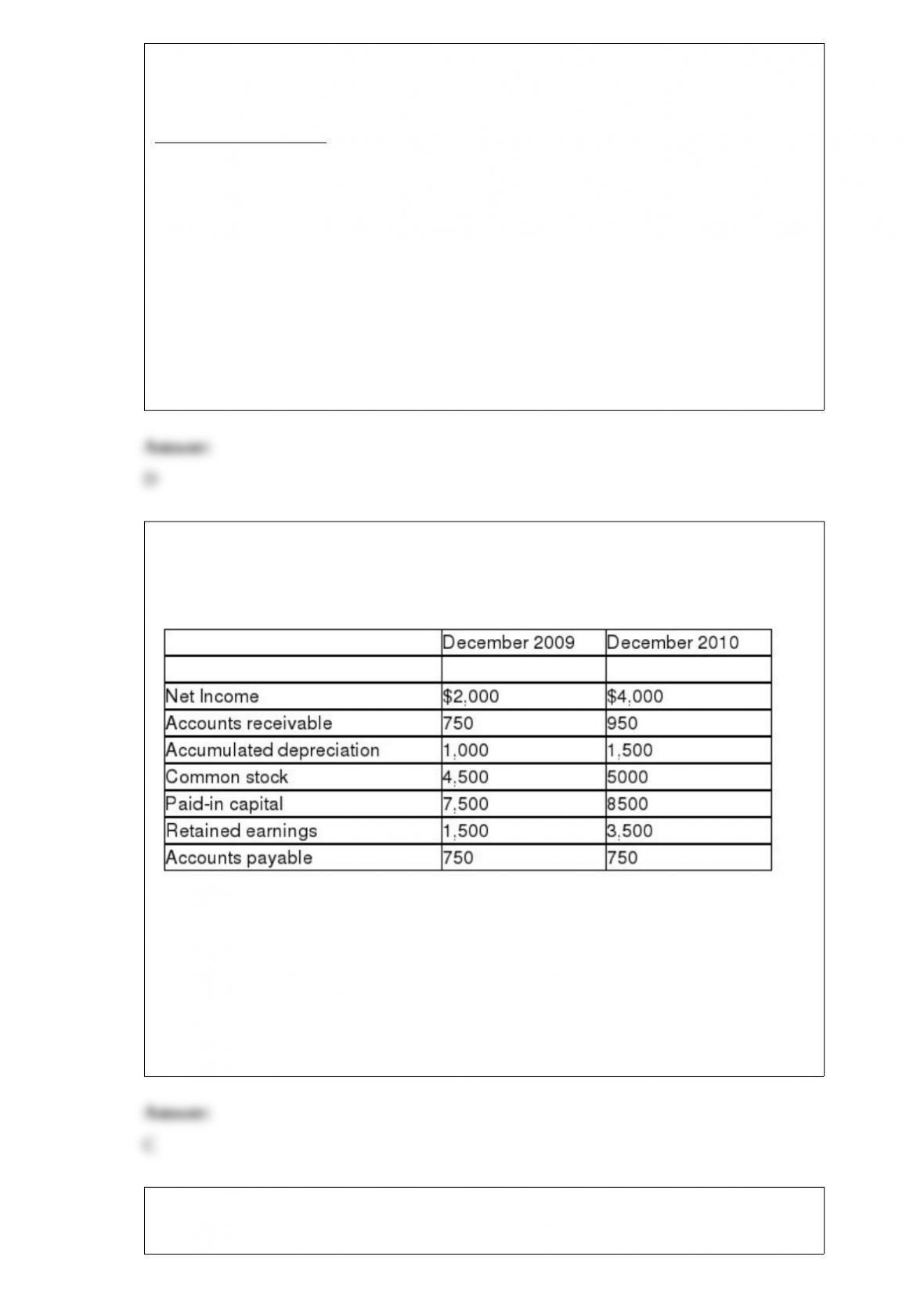
34) Table 3-1
Jones Company
Financial Information
Based on the information in Table 3-1, assuming that no common stock was
repurchased during the year, the firm issued how much new common stock during
2010?
A) $500
B) $1,000
C) $1,500
D) $2,000
35) A company that forgoes the discount when credit terms are 2/10 net 60 is essentially
borrowing money from his supplier for an additional

A) 10 days
B) 50 days
C) 60 days
D) 70 days
36) Your firm is considering investing in one of two mutually exclusive projects.
Project A requires an initial outlay of $3,500 with expected future cash flows of $2,000
per year for the next three years. Project B requires an initial outlay of $2,500 with
expected future cash flows of $1,500 per year for the next two years. The appropriate
discount rate for your firm is 12% and it is not subject to capital rationing. Assuming
both projects can be replaced with a similar investment at the end of their respective
lives, compute the NPV of the two chain cycle for Project A and three chain cycle for
Project B.
A) $2,232 and $85
B) $5,000 and $1,500
C) $2,865 and $94
D) $3,528 and $136
37) Which of the following accounts belong in the liability section of a balance sheet?
A) interest expense
B) accumulated depreciation
C) accounts payable
D) preferred stock
38) Except for the effects of small transaction costs, the forward premium or discount
should be equal and opposite in size to the difference in the national interest rates for
securities of the same maturity. What is the name of this theory?
A) the purchasing power parity theory
B) the Bobby Fisher effect
C) interest rate parity theory
D) the law of one price
39) Determining the best way to raise money to fund a firm’s long-term investments is

called
A) the capital budgeting decision
B) the portfolio decision
C) the money flow processing decision
D) the capital structure decision
40) Perrine Industrial Inc. just paid a dividend of $5 per share. Future dividends are
expected to grow at a constant rate of 7% per year. What is the value of the stock if the
required return is 16%?
A) $33.44
B) $55.56
C) $59.44
D) $65.87
41) Which of the following statements best represents the “Agency Problem”?
A) Managers might attempt to benefit themselves in terms of salary and perquisites at
the expense of shareholders
B) The agency problem results from the separation of management and the ownership
of the firm
C) The agency problem may interfere with the implementation of maximizing
shareholder wealth
D) all of the above
42) Cash inflows come from
A) purchase of marketable securities
B) purchase of fixed assets
C) credit sales
D) cash sales
43) Table 3-1
Jones Company
Financial Information
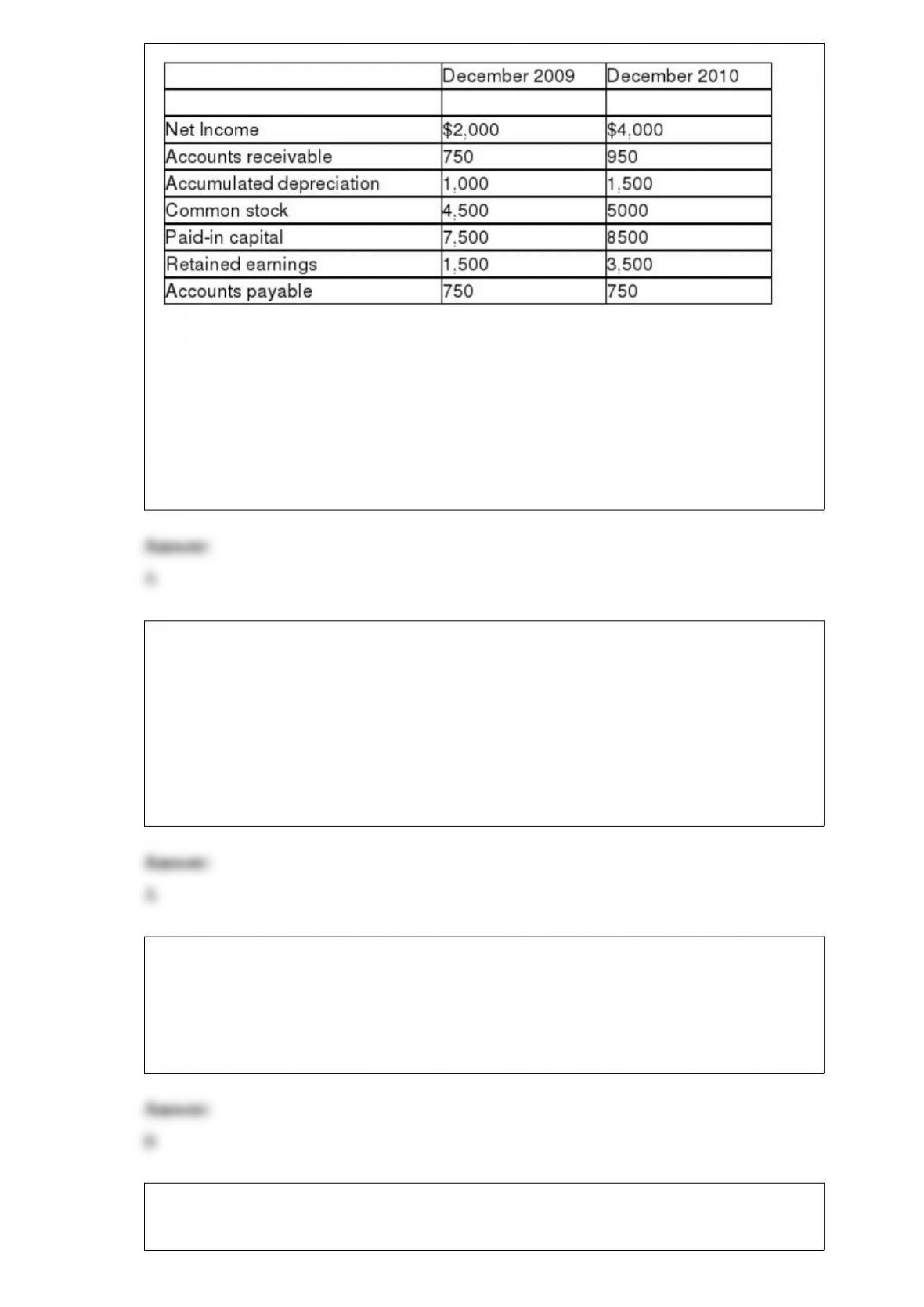
Based on the information in Table 3-1, calculate the after tax cash flow from operations
for 2008 (no assets were disposed of during the year, and there was no change in
interest payable or taxes payable).
A) $4,300
B) $1,450
C) $5,500
D) $6,250
44) You are 21 years old today. Your grandparents set up a trust fund that will pay you
$25,000 per year for 20 years, starting on your 65th birthday to supplement your
retirement. If the trust can earn 7.5% per year, how much will your grandparents need
to put in the trust fund today (rounded to the nearest ten dollars)?
A) $11,370
B) $22,310
C) $5,250
D) $17,450
45) A corporation’s operating profit margin is equal to
A) net income divided by sales
B) EBIT divided by sales
C) EBIT divided by net income
D) sales divided by EBIT
46) Which of the following accounts does NOT belong in the equity section of a
balance sheet?

A) retained earnings
B) paid-in-surplus
C) long-term debt
D) preferred stock
47) Which of the following measures the average relationship between a stock’s returns
and the market’s returns?
A) coefficient of validation
B) standard deviation
C) geometric regression
D) beta coefficient
48) In perfect capital markets there
A) is no informational content assigned to a particular dividend policy
B) are no income taxes
C) are no flotation costs
D) all of the above
49) Simpson Conglomerates borrows $12,000 for a short-term purpose. The loan will
be repaid after 120 days, with Simpson paying a total of $12,400. What is the
approximate cost of credit using the APR, or annual percentage rate, calculation?
A) 3.33%
B) 4.00%
C) 10.00%
D) 11.75%
50) You are analyzing the purchase of new equipment. Since you are not an expert on
this type of equipment, you hire a consulting firm to make recommendations. The
consultant charged you $1,500 and recommended the purchase of the latest model from
ACME Corp. of America. The equipment costs $80,000, and it will cost another
$10,000 to modify it for special use by your firm. The equipment will be depreciated on
a straight-line basis over six years with no salvage value. You expect the equipment will
be sold after three years for $28,000. Use of the equipment will require an increase in

your company’s net working capital of $4,000, but this $4,000 will be recovered at the
end of year three. The use of the equipment will have no effect on revenues, but it is
expected to save the firm $50,000 per year in before-tax operating costs. Your
company’s marginal tax rate is 35%. What is the initial outlay required to fund this
project?
A) $80,000
B) $84,000
C) $90,000
D) $94,000