1) Which variance is commonly associated with measuring the cost of under- or
over-utilization of plant capacity?
A.The variable-overhead spending variance
B.The variable-overhead efficiency variance
C.The fixed-overhead budget variance
D.The fixed-overhead volume variance
E.The total fixed-overhead variance
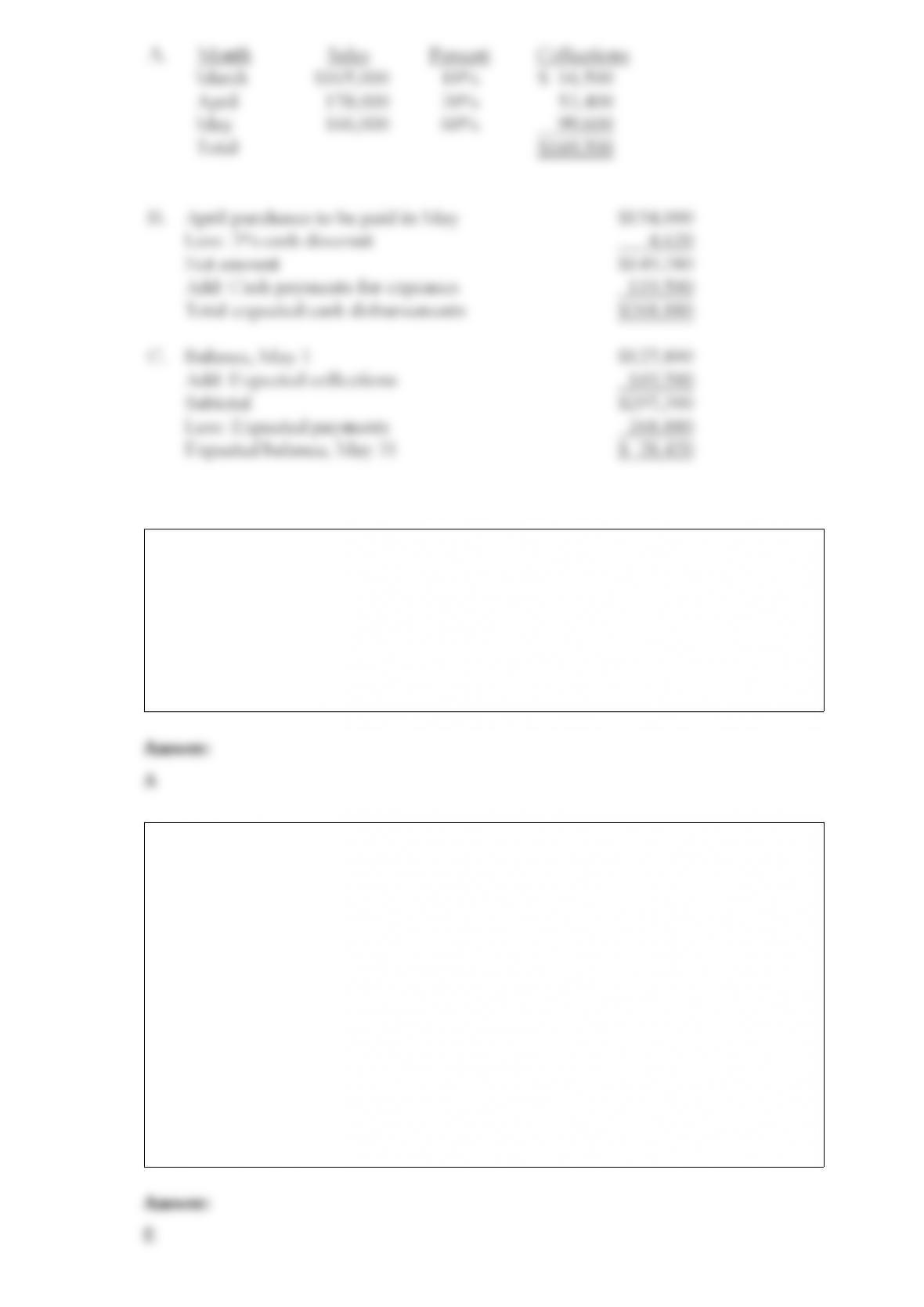
2) Bentson Corporation, a wholesaler, provided the following information:
Customers pay 60% of their balances in the month of sale, 30% in the month following
sale, and 10% in the second month following sale. The company pays all invoices in the
month following purchase and takes advantage of a 3% discount on all amounts due.
Cash payments for operating expenses in May will be $119,500; Bentson’s cash balance
on May 1 was $127,800.
Required:
Determine the following:
A. Expected cash collections during May.
B. Expected cash disbursements during May.
C. Expected cash balance on May 31 .
3) Mideast Motors manufactures automobiles. Which of the following would not be
classified as direct materials by the company?
A.Wheel lubricant
B.Tires
C.Interior leather
D.CD player
E.Sheet metal used in the automobile’s body
4) Consider the following factors:
I. The degree of correlation between consumption of an activity and consumption of a
particular cost driver.
II. The likelihood that a particular cost driver will induce a desired behavioral effect.
III. The likelihood that a particular cost driver will cause an increase in the cost of
measurement.
Which of these factors should be considered in the selection of a cost driver?
A.I only
B.I and II
C.I and III
D.II and III
E.I, II, and III

5) Chesley Corporation, which uses least-squares regression analysis, has derived the
following regression equation for estimates of manufacturing overhead: Y = 495,000 +
5.65X. Which of the following statements is true if the primary cost driver is machine
hours?
A.Total manufacturing overhead is represented by the variable “X”
B.The company anticipates $495,000 of fixed manufacturing overhead
C.”X” is commonly known as the dependent variable
D.”X” represents the number of machine hours
E.The company anticipates $495,000 of fixed manufacturing overhead and “X”
represents the number of machine hours
6) Booster, Inc. recently conducted a least-squares regression analysis to predict selling
expenses. The company has constructed the following regression equation: Y = 329,000
+ 7.80X. Which of the following statements is false if the primary cost driver is number
of units sold?
A.The company anticipates $329,000 of fixed selling expenses
B.”Y” represents total selling expenses
C.The company expects both variable and fixed selling expenses
D.For each unit sold, total selling expenses will increase by $7.80
E.”X” represents the number of hours worked during the period
7) As activity decreases, unit variable cost:
A.increases proportionately with activity
B.decreases proportionately with activity
C.remains constant
D.increases by a fixed amount
E.decreases by a fixed amount
8) Which of the following would not typically be classified as a discretionary fixed
cost?
A.Equipment depreciation
B.Employee development (education) programs
C.Advertising
D.Outlays for research and development
E.Charitable contributions

9) In the two-stage cost allocation process, costs are assigned:
A.from jobs, to service departments, to production departments
B.from service departments, to jobs, to production departments
C.from service departments, to production departments, to jobs
D.from production departments, to jobs, to service departments
E.from the balance sheet (when goods are produced), to the income statement (when
goods are sold)
10) Strayer has a break-even point of 120,000 units. If the firm’s sole product sells for
$40 and fixed costs total $480,000, the variable cost per unit must be:
A.$4
B.$36
C.$44
D.an amount that cannot be derived based on the information presented
E.an amount other than $4, $36 or $44, but one that can be derived based on the
information presented
11) Which of the following does not minimize ordering costs when using JIT
purchasing?
A.Reducing the number of vendors
B.Negotiating long-term supply agreements
C.Making less frequent payments
D.Maintaining a safety stock
E.Eliminating inspections
12) Fester Company is considering whether to sell Retox at the split-off point or subject
it to further processing and produce a more refined product known as Retox-F. Consider
the following items:
I. The selling price of Retox-F.
II. The joint processing cost of Retox.
III. The separable cost of producing Retox-F.
Which of the above items is (are) relevant to Foster’s decision to process Retox into
Retox-F?

A.I only
B.II only
C.III only
D.I and II
E.I and III
13) Holden Industries began July with a finished-goods inventory of $48,000. The
finished-goods inventory at the end of July was $56,000 and the cost of goods sold
during the month was $125,000. The cost of goods manufactured during July was:
A.$104,000
B.$125,000
C.$117,000
D.$133,000
E.None of the other answers are correct
14) Bushnell, Inc. has a standard variable overhead rate of $4 per machine hour, with
each completed unit expected to take three machine hours to produce. A review of the
company’s accounting records found the following:
Actual variable overhead: $210,000
Variable-overhead efficiency variance: $18,000U
Variable-overhead spending variance: $30,000F
How many units did Bushnell actually produce during the period?
A.13,500
B.16,500
C.18,500
D.21,500
E.None of the other answers are correct
15) You received a $5,000 loan at the end of each of your four years of college. Aunt
Rose agreed to pay off your loans at the end of your fourth year of school. How much
will she have to pay? Assume a 4% interest rate compounded annually on student loans.
A.$20,000
B.$21,235
C.$39,930
D.$50,000
E.None of the other answers are correct
16)
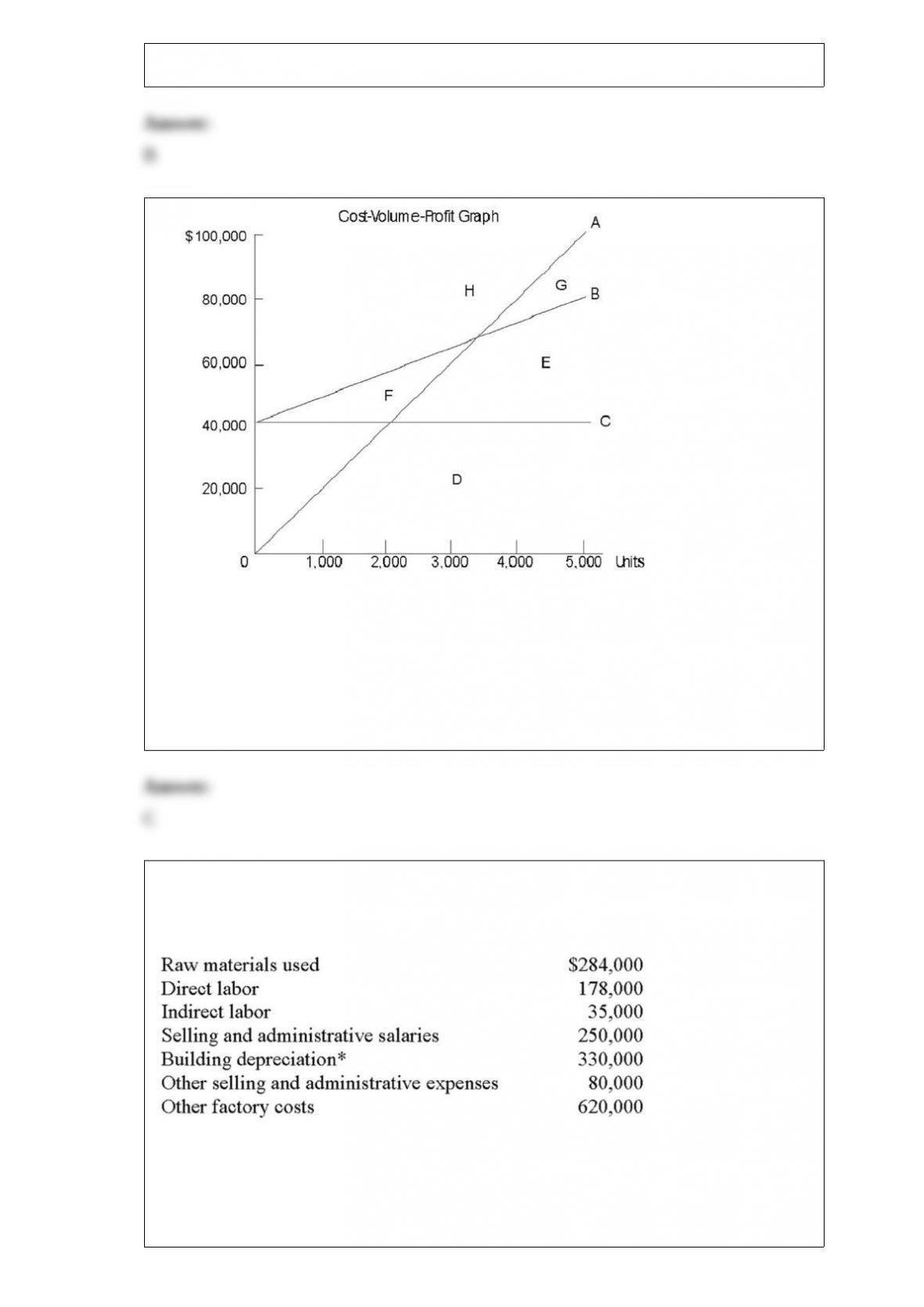
Refer to the figure above. The slope of line B is equal to the:
A.fixed cost per unit
B.selling price per unit
C.variable cost per unit
D.profit per unit
E.unit contribution margin
17) The following selected information was extracted from the 20×3 accounting records
of Medina Products
*Seventy percent of the company’s building was devoted to production activities; the
remaining 30% was used for selling and administrative functions.
Medina’s beginning and ending work-in-process inventories amounted to $306,000 and
$245,000, respectively. The company’s beginning and ending finished-goods
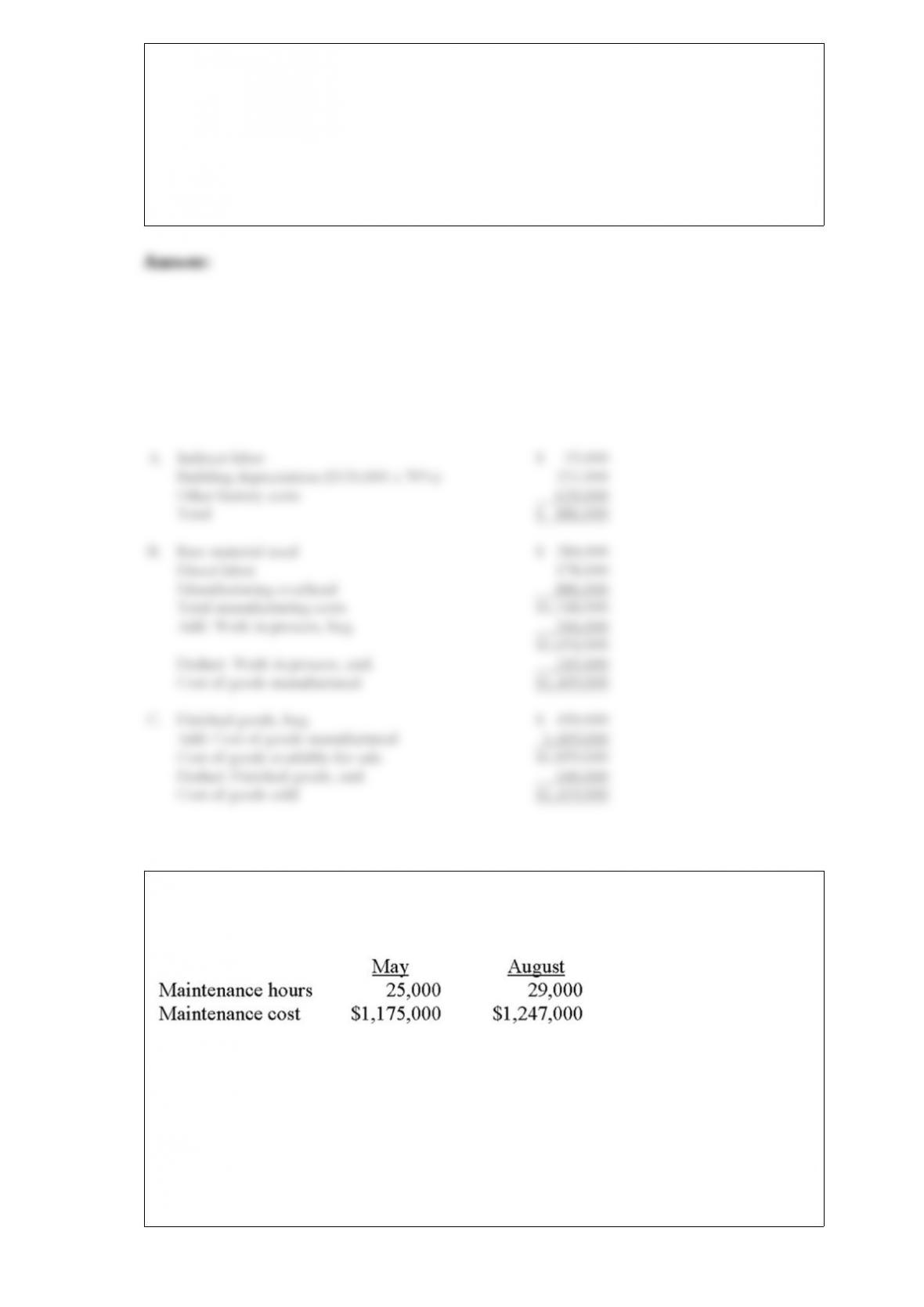
inventories were $450,000 and $440,000, respectively.
Required:
A. Calculate Medina’s manufacturing overhead for the year.
B. Calculate Medina’s cost of goods manufactured.
C. Compute Medina’s cost of goods sold.
18) The following data relate to the Lisle Company for May and August of the current
year:
May and August were the lowest and highest activity levels, and Lisle uses the high-low
method to analyze cost behavior. Which of the following statements is true?
A.The variable maintenance cost is $18 per hour
B.The variable maintenance cost is $22 per hour
C.The variable maintenance cost is $24 per hour
D.The fixed maintenance cost is $72,000 per month
E.More than one of the other answers is true
19) Information is said to be useful in decision making if it possesses three
characteristics.
Required:
A. List the three characteristics of useful information.
B. Frequently, there is a conflict between two of the characteristics requested in part
“A.” Briefly explain what this conflict is.
C. What distinguishes relevant from irrelevant information?
20) Kenyon Company produces two products (F56 and F57), applying manufacturing
overhead on the basis of direct labor hours. Anticipated unit production costs (material,
labor, and overhead) and manufacturing volumes are:
F56: 2,000 units, $234
F57: 3,500 units, $271
Kenyon’s overhead arises because of various activities, one of which is purchase-order
processing. Budgeted cost for this activity is expected to be $70,000. The firm believes
that the number of purchase orders processed is a key cost driver and expects the
following activity for its products: F56, 10 purchase orders; F57, 40 purchase orders.
Kenyon’s selling prices are based heavily on cost.
Required:
A. Activity-based costing (ABC) is said to result in improved costing accuracy when
compared with traditional costing procedures. Briefly explain how this improved
accuracy is attained.
B. Compute:
1> the pool rate for purchase-order processing.
2> the purchase-order processing cost to be charged to one unit of F56 .
C. Assume that Kenyon switched to activity-based costing and calculated total unit
production costs as follows: F56, $285; F57, $220.
1> Which of the two products, F56 or F57, was overcosted prior to the change to ABC?
No explanation is necessary.
2> Which of the two products, F56 or F57, may have been less competitive in the
marketplace prior to the change to ABC? Briefly explain.
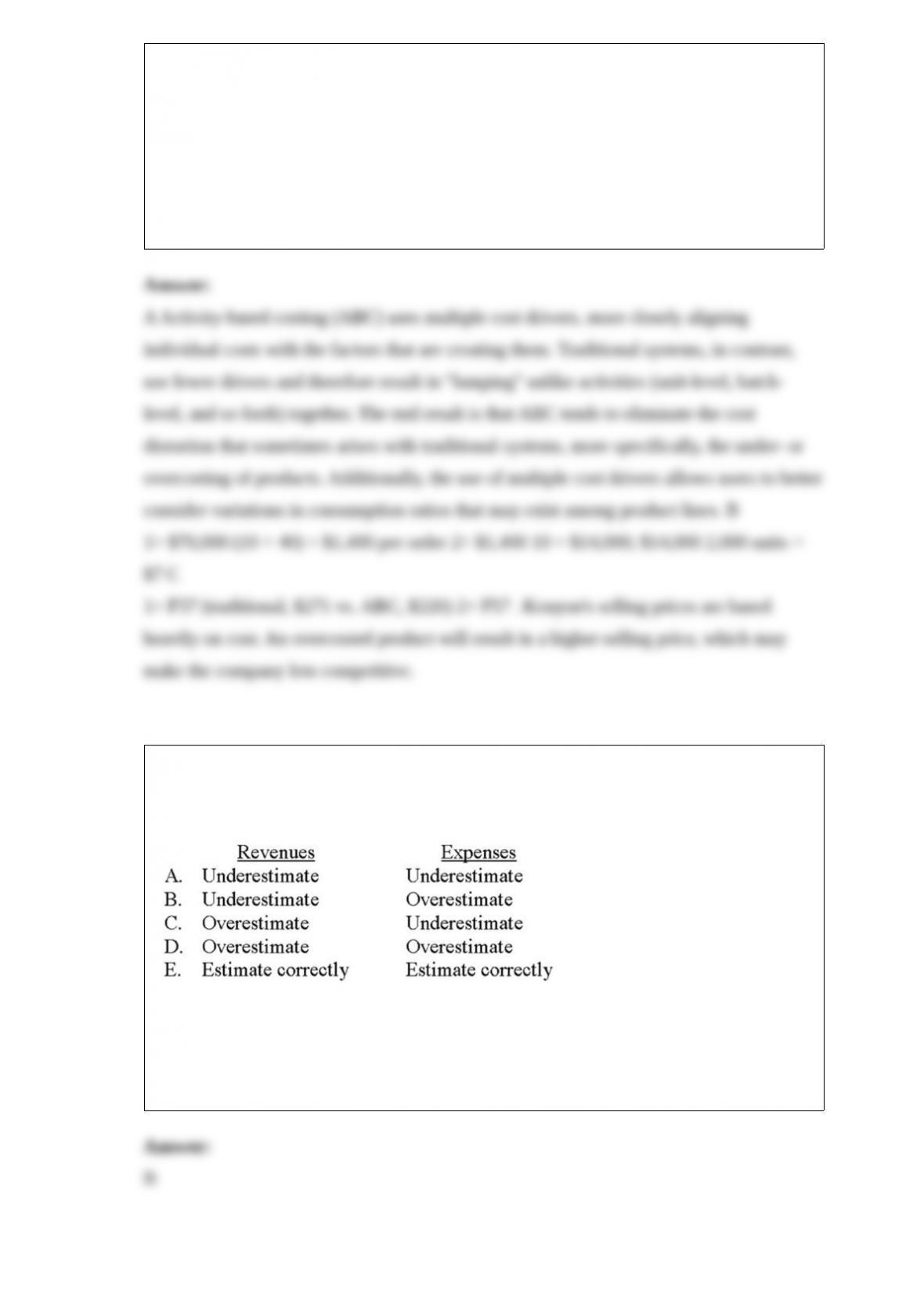
21) If a manager builds slack into a budget, how would that manager handle estimates
of revenues and expenses?
A.Choice A
B.Choice B
C.Choice C
D.Choice D
E.Choice E
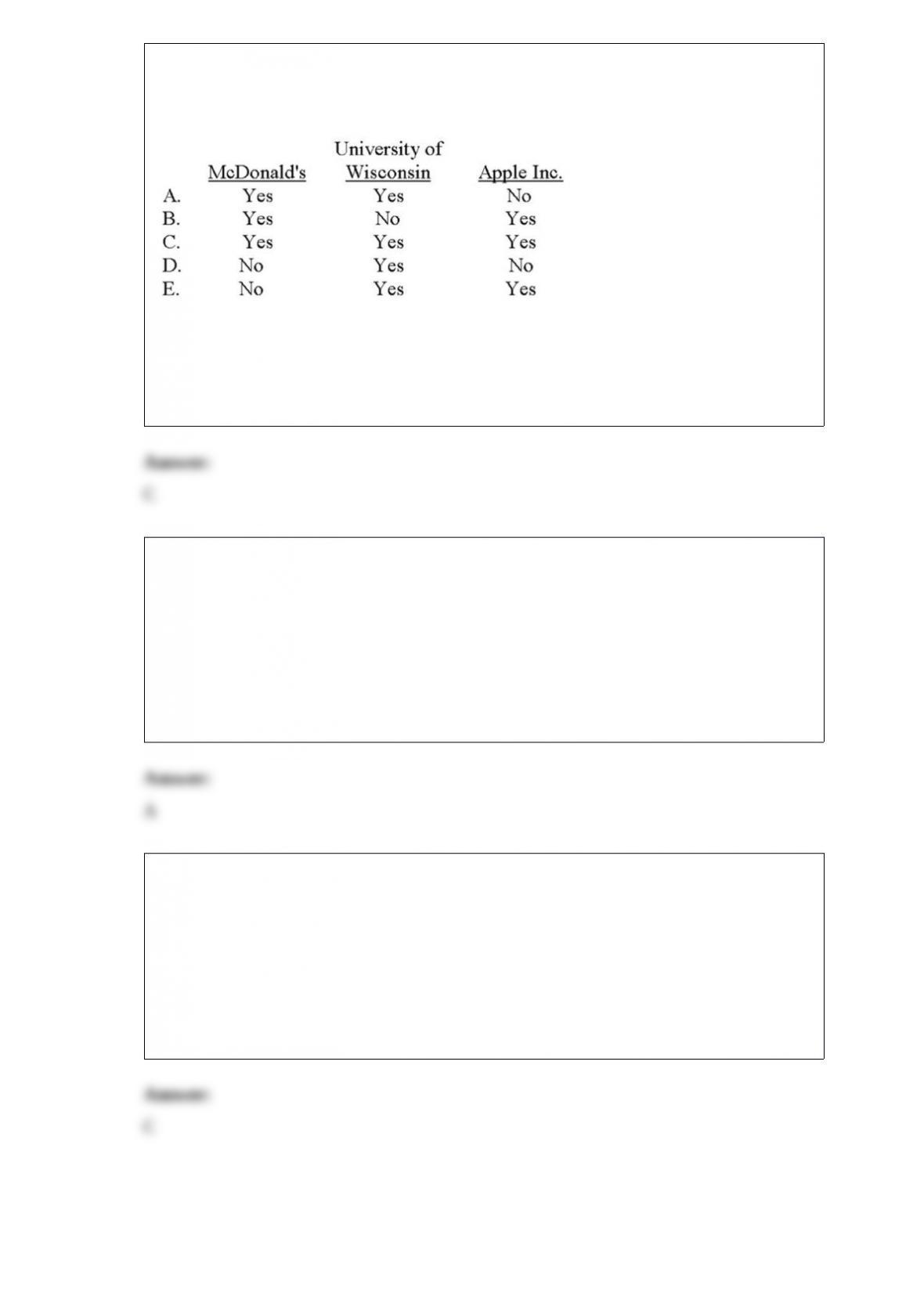
22) Which of the following choices correctly depicts whether McDonald’s, the
University of Wisconsin, and Apple Inc. would have a need for managerial accounting?
A.Choice A
B.Choice B
C.Choice C
D.Choice D
E.Choice E
23) Lassie Company uses cost-plus pricing and has calculated total variable
manufacturing cost, total absorption manufacturing cost, and total cost for one of its
products. Which of these costs would be the smallest?
A.Total variable manufacturing cost
B.Total absorption manufacturing cost
C.Total cost
D.There is no difference between total absorption manufacturing cost and total cost
E.More information is needed to correctly answer the question
24) Assume that a managerial accountant regularly communicates with business
associates to avoid conflicts of interest and advises relevant parties of potential
conflicts. In so doing, the accountant will have applied the ethical standard of:
A.objectivity
B.confidentiality
C.integrity
D.credibility
E.unified behavior
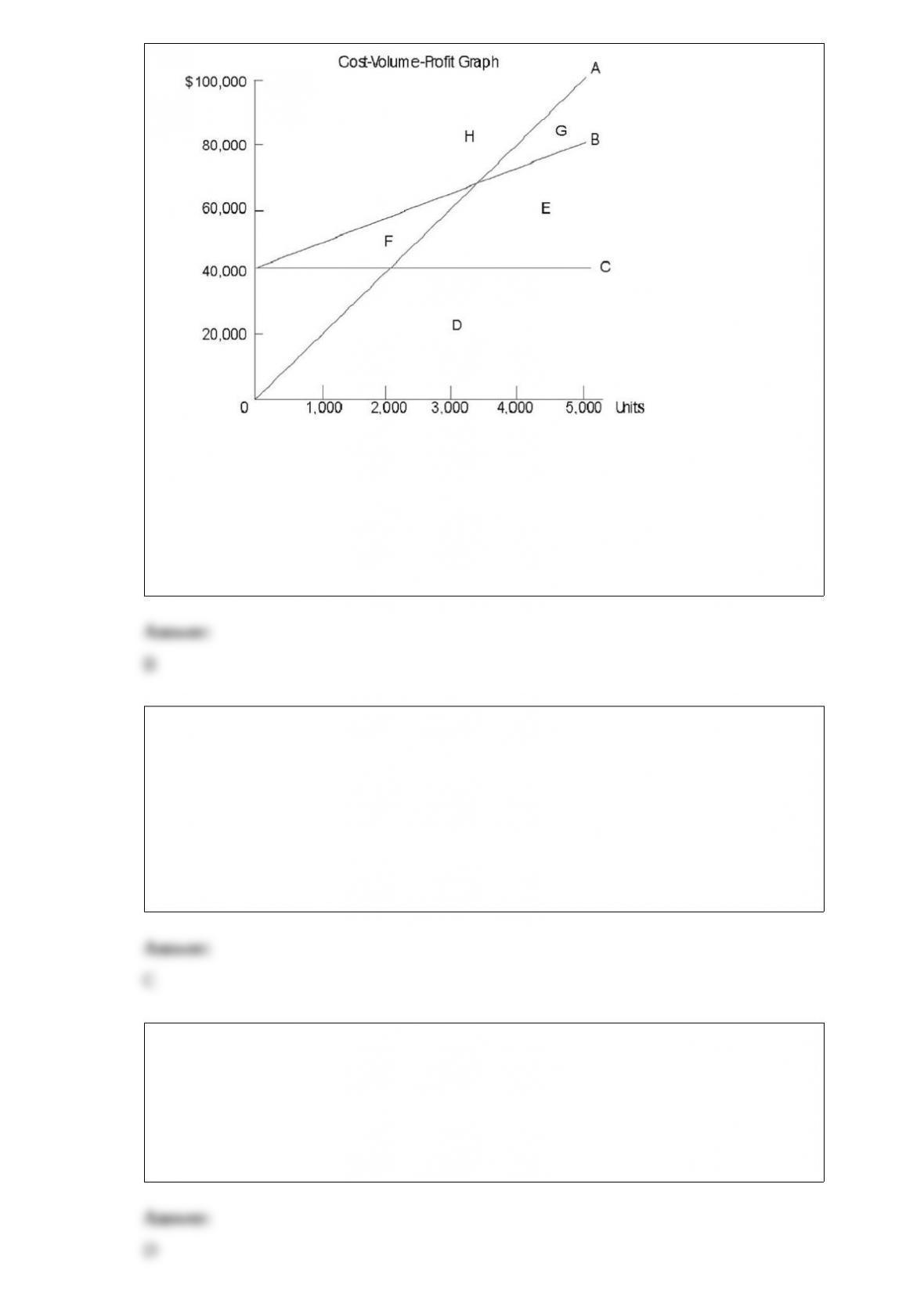
25)
Refer to the figure above. The slope of line A is equal to the:
A.fixed cost per unit
B.selling price per unit
C.profit per unit
D.variable cost per unit
E.unit contribution margin
26) Lawson, Inc. sells a single product for $12. Variable costs are $8 per unit and fixed
costs total $360,000 at a volume level of 60,000 units. Assuming that fixed costs do not
change, Lawson’s break-even point would be:
A.30,000 units
B.45,000 units
C.90,000 units
D.negative because the company loses $2 on every unit sold
E.a positive amount other than the specific amounts given
27) The assignment of direct labor cost to individual jobs is based on:
A.an estimate of the total time spent on the job
B.actual total payroll cost divided equally among all jobs in process
C.estimated total payroll cost divided equally among all jobs in process
D.the actual time spent on each job multiplied by the wage rate
E.the estimated time spent on each job multiplied by the wage rate

28) Which of the following statements is (are) true regarding a company that has
implemented flexible manufacturing systems and activity-based costing?
I. The company has erred, as these two practices used in conjunction with one another
will severely limit the firm’s ability to analyze costs over the relevant range.
II. Costs formerly viewed as fixed under traditional-costing systems may now be
considered variable with respect to changes in cost drivers such as number of setups,
number of material moves, and so forth.
III. As compared with the results obtained under a traditional-costing system, the
concept of break-even analysis loses meaning.
A.I only
B.II only
C.III only
D.I and II
E.II and III
29) Under which of the following condition(s) are prices said to be elastic?
A.Choice A
B.Choice B
C.Choice C
D.Choice D
E.Choice E
30) St. Helena Cellars produces wine in northern California. Consider the following
selected costs that arose during the current year:
1> Safety costs at winery
2> Truckload shipping costs
3> Building maintenance costs
4> Bottle and cork cost
5> Development cost of new, after-dinner wine
6> Tasting and testing costs
Required:
A. Briefly distinguish between unit-level and product-sustaining activities.
B. Classify the six costs listed as arising from a unit-level, batch-level,
product-sustaining, or facility-level activity.
31) Sunk costs and opportunity costs are inherent in decision making.
Required:
A. Define the terms ‘sunk cost” and “opportunity cost.”
B. How are sunk costs treated when making decisions?
C. “Information about sunk costs can be found in the financial statements and
accounting records; however, information about opportunity costs is omitted.” Do you
agree with this statement? Explain.
32) Which of the following statements best describes the relationship between the
sales-forecasting process and the master-budgeting process?
A.The sales forecast is typically completed after completion of the master budget
B.The sales forecast is typically completed approximately halfway through the
master-budget process
C.The sales forecast is typically completed before the master budget and has no impact
on the master budget
D.The sales forecast is typically completed before the master budget and has little
impact on the master budget
E.The sales forecast is typically completed before the master budget and has significant
impact on the master budget
33) Algeria Transport Company has average invested capital of $800,000 and a target
return on investment of 15%. The total cost per unit is $20 based on a volume level of
25,000 units. Albany’s markup percentage on total cost is:
A.9.375%
B.24.0%
C.47.5%
D.62.5%
E.none of the other answers are correct
34) Rowe Corporation reported the following variances for the period just ended:
Variable-overhead spending variance: $50,000U
Variable-overhead efficiency variance: $28,000U
Fixed-overhead budget variance: $70,000U
Fixed-overhead volume variance: $30,000U
If Rowe prepared an overhead cost performance report, which of these overhead
variances is likely to be excluded from the report?
A.Variable-overhead spending variance
B.Variable-overhead efficiency variance
C.Fixed-overhead budget variance
D.Fixed-overhead volume variance
E.None of the variances would be excluded
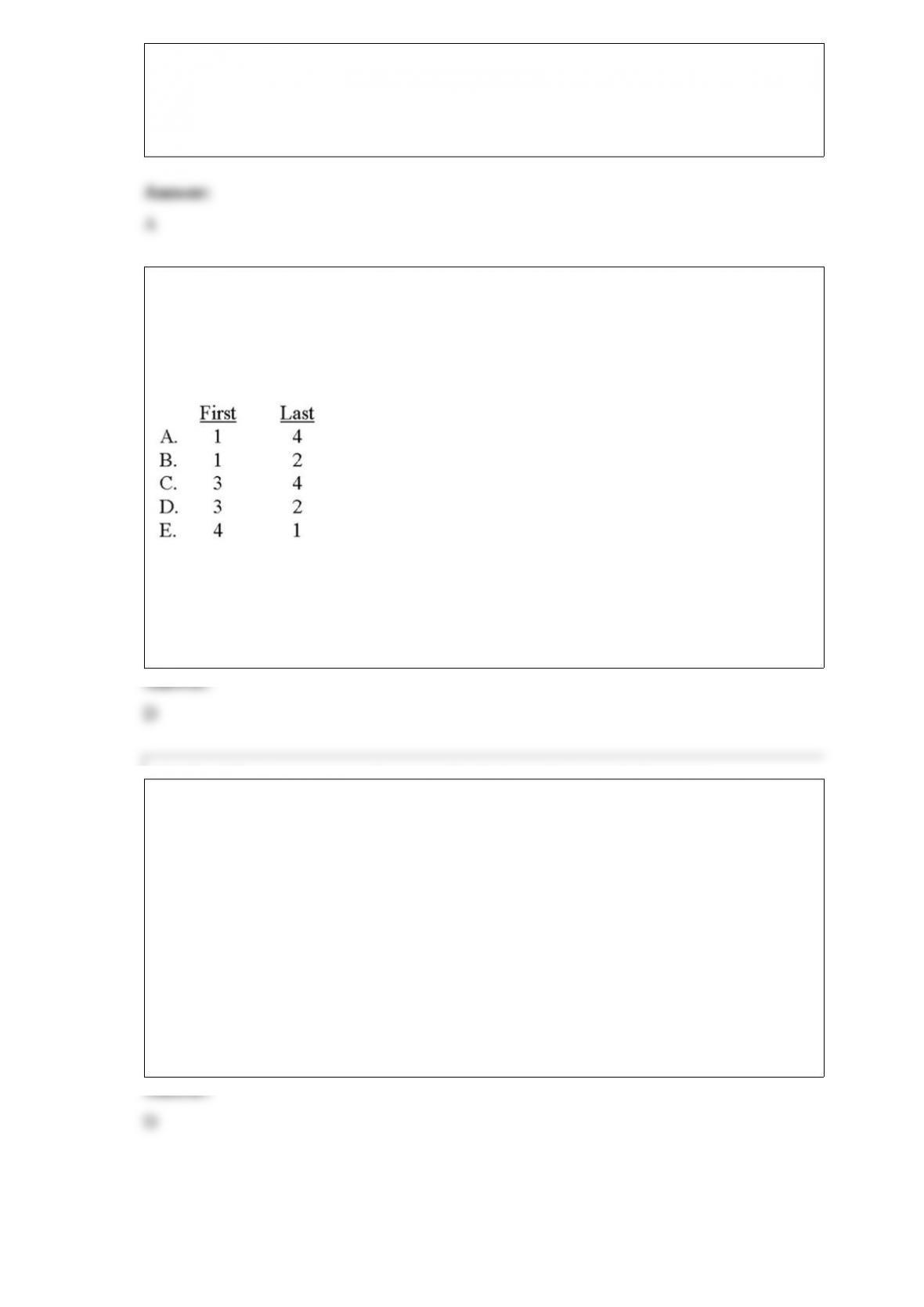
35) You are analyzing Becker Corporation and Newton Corporation and have
concluded that Becker has a higher operating leverage factor than Newton. Which one
of the following choices correctly depicts (1) the relative use of fixed costs (as opposed
to variable costs) for the two companies and (2) the percentage change in income
caused by a change in sales?
A.Choice A
B.Choice B
C.Choice C
D.Choice D
E.Choice E
36) The master budget contains the following components, among others: (1)
direct-material budget, (2) budgeted balance sheet, (3) production budget, and (4) cash
budget. Which of these components would be prepared first and which would be
prepared last?
A.Choice A
B.Choice B
C.Choice C
D.Choice D
E.Choice E
37) The following costs are relevant to the decision situation cited except:
A.the cost of hiring a full-time staff attorney, in a decision to establish an in-house legal
department or retain the services of a prominent law firm
B.the remodeling cost of existing office space, in a firm’s decision to stay at its current
location or move to a new building
C.the long-term salary costs demanded by Joe Torrez (a superstar) and Rip Moran (an
average player) in baseball contract negotiations, in a decision that determines the
amounts by which ticket prices must be raised
D.the cost to enhance an airline’s Web site, in a decision to expand existing service to
either Salt Lake City or Phoenix
E.the commissions that could be earned by a salesperson, in a decision that involves
salesperson compensation methods (i.e., commissions or flat monthly salaries)