1) a netting center necessarily implies that the mnc has a central cash manager.
2) many of the skills necessary for effective cash management are the same regardless
of whether the firm has only domestic operations or if it operates internationally.
3) edge act banks are not prohibited from owning equity in business corporations,
unlike domestic commercial banks.
4) an edge act bank is typically located in a state different from that of its parent in
order to get around the prohibition on interstate branch banking.
5) eurobonds sold in the united states may not be sold to u.s. citizens.
6) public traders do not trade directly with one another in a dealer market.
7) a put option on $15,000 with a strike price of 10,000 is the same thing as a call
option on 10,000 with a strike price of $15,000.
8) an income tax is a direct tax.
9) shareholders of u.s. targets experience higher wealth gains when they are acquired by
foreign firms than when acquired by u.s. firms.
10) under the monetary/nonmonetary method, revenue and expense items associated
with nonmonetary accounts, such as cost of goods sold and depreciation, are translated
at the historical rate associated with the balance sheet account.
11) the cash manager of a domestic firm should source funds internationally to obtain
the lowest borrowing cost and to place excess funds wherever the greatest return can be
earned regardless of currency.
12) forfaiting meets islamic finance practices.
13) a multilateral netting system is beneficial in reducing the number of and the
expense associated with interaffiliate foreign exchange transactions.
14) a central cash manager has a global view of the most favorable borrowing rates and
most advantageous investment rates.
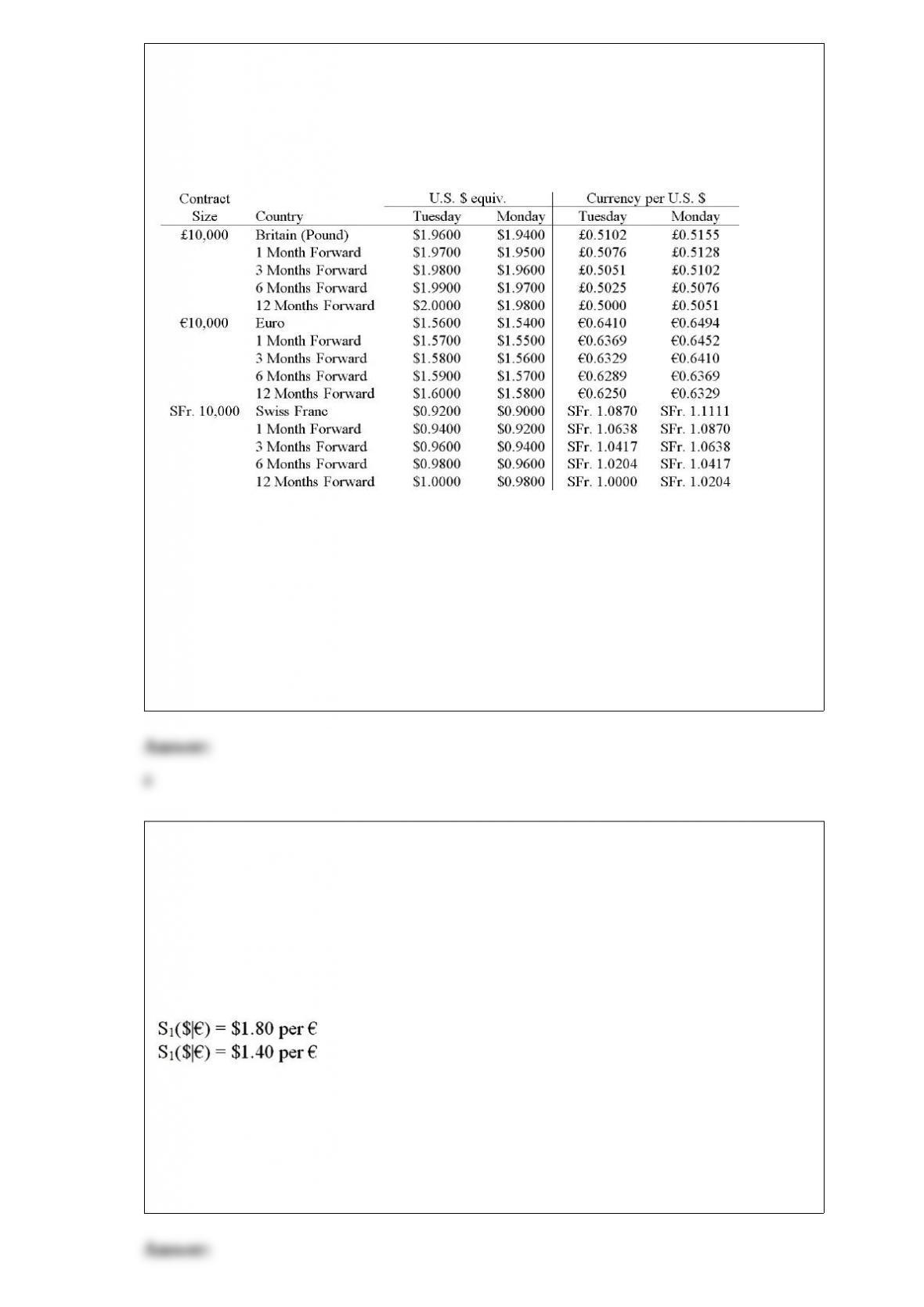
15) your firm is a u.k.-based exporter of bicycles. you have sold an order to a swiss firm
for sfr. 1,000,000 worth of bicycles. payment from the swiss firm (in swiss francs) is
due in 12 months. detail a strategy using futures contracts that will hedge your
exchange rate risk. have an estimate of how many contracts of what type and maturity.
a.go short 100 12-month swiss franc futures contracts; and long 50 12-month pound
futures contracts
b.go long 100 12-month swiss franc futures contracts; and short 50 12-month pound
futures contracts
c.go short 100 12-month swiss franc futures contracts; and short 50 12-month pound
futures contracts
d.go long 100 12-month swiss franc futures contracts; and long 50 12-month pound
futures contracts
e.none of the above
16) an american hedge fund is considering a one-year investment in an italian
government bond with a one-year maturity and a euro-denominated rate of return of i =
5%. the bond costs 1,000 today and will return 1,050 at the end of one year without
risk. the current exchange rate is 1.00 = $1.50. u.s. dollar-denominated government
bonds currently have a yield to maturity of 4%. suppose that the european central bank
is considering either tightening or loosening its monetary policy. it is widely believed
that in one year there are only two possibilities:
following revaluation, the exchange rate is expected to remain steady for at least
another year
find the irr in dollars for the american firm if they wait one year to buy the bond after
the exchange rate falls to s1($|) = $1.40 per . assume that i doesn’t change.
17) the large exchange markets in the united states are
a.agency markets
b.call markets
c.auction markets
d.agency/auction markets
18) relative to the spot price the forward price will be
a.usually less than the spot price
b.usually more than the spot price
c.usually equal to the spot price
d.usually less than or more than the spot price more often than it is equal to the spot
price
19) recent studies show that when investors control exchange risk by using currency
forward contracts,
a.they can substantially enhance the efficiency of international bond portfolios
b.they can substantially enhance the efficiency of international stock portfolios
c.the risk of investing in foreign stock markets is can be completely hedged
d.both a and b
20) the current exchange rate is £1.00 = $2.00. compute the correct balances in bank a’s
correspondent account(s) with bank b if a currency trader employed at bank a buys
£45,000 from a currency trader at bank b for $90,000 using its correspondent
relationship with bank b.
a.bank a’s dollar-denominated account at b will rise by $90,000
b.bank b’s dollar-denominated account at a will fall by $90,000
c.bank a’s pound-denominated account at b will rise by £45,000
d.bank b’s pound-denominated account at a will rise by £45,000
21) straight fixed-rate bond issues have
a.a designated maturity date at which the principal of the bond issue is promised to be
repaid. during the life of the bond, fixed coupon payments, which are a percentage of
the face value, are paid as interest to the bondholders
b.a designated maturity date at which the principal of the bond issue is promised to be
repaid. during the life of the bond, coupon payments, which are a percentage of the face
value, are computed according to a fixed formula
c.a fixed payment, which amortizes the debt, like a house payment or car payment
d.none of the above
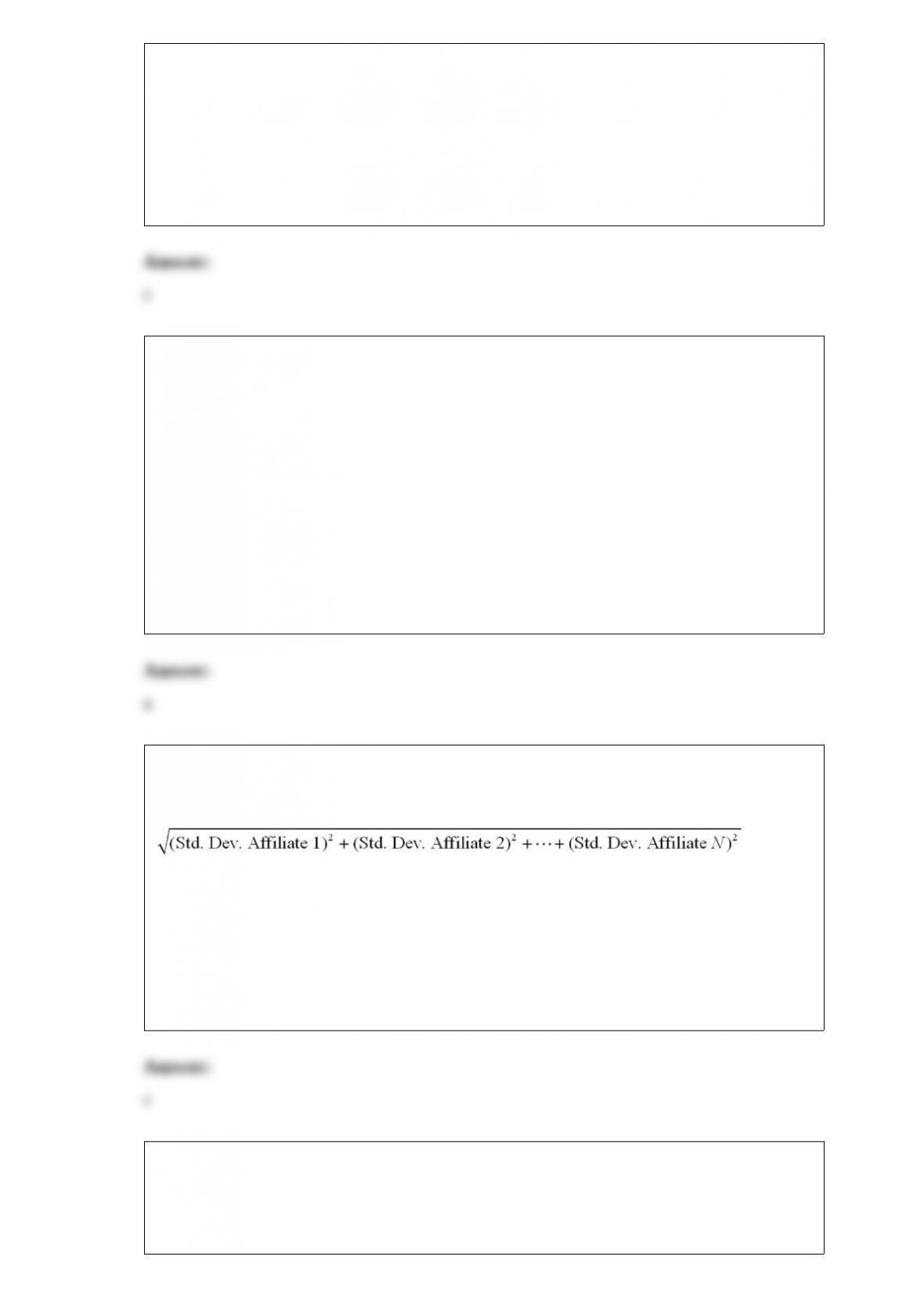
22) the formula for the standard deviation of cash held by the centralized depository for
n affiliates is
a.the formula assumes that interaffiliate cash flows have a correlation coefficient of -1
b.the formula assumes that interaffiliate cash flows have a correlation coefficient of +1
c.the formula assumes that interaffiliate cash flows have a correlation coefficient of 0
d.none of the above
23) the required return on equity for a levered firm is 10.60%. the debt to equity ratio is
the tax rate is 40%, the pre-tax cost of debt is 8%. find the cost of capital if this firm
were financed entirely with equity.
a.10%

b.12%
c.8.67%
d.none of the above
24) mnc stands for
a.multinational corporation
b.multi-nationalized corporation
c.military national cooperation
25) in the event of a default on one side of a futures trade,
a.the clearing member stands in for the defaulting party
b.the clearing member will seek restitution for the defaulting party
c.if the default is on the short side, a randomly selected long contract will not get paid.
that party will then have standing to initiate a civil suit against the defaulting short
d. both a and b
26) in recent years,
a.the u.s. dollar has appreciated substantially against most major currencies of the
world, especially against the euro
b.the u.s. dollar has depreciated substantially against most major currencies of the
world, especially against the euro
c.the u.s. dollar has maintained its value against most major currencies of the world,
especially against the euro

27) suppose mexico is a major export market for your u.s.-based company and the
mexican peso depreciates drastically against the u.s. dollar, as it did in december 1994.
this means that
a.your company’s products can be priced out of the mexican market, as the peso price of
american imports will rise following the peso’s fall
b.your firm will be able to charge more in dollar terms while keeping peso prices stable
c.your domestic competitors will enjoy a period of facing little price competition from
mexican imports
d.both b and c are correct
28) the underlying philosophy of the monetary/nonmonetary method is that
a.monetary accounts have a similarity because their value represents a sum of money
whose currency equivalent after translation is independent of exchange rate changes
b.monetary accounts have a similarity because their value represents a sum of money
whose currency equivalent after translation changes each time the exchange rate
changes
c.assets and liabilities should be translated based on their maturity
d.most income statement items are translated at the average exchange rate for the
period. depreciation and cost of goods sold, however, are translated at historical rates if
the associated balance sheet accounts are carried at historical costs
29) will an arbitrageur facing the following prices be able to make money?
a.yes, borrow 1,000,000 at 3.65%; trade for $ at the bid spot rate $1.40 = 1.00; invest at
4.1%; hedge this with a long position in a forward contract
b.yes, borrow $1,000,000 at 4.2%; trade for at the spot ask exchange rate $1.43 = 1.00;
invest 699,300.70 at 3.5%; hedge this by going short in forward (agree to sell @ bid
price of $1.44/ in one year). cash flow in 1 year $237.76
c.no; the transactions costs are too high

d.none of the above
30) in 1992, the enron development corporation, a subsidiary of the houston-based
energy company, signed a contract to build the largest-ever power plant in india,
requiring a total investment of $2.8 billion. after enron had spent nearly $300 million,
the project was canceled by hindu nationalist politicians in the maharashtra state where
the plant was to be built. which of the following are true?
a.upon the news release of the project cancellation, enron’s share price fell immediately
by about 10 percent
b.in the process of structuring the deal, enron made a profound political miscalculation:
instead of waiting for the next election results, enron rushed to close the deal and began
construction, apparently believing that a new government would find it difficult to
unwind the deal when construction was already under way
c.enron had the last laugh, however when they went bankrupt and left the power plant
unfinished
d.all of the above
31) factors affecting international equity returns are
a.macroeconomic variables that influence the overall economy
b.exchange rate changes
c.the industrial structure of the country
d.all of the above
32) credit entries in the u.s. balance of payments
a.result from foreign sales of u.s. goods and services, goodwill, financial claims, and
real assets
b.result from u.s. purchases of foreign goods and services, goodwill, financial claims,
and real assets
c.give rise to the demand for dollars
d.give rise to the supply of dollars
e.both a and c
33) factor income
a.consists largely of interest, dividends, and other income on foreign investments
b.is a theoretical construct of the factors of production, land, labor, capital, and
entrepreneurial ability
c.is generally a very minor part of national income accounting, smaller than the
statistical discrepancy
d.none of the above
34) intangible assets are often hard to package and sell to foreigners
a.because they usually default on the contracts that they sign
b.as a result, there is more fdi than there might otherwise be
c.because property rights in intangible assets are difficult to establish and protect,
especially in foreign countries where legal recourse may not be readily available
d.both b and c
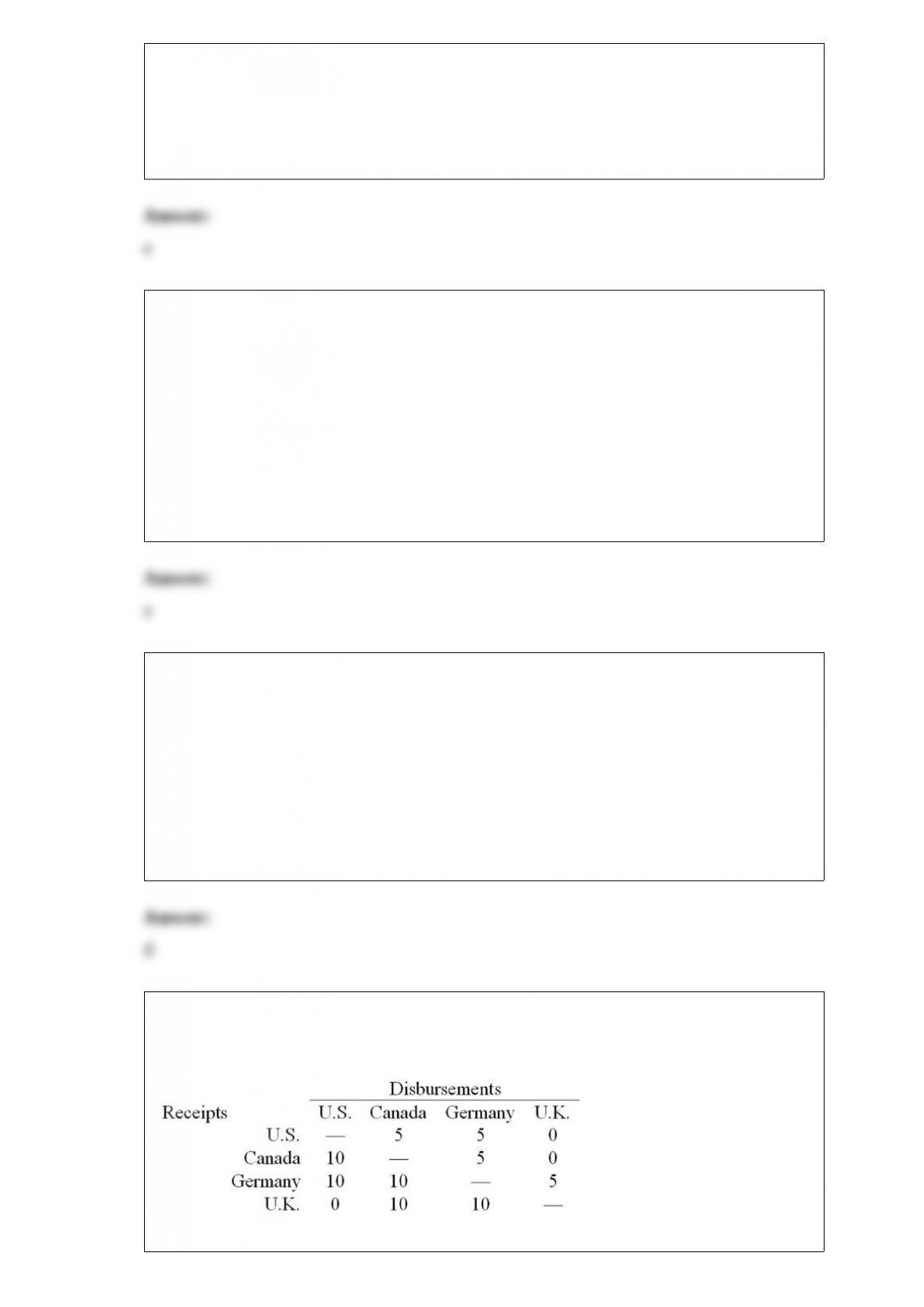
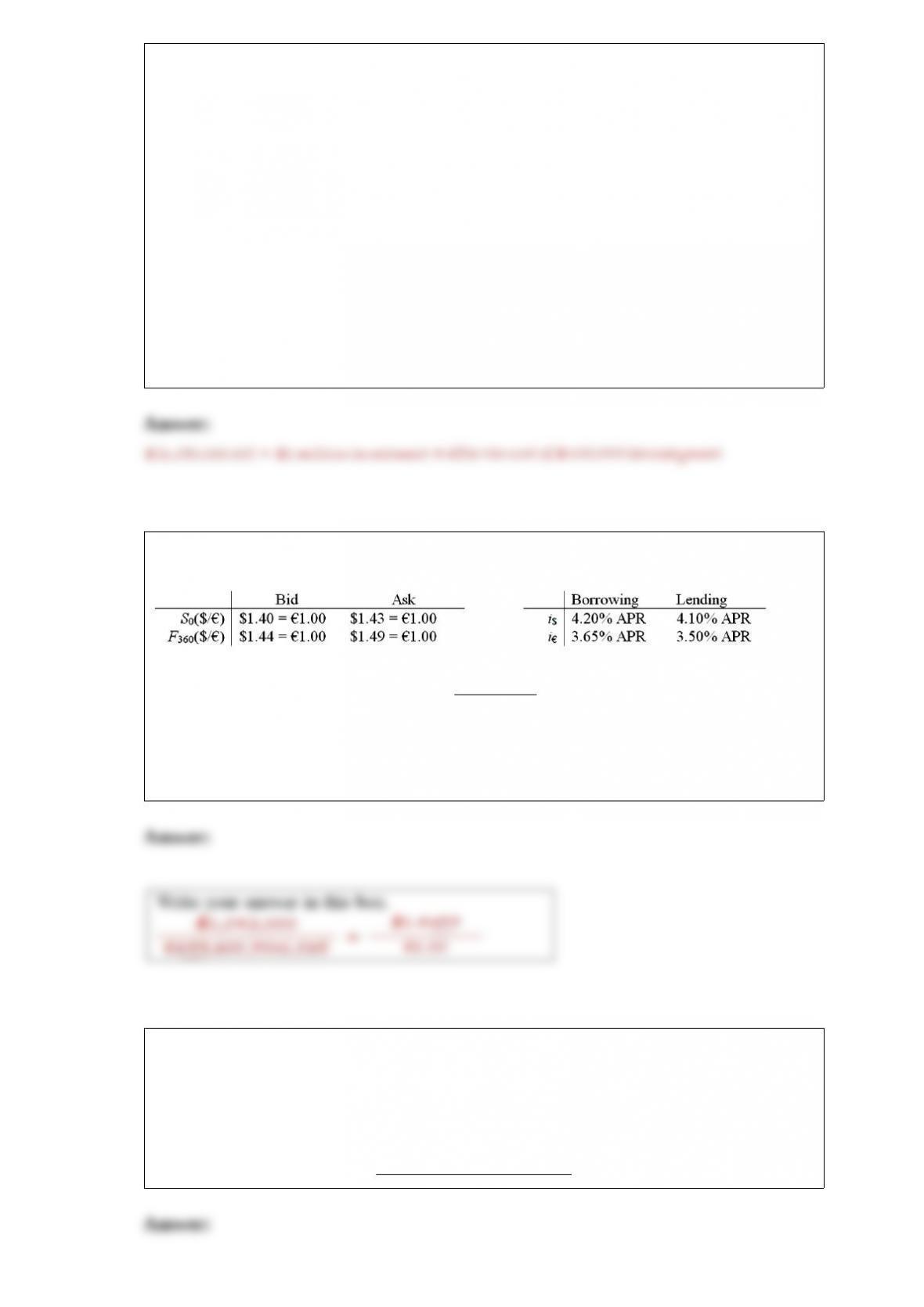
35) your firm’s interaffiliate cash receipts and disbursements matrix is shown below
($000):
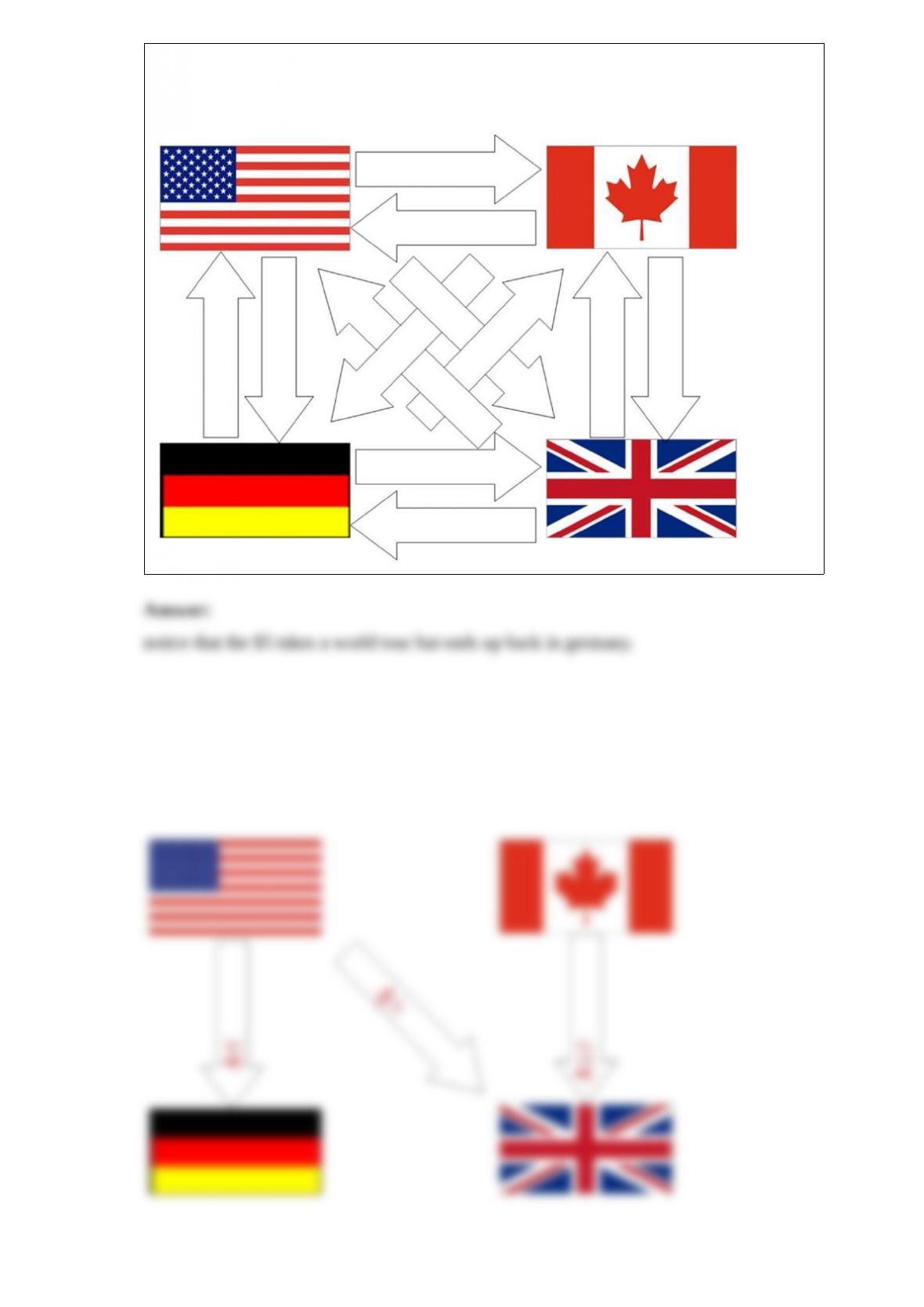
using your results to the last question, use multilateral netting to simplify.
36) your firm is based in southern ireland (and thereby operates in euro, not pounds)
and is considering an investment in the united states.
the project involves selling widgets: you project a sales volume of 50,000 widgets per
year, sales price of $20 per widget with a contribution margin of $15 per widget.
the project will last for 5 years, require an investment of $1,000,000 at time zero (which
will be depreciated straight-line to $10,000 over the 5 years). salvage value for the
equipment is projected to be $10,000. the project will operate in rented quarters:
$300,000 rent is due at the start of each year.
the corporate tax rate is 12% in ireland and 40% in the u.s.
for simplicity, assume that taxes are paid like sales taxes: immediately.
the spot exchange rate is $1.50 = 1.00. the cost of capital to the irish firm for a domestic
project of this risk is 8%. the u.s. risk-free rate is 3%; the irish risk-free rate is 2%.
what is cf0 in dollars?
37) assume that you are a retail customer.
please note that your answers are worth zero points if they do not include currency
symbols ($, )
using your previous answers and a bit more work, find the 1-year forward bid exchange
rate in $ per that that satisfies irp from the perspective of a customer.
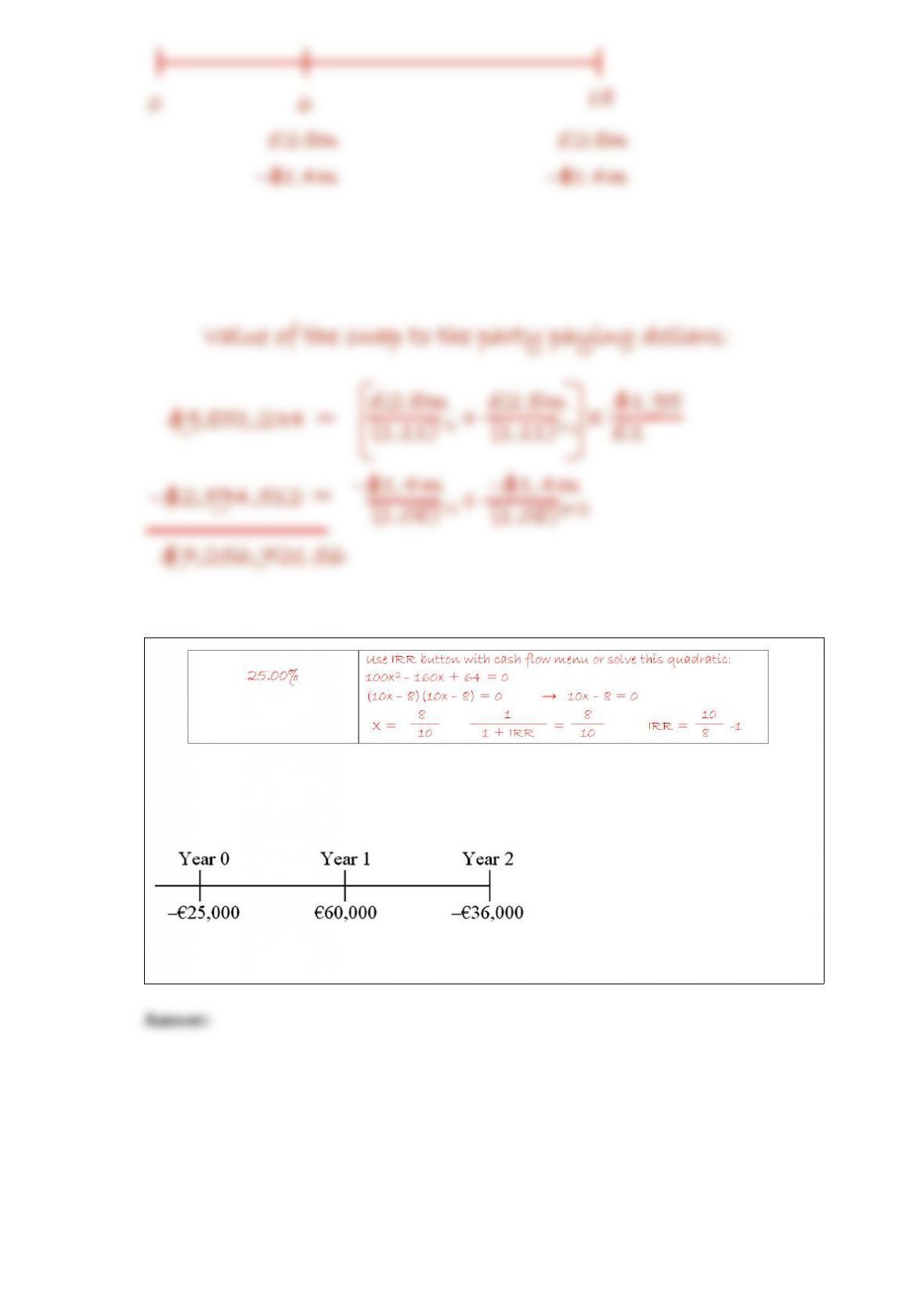
38) an interest-only currency swap has a remaining life of 18 months. it involves
exchanging interest at 14% on £20 million for interest at 10% on $14 million once a
year. the term structure of interest rates is currently flat in both the u.s. and in the u.k. if
the swap were negotiated today the interest rates exchanged would be $8% and £11%.
all rates were quoted with annual compounding. the current exchange rate is $1.95 = £1.
what is the value of the swap to the party paying dollars?
39)
consider the following international investment opportunity. it involves a gold mine that
can be opened at a cost, then produces a positive cash flow, but then requires
environmental clean-up:
find the euro-zone cost of capital to compute is the dollar-denominated npv of this
project.