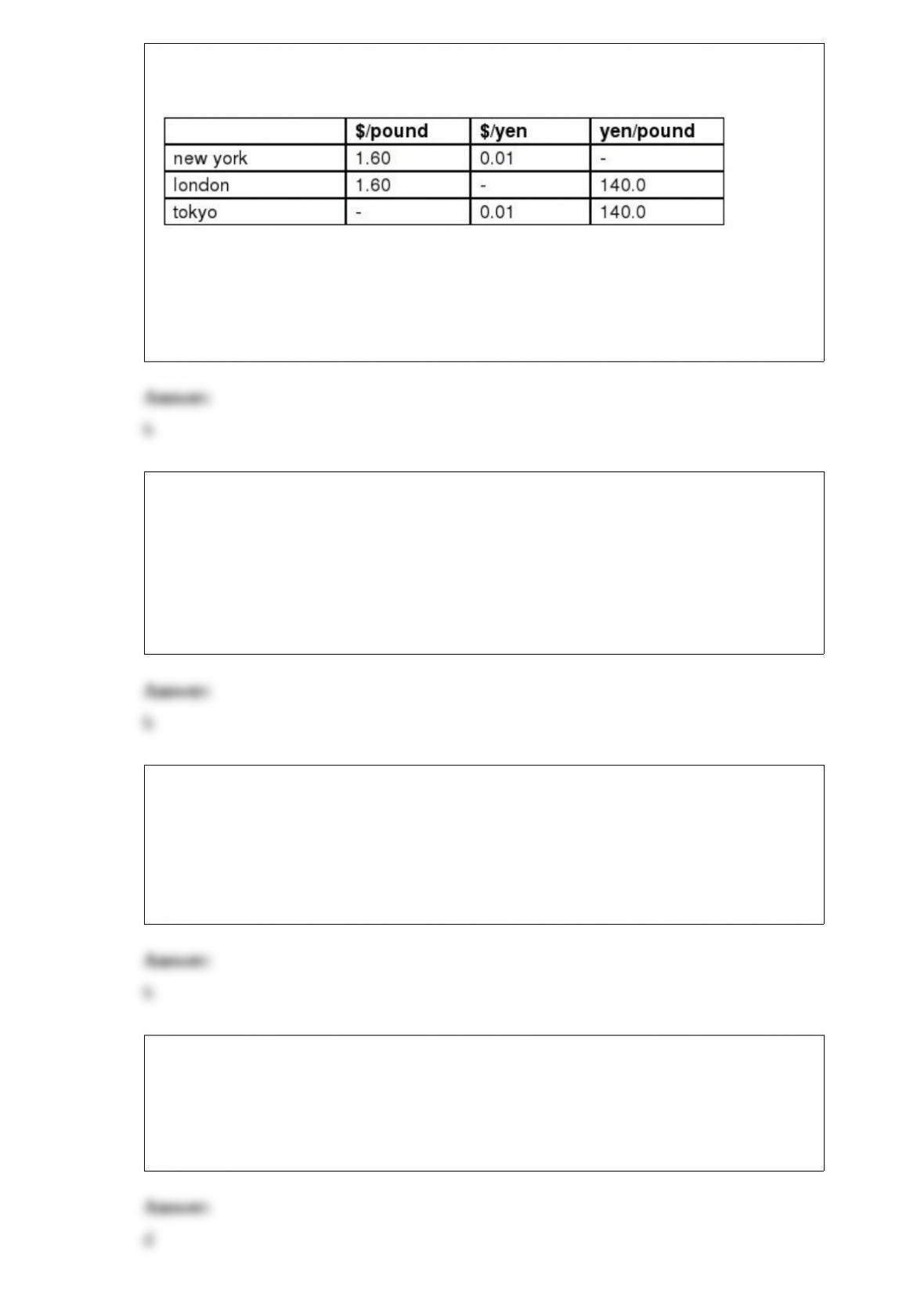
1) assume that the following exchange rates exist for the u.s. dollar, japanese yen and
the british pound.
if you are an arbitrageur that starts with $1,000 in new york,
a.you will buy pound in new york, because pound is cheaper in new york
b.you will buy yen in new york, because pound is more expensive in new york
c.you will buy both pound and yen in new york to spread the risk
d.there is no arbitrage opportunity in this case
2) suppose that the 1-year forward rate of dollar per peso is $11.25, the current spot rate
($/peso) is $10.00, and the expected future spot rate ($/peso) is $11.50. the forward
premium on the peso is:
a.-2.5%
b.12.5%
c.15%
d.22.75%
3) suppose the dollar is devalued. if an import contract is written in a foreign currency,
then the value of u.s. imports:
a.decrease
b.increase
c.stay the same
d.not possible to answer with the given information
4) which of the following currencies do not exist in physical form?
a.u.s. dollar
b.swiss franc
c.euro
d.special drawing rights

5) if imports exceed exports, then:
a.private saving exceeds public saving
b.private saving plus public saving exceed domestic investment
c.private saving plus public saving minus domestic investment is negative
d.domestic investment is negative
6) starting from a position where a nations money demand equals the money supply and
its balance of payments is in equilibrium. according to the monetary approach to the
balance of payments, when the nations central bank increases money supply, the
balance of trade moves into ________ position and net official holding of foreign
reserves ________.
a.surplus; increases
b.surplus; decreases
c.deficit; increases
d.deficit; decreases
7) a foreign resident increasing her holdings of a u.s. financial asset causes a:
a.credit in the u.s. merchandise account
b.debit in the u.s. current account
c.credit in the u.s. private capital account
d.debit in the u.s. private capital account
8) the following example supports which extension to the monetary approach to
exchange rates: the chairman of a central bank announces a new monetary policy.
immediately, there is a change in the exchange rate.
a.news approach
b.trade balance approach
c.equilibrium approach
d.overshooting approach
9) when the value of the dollar changes from 0.75 pounds to 0.5 pounds, then the pound
has
a.appreciated against the dollar by 33.3%

b.depreciated against the dollar by 33.3%
c.appreciated against the dollar by 50.0%
d.depreciated against the dollar by 50.0%
10) suppose that the u.s. fed increases the money supply by 10%. then under maer:
a.the exchange rate (dollar/foreign currency) rises by 10%
b.the exchange rate (dollar/foreign currency) falls by 10%
c.foreign inflation rises by 10%
d.foreign inflation falls by 10%
11) suppose that an emerging economy has its currency pegged to the $. its currency is
under pressure to depreciate. to maintain a fixed exchange rate, the central bank of this
economy has to intervene by:
a.selling its currency, causing it to gain dollar reserves
b.selling its currency, causing it to lose dollar reserves
c.buying its currency, causing it to gain dollar reserves
d.buying its currency, causing it to lose dollar reserves
12) which of the following is not a contributory factor in the 2008-09 great recession?
a.the use of low introductory mortgage rates in sub-prime lending; when they expired,
the mortgagees were unable to pay the increased payments
b.mortgages being sold on by their originating organization and not being kept on its
books
c.chinese government bought too many u.s. government bonds
d.the increasing complexity and interconnectivity of financial instruments such as credit
default swaps
13) suppose interest parity holds. there is a change in u.s. policy that leads to
expectations of a lower u.s. inflation rate. the decrease in expected inflation will cause
dollar interest rates to _______.
a.stay the same

b.fall
c.rise
d.none of the above
14) figure 13-3:
using figure 13-3, which of the following is correct about the bpc (horizontal) curve?
a.it assumes perfect capital mobility
b.it assumes perfect substitutability between domestic and foreign assets
c.it represents equilibria in the balance of payment
d.all of the above are correct