
Continents are, on average, about 2 km higher than sea level.
When air is cooled to its dew point, the relative humidity is 100%.
Bright centers of solar activity are called filaments.
The concept that the earth maintained a circular orbit around the Sun was dogma during
the middle ages.

The capacity of air to “hold” water vapor is temperature dependent.
The higher the viscosity of a magma, the lower the potential for explosive eruptions.
The main destruction from shield volcanos like Kilauea in Hawaii is slow burial of
man-made feature by lava rather than explosive volcanic activity.
Abyssal plains with sediments covering the seafloor igneous rocks are more extensive
in the central Pacific basin than in the North Atlantic.

The least massive main-sequence stars are blue in color.
Much of the original free oxygen in the atmosphere combined with iron dissolved in
water to become iron oxide.
Precipitation associated with a cold front is usually more intense and shorter in duration
than precipitation generated by a warm front.

Subduction only occurs when oceanic rocks are forced beneath a continent.
The capacity of a stream measures the maximum size of particles it is capable of
transporting.
Oceanic crust has a mafic composition and therefore is denser than continental crust.
Stratified drift is sorted by glacial ice as the glacier begins to melt and drop its load of
sediment.

When unstable air is forced to rise, towering clouds and stormy conditions are expected.
Lava always erupts violently, but magma often flows quietly.
If the temperature drops and the amount of moisture in the air remains unchanged, the
relative humidity will increase.

The radioactive isotope, potassium-40, has argon-40 as a daughter product.
The particles in breccia are primarily silt sized.
Stars spend most of their life span as main-sequence stars.
When Earth is the farthest from the Sun, it is said to be in the perihelion position.

An eclipse of the Moon can be seen by anyone on the side of Earth facing the Moon.
Low pressure at the surface also requires low pressure aloft for air to continue to flow
toward the low.
The atmosphere of Mars is less dense than Earth’s, but dust storms and sand dunes
indicate wind action occurs on Mars.
A baymouth bar is a manmade feature designed to control wave erosion.

When a wave arrives at an irregular shoreline, the wave front remains straight as it
impinges on the shore.
The Coriolis effect influences wind speed but not wind direction.
Radiometric data was the key to modern geology replacing catastrophism.

Blue stars are cooler than red stars.
Monoclines, anticlines, synclines and domes are all examples of ________.
A) faulting
B) jointing
C) flow
D) foliation
Organisms contribute to soils formation by ________.
A) contributing organic matter to the soil
B) degrading organic matter to form humus
C) stirring the soil to allow air infiltration
D) all of the above

In terrain with steep hill slopes, which crop and cultivation technique will minimize soil
erosion?
A) corn; rows trending straight down the slope, frequent cultivation
B) apples; land between the trees is planted in grass and not cultivated
C) winter wheat; after the harvest, the field is plowed and left idle until next fall
D) bean; rows are spaced wider than on a level field
Between 25 and 35 latitude, salinity is likely to be ________.
A) high
B) low
C) average
D) seasonally variable
Which of the following is determined by measuring the amplitude of waves recorded
from an earthquake?
A) epicenter
B) focus or hypocenter
C) magnitude
D) intensity
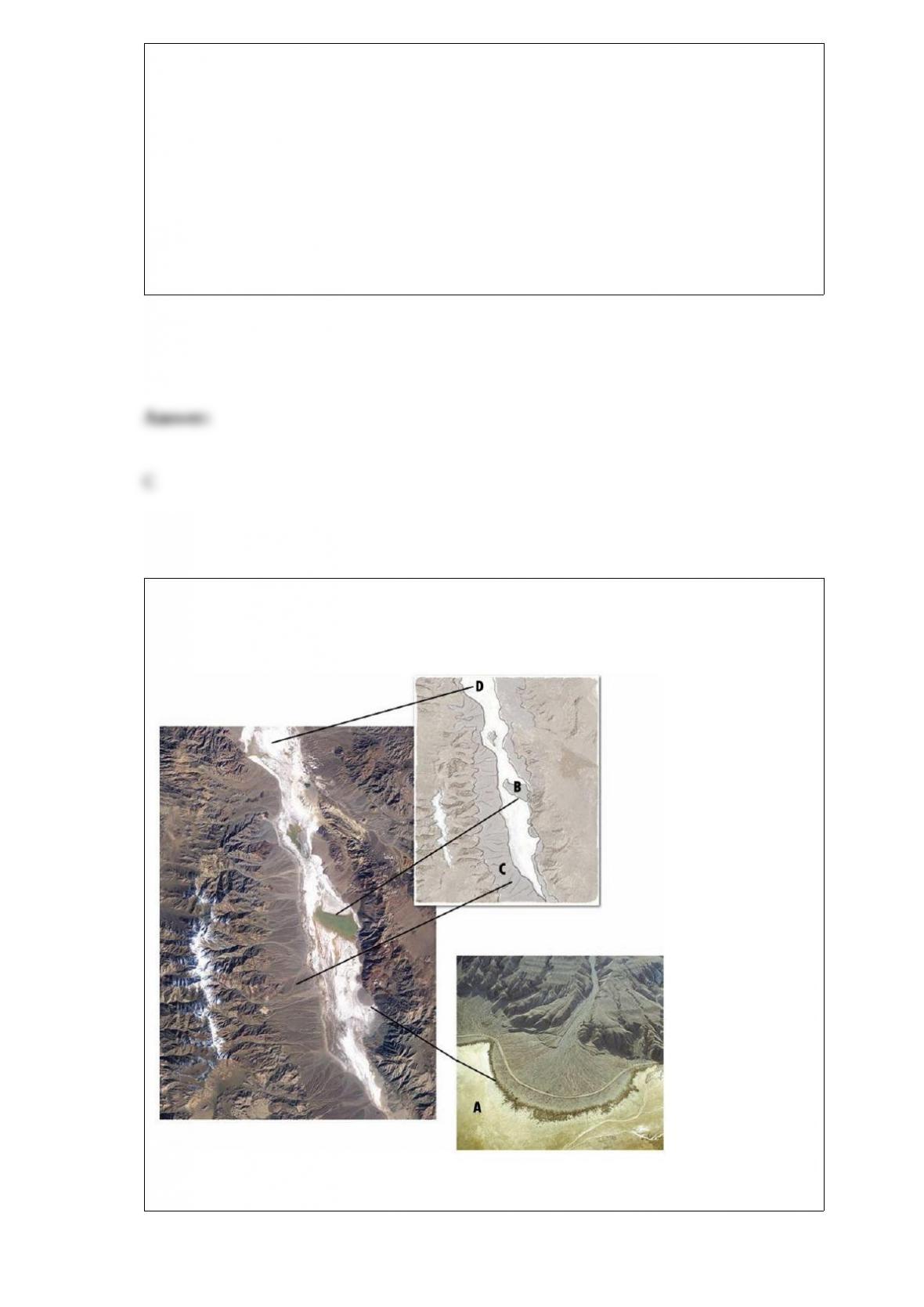
In the figure above, identify the letter corresponding to a Bajada.

Tornadoes most often move TOWARDS what direction?
A) west
B) southeast
C) northeast
D) northwest
Why does a rain gauge have a wide opening that funnels into a narrow tube?
A) Rain drops are too far apart to measure with a narrow opening.
B) The narrow tube takes less space.
C) The wide opening allows evaporation so it is a more accurate representation of what
actually happens on the surface.
D) The narrow tube minimizes evaporation and magnifies the amount of rain captured
by the wide opening.

Mountain building in the western margin of North America records a history of both
________.
A) continental collision and terrane accretion
B) Andean type subduction and terrane accretion
C) Andean type subduction and continental collision
D) none of the above
Ocean ridges form because ________.
A) rocks bulge up in ridges along transform faults associated with the ridge
B) they are a broad seafloor highland formed by sea floor spreading
C) they are submarine collisional mountain belts, forming submarine mountains that
haven’t yet risen from the sea floor
D) they are chains of volcanos, like the Hawaiian Islands, that form along hot spots
Heat flows ________.
A) from hot to cold

B) from cold to hot
C) in both directions
D) in neither direction
The deepest well that has ever been drilled on the earth is ________ deep, about 1/500th
of the radius of the earth.
A) 12.3 km
B) 20.7 km
C) 31.4 km
D) 40.5 km
Folded limestones that are exposed high elevations in the Himalayas were originally
deposited as sediments in a ________.
A) marine basin between India and Eurasia.
B) Cenozoic fault basin between Africa and Arabia.
C) deep ocean trench along the southern margin of India.

D) late Paleozoic syncline north of the Tibetan Plateau.
Calderas range in size from less than 1km to tens of kilometers across. What do they all
have in common?
A) They all form by subsidence of the caldera center due to withdrawal of magma from
below.
B) They all form in explosive eruptions.
C) They all are formed in rhyolitic volcanos and have associated eruptions of ash flow
tuff.
D) They all form from collapse of composite volcanos following explosive eruptions;
Crater lake is an example.
African dust from the Sahara desert is observed across the Atlantic as far west as the
Caribbean region where it produces a hazy sky condition during the annual dry season.
You are a climate scientist and make a prediction that the Sahara was not a desert
during glacial periods in the northern hemisphere. How could you test this hypothesis
by looking at deep sea sediments from the Atlantic off west Africa?
A) You would look at fossils to see if there were organisms that preferred dusty
conditions vs. clear water conditions.
B) You could look at the sediments to see if there were biogenic sediments interbedded
with sediments with terrigeneous input corresponding to the dry, interglacial intervals.

C) You could measure the isotopes in the sediment to estimate the sea surface
temperatures.
D) The hypothesis is untestable with deep sea sediment.
Which of the following might not be considered a natural cause of climate change?
A) explosive volcanic eruptions
B) changes in atmospheric ozone
C) plate tectonics
D) changes in the earth’s orbit
E) variations in solar radiation
Why does magma viscosity vary with silica content?
A) Increasing silica increases a tendency for silica bonds to link up in networks, acting
like a polymerization of the magma.
B) Increasing silica content lowers the melting temperature and since increasing the
temperature of a magma decreases viscosity increasing silica content increases
viscosity.

C) Increasing silica content increases the amount of water a magma can dissolve and
water decreases magma viscosity, so increasing silica content decreases magma
viscosity.
D) There is no correlation between silica content and magma viscosity.
Chemical weathering rates are highest in ________.
A) hot dry climates
B) hot wet climates
C) cold wet climates
D) cold dry climates
A rock outcrop exposes a layer of obsidian overlain by volcanic ash and a layer with
fragments of lapilli. What rock composition and eruptive type fits this description?
A) basalt erupted from a cinder cone
B) basalt flows and interbedded andesite deposited on a shield volcano
C) andesite and basalt erupted from a stratovolcano
D) rhyolite erupted in violent pyroclastic eruptions

A(n) ________ fault has little or no vertical movements of the two blocks.
A) stick slip
B) oblique slip
C) strike slip
D) dip slip
What moon in the outer solar system is most “earthlike” in terms of landforms, and
possesses liquids (liquid methane not water) flowing across the surface?
A) Europa
B) Ganymede
C) Titan
D) Tethys

Oceanic lithosphere subducts (sinks into the asthenosphere) because ________.
A) old oceanic lithosphere is more dense that the asthenosphere
B) the upwelling magma at divergent boundaries pushes the lithospheric plate into the
asthenosphere
C) the pressure from two plates colliding forces one plate into the asthenosphere
D) The convection of the mantle pulls the lithosphere into the asthenosphere
A very slow motion of Earth’s axis that requires 26,000 years to complete is called
________.
A) Ptolemaic motion
B) occultation
C) axial precession
D) perturbation
E) retrograde motion
Given an environmental lapse rate of 5oC/1000 m and a dry adiabatic of 10oC, what

would be the temperature of air at an elevation of 2000 m if the surface air temperature
is 25oC?
A) 25oC
B) 20oC
C) 15oC
D) 10oC
E) 5oC
In the food chain, each feeding stage is called a ________ level.
A) trophic
B) bios
C) replenishment
D) none of these
Construction of a seawall produces an effect analogous to what kind of natural coastal
feature?

A) a sea cliff producing erosion at the base of the sea cliff (i.e., the seawall)
B) an island offshore breaking waves and trapping sand behind to form a tombolo
C) a barrier island, which forms an artificial beach at the front of the seawall
D) a spit, formed by sand moving by longshore drift accumulating along the opening of
a tidal channel
Which of the following refers to the investigative process by which geologists identify
and match sedimentary strata and other rocks of the same ages in different areas?
A) super matching
B) correlation
C) strata indexing
D) cross-access dating
Ice Age glaciers had many indirect effects. Which one of the following was not such an
effect?
A) formation of mountains
B) extinction of some organisms

C) changes in some river courses
D) sea level fluctuations
If sea ice melts, this would affect the climate by ________.
A) increasing the moisture in the atmosphere
B) reducing the amount of solar energy absorbed at the surface
C) increasing the amount of solar energy absorbed at the surface
D) decreasing the moisture in the atmosphere
E) increasing albedo
Clay minerals are light silicates that form ________.
A) from molten rock
B) from mechanical weathering of any rock
C) from chemical weathering of igneous rocks
D) from pressure and heat.

The lithosphere is the outer layer of the earth characterized by ________.
A) soft rocks that flow easily
B) hard rocks that break
C) layers of both hard and soft rocks
D) magma
Given an environmental lapse rate of 5oC/1000 m and a dry adiabatic of 10oC, what
would what would happen if unsaturated air that had a temperature of 25oC at the
surface were forced to rise 2000 m in the air ?
A) It would keep rising because it would be less dense than the surrounding air.
B) It would sink back to the surface because it was more dense than the surrounding air.
C) It would be warmer than the air around it so it would keep rising.
D) It would be colder than the air around it so it would sink.
E) It would have the same temperature and density as the surrounding air so it would
stay at that height.
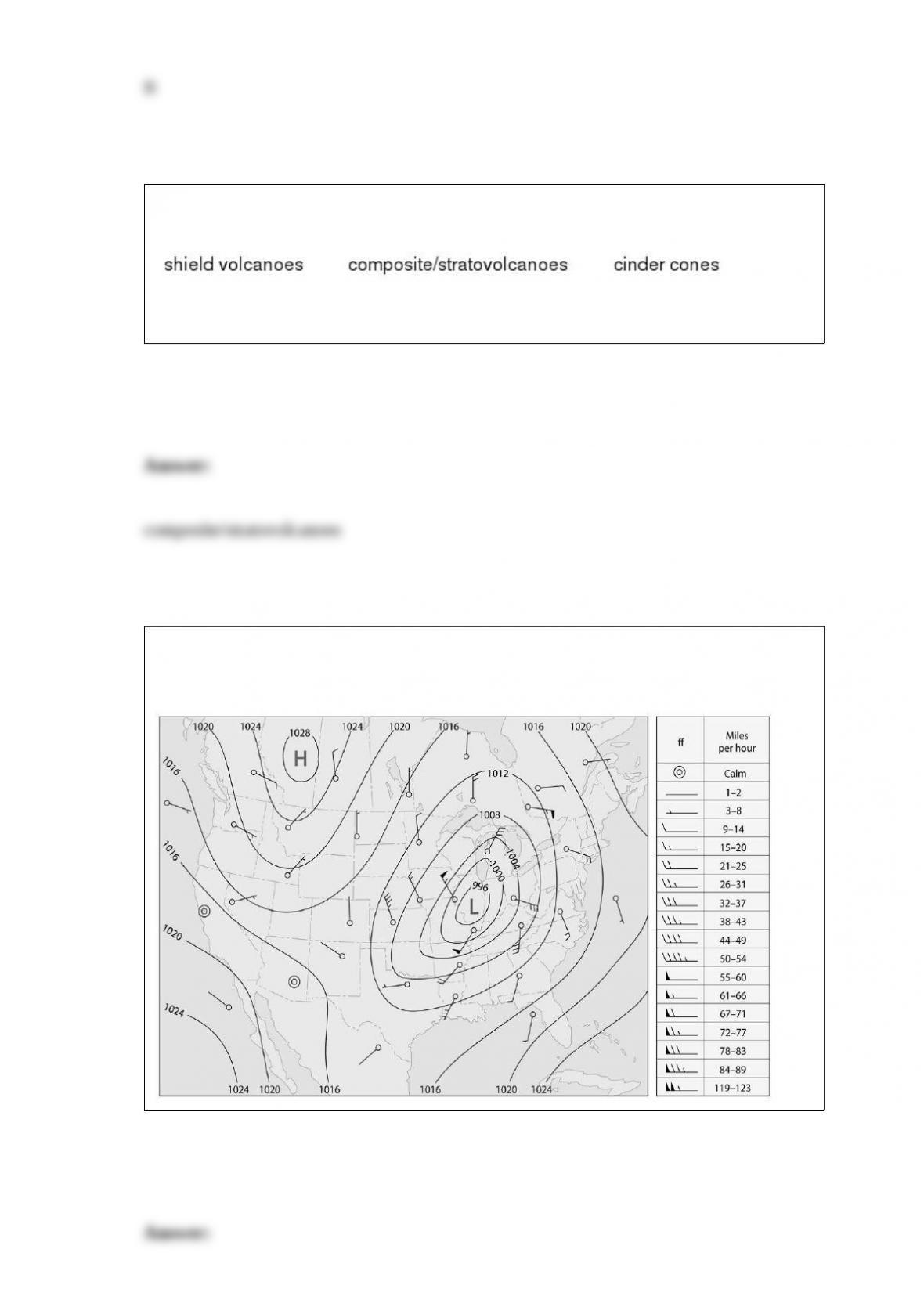
Give the term that best answers each phrase.
large, fairly steep-sided cones composed of lavas and pyroclastic layers
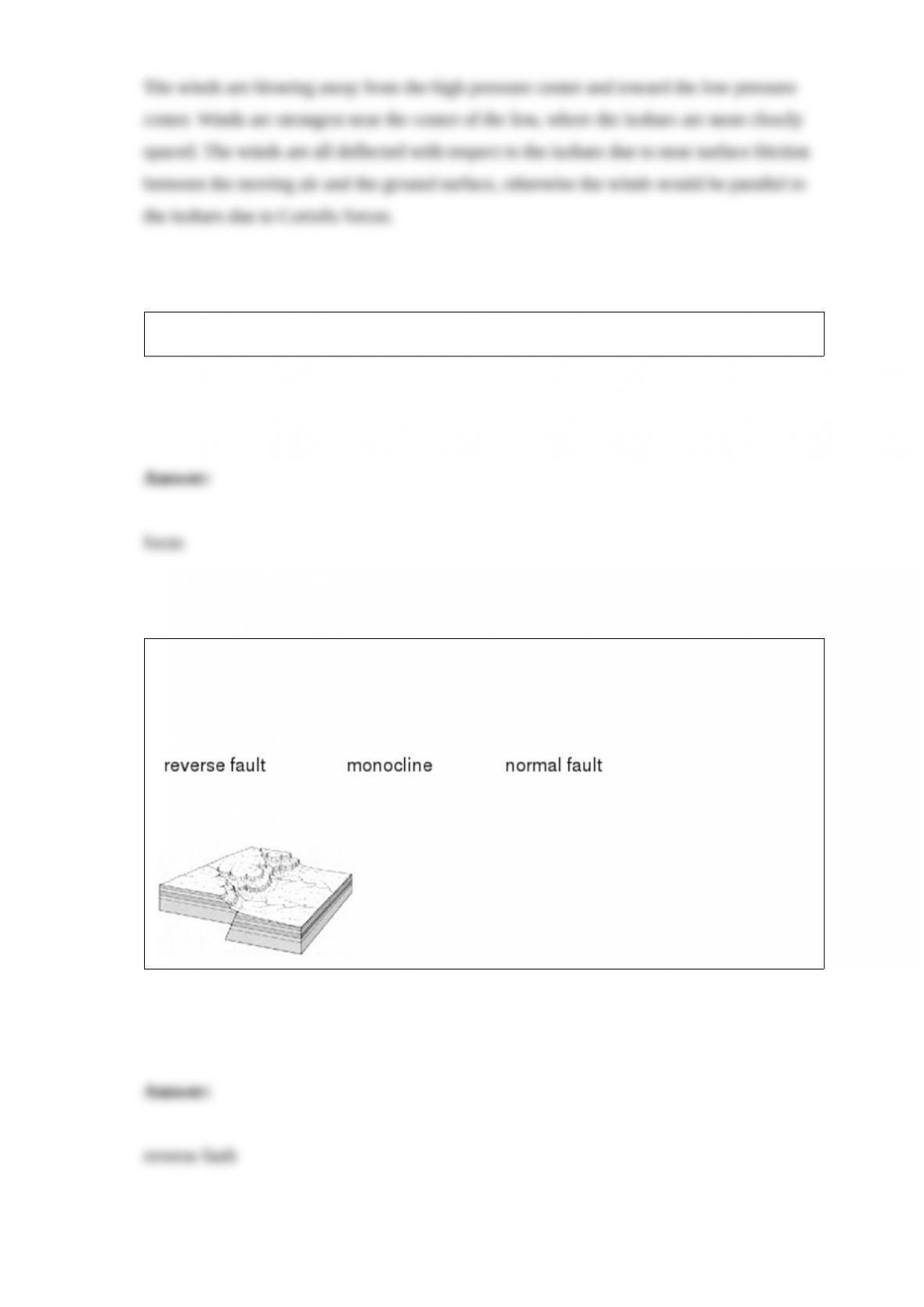
On the weather map below, describe the wind pattern and the relationship between the
winds and isobars.
The ________ is the site of initial rupturing associated with an earthquake.
Carefully study each illustration below to determine the type(s) of geologic
structure(s) it contains. Match each one to the correct answers listed.
________
Examine the words and/or phrases for each question below and determine the
relationship among the majority of words/phrases. Choose the option which does not fit
the pattern.
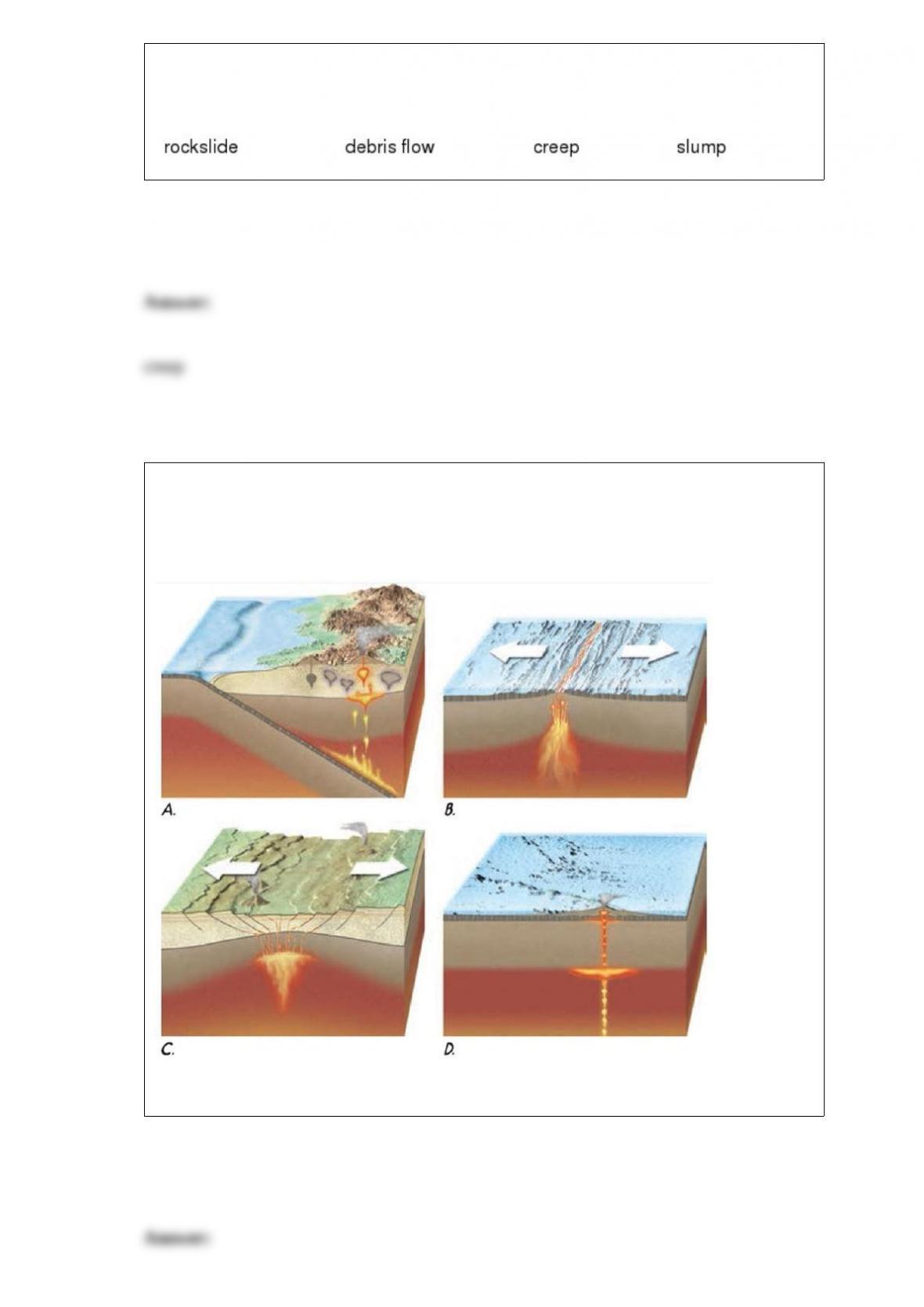
Match the name of the tectonic feature with the Figure.
oceanic spreading center

Examine the words and/or phrases for each question below and determine the
relationship among the majority of words/phrases. Choose the option which does not fit
the pattern.
Examine the words and/or phrases for each question below and determine the
relationship among the majority of words/phrases. Choose the option which does not fit
the pattern.
Two weather stations record air pressure. Weather station 1 is 100km north of weather
station 2. The pressure at station 1 is 1023mb and at station 2 it is 1015mb. What is the
pressure gradient between the two stations?

Examine the words and/or phrases for each question below and determine the
relationship among the majority of words/phrases. Choose the option which does not fit
the pattern.
When the Sun crosses the celestial equator, and day and night are of equal length
around the globe, it is the time of the ________.
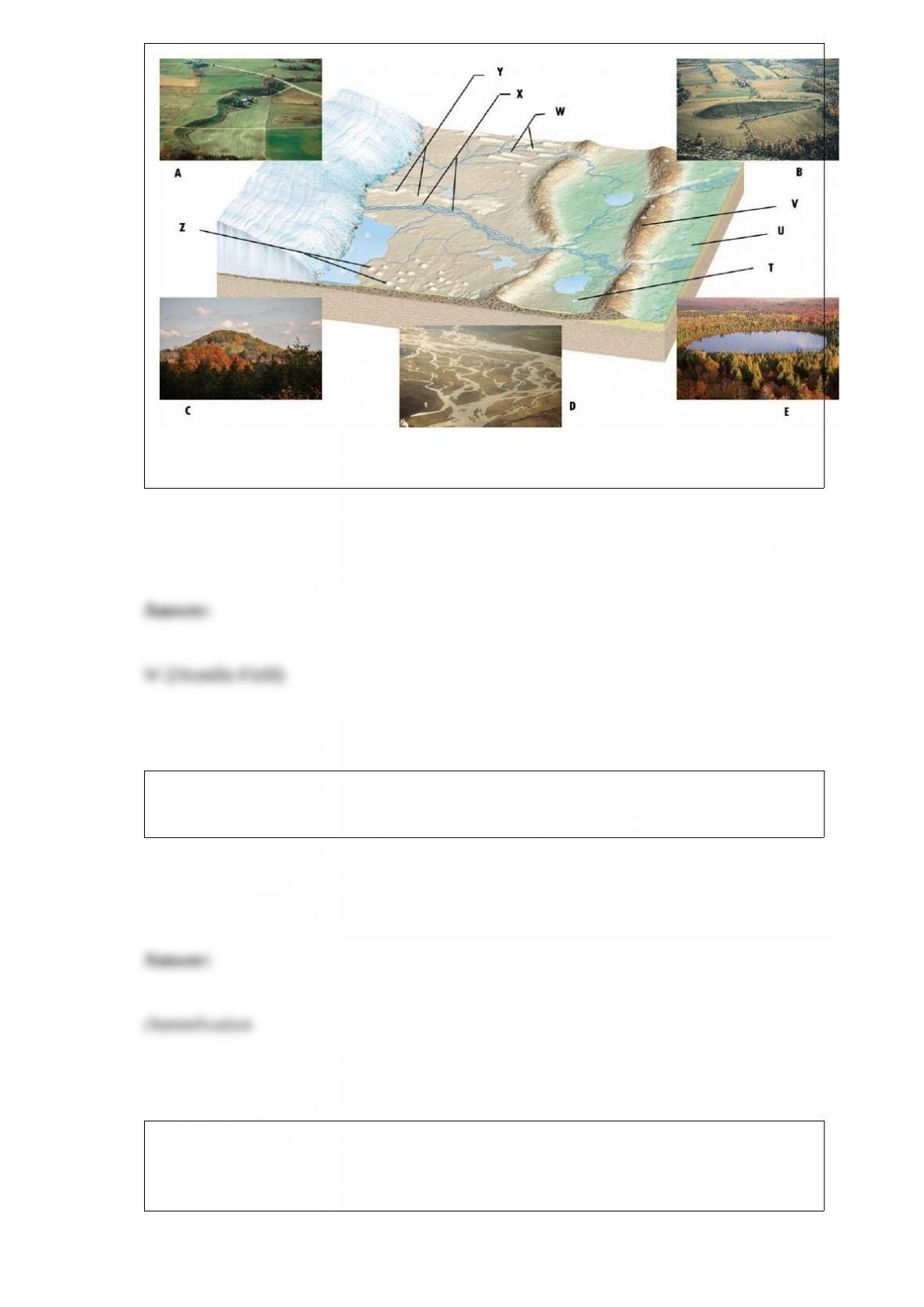
Which letter, S thru Z, corresponds to the object in the photo labeled “B”?
As a form of flood control, ________ involves altering a stream channel to speed the
flow of water to prevent it from reaching flood height.
In a given area where you have little knowledge of the local geology (rocks types,
fossils, etc.), what type of unconformity would be the most difficult to recognize in an
exposed sequence of rocks? Why?

The “true” brightness of a star is called its ________ magnitude.
Examine the words and/or phrases for each question below and determine the
relationship among the majority of words/phrases. Choose the option which does not fit
the pattern.
Would earthquakes of similar magnitudes in different regions of the Earth cause
approximately the same levels of damage necessarily? In your explanation, consider
both geologic and human-induced factors.
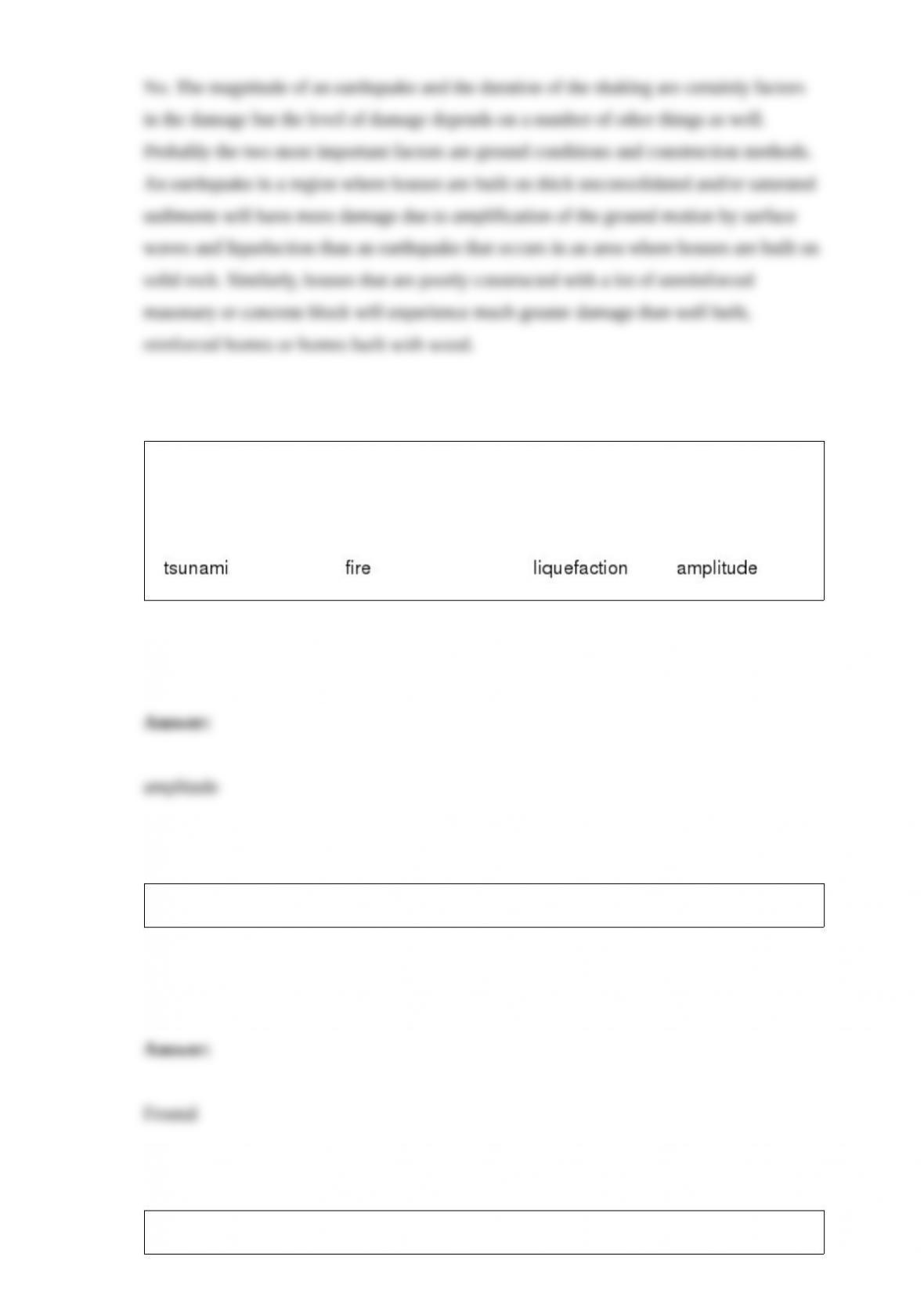
Examine the words and/or phrases for each question below and determine the
relationship among the majority of words/phrases. Choose the option which does not fit
the pattern.
________ wedging occurs when warm air is forced over cooler air.
Some elements are released from the earth’s interior to the surface through a process

called ________.