Instructor Resource
Neck, Entrepreneurship
SAGE Publishing, 2018
Appendix A: Financial Statements and Projections for
Startups
Test Bank
Multiple Choice
1. The three essential financial statements include all of the following EXCEPT ______.
a. balance sheet
b. cash flow statement
c. entrepreneurs scorecard
d. income statement
2. Vivienne wants to produce a report that measures her financial performance on a
monthly basis. She wants to see selling- and expense-related activities that result in
profit or loss over a period of time. She is interested in producing which of the following
statements?
a. backlog statement
b. revenue statement
c. entrepreneurs scorecard
d. income statement
3. Arya wants to produce a financial report that shows the amounts the company owes,
what it owns, and include her shareholder stake at a particular date in time. She wants
to produce a(n) ______.
a. balance sheet
b. bookings order
c. accounts receivable sheet
d. income statement
Instructor Resource
Neck, Entrepreneurship
SAGE Publishing, 2018
4. Karter is very busy and wants to produce a financial report that details the inflows and
outflows of cash for his company over the last month. He is interested in producing a(n)
______.
a. shareholders statement
b. cash flow statement
c. entrepreneurs scorecard
d. accrued expenses report
5. The financial statement that subtracts cost of goods sold from revenue to arrive at
gross profit is a(n) ______.
a. balance sheet
b. cash flow statement
c. entrepreneurs scorecard
d. income statement
6. The backlog report is ______.
a. the amount of money that the company owes vendors
b. the amount of money due to a company from its customers
c. the orders that have been received but not delivered to the customer
d. the orders that have been delivered to the customer but not yet received
Instructor Resource
Neck, Entrepreneurship
SAGE Publishing, 2018
7. Operating expenses include which of the following?
a. cost of goods sold
b. liabilities, deferred expenses, and assets
c. sales expense and administrative and general expenses
d. amortization and interest expense
8. Earnings before interest, taxes, depreciation, and amortization is the same as
______.
a. EBT
b. EBIT
c. EBITDA
d. EBIDA
9. The balance sheet shows ______.
a. what the business owns and what the business owes
b. only net worth
c. current expenses
d. shareholder deferred revenue
10. ______ are assets converted into cash within a year.
a. Cash flow assets
Instructor Resource
Neck, Entrepreneurship
SAGE Publishing, 2018
b. Current assets
c. Intangible assets
d. Deferred assets
11. ______ is the amount that customers owe to a company after receipt of item(s)
purchased.
a. Accounts payable
b. Accounts receivable
c. Accounts deferred
d. Accounts accrued
12. Brynlee paid $500,000 for a company, $100,000 in excess of the book value.
Brynlee has ______.
a. $100,000 of expenses
b. $100,000 of intangible assets
c. goodwill of $100,000
d. badwill of $100,000
13. Which of the following are intangible assets?
a. assets you cannot touch or access
b. a plug amount received to balance the books
c. patents, software programs, copyrights, trademarks, and/or brand names
d. property, plant, and equipment
Instructor Resource
Neck, Entrepreneurship
SAGE Publishing, 2018
14. When a company has long-term investments, it means they ______.
a. have cash, stocks, bonds, and real estate that has been on their books longer than
one year
b. should be selling them soon so they can become short-term profit
c. have more cash than they need and they are wasting it on long-term investments
d. are going for a bank loan
15. Jaylah has a 5-year bank loan with her business. The principal that is scheduled to
be paid in the last 4 years is considered ______.
a. a loss
b. a long-term debt
c. a short-term portion of long-term debt
d. operational cash flows
16. Kurt has a 5-year bank loan with his business. The principal that is scheduled to be
paid in the first 12 months is considered ______.
a. a loss
b. a long-term liability
c. a short-term portion of long term debt
d. operational cash flows
Instructor Resource
Neck, Entrepreneurship
SAGE Publishing, 2018
17. Shareholders equity includes two main components: ______.
a. retained earnings and capital stock
b. long-term investments and retained earnings
c. intangible assets and capital stock
d. retained earnings and fixed assets
18. Which of the following is NOT a cash inflow?
a. loans
b. wages
c. sales
d. interest
19. A linkage between the financial statements includes which of the following?
a. net income from the balance sheet is entered into the income statement
b. net income from the income statement is entered into the retained earnings in the
balance sheet
c. assets have to equal liabilities
d. cash is the total expenses on the income report
20. Jimi is very interested in managing his cash. You mentioned this course to him and
told him about ______, which is the number of days a company’s cash is tied up in the
production and sales process.
Instructor Resource
Neck, Entrepreneurship
SAGE Publishing, 2018
a. the income statement
b. Cash Convention Report
c. cash conversion cycle
d. adding depreciation and amortization to net income
21. Janis went to her accountant and learned about DSO, defined as ______.
a. measuring the number of days it takes to collect on accounts receivable
b. measuring the average number of days it takes to sell the entire inventory of a
company
c. measuring the number of days it takes you to pay your bills
d. equaling DOI + DSO – DPO
22.Arabella went to her accountant and learned about DOI, defined as ______.
a. measuring the number of days it takes to collect on accounts receivable
b. measuring the average number of days it takes to sell the entire inventory of a
company
c. measuring the number of days it takes you to pay your bills
d. equaling DOI + DSO – DPO
23. Jax went to his accountant and learned about cash conversion cycle, defined as that
which ______.
a. measures the number of days it takes to collect on accounts receivable
b. measures the average number of days it takes to sell the entire inventory of a
company
c. measures the number of days it takes you to pay your bills
Instructor Resource
Neck, Entrepreneurship
SAGE Publishing, 2018
d. equals DOI + DSO – DPO
24. The pro forma financial statement should include at least three scenarios of your
financial forecast, each containing an income statement, balance sheet, and ______.
a. the cash outflow statement
b. capitol stock
c. cash flow statement
d. accrued expenses
25. In many types of business people can account for ______ of operating costs.
a. 25% to 40%
b. up to 50%
c. 60% to 70%
d. 75% to 85%
26. Norah is interested in developing her payables policy. She wants to make a policy
for which of the following?
a. the process and timing in which obligations to pay for goods and services received by
the business will be paid
b. the price and timing of raw materials, and other goods and services necessary to
build, sell, and support products
c. how pricing will be determined for her products and services
d. the process and timing in which obligations to pay for products and services sold will
be billed and collected
Instructor Resource
Neck, Entrepreneurship
SAGE Publishing, 2018
27. Norah is interested in developing her purchasing policy. She wants to make a policy
for which of the following?
a. the price and timing of raw materials, and other goods and services necessary to
build, sell, and support products
b. how pricing will be determined for her products and services
c. the level of compensation and benefits for each type of position in the business
d. the process and timing in which obligations to pay for products and services sold will
be billed and collected
28. Norah is interested in developing her pricing policy. She wants to make a policy for
which of the following?
a. the price and timing of raw materials, and other goods and services necessary to
build, sell, and support products
b. how pricing will be determined for her products and services
c. the level of compensation and benefits for each type of position in the business
d. the process and timing in which obligations to pay for products and services sold will
be billed and collected
29. Norah is interested in developing her compensation policy. She wants to make a
policy for which of the following?
a. the price and timing of raw materials, and other goods and services necessary to
build, sell, and support products
b. how pricing will be determined for her products and services
c. the level of compensation and benefits for each type of position in the business
d. the process and timing in which obligations to pay for products and services sold will
be billed and collected
Instructor Resource
Neck, Entrepreneurship
SAGE Publishing, 2018
30. Norah is interested in developing her credit policy. She wants to make a policy for
which of the following?
a. the price and timing of raw materials, and other goods and services necessary to
build, sell, and support products
b. how pricing will be determined for her products and services
c. the level of compensation and benefits for each type of position in the business
d. the process and timing in which obligations to pay for products and services sold will
be billed and collected
True/False
1. Presenting carefully thought-out financial projections to investors is an exercise in
lowering perceived risk in both you as an entrepreneur and your idea.
2. Shari discussed her income statement with you and described her report as reporting
what the company owes, what it owns, and her shareholder stake at the last day of the
prior month. This statement is an income statement.
Instructor Resource
Neck, Entrepreneurship
SAGE Publishing, 2018
3. Bill’s business has sales of $100,000, inventory of $20,000, cost of goods sold of
$31,000, and general and administrative expenses of $45,000. Bill’s gross profit is
$69,000.
4. Bill’s business has sales of $100,000, inventory of $20,000, cost of goods sold of
$31,000, and general and administrative expenses of $45,000. Bill’s operating profit is
$4,000.
5. Bill’s business has sales of $100,000, inventory of $20,000, cost of goods sold of
$31,000, and general and administrative expenses of $45,000. Bill’s gross profit is
$80,000.
6. Sally is worried about her backlog report. This is a report on orders that have been
delivered but not yet paid by the customers.
7. Sandy’s balance sheet is partially completed. However, she has total assets of
$120,000 and total stockholder’s equity of $15,000. Her liabilities should total $105,000.
Instructor Resource
Neck, Entrepreneurship
SAGE Publishing, 2018
8. Sandy’s balance sheet shows assets of $120,000, liabilities of $100,000 and
stockholder’s equity of $25,000. Her balance sheet is in balance.
9. Currents assets are cash and other assets such as inventory, accounts payable, and
prepaid expenses that can be converted into cash within a year.
10. Goodwill is the price paid for an asset in excess of its book value. This usually
occurs when a company acquires another business.
Essay
1. Compare and contrast the Income Statement and the Statement of Cash Flows.
Instructor Resource
Neck, Entrepreneurship
SAGE Publishing, 2018
2. Compare and contrast the Balance Sheet and the Statement of Cash Flows.
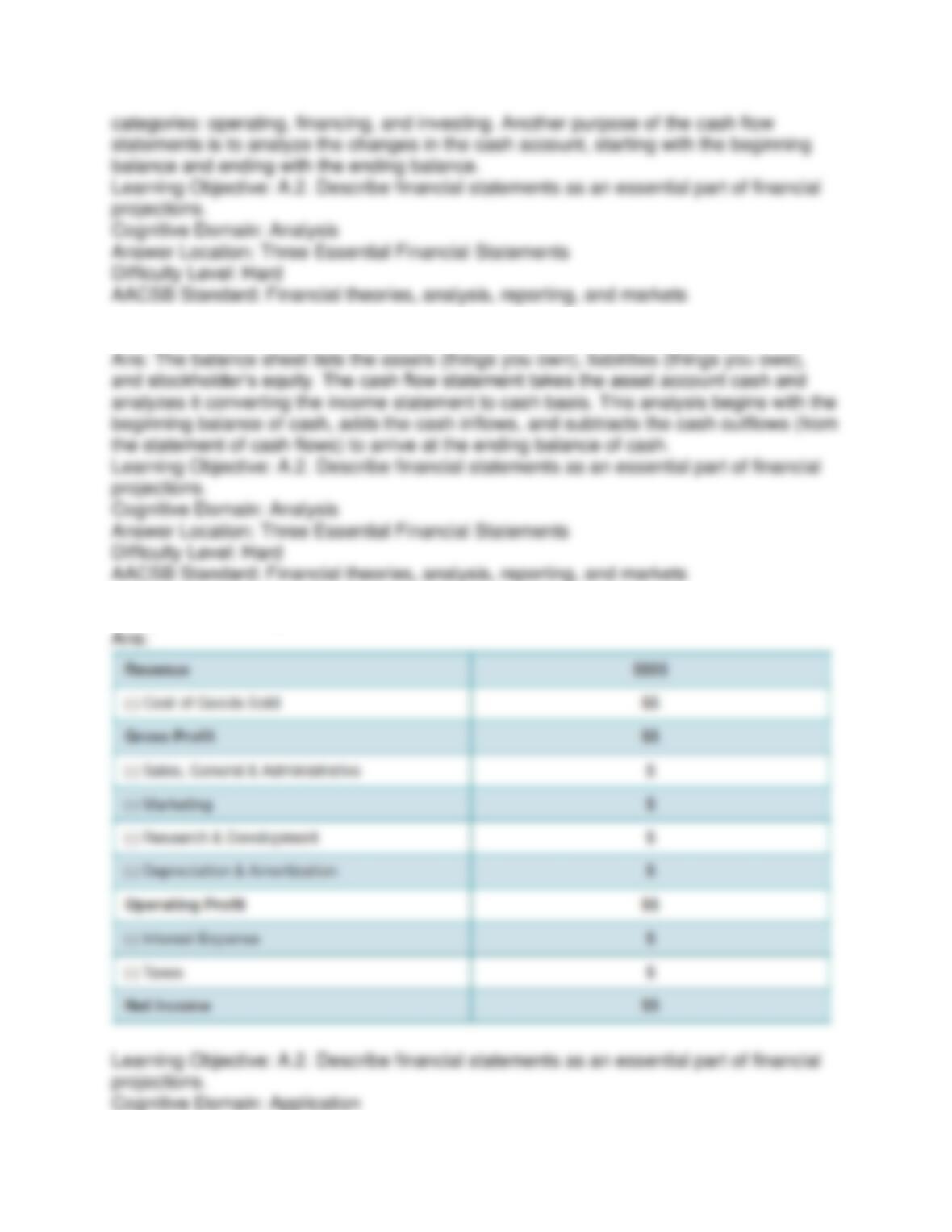
3. Provide the line by line format of an income statement.
Instructor Resource
Neck, Entrepreneurship
SAGE Publishing, 2018
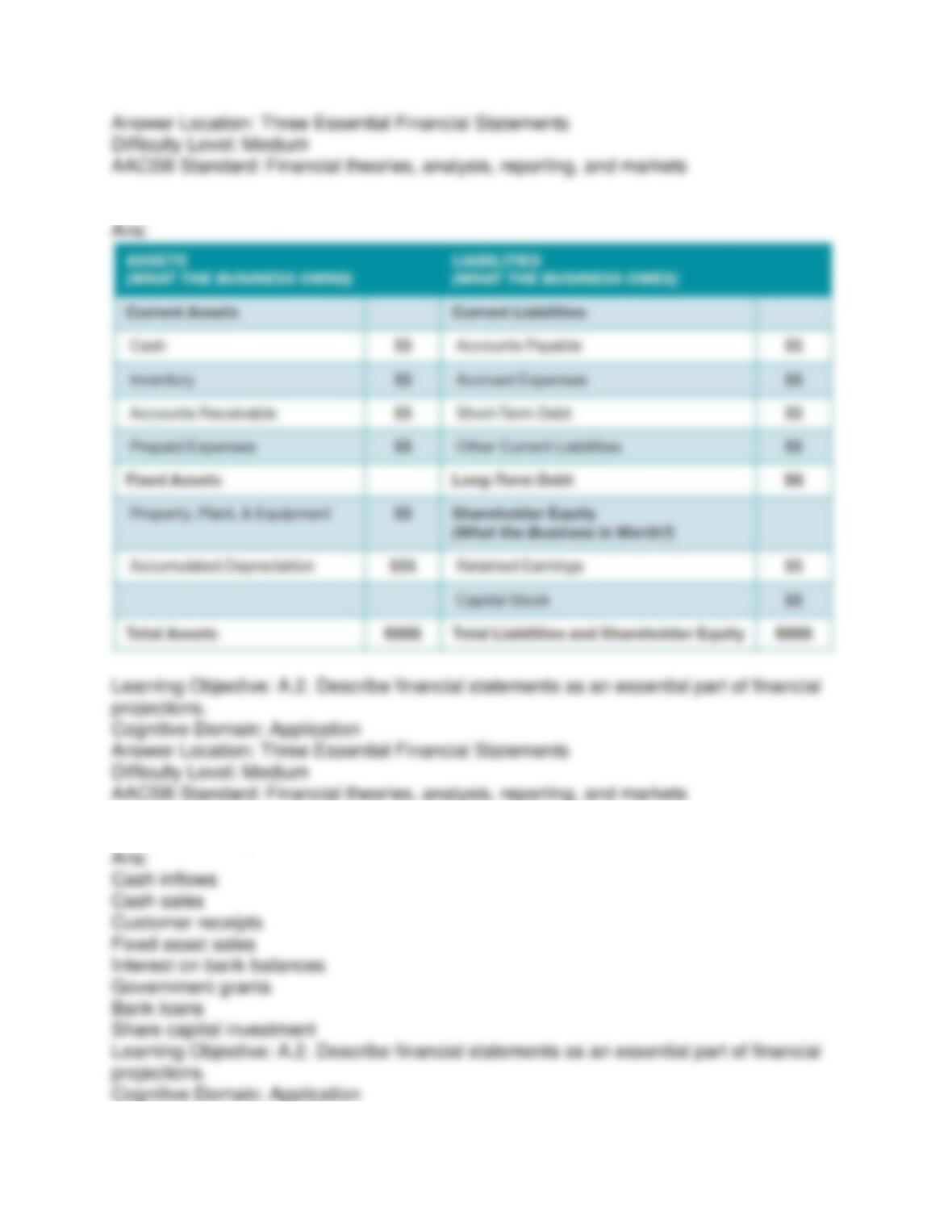
4. Provide the line by line format of a balance sheet.
5. List five examples of cash inflows.
Instructor Resource
Neck, Entrepreneurship
SAGE Publishing, 2018
6. List five examples of cash outflows.
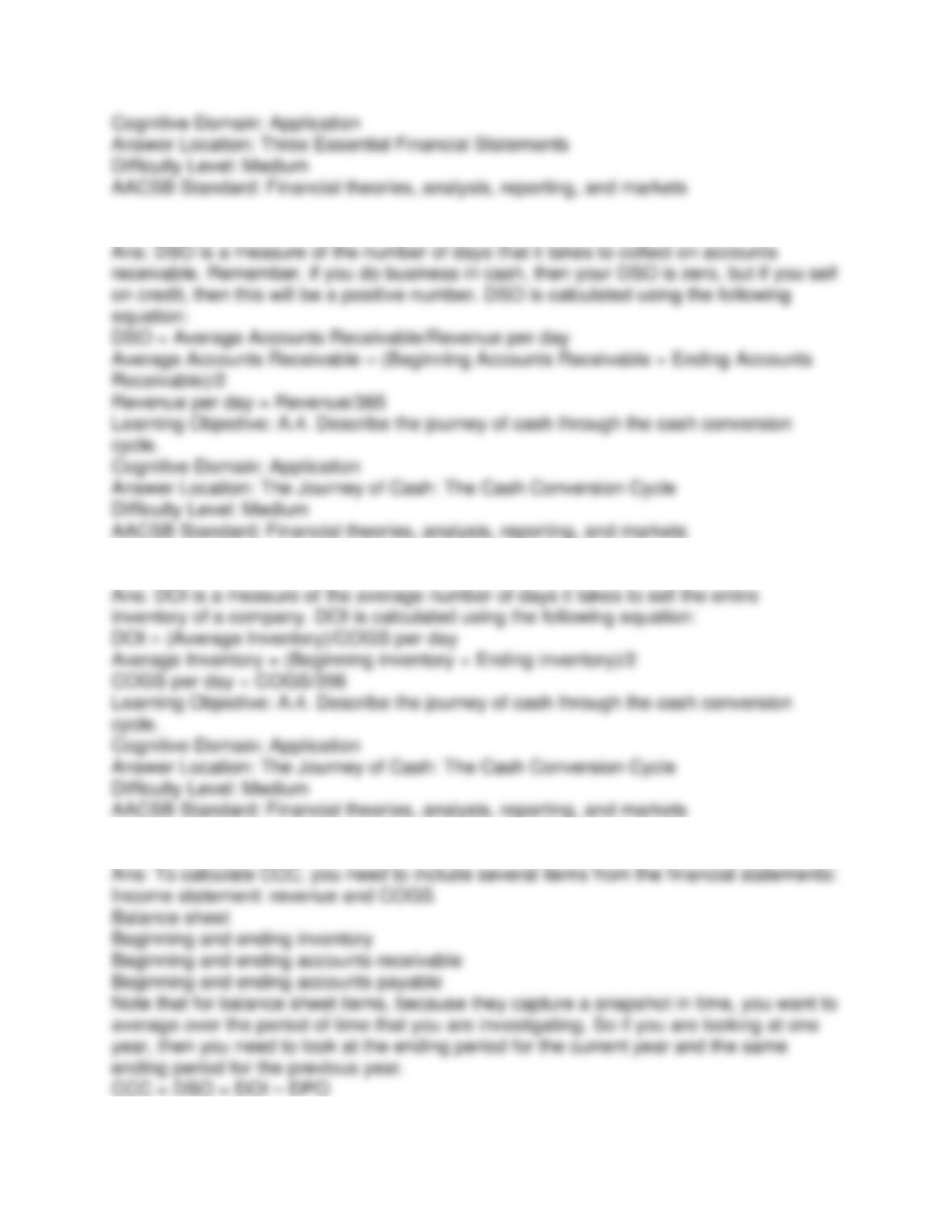
7. Provide the line by line format of the Statement of Cash Flows.
Instructor Resource
Neck, Entrepreneurship
SAGE Publishing, 2018
8. Describe DSO.
9. Describe DOI.
10. Describe how you calculate CCC, Cash Conversion Cycle.
Instructor Resource
Neck, Entrepreneurship
SAGE Publishing, 2018