Ch. 9 Applications of Trigonometric Functions
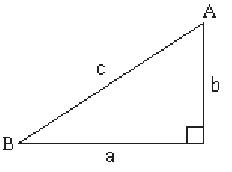
9.1 Applications Involving Right Triangles
1 Solve Right Triangles
MULTIPLE CHOICE. Choose the one alternative that best completes the statement or answers the question.
Solve the right triangle using the information given. Round answers to two decimal places, if necessary.
1) b = 4
,
A = 40°; Find a
,
c, and B.
A) a = 3.36
c = 5.22
B = 50°
B) a = 4.36
c = 5.22
B = 50°
C) a =3.36
c = 6.22
B =50°
D) a =4.36
c = 6.22
B = 50°
2) a = 3
,
A = 25°; Find b
,
c, and B.
A) b = 6.43
c = 7.1
B = 65°
B) b = 6.43
c = 7.1
B = 75°
C) b =6.43
c = 8.1
B = 65°
D) b =6.43
c = 8.1
B = 75°
3) a = 4
,
b = 3; Find c, A
,
and B.
A) c = 5
A = 53.13°
B = 36.87°
B) c = 2.65
A = 54.13°
B = 35.87°
C) c =2.65
A = 53.13°
B = 36.87°
D) c = 5
A = 54.13°
B = 35.87°
4) a = 4
,
c = 8; Find b
,
A
,
and B.
A) b = 6.93
A = 30°
B = 60°
B) b = 6.93
A = 60°
B = 30°
C) b =8.94
A = 30°
B = 60°
D) b =8.94
A = 31°
B = 59°
2 Solve Applied Problems
MULTIPLE CHOICE. Choose the one alternative that best completes the statement or answers the question.
Solve the problem.
1) A surveyor is measuring the distance across a small lake. He has set up his transit on one side of the lake
150 feet from a piling that is directly across from a pier on the other side of the lake. From his transit, the
angle between the piling and the pier is 60°. What is the distance between the piling and the pier to the
nearest foot?
A) 260 ft B) 130 ft C) 75 ft D) 87 ft
2) A radio transmission tower is 180 feet tall. How long should a guy wire be if it is to be attached 9 feet from
the top and is to make an angle of 24° with the ground? Give your answer to the nearest tenth of a foot.
A) 420.4 ft B) 442.5 ft C) 187.2 ft D) 197.0 ft
3) A straight trail with a uniform inclination of 14° leads from a lodge at an elevation of 700 feet to a
mountain lake at an elevation of 8800 feet. What is the length of the trail (to the nearest foot)?
A) 33,482 ft B) 36,375 ft C) 8348 ft D) 9069 ft
Page 1
4) A building 150 feet tall casts a 30 foot long shadow. If a person looks down from the top of the building,
what is the measure of the angle between the end of the shadow and the vertical side of the building (to
the nearest degree)? (Assume the person’s eyes are level with the top of the building.)
A) 11° B) 79° C) 78° D) 12°
5)
J
ohn (whose line of sight is 6 ft above horizontal) is trying to estimate the height of a tall oak tree. He first
measures the angle of elevation from where he is standing as 35°. He walks 30 feet closer to the tree and
finds that the angle of elevation has increased by 12°. Estimate the height of the tree rounded to the nearest
whole number.
A) 67 ft B) 90 ft C) 86 ft D) 61 ft
6) A photographer points a camera at a window in a nearby building forming an angle of 42° with the
camera platform. If the camera is 52 m from the building, how high above the platform is the window, to
the nearest hundredth of a meter?
A) 46.82 m B) 0.9 m C) 1.11 m D) 57.75 m
7) A tree casts a shadow of 26 meters when the angle of elevation of the sun is 24°. Find the height of the tree
to the nearest meter.
A) 12 m B) 11 m C) 10 m D) 13 m
8) A twenty–five foot ladder just reaches the top of a house and forms an angle of 41.5° with the wall of the
house. How tall is the house? Round your answer to the nearest 0.1 foot.
A) 18.7 ft B) 18.6 ft C) 18.8 ft D) 19 ft
SHORT ANSWER. Write the word or phrase that best completes each statement or answers the question.
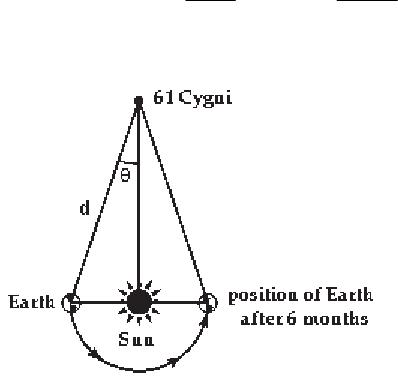
9) In 1838, the German mathematician and astronomer Friedrich Wilhelm Bessel was the first person to
calculate the distance to a star other than the Sun. He accomplished this by first determining the parallax
of the star, 61 Cygni, at 0.314 arc seconds (Parallax is the change in position of the star measured against
background stars as Earth orbits the Sun. See illustration.) If the distance from Earth to the Sun is about
150,000,000 km and
θ = 0.314 seconds = 0.314
60 minutes = 0.314
60 · 60 degrees
determine the distance d from Earth to 61 Cygni using Bessel’s figures.
Page 2
MULTIPLE CHOICE. Choose the one alternative that best completes the statement or answers the question.
10) Two hikers on opposite sides of a canyon each stand precisely 525 meters above the canyon floor. They
each sight a landmark on the canyon floor on a line directly between them. The angles of depression from
each hiker to the landmark meter are 37° and 21°. How far apart are the hikers? Round your answer to the
nearest whole meter.
A) 2064 m B) 2065 m C) 2063 m D) 1064 m
SHORT ANSWER. Write the word or phrase that best completes each statement or answers the question.
11) Yosemite Falls in California consists of three sections: Upper Yosemite Fall (by itself one of the ten highes
t
waterfalls in the world), the Middle Cascade, and Lower Yosemite Fall. From a footbridge across the creek
2500 feet from the falls, the angles of elevation to the top and bottom of Upper Yosemite Fall are 45.74° and
24.42°, respectively. How high is the total series of three falls? How high is Upper Yosemite Fall? Round
your answers to the nearest foot.
MULTIPLE CHOICE. Choose the one alternative that best completes the statement or answers the question.
12) A forest ranger at Lookout A sights a fire directly north of her position. Another ranger at Lookout B,
exactly 2 kilometers directly west of A, sights the same fire at a bearing of N41.2°E. How far is the fire
from Lookout A? Round your answer to the nearest 0.01 km.
A) 2.28 km B) 2.32 km C) 2.18 km D) 2.25 km
13) A sailboat leaves port on a bearing of S72°W. After sailing for two hours at 12 knots, the boat turns 90°
toward the south. After sailing for three hours at 9 knots on this course, what is the bearing to the ship
from port? Round your answer to the nearest 0.1°.
A) S23.6°W B) S24.6°W C) N23.6°E D) N24.6°E
14) From the edge of a 1000–foot cliff, the angles of depression to two cars in the valley below are 21° and 28°.
How far apart are the cars? Round your answers to the nearest 0.1 ft.
A) 724.4 ft B) 724.5 ft C) 714.4 ft D) 713.4 ft
9.2 The Law of Sines
1 Solve SAA or ASA Triangles
MULTIPLE CHOICE. Choose the one alternative that best completes the statement or answers the question.
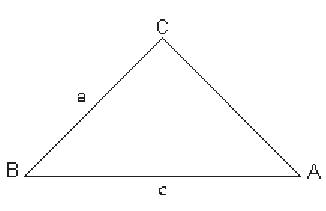
Solve the triangle.
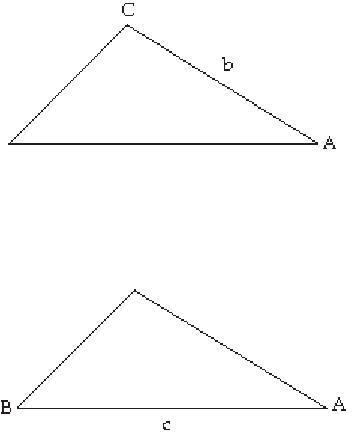
1)
65°
4
40°
A) B = 75°
,
a = 2.66
,
c = 3.75 B) B =75°
,
a =3.75
,
c = 2.66
C) B = 80°
,
a = 2.66
,
c = 3.75 D) B =70°
,
a =3.75
,
c = 2.66
Page 3
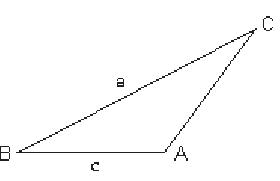
2)
3
20° 105°
A) C = 55°
,
a = 8.47
,
c = 7.19 B) C =55°
,
a =7.19
,
c = 8.47
C) C = 60°
,
a = 8.47
,
c = 7.19 D) C =50°
,
a =7.19
,
c = 8.47
3) A = 20°
,
B = 60°
,
a = 5
A) C = 100°
,
b = 12.66
,
c = 14.4 B) C =100°
,
b =14.4
,
c = 12.66
C) C = 100°
,
b = 13.66
,
c = 14.4 D) C =100°
,
b =14.4
,
c = 11.66
4) B = 20°
,
C = 90°
,
a = 3
A) A = 70°
,
b = 1.09
,
c = 3.19 B) A =70°
,
b =3.19
,
c = 1.09
C) A = 70°
,
b = 4.19
,
c = 1.09 D) A =70°
,
b =2.09
,
c = 3.19
2 Solve SSA Triangles
MULTIPLE CHOICE. Choose the one alternative that best completes the statement or answers the question.
Two sides and an angle are given. Determine whether the given information results in one triangle, two triangles,
or no triangle at all. Solve any triangle(s) that results.
1) a = 7, b = 9, B = 49°
A) one triangle
A = 35.94°, C = 95.06°, c = 11.88
B) one triangle
A = 76.01°, C = 54.99°, c = 7.60
C) two triangles
A1 = 76.01°, C1 = 54.99°, c1 = 7.60 or
A2 = 103.99°, C2 = 27.01, c2 = 12.14
D) no triangle
2) b = 3
,
c = 4
,
B = 70°
A) one triangle
C = 36°, A = 74°, a = 11
B) one triangle
B = 35°, A = 75°, a = 7
C) one triangle
C = 34°, A = 76°, a = 9
D) no triangle
3) a = 22
,
b = 15
,
B = 20°
A) two triangles
A1 = 30.11°, C1 = 129.89°, c1 = 33.65 or
A2 = 149.89°, C2 = 10.11°, c2 = 7.7
B) one triangle
A = 30.11°, C = 129.89°, c = 33.65
C) one triangle
A = 149.89°, C = 10.11°, c = 7.7
D) no triangle
4) A = 30°
,
a = 7
,
b = 14
A) B = 90°
,
C = 60°
,
c = 12.1 B) B =60°
,
C =90°
,
c = 12.1
C) B = 60°
,
C = 60°
,
c = 12.1 D) no triangle
Page 4
5) B = 94°
,
b = 2
,
a = 25
A) one triangle
A = 48°, C = 39°, c = 31
B) one triangle
A = 47°, C = 39°, c = 27
C) one triangle
A = 46°, C = 39°, c = 29
D) no triangle
6) B = 42°
,
b = 2
,
a = 23
A) one triangle
A = 38°, C = 99°, c = 22
B) one triangle
A = 40°, C = 97°, c = 25
C) one triangle
A = 41°, C = 98°, c = 26.5
D) no triangle
7) B = 12°
,
b = 2.5
,
a = 6.01
A) two triangles
A1 = 30°, C1 = 138°, c1 = 8;
A2 = 150°, C2 = 18°, c2 = 3.7
B) one triangle
A = 30°, C = 138°, c = 8
C) one triangle
A = 150°, C = 18°, c = 3.7
D) no triangle
8) A = 75°
,
a = 4
,
b = 5
A) one triangle
B = 39°, C = 66°, c = 13
B) one triangle
A = 38°, C = 67°, c = 9
C) one triangle
B = 37°, C = 68°, c = 11
D) no triangle
9) C = 35°
,
a = 18.7, c = 16.1
A) two triangles
A1 = 42°, B1 = 103°, b1 = 27.4;
A2 = 138°, B2 = 7°, b2 = 3.4
B) two triangles
A1 = 103°, B1 = 42°, b1 = 27.4;
A2 = 7°, B2 = 138°, b2 = 3.4
C) one triangle
A = 42°, B = 103°, b = 27.4
D) no triangle
10) B = 41°
,
a = 4, b = 3
A) two triangles
A1 = 61°, C1 = 78°, c1 = 4.5;
A2 = 119°, C2 = 20°, c2 = 1.6
B) two triangles
A1 = 61°, C1 = 78°, c1 = 0.1;
A2 = 119°, C2 = 20°, c2 = 0.1
C) one triangle
A = 29°, C = 110°, c = 5.7
D) no triangle
Solve the problem.
11) Given a triangle with a = 9, b = 11
,
A =31°
,
what is (are) the possible length(s) of c? Round your answer to
two decimal places.
A) 16.42 or 2.44 B) 6.61 C) 16.42 or 3.41 D) 14.21
Page 5
3 Solve Applied Problems
MULTIPLE CHOICE. Choose the one alternative that best completes the statement or answers the question.
Solve the problem.
1) An airplane is sighted at the same time by two ground observers who are 5 miles apart and both directly
west of the airplane. They report the angles of elevation as 14° and 25°. How high is the airplane?
A) 2.68 mi B) 1.21 mi C) 4.68 mi D) 2.11 mi
2) A surveyor standing 53 meters from the base of a building measures the angle to the top of the building
and finds it to be 37°. The surveyor then measures the angle to the top of the radio tower on the building
and finds that it is 47°. How tall is the radio tower?
A) 16.9 m B) 6.87 m C) 6.18 m D) 9.35 m
3) A ship sailing parallel to shore sights a lighthouse at an angle of 12° from its direction of travel. After
traveling 3 miles farther, the angle is 25°. At that time, how far is the ship from the lighthouse?
A) 2.77 mi B) 1.48 mi C) 5.64 mi D) 3 mi
4) A rocket tracking station has two telescopes A and B placed 2.2 miles apart. The telescopes lock onto a
rocket and transmit their angles of elevation to a computer after a rocket launch. What is the distance to
the rocket from telescope B at the moment when both tracking stations are directly east of the rocket
telescope A reports an angle of elevation of 30° and telescope B reports an angle of elevation of 53°?
A) 2.82 mi B) 1.38 mi C) 4.5 mi D) 3.51 mi
5) A guy wire to the top of a tower makes an angle of 64° with the level ground. At a point 30 feet farther
from the base of the tower and in line with the base of the wire, the angle of elevation to the top of the
tower is 25°. What is the length of the guy wire?
A) 20.15 ft B) 14.11 ft C) 42.85 ft D) 63.8 ft
6) A ship at sea, the Admiral, spots two other ships, the Barstow and the Cauldrew and measures the angle
between them at be 45°. They radio the Barstow and by comparing known landmarks, the distance
between the the Admiral and the Barstow is found to be 323 meters. The Barstow reports an angle of 59°
between the Admiral and the Cauldrew. To the nearest meter, what is the distance between the Barstow
and the Cauldrew?
A) 235 m B) 81 m C) 266 m D) 49 m
SHORT ANSWER. Write the word or phrase that best completes each statement or answers the question.
7) Two surveyors 180 meters apart on the same side of a river measure their respective angles to a poin
t
between them on the other side of the river and obtain 54° and 68°. How far from the point (line–of–sight
distance) is each surveyor? Round your answer to the nearest 0.1 meter.
MULTIPLE CHOICE. Choose the one alternative that best completes the statement or answers the question.
8) A flagpole is perpendicular to the horizontal but is on a slope that rises 10° from the horizontal. The pole
casts a 43–foot shadow down the slope and angle of elevation of the sun measured from the slope is 36°.
How tall is the pole? Round your answer to the nearest 0.1 foot.
A) 36.4 ft B) 35.4 ft C) 33.5 ft D) 36.2 ft
9) It is 4.7 km from Lighthouse A to Port B. The bearing of the port from the lighthouse is N73°E. A ship has
sailed due west from the port and its bearing from the lighthouse is N31°E. How far has the ship sailed
from the port? Round your answer to the nearest 0.1 km.
A) 3.7 km B) 3.5 km C) 2.7 km D) 3.1 km
Page 6
SHORT ANSWER. Write the word or phrase that best completes each statement or answers the question.
10) A pier 1250 meters long extends at an angle from the shoreline. A surveyor walks to a point 1500 meters
down the shoreline from the pier and measures the angle formed by the ends of the pier. If is found to be
53°. What acute angle (correct to the nearest 0.1°) does the pier form with the shoreline? Is there more than
one possibility? If so, how can we know which is the correct one?
MULTIPLE CHOICE. Choose the one alternative that best completes the statement or answers the question.
11) Two tracking stations are on the equator 148 miles apart. A weather balloon is located on a bearing of N
41°E from the western station and on a bearing of N 21°E from the eastern station. How far is the balloon
from the western station? Round to the nearest mile.
A) 404 mi B) 413 mi C) 382 mi D) 373 mi
12) To find the distance AB across a river, a distance BC of 1010 m is laid off on one side of the river. It is
found that B = 113.3° and C = 16.5°. Find AB. Round to the nearest meter.
A) 373 m B) 376 m C) 289 m D) 286 m
9.3 The Law of Cosines
1 Solve SAS Triangles
MULTIPLE CHOICE. Choose the one alternative that best completes the statement or answers the question.
Solve the triangle.
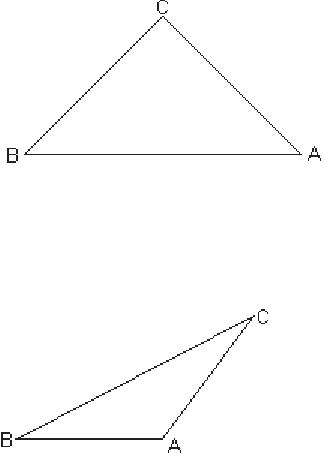
1)
5
25°
10
A) b = 5.86
,
A = 21.1°
,
C = 133.9° B) b =5.86
,
A =133.9°
,
C = 21.1°
C) b = 6.86
,
A = 21.1°
,
C = 133.9° D) b =4.86
,
A =133.9°
,
C = 21.1°
2)
110°
24
A) c = 5.05
,
A = 21.8°
,
B = 48.2° B) c =5.05
,
A =48.2°
,
B = 21.8°
C) c = 6.05
,
A = 21.8°
,
B = 48.2° D) c =4.05
,
A =48.2°
,
B = 21.8°
3) b = 5
,
c = 6
,
A = 80°
A) a = 7.11
,
B = 43.8°
,
C = 56.2° B) a =7.11
,
B =56.2°
,
C = 43.8°
C) a = 8.11
,
B = 43.8°
,
C = 56.2° D) a =6.11
,
B =56.2°
,
C = 43.8°
4) a = 6, b = 8, C = 70°
A) c = 8.2, A = 43.5°
,
B = 66.5° B) c =9, A =52.8°
,
B = 57.2°
C) c = 10, A = 56.9°
,
B = 53.1° D) c =6.3, A =28.6°
,
B = 81.4°
Page 7
5) a = 80
,
b = 12
,
C = 115°
A) c = 85.76
,
A = 57.7°
,
B = 7.3° B) c =88.66
,
A =59.7°
,
B = 5.3°
C) c = 91.56
,
A = 55.7°
,
B = 9.3° D) no triangle
6) a = 5
,
c = 4
,
B = 90°
A) b = 6.4
,
A = 51.4°
,
C = 38.6° B) b =6.4
,
A =38.6°
,
C = 51.4°
C) b = 7.4
,
A = 51.4°
,
C = 38.6° D) b =5.4
,
A =38.6°
,
C = 51.4°
7) a = 8
,
c = 9
,
B = 118°
A) b = 14.6
,
A = 29°
,
C = 33° B) b =17.5
,
A =31°
,
C = 31°
C) b = 20.4
,
A = 27°
,
C = 35° D) no triangle
8) b = 5
,
c = 10
,
A = 110°
A) a = 12.6
,
B = 22°
,
C = 48° B) a =15.5
,
B =24°
,
C = 46°
C) a = 18.4
,
B = 20°
,
C = 50° D) no triangle
9) b = 2
,
c = 3
,
A = 70°
A) a = 2.98
,
B = 39.1°
,
C = 70.9° B) a =2.98
,
B =70.9°
,
C = 39.1°
C) a = 3.98
,
B = 39.1°
,
C = 70.9° D) a =1.98
,
B =70.9°
,
C = 39.1°
2 Solve SSS Triangles
MULTIPLE CHOICE. Choose the one alternative that best completes the statement or answers the question.
Solve the triangle.
1)
64
7
A) A = 58.8°
,
B = 34.8°
,
C = 86.4° B) A =34.8°
,
B =58.8°
,
C = 86.4°
C) A = 58.8°
,
B = 86.4°
,
C = 34.8° D) A =34.8°
,
B =86.4°
,
C = 58.8°
2)
9
6
4
A) A = 127.2°
,
B = 32.1°
,
C = 20.7° B) A =32.1°
,
B =127.2°
,
C = 20.7°
C) A = 127.2°
,
B = 20.7°
,
C = 32.1° D) A =32.1°
,
B =20.7°
,
C = 127.2°
3) a = 13
,
b = 13
,
c = 12
A) A = 62.5°
,
B = 62.5°
,
C = 55° B) A =63.5°
,
B =63.5°
,
C = 53°
C) A = 55°
,
B = 62.5°
,
C = 62.5° D) A =62.5°
,
B =55°
,
C = 62.5°
Page 8
4) a = 8
,
b = 6
,
c = 4
A) A = 104.5°
,
B = 46.6°
,
C = 28.9° B) A =46.6°
,
B =104.5°
,
C = 28.9°
C) A = 104.5°
,
B = 28.9°
,
C = 46.6° D) A =46.6°
,
B =28.9°
,
C = 104.5°
5) a = 9
,
b = 14
,
c = 17
A) A = 31.9°
,
B = 55.3°
,
C = 92.8° B) A =33.9°
,
B =53.3°
,
C = 92.8°
C) A = 29.9°
,
B = 55.3°
,
C = 94.8° D) no triangle
6) a = 19, b = 16, c = 11
A) A = 87.4°
,
B = 57.3°
,
C = 35.3° B) A =87.4°
,
B=35.3°
,
C = 57.3°
C) A = 57.3°
,
B = 87.4°
,
C = 35.3° D) A =35.3°
,
B =57.3°
,
C = 87.4°
3 Solve Applied Problems
MULTIPLE CHOICE. Choose the one alternative that best completes the statement or answers the question.
Solve the problem.
1) In flying the 79 miles from Champaign to Peoria, a student pilot sets a heading that is 12° off course and
maintains an average speed of 96 miles per hour. After 15 minutes, the instructor notices the course error
and tells the student to correct his heading. Through what angle will the plane move to correct the heading
and how many miles away is Peoria when the plane turns?
A) 17.1°; 55.75 mi B) 162.9°; 55.75 mi C) 17.1°; 70.44 mi D) 162.9°; 70.44 mi
2) Two points A and B are on opposite sides of a building. A surveyor selects a third point C to place a
transit. Point C is 50 feet from point A and 65 feet from point B. The angle ACB is 53°. How far apart are
points A and B?
A) 53 ft B) 103.1 ft C) 69.1 ft D) 93.2 ft
3) The distance from home plate to dead center field in a certain baseball stadium is 408 feet. A baseball
diamond is a square with a distance from home plate to first base of 90 feet. How far is it from first base to
dead center field?
A) 350.2 ft B) 385.5 ft C) 475.9 ft D) 333.1 ft
4) A famous golfer tees off on a long, straight 457 yard par 4 and slices his drive 16° to the right of the line
from tee to the hole. If the drive went 290 yards, how many yards will the golfer’s second shot have to be
to reach the hole?
A) 195.3 yd B) 740.1 yd C) 406.9 yd D) 648.3 yd
5) A famous golfer tees off on a straight 390 yard par 4 and slices his drive to the right. The drive goes 280
yards from the tee. Using a 7–iron on his second shot, he hits the ball 170 yards and it lands inches from
the hole. How many degrees (to the nearest degree) to the right of the line from the tee to the hole did he
slice his drive?
A) 23° B) 118° C) 39° D) 52°
6) Island A is 150 miles from island B. A ship captain travels 250 miles from island A and then finds that he is
off course and 160 miles from island B. What angle, in degrees, must he turn through to head straight for
island B? Round the answer to two decimal places. (Hint: Be careful to properly identify which angle is the
turning angle.)
A) 145.08° B) 55.08° C) 34.92° D) 110.17°
Page 9
7) A ladder leans against a building that has a wall slanting away from the ladder at an angle of 96° with the
ground. If the bottom of the ladder is 23 feet from the base of the wall and it reaches a point 52 feet up the
wall, how tall is the ladder to the nearest foot?
A) 59 ft B) 60 ft C) 61 ft D) 58 ft
8) A plane takes off from an airport on the bearing S29°W. It continues for 20 minutes then changes to
bearing S52°W and flies for 2 hours 20 minutes on this course then lands at a second airport. If the plane’ s
speed is 420 mph, how far from the first airport is the second airport? Round your answer correct to the
nearest mile.
A) 1110 mi B) 1111 mi C) 1010 mi D) 1011 mi
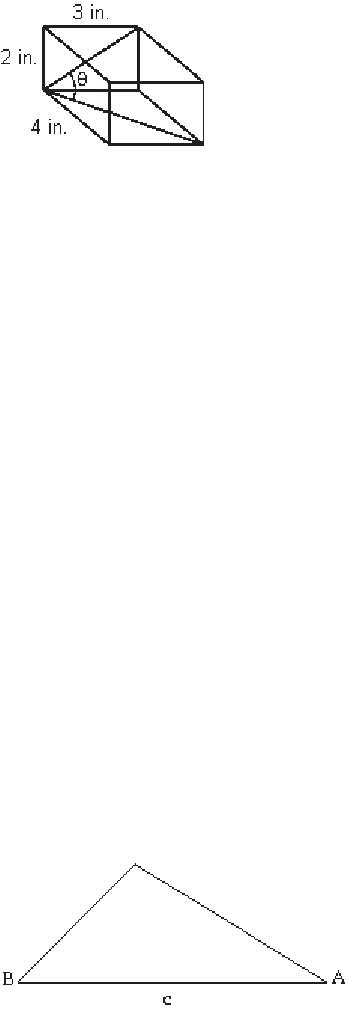
9) A box has dimensions 2″ × 3″ × 4″. (See illustration.)
Determine the angle θ formed by the diagonal of the 2″ × 3″ side and the diagonal of the 3″ × 4″ side.
Round your answer to the nearest degree.
A) 60° B) 50° C) 65° D) 62°
10) A plane flying a straight course observes a mountain at a bearing of 33.8° to the right of its course. At that
time the plane is 8 kilometers from the mountain. A short time later, the bearing to the mountain becomes
43.8°. How far is the plane from the mountain when the second bearing is taken (to the nearest tenth of a
km)?
A) 6.4 km B) 10 km C) 11 km D) 4.3 km
11) Two sailboats leave a harbor in the Bahamas at the same time. The first sails at 21 mph in a direction 330°.
The second sails at 31 mph in a direction 200°. Assuming that both boats maintain speed and heading,
after 4 hours, how far apart are the boats?
A) 189.3 mi B) 121.6 mi C) 137.8 mi D) 164.9 mi
12) Two points A and B are on opposite sides of a building. A surveyor selects a third point C to place a
transit. Point C is 48 feet from point A and 64 feet from point B. The angle ACB is 52°. How far apart are
points A and B?
A) 51.2 ft B) 100.9 ft C) 67.1 ft D) 91.1 ft
9.4 Area of a Triangle
1 Find the Area of SAS Triangles
MULTIPLE CHOICE. Choose the one alternative that best completes the statement or answers the question.
Find the area of the triangle. If necessary, round the answer to two decimal places.
1)
105°
48
A) 15.45 B) 19 C) 61.82 D) 4.14
Page 10
2)
3
25°
8
A) 5.07 B) 10.14 C) 20.29 D) 10.88
3) A = 20°
,
b = 15
,
c = 4
A) 10.26 B) 28.19 C) 8.26 D) 30.19
4) A = 83°
,
b = 9, c = 6
A) 26.80 B) 3.29 C) 27.01 D) 53.60
5) A = 23°
,
b = 9, c = 2
A) 3.52 B) 3.51 C) 3.50 D) 3.53
6) a = 12, b = 15, C = 52°
A) 70.92 B) 35.46 C) 141.84 D) 88.80
SHORT ANSWER. Write the word or phrase that best completes each statement or answers the question.
Solve the problem.
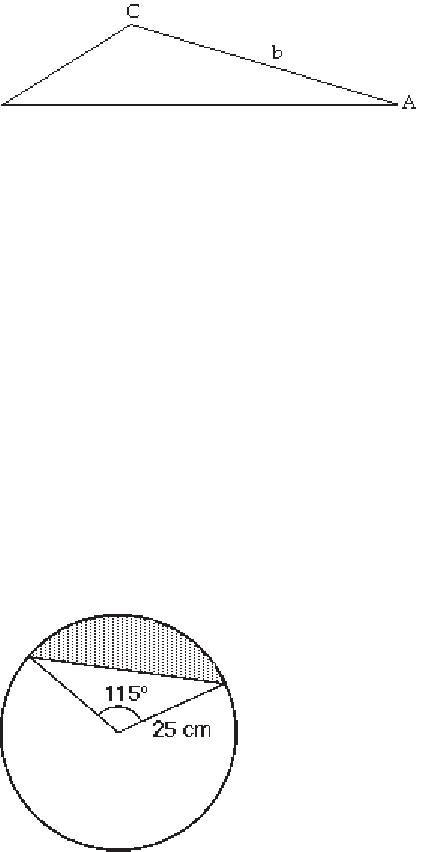
7) Find the area of the shaded portion ( see illustration) of a circle of radius 25 cm, formed by a central angle
of 115°. Round your answer to the nearest square cm.
[Hint: Subtract the area of the triangle from the area of the sector of the circle to obtain the area of the
shaded portion.]
MULTIPLE CHOICE. Choose the one alternative that best completes the statement or answers the question.
8) A new homeowner has a triangular–shaped back yard. Two of the three sides measure 65 ft and 80 ft and
form an included angle of 125°. The owner wants to approximate the area of the yard, so that he can
determine the amount of fertilizer and grass seed to be purchased. Find the area of the yard rounded to
the nearest square foot.
A) 2130 sq. ft B) 4260 sq. ft C) 2129 sq. ft D) 5200 sq. ft
Page 11
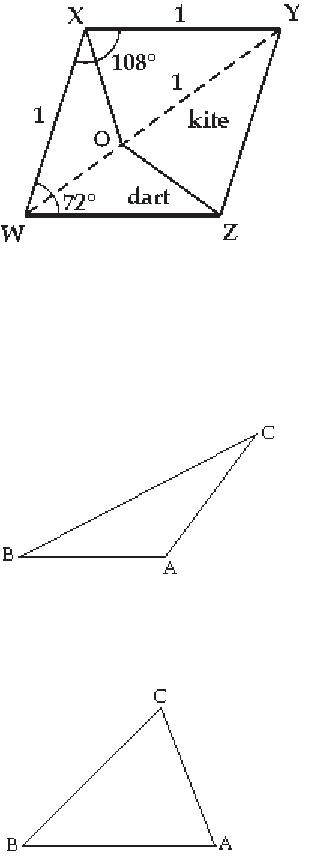
SHORT ANSWER. Write the word or phrase that best completes each statement or answers the question.
9) Penrose tiles are formed from a rhombus WXYZ with sides of length 1 and interior angles 72° and 108°.
(Refer to the illustration.) A point O is chosen on the diagonal 1 unit from Y. Line segments OX and OZ are
drawn to the other vertices. The two resulting tiles are called a kite (figure OXYZ) and a dart (figure
OXWZ). Find the area of the kite tile and the dart tile, correct to the nearest 0.01.
2 Find the Area of SSS Triangles
MULTIPLE CHOICE. Choose the one alternative that best completes the statement or answers the question.
Find the area of the triangle. If necessary, round the answer to two decimal places.
1)
9
6
5
A) 14.14 B) 214.94 C) 4.47 D) 48.06
2)
42
4
A) 3.87 B) 53.67 C) 1.73 D) 16.97
3) a = 16
,
b = 16
,
c = 13
A) 95.03 B) 98.03 C) 101.03 D) 104.03
4) a = 4, b = 5, c = 7
A) 9.80 B) 16.01 C) 10.01 D) 3.46
5) a = 6, b = 6, c = 7
A) 17.06 B) 21.14 C) 15.54 D) 18.25
6) a = 14, b = 32, c = 26
A) 177.99 B) 5280.01 C) 3219.69 D) 181.99
Page 12
Solve the problem.
7) A room in the shape of a triangle has sides of length 7 yd, 9 yd, and 12 yd. If carpeting costs $17.50 a
square yard and padding costs $5.25 a square yard, how much to the nearest dollar will it cost to carpet the
room, assuming that there is no waste?
A) $712 B) $548 C) $697 D) $689
8) Find the area of the Bermuda Triangle if the sides of the triangle have the approximate lengths 849 miles,
926 miles, and 1301 miles.
A) 392,047 mi B) 1,568,186 mi C) 498,394 mi D) 519,596 mi
9) A painter needs to cover a triangular region 60 meters by 69 meters by 70 meters. A can of paint covers 70
square meters. How many cans will be needed?
A) 27 cans B) 308 cans C) 14 cans D) 3 cans
9.5 Simple Harmonic Motion; Damped Motion; Combining Waves
1 Build a Model for an Object in Simple Harmonic Motion
MULTIPLE CHOICE. Choose the one alternative that best completes the statement or answers the question.
An object attached to a coiled spring is pulled down a distance a from its rest position and then released. Assuming
that the motion is simple harmonic with period T, write an equation that relates the displacement d of the object
from its rest position after t seconds. Also assume that the positive direction of the motion is up.
1) a = 8; T = 3 seconds
A) d = –8 cos 2
3 πt B) d = –3 cos 1
4 πt C) d = –8 sin 2
3 πt D) d = –8 cos 1
3 πt
2) a = 16; T = 7 seconds
A) d = –16 cos 2
7 πt B) d = –7 cos 1
8 πt C) d = –16 sin 2
7 πt D) d = –16 cos 1
7 πt
3) a = 19; T = 3π seconds
A) d = –19 cos 2
3 t B) d = –3 cos 2
19 t C) d = –19 sin 2
3 πt D) d = –19 cos 2
3 πt
4) a = 5; T = 10 seconds
A) d = –5 cos π
5 t B) d = 5 cos (10t) C) d = –5 cos (10t) D) d = 5 cos π
5 t
At time t = 0, an object attached to a coiled spring is at its resting position and moving down. Assuming that the
motion is simple harmonic with period T, write an equation that relates the displacement d of the object from its
rest position after t seconds. Also assume that the positive direction of the motion is up.
5) a = 8; T = 3 seconds
A) d = –8 sin 2
3 πt B) d = –3 sin 1
4 πt C) d = –8 cos 2
3 πt D) d = –8 cos 1
3 πt
6) a = 16; T = 10 seconds
A) d = –16 sin 1
5 πt B) d = –10 cos 1
8 πt C) d = –16 cos 1
5 πt D) d = –16 sin 1
10 πt
Page 13

7) a = 11; T = 3π seconds
A) d = –11 sin 2
3 t B) d = –3 sin 2
11 t C) d = –11 cos 2
3 πt D) d = –11 sin 2
3 πt
8) a = 5; T = 10 seconds
A) d = –5 sin π
5 t B) d = 5 sin (10t) C) d = –5 cos (10t) D) d = 5 cos π
5 t
Solve the problem.
9) An object in simple harmonic motion has a frequency of 3
2 oscillations per second and an amplitude of 5
feet. Write an equation in the form d = a sin ωt for the object’s simple harmonic motion.
A) d = 5 sin 3πtB)d
= 5 sin 3πt
2C) d = 5 sin 3t
2πD) d = 5 sin 2t
3
10) An object has a frequency of 4 vibrations per second. Write an equation in the form d = sin ωt for the
object’s simple harmonic motion.
A) d = sin 8πtB)d
= sin 8t C) d = sin 4
πtD)d
=sin 2πt
11) A weight attached to a spring is pulled down 5 inches below the equilibrium position. Assuming that the
frequency of the system is 7
π cycles per second, determine a trigonometric model that gives the position of
the weight at time t seconds.
A) y = –5 cos 14t B) y = 5 cos 14t C) y = –5 cos 7
πtD)y
=5πcos 7t
2 Analyze Simple Harmonic Motion
MULTIPLE CHOICE. Choose the one alternative that best completes the statement or answers the question.
The displacement d (in meters) of an object at time t (in seconds) is given. Describe the motion of the object. What
is the maximum displacement from its resting position, the time required for one oscillation, and the frequency?
1) d = 5 sin (5t)
A) simple harmonic; 5 m; 2
5 π sec; 5
2π oscillations/sec
B) simple harmonic; 5 m; 5
2π sec; 2
5 π oscillations/sec
C) simple harmonic; –5 m; 2
5 π sec; 5
2π oscillations/sec
D) simple harmonic; 5 m; 5 π sec; 5
π oscillations/sec
Page 14
2) d = –5 sin (5t)
A) simple harmonic; 5 m; 2
5 π sec; 5
2π oscillations/sec
B) simple harmonic; 5 m; 5
2π sec; 2
5 π oscillations/sec
C) simple harmonic; –5 m; 2
5 π sec; 5
2π oscillations/sec
D) simple harmonic; –5 m; 5 π sec; 5
π oscillations/sec
3) d = 4 cos (3t)
A) simple harmonic; 4 m; 2
3 π sec; 3
2π oscillations/sec
B) simple harmonic; 4 m; 3
2π sec; 2
3 π oscillations/sec
C) simple harmonic; –4 m; 2
3 π sec; 3
2π oscillations/sec
D) simple harmonic; 4 m; 3 π sec; 3
π oscillations/sec
4) d = –2 cos π
2t
A) simple harmonic; 2 m; 4 sec; 1
4 oscillation/sec
B) simple harmonic; –2 m; 4 sec; 1
4 oscillation/sec
C) simple harmonic; 2 m; 1
4 sec; 4 oscillations/sec
D) simple harmonic; 2 m; 2 sec; 1
2 oscillation/sec
5) d = 7 – 3 sin (πt)
A) simple harmonic; 3 m; 2 sec; 1
2 oscillation/sec
B) simple harmonic; –3 m; 2 sec; 1
2 oscillation/sec
C) simple harmonic; 3 m; 1
2 sec; 2 oscillations/sec
D) simple harmonic; 7 m; 2 sec; 1
2 oscillation/sec
Page 15
3 Analyze an Object in Damped Motion
MULTIPLE CHOICE. Choose the one alternative that best completes the statement or answers the question.
An object of mass m (in grams) attached to a coiled spring with damping factor b (in grams per second) is pulled
down a distance a (in centimeters) from its rest position and then released. Assume that the positive direction of
the motion is up and the period is T (in seconds) under simple harmonic motion. Develop a model that relates the
distance d of the object from its rest position after t seconds.
1) m =30
,
a = 6
,
b = 0.5
,
T = 4
A) d = –6e–0.5t/60 cos π2
4 – 0.25
3600 t B) d = 6e0.5t/60 cos π2
4 – 0.25
3600 t
C) d = –6e–0.5t/60 cos π2
16 – 0.25
900 t D) d = 6e–0.5t/60 cos π2
16 – 0.25
3600 t
2) m = 20
,
a = 8
,
b = 0.7
,
T = 3
A) d = –8e–0.7t/40 cos 4π2
9 – 0.49
1600 t B) d = 8e0.7t/40 cos 4π2
9 – 0.49
1600 t
C) d = –8e–0.7t/40 cos 2π2
9 – 0.49
400 t D) d = 8e–0.7t/40 cos 4π2
3 – 0.49
1600 t
3) m = 25
,
a = 12
,
b = 0.75
,
T = 4
A) d = –12e–0.75t/50 cos π2
4 – 0.5625
2500 t B) d = 12e0.75t/50 cos π2
4 – 0.5625
2500 t
C) d = –12e–0.75t/50 cos π2
16 – 0.5625
625 t D) d = 12e–0.75t/50 cos π2
16 – 0.5625
2500 t
4) m = 15
,
a = 8
,
b = 0.55
,
T = 3
A) d = –8e–0.55t/30 cos 4π2
9 – 0.3025
900 t B) d = 8e0.55t/30 cos 4π2
9 – 0.3025
900 t
C) d = –8e–0.55t/30 cos 2π2
9 – 0.3025
225 t D) d = 8e–0.55t/30 cos 4π2
3 – 0.3025
900 t
Page 16
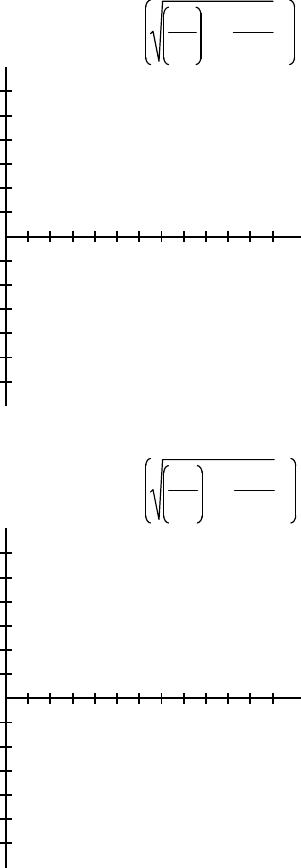
SHORT ANSWER. Write the word or phrase that best completes each statement or answers the question.
The distance d (in meters) of the bob of a pendulum of mass m (in kilograms) from its rest position at time t (in
seconds) is given. The bob is released from the left of its rest position, which represents a negative direction.
(a) Describe the motion of the object. Be sure to give the mass and damping factor.
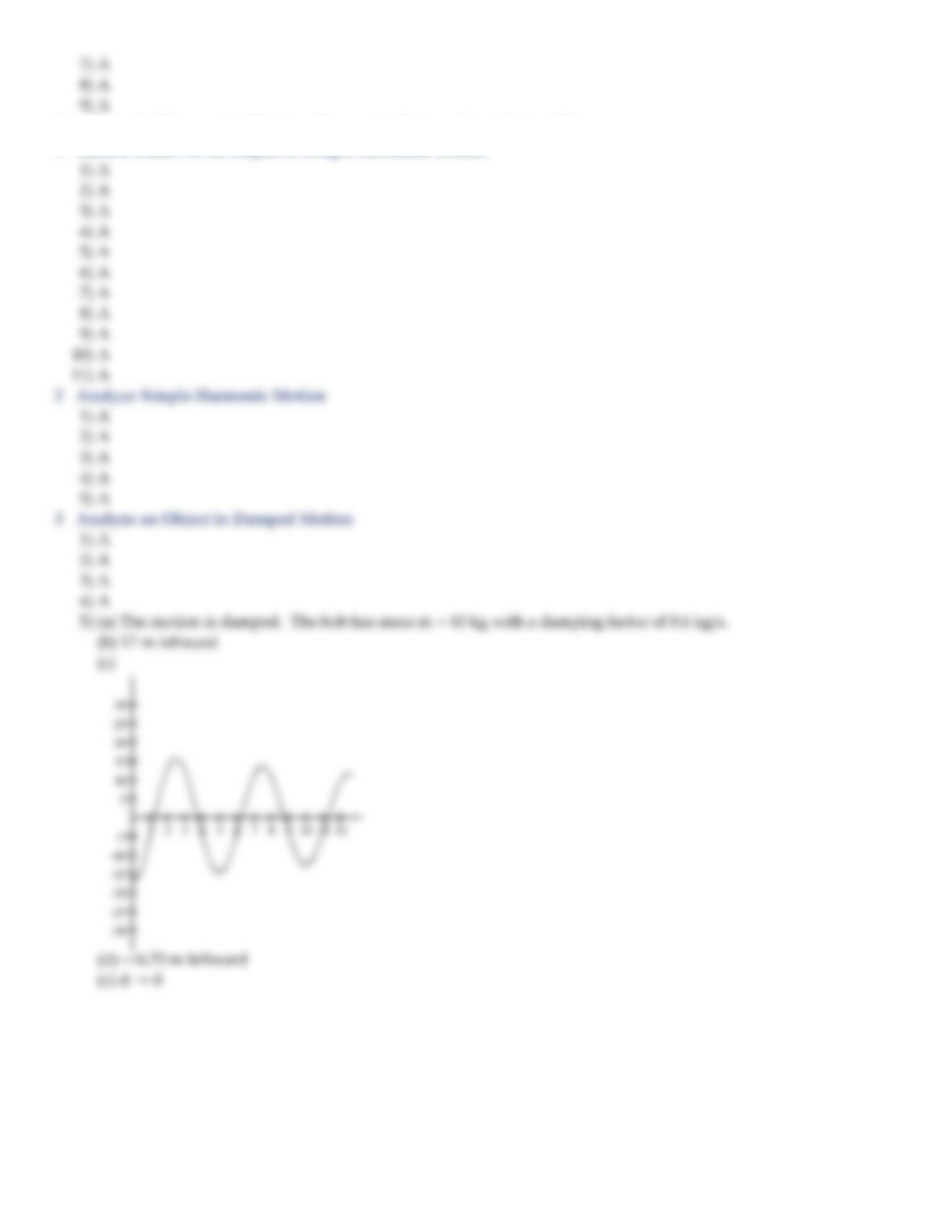
(b) What is the initial displacement of the bob? That is, what is the displacement at t = 0?
(c) Graph the motion using a graphing utility
(d) What is the displacement of the bob at the start of the second oscillation?
(e) What happens to the displacement of the bob as time increases without bound?
5) d = –17e–0.6t/20 cos 2π
5
2 – 0.36
400 t
6) d = –12e–0.8t/20 cos π
2.5
2 – 0.64
400 t
Solve the problem.
7) An object of mass m attached to a coiled spring with damping factor b is pulled down a distance a from its
rest position and then released. Assume the positive direction of the motion is up and the period of the
first oscillation is T. Write an equation that relates the distance d of the object from its rest position after t
seconds.
m = 15 g; a = 11 cm; b = 0.7 g/sec; T = 3 sec
Page 17
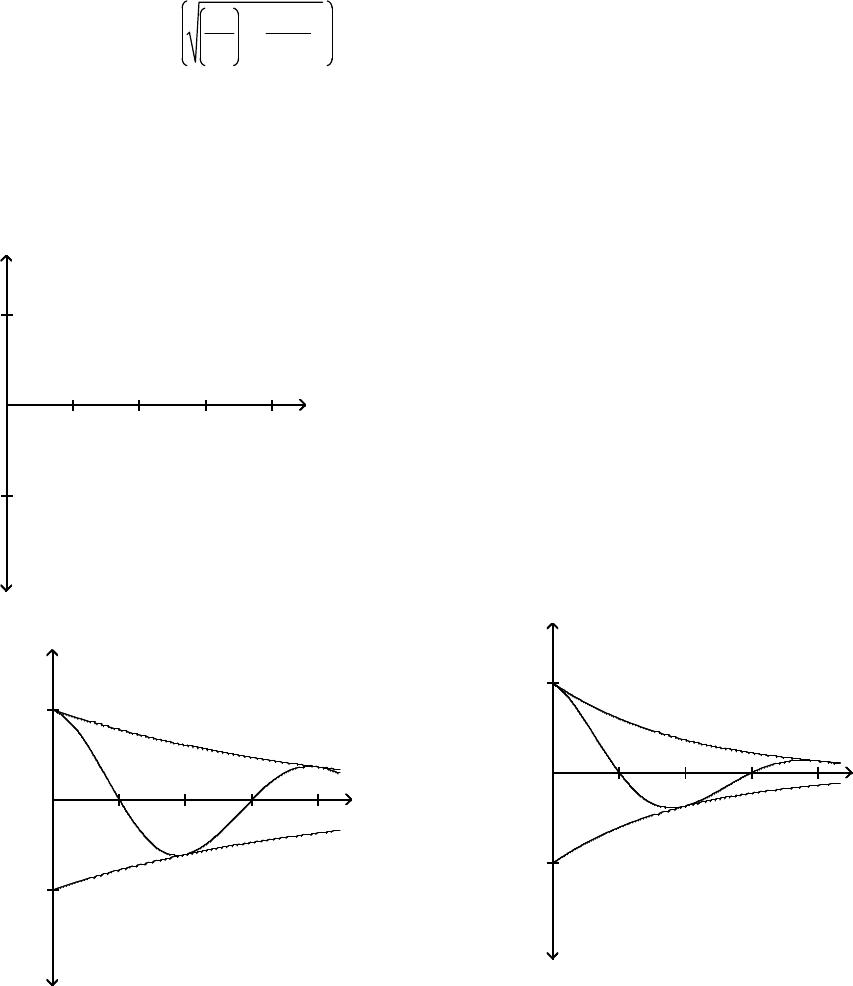
MULTIPLE CHOICE. Choose the one alternative that best completes the statement or answers the question.
8) The distance d (in meters) of the bob of a pendulum from its rest position at time t (in seconds) is given by:
d = –9e–0.6t/60 cos 2π
7
2– 0.36
3600 t
What is the maximum displacement of the bob after the first oscillation?
A) about 8.39 m B) about 0.13 m C) about 5.18 m D) about 8.91 m
Graph the damped vibration curve for 0 ≤ t ≤ 2π.
9) d(t) = e–t
/
2π cos t
x
2
y
1
-1
x
2
y
1
-1
A)
x
2
y
1
-1
x
2
y
1
-1
B)
x
2
y
1
-1
x
2
y
1
-1
Page 18
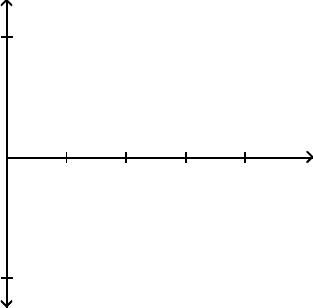
SHORT ANSWER. Write the word or phrase that best completes each statement or answers the question.
Solve the problem.
10) An object is suspended from a coiled spring. It is pulled downward and released. The position P above or
below its rest position after t seconds is given by
P = –e–x/2π cos x
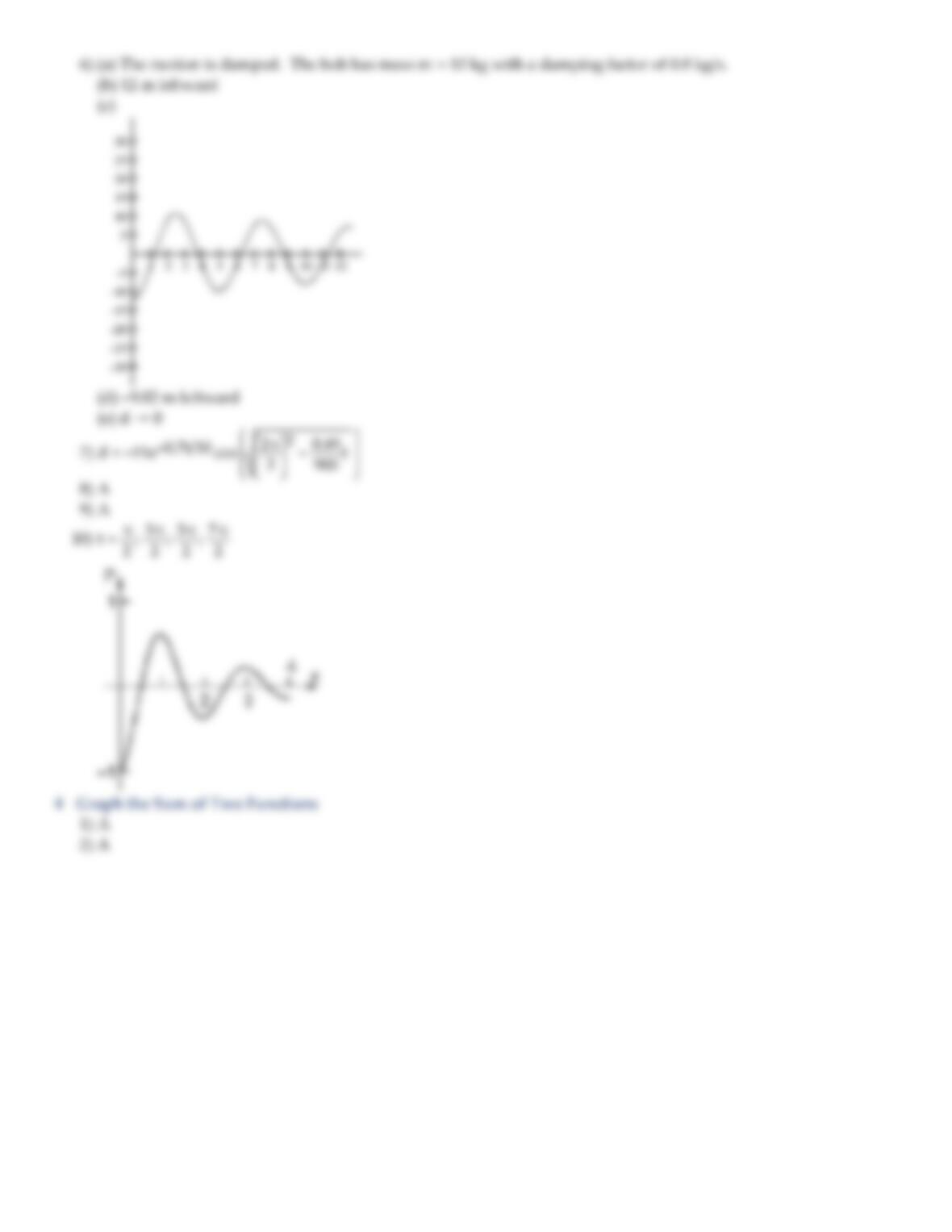
Find all values of t (0 ≤ t < 4π) for which the object is at the rest position and graph the equation for
0 ≤ t < 4π.
x
1234
P
1
-1
x
1234
P
1
-1
Page 19
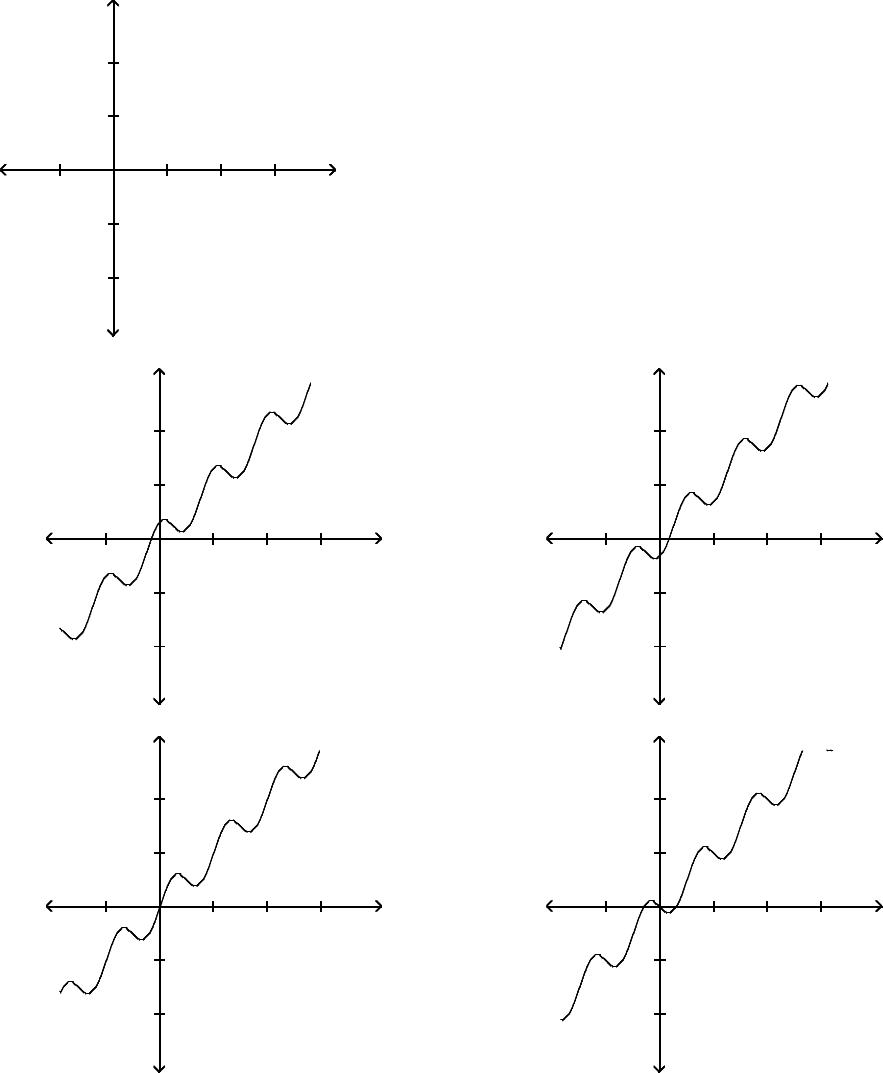
4 Graph the Sum of Two Functions
MULTIPLE CHOICE. Choose the one alternative that best completes the statement or answers the question.
Use the method of adding y–coordinates to graph the function.
1) f(x) = x + cos (2x)
x
–
2
3
y
2
–
-2
x
–
2
3
y
2
–
-2
A)
x
–
2
3
y
2
–
-2
x
–
2
3
y
2
–
-2
B)
x
–
2
3
y
2
–
-2
x
–
2
3
y
2
–
-2
C)
x
–
2
3
y
2
–
-2
x
–
2
3
y
2
–
-2
D)
x
–
2
3
y
2
–
-2
x
–
2
3
y
2
–
-2
Page 20
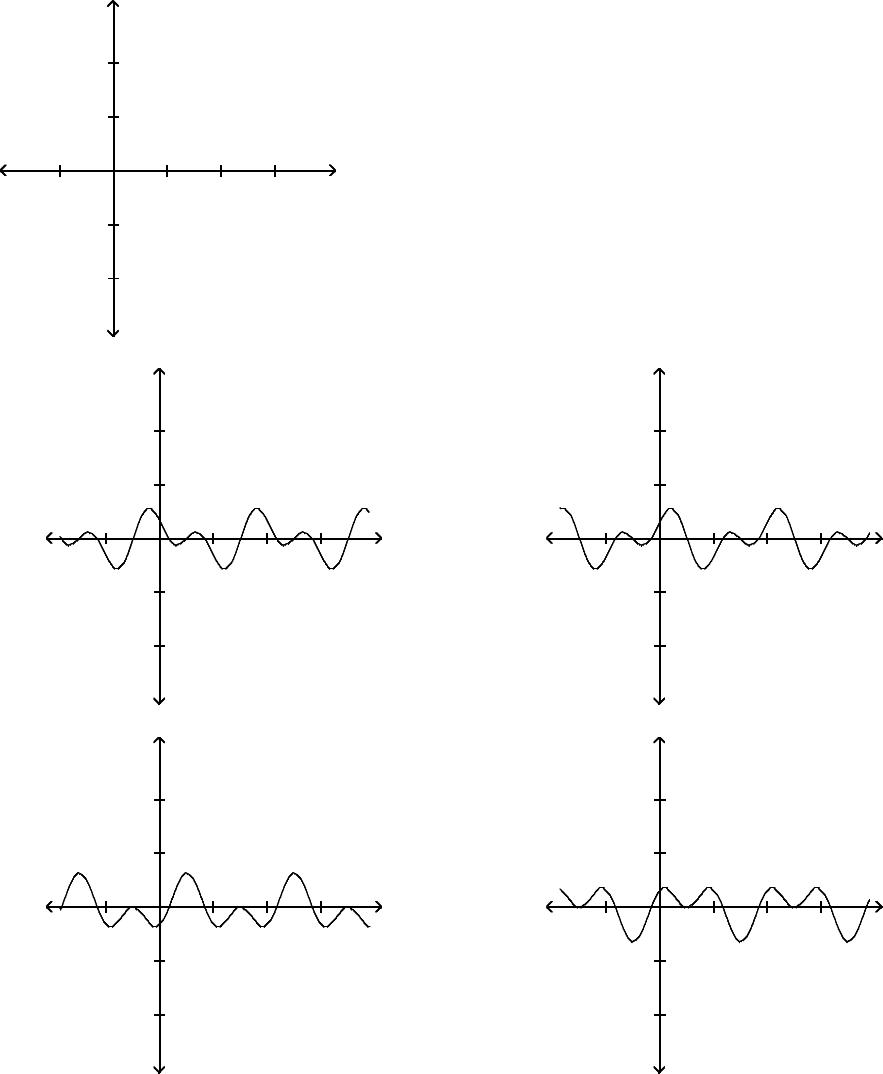
2) g(x) = cos x – sin (2x)
x
–
2
3
y
2
–
-2
x
–
2
3
y
2
–
-2
A)
x
–
2
3
y
2
–
-2
x
–
2
3
y
2
–
-2
B)
x
–
2
3
y
2
–
-2
x
–
2
3
y
2
–
-2
C)
x
–
2
3
y
2
–
-2
x
–
2
3
y
2
–
-2
D)
x
–
2
3
y
2
–
-2
x
–
2
3
y
2
–
-2
Page 21
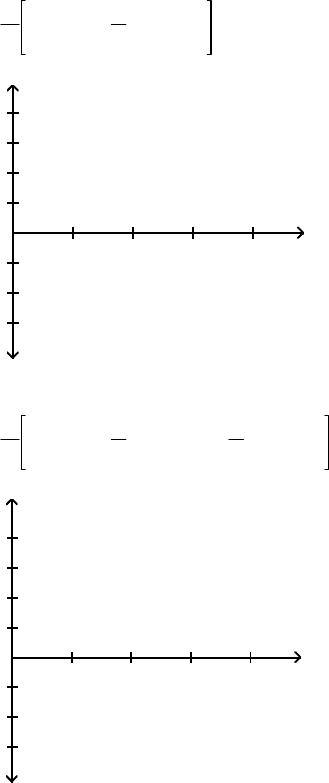
SHORT ANSWER. Write the word or phrase that best completes each statement or answers the question.
Solve the problem.
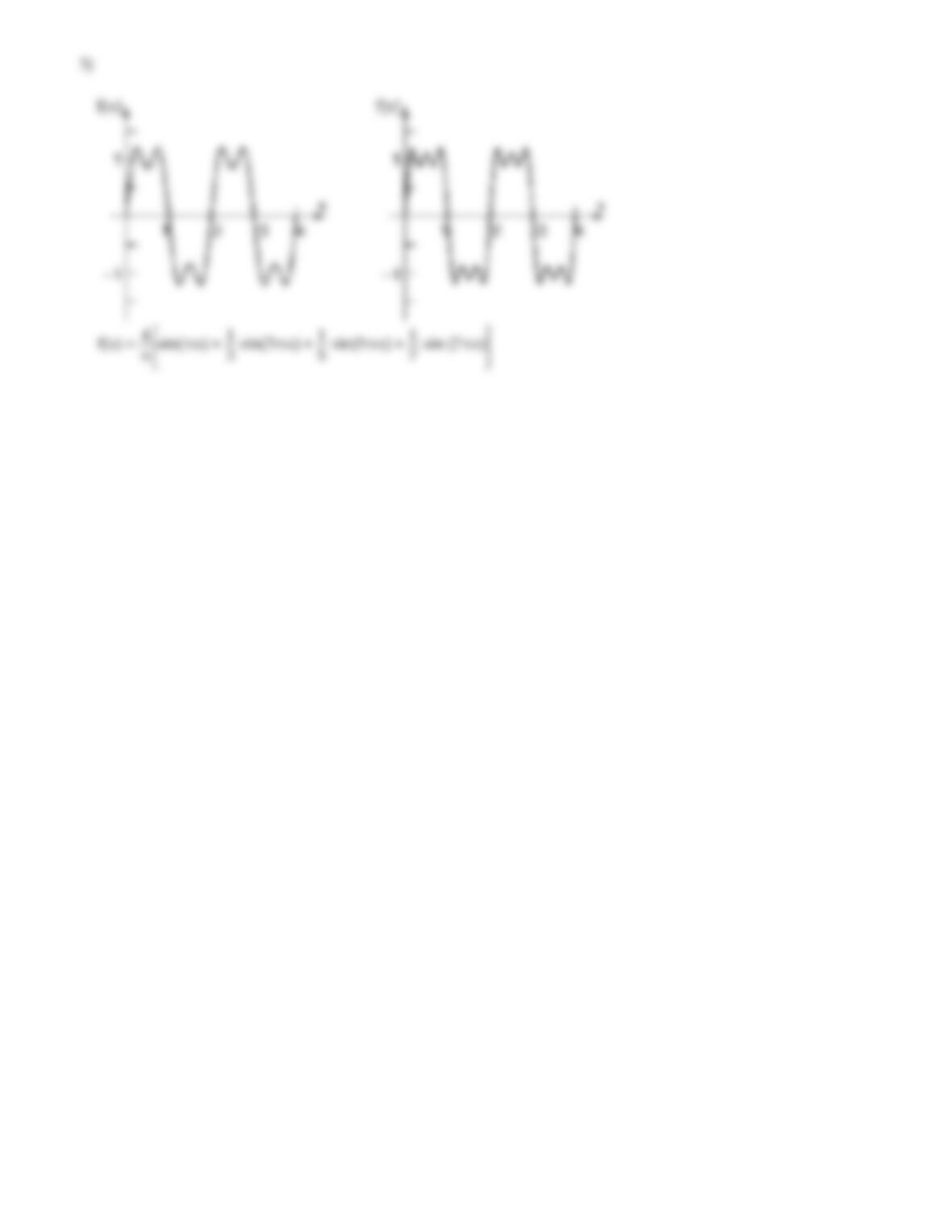
3) A square wave is built up from sinusoidal curves of varying periods and amplitudes.
Graph the following function, which can be used to approximate the square wave.
f(x) = 4
πsin(πx) + 1
3 sin(3πx) 0 ≤ x ≤ 4
x
1234
f(x)
2
1
-1
x
1234
f(x)
2
1
-1
A better approximation to the square wave is given by
f(x) = 4
πsin(πx) + 1
3 sin(3πx) + 1
5 sin(5πx) 0 ≤ x ≤ 4
x
1234
f(x)
2
1
-1
x
1234
f(x)
2
1
-1
Graph this function and compare the result to the previous graph. Adding another term will improve the
approximation even more. Write this new function with four terms.
Page 22
Ch. 9 Applications of Trigonometric Functions
Answer Key
9.1 Applications Involving Right Triangles
9.2 The Law of Sines
9.3 The Law of Cosines
9.4 Area of a Triangle
Page 24
9.5 Simple Harmonic Motion; Damped Motion; Combining Waves
Page 25
Page 26
Page 27