Ch. 8 Analytic Trigonometry
8.1 The Inverse Sine, Cosine, and Tangent Functions
1 Find the Exact Value of an Inverse Sine, Cosine, or Tangent Function
MULTIPLE CHOICE. Choose the one alternative that best completes the statement or answers the question.
Find the exact value of the expression.
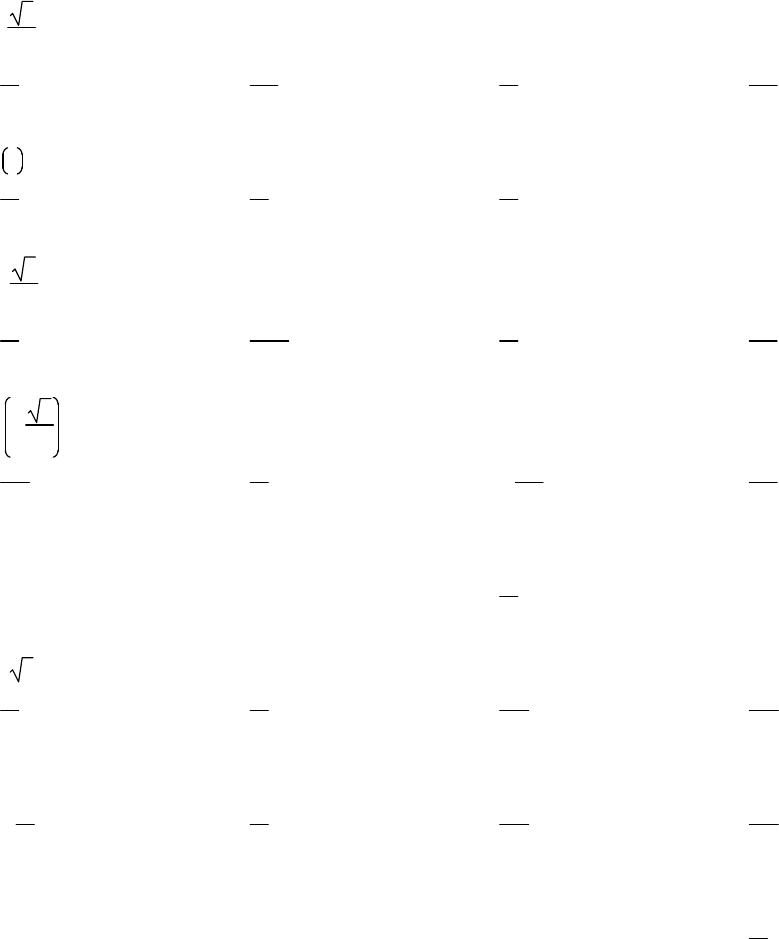
1) sin–1 3
2
A) π
3B) 2π
3C) π
4D) 3π
4
2) sin–11
A) π
2B) π
4C) π
3D) π
3) cos–1 3
2
A) π
6B) 11π
6C) π
4D) 7π
4
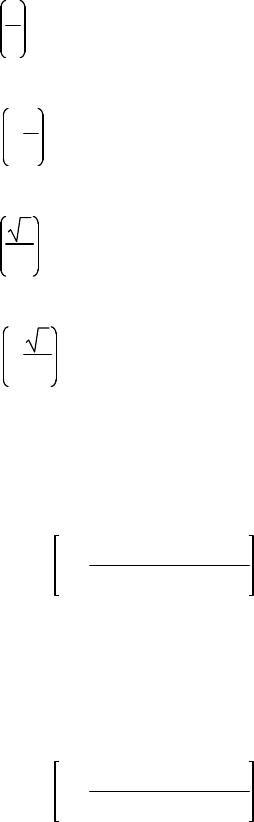
4) cos–1– 3
2
A) 5π
6B) π
6C) – 3π
4D) 2π
3
5) cos–1(1)
A) 0 B) πC) π
2D) –π
6) tan–1 3
A) π
3B) π
6C) 5π
4D) 3π
4
7) tan–1(–1)
A) – π
4B) π
4C) 5π
4D) 7π
4
8) tan–10
A) 0 B) 2πC) πD) π
2
2 Find an Approximate Value of the Inverse Sine, Cosine, and Tangent Functions
MULTIPLE CHOICE. Choose the one alternative that best completes the statement or answers the question.
Use a calculator to find the value of the expression rounded to two decimal places.
1) sin–1(–0.3)
A) –0.30 B) –17.46 C) 1.88 D) 107.46
Page 1
2) cos–1(–0.6)
A) 2.21 B) 126.87 C) –0.64 D) –36.87
3) tan–1(–1.1)
A) –0.83 B) –47.73 C) –0.74 D) –42.27
4) sin–13
4
A) 0.85 B) 48.59 C) 0.72 D) 41.41
5) cos–1– 5
7
A) 2.37 B) 135.58 C) –0.80 D) –45.58
6) sin–12
5
A) 0.29 B) 16.43 C) 1.28 D) 73.57
7) cos–1– 6
5
A) 2.08 B) 119.33 C) –0.51 D) –29.33
SHORT ANSWER. Write the word or phrase that best completes each statement or answers the question.
Solve the problem.
8) The formula
D = 24 1 – cos–1(tan i tan θ)
π
can be used to approximate the number of hours of daylight when the declination of the sun is i° at a
location θ° north latitude for any date between the vernal equinox and autumnal equinox. To use this
formula, cos–1 (tan i tan θ) must be expressed in radians. Approximate the number of hours of daylight in
Fargo, North Dakota, (46°52′ north latitude) for vernal equinox (i = 0°).
9) The formula
D = 24 1 – cos–1(tan i tan θ)
π
can be used to approximate the number of hours of daylight when the declination of the sun is i° at a
location θ° north latitude for any date between the vernal equinox and autumnal equinox. To use this
formula, cos–1 (tan i tan θ) must be expressed in radians. Approximate the number of hours of daylight in
Flagstaff, Arizona, (35°13′ north latitude) for summer solstice (i = 23.5°).
Page 2
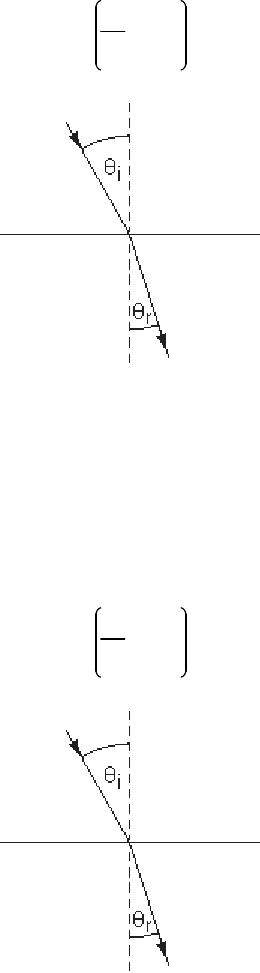
10) When light travels from one medium to anotherfrom air to water, for instanceit changes direction.
(This is why a pencil, partially submerged in water, looks as though it is bent.) The angle of incidence θi is
the angle in the first medium; the angle of refraction θr is the second medium. (See illustration.) Each
medium has an index of refractionni and nr, respectivelywhich can be found in tables. Snell’s law
relates these quantities in the formula
ni sinθi = nr sin θr
Solving for θr, we obtain
θr = sin–1 ni
nr sin θi
Find θr for crown glass (ni = 1.52), water(nr = 1.33), and θi = 38°.
11) When light travels from one medium to anotherfrom air to water, for instanceit changes direction.
(This is why a pencil, partially submerged in water, looks as though it is bent.) The angle of incidence θr is
the angle in the first medium; the angle of refraction θr is the second medium. (See illustration.) Each
medium has an index of refractionni and nr, respectivelywhich can be found in tables. Snell’s law
relates these quantities in the formula
ni sinθi = nr sin θr
Solving for θr, we obtain
θr = sin–1 ni
nr sin θi
Find θr for air (ni = 1.0003), methylene iodide (nr = 1.74), and θi = 14.7°.
Page 3
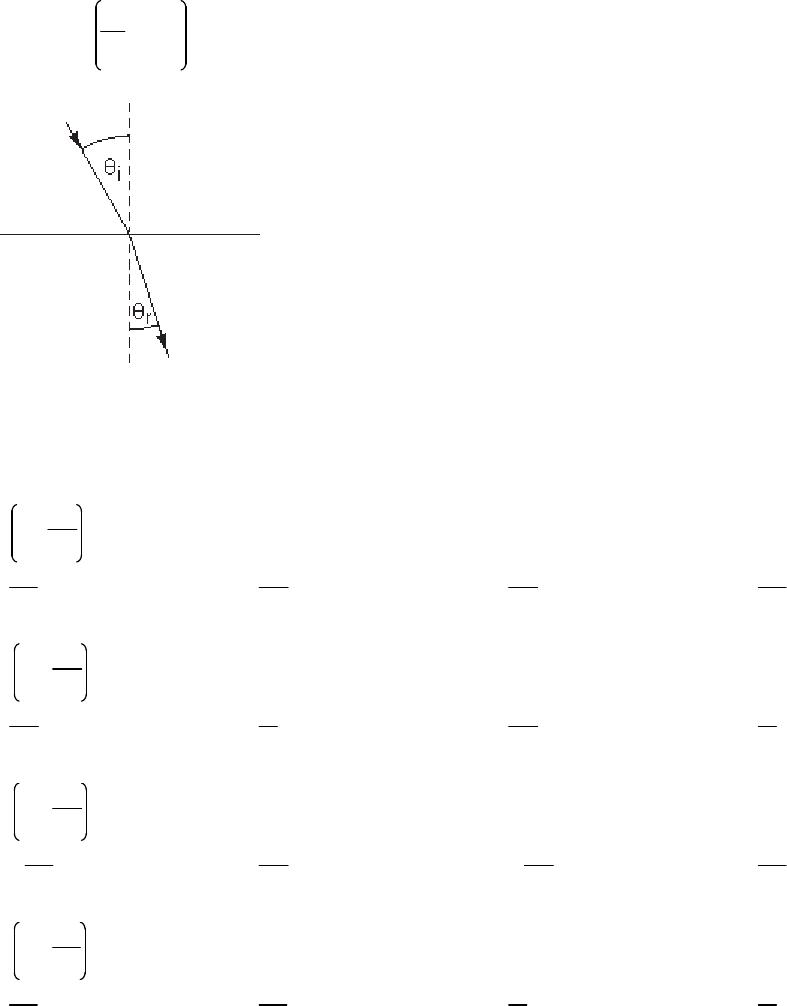
12) When light travels from one medium to anotherfrom air to water, for instanceit changes direction.
(This is why a pencil, partially submerged in water, looks as though it is bent.) The angle of incidence θi is
the angle in the first medium; the angle of refraction θr is the second medium. (See illustration.) Each
medium has an index of refractionni and nr, respectivelywhich can be found in tables. Snell’s law
relates these quantities in the formula
ni sinθi = nr sin θr
Solving for θr, we obtain
θr = sin–1 ni
nr sin θi
Find θr for fused quartz (ni = 1.46), ethyl alcohol (nr = 1.36), and θi = 8.5°.
3 Use Properties of Inverse Functions to Find Exact Values of Certain Composite Functions
MULTIPLE CHOICE. Choose the one alternative that best completes the statement or answers the question.
Find the exact value of the expression. Do not use a calculator.
1) sin–1sin 4π
7
A) 3π
7B) 4π
7C) 7
4πD) 7
3π
2) cos–1cos 6π
7
A) 6π
7B) π
7C) 7
6πD) 7
π
3) tan–1tan 5π
7
A) – 2π
7B) 5π
7C) – 5π
7D) 2π
7
4) cos–1cos 7π
6
A) 5π
6B) 4π
3C) π
6D) π
3
Page 4

5) cos–1cos – π
4
A) π
4B) 3π
4C) – π
4D) 5π
4
6) tan–1tan – π
6
A) – π
6B) 5π
6C) π
6D) 7π
6
7) sin–1sin – π
6
A) – π
6B) 5π
6C) π
6D) 7π
6
8) tan–1tan 6π
7
A) – π
7B) 6π
7C) 8π
7D) – 8π
7
9) sin–1sin 7π
6
A) – π
6B) 5π
6C) π
6D) 7π
6
10) cos–1cos – 4π
3
A) 2π
3B) – π
3C) π
3D) 4π
3
11) sin–1sin – 2
5
A) – 2
5B) 2
5C) 3
5D) – 3
5
Find the exact value, if any, of the composite function. If there is no value, say it is “not defined”. Do not use a
calculator.
12) sin[sin–1(–0.5)]
A) –0.5 B) 2.6 C) 0.5 D) not defined
13) tan(tan–1(–6.5))
A) –6.5 B) 6.5 C) 9.6 D) not defined
14) tan(tan–13)
A) 3 B) –3 C) 1 D) not defined
15) cos[cos–1(–9)]
A) –9 B) 9 C) 1 D) not defined
Page 5
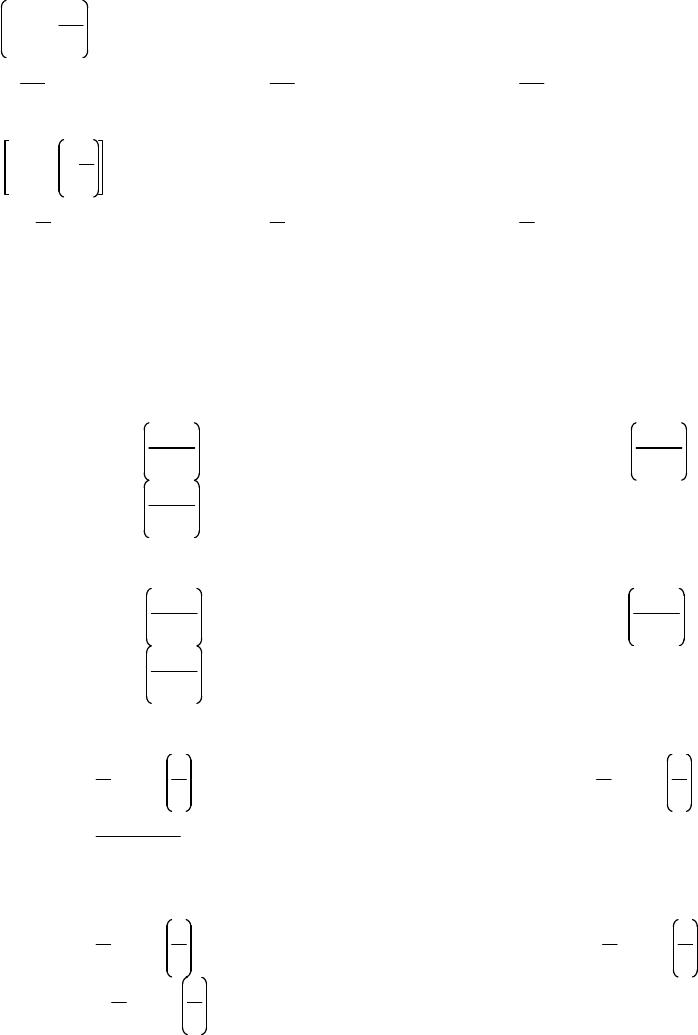
16) sin(sin–1 1.8)
A) 1.8 B) –1.8 C) 0.8 D) not defined
17) cos[cos–1(–1.3)]
A) 1.3 B) –1.3 C) 0.3 D) not defined
18) sin sin–1 7
10
A) 7
10 B) 1
10 C) 3
10 D) not defined
19) cos cos–1– 5
8
A) – 5
8B) 5
8C) 3
8D) not defined
4 Find the Inverse Function of a Trigonometric Function
MULTIPLE CHOICE. Choose the one alternative that best completes the statement or answers the question.
Find the inverse function f–1 of the function f.
1) f(x) = 7 sin x – 4
A) f–1(x) = sin–1x + 4
7B) f–1(x) = cos x +4
7
C) f–1(x) = sin–1x + 7
4 D) f–1(x) = 7 sin–1 x – 4
2) f(x) = 2 cos x + 3
A) f–1(x) = cos–1x –3
2B) f–1(x) = sin x –3
2
C) f–1(x) = cos–1x +3
2D) f–1(x) = 2 cos–1 x + 3
3) f(x) = 9 tan(3x)
A) f–1(x) = 1
3 tan–1x
9B) f–1(x) = 1
9 tan–1x
3
C) f–1(x) = 1
9 tan(3x) D) f–1(x) = 9 tan–1(3x)
4) f(x) = –4 cos(5x)
A) f–1(x) = 1
5 cos–1x
4B) f–1(x) = 1
4 cos–1x
5
C) f–1(x) = – 1
5 cos–1x
4D) f–1(x) = – 4 cos–1(5x)
5) f(x) = – sin(x + 3) – 6
A) f–1(x) = – sin–1(x + 6) – 3B)f
–1(x) = sin–1(x + 6) – 3
C) f–1(x) = – sin–1(x + 3) – 6D)f
–1(x) = – sin–1(x – 6) + 3
Page 6

6) f(x) = cos(x – 5) – 4
A) f–1(x) = cos–1(x + 4) + 5B)f
–1(x) = cos–1(x – 4) – 5
C) f–1(x) = cos–1(x – 5) – 4D)f
–1(x) = cos–1(x + 5) + 4
7) f(x) = 3 tan(10x – 7)
A) f–1(x) = 1
10 tan–1x
3 + 7 B) f–1(x) = 1
3tan–1x
10 + 7
C) f–1(x) = 3 tan–1(10x – 7) D) f–1(x) = 1
10 tan–1x
3 – 7
8) f(x) = –5 cos(10x + 8)
A) f–1(x) = 1
10 cos–1x
5 – 8 B) f–1(x) = 1
5cos–1x
10 – 8
C) f–1(x) = – 5 cos–1(10x + 8) D) f–1(x) = – 1
10 cos–1x
5 + 8
Find the domain of the function f and of its inverse function f–1.
9) f(x) = 7 sin x – 10
A) Domain of f: (–∞
,
∞)
Domain of f–1: [–17, –3]
B) Domain of f: (–∞
,
∞)
Domain of f–1: [3, 17]
C) Domain of f: (–∞
,
∞)
Domain of f–1: (–∞, ∞)
D) Domain of f: [3
,
17]
Domain of f–1: [–17, –3]
10) f(x) = 5 tan x + 7
A) Domain of f: x ≠ (2k + 1)π
2 ; k an integer
Domain of f–1: (–∞, ∞)
B) Domain of f: (–∞
,
∞)
Domain of f–1: [2, 12]
C) Domain of f: (–∞
,
∞)
Domain of f–1: x ≠ (2k + 1)π
2 ; k an integer
D) Domain of f: x ≠ (2k + 1)π
2 ; k an integer
Domain of f–1: [2, 12]
11) f(x) = 2 sin(5x)
A) Domain of f: (–∞
,
∞)
Domain of f–1: [–2, 2]
B) Domain of f: (–∞
,
∞)
Domain of f–1: [3, 7]
C) Domain of f: (–∞
,
∞)
Domain of f–1: [–5, 5]
D) Domain of f: – 1
5 , 1
5
Domain of f–1: (–∞, ∞)
12) f(x) = –5 cos(7x)
A) Domain of f: (–∞
,
∞)
Domain of f–1: [–5, 5]
B) Domain of f: (–∞
,
∞)
Domain of f–1: [2, 12]
C) Domain of f: (–∞
,
∞)
Domain of f–1: [–7, 7]
D) Domain of f: – 1
7 , 1
7
Domain of f–1: (–∞, ∞)
Page 7

13) f(x) = cos(x – 2) + 7
A) Domain of f: (–∞
,
∞)
Domain of f–1: [6, 8]
B) Domain of f: (–∞
,
∞)
Domain of f–1: (–∞, ∞)
C) Domain of f: (–∞
,
∞)
Domain of f–1: [–8, –6]
D) Domain of f: [–2
,
2]
Domain of f–1: (–∞, ∞)
14) f(x) = tan(x – 7) + 5
A) Domain of f: x ≠ (2k + 1)π
2 + 5 ; k an integer
Domain of f–1: (–∞, ∞)
B) Domain of f: x ≠ (2k + 1)π
2 ; k an integer
Domain of f–1: (–∞, ∞)
C) Domain of f: (–∞
,
∞)
Domain of f–1: [–6, –4]
D) Domain of f: [–7
,
7]
Domain of f–1: (–∞, ∞)
15) f(x) = –4 cos(10x + 2)
A) Domain of f: (–∞
,
∞)
Domain of f–1: [–4, 4]
B) Domain of f: (–∞
,
∞)
Domain of f–1: [–10, 10]
C) Domain of f: [–4
,
4]
Domain of f–1: (–∞, ∞)
D) Domain of f: (–∞
,
∞)
Domain of f–1: (–∞, ∞)
16) f(x) = 5 sin(9x – 1)
A) Domain of f: (–∞
,
∞)
Domain of f–1: [–5, 5]
B) Domain of f: (–∞
,
∞)
Domain of f–1: [–9, 9]
C) Domain of f: [–5
,
5]
Domain of f–1: (–∞, ∞)
D) Domain of f: – 1
9, 1
9
Domain of f–1: (–∞, ∞)
5 Solve Equations Involving Inverse Trigonometric Functions
MULTIPLE CHOICE. Choose the one alternative that best completes the statement or answers the question.
Find the exact solution of the equation.
1) cos–1 x = 0
A) x = 1B)x = πC) x =0D)x
= –1
2) sin–1 x = π
2
A) x = 1B)x = 0C)x =πD) x = –1
3) sin–1 x = π
6
A) x = 1
2B) x = 1C)x =0D)x
= – 1
2
Page 8
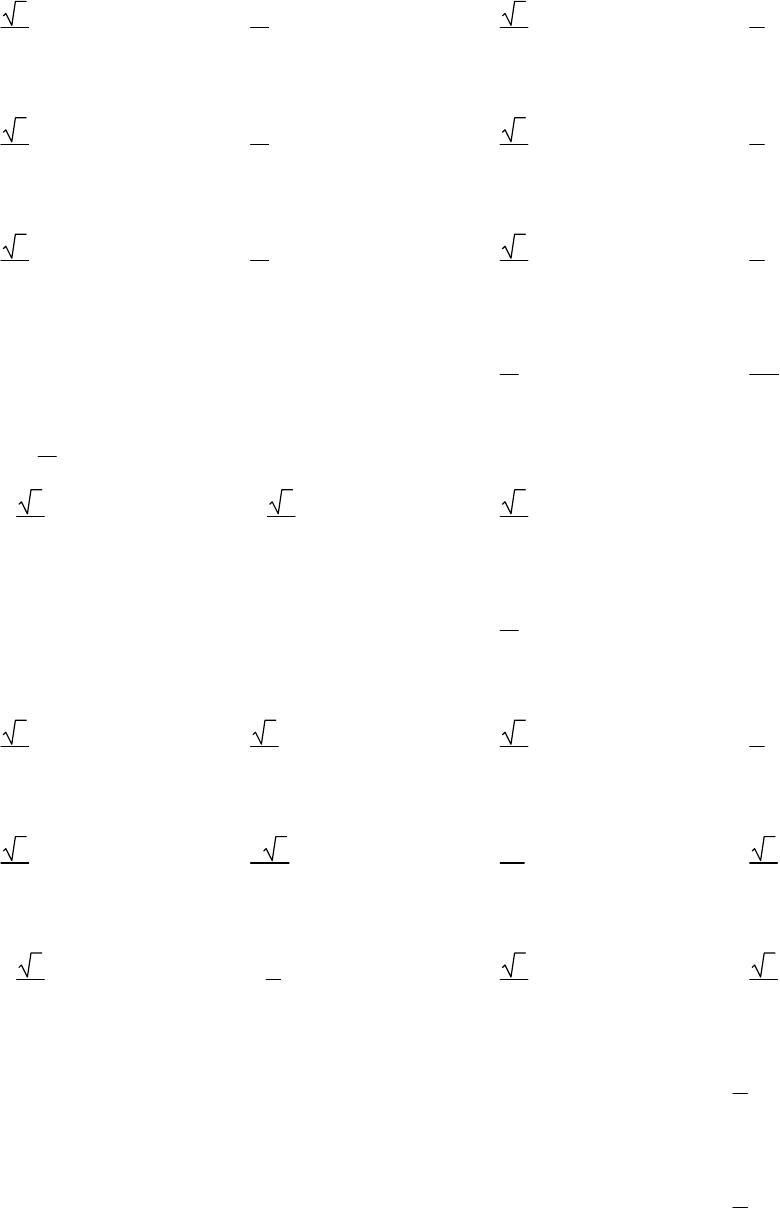
4) 3 sin–1 x = π
A) x = 3
2B) x = π
3C) x = 2
2D) x = 1
2
5) 6 cos–1 x = π
A) x = 3
2B) x = π
6C) x = 2
2D) x = 1
2
6) 4 cos–1 x = π
A) x = 2
2B) x = π
4C) x = 3
2D) x = 1
2
7) 2 cos–1 x = π
A) x = 0B)x = 1C)x = π
2D) x = 3π
2
8) –sin–1(4x) = π
4
A) x = – 2
8B) x =- 2
2C) x = 2
8D) x =0
9) –4 tan–1 x = π
A) x = –1B)x
= 1C)x = π
4D) x =0
10) 3 tan–1(2x) = π
A) x = 3
2B) x = 3
4C) x = 3
6D) x = 1
4
11) 4 cos–1(5x) = π
A) x = 2
10 B) x = 52
2C) x = 1
10 D) x = 3
10
12) –3 sin–1(2x) = π
A) x = – 3
4B) x = – 1
4C) x = 3
4D) x = 2
4
13) 5 cos–1 x – π = 3 cos–1 x
A) 0 B) 1 C) –1D)
– 1
2
14) 4 sin–1 x – 4π = 2 sin–1 x – 5π
A) –1 B) 1 C) 0 D) – 1
2
Page 9

8.2 The Inverse Trigonometric Functions (Continued)
1 Find the Exact Value of Expressions Involving the Inverse Sine, Cosine, and Tangent Functions
MULTIPLE CHOICE. Choose the one alternative that best completes the statement or answers the question.
Find the exact value of the expression.
1) sec sin–1– 3
2
A) 2 B) 1 C) 0 D) 2
2
2) cos sin–1 1
2
A) 3
2B) 1 C) 0 D) 2
2
3) tan cos–1– 1
2
A) –3 B) –1C)3D) – 3
3
4) sin cos–1– 2
2
A) 2
2B) – 1
2C) – 2
2D) 3
2
5) csc cos–1 3
2
A) 2 B) 23
3C) 1
2D) 2
2
6) cot[sin–1(–1)]
A) 0 B) –1C)
– 3
2D) – 2
2
7) tan(cos–1 1)
A) 0 B) –1C)
3
2D) 2
2
8) cos tan–1 3
3
A) 3
2B) 3
3C) 1
2D) π
3
9) sec[tan–1(–3)]
A) 2 B) 23
3C) 1
2D) – 23
3
Page 10

10) cos[tan–1(–1)]
A) 2
2B) – 2
2C) 1
2D) – 3
2
11) csc tan–1 3
3
A) 2 B) 23
3C) 3 D) 1
2
12) cot sin–1 2
2
A) 1 B) 2 C) 2
2D) 2
13) sin(tan–1 2)
A) 25
5B) 2 5 C) 52
2D) 5 2
14) sin cos–1 2
3
A) 5
3B) 5
2C) 2
3D) 25
5
15) tan cos–1 8
9
A) 17
8B) 17
9C) 9
8D) 17
16) sec sin–1– 4
7
A) 733
33 B) 33
7C) – 7
4D) – 433
33
17) cot sin–1– 2
5
A) – 21
2B) – 521
21 C) 21
5D) 221
21
18) cos tan–1– 2
3
A) 313
13 B) – 313
13 C) 13
2D) – 13
3
Page 11

19) csc tan–1– 8
9
A) – 145
8B) – 9 145
145 C) 9 145
145 D) 145
9
20) cot cos–1– 20
29
A) – 20
21 B) – 20
3C) – 21
20 D) 29
20
21) cos sin–1 3
5
A) 4
5B) 1
5C) – 3
5D) – 4
5
22) cos sin–14
5
A) 3
5B) 1
5C) – 4
5D) – 3
5
23) tan cos–1– 15
17
A) – 8
15 B) – 15 2
2C) – 15
8D) 17
15
24) sin tan–1– 8
15
A) – 8
17 B) – 8
3C) 8
17 D) – 15
8
25) sin cos–1– 3
5
A) 4
5B) 1
5C) 3
5D) – 4
5
26) sin cos–12
5
A) 21
5B) 21
2C) 2
5D) 221
21
27) tan cos–14
7
A) 33
4B) 33
7C) 7
4D) 33
Page 12

28) cos tan–1– 2
3
A) 313
13 B) – 313
13 C) 13
2D) – 13
3
29) cos–1cos 7π
6
A) 5π
6B) π
3C) π
6D) 4π
5
30) cos–1sin 7π
6
A) 2π
3B) π
3C) π
6D) 4π
5
31) cos–1cos – π
6
A) π
6B) 5π
6C) – π
6D) 7π
6
32) sin–1sin 5π
4
A) – π
4B) 3π
4C) π
4D) 5π
4
33) cos–1cos – 5π
4
A) 3π
4B) – π
4C) π
4D) 5π
4
34) sin–1sin 6π
7
A) π
7B) 6π
7C) 7
6πD) 7
π
35) tan–1tan 5π
7
A) – 2π
7B) 5π
7C) – 5π
7D) 2π
7
36) cos–1sin 5π
4
A) 3π
4B) 5π
4C) – π
4D) π
4
37) cos–1sin – π
6
A) 2π
3B) – π
3C) 5π
6D) – π
6
Page 13

38) sin–1cos 5π
3
A) π
6B) π
3C) – π
6D) 2π
3
39) sin–1cos – 5π
6
A) – π
3B) π
3C) – π
6D) 2π
3
2 Define the Inverse Secant, Cosecant, and Cotangent Functions
MULTIPLE CHOICE. Choose the one alternative that best completes the statement or answers the question.
Find the exact value of the expression.
1) cot–1–3
A) 5π
6B) π
6C) π
3D) 2π
3
2) csc–1–2
A) – π
6B) π
6C) π
3D) 2π
3
3) sec–12
A) π
3B) π
6C) π
4D) 2π
3
4) sec–1(–2)
A) 2π
3B) – π
3C) 4π
3D) – 2π
3
5) cot–1 3
A) π
6B) π
3C) π
4D) 2π
3
6) cot–1– 3
3
A) 2π
3B) – π
3C) 5π
6D) – π
6
7) csc–1– 23
3
A) – π
3B) 2π
3C) 5π
6D) – π
6
8) csc–1(–1)
A) – π
2B) – π
3C) π
2D) π
Page 14

3 Use a Calculator to Evaluate sec^–1 x, csc^–1 x, and cot^–1 x
MULTIPLE CHOICE. Choose the one alternative that best completes the statement or answers the question.
Use a calculator to find the value of the expression in radian measure rounded to two decimal places.
1) csc–1 6
5
A) 0.99 B) 56.44 C) 0.59 D) 33.56
2) sec–1 – 7
A) 1.71 B) 98.21 C) –0.14 D) –8.21
3) cot–1 5
3
A) 0.54 B) 30.96 C) 1.03 D) 59.04
4) sec–1 – 7
3
A) 2.01 B) 0.50 C) 1.13 D) –2.01
Solve the problem.
5) When granular materials are allowed to fall freely, they form conical (cone–shaped) piles. The naturally
occurring angle of slope, measured from the horizontal, at which the loose material comes to rest is called
the angle of repose and varies for different materials. The angle of repose θ is related to the height h and
base radius r of the conical pile by the equation θ = cot–1 r
h. Find the angle of repose for a granular
material which forms a cone–shaped pile with a height of 16 feet and a base diameter of 35.2 feet.
A) θ = 42.27° B) θ = 24.44° C) θ =47.73° D) θ =65.56°
6) When granular materials are allowed to fall freely, they form conical (cone–shaped) piles. The naturally
occurring angle of slope, measured from the horizontal, at which the loose material comes to rest is called
the angle of repose and varies for different materials. The angle of repose θ is related to the height h and
base radius r of the conical pile by the equation θ = cot–1 r
h. A certain granular material forms a
cone–shaped pile with a height of 15 feet and a base diameter of 33 feet. What is the height of a pile that
has a base diameter of 116 feet?
A) 52.73 ft B) 255.20 ft C) 26.36 ft D) 58.00 ft
4 Write a Trigonometric Expression as an Algebraic Expression
MULTIPLE CHOICE. Choose the one alternative that best completes the statement or answers the question.
Write the trigonometric expression as an algebraic expression in u.
1) sin (tan–1 u)
A) uu
2 + 1
u2 + 1
B) uu
2 – 1
u2 – 1
C) u u2 + 1 D) u2 + 1
u2 + 1
2) cos (tan–1 u)
A) u2 + 1
u2 + 1
B) u2 – 1
u2 – 1
C) u u2 + 1 D) uu
2 + 1
u2 + 1
Page 15

3) cos (sin–1 u)
A) 1 – u2B) u2 + 1 C) u2 – 1 D) u2 + 1
u
4) cos (cot–1 u)
A) uu
2 + 1
u2 + 1
B) u2 + 1
u2 + 1
C) u2 – 1 D) u2 + 1
u
5) tan (csc–1 u)
A) u2 – 1
u2 – 1
B) u2 – 1
uC) u2 – 1 D) u2 + 1
u2 + 1
6) sin (csc–1 u)
A) 1
uB) u2 – 1
uC) u D) u2 + 1
u
7) tan (sin–1 u)
A) u1
– u2
1 – u2B) 1 – u2
uC) 1 – u2D) uu
2 + 1
u2 + 1
8) csc (tan–1 u)
A) u2 + 1
uB) u2 – 1
u2 – 1
C) u2 + 1
u2 + 1
D) uu
2 + 1
u2 + 1
9) sec (sin–1 u)
A) 1 – u2
1 – u2B) u2 – 1
uC) 1 – u2D) u2 – 1
u2 – 1
10) cot (cos–1 u)
A) u1
– u2
1 – u2B) 1 – u2
uC) 1 – u2D) uu
2 + 1
u2 + 1
8.3 Trigonometric Equations
1 Solve Equations Involving a Single Trigonometric Function
MULTIPLE CHOICE. Choose the one alternative that best completes the statement or answers the question.
Solve the equation on the interval 0 ≤ θ < 2π.
1) 2 cos θ + 3 = 2
A) 2π
3, 4π
3B) 2π
3, 5π
3C) 5π
6, 7π
6D) 5π
6, 11π
6
Page 16
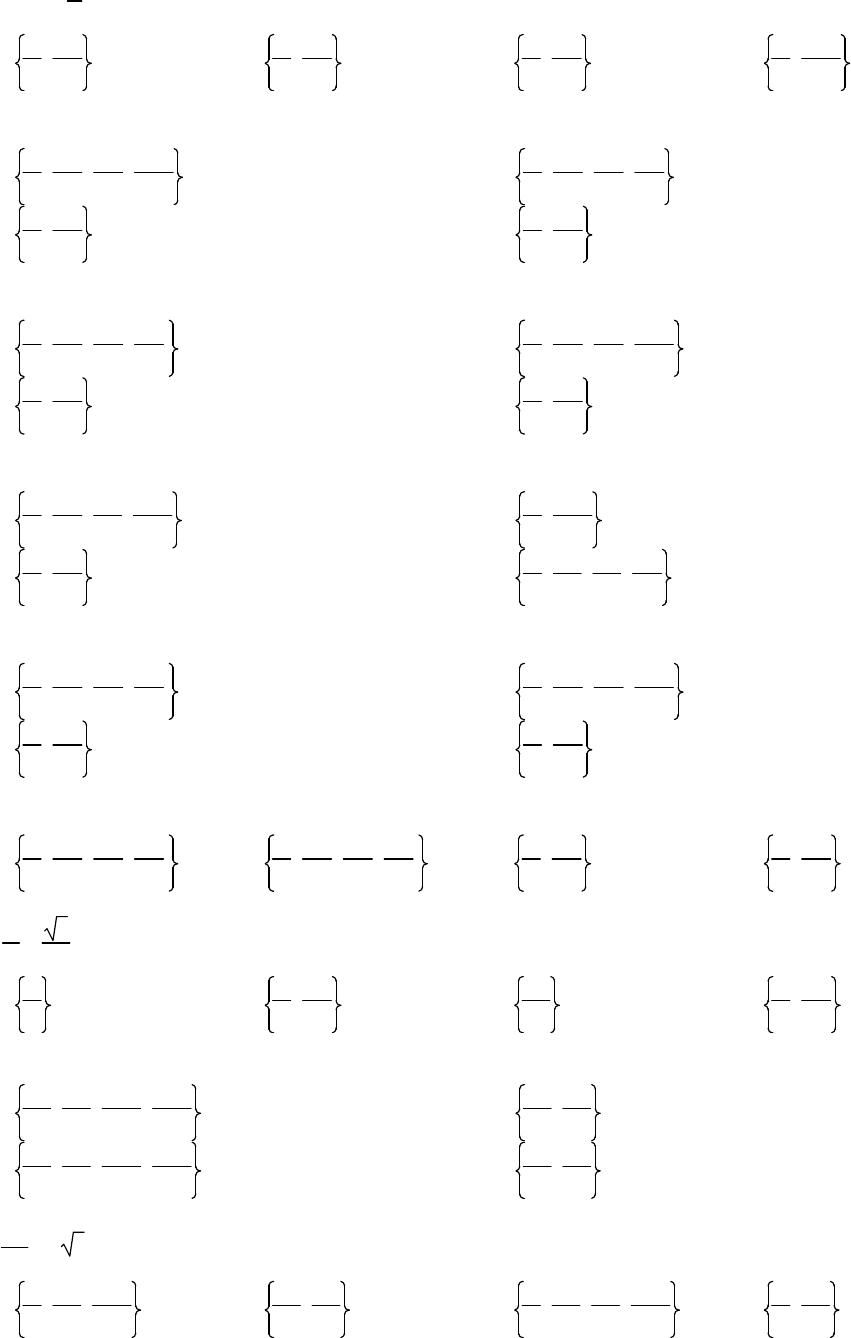
2) 1 – sin θ = 1
2
A) π
6, 5π
6B) π
3, 2π
3C) π
3, 4π
3D) π
6, 11π
6
3) 4 sin2 θ = 1
A) π
6, 5π
6, 7π
6, 11π
6B) π
3, 2π
3, 4π
3, 5π
3
C) π
3, 2π
3D) π
6, 5π
6
4) tan2 θ = 3
A) π
3, 2π
3, 4π
3, 5π
3B) π
6, 5π
6, 7π
6, 11π
6
C) π
3, 4π
3D) π
6, 7π
6
5) 4 cos2x – 3 = 0
A) π
6, 5π
6, 7π
6, 11π
6B) π
6, 11π
6
C) π
3, 5π
3D) π
3, 2π
3, 4π
3, 5π
3
6) 4 sin2 θ – 3 = 0
A) π
3, 2π
3, 4π
3, 5π
3B) π
6, 5π
6, 7π
6, 11π
6
C) π
3, 2π
3D) π
6, 5π
6
7) 2 cos2 θ – 1 = 0
A) π
4, 3π
4, 5π
4, 7π
4B) π
3, 2π
3, 4π
3, 5π
3C) π
4, 7π
4D) π
3, 5π
3
8) tan θ
2 = 3
3
A) π
3B) π
3, 4π
3C) 2π
3D) π
3, 7π
3
9) tan(2θ) = –1
A) 3π
8, 7π
8, 11π
8, 15π
8B) 3π
8, 5π
8
C) 3π
8, 5π
8, 11π
8, 13π
8D) 3π
8, 7π
8
10) sec 3θ
2 = –2
A) π
2, 5π
6, 11π
6B) 5π
6, 7π
6C) π
2, 5π
6, 7π
6, 11π
6D) π
2, 5π
6
Page 17
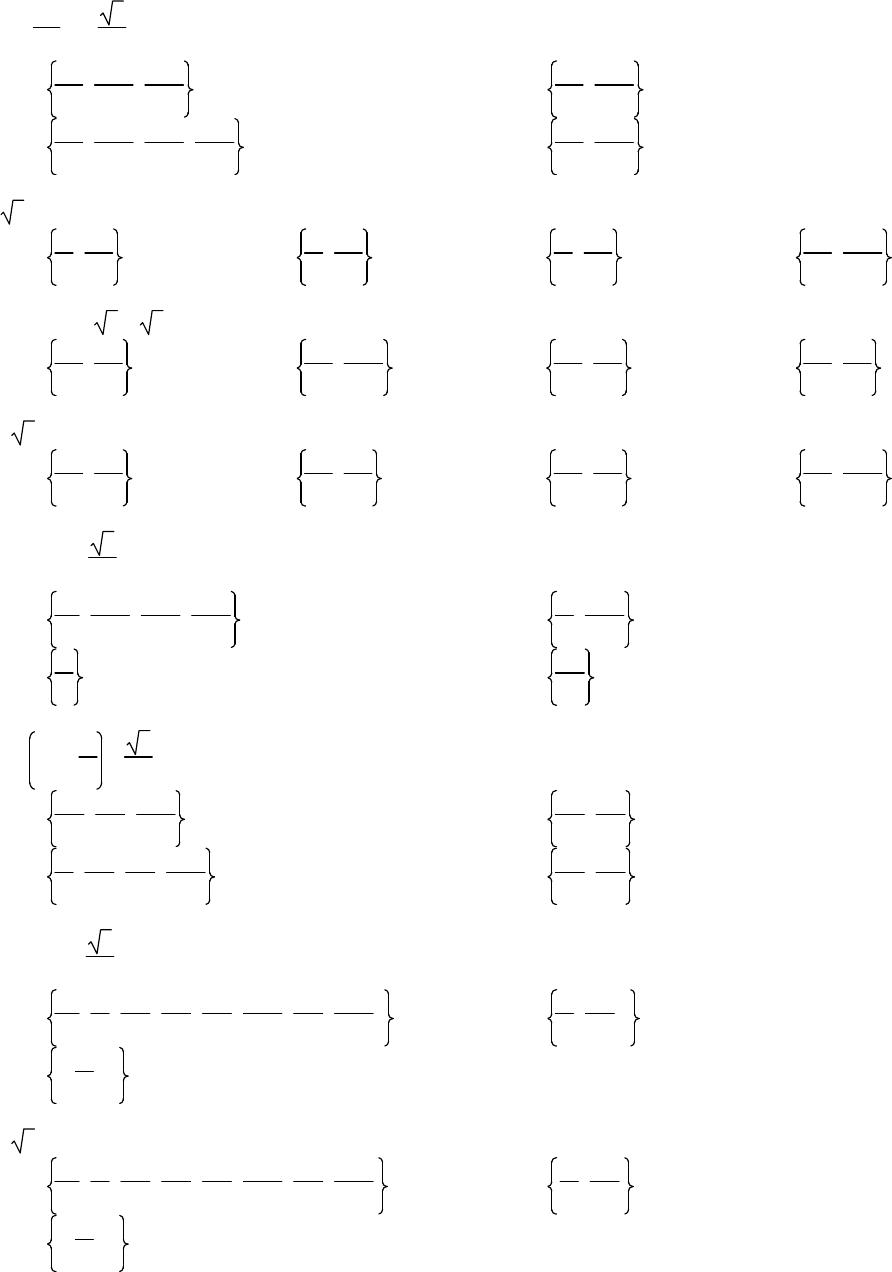
11) cot 3θ
2 = – 3
3
A) 4π
9, 10π
9, 16π
9B) 8π
9, 10π
9
C) 4π
9, 10π
9, 16π
9, 22π
9D) 4π
9, 10π
9
12) 3 cot θ – 1 = 0
A) π
3, 4π
3B) π
3, 2π
3C) π
6, 7π
6D) 7π
6, 11π
6
13) 2 cos θ + 23 = 3
A) 5π
6, 7π
6B) 7π
6, 11π
6C) 2π
3, 4π
3D) 2π
3, 5π
3
14) 5 2 sin θ + 4 = –1
A) 5π
4, 7π
4B) 3π
4, 7π
4C) 4π
3, 5π
3D) 7π
6, 11π
6
15) cos(2θ) = 3
2
A) π
12, 11π
12 , 13π
12 , 23π
12 B) π
6, 11π
6
C) π
2D) 3π
2
16) cos 2θ – π
2 = 2
2
A) 3π
8, 9π
8, 11π
8B) 3π
8, 7π
8
C) π
4, 5π
4, 9π
4, 13π
4D) 3π
8, 9π
8
17) sin(4θ) = 3
2
A) π
12, π
6, 2π
3, 7π
12 , 7π
6, 13π
12 , 5π
3, 19π
12 B) π
4, 5π
4
C) 0, π
4, πD) {0}
18) 2 3 sin(4θ) = 3
A) π
12, π
6, 2π
3, 7π
12 , 7π
6, 13π
12 , 5π
3, 19π
12 B) π
4, 5π
4
C) 0, π
4, πD) {0}
Page 18

19) csc(3θ) = 0
A) No solution B) 0, 2π
3, π, 4π
3C) π
4, 3π
4, 5π
4, 7π
4D) π
8, 9π
8
20) 2 cos(2θ) = 1
A) π
8, 7π
8, 9π
8, 15π
8B) 0, 2π
3, π, 4π
3
C) π
4, 3π
4, 5π
4, 7π
4D) No solution
21) cos θ – 1 = 0
A) {0} B) {π}C)
π
2D) 3π
2
22) 6 csc θ – 3 = 3
A) π
2B) {π}C){2π}D)
3π
2
23) 2 cos(2θ) = 3
A) π
12, 11π
12 , 13π
12 , 23π
12 B) π
6, 11π
6
C) π
2D) 3π
2
24) 2 cos θ + 1 = 0
A) 2π
3, 4π
3B) π
3, 5π
3C) π
2, 3π
2D) 3π
2
25) cot 2θ – π
2 = 1
A) 3π
8, 7π
8, 11π
8, and 15π
8B) 3π
8, 7π
8
C) π
4, 5π
4, 9π
4, and 13π
4D) 3π
8
Solve the equation. Give a general formula for all the solutions.
26) cos θ = 1
A) {θ|θ = 0 + 2kπ}B){θ|θ =π +2kπ}C)θ|θ = π
2 + 2kπD) θ|θ = 3π
2 + 2kπ
27) sin θ = 1
A) θ|θ = π
2 + 2kπB) {θ|θ =π +2kπ}C){θ|θ =0 +2kπ}D)θ|θ = 3π
2 + 2kπ
28) sin θ = 0
A) {θ|θ = 0 + kπ}B){θ|θ =0 +2kπ}C)θ|θ = π
2 + 2kπD) θ|θ = π
2 + kπ
Page 19

29) cos θ = 0
A) θ|θ = π
2 + kπB) {θ|θ =0 +2kπ}C)θ|θ = π
2 + 2kπD) {θ|θ =0 +kπ}
30) sin θ = 3
2
A) θ|θ = π
3 + 2kπ, θ = 2π
3 + 2kπB) θ|θ = π
3 + kπ, θ = 2π
3 + kπ
C) θ|θ = π
6 + 2kπ, θ = 5π
6 + 2kπD) θ|θ = π
6 + kπ, θ = 5π
6 + kπ
31) tan θ = –1
A) θ|θ = 3π
4 + kπB) θ|θ = π
4 + 2kπC) θ|θ = 3π
4 + 2kπD) θ|θ = π
4 + kπ
32) cos θ – 1 = 0
A) {θ|θ = 2kπ}B){θ|θ=π+2kπ}C)θ|θ = π
2 + 2kπD) θ|θ = 3π
2 + 2kπ
33) 2 cos θ + 1 = 0
A) θ|θ = 2π
3 + 2kπ, θ = 4π
3 + 2kπB) θ|θ = 2π
3 + kπ, θ = 4π
3 + kπ
C) θ|θ =π
2 + 2kπ, θ = 3π
2 + 2kπD) θ|θ = 3π
2 + kπ
34) cos(2θ) = 2
2
A) θ|θ = π
8 + kπ, θ = 7π
8 + kπB) θ|θ = π
8 + 2kπ, θ = 7π
8 + 2kπ
C) θ|θ = π
4 + kπ, θ = 3π
4 + kπD) θ|θ = 2π
3 + kπ, θ = 4π
3 + kπ
35) csc θ
3 = 23
3
A) {θ|θ = π + 6kπ}B)θ|θ = π
2 + 6kπC) θ|θ = π
9 + 2kπD) θ|θ = π
18 + 2kπ
36) cos θ = – 2
2
A) θ θ = 3π
4 + 2kπ, θ = 5π
4 + 2kπB) θ θ = 5π
4 + 2kπ, θ = 7π
4 + 2kπ
C) θ θ = 3π
4 + kπD) θ θ = 2π
3 + 2kπ, θ = 4π
3 + 2kπ
37) tan θ = 3
A) θ θ = π
3 + kπB) θ θ = π
3 + 2kπ
C) θ θ = π
3 + 2kπ, θ = 2π
3 + 2kπD) θ θ = π
6 + kπ
Page 20
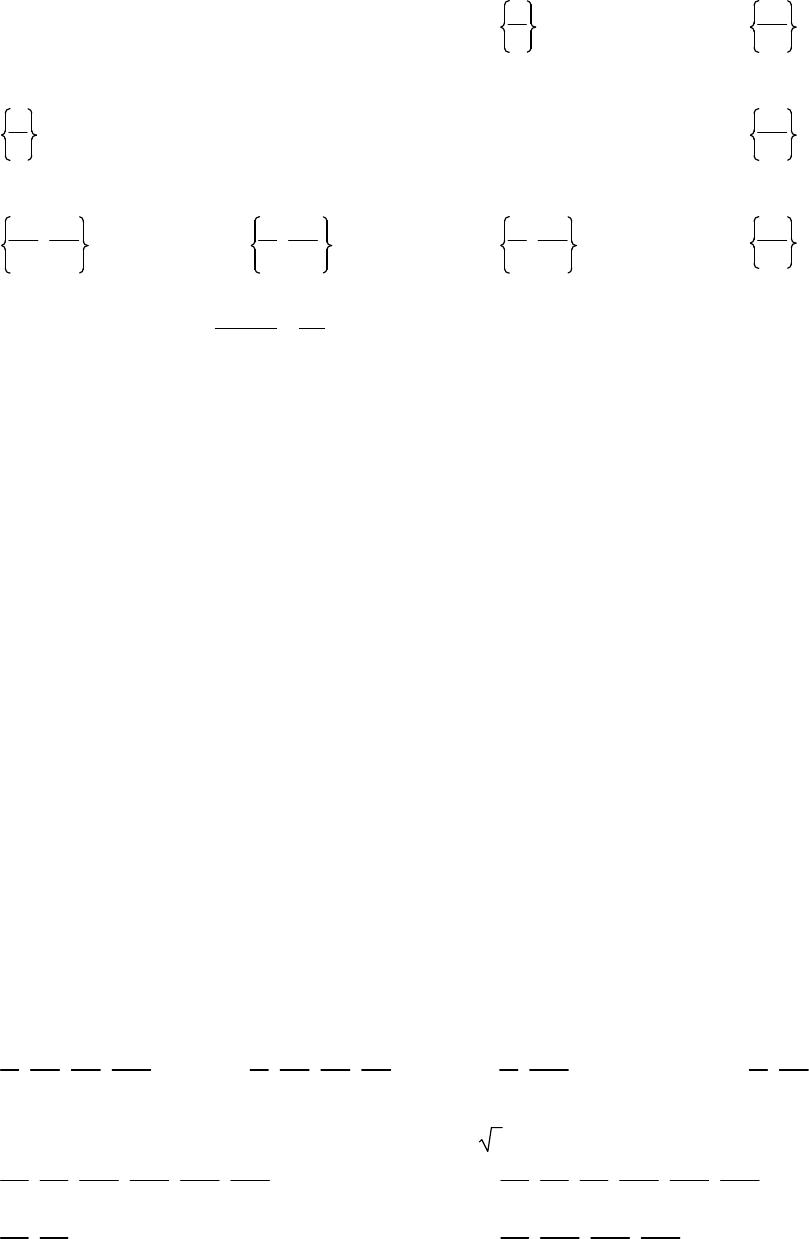
Solve the equation on the interval [0, 2π).
38) Suppose f(x) = cos θ – 1. Solve f(x) =0.
A) {0} B) {π}C)
π
2D) 3π
2
39) Suppose f(x) = 6 csc θ – 3. Solve f(x) =3.
A) π
2B) {π}C){2π}D)
3π
2
40) Suppose f(x) = 2 cos θ + 1. Solve f(x) =0.
A) 2π
3, 4π
3B) π
3, 5π
3C) π
2, 3π
2D) 3π
2
Solve the problem using Snell’s Law: sin θ1
sin θ2 = v1
v2.
41) A light beam in air travels at 2.99 × 10⁸ meters per second. If its angle of incidence to a second medium is
40° and its angle of refraction in the second medium is 29°, what is its speed in the second medium (to two
decimal places)?
A) 2.26 × 10⁸ mps B) 3.96 × 10⁸ mps C) 1.92 × 10⁸ mps D) 1.45 × 10⁸ mps
42) A ray of light near the horizon with an angle of incidence of 81° enters a pool of water and strikes a fish’s
eye. If the index of refraction is 1.33, what is the angle of refraction (to two decimal places)?
A) 47.96° B) 42.04° C) 45.31° D) 44.69°
43) The index of refraction of light passing from air into a second medium is 1.39. If the angle of incidence is
82°, what is the angle of refraction (to two decimal places)?
A) 45.43° B) 44.57° C) 43.17° D) 46.83°
44) A light beam traveling through air makes an angle of incidence of 37° upon a second medium. The
refracted beam makes an angle of refraction of 24°. What is the index of refraction of the material of the
second medium? Give the answer to two decimal places.
A) 1.48 B) 0.68 C) 0.60 D) 0.41
45) A light beam in air travels at 2.99 × 10⁸ meters per second. If its angle of incidence to a second medium is
83° and its angle of refraction in the second medium is 74°, what is its speed in the second medium (to two
decimal places)?
A) 2.90 × 10⁸ mps B) 3.09 × 10⁸ mps C) 2.97 × 10⁸ mps D) 2.87 × 10⁸ mps
Solve the problem.
46) What are the x–intercepts of the graph of f(x) = 4 cos2 x – 3 on the interval [0, 2π]?
A) π
6, 5π
6, 7π
6, 11π
6B) π
3, 2π
3, 4π
3, 5π
3C) π
6, 11π
6D) π
3, 5π
3
47) What are the x–intercepts of the graph of f(x) = 2 sin(3x) + 3 on the interval [0, 2π]?
A) 4π
9, 5π
9, 10π
9, 11π
9, 16π
9, 17π
9B) 2π
9, 5π
9, 8π
9, 11π
9, 14π
9, 17π
9
C) 4π
9, 5π
9D) 7π
18 , 11π
18 , 19π
18 , 23π
18
Page 21
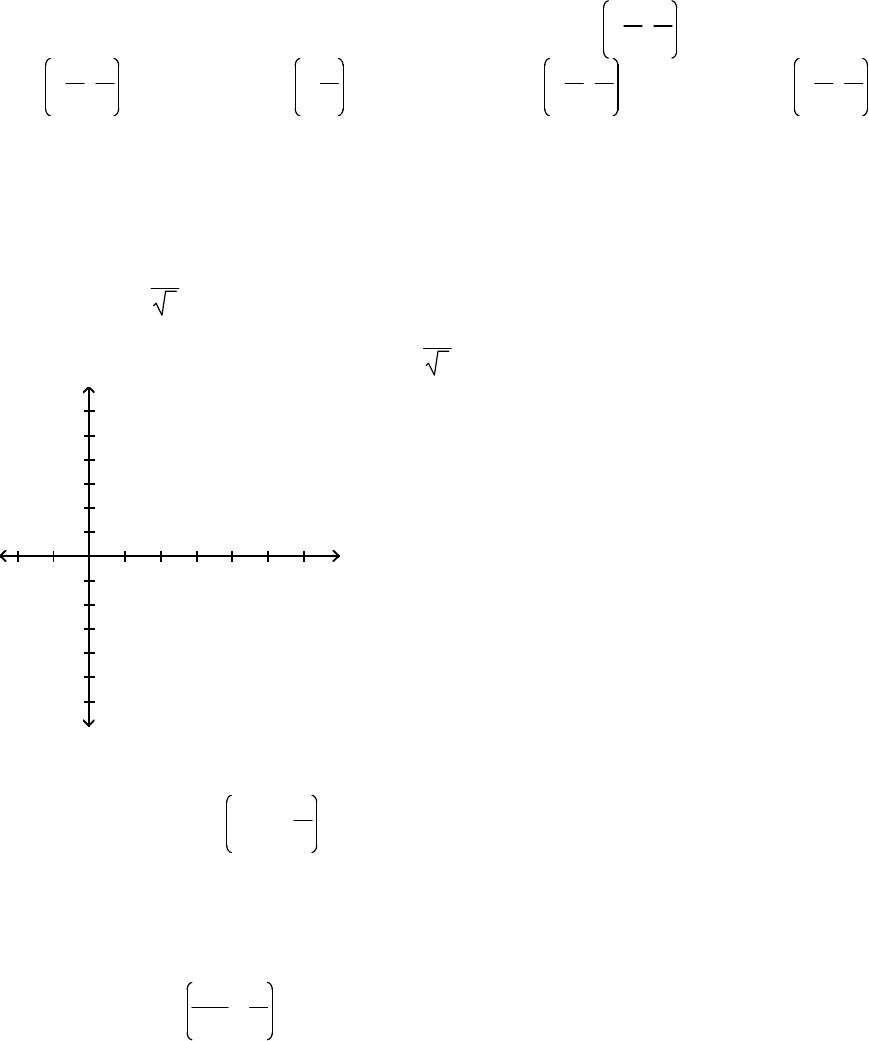
48) Given f(x) = 1 tan x, for what values of x is f(x) > –1 on the interval – π
2, π
2 ?
A) – π
4, π
2B) 0, π
2C) – π
4, π
4D) – π
2, π
4
SHORT ANSWER. Write the word or phrase that best completes each statement or answers the question.
49) Given f(x) = 2 sin x
(a) Find the intercepts of the graph of f on the interval [–π, 3π].
(b) Graph f(x) = 2 sin x on the interval [–π, 3π].
(c) Solve f(x) = – 2
2 on the interval [–π, 3π].
(d) Determine the values of x such that f(x) < – 2
2 on the interval [–π, 3π].
x
–
23
y
6
4
2
-2
-4
-6
x
–
23
y
6
4
2
-2
-4
-6
MULTIPLE CHOICE. Choose the one alternative that best completes the statement or answers the question.
50) The function I(t) = 40 sin 60πt – π
2 represents the amperes of current produced by an electric generator as
a function of time t, where t is measured in seconds. Find the smallest value of t for which the current is 20
amperes. Round your answer to three decimal places, if necessary.
A) 0.011 B) 0.033 C) 0.017 D) 0.008
51) A weight suspended from a spring is vibrating vertically with up being the positive direction. The
function f(t) = 10 sin 3πt
4 – π
4 represents the distance in centimeters of the weight from its rest position as
a function of time t, where t is measured in seconds. Find the smallest positive value of t for which the
displacement of the weight above its rest position is 5 cm. Round answer to three decimal places, if
necessary.
A) 0.556 B) 0.222 C) 2.293 D) 1.586
SHORT ANSWER. Write the word or phrase that best completes each statement or answers the question.
52) You are flying a kite and want to know its angle of elevation. The string on the kite is 43 meters long and
the kite is level with the top of a building that you know is 28 meters high. Use an inverse trigonometric
function to find the angle of elevation of the kite. Round to two decimal places.
Page 22

53) Before exercising, an athlete measures her air flow and obtains a = 0.65 sin 2π
5t where a is measured in
liters per second and t is the time in seconds. If a > 0, the athlete is inhaling; if a < 0, the athlete is exhaling.
The time to complete one complete inhalation/exhalation sequence is a respiratory cycle. Find the values of
t for which the athlete’s air flow is zero. Find all values of t for t < 20 seconds.
54) A mass hangs from a spring which oscillates up and down. The position P (in feet) of the mass at time t (in
seconds) is given by P = 4 cos (4t). For what values of t, 0 ≤ t < π, will the position be 2 2 feet? Find the
exact values. Do not use a calculator.
55) The path of a projectile fired at an inclination θ(in degrees) to the horizontal with an initial velocity v0is a
parabola. The range R of the projectile, that is, the horizontal distance that the projectile travels, is found
by using the formula
R =
v2
0
gsin (2θ)
where g is the acceleration due to gravity. Suppose the projectile is fired with an initial velocity of 400 feet
per seconds and g = 32 feet per second2. What angle θ, 0° ≤ θ < 90°, would you select for the range to be
2500 feet? (There should be two values of θ.)
56) Wildlife management personnel use predator–prey equations to model the populations of certain
predators and their prey in the wild. Suppose the population M of a predator after t months is given by
M = 750 + 125 sin π
6t
while the population N of its primary prey is given by
N = 12,250 + 3050 cos π
6t
Find the values of t, 0 ≤ t < 12, for which the predator population is 875. Find the values of t, 0 ≤ t < 12, for
which the prey population is 10,725.
57) A consumer notes the sinusoidal nature of her monthly power bills. In winter when she uses electricity to
heat her home and in summer when she cools her home, the bills are high. In spring and fall, significantly
less electricity is used and the bills are much smaller. The following function models this behavior.
C = 60 + 40 cos π
3t – π
3
Here C is the cost of power in dollars for the month t, 1 ≤ t ≤ 12, with t = 1 corresponding to January. For
what values of t, 1 ≤ t ≤ 12, is the cost exactly $80?
58) The average daily temperature T of a city in the United States is approximated by
T = 55 – 23 cos 2π
365 (t – 30)
where t is in days, 1 ≤ t ≤ 365, and t = 1 corresponds to January 1. For what range of values of t is the
average daily temperature above 70°F? Use a calculator and round answers to the nearest whole number.
2 Solve Trigonometric Equations Using a Calculator
MULTIPLE CHOICE. Choose the one alternative that best completes the statement or answers the question.
Use a calculator to solve the equation on the interval 0 ≤θ<2π. Round the answer to two decimal places.
1) sin θ = 0.47
A) {0.49
,
2.65} B) {0.49
,
5.79} C) {0.49
,
3.63} D) {0.49
,
2.06}
Page 23
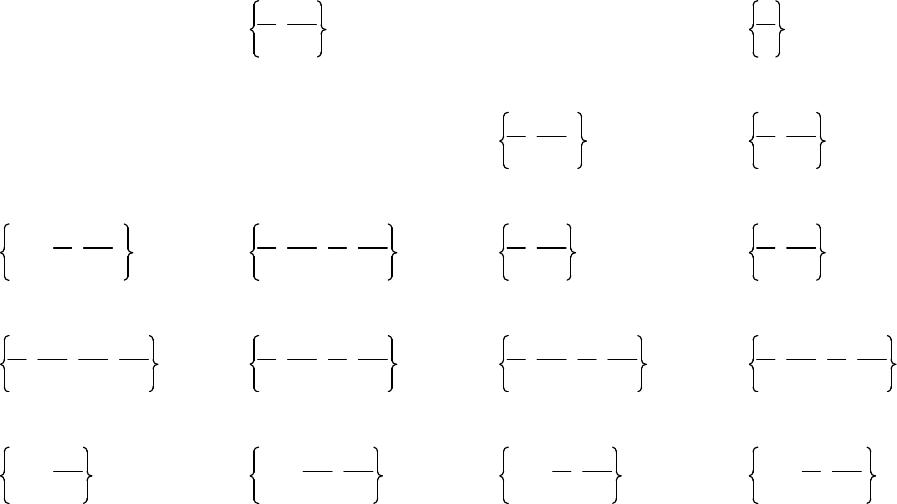
2) cos θ = 0.53
A) {1.01
,
5.27} B) 1.01
,
2.13 C) {1.01
,
4.15} D) {1.01
,
2.58}
3) tan θ = 5.1
A) {1.38
,
4.52} B) {1.38
,
4.90} C) {1.38
,
1.76} D) {1.38
,
2.95}
4) sin θ = –0.28
A) {3.43
,
6.00} B) {0.28
,
6.00} C) {0.28
,
3.42} D) {0.28
,
1.85}
5) cos θ = –0.77
A) {2.45
,
3.83} B) {2.45
,
5.59} C) {0.69
,
3.83} D) {0.69
,
2.45}
6) 2 csc θ = 5
A) {0.41, 2.73} B) {0.20} C) {0.41} D) {0.20, 2.94}
7) csc θ = –6
A) 6.12
,
3.31 B) 0.17
,
3.31 C) –1.74
,
8.02 D) –1.74
,
1.40
8) 7 cot θ = – 4
A) 2.09
,
5.23 B) 2.09
,
4.19 C) 2.62
,
5.76 D) 2.62
,
6.80
9) 7 tan θ – 6 = 0
A) 0.71
,
3.85 B) 0.71
,
2.43 C) 0.71
,
5.57 D) 0.86
,
4.00
10) 7 sin θ + 2 = 0
A) 3.43
,
5.99 B) 2.85
,
5.99 C) 1.86
,
4.42 D) 1.86
,
5.00
3 Solve Trigonometric Equations Quadratic in Form
MULTIPLE CHOICE. Choose the one alternative that best completes the statement or answers the question.
Solve the equation on the interval 0 ≤ θ < 2π.
1) cos2 θ – 1 = 0
A) {0, π}B)
π
2, 3π
2C) {0} D) π
2
2) cos2 θ + 2 cos θ + 1 = 0
A) {π}B){2π}C)
π
2, 3π
2D) π
4, 7π
4
3) 2 sin2 θ = sin θ
A) 0, π, π
6, 5π
6B) π
2, 3π
2, π
3, 2π
3C) π
6, 5π
6D) π
3, 2π
3
4) csc5 θ – 4 csc θ = 0
A) π
4, 3π
4, 5π
4, 7π
4B) π
4, 3π
4, π
6, 5π
6C) π
4, 5π
4, π
3, 5π
3D) π
4, 3π
4, π
3, 5π
6
5) sin2 θ + sin θ = 0
A) 0, π, 3π
2B) 0, π, 4π
3, 5π
3C) 0, π, π
3, 5π
3D) 0, π, π
3, 2π
3
Page 24
6) 2 cos2 θ – 3 cos θ + 1 = 0
A) 0, π
3, 5π
3B) π
3, π
2, 5π
3C) 0, π
6, 11π
6D) 0, π
3, 2π
3
7) 2 sin2 θ – 3 sin θ – 2 = 0
A) 7π
6, 11π
6B) π
2, 7π
6, 11π
6C) π
2, 5π
6, 7π
6D) 4π
3, 5π
3
SHORT ANSWER. Write the word or phrase that best completes each statement or answers the question.
Solve the problem.
8) A water wheel rotates through the angle θ
,
the water level L behind the wheel changes according to the
equation
L = 1 – sin θ – 2 cos2 θ
where L is measured in inches. Determine the values of θ for which the water level is zero. Find the exact
values. Do not use a calculator.
4 Solve Trigonometric Equations Using Fundamental Identities
MULTIPLE CHOICE. Choose the one alternative that best completes the statement or answers the question.
Solve the equation on the interval 0 ≤ θ < 2π.
1) tan θ + sec θ = 1
A) {0} B) π
4C) 5π
4D) No solution
2) sec2 θ – 2 = tan2 θ
A) No solution B) π
3C) π
6D) π
4
3) sin2 θ – cos2 θ = 0
A) π
4, 3π
4, 5π
4, 7π
4B) π
4, π
6C) π
4, π
3D) π
4
4) 3 cot2 θ – 4 csc θ = 1
A) π
6, 5π
6B) 7π
6, 11π
6C) π
6D) 7π
6
5) sin2 θ = 5(cos θ + 1)
A) {π}B)
3π
2C) {0} D) No solution
6) cos2 θ = 3(1 – sin θ)
A) π
2B) 3π
2C) {0} D) {π}
7) 2 sin2 θ = 3(cos θ + 1)
A) 2π
3, π, 4π
3B) 5π
6, π, 7π
6C) 0, 2π
3, 5π
3D) 0, 5π
6, 11π
6
Page 25
8) cos2 θ – sin2 θ = 1 + sin θ
A) 0, π, 7π
6, 11π
6B) 0, π
6, 5π
6, πC) 0, π, 4π
3, 5π
3D) π
2, 7π
6, 3π
2, 11π
6
9) sin2 θ – cos2 θ + cos θ = 0
A) 0, 2π
3, 4π
3B) 0, π
3, 5π
3C) 0, 2π
3, π, 4π
3D) 0, 5π
6, 7π
6
10) 1 + cos θ = 2 sin2 θ
A) π
3, π, 5π
3B) π
3, 3π
2, 5π
3C) 2π
3, π, 4π
3D) π
6, 3π
2, 11π
6
11) (csc θ – 2)(cot θ + 1) = 0
A) π
6, 3π
4, 5π
6, 7π
4B) π
6, 3π
4, 5π
6, 5π
4
C) π
6, 3π
4, 7π
4, 11π
6D) 3π
4, 7π
6, 5π
4, 11π
6
12) sec θ = cos θ
A) {0, π}B)
π
2, 3π
2C) {0} D) π
4, 7π
4
13) cot θ = 2 cos θ
A) π
6, π
2, 5π
6, 3π
2B) 0, π
6, 5π
6, πC) π
3, π
2, 2π
3, 3π
2D) 0, π
3, 2π
3, π
14) tan2 θ = – 3
2 sec θ
A) 2π
3, 4π
3B) π
3, 5π
3C) 5π
6, 7π
6D) π
3, 2π
3, 4π
3, 5π
3
15) tan θ + sec θ = 1
A) {0} B) π
4C) 5π
4D) No solution
16) sec2 θ – 2 = tan2 θ
A) No solution B) π
3C) π
6D) π
4
17) 3 cot2 θ – 4 csc θ = 1
A) π
6, 5π
6B) 7π
6, 11π
6C) π
6D) 7π
6
Page 26

Solve the problem.
18) The altitude of a projectile in feet (neglecting air resistance) is given b
y
y = (tan θ)x – 16
v2 cos2 θ
x2,
where x is the horizontal distance covered in feet and v is the initial velocity of the projectile at an angle θ
from the horizontal. Find the firing angle (in degrees) of a projectile fired at an initial velocity of 100 feet
per second so that it strikes the ground 312.5 feet from the firing point.
A) 45° B) 30° C) 22.5° D) 50°
5 Solve Trigonometric Equations Using a Graphing Utility
SHORT ANSWER. Write the word or phrase that best completes each statement or answers the question.
Use a calculator to solve the equation on the interval 0 ≤x <2π. Round the answer to one decimal place if
necessary.
1) x + 3 sin x = 1
2) 2x – 3 cos x = 0
3) ex = cos x
4) 2x2 – 3x sin x = 2
5) 6x – 5 sin x = 2
6) cos x + sin x = 2x
7) x2 – 4 cos x = 0
8) x2 – 3 sin(2x) = 2x
9) 7 cos x – ex = 1, x > 0
MULTIPLE CHOICE. Choose the one alternative that best completes the statement or answers the question.
Use a graphing utility to solve the equation on the interval 0° ≤x<360°. Express the solution(s) rounded to one
decimal place.
10) 2 + 13 sin x = 14 cos2 x
A) 34.9°
,
145.2° B) 34.9°
,
214.9° C) 55.2°
,
124.9° D) 214.9°
,
325.2°
SHORT ANSWER. Write the word or phrase that best completes each statement or answers the question.
11) –11 + 24 sin x = 16 cos2 x
MULTIPLE CHOICE. Choose the one alternative that best completes the statement or answers the question.
12) sin2 x – 8 sin x + 16 = 0
A) No solution B) 28.2°
,
151.8°
,
208.2°
,
331.8°
C) 208.2°
,
331.8° D) 28.2°
,
151.8°
Page 27

13) sin2 x + 8 sin x + 16 = 0
A) No solution B) 28.2°
,
151.8°
,
208.2°
,
331.8°
C) 208.2°
,
331.8° D) 28.2°
,
151.8°
14) sin2 x – 8 sin x – 4 = 0
A) 208.2°
,
331.8° B) 28.2°
,
151.8°
,
208.2°
,
331.8°
C) 28.2°
,
151.8° D) No solution
15) sin2 x + 8 sin x – 4 = 0
A) 28.2°
,
151.8° B) 28.2°
,
151.8°
,
208.2°
,
331.8°
C) 208.2°
,
331.8° D) No solution
16) tan2 x + 5 tan x + 3 = 0
A) 103.1°
,
145.1°
,
283.1°
,
325.1° B) 70.5°
,
109.5°
,
180.0°
C) 49.8°
,
130.2°
,
229.8°
,
310.2° D) 51.8°
,
128.2°
17) 3 cos2 x + 2 cos x = 1
A) 70.5°
,
180.0°
,
289.5° B) 103.2°
,
145.2°
,
283.2°
,
325.2°
C) 49.8°
,
130.2°
,
229.8°
,
310.2° D) 51.8°
,
128.2°
18) 7 cot2 x – 5 = 0
A) 49.8°
,
130.2°
,
229.8°
,
310.2° B) 103.2°
,
145.2°
,
283.2°
,
325.2°
C) 70.5°
,
109.5°
,
180.0° D) 51.8°
,
128.2°
19) cos2 x + cos x – 1 = 0
A) 51.8°
,
308.2° B) 103.2°
,
145.2°
,
283.2°
,
325.2°
C) 70.5°
,
109.5°
,
180.0° D) 49.8°
,
130.2°
,
229.8°
,
310.2°
SHORT ANSWER. Write the word or phrase that best completes each statement or answers the question.
Solve the problem.
20) A weight is suspended on a system of spring and oscillates up and down according to
P = 0.1[3 cos(8t) – sin(8t)]
where P is the position in meters above or below the point of equilibrium (P = 0) and t is time in seconds.
Find the time when the weight is at equilibrium. Find all values of t, 0 ≤ t ≤ 1, rounded to the nearest 0.01
second.
21) The ground movement of an earthquake near a fault line is modeled by the equation
d = D tan π
21 – 2M
S
where M is the horizontal movement (in meters) at a distance d (in kilometers) from the earthquake, D is
the depth (also in kilometers) below the surface of the center of the earthquake, and S is the total
horizontal displacement (also in meters) at the fault line. What is the horizontal movement 5 kilometers
from an earthquake centered 3 kilometers below the surface with a total horizontal displacement of 4
meters? Round the answer to the nearest 0.01 meter.
22) The seasonal variation in the length of daylight can be represented by a sine function. For example, the
daily number of hours of daylight in a certain city in the U.S. can be given by h = 41
4 + 5
3 sin 2πx
365 , where x
is the number of days after March 21 ( disregarding leap year). On what day(s) will there be about 10
hours of daylight?
Page 28

8.4 Trigonometric Identities
1 Use Algebra to Simplify Trigonometric Expressions
SHORT ANSWER. Write the word or phrase that best completes each statement or answers the question.
Simplify the trigonometric expression by following the indicated direction.
1) Rewrite in terms of sine and cosine: tan x ·cot x
2) Multiply sin θ
1 – cos θ by 1 + cos θ
1 + cos θ
3) Rewrite over a common denominator: 1
1 – sin θ + 1
1 + sin θ
4) Multiply and simplify: (tan θ + 1)(tan θ + 1) – sec2 θ
tan θ
5) Factor and simplify: 3 sin2 θ + 4 sin θ + 1
sin2 θ – 1
MULTIPLE CHOICE. Choose the one alternative that best completes the statement or answers the question.
Simplify the expression.
6) cos θ
1 + sin θ + tan θ
A) sec θB) cos θ+sin θC) 1 D) sin2 θ
7) (1 + cot θ)(1 – cot θ) – csc2 θ
A) –2 cot2 θB) 0 C) 2 D) 2 cot2 θ
2 Establish Identities
SHORT ANSWER. Write the word or phrase that best completes each statement or answers the question.
Establish the identity.
1) cot θ · sec θ = csc θ
2) tan θ · csc θ = sec θ
3) sin2(–θ) + cos2(–θ) = 1
4) tan u(csc u – sin u) = cos u
5) csc2u – cos u sec u= cot2 u
6) (sin x)(tan x cos x – cot x cos x) = 1 – 2 cos 2 x
7) cot2x = (csc x – 1)(csc x + 1)
8) (1 – cos x)(1 + cos x) = sin2x
Page 29

9) (sec u – tan u)(sec u + tan u) = 1
10) (1 + tan2u)(1 – sin2u) = 1
11) (tan v + 1)2 + (tan v – 1)2= 2 sec2v
12) sec u + tan u = cos u
1 – sin u
13) tan u – 1
tan u + 1 = 1 – cot u
1 + cot u
14) 11 csc2θ – 7 cot2θ = 4 csc2θ + 7
15) 1 – cos2u
1 – sin u = – sin u
16) 1 – cos θ
1 + cos θ = sec θ – 1
sec θ + 1
17) sec θ – 1
tan θ = tan θ
sec θ + 1
18) 1– sec θ
tan θ + tan θ
1 – sec θ = –2 csc θ
19) cos u
cos u – sin u = 1
1 – tan u
20) (sec v + tan v)2 = 1 + sin v
1 – sin v
21) cos u
1 + tan u – sin u
1 + cot u = cos u – sin u
22) cot u + csc u – 1
cot u – csc u + 1 = csc u + cot u
23) tan u + cot u
tan u – cot u = 1
sin2u – cos2u
24) csc θ + cot θ
tan θ + sin θ = csc θ cot θ
25) 1 – cot2v
1 + cot2v
+ 1 = 2 sin2v
26) csc u – sin u = cos u cot u
Page 30

27) 1 + cos u
1 – cos u – 1 – cos u
1 + cos u = 4 cot u csc u
28) tan v + sec v
sec v – tan v + sec v
tan v = – cos v cot v
29) sin3θ – cos3θ
sin θ – cos θ = 1 + sin θ cos θ
30) (a tan u + b)2 + (b tan u – a)2 = (a2 + b2) sec2 u
31) sin α + sin β
csc α + csc β = sin α sin β
32) (cos α + sin β)2 + (cos α – sin β)2 = 2(cos2α + sin2β)
33) ln cot u = ln cos u – ln sin u
34) ln 1
+ sin u + ln 1 – sin u = 2 ln cos u
35) cos x csc x tan x = 1
36) 1 + sec2x sin2x = sec2x
37) 1 + csc x
sec x = cos x + cot x
38) tan2x = sec2x – sin2x – cos2x
39) sin x
1 – cos x + sin x
1 + cos x = 2 csc x
40) cot2x
csc x – 1 = 1 + sin x
sin x
41) cot 2 x + csc 2 x = 2 csc 2 x – 1
42) cot x
1 + csc x = csc x – 1
cot x
43) cot 2 x
csc x + 1 = 1 – sin x
sin x
44) sec 4 x – tan 4 x = sec 2 x + tan 2 x
45) 1 – sin t
cos t = cos t
1 + sin t
46) cos t
1 + sin t + 1 + sin t
cos t = 2 sec t
Page 31

47) sin x + cos x
sin x – cos x = 1 + 2 sin x cos x
2 sin 2 x – 1
48) csc x – 1
csc x + 1 = cot 2 x
csc 2 x + 2 csc x + 1
49) csc 4 x – cot 4 x = csc 2 x + cot 2 x
50) sin3 x cos2 x = sin x (cos2 x – cos4 x)
51) csc3 x tan2 x = csc x (1 + tan2 x)
52) cot x sec4 x = cot x + 2 tan x + tan3 x
53) sin x
csc x – 1 + sin x
csc x + 1 = 2 tan 2 x
54) cos x
sec x – 1 – cos x
sec x + 1 = 2 cos x
tan2 x
55) 1 – 2 sec x – 3 sec2 x
–tan 2 x
= 1 – 3 sec x
1 – sec x
56) 5 csc2 x + 4 csc x – 1
cot 2 x
= 5 csc x – 1
csc x – 1
57) cot3x = cot x (csc2 x – 1)
Show that the functions f and g are identically equal.
58) f(x) = csc x · sec x, g(x) = cot x + tan x
59) f(θ) = sec θ – 1
tan θ – tan θ
sec θ + 1 , g(θ) = 0
60) f(θ) = csc θ + cot θ, g(θ) = sin θ
1 – cos θ
8.5 Sum and Difference Formulas
1 Use Sum and Difference Formulas to Find Exact Values
MULTIPLE CHOICE. Choose the one alternative that best completes the statement or answers the question.
Find the exact value of the expression.
1) sin – 11π
12
A) 2 – 6
4B) 6 – 2
4C) 2 + 6
4D) – 6 + 2
4
Page 32
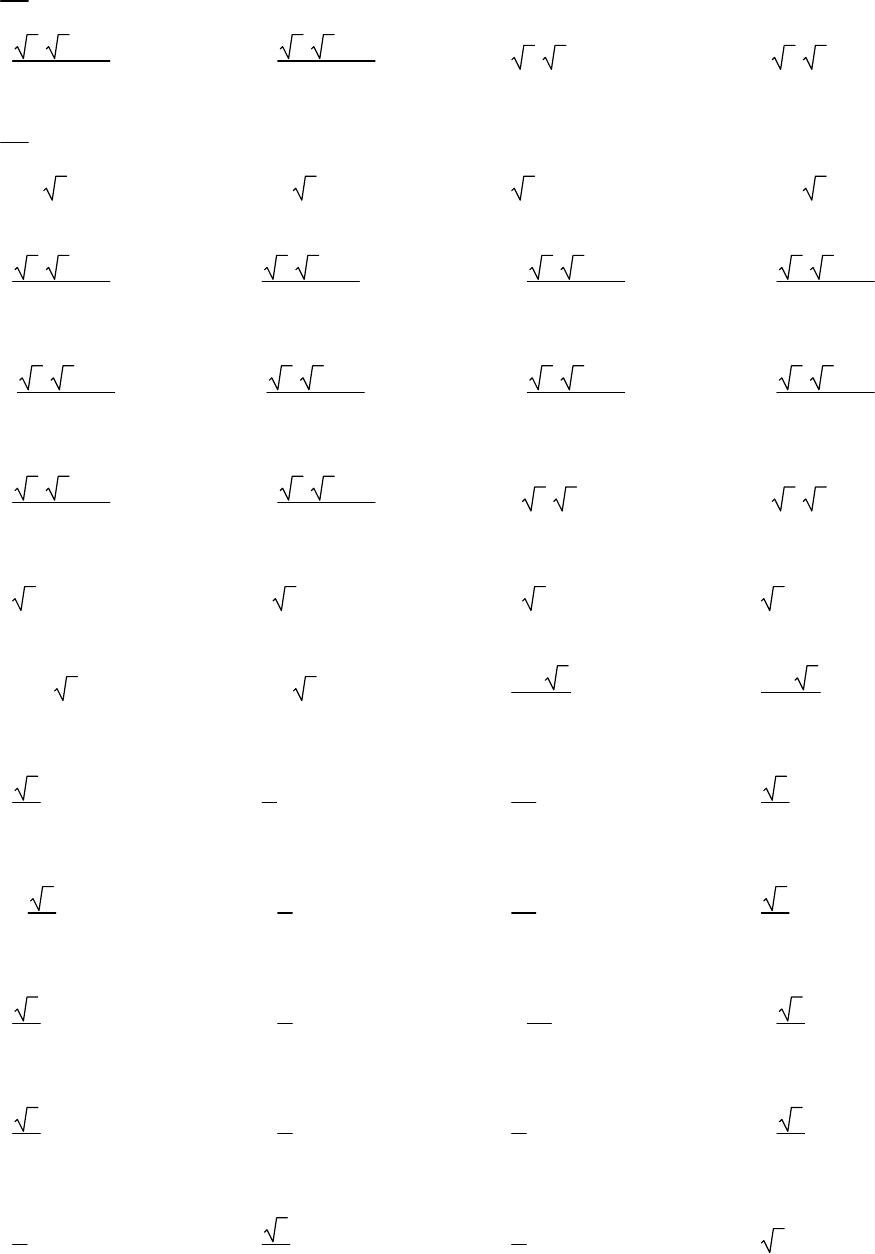
2) cos 5π
12
A) 2(3 – 1)
4B) – 2(3 – 1)
4C) 2(3 – 1) D) –2(3 – 1)
3) tan 5π
12
A) 2 – 3 B) 2 + 3 C) 3 – 2D)
–2 – 3
4) sin 15°
A) 2(3 – 1)
4B) 2(3 + 1)
4C) – 2(3 + 1)
4D) – 2(3 – 1)
4
5) sin 15°
A) 2(3 – 1)
4B) 2(3 + 1)
4C) –2(3 – 1)
4D) –2(3 + 1)
4
6) sin 165°
A) 2(3 – 1)
4B) – 2(3 – 1)
4C) –2(3 + 1) D) –2(3 – 1)
7) tan 255°
A) 3 + 2B)
–3 + 2C)
–3 – 2D)3 – 2
8) tan 345°
A) –2 – 3 B) 2 + 3 C) 2 – 3
4D) 2 + 3
4
9) sin 25° cos 35° + cos 25° sin 35°
A) 3
2B) 1
2C) 5
12 D) 3
3
10) sin 265° cos 25° – cos 265° sin 25°
A) – 3
2B) – 1
2C) 53
12 D) 3
2
11) sin 215° cos 95° – cos 215° sin 95°
A) 3
2B) – 1
2C) – 43
12 D) – 3
2
12) sin 20° cos 100° + cos 20° sin 100°
A) 3
2B) – 1
2C) 1
3D) – 3
2
13) cos 15° cos 45° – sin 15° sin 45°
A) 1
2B) 3
2C) 1
4D) 3
Page 33
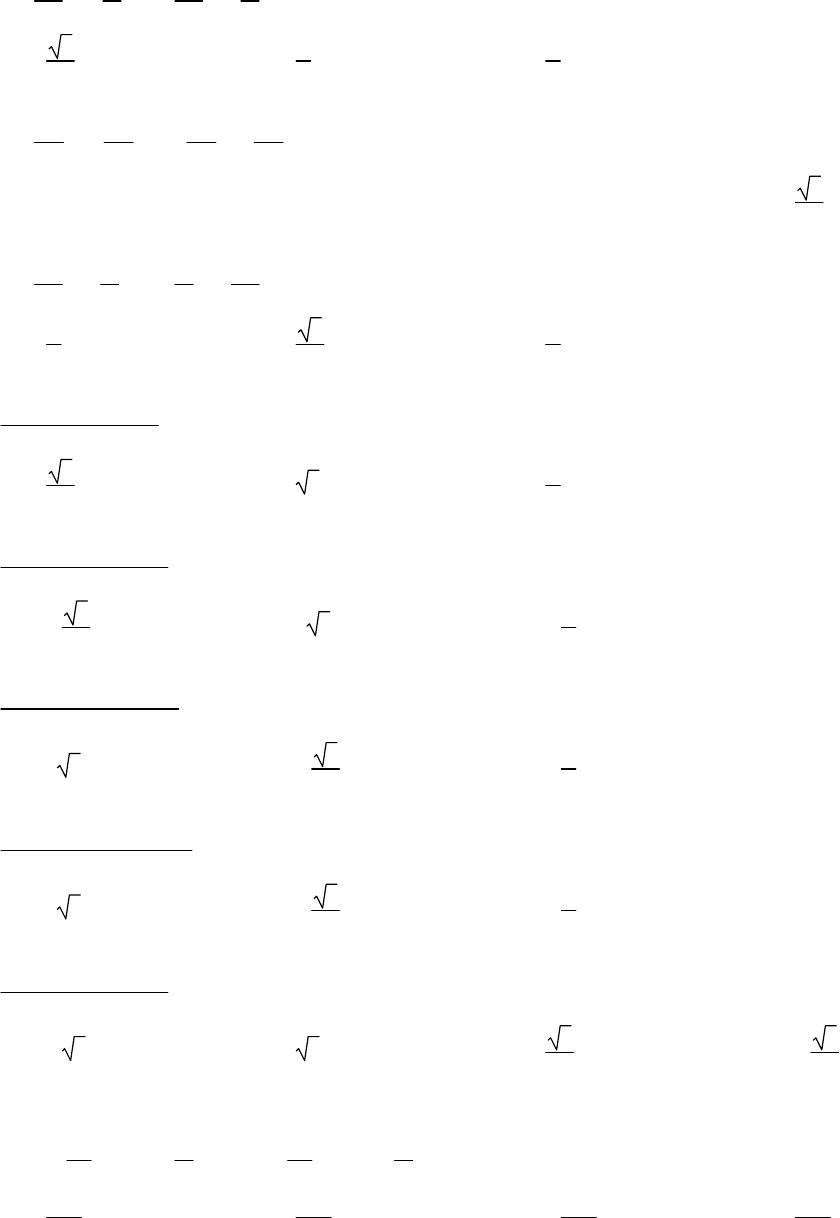
14) cos 5π
12 cos π
4 + sin 5π
12 sin π
4
A) 3
2B) 1
2C) 1
4D) 1
15) cos 5π
18 cos 2π
9 – sin 5π
18 sin 2π
9
A) 0 B) –1C)1 D)
2
2
16) cos 5π
18 sin π
9 – cos π
9 sin 5π
18
A) 1
2B) 3
2C) 1
4D) 1
17) tan 5° + tan 25°
1 – tan 5° tan 25°
A) 3
3B) 3 C) 1
2D) 2
18) tan 70° + tan 80°
1 – tan 70° tan 80°
A) – 3
3B) –3 C) – 1
2D) –2
19) tan 165° – tan 45°
1 + tan 165° tan 45°
A) –3 B) – 3
3C) – 1
2D) –2
20) tan 70° – tan (–50°)
1 + tan 70° tan (–50°)
A) –3 B) – 3
3C) – 1
2D) –2
21) 1 – tan 80° tan 70°
tan 80° + tan 70°
A) – 3 B) 3 C) 3
3D) – 3
3
Find the exact value under the given conditions.
22) sin α = 5
13, 0 < α < π
2; cos β = 20
29, 0 < β < π
2Find cos (α + β).
A) 135
377 B) 345
377 C) – 152
377 D) 352
377
Page 34

23) sin α = 4
5, π
2 < α < π; cos β = 12
13, 0 < β < π
2Find sin (α – β).
A) 63
65 B) 56
65 C) 16
65 D) 33
65
24) tan α = 21
20, π < α < 3π
2; cos β = – 7
25, π
2 < β < πFind sin (α + β).
A) – 333
725 B) 644
725 C) – 364
725 D) 627
725
25) sin α = – 20
29, 3π
2 < α < 2π; tan β = – 24
7, π
2 < β < πFind cos (α + β).
A) 333
725 B) – 627
725 C) – 364
725 D) 644
725
26) sin α = 4
5, π
2 < α < π; cos β = 2
5, 0 < β < π
2Find cos (α – β).
A) –6 + 421
25 B) 8 + 321
25 C) 8 – 321
25 D) 6 – 421
25
27) sin α = – 4
5, 3π
2 < α < 2π; cos β = – 21
5, π < β < 3π
2Find sin (α – β).
A) 6 + 421
25 B) –6 + 421
25 C) –8 + 321
25 D) –8 – 321
25
28) sin α = – 24
25, π < α < 3π
2; tan β = – 221
21 , π
2 < β < πFind cos (α + β).
A) 48 + 721
125 B) 48 – 721
125 C) –14 – 24 21
125 D) 14 – 24 21
125
29) cos α = – 24
25, π
2 < α < π; sin β = – 21
5, π < β < 3π
2Find cos (α + β).
A) 48 + 721
125 B) –48 – 721
125 C) 14 – 24 21
125 D) –14 + 24 21
125
30) cos α = 1
3, 0 < α < π
2; sin β = – 1
2, – π
2 < β < 0 Find tan(α + β).
A) 93
– 82
5B) 93
+ 82
5C) 93
– 82
3D) 93
+ 82
3
31) cos α = – 12
13, π
2 < α < π; sin β = 15
17, π
2 < α < πFind tan(α + β).
A) – 220
21 B) 20
3C) – 220
221 D) – 220
171
Page 35
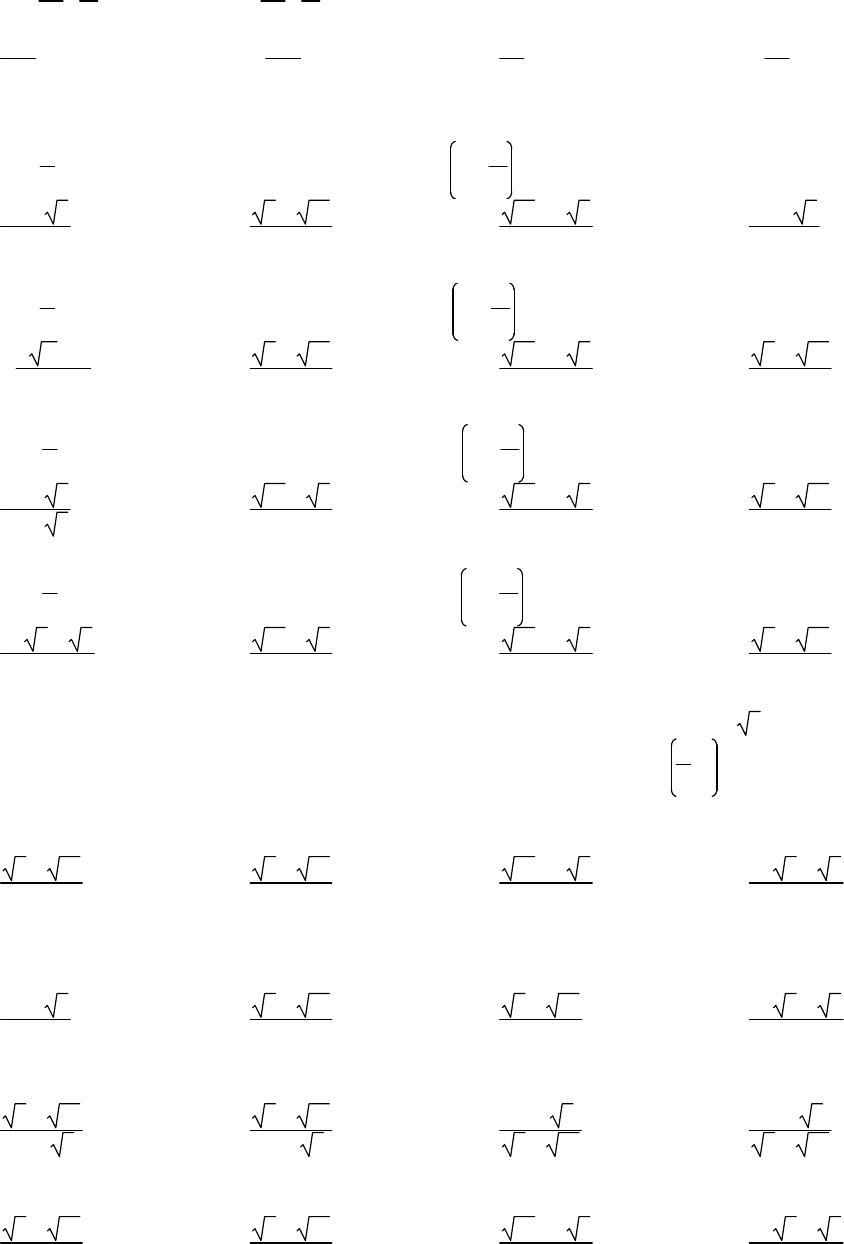
32) cos α = – 12
13, π
2 < α < π; sin β = 15
17, π
2 < α < π Find tan(α – β).
A) 140
171 B) – 220
171 C) 20
3D) – 20
3
Solve the problem.
33) If sin θ = 1
4, θ in quadrant II, find the exact value of sin θ – π
3
A) 1 + 35
8B) 3 – 15
8C) 15 – 43
16 D) 1 – 35
8
34) If sin θ = 1
4, θ in quadrant II, find the exact value of cos θ + π
6
A) – 35
+ 1
8B) 3 – 15
8C) 15 – 43
16 D) 3 + 15
8
35) If cos θ = 1
3, θ in quadrant IV, find the exact value of tan θ + π
4
A) 1 – 22
1 + 22 B) 15 – 3
8C) 15 – 43
16 D) 3 + 15
8
36) If cos θ = 1
3, θ in quadrant IV, find the exact value of sin θ + π
3
A) –22
+ 3
6B) 15 – 3
8C) 15 – 43
16 D) 3 + 15
8
Given that f(x) = sin x, g(x) = cos x, and h(x) = tan x, evaluate the given function. The point (x, 3), on the circle
x2 + y2 = 4, also lies on the terminal side of an angle α in standard position. The point 1
4, y , on the circle
x2 + y2 = 1, also lies on the terminal side of an angle β in quadrant IV.
37) f(α + β)
A) 3 – 15
8B) 3 + 15
8C) 15 – 43
16 D) –22
+ 3
6
38) g(α + β)
A) 1 + 35
8B) 3 + 15
8C) 3 – 15
8D) –22
+ 3
6
39) h(α – β)
A) 3 + 15
1 – 35 B) 3 – 15
1 + 35 C) 1 – 35
3 + 15 D) 1 + 35
3 – 15
40) f(α – β)
A) 3 + 15
8B) 3 – 15
8C) 15 – 43
16 D) –22
+ 3
6
Page 36
2 Use Sum and Difference Formulas to Establish Identities
SHORT ANSWER. Write the word or phrase that best completes each statement or answers the question.
Establish the identity.
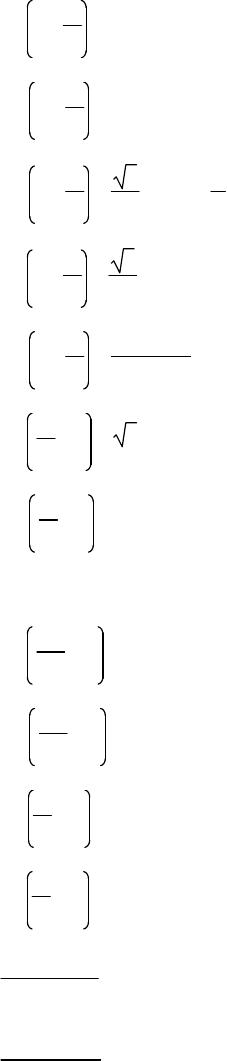
1) sin x + π
2 = cos x
2) cos x + π
2 = –sin x
3) cos x + π
6 = 3
2 cos x – 1
2 sin x
4) sin x – π
4 = 2
2(sin x – cos x)
5) tan x – π
4 = tan x – 1
1 + tan x
6) sin π
4 + x = 2(cos x + sin x)
7) tan π
2 + x = –cot x
8) tan(θ – π) = tan θ
9) sin 3π
2 – θ = –cos θ
10) cos 3π
2 – θ = –sin θ
11) sec π
2 + u = –csc u
12) csc π
2 + u = sec u
13) sin(α – β)
sin α sin β = cot β – cot α
14) cos(α + β)
cos α sin β = cot β – tan α
15) sin(x + y) – sin(x – y) =2 cos x sin y
16) cos(x – y) – cos(x + y) = 2 sin x sin y
Page 37
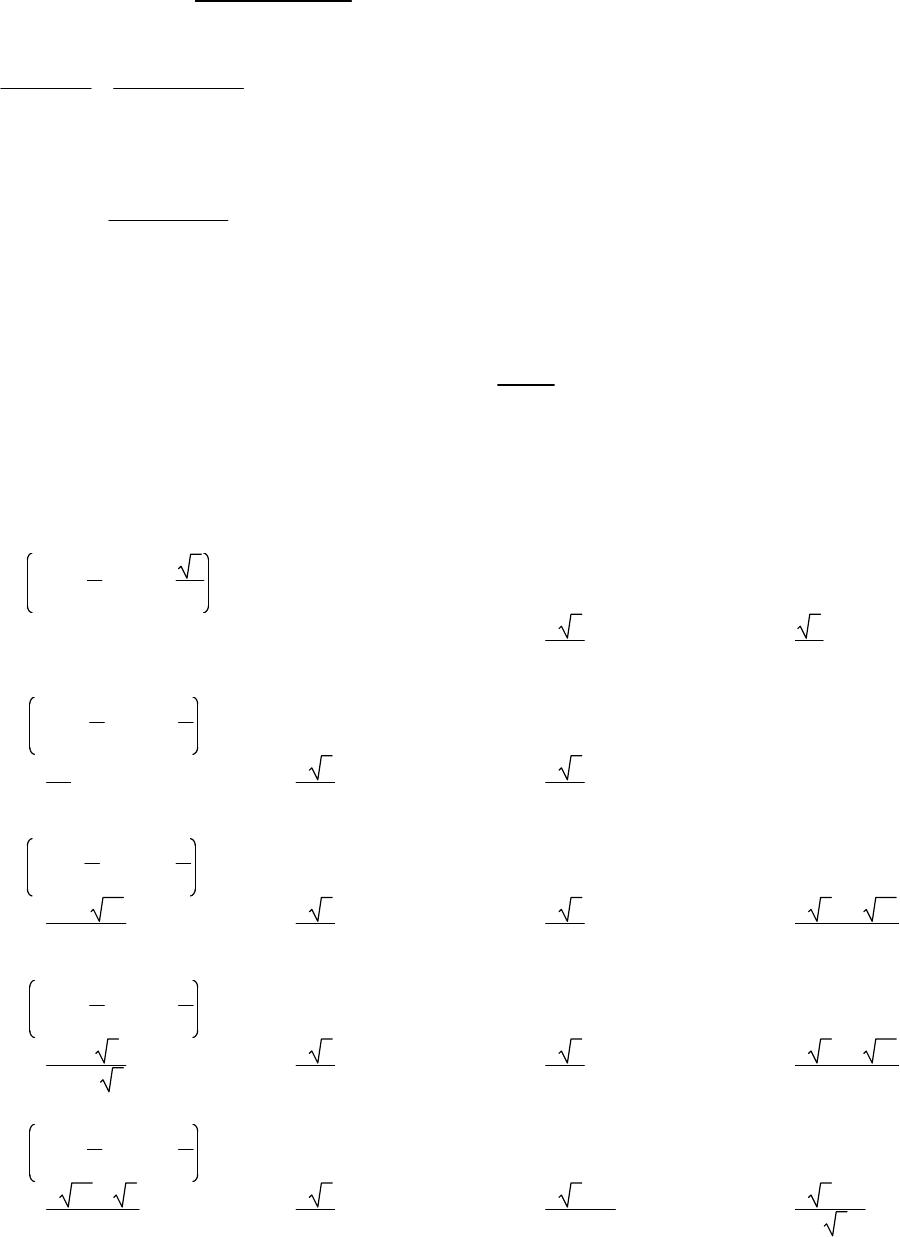
17) cot(x + y) cot(x – y) = 1 – tan2 x tan2 y
tan2 x – tan2 y
18) cos(x – y)
cos(x + y) = 1 + tan x tan y
1 – tan x tan y
19) sin(α – β) cos(α + β) = sin α cos α – sin β cos β
20) csc(u + v) = csc u csc v
cot v + cot u
21) cot(π – θ) = – cot θ
Solve the problem.
22) If tan α = x + 1 and tan β = x – 1, show that cot(α + β) = 2 – x2
2x
3 Use Sum and Difference Formulas Involving Inverse Trigonometric Functions
MULTIPLE CHOICE. Choose the one alternative that best completes the statement or answers the question.
Find the exact value of the expression.
1) sin cos–1 1
2 – sin–1 3
2
A) 0 B) 1 C) 23
2D) 3
3
2) cos tan–1 4
3 – sin–1 3
5
A) 24
25 B) 26
5C) 23
5D) 1
3) sin sin–1 2
3 + cos–1 1
3
A) 2 + 210
9B) 26
5C) 23
5D) 23
+ 210
9
4) tan tan–1 3
4 + sin–1 1
2
A) 9 + 43
12 – 33 B) 26
5C) 23
5D) 23
+ 210
9
5) cos sin–1 1
3 – tan–1 1
2
A) 410
+ 5
15 B) 26
5C) 23
+ 1
5D) 23
+ 4
35
Page 38
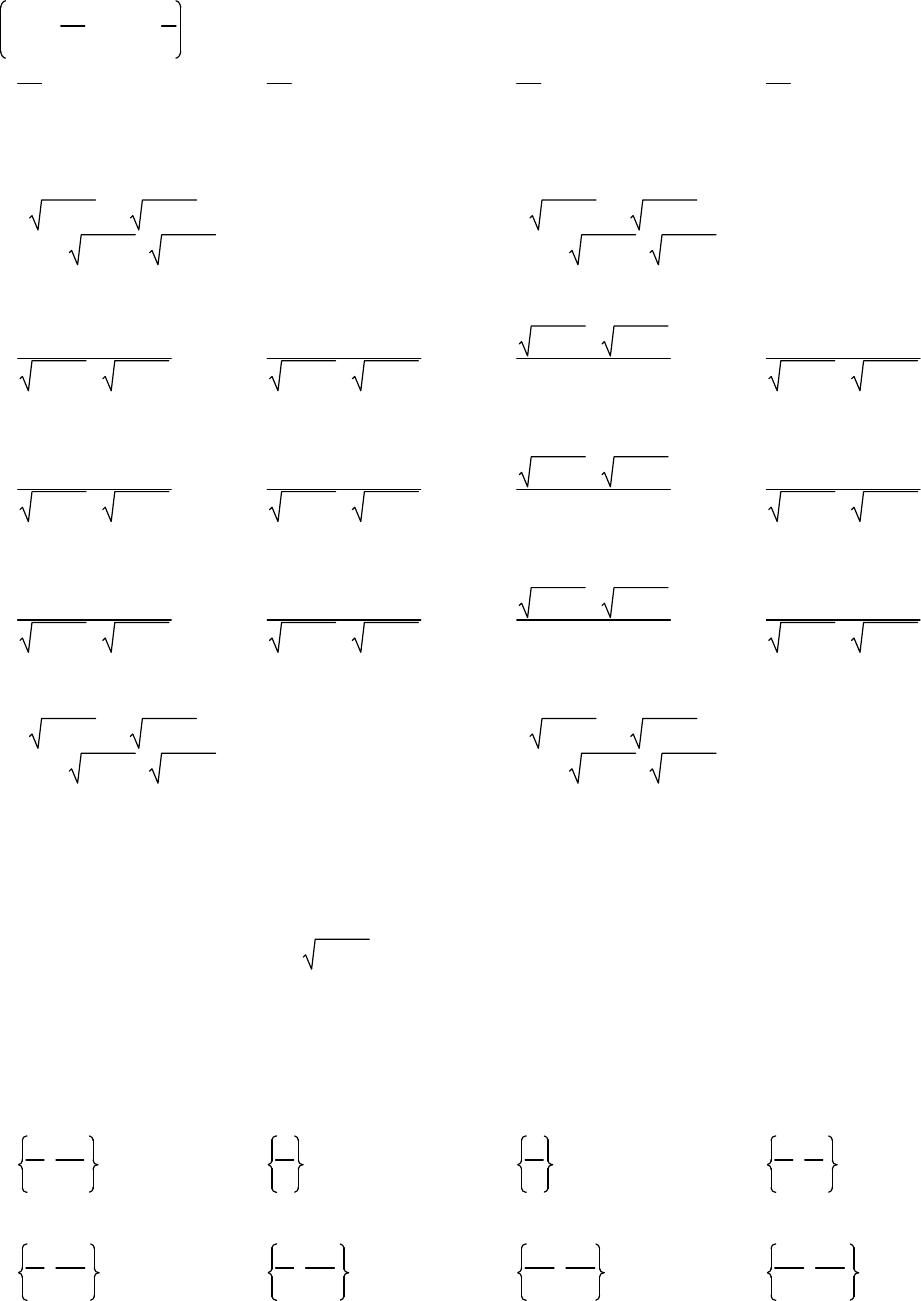
6) cos tan–1 5
12 – cos–1 4
5
A) 63
65 B) 13
24 C) 7
13 D) 52
65
Write the trigonometric expression as an algebraic expression containing u and v.
7) cos(sin–1 u – cos–1 v)
A) v 1 – u2 + u1 – v2B) v 1 – u2 – u1 – v2
C) uv – (1 – u2)( 1 – v2) D) uv + (1 – u2)( 1 – v2)
8) cos(tan–1 u + tan–1 v)
A) 1 – uv
u2 + 1 · v
2 + 1
B) 1 +uv
u2 + 1 · v
2 + 1
C) u2 + 1 · v
2 + 1
1 – uv D) u +v
u2 + 1 · v
2 + 1
9) sin(tan–1 u + tan–1 v)
A) u + v
u2 + 1 · v
2 + 1
B) 1 +uv
u2 + 1 · v
2 + 1
C) u2 + 1 · v
2 + 1
1 – uv D) 1 –uv
u2 + 1 · v
2 + 1
10) sin(tan–1 u – tan–1 v)
A) u – v
u2 + 1 · v
2 + 1
B) 1 –uv
u2 + 1 · v
2 + 1
C) u2 + 1 · v
2 + 1
1 – uv D) 1 +uv
u2 + 1 · v
2 + 1
11) cos(sin–1 u + cos–1 v)
A) v 1 – u2 – u1 – v2B) v 1 – u2 + u1 – v2
C) uv – (1 – u2)( 1 – v2) D) uv + (1 – u2)( 1 – v2)
SHORT ANSWER. Write the word or phrase that best completes each statement or answers the question.
Solve the problem.
12) Show that sin(sin–1v – cos–1v) = 2v2 – 1
13) Show that cos(sin–1v – cos–1v) = 2v 1 – v2
4 Solve Trigonometric Equations Linear in Sine and Cosine
MULTIPLE CHOICE. Choose the one alternative that best completes the statement or answers the question.
Solve the equation on the interval 0 ≤ θ < 2π.
1) cos θ – sin θ = 0
A) π
4, 5π
4B) π
4C) π
2D) π
6, π
3
2) cos θ = sin θ
A) π
4, 5π
4B) π
4, 7π
4C) 3π
4, 5π
4D) 3π
4, 7π
2
Page 39
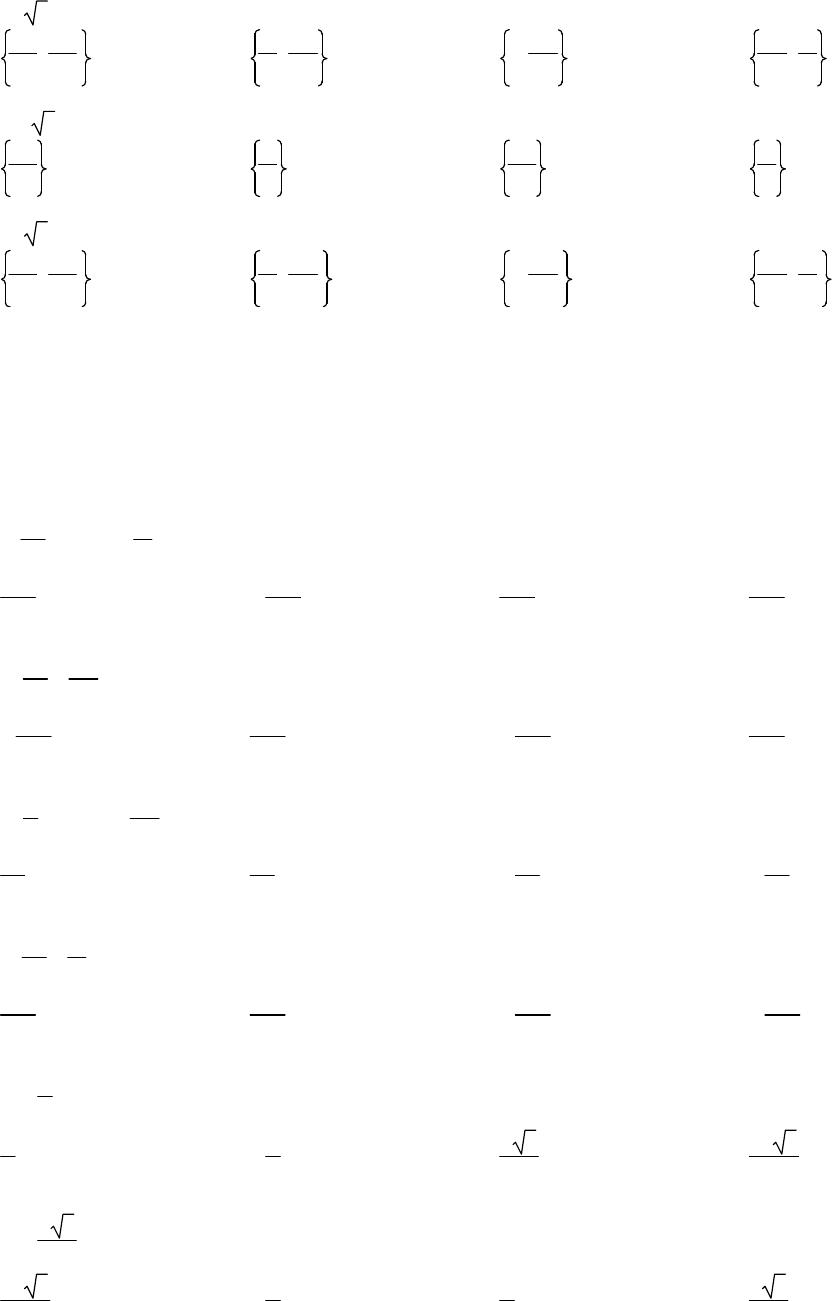
3) sin θ + 3cos θ = –1
A) 3π
2, 5π
6B) π
2, 7π
6C) 0, 2π
3D) 3π
2, π
6
4) sin θ = –2 – cos θ
A) 5π
4B) π
4C) 3π
2D) π
2
5) sin θ + 3cos θ = –1
A) 3π
2, 5π
6B) π
2, 7π
6C) 0, 2π
3D) 3π
2, π
6
8.6 Double–angle and Hal
f
–angle Formulas
1 Use Double–angle Formulas to Find Exact Values
MULTIPLE CHOICE. Choose the one alternative that best completes the statement or answers the question.
Use the information given about the angle θ, 0 ≤θ≤2π
,
to find the exact value of the indicated trigonometric
function.
1) sin θ = 20
29, 0 < θ < π
2Find cos(2θ).
A) 41
841 B) – 41
841 C) 840
841 D) 42
841
2) cos θ = 5
13, 3π
2 < θ < 2πFind sin(2θ).
A) – 120
169 B) 119
169 C) – 119
169 D) 120
169
3) tan θ = 4
3, π < θ < 3π
2Find sin(2θ).
A) 24
25 B) 7
25 C) – 7
25 D) – 24
25
4) csc θ = 13
5, π
2 < θ < πFind cos(2θ).
A) 119
169 B) 120
169 C) – 119
169 D) – 120
169
5) csc θ = – 3
2, tan θ > 0 Find cos(2θ).
A) 1
9B) – 1
9C) 45
9D) –45
9
6) sec θ = – 35
5, csc θ > 0 Find sin(2θ).
A) –45
9B) – 1
9C) 1
9D) 45
9
Page 40

7) sin θ = 210
7, tan θ < 0 Find sin(2θ).
A) –12 10
49 B) – 31
49 C) 31
49 D) 12 10
49
8) cos θ = – 3
7, csc θ < 0 Find cos(2θ).
A) – 31
49 B) –12 10
49 C) 31
49 D) 12 10
49
9) sin θ = – 4
5, 3π
2 < θ < 2πFind cos(2θ).
A) 7
25 B) – 7
25 C) 24
25 D) – 24
25
10) cos θ = 5
5, 0 < θ < π
2Find sin(2θ).
A) 4
5B) 2
5C) 1
5D) 3
5
11) sin θ = – 4
5, 3π
2 < θ < 2πFind sin(2θ).
A) – 24
25 B) – 7
25 C) 24
25 D) 7
25
12) tan θ = 7
24, π < θ < 3π
2Find cos(2θ).
A) 527
625 B) 336
625 C) – 336
625 D) – 527
625
13) cos θ = – 5
13, π
2 < θ < πFind cos(2θ).
A) – 119
169 B) – 120
169 C) 120
169 D) 119
169
14) sin θ = – 4
5, 3π
2 < θ < 2πFind tan(2θ).
A) 24
7B) 7
24 C) – 24
7D) – 7
24
15) tan θ = 7
24, π < θ < 3π
2Find tan(2θ).
A) 336
527 B) – 336
527 C) 527
336 D) – 527
336
Page 41
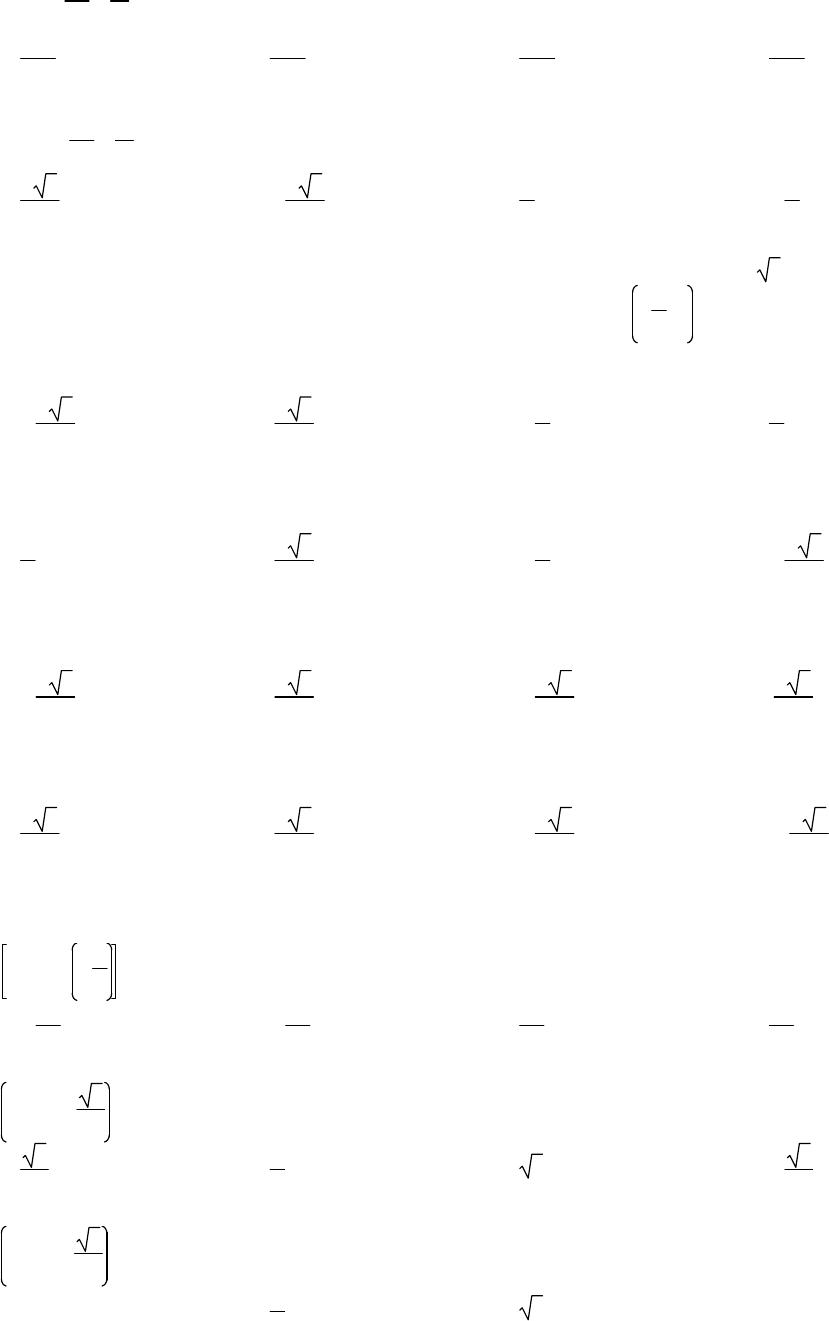
16) cos θ = – 5
13, π
2 < θ < πFind tan(2θ).
A) 120
119 B) 119
120 C) 169
119 D) 169
120
17) cos 2θ = – 24
25, π
2 < 2θ < πFind sin θ.
A) 72
10 B) – 72
10 C) 7
5D) – 7
5
Given that f(x) = sin x, g(x) = cos x, and h(x) = tan x, evaluate the given function. The point (x, 3), on the circle
x2 + y2 = 7, also lies on the terminal side of an angle α in quadrant II. The point – 1
3, y , on the circle x2 + y2 = 1,
also lies on the terminal side of an angle β in quadrant III.
18) f(2α)
A) – 43
7B) 43
7C) – 1
7D) 1
7
19) g(2α)
A) 1
7B) 43
7C) – 1
7D) – 43
7
20) h(2β)
A) – 42
7B) 42
7C) – 42
9D) 42
9
21) f(2β)
A) 42
9B) 42
7C) – 42
9D) – 42
7
Find the exact value of the expression.
22) sin 2 cos–1– 3
5
A) – 24
25 B) – 12
25 C) 24
25 D) 12
25
23) sin 2 cos–1 3
2
A) 3
2B) 1
2C) 3 D) – 3
2
24) sin 2 sin–1 2
2
A) 1 B) 1
2C) 3 D) 0
Page 42

25) cos 2 sin–1– 5
13
A) 119
169 B) – 12
13 C) 10
13 D) 25
+ 10
13
26) cos 2 tan–1 12
5
A) – 119
169 B) – 144
169 C) 10
13 D) – 3
13
27) tan 2 cos–1– 4
5
A) – 24
7B) – 12
7C) – 96
35 D) 75
32
28) sec 2 tan–1 4
3
A) – 25
7B) – 12
7C) 24
7D) – 7
25
29) cos sin–1 2
3 + 2 sin–1– 1
3
A) 75
+ 82
27 B) 26
5C) 23
5D) 23
+ 210
9
SHORT ANSWER. Write the word or phrase that best completes each statement or answers the question.
Solve the problem.
30) The path of a projectile fired at an inclination θ(in degrees) to the horizontal with an initial speed v0is a
parabola. The range R of the projectile, that is, the horizontal distance that the projectile travels, is found
by using the formula
R =
v2
0
g sin(2θ)
where g is the acceleration due to gravity. The maximum height H of the projectile is
H =
v2
0
4g (1 – cos(2θ))
Find the range R and the maximum height H in terms of g if the projectile is fired with an initial speed of
200 meters per second at an angle of 15° and then at an angle of 22.5°. Do not use a calculator, but simplify
the answers.
Page 43
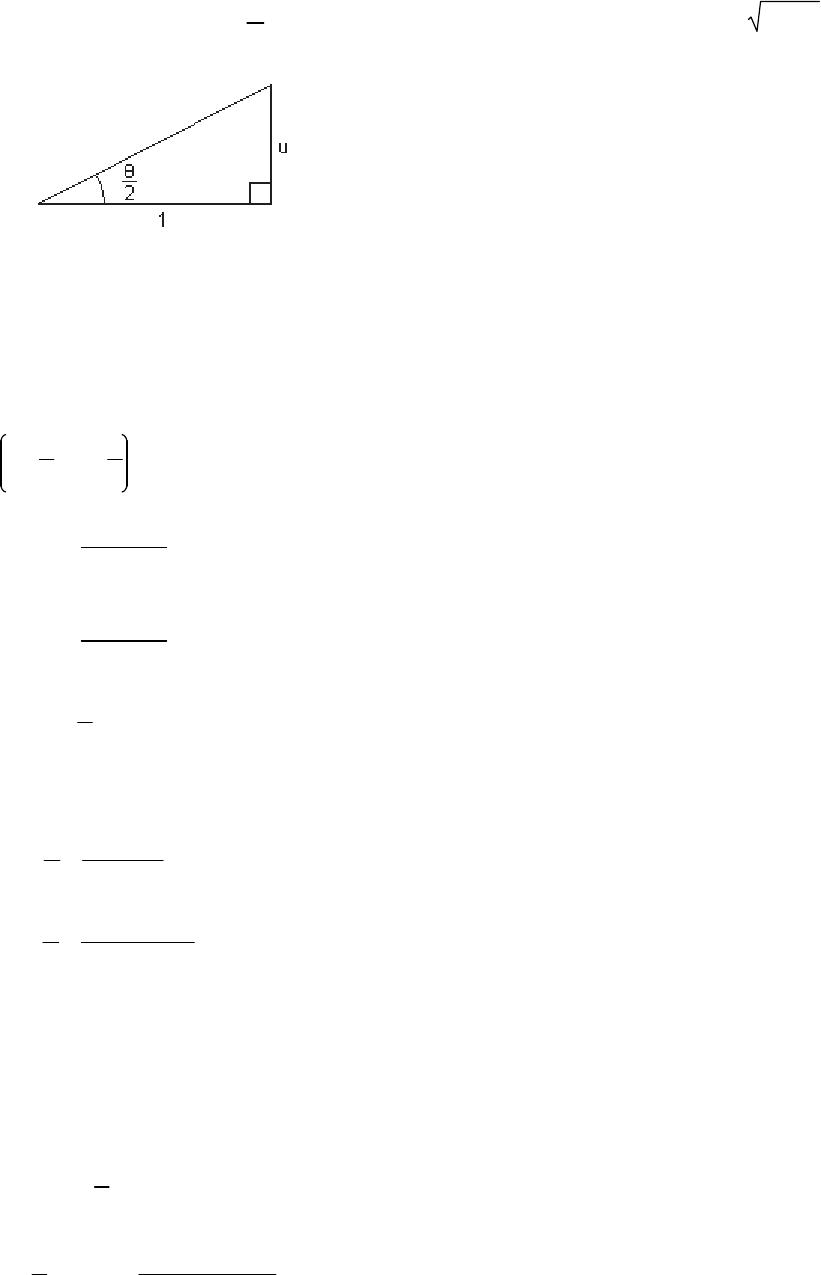
31) Draw a triangle so that tan θ
2 = u. The hypotenuse of the triangle with have length 1 + u2. Use the
illustration and the double angle formulas to write sin θ and cos θ in terms of u.
2 Use Double–angle Formulas to Establish Identities
SHORT ANSWER. Write the word or phrase that best completes each statement or answers the question.
Establish the identity.
1) tan 2 u (1 + cos(2u)) = 1 – cos(2u)
2) cos x
2 – sin x
2
2 = 1 – sin x
3) sec(2θ)= csc2θ
csc2θ – 2
4) cot(2θ)= csc2θ – 2
2 cot θ
5) cos4 x = 1
8(3 + 4 cos(2x) + cos (4x))
6) cos(3x) = cos3 x – 3 sin2 x cos x
7) sec2 u
2 = 2 sec u
sec u + 1
8) cot2 u
2 = csc u + cot u
csc u – cot u
9) sin(4u) = 2 sin(2u) cos(2u)
10) cos(4u) = 2 cos2(2u) – 1
11) sin(4x) = (4 sin x cos x)(2 cos2 x – 1)
12) sin3(3x) = 1
2(sin(3x))(1 – cos(6x))
13) 1 + 1
2 sin(2θ) = sin3 θ – cos3 θ
sin θ – cos θ
Page 44
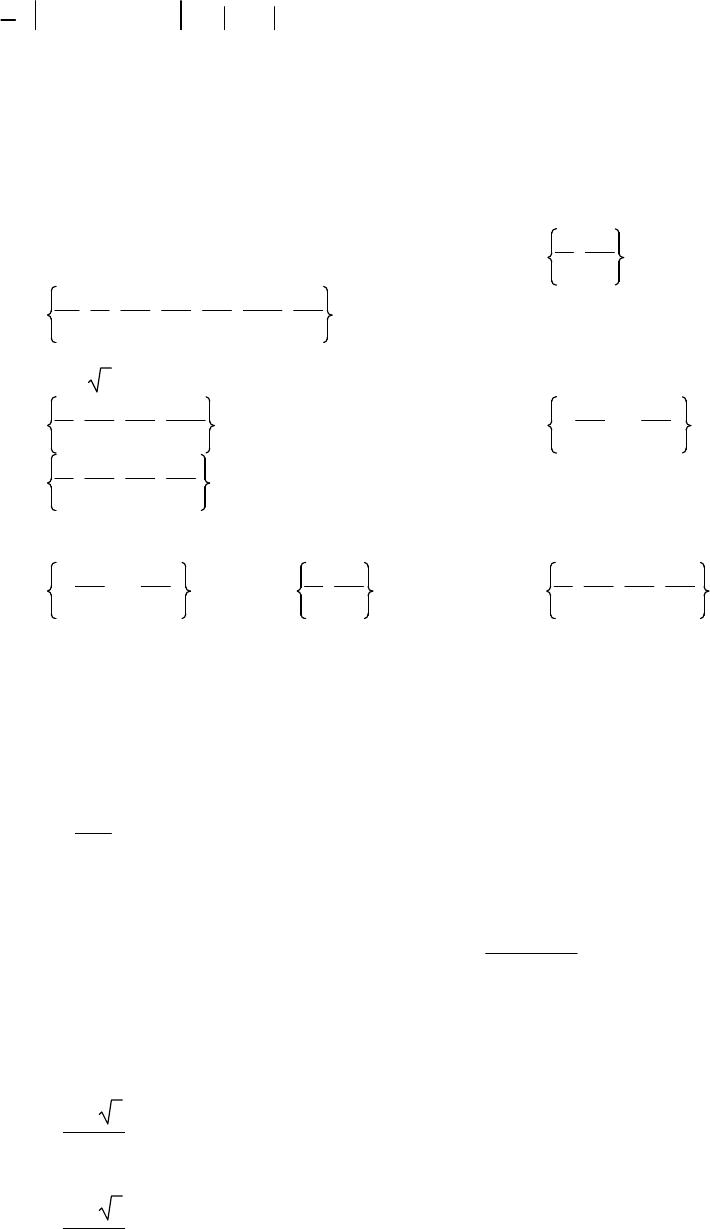
14) 1
2ln sin2u + cos(2u) = ln cos u
15) cos(4θ) = cos4 θ – 6 sin2 θ cos2 θ + sin4 θ
MULTIPLE CHOICE. Choose the one alternative that best completes the statement or answers the question.
Solve the equation on the interval 0 ≤ θ < 2π.
16) tan(2θ) – tan θ = 0
A) {0, π}B)
π
4, 5π
4
C) π
12, π
6, 2π
3, 7π
12 , 7π
6, 13π
12 , 5π
3D) {0}
17) cos(2θ) = 2
– cos(2θ)
A) π
8, 7π
8, 9π
8, 15π
8B) 0, 2π
3, π, 4π
3
C) π
4, 3π
4, 5π
4, 7π
4D) No solution
18) sin(2θ) + sin θ = 0
A) 0, 2π
3, π, 4π
3B) π
8, 9π
8C) π
4, 3π
4, 5π
4, 7π
4D) No solution
SHORT ANSWER. Write the word or phrase that best completes each statement or answers the question.
Solve the problem.
19) The path of a projectile fired at an inclination θ(in degrees) to the horizontal with an initial speed v0is a
parabola. The maximum height H of the projectile is given by
H =
v2
0
4g (1 – cos (2θ))
where g is the acceleration due to gravity.
Show that the maximum height H can be written H =
v2
0sin2 θ
2g
20) An object is propelled upward at an angle θ, 45°
<
θ
<
90°, to the horizontal with an initial velocity of v0
feet per second from the base of a plane that makes an angle of 45° with the horizontal. If air resistance is
ignored, the distance R that it travels up the inclined plane is given by the function
R(θ) = v022
32 [sin(2θ) – cos(2θ) – 1].
Show that
R(θ) = v022
16 [sin θ(cos θ + sin θ) – 1].
21) If x = 3 tan θ, express sin(2θ) as a function of x.
Page 45

3 Use Half–angle Formulas to Find Exact Values
MULTIPLE CHOICE. Choose the one alternative that best completes the statement or answers the question.
Use the information given about the angle θ, 0 ≤θ≤2π
,
to find the exact value of the indicated trigonometric
function.
1) sin θ = 1
4, 0 < θ < π
2Find sin θ
2.
A) 8 – 215
4B) 10
4C) 6
4D) 8 + 215
4
2) sin θ = 1
4, tan θ > 0 Find cos θ
2.
A) 8 + 215
4B) 10
4C) 6
4D) 8 – 215
4
3) cos θ = 1
4, csc θ > 0 Find sin θ
2.
A) 6
4B) 8 + 215
4C) 10
4D) 8 – 215
4
4) tan θ = 12
5, π < θ < 3π
2Find sin θ
2.
A) 313
13 B) – 313
13 C) 213
13 D) – 213
13
5) tan θ = 12
5, π < θ < 3π
2Find cos θ
2.
A) – 213
13 B) – 313
13 C) 213
13 D) 313
13
6) sin θ = – 5
5, 3π
2 < θ < 2πFind cos θ
2.
A) – 5 + 25
10 B) 5 + 25
10 C) – 5 – 25
10 D) 5 – 25
10
7) sin θ = – 5
5, 3π
2 < θ < 2πFind sin θ
2.
A) 5 – 25
10 B) 5 + 25
10 C) – 5 – 25
10 D) – 5 + 25
10
8) sec θ = 4, 0 < θ < π
2Find cos θ
2.
A) 10
4B) 6
4C) 8 – 215
4D) 8 + 215
4
Page 46
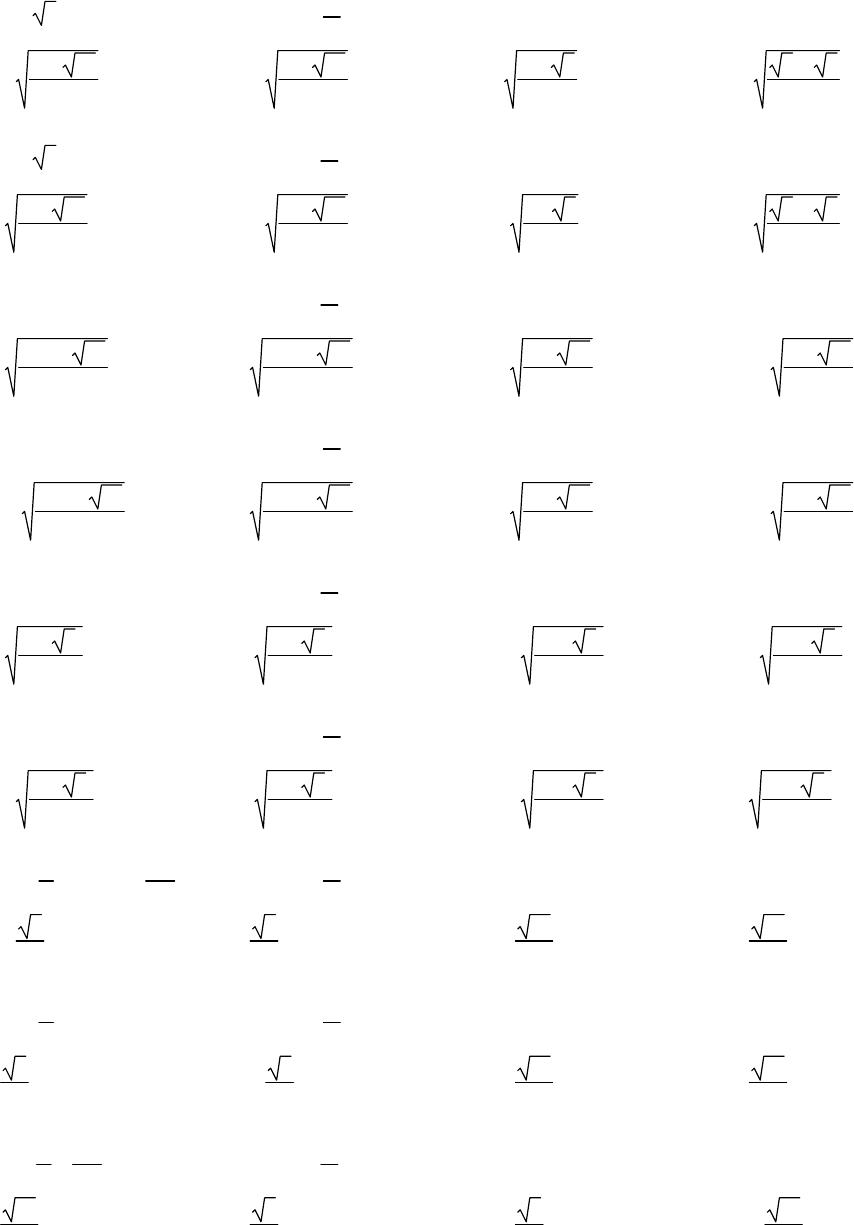
9) csc θ = –6, cos θ > 0 Find cos θ
2.
A) – 6 + 30
12 B) – 6 – 30
12 C) 6 + 5
12 D) 6 + 5
12
10) csc θ = –6, cos θ > 0 Find sin θ
2.
A) 6 – 30
12 B) – 6 – 30
12 C) 6+ 5
12 D) 6 – 5
12
11) cot θ = –3, sec θ > 0 Find sin θ
2.
A) 10 – 310
20 B) 10 + 310
20 C) 3 – 10
20 D) – 3 + 10
20
12) cot θ = –3, sec θ > 0 Find cos θ
2.
A) – 10 + 310
20 B) 10 + 310
20 C) 3 – 10
20 D) – 3 + 10
20
13) tan θ = 2, cos θ < 0 Find sin θ
2.
A) 5 + 5
10 B) 5 – 5
10 C) –1 + 5
10 D) –1 – 5
10
14) tan θ = 2, cos θ < 0 Find cos θ
2.
A) – 5 – 5
10 B) 5 – 5
10 C) –1 + 5
10 D) 1 – 5
10
15) cos θ = – 3
5, π < θ < 3π
2Find cos θ
2.
A) – 5
5B) 5
5C) – 30
10 D) 30
10
16) cos θ = – 3
5, sin θ > 0 Find cos θ
2.
A) 5
5B) – 5
5C) – 30
10 D) 30
10
17) sin θ = – 3
5, 3π
2 < θ < 2πFind sin θ
2.
A) 10
10 B) 5
5C) – 5
5D) – 30
10
Page 47

18) sec θ = – 17
15, π
2 < θ < πFind sin θ
2.
A) 417
17 B) – 17
17 C) – 4
17 D) 17
17
19) sin θ = – 12
13, 3π
2 < θ < 2πFind cos θ
2.
A) – 313
13 B) 313
13 C) 5
26 D) – 213
13
20) csc θ = – 5
2, tan θ > 0 Find cos θ
2.
A) – 50 – 10 21
10 B) 50 + 10 21
10 C) 21
10 D) – 5 + 21
10
21) cos θ = 4
5, 3π
2 ≤ θ ≤ 2πFind cos θ
2.
A) – 310
10 B) 2
5C) 310
10 D) – 2
5
22) cos θ = 1
4, 0 < θ < π
2Find cos θ
2.
A) 10
4B) 6
4C) 8 – 2 15
4D) 8 + 2 15
4
23) cos θ = 1
4, 0 < θ < π
2Find sin θ
2.
A) 6
4B) 10
4C) 8 – 2 15
4D) 8 + 2 15
4
24) sec θ = 4, 0 < θ < π
2Find cos θ
2.
A) 10
4B) 6
4C) 8 – 2 15
4D) 8 + 2 15
4
25) cos θ = – 3
5, π
2 < θ < πFind cos θ
2.
A) 5
5B) – 5
5C) – 30
10 D) 30
10
26) sin θ = – 3
5, 3π
2 < θ < 2πFind sin θ
2.
A) 10
10 B) 5
5C) – 5
5D) – 30
10
Page 48
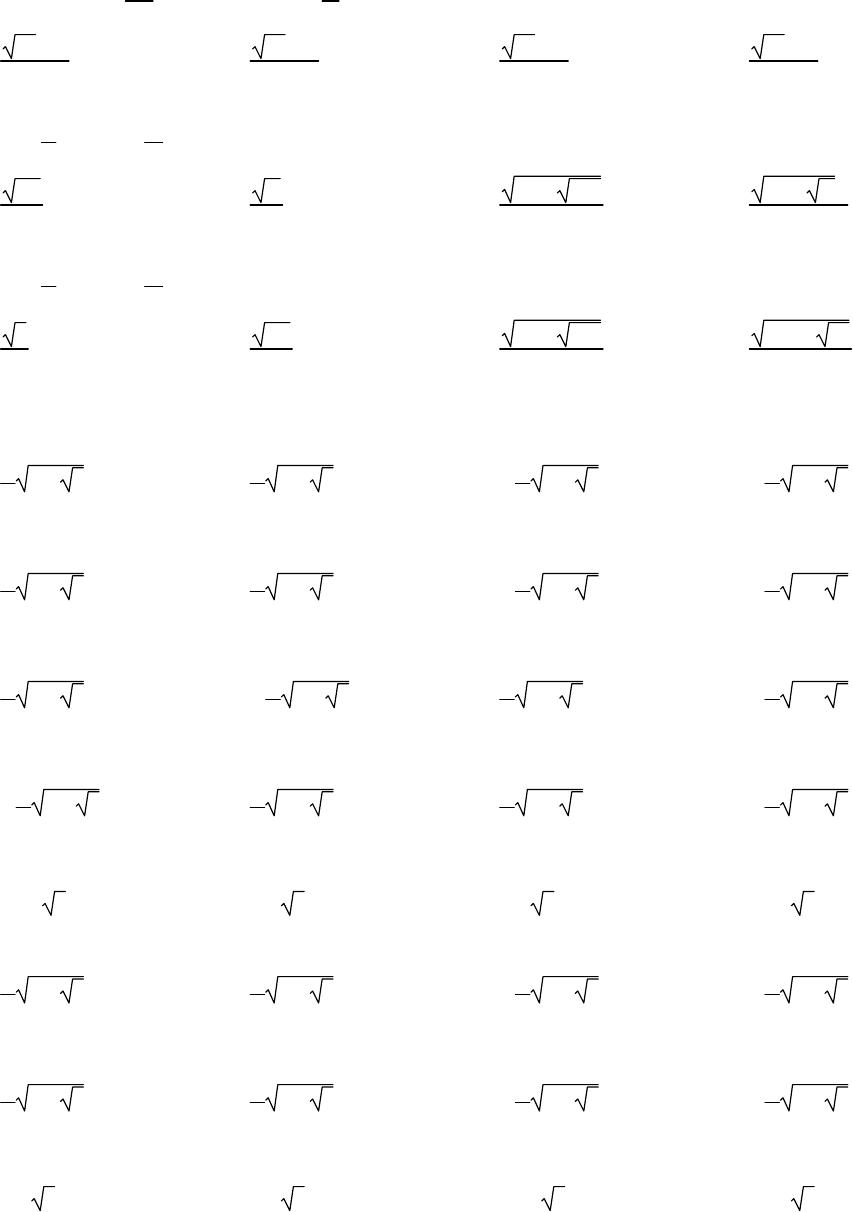
27) tan θ = 3, π < θ < 3π
2Find tan θ
2.
A) 10 + 1
–3B) 10 + 1
3C) 10 – 1
–3D) 10 – 1
3
28) cos(2θ) = 1
4, 0 < θ < π
2Find cos θ.
A) 10
4B) 6
4C) 8 – 210
4D) 8 – 25
2
29) cos(2θ) = 1
4, 0 < θ < π
2Find sin θ.
A) 6
4B) 10
4C) 8 – 210
4D) 10 – 26
4
Use the Half–angle Formulas to find the exact value of the trigonometric function.
30) sin 22.5°
A) 1
22 – 2 B) 1
22 + 2 C) – 1
22 – 2 D) – 1
22 + 2
31) cos 22.5°
A) 1
22 + 2 B) 1
22 – 2 C) – 1
22 – 2 D) – 1
22 + 2
32) sin 165°
A) 1
22 – 3 B) – 1
22 + 3 C) 1
22 + 3 D) – 1
22 – 3
33) cos 165°
A) – 1
22 + 3 B) 1
22 – 3 C) 1
22 + 3 D) – 1
22 – 3
34) tan 165°
A) –2 + 3 B) 2 + 3 C) 2 – 3 D) –2 – 3
35) sin 75°
A) 1
22 + 3 B) 1
22 – 3 C) – 1
22 + 3 D) – 1
22 – 3
36) cos 75°
A) 1
22 – 3 B) 1
22 + 3 C) – 1
22 + 3 D) – 1
22 – 3
37) tan 75°
A) 2 + 3 B) 2 – 3 C) –2 – 3 D) –2 + 3
Page 49

38) sin 5π
12
A) 1
22 + 3 B) 1
22 – 3 C) – 1
22 + 3 D) – 1
22 – 3
39) cos 5π
12
A) 1
22 – 3 B) 1
22 + 3 C) – 1
22 + 3 D) – 1
22 – 3
40) cos – π
8
A) 1
2 2
+ 2 B) 1
2 2
– 2 C) 1
2 1
+ 2 D) 1
2 1
– 2
41) sin π
12
A) 1
2 2
– 3 B) 1
2 2
+ 3 C) 1
2 1
– 3 D) 1
2 1
– 3
42) sin 7π
8
A) 1
2 2
– 2 B) – 1
2 2
– 2 C) 1
2 1
– 2 D) – 1
2 2
– 3
43) tan 7π
8
A) 1 – 2 B) 1 + 2 C) –1 + 2 D) –1 – 2
Find the exact value of the expression.
44) sin21
2 cos–1 4
5
A) 1
10 B) 9
10 C) 1
5D) 1
25
45) cos21
2 sin–1 4
5
A) 4
5B) 9
10 C) 1
5D) 16
25
Given that f(x) = sin x, g(x) = cos x, and h(x) = tan x, evaluate the given function. The point (x, 3), on the circle
x2 + y2 = 7, also lies on the terminal side of an angle α in quadrant II. The point – 1
3, y , on the circle x2 + y2 = 1,
also lies on the terminal side of an angle β in quadrant III.
46) f α
2
A) 7 + 27
14 B) 7 – 27
14 C) 2 +7
14 D) 2 – 7
14
Page 50
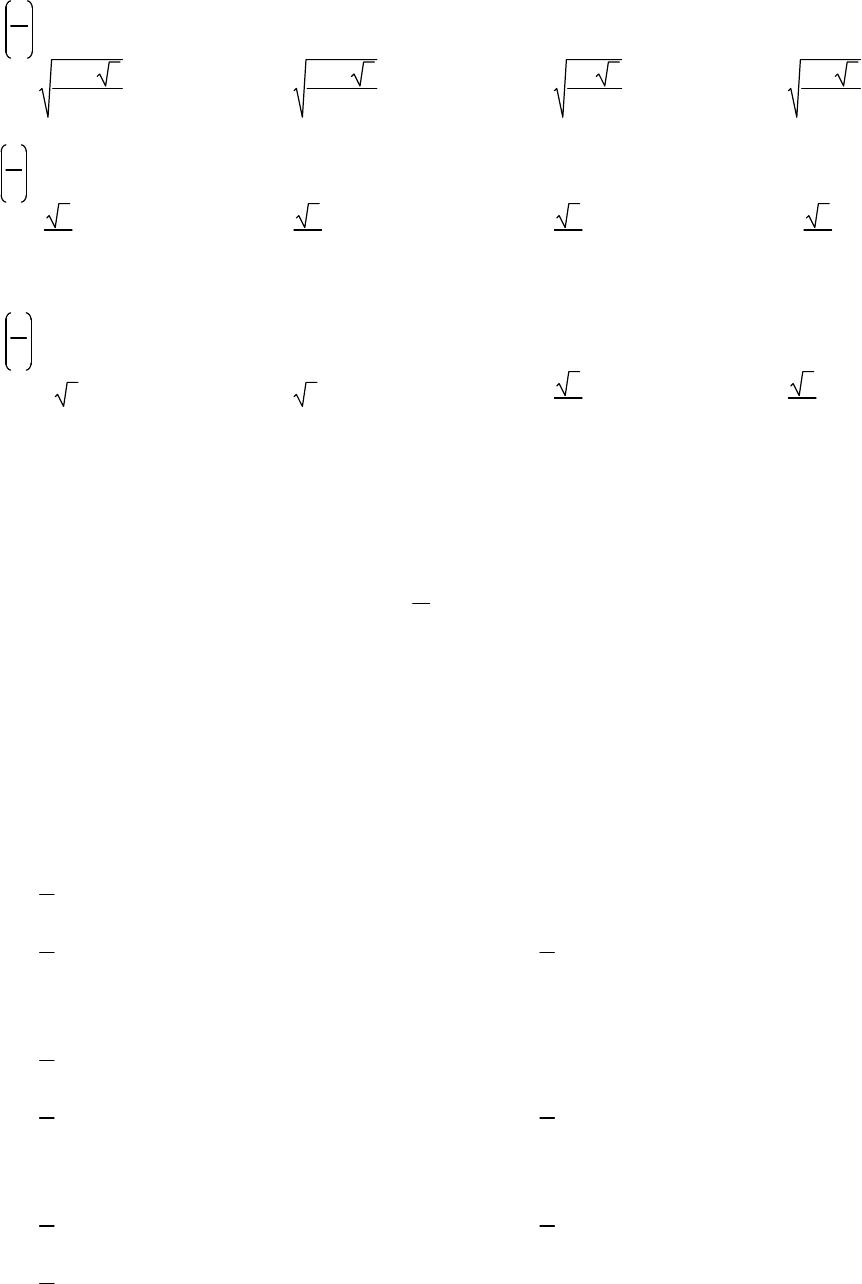
47) g α
2
A) 7 – 27
14 B) 7 + 27
14 C) – 2 +7
14 D) 2 – 7
14
48) f β
2
A) 6
3B) 3
3C) – 6
3D) – 3
3
49) h β
2
A) – 2 B) 2 C) – 2
2D) 2
2
SHORT ANSWER. Write the word or phrase that best completes each statement or answers the question.
Solve the problem.
50) The two equal sides of an isosceles triangle measure three feet. Let the angle between the sides measure θ.
Find the area A of the triangle as a function of θ
2. The answer may include more than one trigonometric
function.
8.7 Product–to–Sum and Sum–to–Product Formulas
1 Express Products as Sums
MULTIPLE CHOICE. Choose the one alternative that best completes the statement or answers the question.
Express the product as a sum containing only sines or cosines.
1) sin(8θ) cos(4θ)
A) 1
2[sin(12θ) + sin(4θ)] B) sin cos(32θ2)
C) 1
2[cos(12θ) – cos(4θ)] D) 1
2[sin(12θ) + cos(4θ)]
2) sin(6θ) sin(2θ)
A) 1
2[ cos(4θ) – cos(8θ)] B) sin2(12θ2)
C) 1
2[cos(8θ) – cos(4θ)] D) 1
2[sin(8θ) + cos(4θ)]
3) cos(5θ) cos(4θ)
A) 1
2[ cos θ + cos(9θ)] B) 1
2[cos(9θ) – sin θ]
C) 1
2[cos(9θ) – cos θ] D) cos2(20θ2)
Page 51

4) sin(2θ) sin(4θ)
A) 1
2[cos(2θ) – cos(6θ)] B) 1
2[cos(6θ) – sin(2θ)]
C) 1
2[– cos(2θ) – cos(6θ)] D) sin2(8θ2)
5) sin(2θ) cos(3θ)
A) 1
2[sin(5θ) – sin θ]B)
1
2[cos(5θ) + sin θ]C)
1
2[cos(5θ) – cos θ] D) sin cos(6θ2)
6) cos(3θ) cos(5θ)
A) 1
2[cos(2θ) + cos(8θ)] B) 1
2[cos(8θ) – sin(2θ)]
C) 1
2[cos(8θ) – cos(2θ)] D) cos2(11θ2)
7) cos 9θ
2 cos θ
2
A) 1
2[cos(4θ) + cos(5θ)] B) 1
4[cos(10θ) – sin(8θ)]
C) 1
4cos2(9θ)D)
1
2[cos(5θ) – sin(4θ)]
8) sin θ
2 cos 11θ
2
A) 1
2[sin(6θ) – sin(5θ)] B) 1
4[cos(12θ) – sin(10θ)]
C) 1
4 sin cos(11θ)D)
1
2[cos(6θ) + sin(5θ)]
9) –2 sin(5θ) sin θ
A) cos(6θ) – cos(4θ) B) cos(6θ) +cos(4θ) C) cos(7θ) +cos(3θ) D) cos(7θ) –cos(3θ)
10) 2 cos(7θ) cos θ
A) cos(8θ) + cos(6θ) B) cos(8θ) +sin(6θ) C) cos(14θ) +cos(2θ) D) cos(10θ) +sin(4θ)
Complete the identity.
11) sin(2θ) sin(5θ) cos(2θ) cos(5θ) = ?
A) cos2(3θ) – cos2(7θ)
4B) sin2(20θ)
4
C) cos2(7θ) + cos2(3θ)
4D) cos2(20θ)
12) sin θ [sin(5θ) + sin 7θ)] = ?
A) cos θ [cos(5θ) – cos(7θ)] B) cos θ[cos(5θ)+cos(7θ)]
C) 1
2 cos θ [cos(5θ) – cos(7θ)] D) 1
2 cos θ [cos(5θ) + cos(7θ)]
Page 52
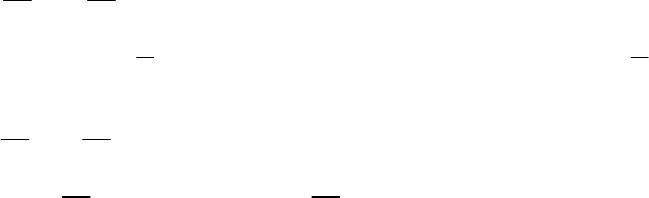
SHORT ANSWER. Write the word or phrase that best completes each statement or answers the question.
Solve the problem.
13) A product of two oscillations with different frequencies such as
f(t) = sin(10t) sin(t)
is important in acoustics. The result is an oscillation with “oscillating amplitude.”
(i) Write the product f(t) of the two oscillations as a sum of two cosines and call it g(t).
(ii) Using a graphing utility, graph the function g(t) on the interval 0 ≤ t ≤ 2π.
(iii) On the same system as your graph, graph y = sin t and y = –sin t.
(iv) The last two functions constitute an “envelope” for the function g(t). For certain values of t, the two
cosine functions in g(t) cancel each other out and near–silence occurs; between these values, the two
functions combine in varying degrees. The phenomenon is known (and heard) as “beats.” For what values
of t do the functions cancel each other?
2 Express Sums as Products
MULTIPLE CHOICE. Choose the one alternative that best completes the statement or answers the question.
Express the sum or difference as a product of sines and/or cosines.
1) sin(8θ) + sin(4θ)
A) 2 sin(6θ) cos(2θ) B) 2 cos(6θ) sin(2θ) C) 2 sin(6θ) sin(2θ) D) 2 sin(12θ)
2) cos(7θ) – cos(3θ)
A) –2 sin(5θ) sin(2θ) B) 2 cos(5θ) cos(2θ)C)
–2 cos(5θ) sin(2θ) D) 2 cos(2θ)
3) cos(4θ) + cos(2θ)
A) 2 cos(3θ) cos θB) 2 sin(3θ) sin θC) 2 cos(3θ) sin θD) 2 cos(3θ)
4) cos(2θ) – cos(4θ)
A) 2 sin(3θ) sin θB) –2 sin(3θ) sin θC) –2 cos(3θ) sin θD) cos(–2θ)
5) sin(10θ) – sin(4θ)
A) 2 sin(3θ) cos(7θ) B) 2 cos(4θ) cos(7θ) C) 2 sin(7θ) cos(3θ) D) 2 sin(3θ)
6) sin(4θ) – sin(6θ)
A) –2 sin θ cos(5θ) B) 2 cos(4θ) cos(5θ) C) 2 sin(5θ) cos θD) –2 sin θ
7) cos 7θ
2 + cos 5θ
2
A) 2 cos(3θ) cos θ
2B) 2 sin(3θ) sin θC) 2 sin(3θ) sin θ
2D) 2 cos(3θ)
8) sin 9θ
2 + sin 5θ
2
A) 2 sin 7θ
2 cos θB) 2 sin 7θ
2 sin θC) 2 cos(7θ) sin θD) 2 sin(7θ)
9) sin(6θ) – sin(4θ)
A) 2 sin θ cos(5θ) B) 2 sin(5θ) cos θC) –2 sin θcos(5θ)D)
–2 sin(5θ) cos θ
10) sin(4θ) – sin(2θ)
A) 2 sin θ cos(3θ) B) sin θcos(3θ) C) 2 sin(3θ) cos θD) sin(3θ) cos θ
Page 53

SHORT ANSWER. Write the word or phrase that best completes each statement or answers the question.
Establish the identity.
11) sin(10θ) + sin(4θ)
2 sin(7θ) = cos(3θ)
12) cos(6θ) – cos(2θ)
2 sin(4θ) = – sin(2θ)
13) sin(8θ) + sin(2θ)
cos(8θ) + cos(2θ) = tan(5θ)
14) cos(3θ) – cos(7θ)
sin(3θ) + sin(7θ) = tan(2θ)
15) sin(7θ) + sin(3θ)
sin(7θ) – sin(3θ) = – tan(5θ)
tan(2θ)
16) cos(8θ) – cos(4θ)
cos(8θ)+ cos(4θ) = – tan(6θ) tan(2θ)
17) sin θ[sin θ + sin(5θ)] = cos(2θ)[cos(2θ) –cos(4θ)]
18) cos α + cos β
sin α – sin β = cot α – β
2
19) sin α – sin β
sin α + sin β = cot α – β
2
MULTIPLE CHOICE. Choose the one alternative that best completes the statement or answers the question.
Complete the identity.
20) 1 – cos(2θ) + cos(6θ) – cos(8θ) = ?
A) 4 sin θ cos(3θ) sin(4θ) B) 4 sin θsin(3θ) sin(4θ)
C) 4 cos θ cos(3θ) sin(4θ) D) 4 cos θcos(3θ) cos(4θ)
Page 54
Solve the problem.
21) On a Touch–Tone phone, each button produces a unique sound. The sound produced is the sum of two
tones, given by
y = sin (2πlt) and y = sin (2πht)
where l and h are the low and high frequencies (cycles per second) shown on the illustration.
The sound produced is thus given by
y = sin (2πlt) + sin (2πht)
Write the sound emitted by touching the 2 key as a product of sines and cosines.
A) y = 2 sin(2033πt) cos(639πt) B) y =2 sin(2174πt) cos(780πt)
C) y = 2 sin(639πt) cos(2033πt) D) y =2 sin(780πt) cos(2174πt)
SHORT ANSWER. Write the word or phrase that best completes each statement or answers the question.
22) If two sound sources at the same volume are equidistant from a microphone, the pressure on the
microphone is given by
p = a cos ω1t + a cos ω2t
where a, ω1, ω2 are constants and t is time. Write p as a product of cosine functions.
Page 55

Ch. 8 Analytic Trigonometry
Answer Key
8.1 The Inverse Sine, Cosine, and Tangent Functions
3 Use Properties of Inverse Functions to Find Exact Values of Certain Composite Functions
Page 56

5 Solve Equations Involving Inverse Trigonometric Functions
8.2 The Inverse Trigonometric Functions (Continued)
Page 59
Page 64
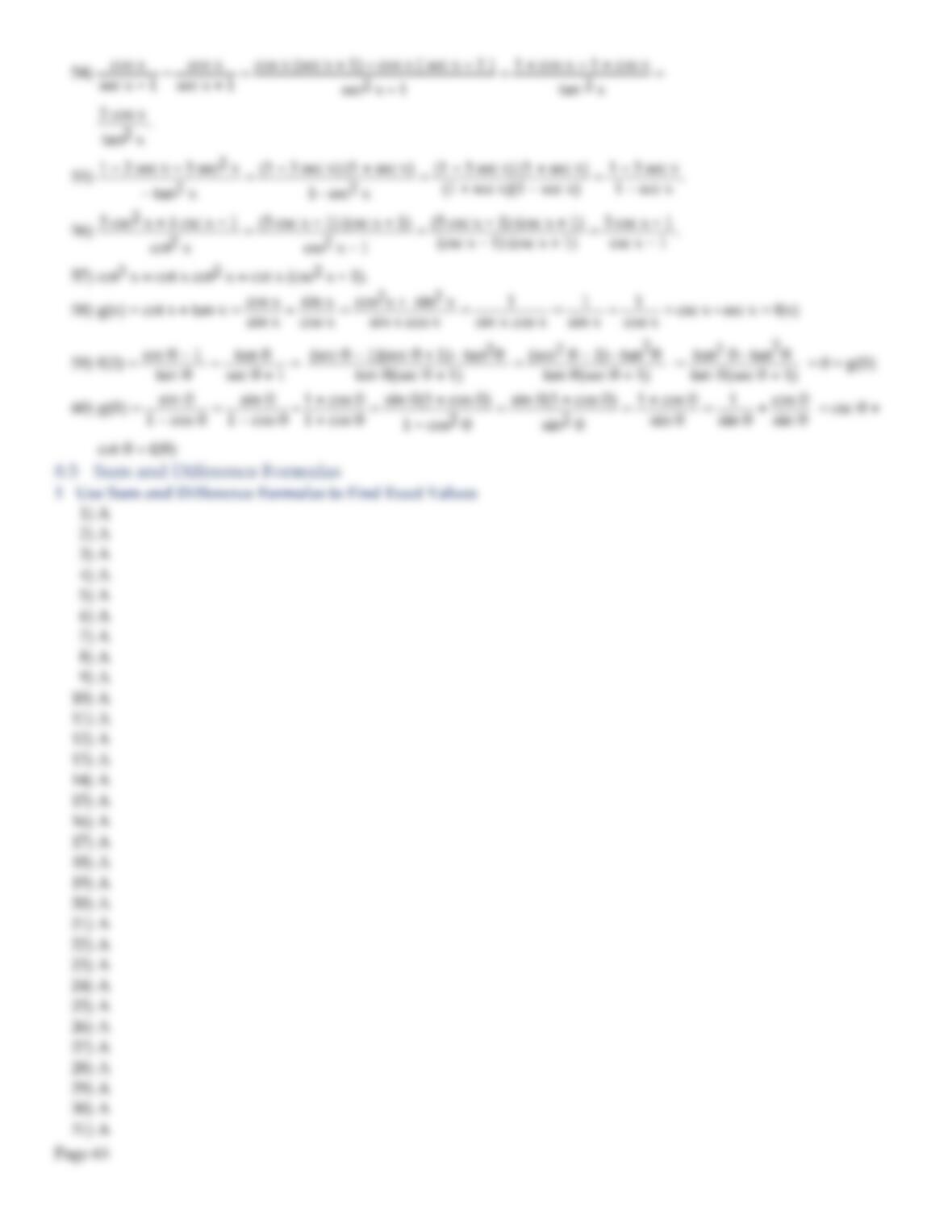
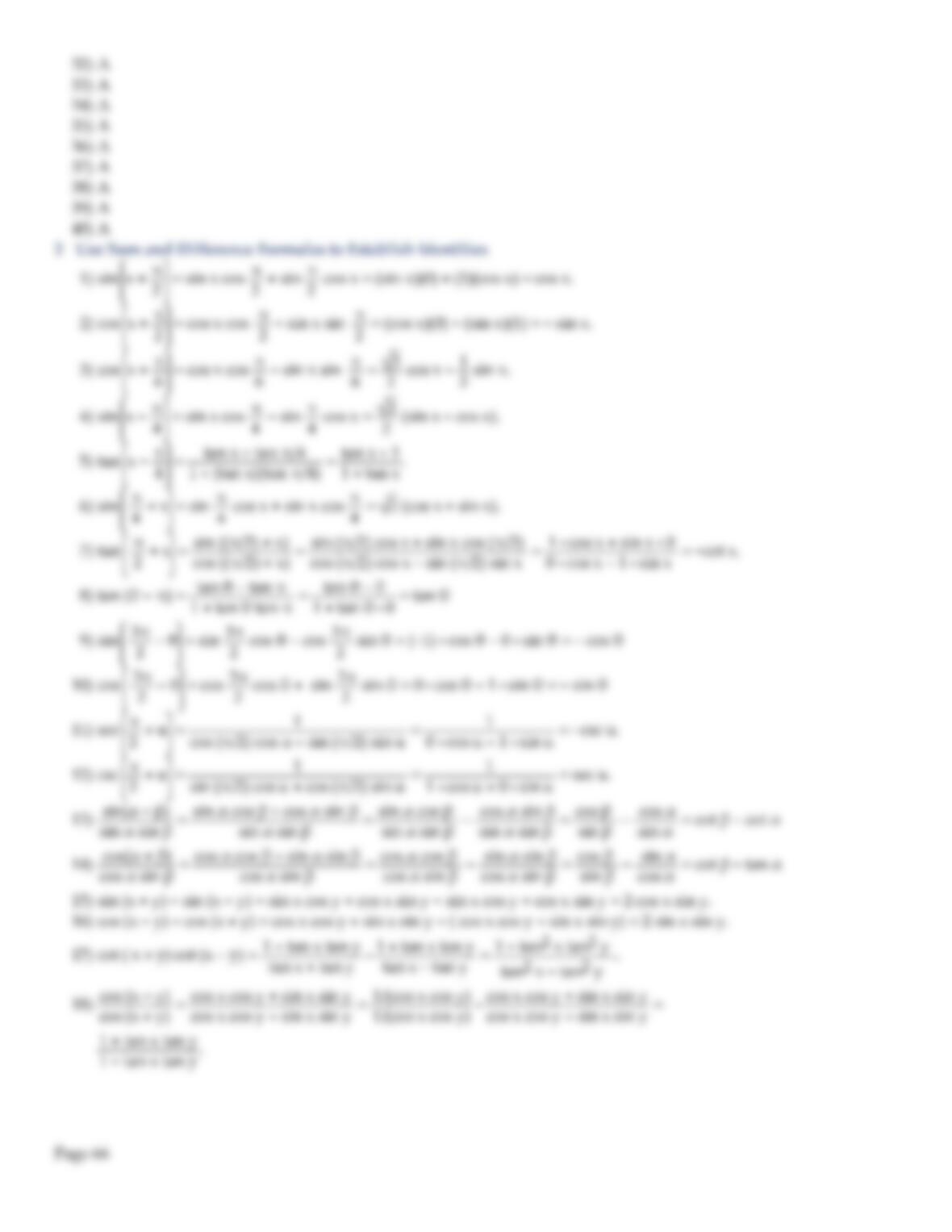
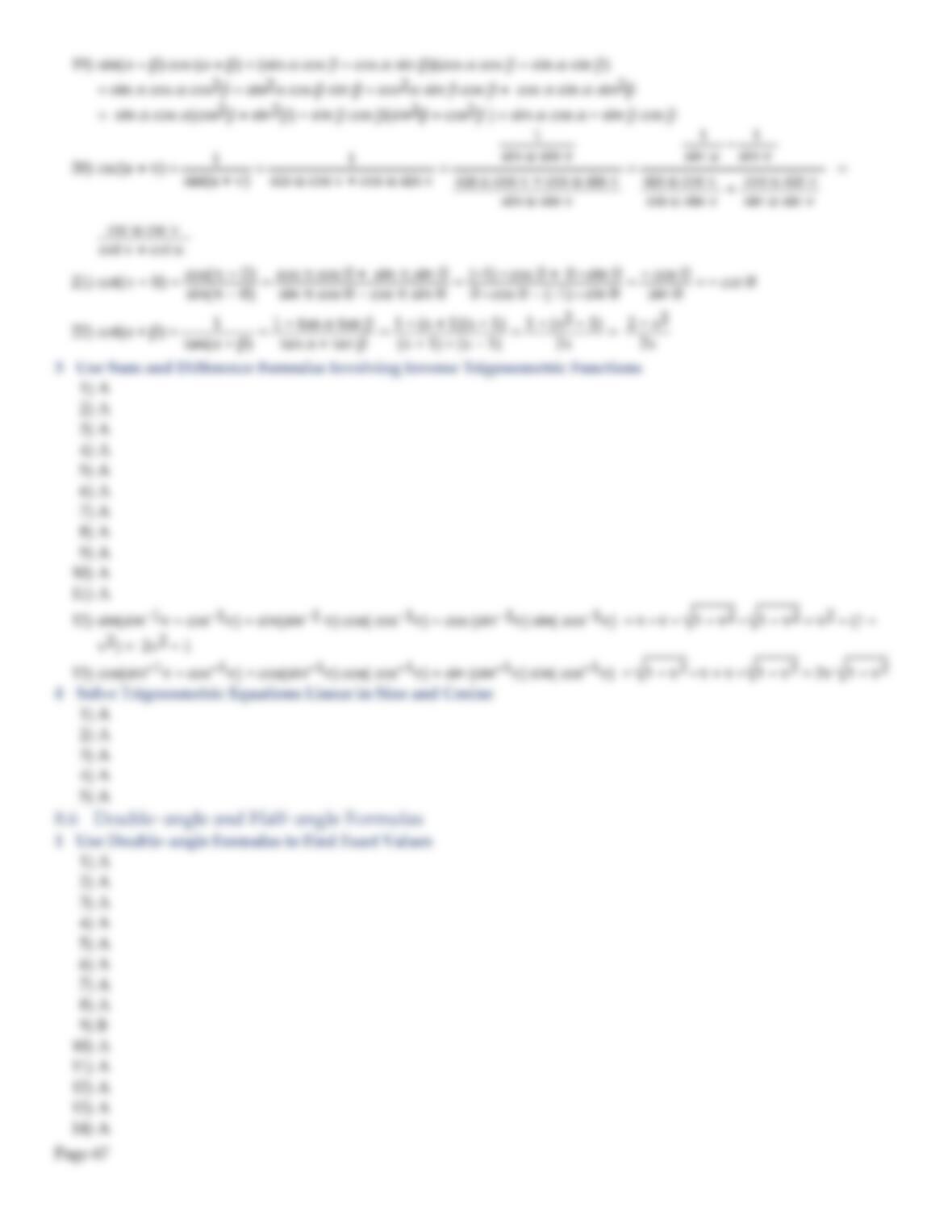
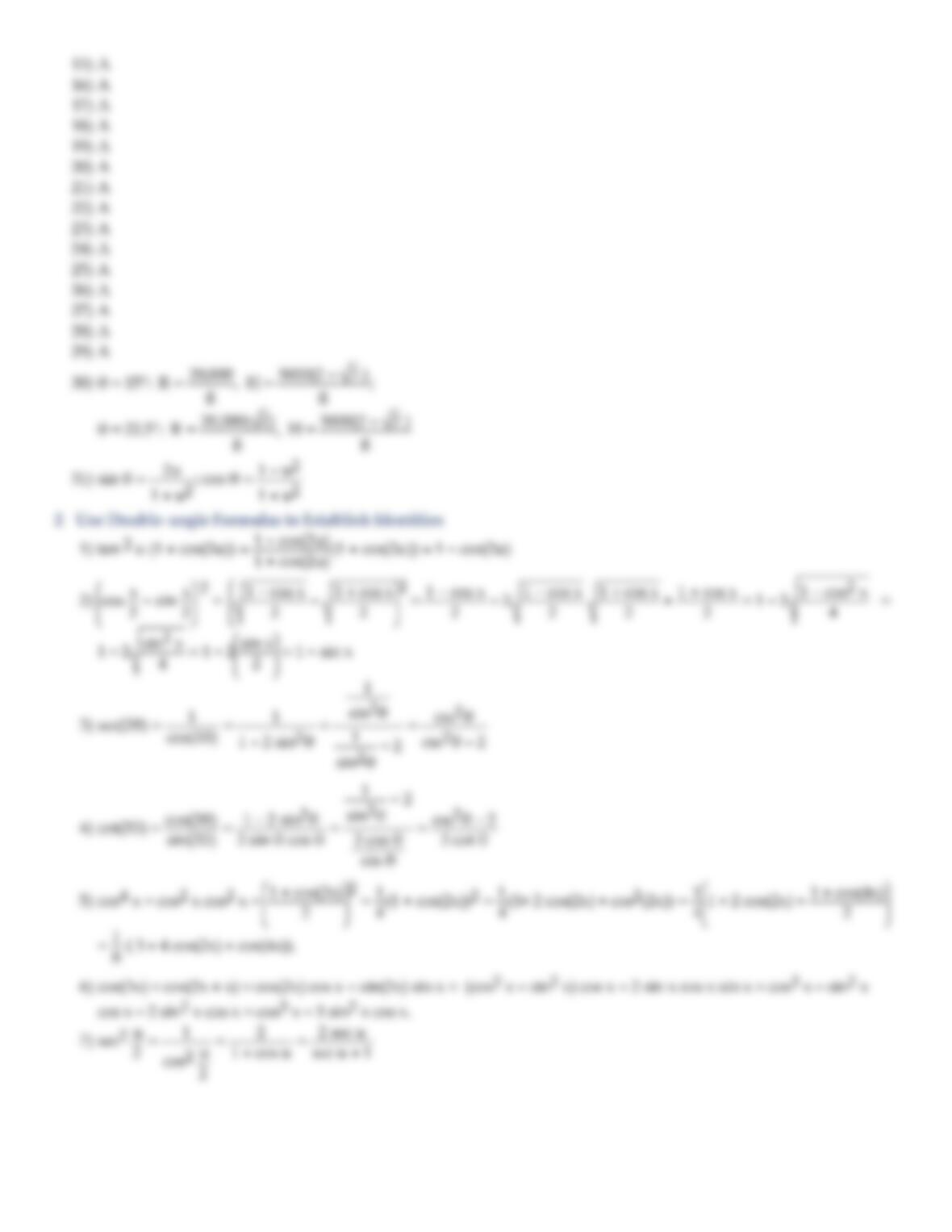
Page 68
Page 70